Pasing Grades
  • Start Selling
  • Blog
  • Contact
  • 0

    Your cart is empty!

English

  • English
  • Spanish
  • Arabic
Create Account Sign In
  • Library
    • New Prep Guides
    • Featured Prep Guides
    • Free Exam Prep Guides
    • Best sellers
  • General
  • Nursing
    • Research Paper
    • Case Study
    • Discussion Post
    • Assignment
    • Exam
    • Practice Questions and Answers
    • Test Bank
    • solutions manual
  • Accounting
    • Case Study
    • Thesis
    • Study Guide
    • Summary
    • Research Paper
    • test bank
  • English
    • Creative Writing
    • Research Paper
    • Summary
    • Rhetorics
    • Literature
    • Journal
    • Exam
    • Grammar
    • Discussion Post
    • Essay
  • Psychology
    • Hesi
    • Presentation
    • Essay
    • Summary
    • Study Guide
    • Essay
    • Solution Manual
    • Final Exam Review
    • Class Notes
    • test bank
  • Business
    • Lecture Notes
    • Solution Manual
    • Presentation
    • Business Plan
    • Class Notes
    • Experiment
    • Summary
    • Practice Questions
    • Study Guide
    • Case Study
    • test bank
    • Exam
  • More
    • Computer Science
    • Economics
    • Statistics
    • Engineering
    • Biology
    • Religious Studies
    • Physics
    • Chemistry
    • Mathematics
    • History
    • Sociology
    • Science
    • Philosophy
    • Law
  • Pages
    • About Us
    • Selling Tips
    • Delivery Policy
    • Faq
    • Privacy Policy
  • Flash Sale
  • Home
  • Test Bank for Human Anatomy and Physiology, 9th Edition, Elaine N. Marieb

Test Bank for Human Anatomy and Physiology, 9th Edition, Elaine N. Marieb

Preview page 1 Preview page 2 Preview page 3
Add To Favorites

Share this item Share this item

  • Item Details
  • Comments (0)
  • Reviews (0)
  • Contact Seller

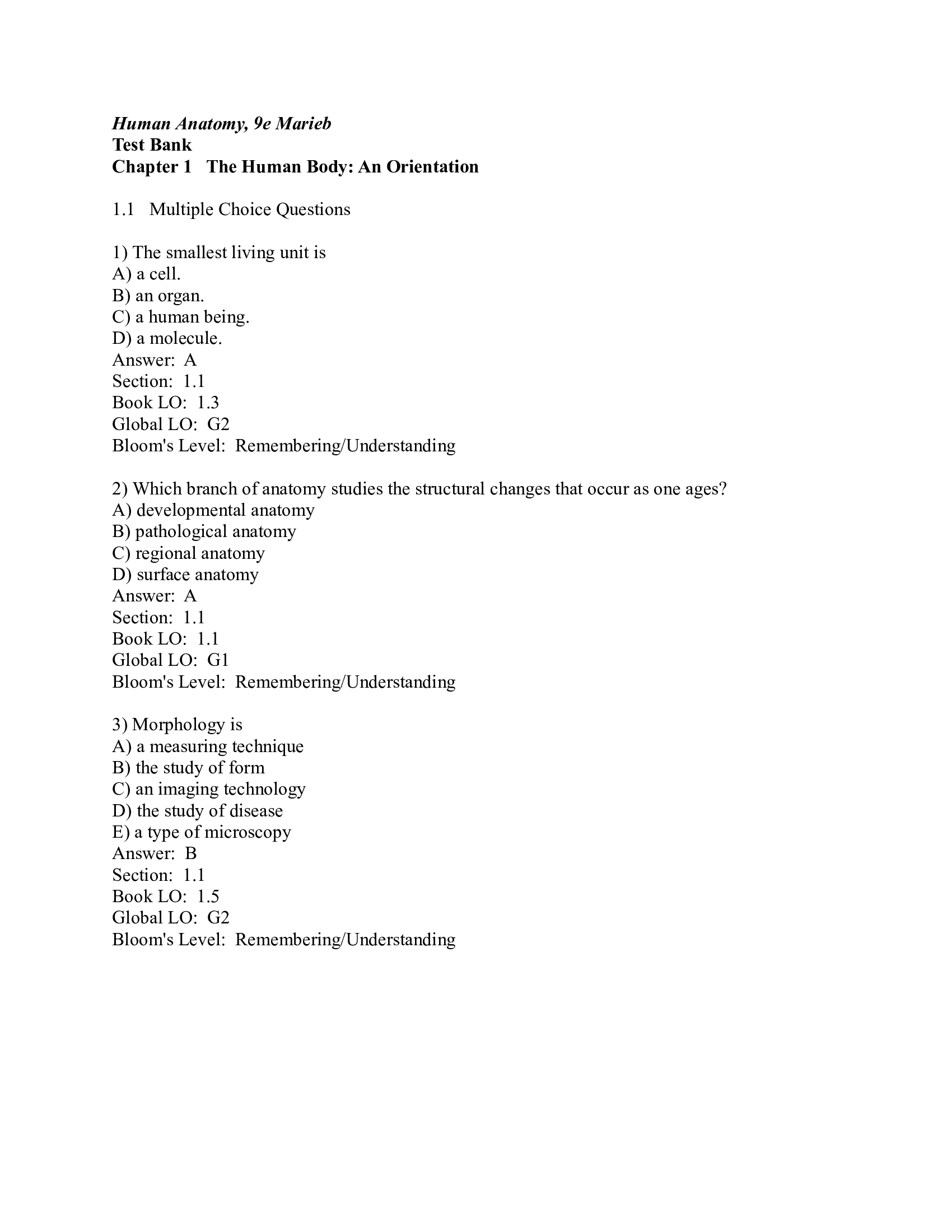
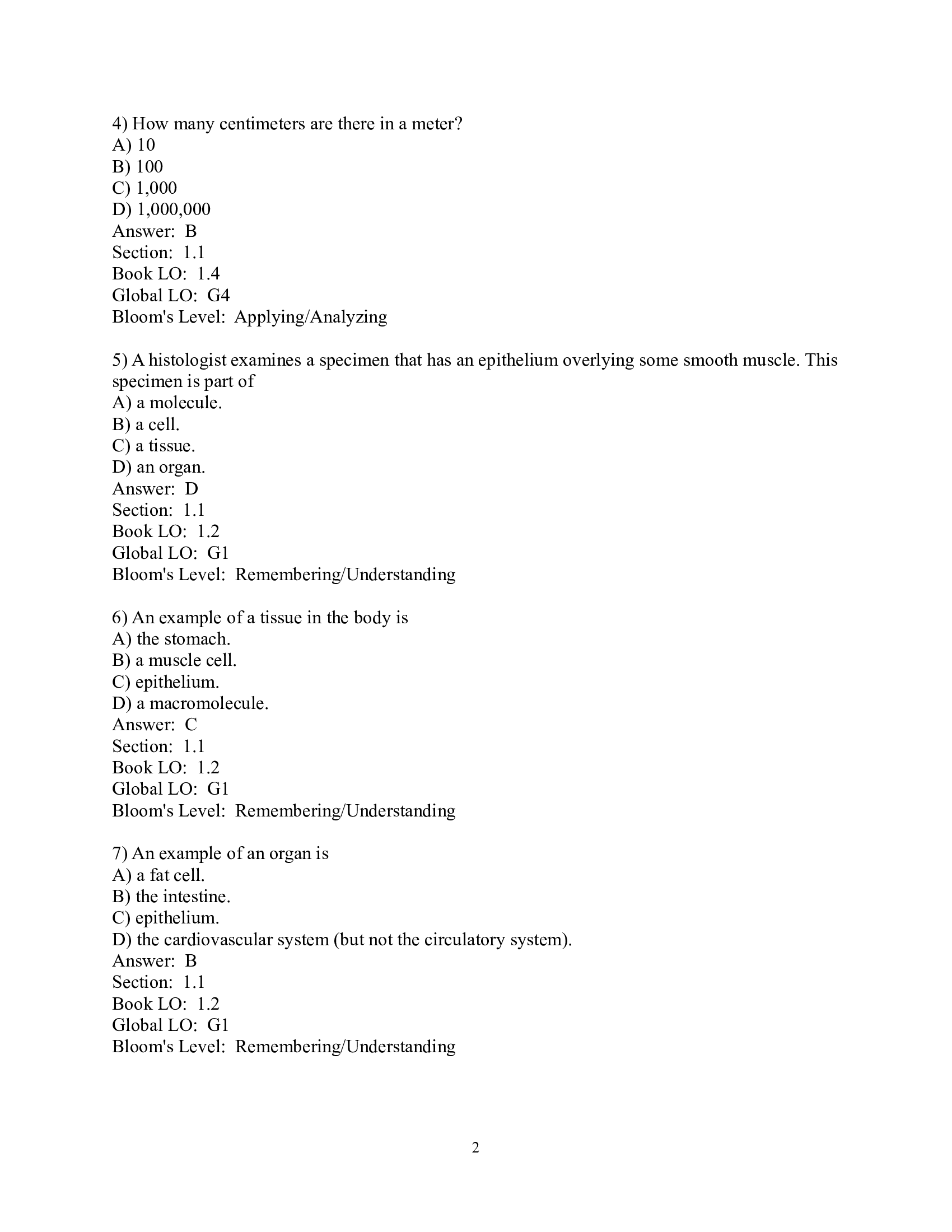
Test Bank for Human Anatomy and Physiology, 9th Edition, Elaine N. Marieb, ISBN10: 0321743261, ISBN13: 9780321743268, ISBN10: 0321802187, ISBN13: 9780321802187 Table of Contents 1. The Human Body: An Orientation 2. Chemistry Comes Alive 3. Cells: The Living Units 4. Tissue: The Living Fabric 5. The Integumentary System 6. Bones and Skeletal Tissues 7. The Skeleton 8. Joints 9. Muscles and Muscle Tissue 10. The Muscular System 11. Fundamentals of the Nervous System and Nervous Tissue 12. The Central Nervous System 13. The Peripheral Nervous System and Reflex Activity 14. The Autonomic Nervous System 15. The Special Senses 16. The Endocrine System 17. Blood 18. The Cardiovascular System: The Heart 19. The Cardiovascular System: Blood Vessels 20. The Lymphatic System and Lymphoid Organs and Tissues 21. The Immune System: Innate and Adaptive Body Defensives 22. The Respiratory System 23. The Digestive System 24. Nutrition, Metabolism, and Body Temperature Regulation 25. The Urinary System 26. Fluid, Electrolyte, and AcidBase Balance 27. The Reproductive System 28. Pregnancy and Human Development 29. Heredity SAMPLE Table of Contents 1. The Human Body: An Orientation 2. Chemistry Comes Alive 3. Cells: The Living Units 4. Tissue: The Living Fabric 5. The Integumentary System 6. Bones and Skeletal Tissues 7. The Skeleton 8. Joints 9. Muscles and Muscle Tissue 10. The Muscular System 11. Fundamentals of the Nervous System and Nervous Tissue 12. The Central Nervous System 13. The Peripheral Nervous System and Reflex Activity 14. The Autonomic Nervous System 15. The Special Senses 16. The Endocrine System 17. Blood 18. The Cardiovascular System: The Heart 19. The Cardiovascular System: Blood Vessels 20. The Lymphatic System and Lymphoid Organs and Tissues 21. The Immune System: Innate and Adaptive Body Defensives 22. The Respiratory System 23. The Digestive System 24. Nutrition, Metabolism, and Body Temperature Regulation 25. The Urinary System 26. Fluid, Electrolyte, and AcidBase Balance 27. The Reproductive System 28. Pregnancy and Human Development 29. Heredity lOMoARcPSD|7704021 Human Anatomy, 9e Marieb Test Bank Chapter 1 The Human Body: An Orientation 1.1 Multiple Choice Questions 1) The smallest living unit is A) a cell. B) an organ. C) a human being. D) a molecule. Answer: A Section: 1.1 Book LO: 1.3 Global LO: G2 Bloom's Level: Remembering/Understanding 2) Which branch of anatomy studies the structural changes that occur as one ages? A) developmental anatomy B) pathological anatomy C) regional anatomy D) surface anatomy Answer: A Section: 1.1 Book LO: 1.1 Global LO: G1 Bloom's Level: Remembering/Understanding 3) Morphology is A) a measuring technique B) the study of form C) an imaging technology D) the study of disease E) a type of microscopy Answer: B Section: 1.1 Book LO: 1.5 Global LO: G2 Bloom's Level: Remembering/Understanding lOMoARcPSD|7704021 4) How many centimeters are there in a meter? A) 10 B) 100 C) 1,000 D) 1,000,000 Answer: B Section: 1.1 Book LO: 1.4 Global LO: G4 Bloom's Level: Applying/Analyzing 5) A histologist examines a specimen that has an epithelium overlying some smooth muscle. This specimen is part of A) a molecule. B) a cell. C) a tissue. D) an organ. Answer: D Section: 1.1 Book LO: 1.2 Global LO: G1 Bloom's Level: Remembering/Understanding 6) An example of a tissue in the body is A) the stomach. B) a muscle cell. C) epithelium. D) a macromolecule. Answer: C Section: 1.1 Book LO: 1.2 Global LO: G1 Bloom's Level: Remembering/Understanding 7) An example of an organ is A) a fat cell. B) the intestine. C) epithelium. D) the cardiovascular system (but not the circulatory system). Answer: B Section: 1.1 Book LO: 1.2 Global LO: G1 Bloom's Level: Remembering/Understanding 2 lOMoARcPSD|7704021 8) Which organ system consists of vessels that do not carry blood, but pick up fluids (and some cells) that are leaked from the blood? A) urinary B) endocrine C) integumentary D) lymphatic Answer: D Section: 1.1 Book LO: 1.3 Global LO: G7 Bloom's Level: Applying/Analyzing 9) Large molecules such as proteins are called A) cells. B) macromolecules. C) multi-atom units. D) cellular organelles. Answer: B Section: 1.1 Book LO: 1.5 Global LO: G1 Bloom's Level: Remembering/Understanding 10) Which organ system covers the external surface of the body, but not the internal surface of the mouth? A) lymphatic B) digestive C) integumentary D) cutaneous Answer: C Section: 1.1 Book LO: 1.3 Global LO: G2 Bloom's Level: Remembering/Understanding 11) Which organ system includes the spinal cord? A) skeletal B) muscular C) nervous D) integumentary Answer: C Section: 1.1 Book LO: 1.3 Global LO: G2 Bloom's Level: Remembering/Understanding 3 lOMoARcPSD|7704021 12) The elimination of nitrogenous wastes from body fluids is regulated by the ________ system. A) urinary B) endocrine C) integumentary D) lymphatic Answer: A Section: 1.1 Book LO: 1.3 Global LO: G2 Bloom's Level: Remembering/Understanding 13) The dimensions of cells and organelles would best be described using which units of measurement? A) mg B) cm C) µm D) m E) ml Answer: C Section: 1.1 Book LO: 1.4 Global LO: G4 Bloom's Level: Applying/Analyzing 14) Which organ system includes the pancreas, thymus, testes, and pituitary gland? A) integumentary B) endocrine C) reproductive D) lymphatic Answer: B Section: 1.1 Book LO: 1.3 Global LO: G7 Bloom's Level: Remembering/Understanding 15) The roots of anatomical terminology lie mainly in A) German and French. B) Latin and Greek. C) Esperanto. D) Russian and Old English. Answer: B Section: 1.1 Book LO: 1.5 Global LO: G1 Bloom's Level: Remembering/Understanding 4 lOMoARcPSD|7704021 16) Hormones are regulatory proteins that are secreted by the ________ system. A) urinary B) endocrine C) integumentary D) lymphatic Answer: B Section: 1.1 Book LO: 1.3 Global LO: G7 Bloom's Level: Remembering/Understanding 17) Which organ system keeps blood constantly supplied with oxygen, removes carbon dioxide, and contains many air tubes? A) urinary B) endocrine C) circulatory D) respiratory Answer: D Section: 1.1 Book LO: 1.3 Global LO: G7 Bloom's Level: Remembering/Understanding 18) The ________ cavity contains the heart and lungs. A) abdominopelvic B) dorsal C) thoracic D) lateral Answer: C Section: 1.2 Book LO: 1.9 Global LO: G2 Bloom's Level: Remembering/Understanding 19) A coronal section through the human body can A) pass through both the nose and the occipital region. B) pass through both ears. C) provide mirror right and left images. D) lie in a horizontal plane. Answer: B Section: 1.2 Book LO: 1.7 Global LO: G2 Bloom's Level: Remembering/Understanding 5 lOMoARcPSD|7704021 Use the diagram above to answer the following questions. 20) Which letter indicates the mental region? A) A B) B C) C D) D E) E Answer: A Section: 1.2 Book LO: 1.7 Global LO: G2 Bloom's Level: Remembering/Understanding 6 lOMoARcPSD|7704021 21) Which letter indicates the umbilical region? A) A B) B C) C D) D E) E Answer: B Section: 1.2 Book LO: 1.7 Global LO: G2 Bloom's Level: Remembering/Understanding 22) Which letter indicates the hallux? A) A B) B C) C D) D E) E Answer: E Section: 1.2 Book LO: 1.7 Global LO: G2 Bloom's Level: Remembering/Understanding 23) Which letter indicates the inguinal region? A) A B) B C) C D) D E) E Answer: C Section: 1.2 Book LO: 1.7 Global LO: G2 Bloom's Level: Remembering/Understanding 24) Which letter indicates the femoral region? A) A B) B C) C D) D E) E Answer: D Section: 1.2 Book LO: 1.7 Global LO: G2 Bloom's Level: Remembering/Understanding 7 lOMoARcPSD|7704021 25) Which structures are evidence of the vertebrate characteristic of segmentation? A) branches of the blood vessels B) multiple joints of fingers C) subdivisions of the gastrointestinal tract D) vertebral column Answer: D Section: 1.2 Book LO: 1.8 Global LO: G2 Bloom's Level: Remembering/Understanding 26) Which statement about visceral serosa is false? A) It clings to the surface of organs. B) It is continuous with the membrane that covers the outer body wall. C) It is deep to the parietal serosa. D) It lines the internal surface of hollow organs. Answer: D Section: 1.2 Book LO: 1.9 Global LO: G2 Bloom's Level: Remembering/Understanding 27) The buccal region is the A) cheeks. B) waist. C) calf of the leg. D) underside of the foot. Answer: A Section: 1.2 Book LO: 1.7 Global LO: G2 Bloom's Level: Remembering/Understanding 28) The popliteal region is A) the side of the leg. B) in the cervical region. C) the posterior surface of the knee. D) the inferior part of the gluteal region. Answer: C Section: 1.2 Book LO: 1.7 Global LO: G2 Bloom's Level: Remembering/Understanding 8 lOMoARcPSD|7704021 29) The coxal region is A) the same as the inguinal region. B) the skin over the "tailbone." C) the hip. D) the posterior surface of the wrist. Answer: C Section: 1.2 Book LO: 1.7 Global LO: G2 Bloom's Level: Remembering/Understanding 30) Which structure is located entirely within the right upper quadrant? A) appendix B) gallbladder C) spleen D) stomach Answer: B Section: 1.2 Book LO: 1.10 Global LO: G2 Bloom's Level: Remembering/Understanding 31) Which organ is not found in the ventral body cavity? A) heart B) liver C) spinal cord D) urinary bladder Answer: C Section: 1.2 Book LO: 1.9 Global LO: G2 Bloom's Level: Applying/Analyzing 32) The ankle lies ________ to the thigh. A) distal B) proximal C) lateral D) inferior Answer: A Section: 1.2 Book LO: 1.7 Global LO: G2 Bloom's Level: Remembering/Understanding lOMoARcPSD|7704021 33) The axillary artery is found in the region of the A) posterior surface of the knee. B) vertebral column. C) armpit. D) long axis of any limb. Answer: C Section: 1.2 Book LO: 1.7 Global LO: G2 Bloom's Level: Remembering/Understanding 34) The extremities are the same as A) the ears. B) the fingers and toes. C) the limbs. D) all structures in the head. Answer: C Section: 1.2 Book LO: 1.7 Global LO: G2 Bloom's Level: Remembering/Understanding 35) Which of the following pairs of organs/structures is located ipsilateral? A) cecum : sigmoid colon B) descending colon : spleen C) mouth : navel D) right lung : left lung Answer: B Section: 1.2 Book LO: 1.10 Global LO: G2 Bloom's Level: Applying/Analyzing 36) A physician viewing an injury to the back would look at the patient's ________ side. A) lateral B) posterior C) cranial D) ventral Answer: B Section: 1.2 Book LO: 1.7 Global LO: G2 Bloom's Level: Remembering/Understanding 10 lOMoARcPSD|7704021 37) The ________ body cavity contains the brain. A) dorsal B) ventral C) serous D) lateral Answer: A Section: 1.2 Book LO: 1.9 Global LO: G2 Bloom's Level: Remembering/Understanding 38) As an anatomical region, lumbar refers to A) the infero-medial aspect of the back. B) part of the lower limb. C) the wrist. D) the breast. Answer: A Section: 1.2 Book LO: 1.7 Global LO: G2 Bloom's Level: Remembering/Understanding 11 . Downloaded by Passing Grades (pasinggrades@gmail.com) lOMoARcPSD|7704021 Use the diagram above to answer the following questions. 39) Which letter indicates the lumbar region? A) A B) B C) C D) D E) E Answer: D Section: 1.2 Book LO: 1.7 Global LO: G2 Bloom's Level: Remembering/Understanding 12 . Downloaded by Passing Grades (pasinggrades@gmail.com) lOMoARcPSD|7704021 40) Which letter indicates the acromial region? A) A B) B C) C D) D E) E Answer: B Section: 1.2 Book LO: 1.7 Global LO: G2 Bloom's Level: Remembering/Understanding 41) Which letter indicates the scapular region? A) A B) B C) C D) D E) E Answer: C Section: 1.2 Book LO: 1.7 Global LO: G2 Bloom's Level: Remembering/Understanding 42) Which letter indicates the popliteal region? A) A B) B C) C D) D E) E Answer: E Section: 1.2 Book LO: 1.7 Global LO: G2 Bloom's Level: Remembering/Understanding 43) Which letter indicates the occipital region? A) A B) B C) C D) D E) E Answer: A Section: 1.2 Book LO: 1.7 Global LO: G2 Bloom's Level: Remembering/Understanding 13 . Downloaded by Passing Grades (pasinggrades@gmail.com) lOMoARcPSD|7704021 44) The chest is ________ to the abdomen. A) superior B) lateral C) anterior D) proximal E) deep Answer: A Section: 1.2 Book LO: 1.7 Global LO: G2 Bloom's Level: Applying/Analyzing 45) The sternal region is ________ to the scapular region. A) superior B) lateral C) anterior D) proximal E) deep Answer: C Section: 1.2 Book LO: 1.7 Global LO: G2 Bloom's Level: Applying/Analyzing 46) Which of these terms refers to the head? A) cranial B) caudal C) medial D) frontal E) sacral Answer: A Section: 1.2 Book LO: 1.7 Global LO: G2 Bloom's Level: Remembering/Understanding 14 . Downloaded by Passing Grades (pasinggrades@gmail.com) lOMoARcPSD|7704021 47) The brain is ________ to the skull. A) superior B) lateral C) anterior D) proximal E) deep Answer: E Section: 1.2 Book LO: 1.7 Global LO: G2 Bloom's Level: Applying/Analyzing 48) The thumb is ________ to the index finger. A) superior B) lateral C) anterior D) proximal E) deep Answer: B Section: 1.2 Book LO: 1.7 Global LO: G2 Bloom's Level: Applying/Analyzing 49) Muscles are ________ to the skin. A) superior B) lateral C) anterior D) proximal E) deep Answer: E Section: 1.2 Book LO: 1.7 Global LO: G2 Bloom's Level: Applying/Analyzing 50) The axillary region is ________ to the sternum. A) superior B) lateral C) anterior D) proximal E) deep Answer: B Section: 1.2 Book LO: 1.7 Global LO: G2 Bloom's Level: Applying/Analyzing 15 . Downloaded by Passing Grades (pasinggrades@gmail.com) lOMoARcPSD|7704021 51) The lip is ________ to the chin. A) superior B) lateral C) anterior D) proximal E) deep Answer: A Section: 1.2 Book LO: 1.7 Global LO: G2 Bloom's Level: Applying/Analyzing 52) The eye is ________ to the occipital region. A) superior B) lateral C) anterior D) proximal E) deep Answer: C Section: 1.2 Book LO: 1.7 Global LO: G2 Bloom's Level: Applying/Analyzing 53) The gluteal region is ________ to the popliteal region. A) superior B) lateral C) anterior D) proximal E) deep Answer: A Section: 1.2 Book LO: 1.7 Global LO: G2 Bloom's Level: Applying/Analyzing 16 . Downloaded by Passing Grades (pasinggrades@gmail.com) lOMoARcPSD|7704021 54) The femoral region is ________ to the plantar region. A) superficial B) lateral C) anterior D) proximal E) deep Answer: D Section: 1.2 Book LO: 1.7 Global LO: G2 Bloom's Level: Applying/Analyzing 55) The heart is ________ to the sternum. A) superior B) lateral C) anterior D) proximal E) deep Answer: E Section: 1.2 Book LO: 1.7 Global LO: G2 Bloom's Level: Applying/Analyzing 56) The pubic area is ________ to the gluteal region. A) superior B) lateral C) anterior D) proximal E) deep Answer: C Section: 1.2 Book LO: 1.7 Global LO: G2 Bloom's Level: Applying/Analyzing 57) The perineal region is the A) side of the leg. B) region between the external genitals and the anus. C) point of the shoulder. D) superior part of the gluteal region. Answer: B Section: 1.2 Book LO: 1.7 Global LO: G2 Bloom's Level: Remembering/Understanding 17 . Downloaded by Passing Grades (pasinggrades@gmail.com) lOMoARcPSD|7704021 58) Which structure is not present in the mediastinum? A) esophagus B) heart C) lung D) trachea Answer: C Section: 1.2 Book LO: 1.9 Global LO: G2 Bloom's Level: Remembering/Understanding 59) A frontal plane is the same as a ________ plane. A) midsagittal B) transverse C) coronal D) sagittal Answer: C Section: 1.2 Book LO: 1.7 Global LO: G2 Bloom's Level: Remembering/Understanding 60) Another name for the midsagittal plane is A) parasagittal. B) oblique. C) coronal. D) median. Answer: D Section: 1.2 Book LO: 1.7 Global LO: G2 Bloom's Level: Remembering/Understanding 61) The umbilical region is ________ to the lumbar region. A) superior B) lateral C) anterior D) proximal E) deep Answer: C Section: 1.2 Book LO: 1.7 Global LO: G2 Bloom's Level: Applying/Analyzing 18 . Downloaded by Passing Grades (pasinggrades@gmail.com) lOMoARcPSD|7704021 62) The cervical region is the A) thigh. B) calf. C) neck. D) head. Answer: C Section: 1.2 Book LO: 1.7 Global LO: G2 Bloom's Level: Remembering/Understanding 63) What is the function of serous membranes? A) They act like wrapping paper to hold visceral organs together. B) They contain gland cells that secrete mucus. C) They halt the spread of infection. D) They reduce friction so that viscera move freely. Answer: D Section: 1.2 Book LO: 1.9 Global LO: G2 Bloom's Level: Remembering/Understanding 64) The dorsal hollow nerve cord A) develops into the brain and spinal cord. B) is a primitive supporting rod. C) contains the notochord. D) is the same as the human backbone. Answer: A Section: 1.2 Book LO: 1.8 Global LO: G1 Bloom's Level: Remembering/Understanding 65) Which statement concerning the anatomical position is false? A) The palms face anteriorly. B) The toes point anteriorly, but the fingers point inferiorly. C) The knees, elbow, and neck are straight (not bent). D) The person is lying down, as straight as possible. Answer: D Section: 1.2 Book LO: 1.6 Global LO: G2 Bloom's Level: Remembering/Understanding 19 . Downloaded by Passing Grades (pasinggrades@gmail.com) lOMoARcPSD|7704021 66) Bilateral symmetry can apply to objects as well as to animal bodies. Which of the following capital letters of the alphabet is not bilaterally symmetrical? A) A B) M C) L D) O Answer: C Section: 1.2 Book LO: 1.8 Global LO: G2 Bloom's Level: Remembering/Understanding 67) Which structure is not covered by visceral serosa? A) lungs B) ribs C) stomach D) uterus Answer: B Section: 1.2 Book LO: 1.9 Global LO: G2 Bloom's Level: Remembering/Understanding 68) The femoral region is the A) buttocks. B) hip. C) thigh. D) toes. Answer: C Section: 1.2 Book LO: 1.7 Global LO: G2 Bloom's Level: Remembering/Understanding 69) The inguinal region lies A) anterior to the elbow joint. B) on the anterior neck. C) where the thigh joins the trunk. D) on the external genitals. Answer: C Section: 1.2 Book LO: 1.7 Global LO: G2 Bloom's Level: Remembering/Understanding 20 . Downloaded by Passing Grades (pasinggrades@gmail.com) lOMoARcPSD|7704021 70) What point or structure in the body is located farthest laterally? (Hint: Questions always refer to the body in the anatomical position.) A) the coxal region B) ear C) little toe D) tip of thumb Answer: D Section: 1.2 Book LO: 1.6 Global LO: G2 Bloom's Level: Applying/Analyzing 71) Although transmission electron microscopy is usually used for high-magnification viewing, it is certainly possible to use it at low magnification as well. That is, one can produce similar micrographs of tissues taken by light microscopy and electron microscopy at the same magnification. Even at the same magnification, however, you can easily tell the two kinds of micrographs apart. How? A) The image in the electron micrograph is still sharper. B) Tissue viewed by electron microscopy is colored, whereas light micrographs are always black and white (and shades of gray). C) Tissue for light microscopy cannot be fixed (no fixation). D) Tissue for electron microscopy cannot be sectioned. Answer: A Section: 1.3 Book LO: 1.12 Global LO: G2 Bloom's Level: Remembering/Understanding 72) During the process of ________, noncellular artifacts can be introduced into histology samples. A) time B) observation C) staining D) photography Answer: C Section: 1.3 Book LO: 1.11 Global LO: G1 Bloom's Level: Remembering/Understanding 21 . Downloaded by Passing Grades (pasinggrades@gmail.com) lOMoARcPSD|7704021 73) The main purpose of fixation is A) to preserve the tissue. B) to mend breaks in tissue sections. C) to make an organ easier to section. D) to stick tissue sections to a glass slide. Answer: A Section: 1.3 Book LO: 1.11 Global LO: G1 Bloom's Level: Remembering/Understanding 74) The "CT" in "CT scanning" stands for A) cut transversely. B) Charles Thorgaard, the inventor's name. C) correlated thickness. D) computed tomography. Answer: D Section: 1.4 Book LO: 1.13 Global LO: G1 Bloom's Level: Remembering/Understanding 75) What is the main advantage of MRI as a medical imaging technique? A) It is safe. B) The patient feels less pain during the procedure than with any other imaging technique. C) It is very inexpensive. D) It shows soft tissues very clearly. Answer: D Section: 1.4 Book LO: 1.13 Global LO: G2 Bloom's Level: Remembering/Understanding 22 . Downloaded by Passing Grades (pasinggrades@gmail.com) lOMoARcPSD|7704021 1.2 True/False Questions 1) Pathological anatomy deals with structural changes caused by disease. Answer: TRUE Section: 1.1 Book LO: 1.1 Global LO: G1 Bloom's Level: Remembering/Understanding 2) Most adults are between 1.5 and 2 meters tall. Answer: TRUE Section: 1.1 Book LO: 1.4 Global LO: G1 Bloom's Level: Applying/Analyzing 3) All vertebrate embryos have a dorsal hollow nerve cord. Answer: TRUE Section: 1.2 Book LO: 1.8 Global LO: G2 Bloom's Level: Remembering/Understanding 4) Serous cavities include the pleural cavity. Answer: TRUE Section: 1.2 Book LO: 1.9 Global LO: G2 Bloom's Level: Remembering/Understanding 5) Serous cavities contain air. Answer: FALSE Section: 1.2 Book LO: 1.9 Global LO: G2 Bloom's Level: Remembering/Understanding 6) A transverse plane could cut the head off the body! Answer: TRUE Section: 1.2 Book LO: 1.7 Global LO: G2 Bloom's Level: Remembering/Understanding 23 . Downloaded by Passing Grades (pasinggrades@gmail.com) lOMoARcPSD|7704021 7) In anatomical position, the palms of the hands face medially toward the thighs. Answer: FALSE Section: 1.2 Book LO: 1.6 Global LO: G2 Bloom's Level: Remembering/Understanding 8) The mediastinum contains the trachea and lungs. Answer: FALSE Section: 1.2 Book LO: 1.9 Global LO: G2 Bloom's Level: Remembering/Understanding 9) The peritoneal cavity is a serous cavity. Answer: TRUE Section: 1.2 Book LO: 1.9 Global LO: G2 Bloom's Level: Remembering/Understanding 10) EM has much greater resolution than LM. Answer: TRUE Section: 1.3 Book LO: 1.12 Global LO: G1 Bloom's Level: Remembering/Understanding 11) A CT scan produces an image of a transverse section of the body. Answer: TRUE Section: 1.4 Book LO: 1.13 Global LO: G7 Bloom's Level: Remembering/Understanding 12) MRI techniques can show only images that are hard and deflect the X-rays. Answer: FALSE Section: 1.4 Book LO: 1.13 Global LO: G7 Bloom's Level: Remembering/Understanding 24 . Downloaded by Passing Grades (pasinggrades@gmail.com) lOMoARcPSD|7704021 13) Ultrasound techniques are used to image a fetus because they are less damaging than other techniques. Answer: TRUE Section: 1.4 Book LO: 1.13 Global LO: G1 Bloom's Level: Remembering/Understanding 14) Angiography imaging is used primarily in the study of blood supply to the heart wall and brain. Answer: TRUE Section: 1.4 Book LO: 1.13 Global LO: G7 Bloom's Level: Remembering/Understanding 15) A CT scan is used to detect regions of high metabolic activity. Answer: FALSE Section: 1.4 Book LO: 1.13 Global LO: G2 Bloom's Level: Remembering/Understanding 1.3 Short Answer Questions 1) Describe the terms proximal and distal. Answer: Proximal means closer to the point of attachment to the main part of the body; distal is farther from the point of attachment. 2) Describe the location of the femoral region in relation to the crural region. Answer: The femoral region is proximal to the crural region. 3) Describe the location of the brachial region in relation to the pollex. Answer: The brachial region is proximal to the pollex. 4) In humans, what term is synonymous with posterior? Answer: dorsal 5) Clinicians refer to ________ anatomy when locating blood vessels to draw blood, feeling pulses, and avoiding nerves while giving injections. Answer: surface 6) In humans, the region between the anus and the external genitals is the ________ region. Answer: perineal 7) The olecranal region is posterior to what region? Answer: antecubital 25 . Downloaded by Passing Grades (pasinggrades@gmail.com) lOMoARcPSD|7704021 8) The head, neck, and trunk comprise the ________ region. Answer: axial 9) What is the anatomical term for the thumb? Answer: pollex 10) One could say that the forearm is ________ to the brachial region. Answer: distal 11) Cutting the body along the median plane produces a(n) ________ section Answer: midsagittal 12) One could describe the scalp as being ________ to the skull. Answer: superficial 13) A(n) ________ plane separates the body into equal left and right halves. Answer: midsagittal (or median) 14) Which type of imaging technology uses radioactive isotopes to detect regions of high metabolic activity? Answer: PET scan 15) The ________ system is involved in immunity. Answer: lymphatic 1.4 Essay Questions 1) Identify each of the systems that are found in the arm. Answer: The arm contains elements of the skeletal, nervous, cardiovascular, muscular, lymphatic, and integumentary systems. 2) Which of the organ systems found in the arm are not found in the leg? Answer: None 3) List the six unique features found in all vertebrates at some stage of their life. Answer: Tube-within-a-tube body plan, bilateral symmetry, dorsal hollow nerve cord, notochord and vertebrae, segmentation, and pharyngeal pouches. 4) In adult humans, what remnants of segmentation remain? Answer: The ribs and the vertebrae, with their segmental spinal nerves, are remnants of segmentation. 26 . Downloaded by Passing Grades (pasinggrades@gmail.com) lOMoARcPSD|7704021 5) Select from the following techniques the best method for assessing brain function in a stroke patient: X-ray imaging, sonography, MRI. Explain why the other choices are not the best choice. Answer: MRI is the best method of assessing brain function. X-rays do not image soft tissues well or with high resolution. They also produce only two-dimensional images of a structure. Sonography cannot be used to study the brain because sound waves cannot pass through the skull. 27 . Downloaded by Passing Grades (pasinggrades@gmail.com)

Contact the Seller

Please Sign In to contact this seller.


  • 👎  Report Copyright Violation

Frequently Asked Questions

What Do I Get When I Buy This Study Material?

+

When you buy a study material on Passing Grades, an instant download link will be sent directly to your email, giving you access to the file anytime after payment is completed.

Is Passing Grades a Trusted Platform?

+

Yes, Passing Grades is a reputable students’ marketplace with a secure payment system and reliable customer support. You can trust us to ensure a safe and seamless transaction experience.

Will I Be Stuck with a Subscription?

+

No, all purchases on Passing Grades are one-time transactions. You only pay for the notes you choose to buy, with no subscriptions or hidden fees attached.

Who Am I Buying These Study Materials From?

+

Passing Grades is a marketplace, which means you are purchasing the document from an individual vendor, not directly from us. We facilitate the payment and delivery process between you and the vendor.

Does Passing Grades Offer Free Study Materials?

+

Yes, sellers on Passing Grades have uploaded numerous free test banks, exams, practice questions, and class notes that can be downloaded at no cost.

Pasinggrades - Quality Study Materials

USD 15

    • Quality checked by Pasing Grades
    • 100% satisfaction guarantee
    • Seller: Angelicer
Buy PDF $15

Seller Information

Angelicer

Member since April 2021

  • icon
  • icon
View Profile
  • total sales

    0
  • Favourites

    0
  • Comments

    0
    ( 0 Ratings )

Item Information

  • Uploaded

    22 May 2022

  • Updated

    24 October 2025

  • Category

    Nursing

  • Item Type

    test bank

  • Tags

    Test Bank Anatomy and Physiology

Related Exam Prep Guides by Angelicer

Test Bank for Success in Practical Vocational Nursing 8th Edition by Knecht
View Document

Test Bank for Succes...

  • Angelicer

    Angelicer

  • test bank

Enhance your study with the Test Bank for Success in Practical Vocational Nursing 8th Edition by Kne...

15 USD

0

0

Test Bank for Illustrated Anatomy of the Head and Neck 5th Edition by Fehrenbach
View Document

Test Bank for Illust...

  • Angelicer

    Angelicer

  • test bank

Boost your understanding with the Test Bank for Illustrated Anatomy of the Head and Neck 5th Edition...

15 USD

0

0

ATI PEDS Proctored Exam Questions and Answers 2026 | Comprehensive Study Guide
View Document

ATI PEDS Proctored E...

  • Angelicer

    Angelicer

  • test bank

Get the ATI PEDS Proctored Exam Questions and Answers for 2025. This comprehensive study guide offer...

15 USD

0

0

Purchase

Download link will be sent to this email immediately after purchase.

IMPORTANT LINKS

  • How To Upload Class Notes
  • Selling Tips
  • Passing Grades's Study Materials
  • Scholarships for International Students 2025

POPULAR CATEGORIES

  • Law
  • Accounting
  • English
  • Psychology
  • Business
  • Nursing
  • Computer Science
  • General

View Document

  • Blog
  • Contact
  • Delivery Policy
  • Latest Scholarships Around the World
  • How to Pass Bar Exams: Passing Grades’ Strategies
  • How to Study and Pass the CPA Exam
  • All Test Banks
  • Faq
  • Copyright Claims
  • Privacy Policy
  • Terms of Use

KNOWLEDGE BASE

  • How to Write A+ Grade Good Research Paper
  • How to Manage Stress During Exam Period
  • Best Time to Study
  • How to Pass NCLEX-RN Exam
  • How To Effectively Utilize Test Banks
  • Popular Shadow Health Exam Assessments
  • Popular HESI Case Studies
  • How to Prepare for a Nursing Career
  • The Importance Of Summaries in Exam Revisvion

© 2026 Pasing Grades. All rights reserved.