
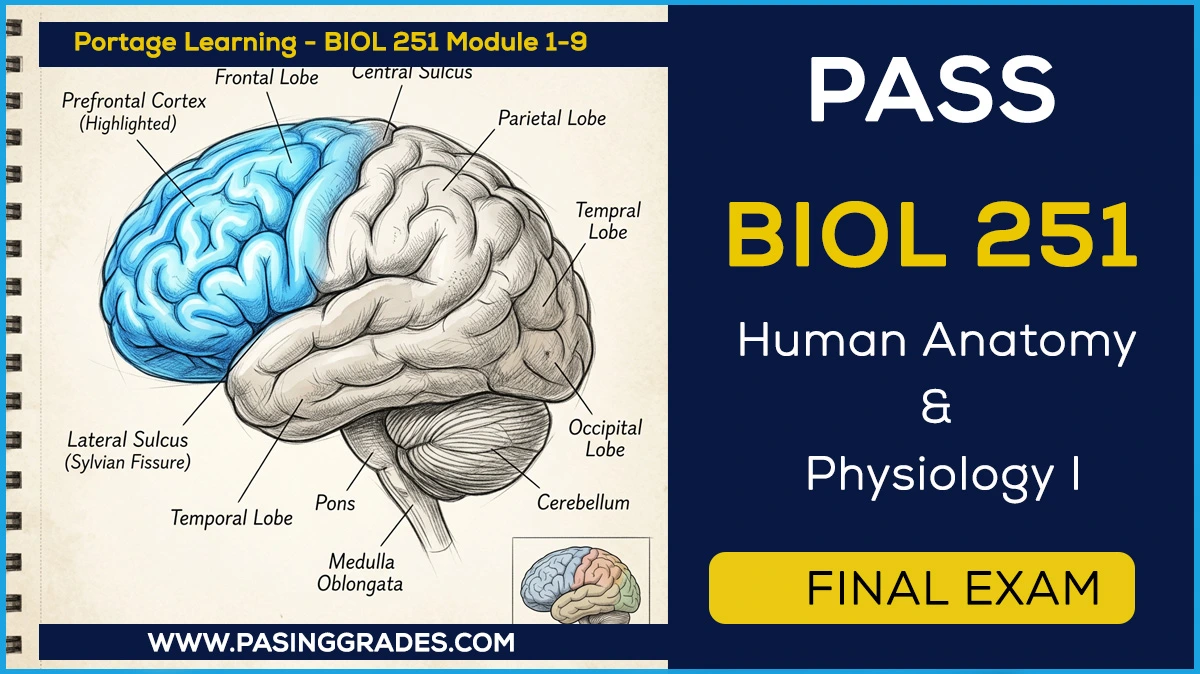
Portage Learning claims that 90% of their students pass their courses. That's a genuinely encouraging number. However, it also means one in ten students struggles, wastes money, and potentially delays their nursing or healthcare program admission timeline.
If you've just enrolled in BIOL 251, or you're thinking about it, the difference between being in that 90% and the 10% almost always comes down to the same handful of mistakes: underestimating the physiology modules, misreading how the course is structured, and not knowing which modules deserve double the study time.
This guide was written to fix that. It covers everything — how the course actually works, how to manage the logistics (the 48-hour rule, the retake policy, Respondus), and a deep, honest breakdown of all nine modules with specific strategies for each. Read it before you start Module 1. It'll save you a lot of stress.
What Is Portage Learning BIOL 251?
BIOL 251 Human Anatomy & Physiology I is a 4-credit, fully online, self-paced science course offered through Portage Learning. Credits are awarded through Geneva College or Bushnell University — both regionally accredited institutions — meaning your transcript will show a legitimate college credit that transfers to more than 2,800 schools nationwide, including major nursing programs at universities like Arizona, Baylor, and Kentucky.
The course is taken primarily by two kinds of students: nursing school applicants who need A&P as a prerequisite, and working adults completing prerequisites on a flexible schedule. Both groups chose Portage for the same reason — no set class times, no campus commute, complete schedule control. That flexibility is real and valuable. But it comes with a tradeoff: nobody is pacing you, reminding you, or warning you when you're falling behind. That responsibility is entirely yours.
BIOL 251 covers nine major body systems across nine modules: from the foundational concepts of homeostasis and cellular biology all the way through the integumentary system, skeletal system, joints, muscles, the nervous system, the peripheral nervous system, the special senses, and finally the endocrine system. Each module has a lecture component, a virtual lab component, and ends in a proctored exam.
How the Course Is Structured — What You're Actually Signing Up For
Before you read a single lesson, you need to understand the mechanics of this course. Several students run into problems not because the science is too hard, but because the course rules catch them off guard.
The Grading Breakdown
The total course is worth 1,730 points. Here's how that breaks down:
- 9 Module Exams — 150 points each (1,350 points total) — these are by far your biggest grade driver
- Final Exam — 200 points — cumulative across all 9 modules
- 9 Case Studies — 10 points each (90 points total)
- 9 Module Problem Sets — 5 points each (45 points total)
- 9 Lab Quizzes — 5 points each (45 points total)
Module exams are where the course is won or lost. Each one is worth 150 points, proctored through Respondus Lockdown Browser with webcam recording. The final exam is worth 200 points. Everything else — labs, case studies, problem sets — is important for your grade cushion, but exam performance determines your outcome.
To earn an A, you need to clear 92.5%. To pass, you need to stay above 59.5%. A B requires 82.5% or better. Factor that into your target from the very first module.
The 48-Hour Rule — Read This Carefully
Here is one of the most misunderstood parts of the course: you can only take one module exam every 48 hours. This is a firm, non-negotiable policy across all Portage Learning courses. The moment you submit a module exam, a 48-hour clock starts before you can open the next one.
This trips up students who enroll thinking they can sprint through the course in a week or two. With 9 module exams plus the final, and the minimum 28-day completion period that Portage enforces, you cannot compress this course below about four weeks even if you studied 12 hours a day. Plan your timeline before you start. If you're working toward a nursing program deadline, count backward from that date and make sure you have at least 6–10 weeks of realistic runway.
The 48-hour window is not just a rule — it's actually a study asset. Use that time to review the current module's feedback, pre-read the next module's material, and practice questions before your next exam opens. Students who treat the waiting period as dead time are leaving easy points on the table.
Also note that professors grade exams Monday through Friday and have up to 72 hours to return feedback. Weekends and holidays are excluded from grading. If you submit an exam on a Friday night, don't expect feedback until Tuesday at the earliest.
The One Retake Rule — Know It Before You Need It
If you score below 70% on any module exam, you have a single opportunity to retake an alternate version of that exam — but only if you haven't yet opened the final exam. You must contact your instructor to request the reset, and you must have genuinely reviewed the exam material and your original attempt before retaking.
When you retake, your original grade is permanently erased and replaced with the new score — for better or worse. This means you should only exercise this option after serious preparation. A retake you're not ready for can lower your grade further, not just fail to raise it.
Exams flagged for academic integrity violations cannot be retaken. There are no exceptions to this.
Respondus Lockdown Browser and Webcam Requirements
Every module exam is proctored using Respondus Lockdown Browser with webcam monitoring (Respondus Monitor). Your computer must have a functioning webcam and microphone. You'll need a photo ID with your full name and picture to verify your identity before each exam.
Critical hardware note: Chromebooks are not compatible with Respondus Lockdown Browser. Standard Android or Windows tablets are also incompatible. You need a desktop or laptop — PC or Mac — running the latest version of Chrome, Firefox, Edge, or Safari. iPad users should verify compatibility before relying on it.
Set up Respondus before your first exam, not the night of. Technical problems during an exam create enormous stress and some setups require troubleshooting time you don't want to spend under exam pressure.
The Virtual Labs
The lab component is delivered entirely through virtual simulations and video demonstrations led by an experienced instructor. Lab quizzes are worth only 5 points each, so students sometimes deprioritize them — which is a mistake for two reasons. First, lab content is also tested on the module exam itself; understanding the lab builds deeper comprehension of the same concepts you'll be quizzed on. Second, lab quizzes are open-book, which means if you've taken thorough notes during the lab videos, the quiz becomes straightforward. Take notes during every lab video. Don't just watch.
Module-by-Module Breakdown: What's Hard, What's Not, and How to Tackle Each
This is the section that will save you the most time. Not all nine modules are created equal. Some are memorization challenges; others demand conceptual understanding that you genuinely cannot fake with flashcards alone. Knowing the difference before you sit down to study each one will change how you allocate your time.
A note on the anatomy-vs-physiology distinction before we get into the modules: anatomy asks "what is this structure?" — it rewards memorization, labeling, and pattern recognition. Physiology asks "how does this work and why?" — it rewards understanding processes, cause-and-effect chains, and systems thinking. The reason so many students struggle in the later modules is that they study physiology the same way they study anatomy. It doesn't work. Knowing the name of a structure is not the same as understanding what it does, why it does it, and what happens when it malfunctions.
Module 1: Introduction to Anatomy and Physiology
Difficulty: Medium | Type: Conceptual foundation + vocabulary
Module 1 establishes the language the rest of the course is built on. Homeostasis, feedback loops, cellular structure, membrane transport, anatomical position, directional terms, body planes, and organ systems — none of this is conceptually overwhelming, but all of it is foundational. Every module that follows assumes you know this material cold.
The most common mistake in Module 1 is treating it as light introductory material and breezing through it. Don't. If you mislearn directional terms (proximal, distal, medial, lateral, anterior, posterior) or get fuzzy on negative vs. positive feedback loops, you'll pay for it repeatedly in Modules 2 through 9. Spend real time here.
Best study approach: Draw out feedback loop diagrams by hand — one for body temperature regulation, one for blood glucose. Then explain them out loud without looking at your notes. If you can teach it to an imaginary audience, you know it. For anatomical terms, don't just memorize the word — picture its location in your own body as you say it.
The lab for this module covers anatomical position, body cavities, organ system overview, and directional vocabulary. These are fundamental — don't skip the lab video. If you want to test your Module 1 knowledge before the exam, BIOL 251 Module 1 exam and lab prep materials are a strong way to confirm you've actually internalized the foundational vocabulary — not just recognized it while reading.
Module 2: Tissues and Skin
Difficulty: Medium | Type: Memorization-heavy with functional understanding
Module 2 covers the four basic tissue types — epithelial, connective, muscle, and nervous tissue — along with their subtypes, characteristics, and locations. Then it pivots to the integumentary system: the layers of skin, dermis, epidermis, hypodermis, hair follicles, sweat glands, sebaceous glands, and the skin's functions including thermoregulation, protection, and vitamin D synthesis.
The tissue classification section is where students lose points. There are many tissue subtypes to learn, and it's easy to mix them up under exam pressure. Simple squamous, stratified squamous, simple columnar, pseudostratified — these names describe both location and function, and understanding the logic behind the names (simple = single layer, stratified = multiple layers, squamous = flat cells, columnar = column-shaped) turns a memorization wall into something manageable.
Best study approach: Build a tissue type table with four columns: tissue type, subtypes, key characteristics, and where in the body it's found. Then quiz yourself by covering each column in turn. For the integumentary system, draw a cross-section of skin from memory — the layers from epidermis to hypodermis — and label every structure. Do this multiple times until the diagram comes naturally. The skin diagram almost always appears on the exam in some form. To check whether your tissue classification knowledge is exam-ready, BIOL 251 module 2 exam review will quickly show you which tissue subtypes you can distinguish confidently and which ones you're still mixing up.
Module 3: Bones and Skeletal Tissue
Difficulty: Medium-High | Type: Memorization + structural understanding
Module 3 is the first module that significantly raises the memorization load. You're learning cartilage types, bone classification by shape, bone functions (support, mineral storage, hematopoiesis), the microscopic structure of bone including the osteon and its components, and then the processes of bone development and remodeling. The module ends with skeletal pathologies: osteoporosis, Paget's disease, rickets, and osteomalacia.
The osteon structure is a consistent exam focus. Know every component — the central (Haversian) canal, lamellae, lacunae, osteocytes, canaliculi, and perforating (Volkmann's) canals — and understand what each one does. Don't just memorize the names; understand why bone is arranged this way and how nutrients and waste travel through that microscopic architecture.
The lab for Module 3 covers the major bones of the skeleton and their bone markings. There are dozens of bone markings to learn — processes, foramina, fossae, condyles, tubercles, trochanters — and students who skip the lab or treat it passively consistently get these wrong on the exam.
Best study approach: Use spaced repetition flashcards for bone names and markings. For the skeletal system, physical models or labeled diagrams work better than re-reading text. Apps like Complete Anatomy or simple Google image searches for labeled skeletal diagrams give you something to test yourself against. For the bone pathologies, create a simple comparison chart: disease name, cause, what goes wrong in the bone tissue, and clinical signs. These appear as application questions on the exam, not just name-recall questions. When it comes to mastering the skeletal system and bone markings, the BIOL 251 Module 3 revision QBank is one of the most effective tools at your disposal. Working through these high-yield practice areas before exam day is highly recommended especially for bone marking identification and pathology application, two concepts that consistently appear on the test.
Module 4: Articulations
Difficulty: Medium | Type: Classification + functional understanding
Module 4 covers the joints of the human body — fibrous joints (sutures, syndesmoses, gomphoses), cartilaginous joints (synchondroses and symphyses), and synovial joints with their subtypes, structural components, and movement types. The module also covers common joint pathologies including sprains, dislocations, inflammatory conditions like rheumatoid arthritis, and degenerative conditions like osteoarthritis.
Synovial joints get the most exam attention. Know the general structure (joint cavity, articular cartilage, synovial membrane, joint capsule) and then the six types of synovial joints and their movement capabilities: gliding, hinge, pivot, condyloid, saddle, and ball-and-socket. The shoulder, hip, and knee get specific treatment in this module because of their clinical relevance — the knee in particular, given how commonly it's injured.
Best study approach: For joint types, link each classification to a physical movement you can actually feel. Think of the pivot joint in your neck when you shake your head "no," the hinge joint at your elbow, or the ball-and-socket at your hip. Connecting anatomy to personal movement makes classification questions intuitive rather than guesswork. For pathological conditions, approach them clinically: if a joint's structure fails in a specific way, what happens functionally? That cause-and-effect reasoning is exactly what clinical case studies test. Utilizing the BIOL 251 Module 4 practice questions alongside your articulations and joint types study materials serves as a crucial checkpoint. Because joint classification and pathology application questions can look deceptively similar, practicing them in advance removes that uncertainty on exam day.
Module 5: Skeletal Muscle Tissue
Difficulty: High | Type: Concept-heavy with memorization component
Module 5 is where the course difficulty makes a real jump. The module covers the gross anatomy of skeletal muscle, the microscopic anatomy of muscle fibers, the neuromuscular junction, and then the sliding filament model of contraction. It also introduces the three muscle tissue types (skeletal, cardiac, smooth), discusses muscle metabolism and ATP sources, covers the effect of aerobic versus anaerobic exercise on muscle tissue, and introduces smooth muscle structure and contraction.
The sliding filament model is the concept that most consistently creates problems. Students read it once and think they understand it. Then they get to the exam and can't explain why calcium is required, what troponin and tropomyosin actually do, or why ATP is needed for both contraction AND relaxation. This model has sequential steps that must be understood as a chain of events, not memorized as isolated facts.
Best study approach: Write out the sliding filament model as a numbered sequence of events — from the arrival of a nerve impulse at the neuromuscular junction, to calcium release from the sarcoplasmic reticulum, to the exposure of actin binding sites, to the power stroke, to cross-bridge cycling, to relaxation when calcium is resequestered. Then cover your list and reconstruct it from scratch. Repeat until you can do it without hesitation.
For the major muscle groups — and their origins, insertions, and actions — use the muscle-naming logic to your advantage. Most muscle names describe their shape, location, or function: the biceps brachii has two heads (bi) in the arm (brachii); the gluteus maximus is the largest (maximus) buttock (gluteus) muscle. Understanding the naming conventions cuts memorization time significantly.
If Module 5's exam prep is giving you trouble, working through practice questions that mirror the exam's question style before exam day is one of the most effective ways to check whether you genuinely understand the material or just think you do. The BIOL 251 Module 5 study guide reinforces skeletal muscle and sliding filament model concepts thus helping you identify the gaps before the exam does.
Module 6: Nervous System and the CNS
Difficulty: Very High | Type: Concept-heavy — the most searched module in the course
Module 6 is consistently the one that generates the most online searches, the most Quizlet activity, and the most student anxiety. The nervous system is vast, and the CNS portion of this module alone covers membrane potentials, action potentials, electrical and chemical synapses, neurotransmitter classification, the anatomy of the brain (cerebral hemispheres, diencephalon, brainstem, cerebellum), the ventricles, meninges, cerebrospinal fluid, the blood-brain barrier, higher mental functions including language and memory, and CNS injuries and disorders.
The membrane potential and action potential content is where most students hit a wall. The challenge is that it's entirely conceptual — you cannot memorize your way through an explanation of how a neuron fires. You have to understand resting membrane potential (why the inside of the neuron is negative at rest), what causes depolarization, what the threshold is, what the all-or-nothing law means, and then how the signal propagates down an axon. Missing any one of these pieces makes the rest confusing.
Best study approach: For action potentials, draw the graph — membrane potential on the Y axis, time on the X axis — and annotate every phase: resting potential, depolarization, repolarization, hyperpolarization, the return to resting. Then explain what ion channels are opening and closing at each phase. Understanding the graph is more valuable than memorizing definitions.
For brain anatomy, use region-by-region spatial learning. Don't try to learn all brain structures at once. Learn the cerebrum and its lobes with their functions first. Then the diencephalon (thalamus as the relay station, hypothalamus as the homeostatic master controller). Then the brainstem (midbrain, pons, medulla — and which vital functions each controls). Then the cerebellum. Map it spatially, top to bottom, front to back.
The pathology section — including TBI, stroke, Alzheimer’s disease, and Parkinson’s disease — is commonly tested through case-study style questions. To perform well, you need to understand the underlying mechanisms behind each condition, not just memorize the disease names or symptoms. Reviewing Portage Learning Module 6 exam questions alongside BIOL 251 nervous system and CNS verified study materials can be especially helpful for this module, since becoming familiar with how nervous system questions are structured can make a noticeable difference on exam day.
Module 7: Peripheral Nervous System, Reflex Activity, and the ANS
Difficulty: High | Type: Concept-heavy with clinical application
Module 7 continues the nervous system content, now moving to the peripheral nervous system, reflex arcs, and the autonomic nervous system. The PNS section covers sensory receptors, cranial nerves and spinal nerves, and motor integration. The reflex section introduces reflex arc anatomy and the different types of somatic and autonomic reflexes. The ANS section divides the autonomic system into its sympathetic (thoracolumbar) and parasympathetic (craniosacral) divisions and covers the neurotransmitters, receptors, and effects of each.
The sympathetic vs. parasympathetic division is the most reliably tested concept in this module. The classic mnemonic applies — sympathetic is "fight or flight," parasympathetic is "rest and digest" — but exams go deeper than the mnemonic. You need to know which division uses which neurotransmitters (norepinephrine for sympathetic, acetylcholine for parasympathetic), which receptors are involved (adrenergic vs. muscarinic/nicotinic), and what the specific effect on each target organ is: heart rate, digestion, pupil size, bladder control, blood vessel tone.
The cranial nerves are another consistent exam point. There are twelve, and you need to know their names, numbers, and primary functions. The classic mnemonic "Oh Oh Oh To Touch And Feel Very Good Velvet, AH!" maps to olfactory, optic, oculomotor, trochlear, trigeminal, abducens, facial, vestibulocochlear, glossopharyngeal, vagus, accessory, hypoglossal. Whether it's sensory, motor, or both (SOME Say Marry Money But My Brother Says Big Brains Matter Most) is equally important.
How to study: Build a two-column comparison table for the sympathetic and parasympathetic divisions covering their origins, preganglionic neurotransmitters, postganglionic neurotransmitters, receptor types, and effects on major organs. This not only simplifies ANS physiology but also becomes a highly effective review tool for the final exam. For the cranial nerves, use mnemonics to memorize the names, then connect each nerve to a clinical scenario by asking what happens when that nerve is damaged.
The BIOL 251 Module 7 test bank can be especially useful for reinforcing these concepts because it exposes you to how PNS, autonomic nervous system, and reflex activity questions are commonly framed on exams. Since reflex arcs and ANS physiology are heavily application-based topics, practicing with exam-style questions is often just as important as learning the content itself.
Module 8: The Special Senses
Difficulty: Medium | Type: Mixed anatomy and physiology
Module 8 covers the five special senses — vision, hearing, equilibrium/vestibular function, smell, and taste. For each, the module covers the anatomy of the sensory organ, how stimuli are transduced into nerve signals, the neural pathway to the brain, and clinical conditions related to dysfunction.
Vision gets the most attention. You need to know the anatomy of the eye (layers: fibrous tunic/sclera/cornea, vascular tunic/choroid/ciliary body/iris, retina; structures: lens, vitreous humor, aqueous humor, fovea, optic disc), how light is refracted and focused, how the retina converts light to electrical signals through rods and cones, and how the visual pathway runs from the retina through the optic chiasm to the visual cortex. Disorders like myopia, hyperopia, astigmatism, cataracts, and glaucoma appear in clinical application questions.
The ear is the second major focus. Know the three anatomical divisions — outer, middle, and inner ear — and the function of each structure: the tympanic membrane, ossicles (malleus, incus, stapes), oval window, cochlea, and the organ of Corti where hair cells transduce sound waves into nerve impulses. The vestibular apparatus (semicircular canals, utricle, saccule) for equilibrium and balance is also testable.
Best study approach: For vision and hearing, draw the pathway of a stimulus from the external environment all the way to the brain. For sound, trace the sequence from sound waves entering the external auditory canal, to vibration of the tympanic membrane, movement of the ossicles, transmission through the oval window, fluid waves in the cochlea, bending of hair cells, activation of the auditory nerve, and finally processing in the auditory cortex. Drawing these pathways forces you to understand the sequence of events rather than simply recognizing terms when you see them.
The lab portion of BIOL 251 Module 8 also includes a virtual cow eye dissection, so take detailed notes during the activity because the lab quiz commonly tests direct structural identification. Reviewing BIOL 251 special senses vision and hearing exam questions can be especially helpful for mastering the visual and auditory pathways, since these questions often require you to trace structures in the correct order, this often improves when you use exam-style practice materials mostly flashcards.
Module 9: The Endocrine System
Difficulty: Very High | Type: Mixed — hormones demand both memorization and conceptual understanding
Module 9 is the final major conceptual challenge of the course, and it earns its difficulty. The endocrine system requires you to learn every major endocrine gland, every hormone each gland produces, each hormone's target organ or tissue, its mechanism of action, and what happens when it's overproduced or underproduced. That's a massive amount of content — and it's tested both as straight recall and as clinical application.
The hypothalamic-pituitary axis is the most important framework in this module. The hypothalamus produces releasing hormones that travel to the anterior pituitary, triggering the release of tropic hormones (TSH, ACTH, FSH, LH, GH, prolactin) that then act on other glands or tissues. The posterior pituitary stores and releases ADH and oxytocin, which are actually produced by the hypothalamus. Negative feedback loops control hormone levels throughout — when the target organ's hormone rises, it signals back to the hypothalamus and pituitary to reduce stimulation.
Beyond the pituitary axis, the module covers the thyroid (T3, T4, calcitonin), parathyroid (PTH), adrenal cortex (cortisol, aldosterone, androgens), adrenal medulla (epinephrine, norepinephrine), pancreas (insulin, glucagon), pineal gland (melatonin), and the gonads. Disorders — Graves' disease, Cushing's syndrome, Addison's disease, diabetes mellitus Types 1 and 2, hypothyroidism, hyperthyroidism — are regularly tested in case study format.
Best study approach: Build a master hormone chart. Columns: gland, hormone, target tissue, effect on target, what happens with hyposecretion, what happens with hypersecretion. Fill it in gland by gland. This chart is your Module 9 study sheet and your final exam review card for the entire endocrine section. For the feedback loops, draw them out with arrows — hypothalamus → anterior pituitary → target gland → hormone → feedback to hypothalamus. Making the loop visual makes it memorable.
Portage Learning'S BIOL 251 Module 9 is the last exam before the final, and it's also the freshest material going into it. Don't let that lull you into underprepping. Revising endocrine system hormones and glands study materials are especially useful here for building confidence with hormone application questions before they appear under exam conditions.
The Hardest Parts of BIOL 251 — And How to Actually Get Through Them
Certain concepts in BIOL 251 are harder than others — not because the material is impossibly complex, but because they require a shift in how you think about studying.
The sliding filament model (Module 5) is one of the most common reasons students use their one retake on the muscle exam. The mistake is trying to memorize the steps as a list rather than understanding them as a causal sequence. Every step causes the next one. Calcium release causes troponin-tropomyosin repositioning which causes actin binding site exposure which allows myosin head attachment which drives the power stroke. Learn the why between each step, not just the steps.
The nervous system (Modules 6 and 7) is where the conceptual demand peaks. Students who study anatomy modules by re-reading text and making flashcards arrive at Module 6 using the same method and find it doesn't produce the same results. Action potentials, synaptic transmission, reflex arcs, and autonomic physiology are all processes — sequences of events with causes and effects. Draw them. Narrate them out loud. Explain them to someone who isn't a science student. If you can do that, you understand them.
The endocrine system (Module 9) is hard because the content volume is high and the clinical application goes deep. Students who try to memorize hormones as disconnected facts — without anchoring them to a gland, a mechanism, a target, and a disorder — consistently underperform. The master hormone chart approach isn't optional for most students; it's what separates the students who earn an A on this exam from those who earn a C.
The broader pattern behind all three of these challenges is the same: physiology requires understanding, not just recognition. You can recognize a term on a flashcard and still fail an exam question that asks you to apply it. Shifting from recognition to explanation — being able to describe a process in your own words without looking at your notes — is the single most effective thing you can do for the harder modules.
How to Study Effectively for Portage Learning Exams
Portage Learning does not use a paper textbook. All learning material lives in the course modules themselves — the written lessons and the video lectures. This is actually an advantage: you're not responsible for a 900-page textbook's worth of material, only the material covered in the course. Exam questions are drawn from the module content, not from supplemental sources.
Watch the video lectures more than once. The first watch builds familiarity. The second watch, with your notes open, builds understanding. For harder modules (6, 7, 9 especially), a third watch focused on the specific concepts that confused you the first time is often worth the investment.
Use the lab quiz structure to your advantage. Lab quizzes are open-book, meaning your notes from the lab videos are your resource during the quiz. Students who take thorough, organized notes during the lab video — labeled diagrams, key terms defined, processes described — find lab quizzes straightforward. Students who passively watch the videos find them stressful and guess-heavy.
Active recall over passive re-reading. Re-reading your notes feels productive but is one of the weakest retention strategies. Closing your notes and attempting to reconstruct the content — on paper, out loud, or both — is far more effective. Use the Feynman Technique for physiology: pick a concept (membrane potential, the hypothalamic-pituitary axis, the sliding filament model), write it out as if explaining it to someone with no science background, and when you get stuck, go back to the source. Getting stuck is the signal, not the failure.
Use the 48-hour window intentionally. After submitting a module exam, you have two days before the next one opens. Review your exam feedback, note which topics you answered incorrectly, re-read those sections in the module, and pre-read the next module to build familiarity before the video lectures. Students who use this time well build momentum through the course. Students who treat it as a break lose it.
Practice questions build pattern recognition. Beyond knowing the content, exam performance depends on recognizing how questions are phrased — what they're actually asking versus what they appear to be asking. Working through BIOL 251 Portage Learning module exam question bank before exam day exposes you to the exam's logic, not just its content. For the harder modules especially, familiarity with question format reduces the cognitive load during the actual exam and lets you focus on applying what you know.
Final Exam Prep — Don't Underestimate This Section
The BIOL 251 final exam is worth 200 points — the single highest-point assessment in the course, equivalent to more than one module exam. It is cumulative across all nine modules, which means everything from homeostasis in Module 1 to hormone disorders in Module 9 is fair game.
The biggest mistake students make in final exam prep is reviewing modules in order, spending too long on the early material they already know well, and running out of time for the later modules where their performance is actually weakest. Flip that approach: identify your two or three weakest modules (usually some combination of 5, 6, 7, and 9 for most students) and spend the majority of your final exam review time there first. Then do a lighter review of the modules you're already confident in to keep that material fresh.
The module problem sets and case studies you completed throughout the course are useful review material — they show you which types of questions the course prioritizes and give you a structured way to revisit each system. The hormone chart you built for Module 9, the feedback loop diagrams from Module 1, the tissue type table from Module 2 — pull all of these out for your final review.
BIOL 251 cumulative final exam review questions covering all nine modules is one of the most efficient ways to audit your readiness before the exam opens. If you can work through cumulative practice questions and identify which areas still feel uncertain, you have a clear and specific list of what to review. That's a far better use of your final prep time than a general re-read of nine modules of material.
Closing Thoughts
BIOL 251 is a serious course. It covers more material than most students expect, and it demands more conceptual thinking than most students prepare for. But it is also absolutely passable — the 90% pass rate is not accidental, and it's not achieved by unusually gifted students. It's achieved by students who understand how the course works, plan their time around the 48-hour rule, study physiology the right way, and don't underestimate modules 6 and 9.
Start Module 1 before you feel ready. Use the waiting periods between exams productively. Draw your diagrams, narrate your processes, build your hormone charts, and test yourself early and often. If you do those things consistently across all nine modules, you will pass this course — and you'll actually understand why the human body works the way it does. That knowledge is the real return on this investment.
Good luck.
0
500