
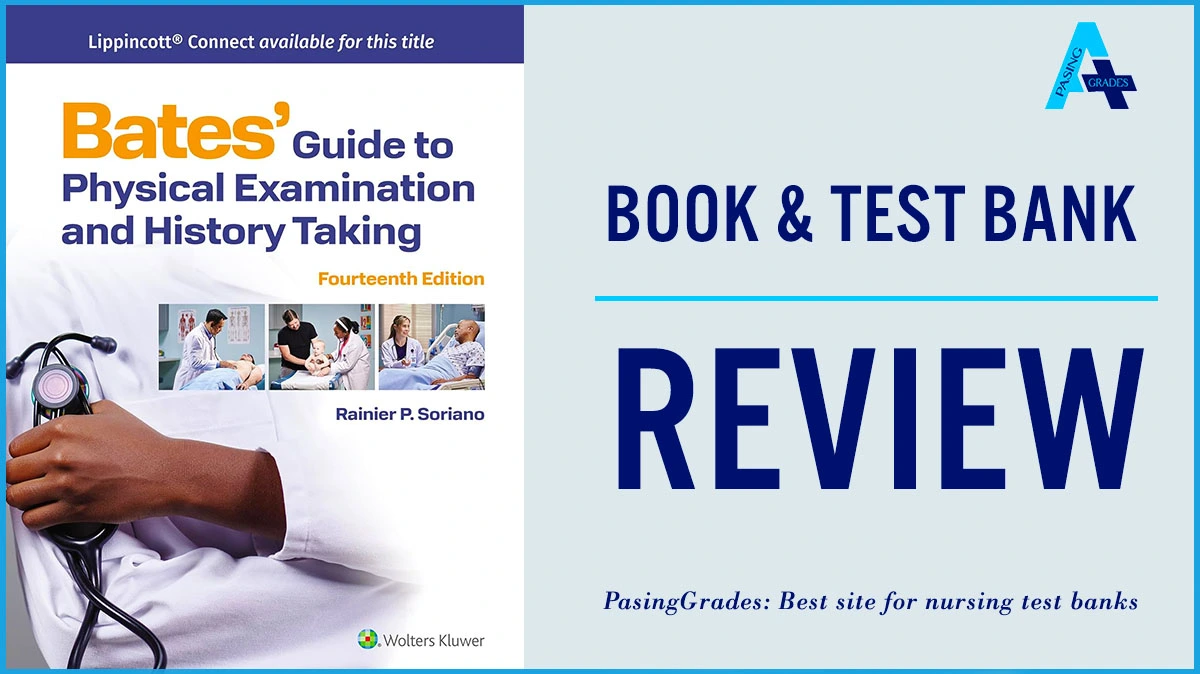
Bates’ Guide to Physical Examination 14th Edition Book and Test Bank Review
Pull up your old Quizlet deck right now. The one with 200+ cards that lovingly color-coded and built off someone's 13th Edition notes from three years ago. I'll wait.
Now close it. Delete it. Because every time a student walks into a simulation lab with that thing memorized, I guarantee that they will self-destruct on some questions of their check-off, these happens frequently, evidence on many online nursing forums.
The goal here is not to scare you but to make sure you pass. The 14th Edition of Bates' Guide to Physical Examination and History Taking has massive changes, structural overhaul of how nursing students are expected to think, document, and act during a patient encounter.
The exam questions, the rubrics, and the clinical judgment framework have all moved. If your study materials haven't moved with them, you are preparing for an exam that no longer exists.
The Pedagogy Shift: From Checklist Nurse to Clinical Thinker
The old model was straightforward. Touch this, listen here, write it down, move on. Head-to-Toe checklists gave students a clean, predictable sequence, and instructors graded accordingly. The 14th Edition is different as it has burned that model down.
Replacing it is the NCSBN Clinical Judgment Measurement Model (CJMM) which is actually the the same framework that powers the Next-Generation NCLEX (NGN). In 2026, your lab check-off is not graded on whether you palpated the spleen in the right direction as it used to be. Today, it is graded on a student's ability to think through six cognitive steps, in sequence, while a standardized patient looks at you expectantly.
Those six steps are:
- Recognize Cues - Identify the relevant data hiding inside a history and physical exam
- Analyze Cues - Connect those cues to a plausible clinical picture
- Prioritize Hypotheses - Rank the most urgent concerns before you act
- Generate Solutions - Pull evidence-based interventions out of your clinical knowledge base
- Take Action - Implement those solutions, on time, in the right order
- Evaluate Outcomes - Circle back and determine whether what you did actually worked
The 14th Edition delivers this through Unfolding Case Studies - scenarios that evolve over multiple pages, presenting new data as the patient's condition changes. Each stage requires a new round of cue recognition and analysis. A student trained on static, standalone multiple-choice questions from an old test bank will freeze at step two every single time.
Your instructor is no longer just watching your hands. They are watching your thinking. And the rubric - often the Lasater Clinical Judgment Rubric - scores you on a spectrum from "Beginning" to "Exemplary." Memorizing normal ranges gets you "Beginning." Applying them to an evolving case study gets you "Exemplary."
Practicing these with NGN-aligned questions before your check-off? The Bates' 14th Edition Test Bank PDF has case studies built around every update covered below
Update Trap 1: The Blood Pressure Numbers That Will Sink Your Safety Rubric
Let me set the scene. You are in the simulation lab. The BP cuff inflates, then you hear that pneumatic wheeze, that particular pressure-release sound of the aneroid gauge ticking down in a too-quiet room. Korotkoff Phase I comes in at $128$, the tapping disappears at $82$. You write it down. You move on.
Under the 13th Edition framework and JNC 7 guidelines, a student might classify $128/82$ mmHg as prehypertension entailing a soft, non-urgent category that implied watchful waiting and a conversation about salt intake. Under the 14th Edition's AHA/ACC standards, that patient has Stage 1 Hypertension. You see the difference?
The threshold has shifted. Prehypertension as a category no longer exists. Here is the updated classification every student must know cold:
|
Blood Pressure Category |
Systolic |
Diastolic |
|
|
Normal |
$<120$ mmHg |
and |
$<80$ mmHg |
|
Elevated |
$120$–$129$ mmHg |
and |
$<80$ mmHg |
|
Stage 1 Hypertension |
$130$–$139$ mmHg |
or |
$80$–$89$ mmHg |
|
Stage 2 Hypertension |
$\geq 140$ mmHg |
or |
$\geq 90$ mmHg |
|
Hypertensive Crisis |
$>180$ mmHg |
and/or |
$>120$ mmHg |
The word or in Stage 1 is what trips students up. A systolic of $128$ mmHg alone reads as Elevated. But pair it with a diastolic of $82$ mmHg, and the diastolic criterion alone qualifies that reading as Stage 1.
Here is the clinical weight of that distinction: for a high-risk patient, let's say, a patient with existing cardiovascular disease or a 10-year ASCVD risk above a certain threshold.
In the latest edition of Bates’ Guide to Physical Examination, the conversation is now anchored on pharmacological intervention at $130/80$ mmHg. Calling $128/82$ mmHg normal on your safety rubric isn't a quibble as it will be regarded as a patient safety error. That is how your instructor will score it, and rightly so.
Update Trap 2: POCUS: Looking Is Now Part of the Physical Exam
There is a running joke among older nurses that the stethoscope is the most expensive piece of jewelry in the hospital. The 14th Edition is not laughing at that joke anymore.
The Chapter 9: Basic Principles and Techniques: Point-of-Care Ultrasound introduces POCUS as a formal component of the physical assessment. Unlike in 13th edition, POCUS is not a specialty skill for radiologists, but an extension of what your hands and ears used to do alone.
If you go through the 14th Edition, you will realize that it frames POCUS as a direct partner to inspection, palpation, percussion, and auscultation. Looking inside the patient is now table stakes in high-level assessment labs.
Students trained exclusively on 13th Edition materials will encounter POCUS questions on exams and in simulation without the conceptual framework to approach them. The ability to correlate an ultrasound finding; bladder distension, pleural effusion, impaired cardiac wall motion with a clinical examination finding is now a testable skill. Listening alone is no longer enough when the standard of care has moved to seeing.
This matters for your check-off in a very practical way. When the case study describes a patient with decreased breath sounds at the base and a history of recent thoracic surgery, the old answer was percussion for dullness, auscultate carefully. The 14th Edition answer adds a POCUS lens: recognize the ultrasound signs of pleural effusion, understand how that visual finding correlates with your hands-on findings, and integrate both into your cue analysis. Students who skip Chapter 9 are handing their instructors easy points to take away.
Update Trap 3: The Geriatric 5Ms - Because "Systems Review" Isn't Good Enough Anymore
I have watched hundreds of students walk through the geriatric assessment section of their lab check-off with a crisp, organized systems review: cardiovascular, respiratory, musculoskeletal, neuro. They cover every organ system. They miss the patient entirely.
The 14th Edition replaces that approach with the Geriatric 5Ms framework - a person-centered model designed for the layered complexity of aging patients. These are not systems. They are domains:
- Mind - Mentation, mood, cognition; includes delirium, dementia, and depression
- Mobility - Gait, balance, functional movement, fall risk
- Medications - Polypharmacy, deprescribing, drug-drug interactions
- Multicomplexity - The interplay of multiple chronic conditions and social determinants of health
- Matters Most - The patient's own goals, preferences, and end-of-life values
The clinical power of this framework is in how the domains cross-contaminate. A student who notes an abnormal gait but fails to connect it to the patient's current medication list - three of which carry anticholinergic burden - has not analyzed their cues. They have only recognized them. The 14th Edition demands the synthesis. The old edition allowed the silo.
For test bank purposes, a 5Ms question will not ask you to define "Multicomplexity." It will present a 78-year-old patient who has fallen twice in six months, is on seven medications, and whose daughter says "he just seems foggy lately." The question will ask you to prioritize your assessment. Students who recognize the cascade - Medications contributing to Mind changes contributing to Mobility deficits contributing to fall risk - earn full credit. Students who check each system independently and move on do not.
Update Trap 4: Cancer Screening Ages - Know the Numbers or Lose the Points
Screening guidelines are the quietest trap in any board exam. Students memorize a number once, never revisit it, and carry it through three clinical years. The 14th Edition updates two screening timelines that appear regularly in lab case studies, and the differences are specific enough that "close enough" will not protect you.
Lung Cancer Screening has expanded. The previous standard anchored eligibility at age 55 to 74 with a 30-pack-year history. The 14th Edition reflects updated ACS guidance: eligibility now begins at age $50$ and extends to age $80$, with a threshold of $20$ pack-years - not 30. A student who counsels a 52-year-old with a 22-pack-year history that they don't meet screening criteria is factually, clinically, and on a test bank question, wrong.
Colorectal Cancer Screening now starts at age $45$ - down from age $50$. This is one of those updates that seems minor until the case study presents a 46-year-old patient and asks what preventive counseling applies. Students recalling "start at 50" will miss it.
Here is a quick reference to take into your next exam:
|
Screening |
Old Guideline |
14th Edition Standard |
|
Lung Cancer |
Age $55$–$74$; $30$+ pack-years |
Age $50$–$80$; $20$+ pack-years |
|
Colorectal Cancer |
Starts at age $50$ |
Starts at age $45$ |
|
Cervical Cancer |
Pap smear starting at age $21$ |
Primary HPV test starting at age $25$ |
Commit the new numbers. These are the numbers your rubric uses. Whatever your old Quizlet says is irrelevant.
Update Trap 5: The Mammary Soufflé - Yes, This Will Be on the Exam
This one separates the students who have actually studied the 14th Edition from the ones who bought a generic study guide and hoped for the best.
During the obstetric assessment section, the 14th Edition introduces a clinical finding called the mammary soufflé - a continuous murmur auscultated over the anterior thorax, specifically audible over the internal mammary artery in some pregnant patients. It arises from the dramatically increased blood volume of pregnancy and the vascular changes that accompany it.
The trap is this: the mammary soufflé sounds like a cardiac murmur. Students who haven't read this section and those using older materials that don't include it - will hear a continuous murmur during a pregnant patient simulation and flag it as a pathological cardiac finding. The 14th Edition is explicit: this is a normal pregnancy variant, not a sign of cardiac dysfunction.
Distinguish it from the functional systolic murmur - a Grade II/IV finding common in pregnancy due to elevated stroke volume - which is also normal. Both are physiological, both can alarm an untrained student, and both appear in updated test bank questions. Know the mammary soufflé by name. Know where it's heard. Know what it means - and what it doesn't.
This kind of specificity is what the 14th Edition rewards. It is also exactly the kind of clinical pearl that separates a first-time pass from a check-off repeat.
The CJMM in Action: What Your Rubric Actually Scores
Connect all of this back to the six-step model and it becomes clear why outdated materials produce students who fail on clinical judgment rather than factual recall. You may know that $130/80$ mmHg is Stage 1 Hypertension - that's "Recognize Cues." But can you, during a simulated encounter with a 67-year-old patient presenting for a wellness visit, Prioritize Hypotheses between hypertension management, medication reconciliation using the 5Ms framework, and a long-overdue colorectal cancer screening conversation?
That is the exam. Not a list of thresholds. A living, unfolding scenario that requires you to hold multiple updated guidelines in your head simultaneously and apply them in the right order to a specific patient.
The rubric your instructor uses does not give partial credit for knowing the old numbers. It rewards integrated thinking, and the only way to practice integrated thinking is through case studies that reflect current standards.
Validating Your Mastery: The Test Bank as a Remediation Tool
Here is the honest reality of what I tell students the week before check-offs: reading the textbook is necessary, but it is not sufficient. You need to sit with questions that mirror the format, the complexity, and the clinical judgment demands of the actual exam. You need to fail some of them in a low-stakes environment so you don't fail them in the lab.
The Bates' 14th Edition Test Bank is built specifically around these updated guidelines and the NGN question format. Use it the way you would use a remediation tool - not to cheat, but to identify exactly which of the five Update Traps you're still carrying 13th Edition thinking into. Practice the Unfolding Case Study format. Work through the bowtie and trend questions that test your ability to "Generate Solutions" and "Evaluate Outcomes." Measure yourself against the CJMM steps before your instructor does.
The students who walk into my lab most confident are not the ones who studied the longest. They are the ones who practiced the right questions - questions aligned to what their rubric actually measures.
The Bottom Line
Fifteen years in assessment labs has taught me one consistent truth: the students who struggle aren't struggling because they're not smart or not hard-working. They're struggling because their materials are testing them on a standard that has already changed.
The 14th Edition moved the blood pressure thresholds. It installed POCUS into the physical exam. It replaced systems-based geriatric review with the 5Ms. It pushed cancer screening ages earlier. It named a pregnancy murmur your old study guide never mentioned. And it graded all of it through a clinical judgment lens that your 13th Edition Quizlet cannot replicate.
Check your materials against every trap in this guide. If any of your sources still say "prehypertension starts at $120/80$ mmHg," or "begin colorectal screening at $50$," or omit POCUS entirely - close them. Find materials aligned to the 14th Edition, practice with a test bank that mirrors NGN question formats, and walk into your check-off knowing that what you've prepared for is what you're actually being graded on.
Your patients - future and simulated alike - deserve a nurse who studied the right edition.
For NGN-aligned practice questions mapped directly to the Bates' 14th Edition updates covered in this guide, access the verified Bates' Guide 14th Edition Test Bank here.
0
281