Pasing Grades
  • Start Selling
  • Blog
  • Contact
  • 0

    Your cart is empty!

English

  • English
  • Spanish
  • Arabic
Create Account Sign In
  • Library
    • New Prep Guides
    • Featured Prep Guides
    • Free Exam Prep Guides
    • Best sellers
  • General
  • Nursing
    • Research Paper
    • Case Study
    • Discussion Post
    • Assignment
    • Exam
    • Practice Questions and Answers
    • Test Bank
    • solutions manual
  • Accounting
    • Case Study
    • Thesis
    • Study Guide
    • Summary
    • Research Paper
    • test bank
  • English
    • Creative Writing
    • Research Paper
    • Summary
    • Rhetorics
    • Literature
    • Journal
    • Exam
    • Grammar
    • Discussion Post
    • Essay
  • Psychology
    • Hesi
    • Presentation
    • Essay
    • Summary
    • Study Guide
    • Essay
    • Solution Manual
    • Final Exam Review
    • Class Notes
    • test bank
  • Business
    • Lecture Notes
    • Solution Manual
    • Presentation
    • Business Plan
    • Class Notes
    • Experiment
    • Summary
    • Practice Questions
    • Study Guide
    • Case Study
    • test bank
    • Exam
  • More
    • Computer Science
    • Economics
    • Statistics
    • Engineering
    • Biology
    • Religious Studies
    • Physics
    • Chemistry
    • Mathematics
    • History
    • Sociology
    • Science
    • Philosophy
    • Law
  • Pages
    • About Us
    • Selling Tips
    • Delivery Policy
    • Faq
    • Privacy Policy
  • Flash Sale
  • Home
  • Test Bank for Success in Practical Vocational Nursing 8th Edition by Knecht

Test Bank for Success in Practical Vocational Nursing 8th Edition by Knecht

Preview page 1 Preview page 2 Preview page 3
Add To Favorites

Share this item Share this item

  • Item Details
  • Comments (0)
  • Reviews (0)
  • Contact Seller

Success In Practical Vocational Nursing 8th Edition Knecht Test Bank

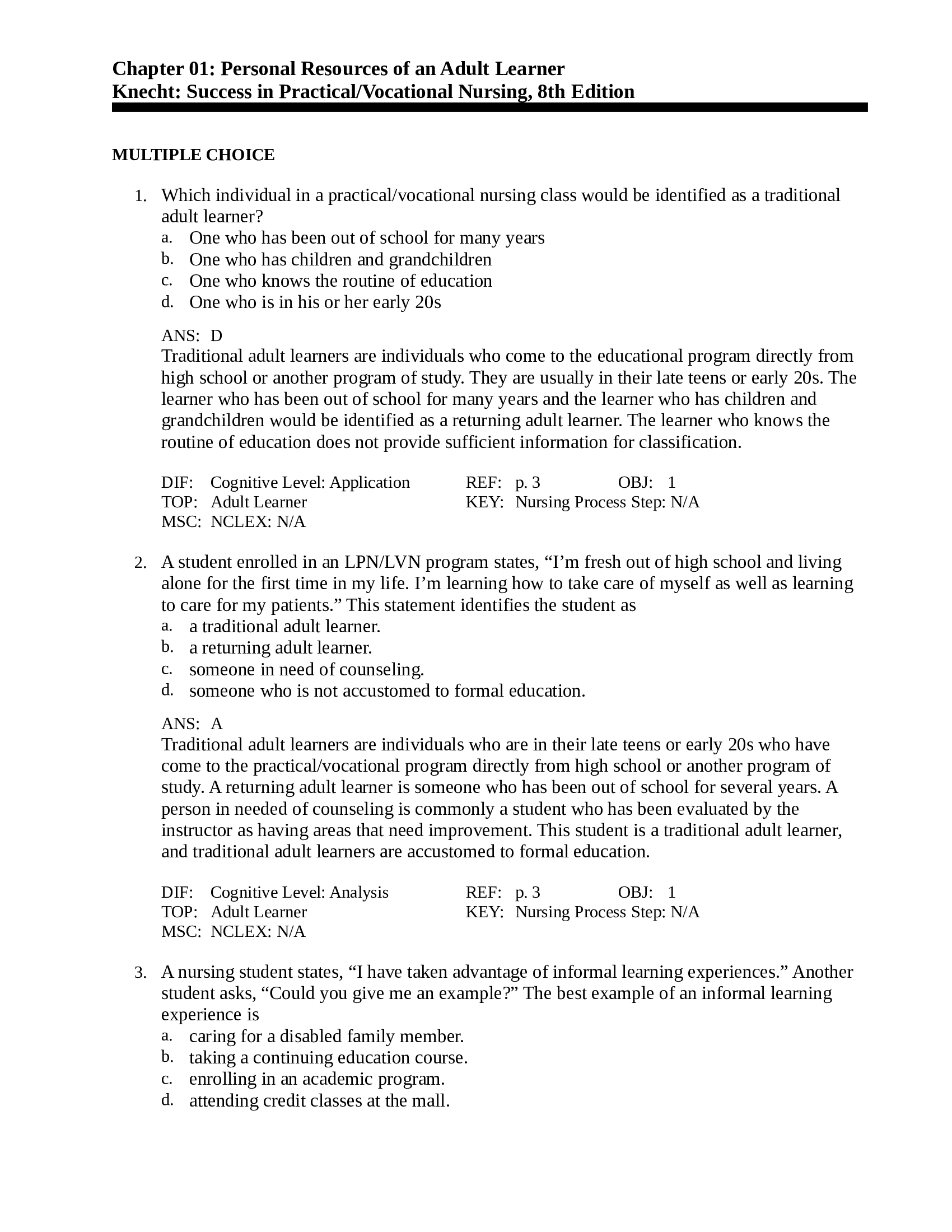
Chapter 01: Personal Resources of an Adult Learner  

Knecht: Success in Practical/Vocational Nursing  

MULTIPLE CHOICE  

1. Which individual in a practical/vocational nursing class would be identified as a traditional

adult learner?  

a. One who has been out of school for many years  

b. One who has children and grandchildren  

c. One who knows the routine of education  

d. One who is in his or her early 20s  

ANS:  D 

Traditional adult learners are individuals who come to the educational program directly from 

high school or another program of study. They are usually in their late teens or early 20s. The

learner who has been out of school for many years and the learner who has children and

grandchildren would be identified as a returning adult learner. The learner who knows the

routine of education does not provide sufficient information for classification.  

DIF:    Cognitive Level: Application             REF:   p. 3                  OBJ:   1  

TOP:  Adult Learner                                     KEY:  Nursing Process Step: N/A  

MSC: NCLEX: N/A 

2. A student enrolled in an LPN/LVN program states, “I’m fresh out of high school and living

alone for the first time in my life. I’m learning how to take care of myself as well as learning

to care for my patients.” This statement identifies the student as a.   a traditional adult

learner.  

b. a returning adult learner.  

c. someone in need of counseling.  

d. someone who is not accustomed to formal education.  

ANS:  A 

Traditional adult learners are individuals who are in their late teens or early 20s who have 

come to the practical/vocational program directly from high school or another program of

study. A returning adult learner is someone who has been out of school for several years. A  

person in needed of counseling is commonly a student who has been evaluated by the

instructor as having areas that need improvement. This student is a traditional adult learner,

and traditional adult learners are accustomed to formal education.  

DIF:    Cognitive Level: Analysis                 REF:   p. 3                  OBJ:   1  

TOP:  Adult Learner                                     KEY:  Nursing Process Step: N/A  

MSC: NCLEX: N/A 

3. A nursing student states, “I have taken advantage of informal learning experiences.”

Another student asks, “Could you give me an example?” The best example of an informal

learning experience is  

a. caring for a disabled family member.  

b. taking a continuing education course.  

c. enrolling in an academic program.  

d. attending credit classes at the mall. 


ANS:  A 

Informal learning experiences are those that take place outside a formal educational setting. A 

person who cares for a disabled family member would gain knowledge and skill in providing 

personal care. An education course, academic program, and credited classes all take place in a

formal educational setting.  

DIF:    Cognitive Level: Comprehension      REF:   p. 3                  OBJ:   2  

TOP:  Informal educational experience       KEY:  Nursing Process Step: N/A  

MSC: NCLEX: N/A 

4. What strategy can be used by a nursing student to effectively combat a fear of failure?  

a. Picture in your mind the rewards of succeeding  

b. Positive self-talk  

c. Create a mental script of positive thoughts  

d. All of the above  

ANS:  D 

Picturing the rewards of succeeding, positive self-talk, and a mental script of positive thoughts 

all contribute a positive mental attitude and are all ways to combat the fear of failure. 


DIF:    Cognitive Level: Comprehension      REF:   p. 4                  OBJ:   2  

TOP:  Promoting success in the program of study                          KEY:  Nursing Process Step: N/A  

MSC: NCLEX: N/A 

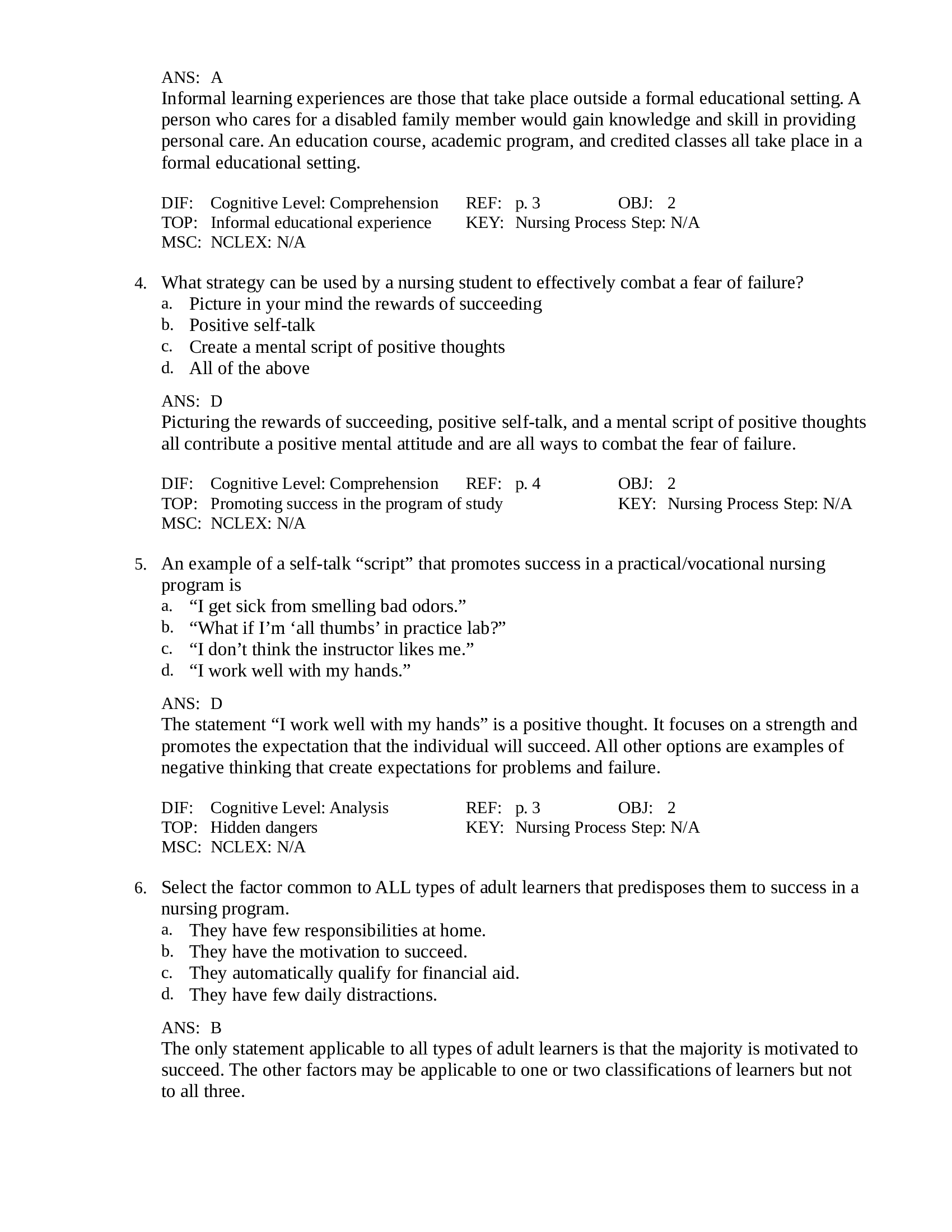
5. An example of a self-talk “script” that promotes success in a practical/vocational nursing

program is  

a. “I get sick from smelling bad odors.”  

b. “What if I’m ‘all thumbs’ in practice lab?”  

c. “I don’t think the instructor likes me.”  

d. “I work well with my hands.”  

ANS:  D 

The statement “I work well with my hands” is a positive thought. It focuses on a strength and 

promotes the expectation that the individual will succeed. All other options are examples of

negative thinking that create expectations for problems and failure.  

DIF:    Cognitive Level: Analysis                 REF:   p. 3                  OBJ:   2  

TOP:  Hidden dangers                                  KEY:  Nursing Process Step: N/A  

MSC: NCLEX: N/A 

6. Select the factor common to ALL types of adult learners that predisposes them to success in

a nursing program.  

a. They have few responsibilities at home.  

b. They have the motivation to succeed.  

c. They automatically qualify for financial aid.  

d. They have few daily distractions.  

ANS:  B 

The only statement applicable to all types of adult learners is that the majority is motivated to 

succeed. The other factors may be applicable to one or two classifications of learners but not 

to all three. 

DIF:    Cognitive Level: Comprehension      REF:   p. 4                  OBJ:   2  

TOP:  Factors predisposing to success         KEY:  Nursing Process Step: N/A  

MSC: NCLEX: N/A  

7. When a class of nursing students discusses their concerns about their program, the concern

shared by most learners is generally the fear of a.   succeeding.  

b. economic problems.  

c. failure.  

d. ridicule.  

ANS:  C 

Some degree of fear of failure is nearly universal and often relates to earlier failures or 

setbacks the learner has experienced in other educational settings. Few individuals are afraid

of succeeding. Uncertainty about economic issues is common among students but is not as

universal as fear of failure. Fear of ridicule is rarely a concern; if present, it is usually

superseded by fear of failure.  

DIF:    Cognitive Level: Analysis                 REF:   p. 4                  OBJ:   2  

TOP:  Hidden dangers                                  KEY:  Nursing Process Step: N/A  

MSC: NCLEX: N/A 

8. The First Amendment of the U.S. Constitution guarantees students the right to  

a. graduate from a program.  

b. fail an academic program.  

c. express oneself in class.  

d. have unlimited absences.  

ANS:  C 

The First Amendment provides for freedom of expression as long as what is expressed does 

not disrupt class or infringe on the rights of peers. The remaining options are topics that are

not addressed by this amendment.  

DIF:    Cognitive Level: Knowledge             REF:   p. 6                  OBJ:   6  

TOP:  Learner rights                                     KEY:  Nursing Process Step: N/A  

MSC: NCLEX: N/A 

9. Which amendment to the U.S. Constitution protects the learner from being asked to leave an

educational program without due process? a.   Eleventh  

b. Twelfth  

c. Thirteenth  

d. Fourteenth  

ANS:  D 

The Fourteenth Amendment guarantees due process. The learner has the right to defend him- 

or herself if charged with a violation of policy or rules. The Eleventh, Twelfth, and Thirteenth

amendments do not address due process.  

DIF:    Cognitive Level: Knowledge             REF:   p. 6                  OBJ:   6  

TOP:  Learner rights                                     KEY:  Nursing Process Step: N/A 

MSC: NCLEX: N/A 


10. When a nursing student expresses concern about being dismissed unfairly from the program,

the most effective peer response would be a.   “Better get over being so negative.”  

b. “You have rights under the Fourteenth Amendment.”  


c. “Watch what you say in class to reduce this possibility.”  

d. “Instructors really do have control over what happens.”  

ANS:  B 

The Fourteenth Amendment guarantees due process to the student. The learner has the right to 

defend him- or herself if charged with a violation of program policy or rules. The other

statements are not the most effective responses to give a student concerned with being

unfairly dismissed.  

DIF:    Cognitive Level: Application             REF:   p. 6                  OBJ:   6 TOP: 

Learner rights                                     KEY:  Nursing Process Step: N/A  

MSC: NCLEX: N/A 


11. A nursing student monopolizes class discussions. Which statement about the situation is

most accurate?  

a. The student is violating the rights of others to participate in class.  

b. The student is demonstrating interdependency with the instructor.  

c. The student is demonstrating passive learning strategies.  

d. The student is at risk for being immediately terminated.  

ANS:  A 

The First Amendment provides the right to freedom of speech as long as what is said does not 

disrupt the class or infringe on the rights of other students. In this case, the student who

monopolizes discussion is violating the right of free expression by others in the class.

Interdependency involves a student who is actively involved in his or her own learning and

who has a collaborative relationship with the instructor. A passive learner is someone who is

not actively involved in his or her own learning. The Fourteenth Amendment assures the

student due process, meaning that first the student must be charged with a violation and

presented with evidence of misconduct. The student will be entitled to state his or her case.  

DIF:    Cognitive Level: Analysis                 REF:   p. 6                  OBJ:   6  

TOP:  Learner rights                                     KEY:  Nursing Process Step: N/A  

MSC: NCLEX: N/A 


12. Which remark by a student in a nursing program verbalizes a strategy that promotes success

in the program?  

a. “I set goals and work to achieve them.”  

b. “I avoid interacting with instructors.”  

c. “I spend 2 to 3 hours daily surfing the net.”  

d. “I limit my partying to 3 to 4 nights a week.”  

ANS:  A 

Setting goals and working to implement them is a strategy associated with active, self-directed 

learning and will promote success. The other responses refer to behaviors that are not

conducive to success, such as avoiding the facilitators of your learning (instructors) and

demonstrating poor time management skills. 

DIF:    Cognitive Level: Analysis                 REF:   p. 8                  OBJ:   5  

TOP:  Active learning                                  KEY:  Nursing Process Step: N/A  

MSC: NCLEX: N/A  

13. Which statement is true regarding the teaching/learning process in practical/vocational

nursing?  

a. If the student fails, the instructor is ultimately at fault.  

b. By asking questions, the student interferes with the instructor’s work.  

c. The student has little responsibility when it comes to evaluation.  

d. The student is responsible for preparing for theory classes and clinical experience.  

ANS:  D 

Advance preparation provides a basis for continued learning in the classroom. It provides the 

learner the opportunity to ask relevant questions about theory. Preparation prior to clinical

experience safeguards patients’ safety. If students fail, it is their own fault; students have

responsibility for their own learning. A key responsibility of learners is to receive and

participate in evaluation; it plays an important role in their education and throughout their

career. Instructors are responsible for creating an environment in which learning can take

place, and a critical part of this is being available to assist with questions and problems that

students cannot solve.  

DIF:    Cognitive Level: Analysis                 REF:   p. 11                OBJ:   5  

TOP:  Learner responsibilities                      KEY:  Nursing Process Step: N/A  

MSC: NCLEX: N/A 

14. A student who wishes to use research findings regarding the best way for students to learn

will a.   stay up late each night and study.  

b. actively participate in the learning process.  

c. sit passively during each lecture session.  

d. cram before each examination.  

ANS:  B 

Studies have shown that people learn best when they are actively involved in their own 

learning and have an interdependent relationship with the instructor. The remaining options

are counterproductive behaviors.  

DIF:    Cognitive Level: Application             REF:   p. 7                  OBJ:   5  

TOP:  Learner responsibilities                      KEY:  Nursing Process Step: N/A  

MSC: NCLEX: N/A  

15. When explaining the responsibility of the learner to a group of nursing students, a mentor

should emphasize that the learner’s first priority is to a.   absorb the knowledge taught by the

instructor.  

b. be self-directed and active in the process of learning.  

c. study only what the instructor emphasizes in class.  

d. focus on learning 65% of the information that is taught.  

ANS:  B

Studies have shown that people learn best when they are actively involved in their own 

learning and have an interdependent relationship with the instructor. Absorbing the

knowledge taught by the instructor describes passive learning. Studying only what the

instructor emphasizes in class and focusing on learning 65% of the information that is taught

are approaches that severely limit learning; students must be self-directed and curious in their

learning.  

DIF:    Cognitive Level: Application             REF:   p. 7                  OBJ:   5  

TOP:  Active learning                                  KEY:  Nursing Process Step: N/A  

MSC: NCLEX: N/A 

16. Which statement best describes an active learning situation?  

a. The learner practices bed-making.  

b. The learner watches a peer make a bed.  

c. The learner watches the instructor make a bed.  

d. The learner pays attention during lecture.  

ANS:  A 

Active learning requires the learner to gain knowledge and skill by his or her own efforts. A 

learner who participates takes an active role. The other options all describe passive learning

situations.  

DIF:    Cognitive Level: Analysis                 REF:   p. 8                  OBJ:   5  

TOP:  Active learning                                  KEY:  Nursing Process Step: N/A  

MSC: NCLEX: N/A 

17. What understanding about the goal of evaluation would be most helpful to a student in a

nursing program?  

a. Evaluation lowers learner self-esteem.  

b. Evaluation ridicules student performance.  

c. Evaluation identifies behaviors that stand in the way of meeting goals.  

d. Evaluation informs the learner of things that annoy the instructor.  

ANS:  C 

Progression toward goal attainment is identified by evaluation. During the process, behaviors 

that stand in the way of goal attainment are identified, along with strengths of performance.

Evaluations should not lower self-esteem, ridicule the student, or point out behaviors the

instructor finds annoying as these will not help the student attain his or her goal.  

DIF:    Cognitive Level: Analysis                 REF:   p. 8                  OBJ:   7  

TOP:  Role of evaluation                              KEY:  Nursing Process Step: N/A  

MSC: NCLEX: N/A 

18. Which learner is fulfilling an important student responsibility when receiving examination

results?  

a. The student who looks at the test grade and hands the test and answer sheet back  

b. The student who argues each wrong answer with the instructor  

c. The student who tries to understand mistakes made on the test  

d. The student who appears interested in the test results  

ANS:  C

Tests should be considered learning experiences. Learners should look at tests with the goal of 

understanding why incorrect answers are wrong, as well as the rationale for correct answers.

Looking at the test grade and handing the test and answer sheet back are not optimal learning

behaviors. Arguing each wrong answer with the instructor does not promote the openness

required for optimal learning. Appearing interested in the test results does not promote

learning.  

DIF:    Cognitive Level: Analysis                 REF:   p. 8 | p. 9         OBJ:   5  

TOP:  Tests as a learning opportunity          KEY:  Nursing Process Step: N/A  

MSC: NCLEX: N/A 

19. To explain clinical evaluation to a new student, what information would best describe where responsibility for the process of clinical evaluation lies?  

a. The instructor evaluates the student’s performance in the clinical area.  

b. Peers evaluate change in clinical skills in each other in the clinical area.  

c. The student continuously monitors his or her performance of selected clinical skills.  

d. Clinical evaluation is a shared responsibility between instructor and student.  

ANS:  D 

The instructor is responsible for evaluating student performance, and the learner is responsible 

for becoming aware of clinical behaviors and modifying the behaviors that hinder goal

attainment. The other options do not address responsibility; they are ways an instructor or

student can identify strong behaviors and behaviors that need improvement.  

DIF:    Cognitive Level: Analysis                 REF:   p. 9                  OBJ:   7  

TOP:  Clinical evaluation                             KEY:  Nursing Process Step: N/A  

MSC: NCLEX: N/A 

20. Learner A is concerned about the clinical evaluation component of the nursing program. A

peer could help alleviate anxiety by explaining that the purpose of clinical evaluation is to a. 

assist the learner to identify strengths and areas needing improvement.  

b. provide constructive criticism related to poor performance behaviors.  

c. keep unsuitable persons from achieving licensure.  

d. help learners develop the ability to listen to negative comments about performance.  

ANS:  A 

Identifying positive behaviors allows them to be reinforced, and identifying areas needing 

improvement fosters modification of the negative behaviors. Providing constructive criticism

related to poor performance behaviors refers to only half of the purpose. Keeping unsuitable

persons from achieving licensure is not the purpose, because early identification and change

in negative behaviors foster ultimate success in the program. Helping learners develop the

ability to listen to negative comments about performance is not a purpose of the clinical

performance evaluation.  

DIF:    Cognitive Level: Application             REF:   p. 9                  OBJ:   7  

TOP:  Clinical evaluation                             KEY:  Nursing Process Step: N/A  

MSC: NCLEX: N/A  

21. Which statement by a nursing student is an example of self-evaluation?  

a. “The other student forgot to use a bath blanket.” 

b. “I contaminated my glove on the edge of the bed.”  

c. “The staff nurse was abrupt with the resident.”  

d. “It was nice to be complimented by my instructor.”  

ANS:  B 

Awareness of one’s actions is a component of self-evaluation. Noticing a breach of sterile 

technique during performance of a clinical skill is an excellent example of self-evaluation.

“The other student forgot to use a bath blanket” describes evaluation of one student by

another. “The staff nurse was abrupt with the resident” describes evaluation of a staff nurse by

another person. “It was nice to be complimented by my instructor” is a reflection of feelings

associated with being complimented, not self-evaluation.  

DIF:    Cognitive Level: Analysis                 REF:   p. 9 | p. 10       OBJ:   7  

TOP:  Self-evaluation                                   KEY:  Nursing Process Step: N/A  

MSC: NCLEX: N/A 

22. Which student expectation of an instructor is reasonable?  

a. The instructor will help resolve the student’s personal problems.  

b. The instructor will motivate the student to improve grades.  

c. The instructor will seek out students to review examinations.  

d. The instructor will provide academic counseling.  

ANS:  D 

Providing academic counseling or making referrals for academic counseling is a responsibility 

of faculty members. The other options are not reasonable expectations. Only the individual

with the problem can resolve it, albeit with assistance from another. Motivation is an internal

factor for the student. It is the learner’s responsibility to seek out the instructor for

examination review.  

DIF:    Cognitive Level: Analysis                 REF:   p. 10                OBJ:   7  

TOP:  Faculty responsibility to students      KEY:  Nursing Process Step: N/A  

MSC: NCLEX: N/A 

23. The practical/vocational nursing student asks an instructor, “How perfect do I have to be to

pass my clinical evaluation? Are any mistakes allowed?” The best response by the instructor

is, “The expected standard of performance in clinical lab is to provide patient care a.   at the

level of an LPN/LVN.”  

b. with a minimum of two errors.”  

c. at the same level as your classmates.”  

d. with manual dexterity and confidence.”  

ANS:  A 

Students are required to provide care at the same level of safe practice as the LPN/LVN. A 

lesser standard is not acceptable. This makes the importance of skill practice in the school’s 

practice laboratory understandable. Errors may affect patient safety. Provision of patient care

at the same level as classmates is true only if the level of classmates is consistent with

LPN/LVN safe practice. Provision of patient care with manual dexterity and confidence does

not provide for safe practice.  

DIF:    Cognitive Level: Application             REF:   p. 11                OBJ:   7  

TOP:  Standard for level of practice by students                             KEY:  Nursing Process Step: N/A  

MSC: NCLEX: N/A 

24. A nursing student tells a peer, “I’m having trouble understanding the rationale for not

restraining confused patients.” The best advice for the peer to offer would be a.   “Ask the

smartest student in the class.”  

b. “Ask a patient for his or her view about it.”  

c. “Ask the instructor to explain it again.”  

d. “Do an Internet search.”  

ANS:  C 

This response reflects the student’s responsibility for seeking faculty help when having 

difficulty in class or clinicals. Asking the smartest student in class might not be helpful if this

student is also having difficulty understanding the content. Asking the patient for his or her

view would not provide balanced information. An Internet search might not yield relevant

information.  

DIF:    Cognitive Level: Application             REF:   p. 7 | p. 11       OBJ:   7  

TOP:  Student responsibility for seeking help                                 KEY:  Nursing Process Step: N/A  

MSC: NCLEX: N/A  

25. A nursing student tells a peer, “My instructor is on my case all the time. I’m picked on more

than any other student in the group. The more I’m criticized, the more nervous I get. I don’t

think I can do anything right. What do you think I should do?” The best advice for the peer to

give would be  

a. “Just keep trying. Things are bound to get better.”  

b. “Make an appointment to talk about this with the instructor.”  

c. “Go see the program director and explain that you’re being harassed.”  

d. “Ask another instructor for help with your skills so you’ll be better prepared.”  

ANS:  B 

This option suggests following the recognized channel of communication by seeking out the 

individual with whom the perceived problem lies—the instructor. “Just keep trying. Things

are bound to get better” is encouraging but will not help resolve the student’s concerns.” “Go

see the program director and explain that you’re being harassed” and “Ask another instructor

for help with your skills so you’ll be better prepared” do not follow the recognized channel of

communication.  

DIF:    Cognitive Level: Application             REF:   p. 7 | p. 11       OBJ:   7  

TOP:  Addressing problems by going to the source                        KEY:  Nursing Process Step: N/A  

MSC: NCLEX: N/A  

MULTIPLE RESPONSE  


1. A student in the nursing program has made various statements relating to his life

situation. Which statements indicate the potential for success? (Select all that apply.) a.   

“I have to hold a full-time job while enrolled in the nursing program.”  

b. “I’m an excellent manager of my time.”  

c. “My spouse is away so much that I don’t have enough help with the children.”  

d. “I’m really looking forward to working as a nurse. It has been my goal for years.”  

ANS:  B, D

Time management skills and enthusiasm for the profession are both indicators for success in 

the nursing program. Having a full-time job and a demanding spouse can be deterrents to the

successful completion of a nursing program.  

DIF:    Cognitive Level: Analysis                 REF:   p. 4                  OBJ:   4  

TOP:  Factors influencing potential for success/failure                   KEY:  Nursing Process Step: N/A  

MSC: NCLEX: N/A 


2. In response to a learner’s questions, which of the following options should be used to

describe desirable outcomes of clinical performance evaluations? (Select all that apply.) 

a.   Discover positive actions of students.  

b. Make students aware of ineffective clinical behaviors.  

c. Role-model how to conduct evaluations of others when in the LPN/LVN expanded role.  

d. Give the student an opportunity to tell the instructor how the instructor’s attitude 

 discourages learning.  

ANS:  A, B, C 

Discovering positive actions of students indicates that it is important to identify positive 

actions and reinforce them via clinical performance. Making students aware of ineffective

clinical behaviors indicates that ineffective clinical behaviors stand in the way of attaining the 

Contact the Seller

Please Sign In to contact this seller.


  • 👎  Report Copyright Violation

Frequently Asked Questions

What Do I Get When I Buy This Study Material?

+

When you buy a study material on Passing Grades, an instant download link will be sent directly to your email, giving you access to the file anytime after payment is completed.

Is Passing Grades a Trusted Platform?

+

Yes, Passing Grades is a reputable students’ marketplace with a secure payment system and reliable customer support. You can trust us to ensure a safe and seamless transaction experience.

Will I Be Stuck with a Subscription?

+

No, all purchases on Passing Grades are one-time transactions. You only pay for the notes you choose to buy, with no subscriptions or hidden fees attached.

Who Am I Buying These Study Materials From?

+

Passing Grades is a marketplace, which means you are purchasing the document from an individual vendor, not directly from us. We facilitate the payment and delivery process between you and the vendor.

Does Passing Grades Offer Free Study Materials?

+

Yes, sellers on Passing Grades have uploaded numerous free test banks, exams, practice questions, and class notes that can be downloaded at no cost.

Pasinggrades - Quality Study Materials

USD 16

    • Quality checked by Pasing Grades
    • 100% satisfaction guarantee
    • Seller: Angelicer
Buy PDF $16

Seller Information

Angelicer

Member since April 2021

  • icon
  • icon
View Profile
  • total sales

    3
  • Favourites

    0
  • Comments

    0
    ( 0 Ratings )

Item Information

  • Uploaded

    06 August 2024

  • Updated

    02 April 2025

  • Category

    Nursing

  • Item Type

    test bank

  • Tags

    test bank knetch nursing exam questions and answers Test Bank for Success in Practical Vocational Nursing

Related Exam Prep Guides by Angelicer

Test Bank for Illustrated Anatomy of the Head and Neck 5th Edition by Fehrenbach
View Document

Test Bank for Illust...

  • Angelicer

    Angelicer

  • test bank

Boost your understanding with the Test Bank for Illustrated Anatomy of the Head and Neck 5th Edition...

16 USD

0

3

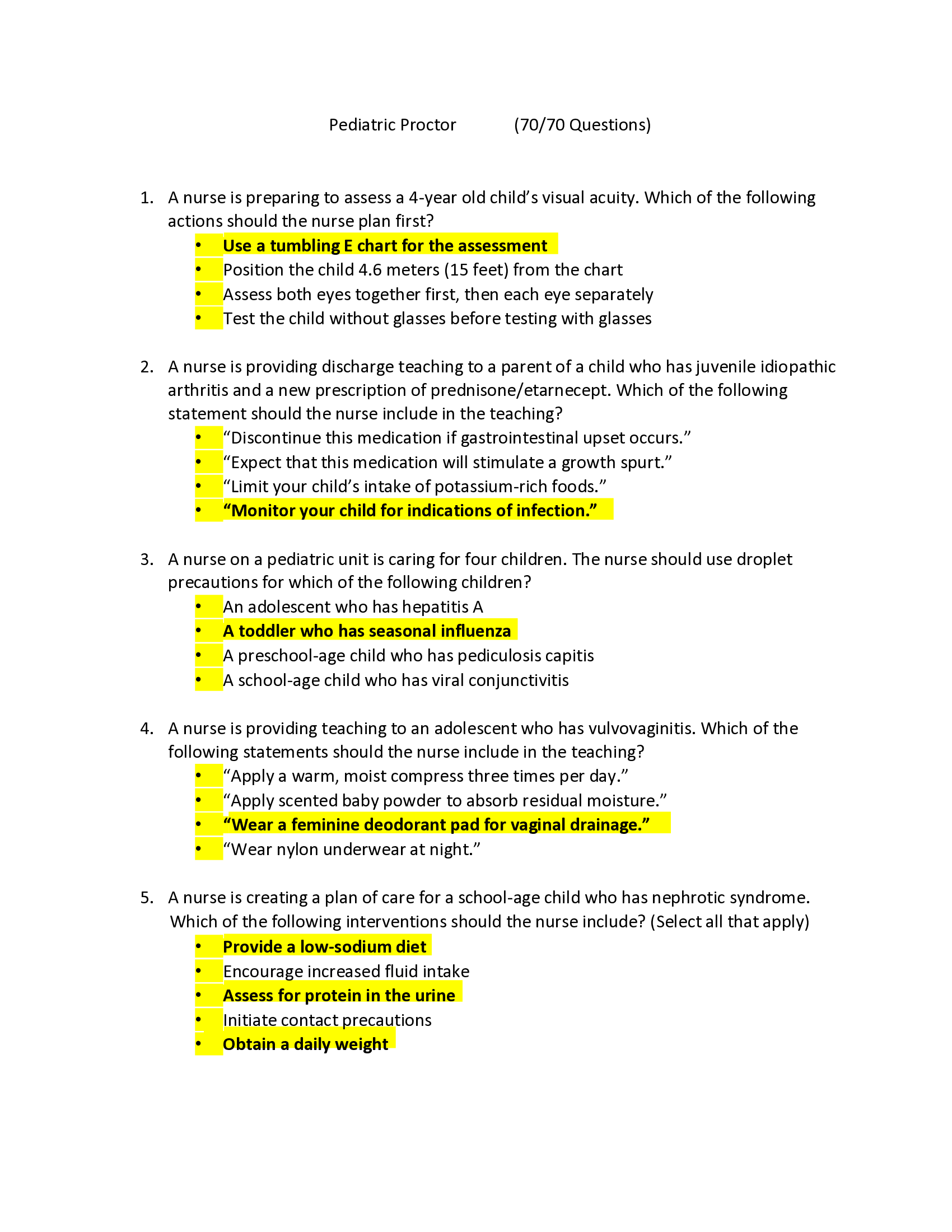
ATI PEDS Proctored Exam Questions and Answers 2026 | Comprehensive Study Guide
View Document

ATI PEDS Proctored E...

  • Angelicer

    Angelicer

  • test bank

Get the ATI PEDS Proctored Exam Questions and Answers for 2025. This comprehensive study guide offer...

16 USD

0

3

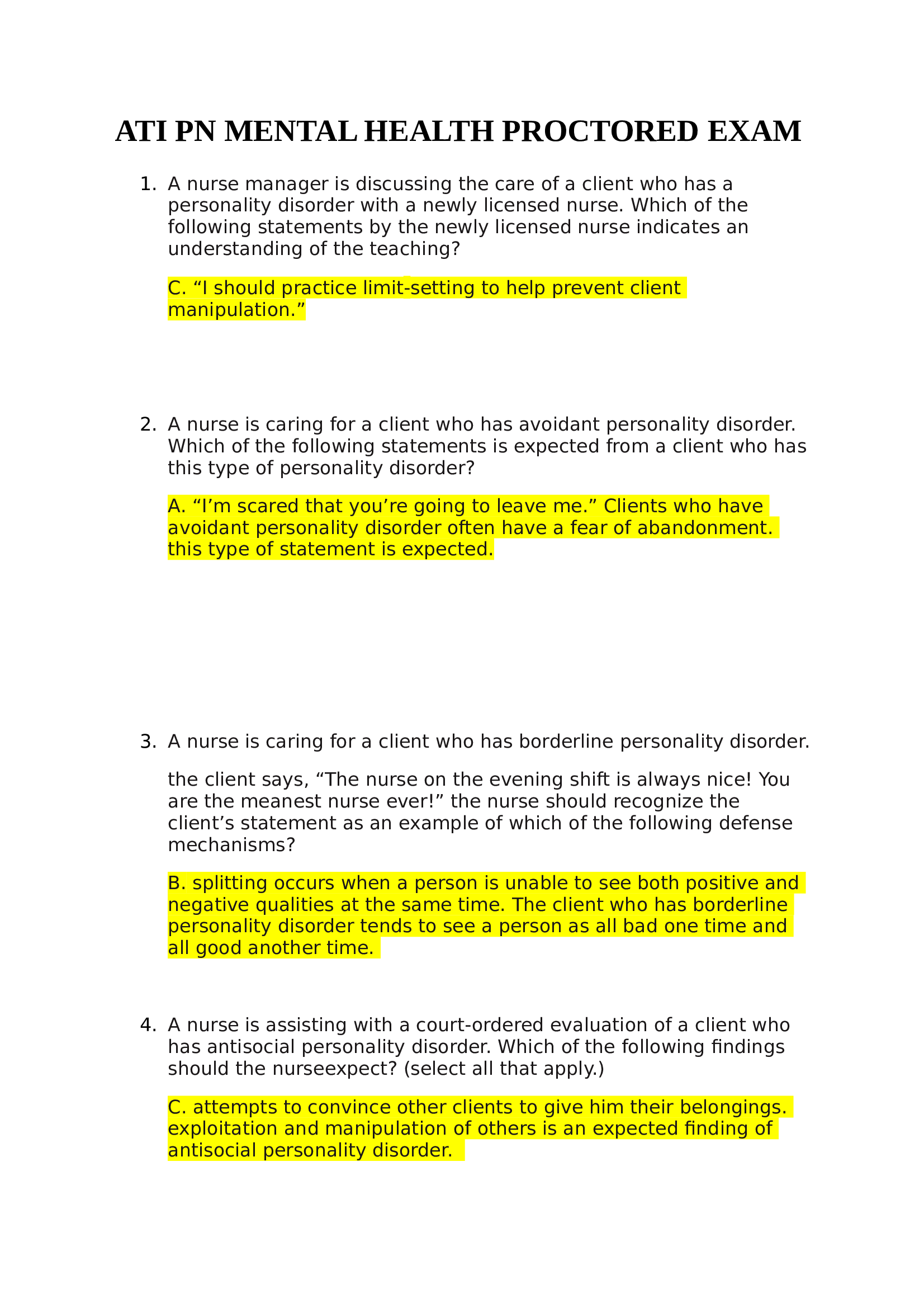
ATI PN Mental Health Proctored Exam 2026 | Questions and Answers
View Document

ATI PN Mental Health...

  • Angelicer

    Angelicer

  • test bank

Prepare effectively with the ATI PN Mental Health Proctored Exam 2024. Get access to a comprehensive...

16 USD

0

3

Purchase

Download link will be sent to this email immediately after purchase.

IMPORTANT LINKS

  • How To Upload Class Notes
  • Selling Tips
  • Passing Grades's Study Materials
  • Scholarships for International Students 2026

POPULAR CATEGORIES

  • Law
  • Accounting
  • English
  • Psychology
  • Business
  • Nursing
  • Computer Science
  • General

View Document

  • Blog
  • Contact
  • Delivery Policy
  • Latest Scholarships Around the World
  • How to Pass Bar Exams: Passing Grades’ Strategies
  • How to Study and Pass the CPA Exam
  • All Test Banks
  • Faq
  • Copyright Claims
  • Privacy Policy
  • Terms of Use

KNOWLEDGE BASE

  • How to Write A+ Grade Good Research Paper
  • How to Manage Stress During Exam Period
  • Best Time to Study
  • How to Pass NCLEX-RN Exam
  • How To Effectively Utilize Test Banks
  • Popular Shadow Health Exam Assessments
  • Popular HESI Case Studies
  • How to Prepare for a Nursing Career
  • The Importance Of Summaries in Exam Revisvion

© 2026 Pasing Grades. All rights reserved.