Pasing Grades
  • Start Selling
  • Blog
  • Contact
  • 0

    Your cart is empty!

English

  • English
  • Spanish
  • Arabic
Create Account Sign In
  • Library
    • New Prep Guides
    • Featured Prep Guides
    • Free Exam Prep Guides
    • Best sellers
  • General
  • Nursing
    • Research Paper
    • Case Study
    • Discussion Post
    • Assignment
    • Exam
    • Practice Questions and Answers
    • Test Bank
    • solutions manual
  • Accounting
    • Case Study
    • Thesis
    • Study Guide
    • Summary
    • Research Paper
    • test bank
  • English
    • Creative Writing
    • Research Paper
    • Summary
    • Rhetorics
    • Literature
    • Journal
    • Exam
    • Grammar
    • Discussion Post
    • Essay
  • Psychology
    • Hesi
    • Presentation
    • Essay
    • Summary
    • Study Guide
    • Essay
    • Solution Manual
    • Final Exam Review
    • Class Notes
    • test bank
  • Business
    • Lecture Notes
    • Solution Manual
    • Presentation
    • Business Plan
    • Class Notes
    • Experiment
    • Summary
    • Practice Questions
    • Study Guide
    • Case Study
    • test bank
    • Exam
  • More
    • Computer Science
    • Economics
    • Statistics
    • Engineering
    • Biology
    • Religious Studies
    • Physics
    • Chemistry
    • Mathematics
    • History
    • Sociology
    • Science
    • Philosophy
    • Law
  • Pages
    • About Us
    • Selling Tips
    • Delivery Policy
    • Faq
    • Privacy Policy
  • Flash Sale
  • Home
  • Test bank for wilkins clinical assessment in respiratory care 8th edition by huber

Test bank for wilkins clinical assessment in respiratory care 8th edition by huber

Preview page 1 Preview page 2 Preview page 3
Add To Favorites

Share this item Share this item

  • Item Details
  • Comments (0)
  • Reviews (0)
  • Contact Seller

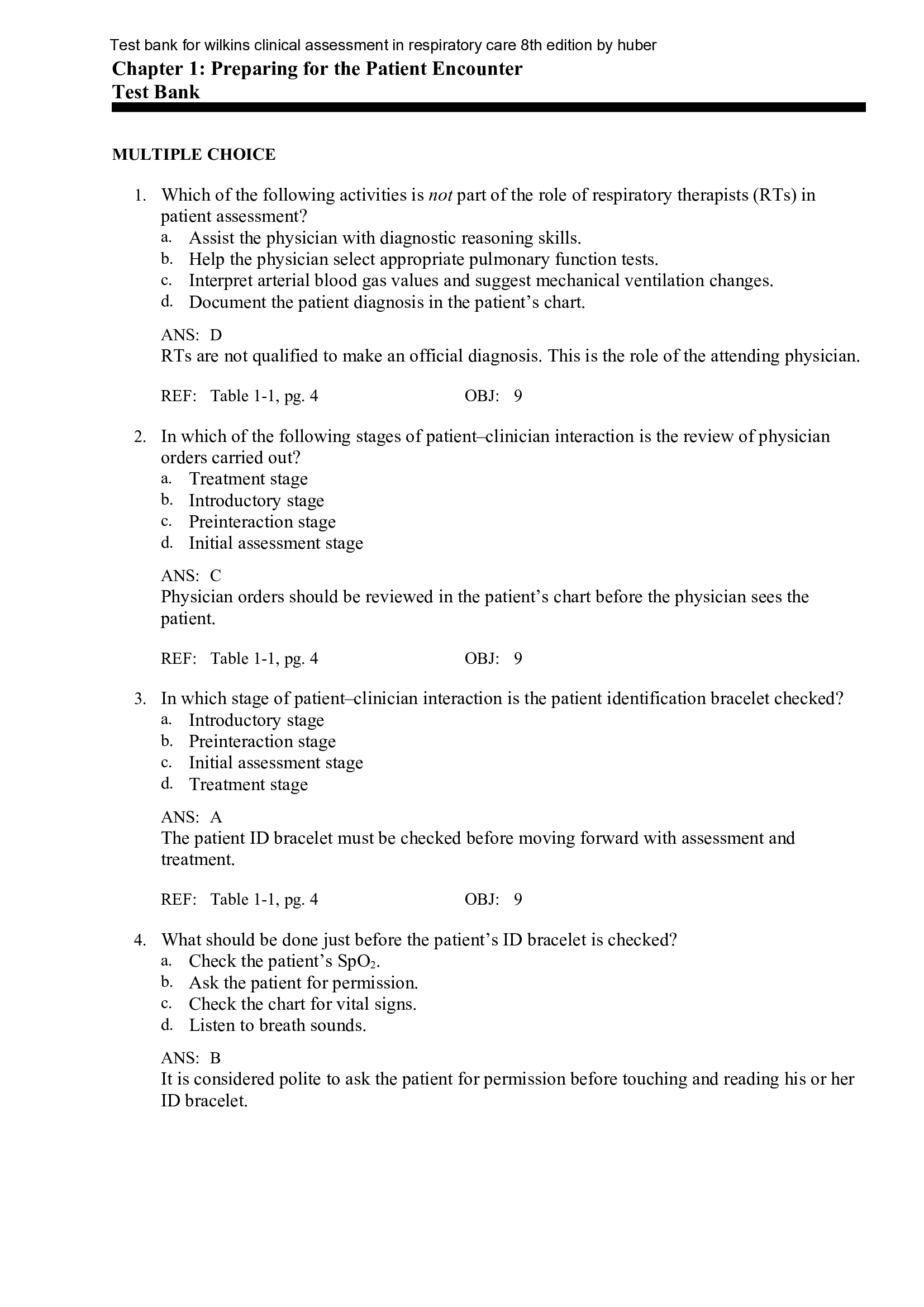
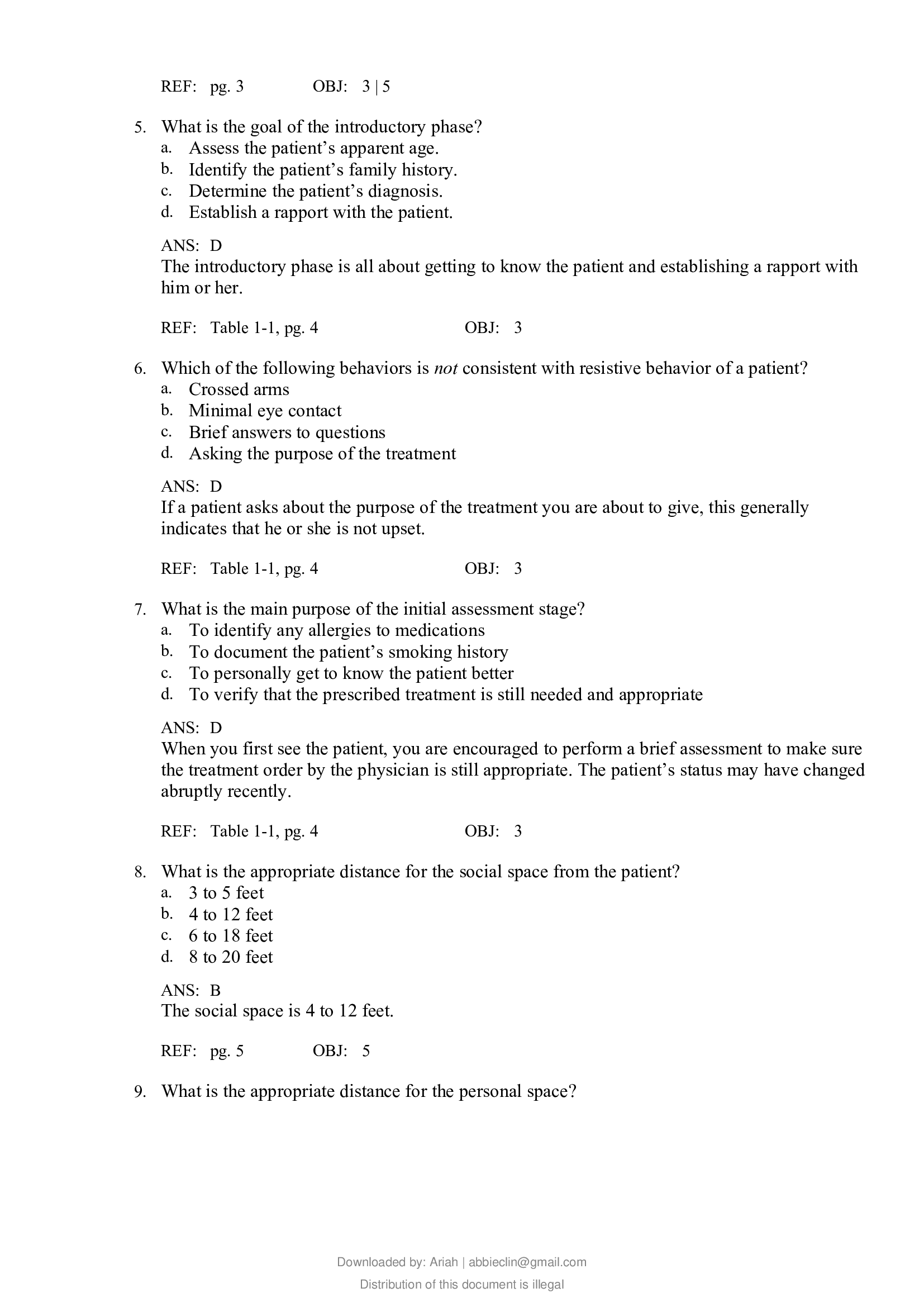
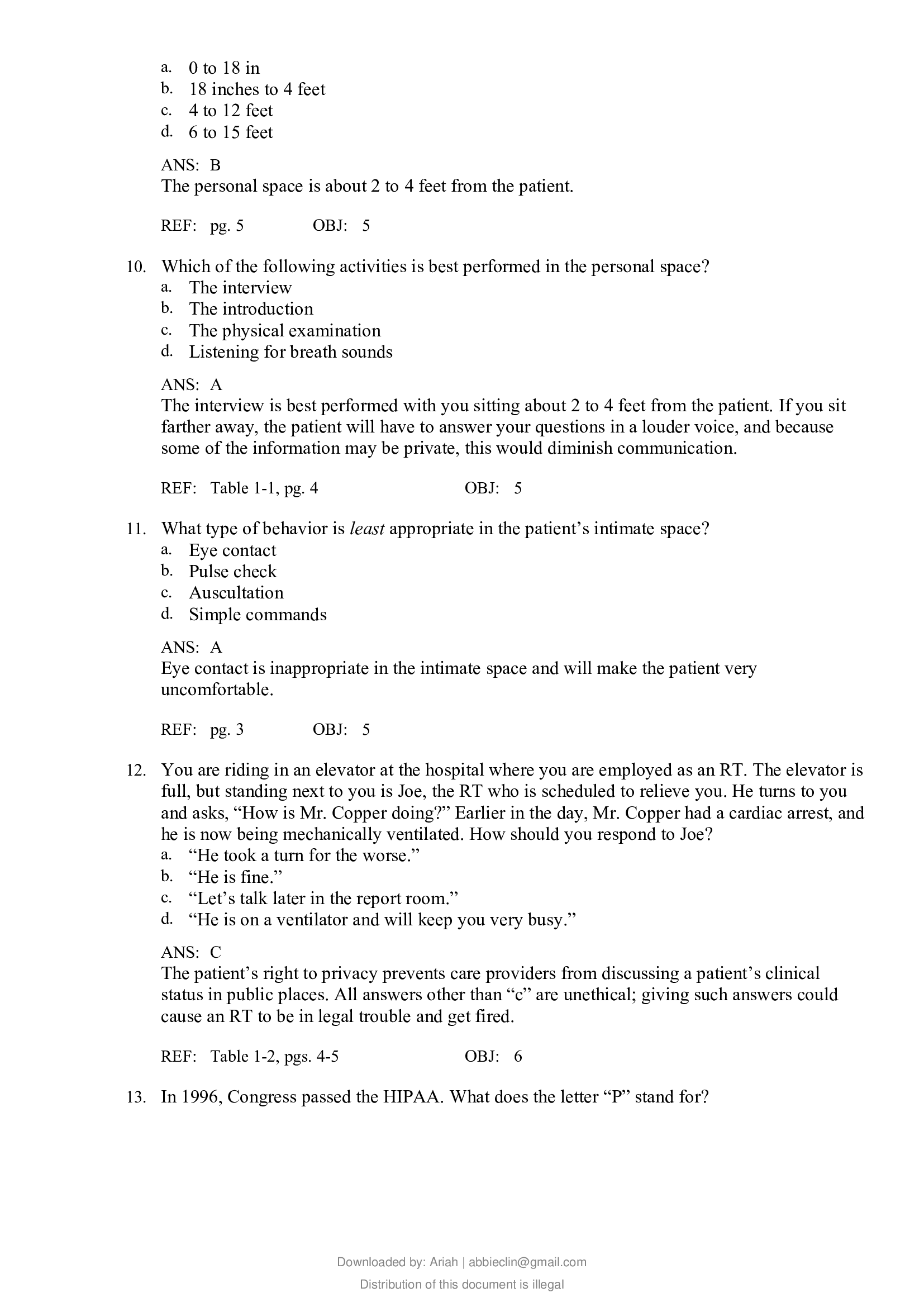
Test bank for wilkins clinical assessment in respiratory care 8th edition by huber/ Test bank for wilkins clinical assessment in respiratory care 8th edition by huber/ Chapter 1: Preparing for the Patient Encounter Test Bank MULTIPLE CHOICE 1. Which of the following activities is not part of the role of respiratory therapists (RTs) in patient assessment? a. Assist the physician with diagnostic reasoning skills. b. Help the physician select appropriate pulmonary function tests. c. Interpret arterial blood gas values and suggest mechanical ventilation changes. d. Document the patient diagnosis in the patient’s chart. ANS: D RTs are not qualified to make an official diagnosis. This is the role of the attending physician. REF: Table 1-1, pg. 4 OBJ: 9 2. In which of the following stages of patient–clinician interaction is the review of physician orders carried out? a. Treatment stage b. Introductory stage c. Preinteraction stage d. Initial assessment stage ANS: C Physician orders should be reviewed in the patient’s chart before the physician sees the patient. REF: Table 1-1, pg. 4 OBJ: 9 3. In which stage of patient–clinician interaction is the patient identification bracelet checked? a. Introductory stage b. Preinteraction stage c. Initial assessment stage d. Treatment stage ANS: A The patient ID bracelet must be checked before moving forward with assessment and treatment. REF: Table 1-1, pg. 4 OBJ: 9 4. What should be done just before the patient’s ID bracelet is checked? a. Check the patient’s SpO2. b. Ask the patient for permission. c. Check the chart for vital signs. d. Listen to breath sounds. ANS: B It is considered polite to ask the patient for permission before touching and reading his or her ID bracelet. REF: pg. 3 OBJ: 3 | 5 5. What is the goal of the introductory phase? a. Assess the patient’s apparent age. b. Identify the patient’s family history. c. Determine the patient’s diagnosis. d. Establish a rapport with the patient. ANS: D The introductory phase is all about getting to know the patient and establishing a rapport with him or her. REF: Table 1-1, pg. 4 OBJ: 3 6. Which of the following behaviors is not consistent with resistive behavior of a patient? a. Crossed arms b. Minimal eye contact c. Brief answers to questions d. Asking the purpose of the treatment ANS: D If a patient asks about the purpose of the treatment you are about to give, this generally indicates that he or she is not upset. REF: Table 1-1, pg. 4 OBJ: 3 7. What is the main purpose of the initial assessment stage? a. To identify any allergies to medications b. To document the patient’s smoking history c. To personally get to know the patient better d. To verify that the prescribed treatment is still needed and appropriate ANS: D When you first see the patient, you are encouraged to perform a brief assessment to make sure the treatment order by the physician is still appropriate. The patient’s status may have changed abruptly recently. REF: Table 1-1, pg. 4 OBJ: 3 8. What is the appropriate distance for the social space from the patient? a. 3 to 5 feet b. 4 to 12 feet c. 6 to 18 feet d. 8 to 20 feet ANS: B The social space is 4 to 12 feet. REF: pg. 5 OBJ: 5 9. What is the appropriate distance for the personal space? Downloaded by: Ariah | abbieclin@gmail.com Distribution of this document is illegal a. 0 to 18 in b. 18 inches to 4 feet c. 4 to 12 feet d. 6 to 15 feet ANS: B The personal space is about 2 to 4 feet from the patient. REF: pg. 5 OBJ: 5 10. Which of the following activities is best performed in the personal space? a. The interview b. The introduction c. The physical examination d. Listening for breath sounds ANS: A The interview is best performed with you sitting about 2 to 4 feet from the patient. If you sit farther away, the patient will have to answer your questions in a louder voice, and because some of the information may be private, this would diminish communication. REF: Table 1-1, pg. 4 OBJ: 5 11. What type of behavior is least appropriate in the patient’s intimate space? a. Eye contact b. Pulse check c. Auscultation d. Simple commands ANS: A Eye contact is inappropriate in the intimate space and will make the patient very uncomfortable. REF: pg. 3 OBJ: 5 12. You are riding in an elevator at the hospital where you are employed as an RT. The elevator is full, but standing next to you is Joe, the RT who is scheduled to relieve you. He turns to you and asks, “How is Mr. Copper doing?” Earlier in the day, Mr. Copper had a cardiac arrest, and he is now being mechanically ventilated. How should you respond to Joe? 

Contact the Seller

Please Sign In to contact this seller.


  • 👎  Report Copyright Violation

Frequently Asked Questions

What Do I Get When I Buy This Study Material?

+

When you buy a study material on Passing Grades, an instant download link will be sent directly to your email, giving you access to the file anytime after payment is completed.

Is Passing Grades a Trusted Platform?

+

Yes, Passing Grades is a reputable students’ marketplace with a secure payment system and reliable customer support. You can trust us to ensure a safe and seamless transaction experience.

Will I Be Stuck with a Subscription?

+

No, all purchases on Passing Grades are one-time transactions. You only pay for the notes you choose to buy, with no subscriptions or hidden fees attached.

Who Am I Buying These Study Materials From?

+

Passing Grades is a marketplace, which means you are purchasing the document from an individual vendor, not directly from us. We facilitate the payment and delivery process between you and the vendor.

Does Passing Grades Offer Free Study Materials?

+

Yes, sellers on Passing Grades have uploaded numerous free test banks, exams, practice questions, and class notes that can be downloaded at no cost.


Pasinggrades - Quality Study Materials

USD 15

    • Quality checked by Pasing Grades
    • 100% satisfaction guarantee
    • Seller: mentor2000
Buy PDF $15

Seller Information

mentor2000

Member since April 2021

  • icon
  • icon
View Profile
  • total sales

    0
  • Favourites

    0
  • Comments

    0
    ( 0 Ratings )

Item Information

  • Uploaded

    22 May 2022

  • Updated

    29 September 2025

  • Category

    Nursing

  • Item Type

    exam

  • Tags

    test bank nursing exam questions and answers wilkins huber clinical assessment respiratory care 8th edition

Related Exam Prep Guides by mentor2000

Test Bank for Essentials for Nursing Practice 8th Edition by Potter | All Chapters
View Document

Test Bank for Essent...

  • mentor2000

    mentor2000

  • exam

Master nursing concepts with this study material; Test Bank for Essentials for Nursing Practice, 8th...

15 USD

0

0

A &P 1 MA278 BSC2 Final Module II Questions & Answers 2026 Update
View Document

A &P 1 MA278 BSC2 Fi...

  • mentor2000

    mentor2000

  • exam

Prepare for success with A&P 1 MA278 BSC2 Final Module II 2024 Q&A. Boost your grades with this comp...

15 USD

0

0

ATI Comprehensive Predictor Exam 2026
View Document

ATI Comprehensive Pr...

  • mentor2000

    mentor2000

  • exam

Prepare for success with the ATI Comprehensive Predictor Exam 2026. Access key practice questions to...

15 USD

0

0

Purchase

Download link will be sent to this email immediately after purchase.

IMPORTANT LINKS

  • How To Upload Class Notes
  • Selling Tips
  • Passing Grades's Study Materials
  • Scholarships for International Students 2025

POPULAR CATEGORIES

  • Law
  • Accounting
  • English
  • Psychology
  • Business
  • Nursing
  • Computer Science
  • General

View Document

  • Blog
  • Contact
  • Delivery Policy
  • Latest Scholarships Around the World
  • How to Pass Bar Exams: Passing Grades’ Strategies
  • How to Study and Pass the CPA Exam
  • All Test Banks
  • Faq
  • Copyright Claims
  • Privacy Policy
  • Terms of Use

KNOWLEDGE BASE

  • How to Write A+ Grade Good Research Paper
  • How to Manage Stress During Exam Period
  • Best Time to Study
  • How to Pass NCLEX-RN Exam
  • How To Effectively Utilize Test Banks
  • Popular Shadow Health Exam Assessments
  • Popular HESI Case Studies
  • How to Prepare for a Nursing Career
  • The Importance Of Summaries in Exam Revisvion

© 2026 Pasing Grades. All rights reserved.