Pasing Grades
  • Start Selling
  • Blog
  • Contact
  • 0

    Your cart is empty!

English

  • English
  • Spanish
  • Arabic
Create Account Sign In
  • Library
    • New Prep Guides
    • Featured Prep Guides
    • Free Exam Prep Guides
    • Best sellers
  • General
  • Nursing
    • Research Paper
    • Case Study
    • Discussion Post
    • Assignment
    • Exam
    • Practice Questions and Answers
    • Test Bank
    • solutions manual
  • Accounting
    • Case Study
    • Thesis
    • Study Guide
    • Summary
    • Research Paper
    • test bank
  • English
    • Creative Writing
    • Research Paper
    • Summary
    • Rhetorics
    • Literature
    • Journal
    • Exam
    • Grammar
    • Discussion Post
    • Essay
  • Psychology
    • Hesi
    • Presentation
    • Essay
    • Summary
    • Study Guide
    • Essay
    • Solution Manual
    • Final Exam Review
    • Class Notes
    • test bank
  • Business
    • Lecture Notes
    • Solution Manual
    • Presentation
    • Business Plan
    • Class Notes
    • Experiment
    • Summary
    • Practice Questions
    • Study Guide
    • Case Study
    • test bank
    • Exam
  • More
    • Computer Science
    • Economics
    • Statistics
    • Engineering
    • Biology
    • Religious Studies
    • Physics
    • Chemistry
    • Mathematics
    • History
    • Sociology
    • Science
    • Philosophy
    • Law
  • Pages
    • About Us
    • Selling Tips
    • Delivery Policy
    • Faq
    • Privacy Policy
  • Flash Sale
  • Home
  • Test Bank for Principles of Anatomy and Physiology, 16th Edition Tortora

Test Bank for Principles of Anatomy and Physiology, 16th Edition Tortora

Preview page 1 Preview page 2 Preview page 3
Add To Favorites

Share this item Share this item

  • Item Details
  • Comments (0)
  • Reviews (0)
  • Contact Seller

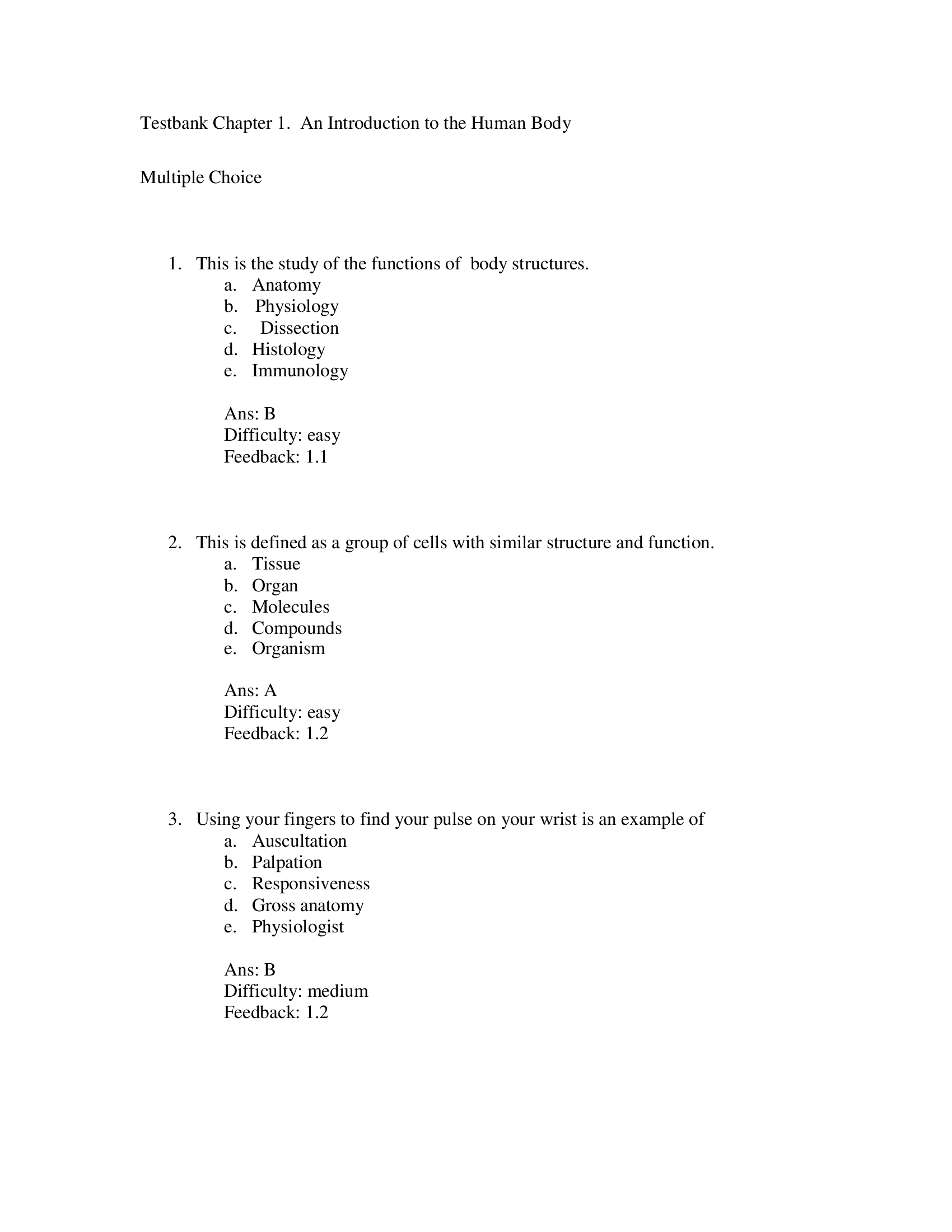
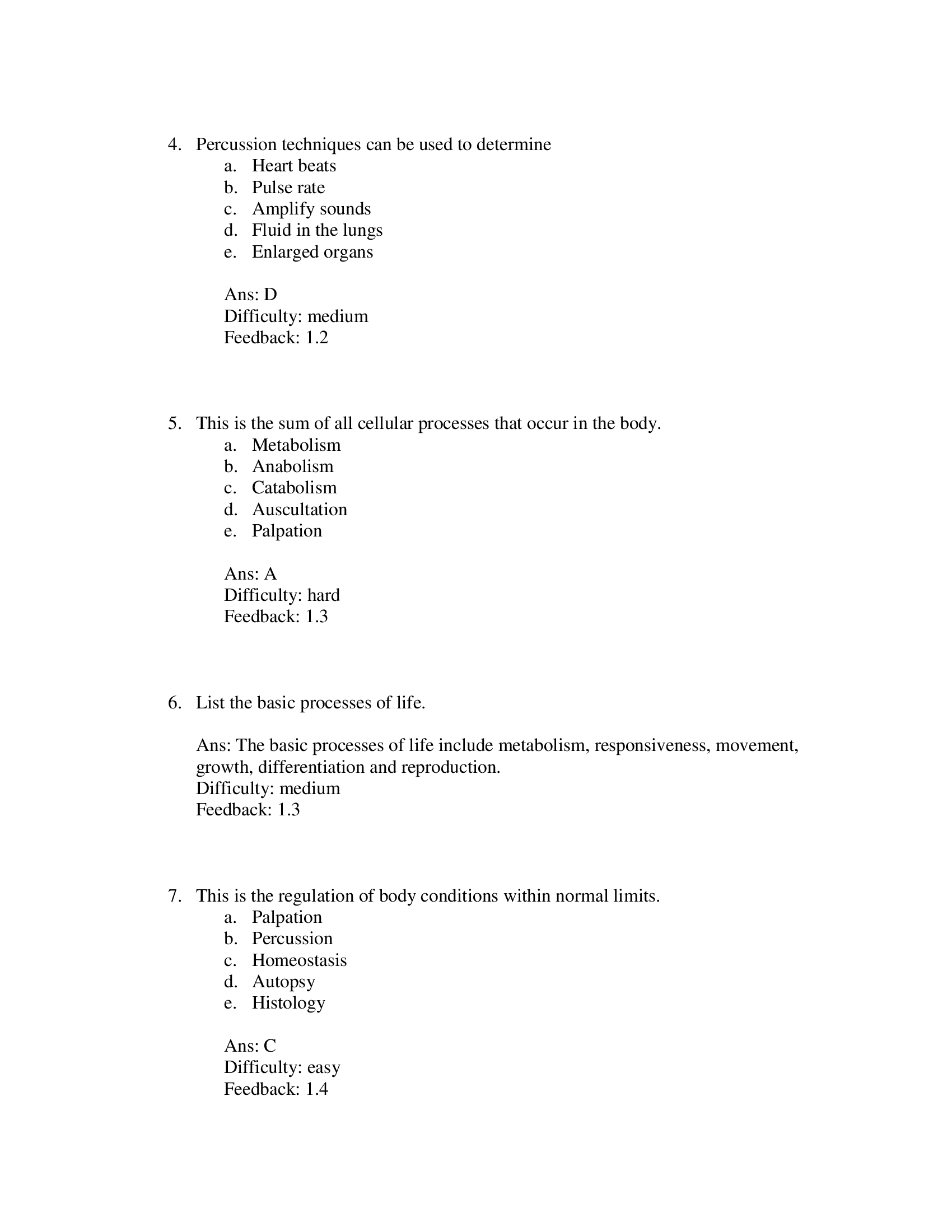
Testbank Chapter 1. An Introduction to the Human Body Multiple Choice 1. This is the study of the functions of body structures. a. Anatomy b. Physiology c. Dissection d. Histology e. Immunology Ans: B Difficulty: easy Feedback: 1.1 2. This is defined as a group of cells with similar structure and function. a. Tissue b. Organ c. Molecules d. Compounds e. Organism Ans: A Difficulty: easy Feedback: 1.2 3. Using your fingers to find your pulse on your wrist is an example of a. Auscultation b. Palpation c. Responsiveness d. Gross anatomy e. Physiologist Ans: B Difficulty: medium Feedback: 1.2 4. Percussion techniques can be used to determine a. Heart beats b. Pulse rate c. Amplify sounds d. Fluid in the lungs e. Enlarged organs Ans: D Difficulty: medium Feedback: 1.2 5. This is the sum of all cellular processes that occur in the body. a. Metabolism b. Anabolism c. Catabolism d. Auscultation e. Palpation Ans: A Difficulty: hard Feedback: 1.3 6. List the basic processes of life. Ans: The basic processes of life include metabolism, responsiveness, movement, growth, differentiation and reproduction. Difficulty: medium Feedback: 1.3 7. This is the regulation of body conditions within normal limits. a. Palpation b. Percussion c. Homeostasis d. Autopsy e. Histology Ans: C Difficulty: easy Feedback: 1.4 8. The systems that provide homeostasis are: a. Cardiovascular and Integumentary b. Nervous system and Endocrine c. Cardiovascular and respiratory systems d. Respiratory and muscular systems e. Urinary and integumentary systems Ans: B Difficulty: easy Feedback: 1.4 9. This body fluid directly affects the proper functioning of cells. a. Lymph b. Blood c. Interstitial fluid d. Aqueous humor e. Vitreous body Ans: C Difficulty: medium Feedback: 1.4 10. Name the differences between a positive and a negative feedback system. Ans: A positive feedback system will strengthen or reinforce a change in one of the body’s controlled conditions while a negative feedback system will reverse a change in a controlled condition. Difficulty: medium Feedback: 1.4 11. This is the structure of a feedback system that receives output from the control center. a. Receptor b. Body fluids c. Brain d. Effector e. Afferent Ans: D Difficulty: medium Feedback: 1.4 12. This is the structure of a feedback system that provides input to the control center. a. Receptor b. Muscle c. Brain d. Effector e. Efferent Ans: A Difficulty: medium Feedback: 1.4 13. A condition NOT regulated by a negative feedback loop would be: a. Childbirth b. Body temperature c. Blood pressure d. Heart rate e. Blood sugar Ans: A Difficulty: medium Feedback: 1.4 14. This is a change in body function that can be measured objectively. a. Symptom b. Disorder c. Disturbance d. Disease e. Sign Ans: E Difficulty: medium Feedback: 1.4 Essay 15. Describe the anatomical position. Ans: In the anatomical position the subject stands erect facing the observer with the head level and the eyes facing forward. The feet are flat on the floor and directed forward and the arms are at the sides with the palms turned forward. Difficulty: medium Feedback: 1.5 Multiple Choice 16. In which cavity is the brain located? a. Cranial cavity b. Vertebral cavity c. Abdominal cavity d. Pericardial cavity e. Pleural cavity Ans: A Difficulty: Easy Feedback: 1.5 17. In which cavity are the lungs located? a. Cranial cavity b. Vertebral cavity c. Abdominal cavity d. Pericardial cavity e. Pleural cavity Ans: E Difficulty: Easy Feedback: 1.5 18. In which cavity is the stomach located? a. Cranial cavity b. Vertebral cavity c. Abdominal cavity d. Pericardial cavity e. Pleural cavity Ans: C Difficulty: Easy Feedback: 1.5 19. This cavity is inferior to the abdominopelvic cavity. a. Vertebral canal b. Cranial cavity c. Abdominal cavity d. Pericardial cavity e. Pelvic cavity Ans: E Difficulty: medium Feedback: 1.5 20. Which cavity would include the heart? a. Cranial cavity b. Vertebral cavity c. Abdominal cavity d. Pericardial cavity e. Pleural cavity Ans: D Difficulty: Easy Feedback: 1.5 21. The function of the secretions of the serous membrane is to: a. Separate the thoracic and abdominal cavities b. Protect the central nervous system c. Prevent infection d. Reduce friction between organs e. Carry nervous impulses Ans: D Difficulty: Medium Feedback: 1.5 22. This plane divides the body into right and left halves. a. Frontal b. Sagittal c. Transverse d. Oblique e. Coronal Ans: B Difficulty: medium Feedback: 1.5 23. This plane divides the body into anterior and posterior halves. a. Frontal b. Sagittal c. Transverse d. Oblique e. Midsagittal Ans: A Difficulty: medium Feedback: 1.5 24. A transverse plane will cut a body or organ into a. Anterior and posterior b. Left and right c. Superior and inferior d. At an angle e. Unequal left and right sides Ans: C Difficulty: medium Feedback: 1.5 25. This directional term means farthest from the midline. a. Medial b. Anterior c. Proximal d. Deep e. Lateral Ans: E Difficulty: medium Feedback: 1.5 26. This directional term means farther from the attachment of a limb to the trunk or farther from the origination of a structure. a. Deep b. Contralateral c. Lateral d. Cephalic e. Distal Ans: E Difficulty: medium Feedback: 1.5 27. This directional term is the opposite of deep. a. Superficial b. Superior c. Inferior d. Distal e. Proximal Ans: A Difficulty: medium Feedback: 1.6 28. Choose the directional term that would make the sentence correct. The heart is to the liver. a. Inferior b. Anterior c. Contralateral d. Superior e. Superficial Ans: D Difficulty: medium Feedback: 1.5 29. Choose the directional term that would make the sentence correct: The sternum is to the heart. a. Posterior b. Anterior c. Inferior d. Superior e. Lateral Ans: B Difficulty: medium Feedback: 1.5 30. Which of the following organs is not found in the abdominal cavity? a. Stomach b. Spleen c. Liver d. Gallbladder e. Diaphragm Ans: E Difficulty: medium Feedback: 1.5 31. This covers the viscera within the thoracic and abdominal cavities and lines the walls of the thorax and abdomen. a. Pericardium b. Pleura c. Mediastinum d. Diaphragm e. Serous membrane Ans: E Difficulty: medium Feedback: 1.5 32. Where on the diagram is the femoral area? a. D b. E c. F d. J e. K 33. Ans: A Difficulty: medium Feedback: 1.5 Where on the diagram is the sacral area? a. C b. D c. E d. I e. J 34. Ans: D Difficulty: medium Feedback: 1.5 Where on the diagram is the cervical area? a. C b. E c. J d. K e. A 35. Ans: E Difficulty: medium Feedback: 1.5 Where on the diagram is the brachial area? a. C b. E c. I d. K e. D 36. Ans: C Difficulty: medium Feedback: 1.5 Where on the diagram is the popliteal area? a. H b. I c. J d. D e. E 37. Ans: C Difficulty: medium Feedback: 1.5 The liver is to the sternum. a. Lateral b. Medial 38. c. Proximal d. Distal e. Superior Ans: A Difficulty: medium Feedback: 1.5 The stomach is to the bladder. a. Lateral b. Medial c. Distal d. Inferior e. Superior 39. Ans: E Difficulty: medium Feedback: 1.5 The humerus is to the scapula. a. Proximal b. Distal c. Medial d. Superior e. Anterior 40. Ans: B Difficulty: medium Feedback: 1.5 Which plane is parasagittal? a. A 41. b. B c. C d. D e. E Ans: B Difficulty: medium Feedback: 1.5 Which plane is frontal? a. A 42. b. B c. C d. D e. E Ans: E Difficulty: medium Feedback: 1.5

Contact the Seller

Please Sign In to contact this seller.


  • 👎  Report Copyright Violation

Frequently Asked Questions

What Do I Get When I Buy This Study Material?

+

When you buy a study material on Passing Grades, an instant download link will be sent directly to your email, giving you access to the file anytime after payment is completed.

Is Passing Grades a Trusted Platform?

+

Yes, Passing Grades is a reputable students’ marketplace with a secure payment system and reliable customer support. You can trust us to ensure a safe and seamless transaction experience.

Will I Be Stuck with a Subscription?

+

No, all purchases on Passing Grades are one-time transactions. You only pay for the notes you choose to buy, with no subscriptions or hidden fees attached.

Who Am I Buying These Study Materials From?

+

Passing Grades is a marketplace, which means you are purchasing the document from an individual vendor, not directly from us. We facilitate the payment and delivery process between you and the vendor.

Does Passing Grades Offer Free Study Materials?

+

Yes, sellers on Passing Grades have uploaded numerous free test banks, exams, practice questions, and class notes that can be downloaded at no cost.

Pasinggrades - Quality Study Materials

USD 16

    • Quality checked by Pasing Grades
    • 100% satisfaction guarantee
    • Seller: Gorski
Buy PDF $16

Seller Information

Gorski

Member since August 2021

  • icon
  • icon
View Profile
  • total sales

    0
  • Favourites

    0
  • Comments

    0
    ( 0 Ratings )

Item Information

  • Uploaded

    03 April 2023

  • Updated

    01 October 2025

  • Category

    Nursing

  • Item Type

    test bank

  • Tags

    Test Bank Principles of Anatomy and Physiology 16th Edition by Bryan Derrickson Gerald Tortora

Related Exam Prep Guides by Gorski

Test Bank for Phillips’s Manual of I.V. Therapeutics; Evidence-Based Practice for Infusion Therapy 7th Edition Lisa Gorski
View Document

Test Bank for Philli...

  • Gorski

    Gorski

  • test bank

Test Bank for Phillips’s Manual of I.V. Therapeutics; Evidence-Based Practice for Infusion Therapy...

16 USD

0

0

Test Bank for Phillips’s Manual of I.V. Therapeutics; Evidence-Based Practice for Infusion Therapy 6th Edition Lisa Gorski
View Document

Test Bank for Philli...

  • Gorski

    Gorski

  • test bank

Test Bank for Phillips’s Manual of I.V. Therapeutics; Evidence-Based Practice for Infusion Therapy...

16 USD

0

0

Module 1 Exam HESI Saunders Online Review for the NCLEX-RN Examination 2 Year, 2nd Edition
View Document

Module 1 Exam HESI S...

  • Gorski

    Gorski

  • test bank

Module 1 Exam HESI Saunders Online Review for the NCLEX-RN Examination 2 Year, 2nd Edition...

16 USD

0

0

Purchase

Download link will be sent to this email immediately after purchase.

IMPORTANT LINKS

  • How To Upload Class Notes
  • Selling Tips
  • Passing Grades's Study Materials
  • Scholarships for International Students 2025

POPULAR CATEGORIES

  • Law
  • Accounting
  • English
  • Psychology
  • Business
  • Nursing
  • Computer Science
  • General

View Document

  • Blog
  • Contact
  • Delivery Policy
  • Latest Scholarships Around the World
  • How to Pass Bar Exams: Passing Grades’ Strategies
  • How to Study and Pass the CPA Exam
  • All Test Banks
  • Faq
  • Copyright Claims
  • Privacy Policy
  • Terms of Use

KNOWLEDGE BASE

  • How to Write A+ Grade Good Research Paper
  • How to Manage Stress During Exam Period
  • Best Time to Study
  • How to Pass NCLEX-RN Exam
  • How To Effectively Utilize Test Banks
  • Popular Shadow Health Exam Assessments
  • Popular HESI Case Studies
  • How to Prepare for a Nursing Career
  • The Importance Of Summaries in Exam Revisvion

© 2026 Pasing Grades. All rights reserved.