
Pasing Grades
  • Start Selling
  • Blog
  • Contact
  • 0

    Your cart is empty!

English

  • English
  • Spanish
  • Arabic
Create Account Sign In
  • Library
    • New Prep Guides
    • Featured Prep Guides
    • Free Exam Prep Guides
    • Best sellers
  • General
  • Nursing
    • Research Paper
    • Case Study
    • Discussion Post
    • Assignment
    • Exam
    • Practice Questions and Answers
    • Test Bank
    • solutions manual
  • Accounting
    • Case Study
    • Thesis
    • Study Guide
    • Summary
    • Research Paper
    • test bank
  • English
    • Creative Writing
    • Research Paper
    • Summary
    • Rhetorics
    • Literature
    • Journal
    • Exam
    • Grammar
    • Discussion Post
    • Essay
  • Psychology
    • Hesi
    • Presentation
    • Essay
    • Summary
    • Study Guide
    • Essay
    • Solution Manual
    • Final Exam Review
    • Class Notes
    • test bank
  • Business
    • Lecture Notes
    • Solution Manual
    • Presentation
    • Business Plan
    • Class Notes
    • Experiment
    • Summary
    • Practice Questions
    • Study Guide
    • Case Study
    • test bank
    • Exam
  • More
    • Computer Science
    • Economics
    • Statistics
    • Engineering
    • Biology
    • Religious Studies
    • Physics
    • Chemistry
    • Mathematics
    • History
    • Sociology
    • Science
    • Philosophy
    • Law
  • Pages
    • About Us
    • Selling Tips
    • Delivery Policy
    • Faq
    • Privacy Policy
  • Flash Sale
  • Home
  • Test Bank for Nursing Leadership and Management 3rd Edition by Kelly

Test Bank for Nursing Leadership and Management 3rd Edition by Kelly

Preview page 1 Preview page 2 Preview page 3
Add To Favorites

Share this item Share this item

  • Item Details
  • Comments (0)
  • Reviews (0)
  • Contact Seller

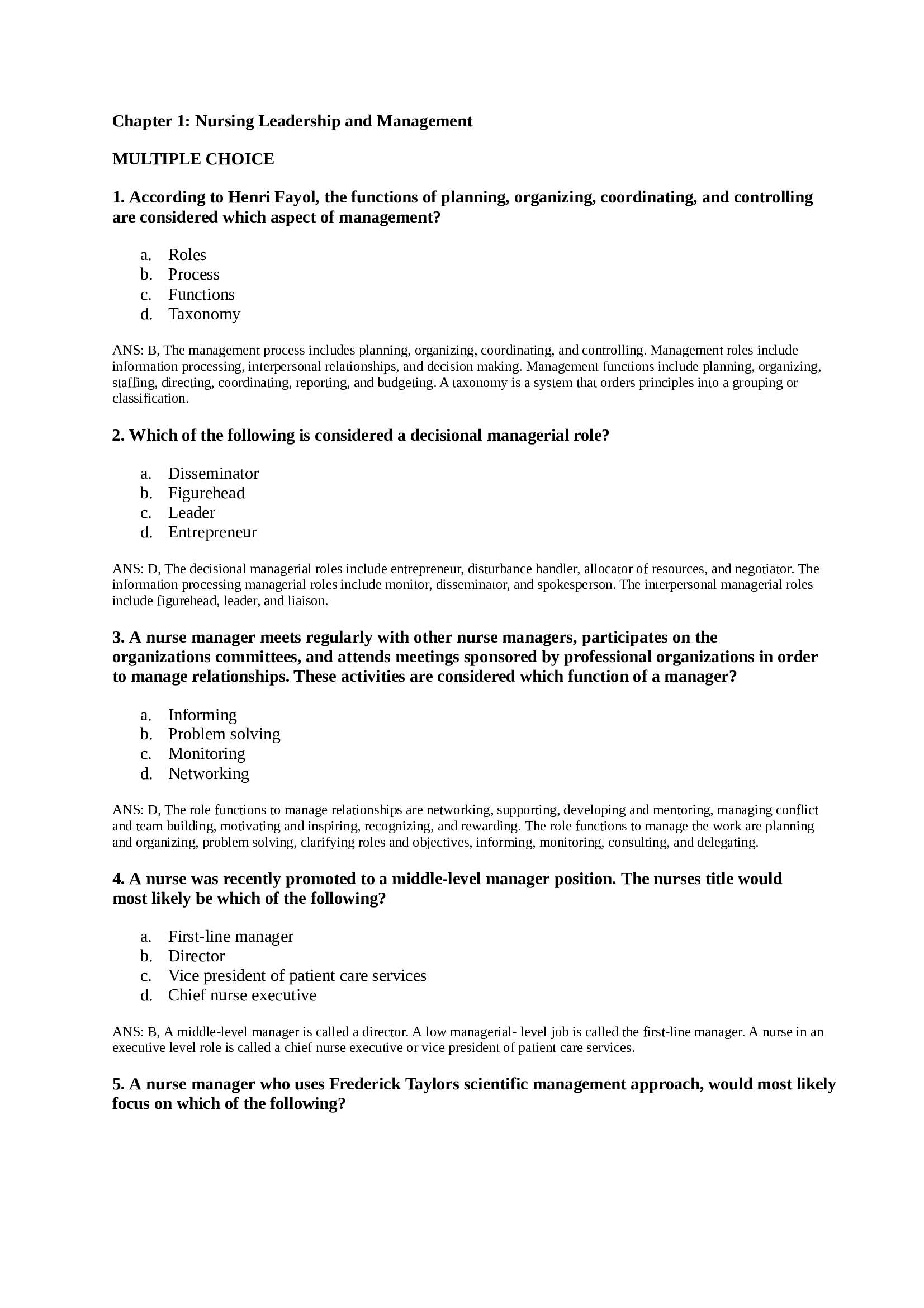
Chapter 1: Nursing Leadership and Management MULTIPLE CHOICE 1. According to Henri Fayol, the functions of planning, organizing, coordinating, and controlling are considered which aspect of management? a. Roles b. Process c. Functions d. Taxonomy ANS: B, The management process includes planning, organizing, coordinating, and controlling. Management roles include information processing, interpersonal relationships, and decision making. Management functions include planning, organizing, staffing, directing, coordinating, reporting, and budgeting. A taxonomy is a system that orders principles into a grouping or classification. 2. Which of the following is considered a decisional managerial role? a. Disseminator b. Figurehead c. Leader d. Entrepreneur ANS: D, The decisional managerial roles include entrepreneur, disturbance handler, allocator of resources, and negotiator. The information processing managerial roles include monitor, disseminator, and spokesperson. The interpersonal managerial roles include figurehead, leader, and liaison. 3. A nurse manager meets regularly with other nurse managers, participates on the organizations committees, and attends meetings sponsored by professional organizations in order to manage relationships. These activities are considered which function of a manager? a. Informing b. Problem solving c. Monitoring d. Networking ANS: D, The role functions to manage relationships are networking, supporting, developing and mentoring, managing conflict and team building, motivating and inspiring, recognizing, and rewarding. The role functions to manage the work are planning and organizing, problem solving, clarifying roles and objectives, informing, monitoring, consulting, and delegating. 4. A nurse was recently promoted to a middle-level manager position. The nurses title would most likely be which of the following? a. First-line manager b. Director c. Vice president of patient care services d. Chief nurse executive ANS: B, A middle-level manager is called a director. A low managerial- level job is called the first-line manager. A nurse in an executive level role is called a chief nurse executive or vice president of patient care services. 5. A nurse manager who uses Frederick Taylors scientific management approach, would most likely focus on which of the following? a. General principles b. Positional authority c. Labor productivity d. Impersonal relations ANS: C, The area of focus for scientific management is labor productivity. In bureaucratic theory, efficiency is achieved through impersonal relations within a formal structure and is based on positional authority. Administrative principle theory consists of principles of management that are relevant to any organization. 6. According to Vrooms Theory of Motivation, force: a. is the perceived possibility that the goal will be achieved. b. describes the amount of effort one will exert to reach ones goal. c. describes people who have free will but choose to comply with orders they are given. d. is a naturally forming social group that can become a contributor to an organization. ANS: B, According to Vrooms Theory of Motivation, Force describes the amount of effort one will exert to reach ones goal. Valence speaks to the level of attractiveness or unattractiveness of the goal. Expectancy is the perceived possibility that the goal will be achieved. Vrooms Theory of Motivation can be demonstrated in the form of an equation: Force = Valence Expectancy (Vroom, 1964). The theory proposes that this equation can help to predict the motivation, or force, of an individual as described by Vroom. 7. According to R. N. Lussier, motivation: a. is unconsciously demonstrated by people. b. occurs externally to influence behavior. c. is determined by others choices. d. occurs internally to influence behavior. ANS: D, Motivation is a process that occurs internally to influence and direct our behavior in order to satisfy needs. Motivation is not explicitly demonstrated by people, but rather it is interpreted from their behavior. Motivation is whatever influences our choices and creates direction, intensity, and persistence in our behavior. 8. According to R. N. Lussier, there are content motivation theories and process motivation theories. Which of the following is considered a process motivation theory? a. Equity theory b. Hierarchy of needs theory c. Existence-relatedness-growth theory d. Hygiene maintenance and motivation factors ANS: A, The process motivation theories are equity theory and expectancy theory. The content motivation theories include Maslows hierarchy of needs theory, Aldefers existence- relatedness-growth (ERG) theory, and Herzbergs hygiene maintenance factors and motivation factors. 9. The theory that includes maintenance and motivation factors is: a. Maslows hierarchy of needs. b. Herzbergs two-factor theory. c. McGregors theory X and theory Y. d. Ouchis theory Z. ANS: B, The two-factor theory of motivation includes motivation and maintenance factors. Maslows hierarchy of needs includes the following needs: physiological, safety, security, belonging, and self-actualization. In theory X, employees prefer security, direction, and minimal responsibility. In theory Y, employees enjoy their work, show self-control and discipline, are able to contribute creatively, and are motivated by ties to the group, organization, and the work itself. The focus of theory Z is collective decision making and long-term employment that involves slower promotions and less direct supervision. 10. A nurse is appointed to a leadership position in the local hospital. The nurses position would be considered which of the following? a. Informal leadership b. Formal leadership c. Leadership d. Management ANS: B, Formal leadership is based on occupying a position in an organization. Informal leadership is shown by an individual who demonstrates leadership outside the scope of a formal leadership role or as a member of a group. Leadership is a process of influence whereby the leader influences others toward goal achievement. Management is a process to achieve organizational goals. 11. A nursing instructor is evaluating whether the nursing students understand the three fundamental qualities that leaders share. According to Bennis and Nanus, the fundamental qualities of effective leaders are: a. guided vision, passion, and integrity. b. knowledge of self, honesty, and maturity. c. intelligence, self-confidence, and determination. d. honesty, self-awareness, and sociability. ANS: ABennis and Nanus list guided vision, passion, and integrity as fundamental qualities of effective leaders. Knowledge of self, honesty and maturity; intelligence, self-confidence and determination; self-awareness and sociability are all desirable traits in leaders as well as in others. 12. The six traits identified by Kirkpatrick and Locke that separate leaders from non-leaders were: a. respectability, trustworthiness, flexibility, self-confidence, intelligence, sociability. b. self-confidence, progression of experiences, influence of others, personal life factors, honesty, drive. c. intelligence, self-confidence, determination, integrity, sociability, honesty. d. drive, desire to lead, honesty, self-confidence, cognitive ability, knowledge of business. ANS: D, Research by Kirkpatrick and Locke concluded that leaders possess six traits: drive, desire to lead, honesty, selfconfidence, cognitive ability, and knowledge of the business. Woods identified five dominant factors that influenced leadership development: self-confidence, innate qualities, progression of experience, influence of significant others, and personal life factors. Stogdill identified the following traits of a leader: intelligence, self- confidence, determination, integrity, and sociability. Murphy and DeBack identified the following leader characteristics: caring, respectability, trustworthiness, and flexibility. 13. A nurse manager who uses a leadership style that is participatory and where authority is delegated to others is most likely using which of the following leadership styles? a. Autocratic b. Democratic c. Laissez-faire d. Employee-centered ANS: B, Democratic leadership is participatory, and authority is delegated to others. Autocratic leadership involves centralized decision making, with the leader making decisions and using power to command and control others. Laissez-faire leadership is passive and permissive, and the leader defers decision making. Employee-centered leadership focuses on the human needs of subordinates. 14. A characteristic of the consideration dimension of leadership behavior is: a. focus on the work to be done b. focus on the task. c. focus on production. d. focus on the employee. ANS: D, The leadership dimension of consideration involves activities that focus on the employee. Initiating structures of leadership involves an emphasis on the work to be done, and a focus on the task and production. 15. The leadership theory that considers follower readiness as a factor in determining leadership style is: a. contingency. b. path goal. a. situational. c. charismatic. ANS: C, Situational leadership considers the follower readiness as a factor in determining leadership style. Contingency theory views the pattern of leader behavior as dependent on the interaction of the personality of the leader and the needs of the situation. In path goal theory, the leader works to motivate followers and influence goal accomplishment. Charismatic leadership has an inspirational quality that promotes an emotional connection from followers. 16. In contingency theory, the feelings and attitudes of followers regarding acceptance, trust, and credibility of the leader are called: a. task structure. b. position power. c. low task structure. d. leader-member relations. ANS: D, In contingency theory, leader-member relations are the feelings and attitudes of followers regarding acceptance, trust, and credibility of the leader. Task structure of contingency theory means the degree that work is defined, with specific procedures, explicit directions, and goals. Low task structure involves work that is not routine, predictable, or clearly defined. Position power in contingency theory is the degree of formal authority and influence associated with the leader. REF: FIEDLERS CONTINGENCY THEORY 17. In situational theory, a telling leadership style is considered: a. high task, high relationship behavior. b. high task, low relationship behavior. c. low task, high relationship behavior. d. low task, low relationship behavior. ANS: B, A telling leadership style is high task behavior and low relationship behavior. A high task, high relationship style is called a selling leadership style. A low task and high relationship style is called a participating leadership style. A low task and low relationship style is called a delegating leadership style. REF: HERSEY AND BLANCHARDS SITUATIONAL THEORY 18. A nursing group has been very successful in achieving its goals even though the group has lacked leadership. Which of the following factors is probably most responsible for the groups success in goal achievement? a. Life experience b. Extrinsic satisfaction c. Informal organizational structures d. Cohesive groups

Contact the Seller

Please Sign In to contact this seller.


  • 👎  Report Copyright Violation

Frequently Asked Questions

What Do I Get When I Buy This Study Material?

+

When you buy a study material on Passing Grades, an instant download link will be sent directly to your email, giving you access to the file anytime after payment is completed.

Is Passing Grades a Trusted Platform?

+

Yes, Passing Grades is a reputable students’ marketplace with a secure payment system and reliable customer support. You can trust us to ensure a safe and seamless transaction experience.

Will I Be Stuck with a Subscription?

+

No, all purchases on Passing Grades are one-time transactions. You only pay for the notes you choose to buy, with no subscriptions or hidden fees attached.

Who Am I Buying These Study Materials From?

+

Passing Grades is a marketplace, which means you are purchasing the document from an individual vendor, not directly from us. We facilitate the payment and delivery process between you and the vendor.

Does Passing Grades Offer Free Study Materials?

+

Yes, sellers on Passing Grades have uploaded numerous free test banks, exams, practice questions, and class notes that can be downloaded at no cost.

Pasinggrades - Quality Study Materials

USD 15

    • Quality checked by Pasing Grades
    • 100% satisfaction guarantee
    • Seller: mentor2000
Buy PDF $15

Seller Information

mentor2000

Member since April 2021

  • icon
  • icon
View Profile
  • total sales

    0
  • Favourites

    0
  • Comments

    0
    ( 0 Ratings )

Item Information

  • Uploaded

    13 May 2024

  • Updated

    27 April 2025

  • Category

    Nursing

  • Item Type

    test bank

  • Tags

    TEST BANK FOR NURSING LEADERSHIP AND MANAGEMENT 3RD EDITION BY KELLY Nursing Leadership and Management

Related Exam Prep Guides by mentor2000

Test Bank for Essentials for Nursing Practice 8th Edition by Potter | All Chapters
View Document

Test Bank for Essent...

  • mentor2000

    mentor2000

  • test bank

Master nursing concepts with this study material; Test Bank for Essentials for Nursing Practice, 8th...

15 USD

0

0

A &P 1 MA278 BSC2 Final Module II Questions & Answers 2026 Update
View Document

A &P 1 MA278 BSC2 Fi...

  • mentor2000

    mentor2000

  • test bank

Prepare for success with A&P 1 MA278 BSC2 Final Module II 2024 Q&A. Boost your grades with this comp...

15 USD

0

0

ATI Comprehensive Predictor Exam 2026
View Document

ATI Comprehensive Pr...

  • mentor2000

    mentor2000

  • test bank

Prepare for success with the ATI Comprehensive Predictor Exam 2026. Access key practice questions to...

15 USD

0

0

Purchase

Download link will be sent to this email immediately after purchase.

IMPORTANT LINKS

  • How To Upload Class Notes
  • Selling Tips
  • Passing Grades's Study Materials
  • Scholarships for International Students 2025

POPULAR CATEGORIES

  • Law
  • Accounting
  • English
  • Psychology
  • Business
  • Nursing
  • Computer Science
  • General

View Document

  • Blog
  • Contact
  • Delivery Policy
  • Latest Scholarships Around the World
  • How to Pass Bar Exams: Passing Grades’ Strategies
  • How to Study and Pass the CPA Exam
  • All Test Banks
  • Faq
  • Copyright Claims
  • Privacy Policy
  • Terms of Use

KNOWLEDGE BASE

  • How to Write A+ Grade Good Research Paper
  • How to Manage Stress During Exam Period
  • Best Time to Study
  • How to Pass NCLEX-RN Exam
  • How To Effectively Utilize Test Banks
  • Popular Shadow Health Exam Assessments
  • Popular HESI Case Studies
  • How to Prepare for a Nursing Career
  • The Importance Of Summaries in Exam Revisvion

© 2026 Pasing Grades. All rights reserved.