Pasing Grades
  • Start Selling
  • Blog
  • Contact
  • 0

    Your cart is empty!

English

  • English
  • Spanish
  • Arabic
Create Account Sign In
  • Library
    • New Prep Guides
    • Featured Prep Guides
    • Free Exam Prep Guides
    • Best sellers
  • General
  • Nursing
    • Research Paper
    • Case Study
    • Discussion Post
    • Assignment
    • Exam
    • Practice Questions and Answers
    • Test Bank
    • solutions manual
  • Accounting
    • Case Study
    • Thesis
    • Study Guide
    • Summary
    • Research Paper
    • test bank
  • English
    • Creative Writing
    • Research Paper
    • Summary
    • Rhetorics
    • Literature
    • Journal
    • Exam
    • Grammar
    • Discussion Post
    • Essay
  • Psychology
    • Hesi
    • Presentation
    • Essay
    • Summary
    • Study Guide
    • Essay
    • Solution Manual
    • Final Exam Review
    • Class Notes
    • test bank
  • Business
    • Lecture Notes
    • Solution Manual
    • Presentation
    • Business Plan
    • Class Notes
    • Experiment
    • Summary
    • Practice Questions
    • Study Guide
    • Case Study
    • test bank
    • Exam
  • More
    • Computer Science
    • Economics
    • Statistics
    • Engineering
    • Biology
    • Religious Studies
    • Physics
    • Chemistry
    • Mathematics
    • History
    • Sociology
    • Science
    • Philosophy
    • Law
  • Pages
    • About Us
    • Selling Tips
    • Delivery Policy
    • Faq
    • Privacy Policy
  • Flash Sale
  • Home
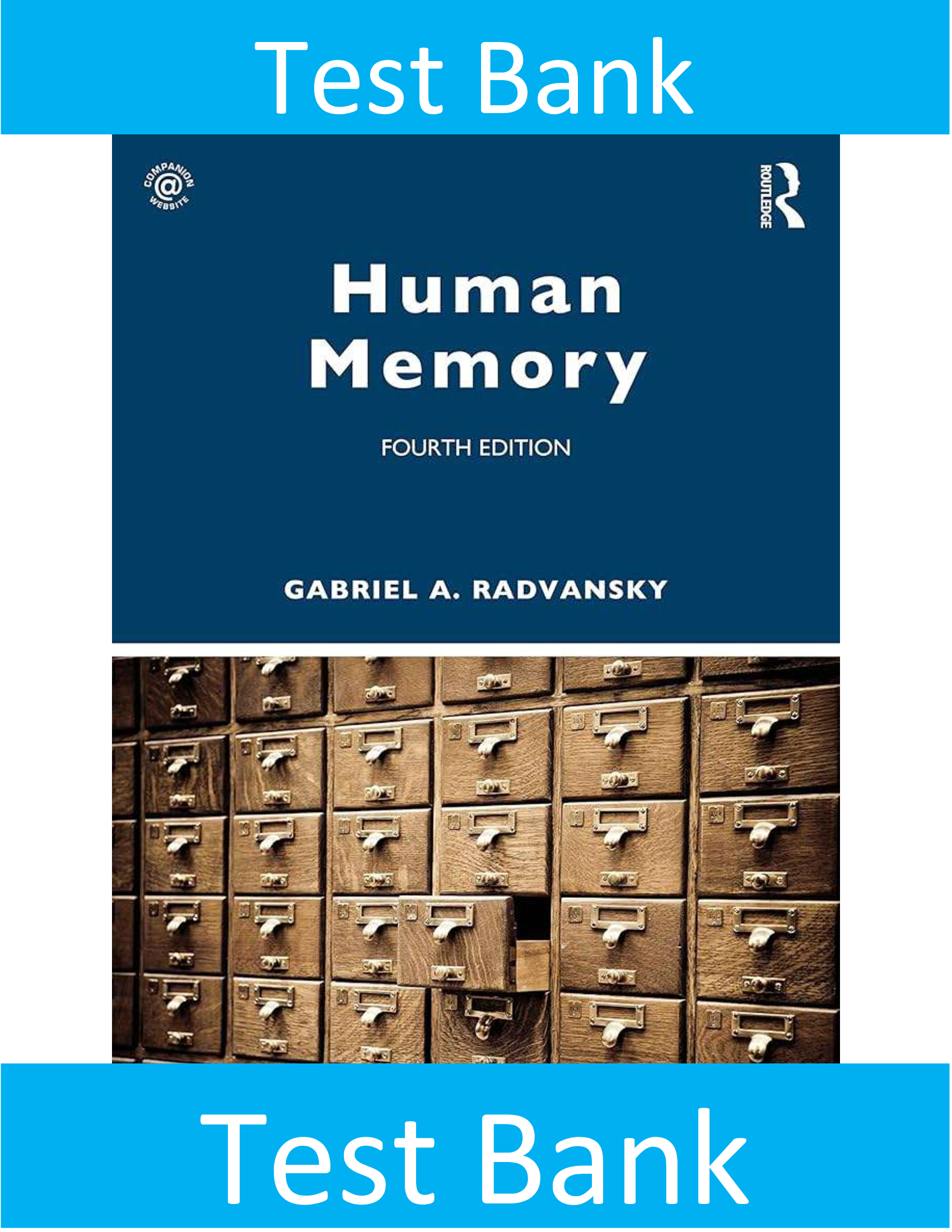
  • Test Bank for Human Memory 4th Edition by Gabriel Radvansky All Chapters

Test Bank for Human Memory 4th Edition by Gabriel Radvansky All Chapters

Preview page 1 Preview page 2 Preview page 3
Add To Favorites

Share this item Share this item

  • Item Details
  • Comments (0)
  • Reviews (0)
  • Contact Seller

Complete Test Bank for Human Memory

4th Edition by Gabriel Radvansky All Chapters

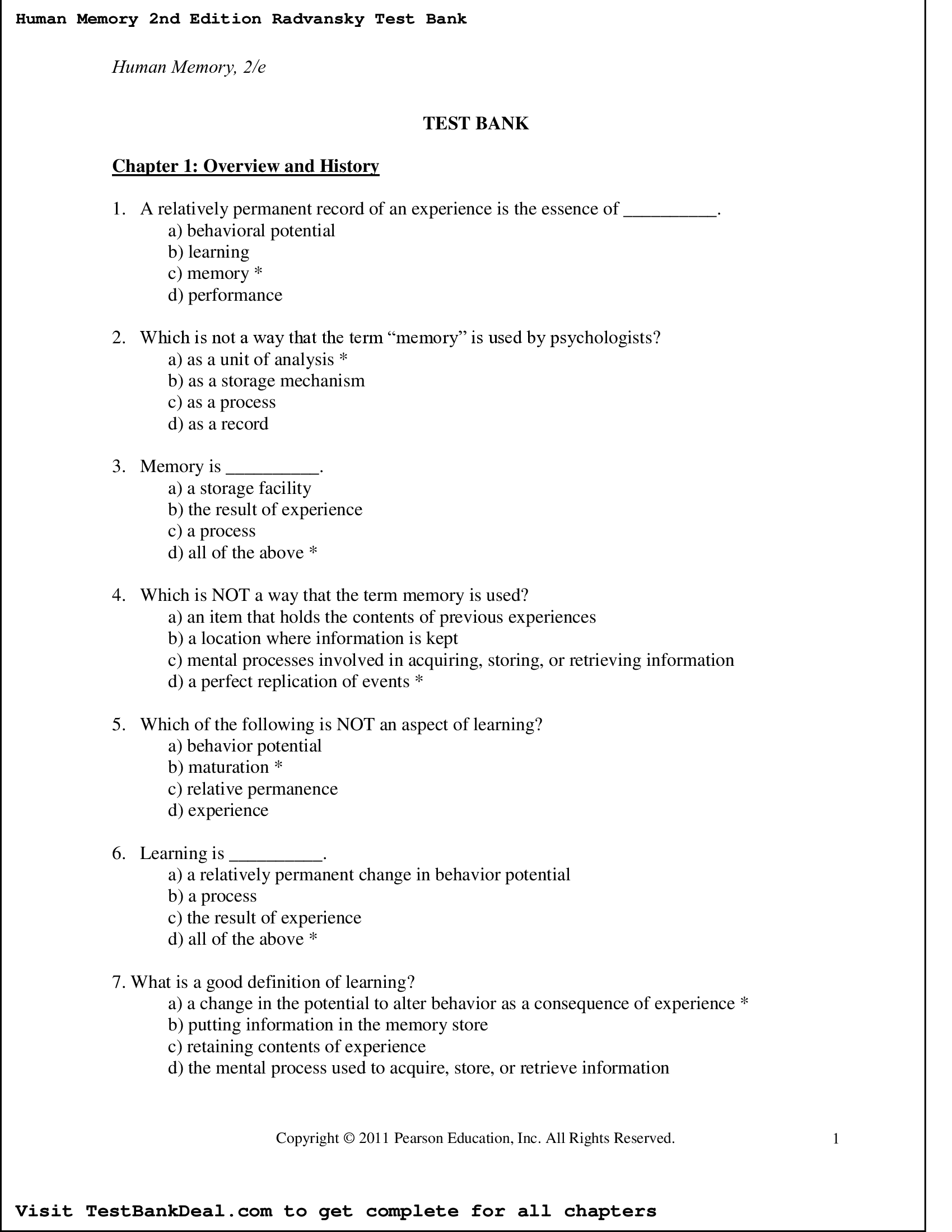
Sample Chapter Questions

1.            A relatively permanent record of an experience is the essence of __________.

a)            behavioral potential

b)            learning

c)            memory *

d)            performance

2.            Which is not a way that the term “memory” is used by psychologists?

a)            as a unit of analysis *

b)            as a storage mechanism

c)            as a process

d)            as a record


3.            Memory is __________.

a)            a storage facility

b)            the result of experience

c)            a process

d)            all of the above *


4.            Which is NOT a way that the term memory is used?

a)            an item that holds the contents of previous experiences 

b)            a location where information is kept

c)            mental processes involved in acquiring, storing, or retrieving information

d)            a perfect replication of events *


5.            Which of the following is NOT an aspect of learning?

a)            behavior potential

b)            maturation *

c)            relative permanence

d)            experience


6.            Learning is __________.

a)            a relatively permanent change in behavior potential

b)            a process

c)            the result of experience

d)            all of the above *


7.            What is a good definition of learning?

a)            a change in the potential to alter behavior as a consequence of experience *

b)            putting information in the memory store

c)            retaining contents of experience

d)            the mental process used to acquire, store, or retrieve information

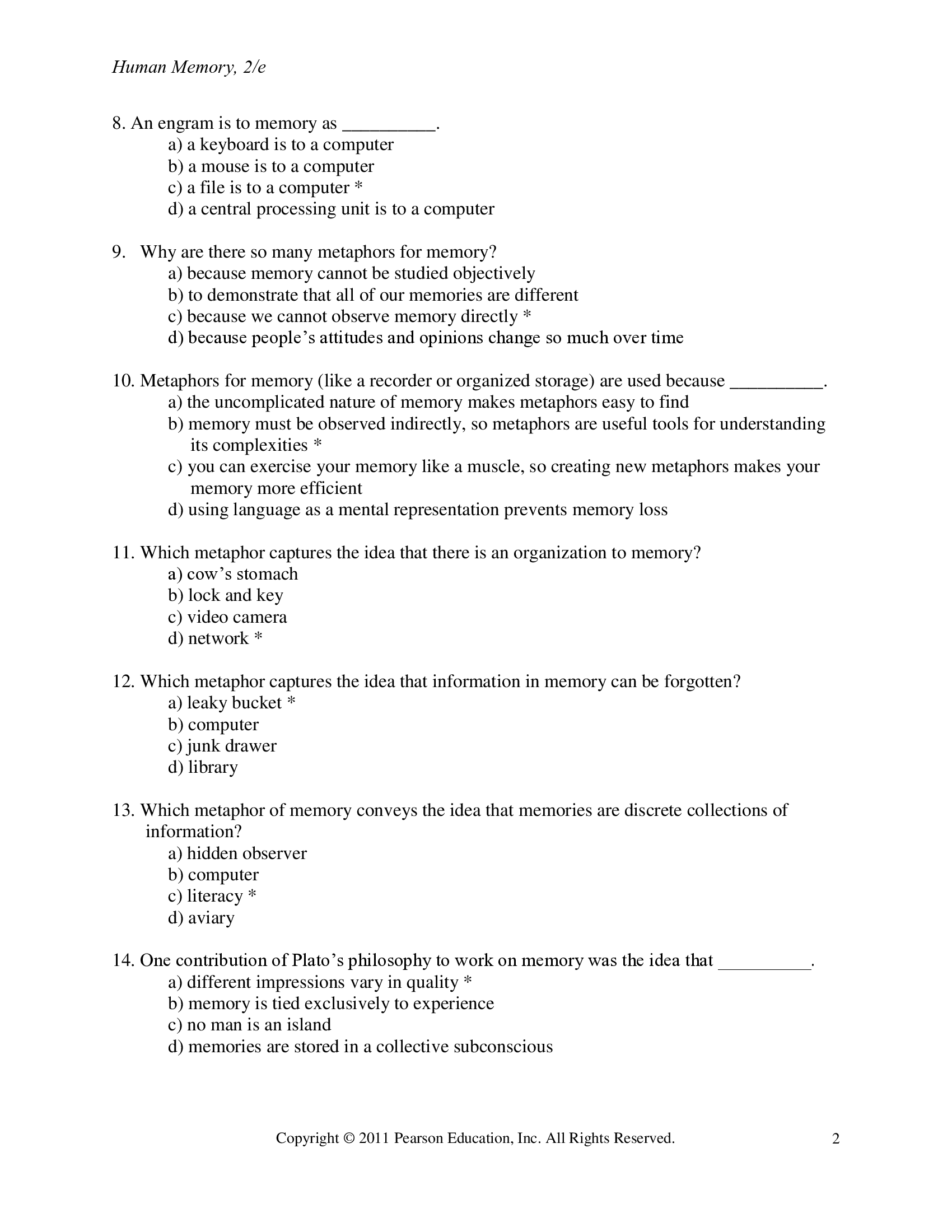
8.            An engram is to memory as __________.

a)            a keyboard is to a computer

b)            a mouse is to a computer

c)            a file is to a computer *

d)            a central processing unit is to a computer


9.            Why are there so many metaphors for memory?

a)            because memory cannot be studied objectively

b)            to demonstrate that all of our memories are different

c)            because we cannot observe memory directly *

d)            because people’s attitudes and opinions change so much over time


10.          Metaphors for memory (like a recorder or organized storage) are used because __________.

a)            the uncomplicated nature of memory makes metaphors easy to find

b)            memory must be observed indirectly, so metaphors are useful tools for understanding its complexities *

c)            you can exercise your memory like a muscle, so creating new metaphors makes your memory more efficient

d)            using language as a mental representation prevents memory loss


11.          Which metaphor captures the idea that there is an organization to memory?

a)            cow’s stomach

b)            lock and key

c)            video camera

d)            network *


12.          Which metaphor captures the idea that information in memory can be forgotten?

a)            leaky bucket *

b)            computer

c)            junk drawer

d)            library


13.          Which metaphor of memory conveys the idea that memories are discrete collections of information?

a)            hidden observer

b)            computer

c)            literacy *

d)            aviary


14.          One contribution of Plato’s philosophy to work on memory was the idea that __________.

a)            different impressions vary in quality *

b)            memory is tied exclusively to experience

c)            no man is an island

d)            memories are stored in a collective subconscious


15.          Aristotle’s laws of association include all of the following EXCEPT __________.

a)            similarity                                                               

b)            contiguity

c)            contrast

d)            idealized abstractions *


16.          Aristotle’s laws of association include all of the following EXCEPT __________.

a)            similarity                                                               

b)            regularity *

c)            contrast

d)            contiguity


17.          Who was the seventeenth-century scientist/philosopher who developed a sophisticated theory of memory but never followed up on it, leaving it to fall into obscurity, further delaying the onset of a scientific study of memory?

a)            Isaac Newton

b)            Robert Hooke *

c)            Charles Darwin

d)            Benjamin Franklin


18.          What influence did Darwin have on theories of memory?

a)            the idea that memory develops in a person through a selection process

b)            the concept that memory is dependent on a complex brain

c)            the idea that memory has developed over the generations to adapt to the demands of the environment *

d)            none


19.          Memory development in a person is guided by his or her DNA.

a)            true

b)            false

c)            partially true*

d)            true, except for cases of brain damage 


20.          An important concept that is heavily used in theories of memory that developed out of the empiricist tradition is __________.

a)            the association *                                               

b)            adaptation to changes in the environment

c)            the engram

d)            separation of mind and body


21.          Empiricists such as Aristotle believed that memory operates as __________.

a)            associations between experiences or stimuli *

b)            a bridge between perceptions and rational abstractions (since empirical observations are often distorted)

c)            an abstract, perfect realm without need for additional inquiry                                     

d)            the rational link between the mind and the body

22.          An important idea for memory research taken from the rationalist tradition in philosophy is that __________.

a)            the mind is rational

b)            everything is explainable with empirical testing

c)            genetics is the guide to understanding memory at its basic level

d)            the mind actively constructs our interpretation of reality *


23.          Something discovered by Ebbinghaus that describes a process that can reduce the effects of forgetting is __________.

a)            forgetting curve                                                

b)            overlearning *

c)            learning curve

d)            savings


24.          Ebbinghaus used nonsense syllables to study memory because __________.

a)            he wanted to study memory in its pure form *

b)            he did not have other people to test

c)            they are easy to create in German

d)            he wanted an experimentally clean way to assess prior knowledge


25.          Which of the following is NOT a principle of memory discovered by Ebbinghaus?

a)            learning curve

b)            schema *

c)            savings

d)            distribution of practice

26.          Which of the following important figures in the history of memory research was interested in how prior knowledge influences memory?

a)            Ebbinghaus                                                          

b)            Barlett *

c)            Thorndike

d)            Tolman

27.          What is an important concept in memory developed by Bartlett?

a)            learning curve

b)            schema *

c)            savings

d)            distribution of practice

28.          What is an important distinction in types of memory made by William James?

a)            memory store hegemony

b)            hierarchical rotations

c)            the difference between primary and secondary memory *

d)            the difference between procedural and declarative memory 

29.          An important contribution of the gestalt movement to modern memory psychology is __________.

a)            isomorphism of representation and process *

b)            reductionistic methods

c)            the emphasis on observable behaviors

d)            segregation of different memory stores

30.          According to the gestalt psychologists, __________.

a)            the whole is more than a sum of its parts

b)            the whole is different than the sum of its parts *

c)            latent learning is the most dominant form of memory

d)            memory is best understood using a reductionistic approach


Contact the Seller

Please Sign In to contact this seller.


  • 👎  Report Copyright Violation

Frequently Asked Questions

What Do I Get When I Buy This Study Material?

+

When you buy a study material on Passing Grades, an instant download link will be sent directly to your email, giving you access to the file anytime after payment is completed.

Is Passing Grades a Trusted Platform?

+

Yes, Passing Grades is a reputable students’ marketplace with a secure payment system and reliable customer support. You can trust us to ensure a safe and seamless transaction experience.

Will I Be Stuck with a Subscription?

+

No, all purchases on Passing Grades are one-time transactions. You only pay for the notes you choose to buy, with no subscriptions or hidden fees attached.

Who Am I Buying These Study Materials From?

+

Passing Grades is a marketplace, which means you are purchasing the document from an individual vendor, not directly from us. We facilitate the payment and delivery process between you and the vendor.

Does Passing Grades Offer Free Study Materials?

+

Yes, sellers on Passing Grades have uploaded numerous free test banks, exams, practice questions, and class notes that can be downloaded at no cost.


Pasinggrades - Quality Study Materials

USD 15

    • Quality checked by Pasing Grades
    • 100% satisfaction guarantee
    • Seller: mentor2000
Buy PDF $15

Seller Information

mentor2000

Member since April 2021

  • icon
  • icon
View Profile
  • total sales

    0
  • Favourites

    0
  • Comments

    0
    ( 0 Ratings )

Item Information

  • Uploaded

    19 June 2025

  • Updated

    19 June 2025

  • Category

    Nursing

  • Item Type

    test bank

  • Tags

    Test Bank for Human Memory 4th Edition by Gabriel Radvansky All Chapters

Related Exam Prep Guides by mentor2000

Test Bank for Essentials for Nursing Practice 8th Edition by Potter | All Chapters
View Document

Test Bank for Essent...

  • mentor2000

    mentor2000

  • test bank

Master nursing concepts with this study material; Test Bank for Essentials for Nursing Practice, 8th...

15 USD

0

0

A &P 1 MA278 BSC2 Final Module II Questions & Answers 2026 Update
View Document

A &P 1 MA278 BSC2 Fi...

  • mentor2000

    mentor2000

  • test bank

Prepare for success with A&P 1 MA278 BSC2 Final Module II 2024 Q&A. Boost your grades with this comp...

15 USD

0

0

ATI Comprehensive Predictor Exam 2026
View Document

ATI Comprehensive Pr...

  • mentor2000

    mentor2000

  • test bank

Prepare for success with the ATI Comprehensive Predictor Exam 2026. Access key practice questions to...

15 USD

0

0

Purchase

Download link will be sent to this email immediately after purchase.

IMPORTANT LINKS

  • How To Upload Class Notes
  • Selling Tips
  • Passing Grades's Study Materials
  • Scholarships for International Students 2025

POPULAR CATEGORIES

  • Law
  • Accounting
  • English
  • Psychology
  • Business
  • Nursing
  • Computer Science
  • General

View Document

  • Blog
  • Contact
  • Delivery Policy
  • Latest Scholarships Around the World
  • How to Pass Bar Exams: Passing Grades’ Strategies
  • How to Study and Pass the CPA Exam
  • All Test Banks
  • Faq
  • Copyright Claims
  • Privacy Policy
  • Terms of Use

KNOWLEDGE BASE

  • How to Write A+ Grade Good Research Paper
  • How to Manage Stress During Exam Period
  • Best Time to Study
  • How to Pass NCLEX-RN Exam
  • How To Effectively Utilize Test Banks
  • Popular Shadow Health Exam Assessments
  • Popular HESI Case Studies
  • How to Prepare for a Nursing Career
  • The Importance Of Summaries in Exam Revisvion

© 2026 Pasing Grades. All rights reserved.