Pasing Grades
  • Start Selling
  • Blog
  • Contact
  • 0

    Your cart is empty!

English

  • English
  • Spanish
  • Arabic
Create Account Sign In
  • Library
    • New Prep Guides
    • Featured Prep Guides
    • Free Exam Prep Guides
    • Best sellers
  • General
  • Nursing
    • Research Paper
    • Case Study
    • Discussion Post
    • Assignment
    • Exam
    • Practice Questions and Answers
    • Test Bank
    • solutions manual
  • Accounting
    • Case Study
    • Thesis
    • Study Guide
    • Summary
    • Research Paper
    • test bank
  • English
    • Creative Writing
    • Research Paper
    • Summary
    • Rhetorics
    • Literature
    • Journal
    • Exam
    • Grammar
    • Discussion Post
    • Essay
  • Psychology
    • Hesi
    • Presentation
    • Essay
    • Summary
    • Study Guide
    • Essay
    • Solution Manual
    • Final Exam Review
    • Class Notes
    • test bank
  • Business
    • Lecture Notes
    • Solution Manual
    • Presentation
    • Business Plan
    • Class Notes
    • Experiment
    • Summary
    • Practice Questions
    • Study Guide
    • Case Study
    • test bank
    • Exam
  • More
    • Computer Science
    • Economics
    • Statistics
    • Engineering
    • Biology
    • Religious Studies
    • Physics
    • Chemistry
    • Mathematics
    • History
    • Sociology
    • Science
    • Philosophy
    • Law
  • Pages
    • About Us
    • Selling Tips
    • Delivery Policy
    • Faq
    • Privacy Policy
  • Flash Sale
  • Home
  • TEST BANK FOR ESSENTIALS OF BIOLOGICAL ANTHROPOLOGY 4TH ED BY LARSEN

TEST BANK FOR ESSENTIALS OF BIOLOGICAL ANTHROPOLOGY 4TH ED BY LARSEN

Preview page 1 Preview page 2 Preview page 3
Add To Favorites

Share this item Share this item

  • Item Details
  • Comments (0)
  • Reviews (0)
  • Contact Seller

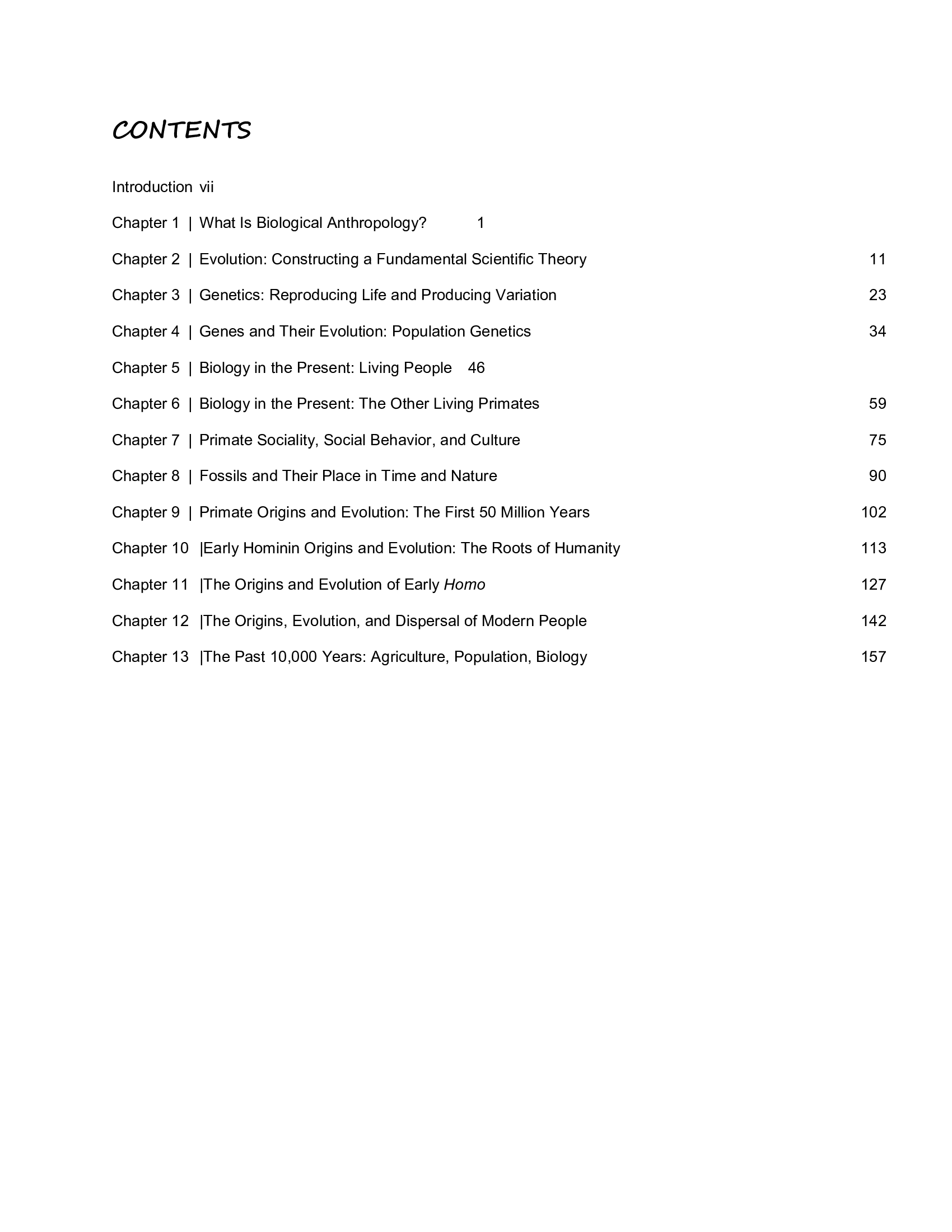
ESSENTIALS OF BIOLOGICAL ANTHROPOLOGY 4TH EDITION BY LARSEN CONTENTS Introduction vii Chapter 1 | What Is Biological Anthropology? 1 Chapter 2 | Evolution: Constructing a Fundamental Scientific Theory 11 Chapter 3 | Genetics: Reproducing Life and Producing Variation 23 Chapter 4 | Genes and Their Evolution: Population Genetics 34 Chapter 5 | Biology in the Present: Living People 46 Chapter 6 | Biology in the Present: The Other Living Primates 59 Chapter 7 | Primate Sociality, Social Behavior, and Culture 75 Chapter 8 | Fossils and Their Place in Time and Nature 90 Chapter 9 | Primate Origins and Evolution: The First 50 Million Years 102 Chapter 10 | Early Hominin Origins and Evolution: The Roots of Humanity 113 Chapter 11 | The Origins and Evolution of Early Homo 127 Chapter 12 | The Origins, Evolution, and Dispersal of Modern People 142 Chapter 13 | The Past 10,000 Years: Agriculture, Population, Biology 157 INTRODUCTION W. W. Norton strives to produce high-quality, valid, and reliable assessment supplements according to the following criteria. STUDENT COMPETENCIES AND EVIDENCE-CENTERED DESIGN A good assessment tool must: 1. define what students need to know and the level of knowledge and skills that constitute competence in the concepts about which they are learning; 2. include test items that provide valid and reliable evidence of competence by assessing the material to be learned at the appropriate level; and 3. enable instructors to judge accurately what students know and how well they know it, thus allowing instructors to focus on areas where students need the most help. SIX QUESTION TYPES These question types are informed by Bloom’s Taxonomy. 1. Remembering questions—test declarative knowledge, including textbook definitions and relationships between two or more pieces of information. Can students recall or remember the information in the same form it was learned? 2. Understanding questions—pose problems in a context different from the one in which the material was learned, requiring students to draw from their declarative and/or procedural understanding of important concepts. Can students explain ideas or concepts? 3. Applying questions—ask students to draw from their prior experiences and use critical-thinking skills to take part in qualitative reasoning about the real world. Can students use learned information in another task or situation? 4. Analyzing questions—test students’ abilities to break down information and see how different elements relate to each other and to the whole. Can students distinguish among the different parts? 5. Evaluating questions—ask students to assess information as a whole and frame their own arguments. Can students justify a stand or decision? 6. Creating questions—pose questions or objectives that prompt students to put elements they have learned together into a coherent whole to generate new ideas. Can students create a new product or point of view based on data? THREE DIFFICULTY LEVELS 1. Easy questions—require a basic understanding of the concepts, definitions, and examples presented in the textbook. 2. Moderate questions—direct students to use critical-thinking skills and to demonstrate an understanding of core concepts independent of specific textbook examples. 3. Difficult questions—ask students to synthesize textbook concepts with their own experiences, making analytical inferences about historical topics and more. GENERAL RULES FOR NORTON ASSESSMENT Each question measures and links explicitly to a specific concept and objective and is written in clear, concise, and grammatically correct language that suits the difficulty level of the material being assessed. To ensure the validity of questions, no extraneous, ambiguous, or confusing material is included, and no slang expressions are used. In developing the questions, every effort has been made to eliminate bias (e.g., race, gender, cultural, ethnic, regional, disability, age, and so on) to require specific knowledge of the material studied, not general knowledge or experience. READING THE TEST ITEM NOTATION Each question in the Test Bank is tagged with five pieces of information designed to help instructors create the most ideal mix of questions for their quizzes or exams. These tags are: • ANS: This is the correct answer for each question. • DIF: This is the difficulty assigned to the problem. Problems have been classified as Easy, Moderate, or Difficult. • MSC: This is the knowledge type (see Six Question Types above) that the question is designed to test. • TOP: This references the topic, taken from the chapter heads, that is tested by the question. • OBJ: This is the learning objective, taken from the instructor guide, that the question is intended to assess.   CHAPTER 1 What Is Biological Anthropology? MULTIPLE CHOICE 1. Before AD 1000, what did the people of St. Catherines Island eat? a. They ate wild animals, fish, and wild plants. b. They ate bison and salmon. c. They were vegetarians and ate wild plants exclusively. d. They ate mostly fruit. ANS: A DIF: Easy OBJ: Characterize the importance of the biocultural approach to anthropological inquiry. TOP: What Is Biological Anthropology? MSC: Remembering 2. What was the cause of the biological change in the indigenous people of St. Catherines Island after AD 1000? a. They became sedentary and had less food to eat because they stayed in the same area. b. They became sedentary and consumed more corn, which caused dental disease due to its high sugar content. c. They became sedentary and did not have enough exercise to keep their bodies fit and healthy. d. They continued as nomads, but loss of animals due to climate change created a decline in their food source. ANS: D DIF: Easy OBJ: Characterize the importance of the biocultural approach to anthropological inquiry. TOP: What Is Biological Anthropology? MSC: Understanding 3. What can be learned from studying a population through time? a. We can learn that lifestyles do not change over time. b. We can learn that diets, and therefore human biology, change through time. c. We can learn that consuming the wrong foods over time does little to population health. d. We can learn that human physiology does not change through time. ANS: B DIF: Moderate OBJ: Characterize the importance of the biocultural approach to anthropological inquiry. TOP: What Is Biological Anthropology? MSC: Understanding 4. Biological anthropologists seek to study a. humans from a cultural perspective. b. humans from a biological perspective. c. humans from biological and cultural perspectives. d. human behavior only. ANS: C DIF: Easy OBJ: Explain the differences and similarities among the four branches of anthropology. TOP: What Is Biological Anthropology? MSC: Understanding 5. Biological anthropologists view how humans come to be the way they are as the result of a. their biological makeups, which primarily define who they are. b. both evolutionary history and their own individual life histories. c. what their genes make them; environment has very little effect. d. their environment; genes have very little effect. ANS: B DIF: Moderate OBJ: Explain the differences and similarities among the four branches of anthropology. TOP: What Is Biological Anthropology? MSC: Understanding   6. Biological anthropologists a. travel around the world to investigate human populations. b. study living populations. c. study primates like lemurs, monkeys, and apes. d. travel around the world to investigate human populations; study living populations; and study primates like lemurs, monkeys, and apes. ANS: D DIF: Easy OBJ: Identify several different research areas in biological anthropology. TOP: What Is Biological Anthropology? MSC: Remembering 7. Primates are a. a group of mammals that share traits like forward-facing eyes, fingernails, and large brains. b. often species with a long snout. c. diverse species that live in various types of environments. d. diverse species that live in various types of environments AND a group of mammals that share traits like forward-facing eyes, fingernails, and large brains. ANS: D DIF: Moderate OBJ: Identify several different research areas in biological anthropology. TOP: What Is Biological Anthropology? MSC: Remembering 8. Biological anthropologists study what type(s) of science? a. astrological c. social b. biological d. biological and social ANS: D DIF: Moderate OBJ: Explain the differences and similarities among the four branches of anthropology. TOP: What Is Biological Anthropology? MSC: Remembering 9. Bipedalism in primates means a. walking on two feet. c. walking using two legs and a tail. b. walking on four feet. d. swinging from branch to branch. ANS: A DIF: Moderate OBJ: Identify and explain the importance of six major attributes that separate humans from nonhuman animals. TOP: What Makes Humans So Different from Other Animals? The Six Steps to Humanness MSC: Remembering 10. What are three key attributes related to human uniqueness? a. eating, sleeping, and watching television b. increased hunting, speech, and dependence on domesticated food c. hunting, avoiding predators, and tool making d. sleeping, hunting, and making clothing ANS: B DIF: Easy OBJ: Identify and explain the importance of six major attributes that separate humans from nonhuman animals. TOP: What Makes Humans So Different from Other Animals? The Six Steps to Humanness MSC: Remembering 11. What makes it possible for humans to accumulate an amazing amount of information over long periods of time? a. social learning c. social media b. television d. mimicry ANS: A DIF: Moderate OBJ: Identify and explain the importance of six major attributes that separate humans from nonhuman animals. TOP: What Makes Humans So Different from Other Animals? The Six Steps to Humanness MSC: Understanding   12. Archaeologists a. study primate evolution. b. devote most of their effort to recovering artifacts and building museum collections. c. study past human societies, focusing mostly on their material remains. d. primarily study the evolution of language. ANS: C DIF: Moderate OBJ: Explain the differences and similarities among the four branches of anthropology. TOP: What Is Anthropology? MSC: Remembering 13. An archaeological field school is announced in your anthropology course. The description says that you will travel to Belize to learn about the lives of the ancient Mayans. What, primarily, do you expect to learn during this field school? a. what species of nonhuman primate occupies this region b. how current populations of immigrants have changed local dialects c. how to excavate and study material culture d. how to socially navigate life in a Central American setting ANS: C DIF: Moderate OBJ: Explain the differences and similarities among the four branches of anthropology. TOP: What Is Anthropology? MSC: Analyzing 14. The scientific method a. relies on making hunches about the natural world. b. involves empirical data collection and hypothesis testing. c. is used to support preconceived notions or theories. d. seeks to establish the absolute scientific truth. ANS: B DIF: Moderate OBJ: Explain the four steps involved in “doing science” (i.e., the scientific method). TOP: How We Know What We Know: The Scientific Method MSC: Understanding 15. Biological anthropology is a science because it a. requires the use of chemicals, excavation tools, or measuring tools. b. uses data to help fill gaps in knowledge about how the natural world operates. c. is practiced by scholars working in humanities departments at universities. d. involves the study of the past. ANS: B DIF: Moderate OBJ: Explain the four steps involved in “doing science” (i.e., the scientific method). TOP: How We Know What We Know: The Scientific Method MSC: Understanding 16. A hypothesis is a. another word for a theory. b. a testable statement that potentially explains specific phenomena observed in the natural world. c. a statement concerning scientific facts assumed to be true. d. unable to be refuted by future investigations. ANS: B DIF: Moderate OBJ: Distinguish between hypotheses and theories. TOP: How We Know What We Know: The Scientific Method MSC: Understanding 17. The hypothesis that the origin of human bipedalism was linked to a shift from life in the trees to life on the ground in the grasslands of Africa a. has been upheld by subsequent scientific data on human origins. b. was developed in consultation with genetic and fossil evidence. c. has been rejected recently subsequent to new fossil evidence. d. has become a scientific law. ANS: A DIF: Moderate OBJ: Distinguish between hypotheses and theories. TOP: How We Know What We Know: The Scientific Method MSC: Remembering

Contact the Seller

Please Sign In to contact this seller.


  • 👎  Report Copyright Violation

Frequently Asked Questions

What Do I Get When I Buy This Study Material?

+

When you buy a study material on Passing Grades, an instant download link will be sent directly to your email, giving you access to the file anytime after payment is completed.

Is Passing Grades a Trusted Platform?

+

Yes, Passing Grades is a reputable students’ marketplace with a secure payment system and reliable customer support. You can trust us to ensure a safe and seamless transaction experience.

Will I Be Stuck with a Subscription?

+

No, all purchases on Passing Grades are one-time transactions. You only pay for the notes you choose to buy, with no subscriptions or hidden fees attached.

Who Am I Buying These Study Materials From?

+

Passing Grades is a marketplace, which means you are purchasing the document from an individual vendor, not directly from us. We facilitate the payment and delivery process between you and the vendor.

Does Passing Grades Offer Free Study Materials?

+

Yes, sellers on Passing Grades have uploaded numerous free test banks, exams, practice questions, and class notes that can be downloaded at no cost.

Pasinggrades - Quality Study Materials

USD 15

    • Quality checked by Pasing Grades
    • 100% satisfaction guarantee
    • Seller: tutor_gesco
Buy PDF $15

Seller Information

tutor_gesco

Member since October 2021

  • icon
  • icon
View Profile
  • total sales

    1
  • Favourites

    0
  • Comments

    0
    ( 0 Ratings )

Item Information

  • Uploaded

    22 May 2022

  • Updated

    29 September 2025

  • Category

    General

  • Item Type

    exam

  • Tags

    test bank biology

Related Exam Prep Guides by tutor_gesco

TEST BANK FOR GENETICS ESSENTIALS CONCEPTS AND CONNECTIONS 4TH EDITION BY PIERCE
View Document

TEST BANK FOR GENETI...

  • tutor_gesco

    tutor_gesco

  • exam

TEST BANK FOR GENETICS ESSENTIALS CONCEPTS AND CONNECTIONS 4TH EDITION BY PIERCE...

15 USD

0

1

TEST BANK FOR ESSENTIALS OF THE LIVING WORLD 6TH EDITION BY JOHNSON
View Document

TEST BANK FOR ESSENT...

  • tutor_gesco

    tutor_gesco

  • exam

Master key biology concepts with the Test Bank for Essentials of the Living World, 6th Edition by Jo...

15 USD

0

1

Test Bank for Human Biology, 16e (Mader)
View Document

Test Bank for Human ...

  • tutor_gesco

    tutor_gesco

  • exam

Test Bank for Human Biology, 16e (Mader)...

15 USD

0

1

Purchase

Download link will be sent to this email immediately after purchase.

IMPORTANT LINKS

  • How To Upload Class Notes
  • Selling Tips
  • Passing Grades's Study Materials
  • Scholarships for International Students 2025

POPULAR CATEGORIES

  • Law
  • Accounting
  • English
  • Psychology
  • Business
  • Nursing
  • Computer Science
  • General

View Document

  • Blog
  • Contact
  • Delivery Policy
  • Latest Scholarships Around the World
  • How to Pass Bar Exams: Passing Grades’ Strategies
  • How to Study and Pass the CPA Exam
  • All Test Banks
  • Faq
  • Copyright Claims
  • Privacy Policy
  • Terms of Use

KNOWLEDGE BASE

  • How to Write A+ Grade Good Research Paper
  • How to Manage Stress During Exam Period
  • Best Time to Study
  • How to Pass NCLEX-RN Exam
  • How To Effectively Utilize Test Banks
  • Popular Shadow Health Exam Assessments
  • Popular HESI Case Studies
  • How to Prepare for a Nursing Career
  • The Importance Of Summaries in Exam Revisvion

© 2026 Pasing Grades. All rights reserved.