Pasing Grades
  • Start Selling
  • Blog
  • Contact
  • 0

    Your cart is empty!

English

  • English
  • Spanish
  • Arabic
Create Account Sign In
  • Library
    • New Prep Guides
    • Featured Prep Guides
    • Free Exam Prep Guides
    • Best sellers
  • General
  • Nursing
    • Research Paper
    • Case Study
    • Discussion Post
    • Assignment
    • Exam
    • Practice Questions and Answers
    • Test Bank
    • solutions manual
  • Accounting
    • Case Study
    • Thesis
    • Study Guide
    • Summary
    • Research Paper
    • test bank
  • English
    • Creative Writing
    • Research Paper
    • Summary
    • Rhetorics
    • Literature
    • Journal
    • Exam
    • Grammar
    • Discussion Post
    • Essay
  • Psychology
    • Hesi
    • Presentation
    • Essay
    • Summary
    • Study Guide
    • Essay
    • Solution Manual
    • Final Exam Review
    • Class Notes
    • test bank
  • Business
    • Lecture Notes
    • Solution Manual
    • Presentation
    • Business Plan
    • Class Notes
    • Experiment
    • Summary
    • Practice Questions
    • Study Guide
    • Case Study
    • test bank
    • Exam
  • More
    • Computer Science
    • Economics
    • Statistics
    • Engineering
    • Biology
    • Religious Studies
    • Physics
    • Chemistry
    • Mathematics
    • History
    • Sociology
    • Science
    • Philosophy
    • Law
  • Pages
    • About Us
    • Selling Tips
    • Delivery Policy
    • Faq
    • Privacy Policy
  • Flash Sale
  • Home
  • TEST BANK FOR ADVANCED ASSESSMENT INTERPRETING FINDINGS AND FORMULATING DIFFERENTIAL DIAGNOSES

TEST BANK FOR ADVANCED ASSESSMENT INTERPRETING FINDINGS AND FORMULATING DIFFERENTIAL DIAGNOSES

Preview page 1 Preview page 2 Preview page 3
Add To Favorites

Share this item Share this item

  • Item Details
  • Comments (0)
  • Reviews (0)
  • Contact Seller

Test Bank For Advanced Assessment: Interpreting Findings And Formulating Differential Diagnoses, 4th Edition, Mary Jo Goolsby, Laurie Grubbs 

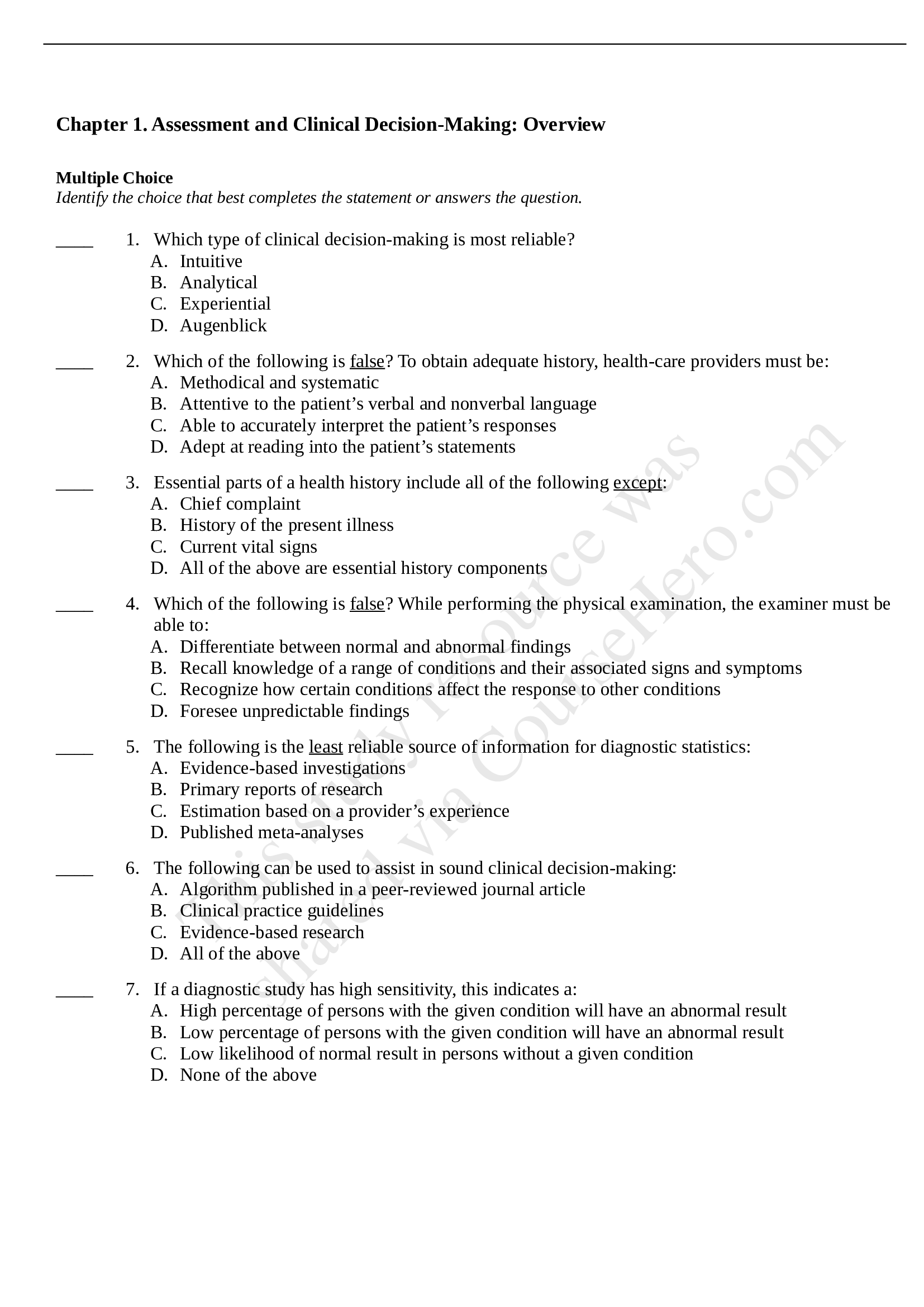
Chapter 1. Assessment and Clinical Decision-Making: Overview

Multiple Choice

Identify the choice that best completes the statement or answers the question.

____     1.            Which type of clinical decision-making is most reliable?

A.            Intuitive

B.            Analytical

C.            Experiential

D.            Augenblick

____     2.            Which of the following is false? To obtain adequate history, health-care providers must be:

A.            Methodical and systematic

B.            Attentive to the patient’s verbal and nonverbal language

C.            Able to accurately interpret the patient’s responses

D.            Adept at reading into the patient’s statements

____     3.            Essential parts of a health history include all of the following except:

A.            Chief complaint

B.            History of the present illness

C.            Current vital signs

D.            All of the above are essential history components

____     4.            Which of the following is false? While performing the physical examination, the examiner must be able to:

A.            Differentiate between normal and abnormal findings

B.            Recall knowledge of a range of conditions and their associated signs and symptoms

C.            Recognize how certain conditions affect the response to other conditions

D.            Foresee unpredictable findings

____     5.            The following is the least reliable source of information for diagnostic statistics:

A.            Evidence-based investigations

B.            Primary reports of research

C.            Estimation based on a provider’s experience

D.            Published meta-analyses

____     6.            The following can be used to assist in sound clinical decision-making:

A.            Algorithm published in a peer-reviewed journal article

B.            Clinical practice guidelines

C.            Evidence-based research

D.            All of the above

____     7.            If a diagnostic study has high sensitivity, this indicates a:

A.            High percentage of persons with the given condition will have an abnormal result

B.            Low percentage of persons with the given condition will have an abnormal result C. Low likelihood of normal result in persons without a given condition D. None of the above

____

____

____ 

Chapter 1. Assessment and Clinical Decision-Making: Overview Answer Section

MULTIPLE CHOICE

1.            ANS: B

Croskerry (2009) describes two major types of clinical diagnostic decision-making: intuitive and analytical. Intuitive decision-making (similar to Augenblink decision-making) is based on the experience and intuition of the clinician and is less reliable and paired with fairly common errors. In contrast, analytical decision-making is based on careful consideration and has greater reliability with rare errors.

                PTS:       1

2.            ANS: D

To obtain adequate history, providers must be well organized, attentive to the patient’s verbal and nonverbal language, and able to accurately interpret the patient’s responses to questions. Rather than reading into the patient’s statements, they clarify any areas of uncertainty.

                PTS:       1

3.            ANS: C

Vital signs are part of the physical examination portion of patient assessment, not part of the health history.

                PTS:       1

4.            ANS: D

While performing the physical examination, the examiner must be able to differentiate between normal and abnormal findings, recall knowledge of a range of conditions, including their associated signs and symptoms, recognize how certain conditions affect the response to other conditions, and distinguish the relevance of varied abnormal findings.

                PTS:       1

5.            ANS: C

Sources for diagnostic statistics include textbooks, primary reports of research, and published meta-analyses. Another source of statistics, the one that has been most widely used and available for application to the reasoning process, is the estimation based on a provider’s experience, although these are rarely accurate. Over the past decade, the availability of evidence on which to base clinical reasoning is improving, and there is an increasing expectation that clinical reasoning be based on scientific evidence. Evidence-based statistics are also increasingly being used to develop resources to facilitate clinical decision-making.

                PTS:       1

6.            ANS: D

To assist in clinical decision-making, a number of evidence-based resources have been developed to assist the clinician. Resources, such as algorithms and clinical practice guidelines, assist in clinical reasoning when properly applied.

This study source was downloaded by 100000826342158 from CourseHero.com on 05-25-2021 21:32:19 GMT -05:00

https://www.coursehero.com/file/21739484/c1/


PTS:

PTS:

PTS:

PTS:

                10.          ANS: B

PTS:

https://www.coursehero.com/file/21739484/c1/

Powered by TCPDF (www.tcpdf.org)


Multiple Choice

____

____

____

____

____


____ 10. A woman with an X-linked dominant disorder will:

A.            Not be affected by the disorder

herself

B.            Transmit the disorder to 50 % of

her offspring (male or female)

C.            Not transmit the disorder to her

daughters

D.            Transmit the disorder to only her

daughters

____ 11. In creating your female patient’s pedigree, you note that she and both of her sisters were affected by the same genetic disorder. Although neither of her parents had indications of the disorder, her paternal grandmother and her paternal grandmother’s two sisters were affected by the same condition. This pattern suggests:

A.            Autosomal dominant disorder

B.            Chromosomal disorder

C.            Mitochondrial DNA disorder

D.            X-linked dominant disorder

____ 12. A woman affected with an X-linked recessive disorder:

A.            Has one X chromosome affected

by the mutation

B.            Will transmit the disorder to all of her children

C.            Will transmit the disorder to all of her sons

D.            Will not transmit the mutation to

any of her daughters

____ 13. Which of the following are found in an individual with aneuploidy?

A.            An abnormal number of

chromosomes

B.            An X-linked disorder

C.            Select cells containing abnormal-

appearing chromosomes

D.            An autosomal recessive disorder

____ 14. The pedigree of a family with a mitochondrial DNA disorder is unique in that:

A.            None of the female offspring will

have the disease

B.            All offspring from an affected

female will have disease

C.            None of the offspring of an


Answer Section

A proband is defined as the affected individual who manifests symptoms of a particular condition through whom a family with a genetic disorder is ascertained (Pagon et al. 1993–2013). The proband is the affected individual that brings the family to medical attention.

PTS: 1

3.            ANS: D

Autosomal dominant (AD) inheritance is a result of a gene mutation in one of the 22 autosomes.

PTS: 1

4.            ANS: C

A consanguineous family is related by descent from a common ancestry and is defined as a “union between two individuals who are related as second cousins or closer” (Hamamy 2012). Consanguinity, if present in the family history, is portrayed using two horizontal lines to establish the relationship between the male and female partners.

PTS: 1

5.            ANS: B

For adopted members of the family, use brackets as the appropriate standardized pedigree symbol ([e.g., brackets]).

PTS: 1

6.            ANS: A

Pedigrees associated with autosomal dominant (AD) disorders typically reveal multiple affected family members with the disease or syndrome. When analyzing the pedigree for AD disorders or syndromes, it is common to see a “vertical” pattern denoting several generations of affected members.

PTS: 1

7.            ANS: C

In autosomal recessive (AR) disorders, the offspring inherits the condition by receiving one copy of the gene mutation from each of the parents. Autosomal recessive disorders must be inherited through both parents (Nussbaum et al. 2007). Individuals who have an AR disorder have two mutated genes, one on each locus of the chromosome. Parents of an affected person are called carriers because each carries one copy of the mutation on one chromosome and a normal gene on the other chromosome. Carriers typically are not affected by the disease.

PTS: 1

8.            ANS: D

Individuals who have an AR disorder have two mutated genes, one on each allele of the chromosome. Parents of an affected person are called carriers because each parent carries one copy of the mutation on one chromosome and a normal gene on the other chromosome. Carriers typically are not affected by the disease. In pedigrees with an AR inheritance patterns, males and females will be equally affected because the gene mutation is on an autosome.

PTS: 1

9.            ANS: A

It is important that parents understand that if they both carry a mutation, the risk to each of their offspring (each pregnancy) is an independent event: 25% disease free, 25% affected, and 50% carrier.

PTS: 1

10.          ANS: B

Everyone born with an X-linked dominant disorder will be affected with the disease. Transmission of the disorder to the next generation varies by gender, however. A woman will transmit the mutation to 50% of all her offspring (male or female).

PTS: 1

11. ANS: D

A man with an X-linked dominant disorder will transmit the mutation to 100% of his daughters (they receive his X chromosome) and none of his sons (they receive his Y chromosome). The pedigree of a family with an X-linked dominant disorder would reveal all the daughters and none of the sons affected with the disorder if the father has an X-linked disorder.

PTS: 1

12. ANS: C

An X-linked recessive disorder means that in a woman, both X

chromosomes must have the mutation if she is to be affected. Because males have only one copy of the X chromosome, they will be affected if their X chromosome carries the mutation.

PTS: 1

13. ANS: A

An individual with an abnormal number of chromosomes has a condition called aneuploidy, which is frequently associated with mental problems or physical problems or both (Jorde, Carey, & Bamshad 2010; Nussbaum et al. 2007).

PTS: 1

14. ANS: B

Mitochondrial DNA is inherited from the ovum and, therefore, from the mother. The pedigree of a family with a mitochondrial DNA disorder is unique in that all offspring (regardless of gender) of an affected female will have the disease, and none of the offspring from an affected male will have the disease.

PTS: 1

15.          ANS: C

Some individuals or couples have unique identifiable risks that should be discussed prior to conception whenever possible. For example, women who will be 35 years of age or older at delivery (advanced maternal age) are at increased risk for aneuploidy.

PTS: 1

16.          ANS: D

The majority of cancers are sporadic or multifactorial due to a combination of genetic and environmental factors; however, approximately 5% to 10% of all cancers are due to a single-gene mutation (Garber & Offit 2005).

PTS: 1

17.          ANS: D

On May 21, 2008, President George W. Bush signed the Genetic Information Nondiscrimination Act (GINA) to protect Americans against discrimination based upon their genetic information when it comes to health insurance and employment, paving the way for patient personalized genetic medicine without fear of discrimination (National Human Genome Research Institute 2012).

PTS: 1

18.          ANS: A

Most disease-causing conditions are not due to a single-gene disorder but are due to multifactorial inheritance, a result of genomics and environmental or behavioral influences. In fact, the leading causes of mortality in the United States—heart disease, cerebrovascular disease, diabetes, and cancer—are all multifactorial. Most congenital malformation, hypertension, arthritis, asthma, obesity, epilepsy, Alzheimer’s, and mental health disorders are also multifactorial.

PTS: 1

19.          ANS: C

Early onset cancer syndromes, heart disease, or dementia are red flags that warrant further investigation regarding hereditary disorders.

PTS: 1

20.          ANS: A

Some disorders have a range of expression from mild to severe. This variability is referred to as the penetrance of genetic disease. For example, patients with neurofibromatosis (NF1), an AD disorder of the nervous system, may manifest with many forms of the disease. For instance, some patients with NF1 may have mild symptoms, like caféau-lait spots or freckling on the axillary or skin, while others may have life-threatening spinal cord tumors or malignancy (Jorde, Carey, & Bamshad 2010; Nussbaum et al. 2007).

PTS: 1

21.          ANS: B

Assessing for dysmorphic features may enable identification of certain syndromes or genetic or chromosomal disorders (Jorde, Carey, & Bamshad 2010; Prichard & Korf 2008). Dysmorphology is defined as “the study of abnormal physical development” (Jorde, Carey, & Bamshad 2010, 302).

PTS: 1

22.          ANS: D

Asking the patient to complete a family history worksheet prior to the appointment saves time in the visit while offering the patient an opportunity to contribute to the collection of an accurate family history. Reviewing the family information can also help establish family rapport while verifying medical conditions in individual family members. If a hereditary condition is being considered but family medical information is unclear or unknown, requesting medical records and pathology or autopsy reports may be warranted.

Contact the Seller

Please Sign In to contact this seller.


  • 👎  Report Copyright Violation

Frequently Asked Questions

What Do I Get When I Buy This Study Material?

+

When you buy a study material on Passing Grades, an instant download link will be sent directly to your email, giving you access to the file anytime after payment is completed.

Is Passing Grades a Trusted Platform?

+

Yes, Passing Grades is a reputable students’ marketplace with a secure payment system and reliable customer support. You can trust us to ensure a safe and seamless transaction experience.

Will I Be Stuck with a Subscription?

+

No, all purchases on Passing Grades are one-time transactions. You only pay for the notes you choose to buy, with no subscriptions or hidden fees attached.

Who Am I Buying These Study Materials From?

+

Passing Grades is a marketplace, which means you are purchasing the document from an individual vendor, not directly from us. We facilitate the payment and delivery process between you and the vendor.

Does Passing Grades Offer Free Study Materials?

+

Yes, sellers on Passing Grades have uploaded numerous free test banks, exams, practice questions, and class notes that can be downloaded at no cost.

Pasinggrades - Quality Study Materials

USD 15

    • Quality checked by Pasing Grades
    • 100% satisfaction guarantee
    • Seller: Angelicer
Buy PDF $15

Seller Information

Angelicer

Member since April 2021

  • icon
  • icon
View Profile
  • total sales

    0
  • Favourites

    0
  • Comments

    0
    ( 0 Ratings )

Item Information

  • Uploaded

    22 May 2022

  • Updated

    24 October 2025

  • Category

    Nursing

  • Item Type

    exam

  • Tags

    test bank nursing

Related Exam Prep Guides by Angelicer

Test Bank for Success in Practical Vocational Nursing 8th Edition by Knecht
View Document

Test Bank for Succes...

  • Angelicer

    Angelicer

  • exam

Enhance your study with the Test Bank for Success in Practical Vocational Nursing 8th Edition by Kne...

15 USD

0

0

Test Bank for Illustrated Anatomy of the Head and Neck 5th Edition by Fehrenbach
View Document

Test Bank for Illust...

  • Angelicer

    Angelicer

  • exam

Boost your understanding with the Test Bank for Illustrated Anatomy of the Head and Neck 5th Edition...

15 USD

0

0

ATI PEDS Proctored Exam Questions and Answers 2026 | Comprehensive Study Guide
View Document

ATI PEDS Proctored E...

  • Angelicer

    Angelicer

  • exam

Get the ATI PEDS Proctored Exam Questions and Answers for 2025. This comprehensive study guide offer...

15 USD

0

0

Purchase

Download link will be sent to this email immediately after purchase.

IMPORTANT LINKS

  • How To Upload Class Notes
  • Selling Tips
  • Passing Grades's Study Materials
  • Scholarships for International Students 2025

POPULAR CATEGORIES

  • Law
  • Accounting
  • English
  • Psychology
  • Business
  • Nursing
  • Computer Science
  • General

View Document

  • Blog
  • Contact
  • Delivery Policy
  • Latest Scholarships Around the World
  • How to Pass Bar Exams: Passing Grades’ Strategies
  • How to Study and Pass the CPA Exam
  • All Test Banks
  • Faq
  • Copyright Claims
  • Privacy Policy
  • Terms of Use

KNOWLEDGE BASE

  • How to Write A+ Grade Good Research Paper
  • How to Manage Stress During Exam Period
  • Best Time to Study
  • How to Pass NCLEX-RN Exam
  • How To Effectively Utilize Test Banks
  • Popular Shadow Health Exam Assessments
  • Popular HESI Case Studies
  • How to Prepare for a Nursing Career
  • The Importance Of Summaries in Exam Revisvion

© 2026 Pasing Grades. All rights reserved.