Pasing Grades
  • Start Selling
  • Blog
  • Contact
  • 0

    Your cart is empty!

English

  • English
  • Spanish
  • Arabic
Create Account Sign In
  • Library
    • New Prep Guides
    • Featured Prep Guides
    • Free Exam Prep Guides
    • Best sellers
  • General
  • Nursing
    • Research Paper
    • Case Study
    • Discussion Post
    • Assignment
    • Exam
    • Practice Questions and Answers
    • Test Bank
    • solutions manual
  • Accounting
    • Case Study
    • Thesis
    • Study Guide
    • Summary
    • Research Paper
    • test bank
  • English
    • Creative Writing
    • Research Paper
    • Summary
    • Rhetorics
    • Literature
    • Journal
    • Exam
    • Grammar
    • Discussion Post
    • Essay
  • Psychology
    • Hesi
    • Presentation
    • Essay
    • Summary
    • Study Guide
    • Essay
    • Solution Manual
    • Final Exam Review
    • Class Notes
    • test bank
  • Business
    • Lecture Notes
    • Solution Manual
    • Presentation
    • Business Plan
    • Class Notes
    • Experiment
    • Summary
    • Practice Questions
    • Study Guide
    • Case Study
    • test bank
    • Exam
  • More
    • Computer Science
    • Economics
    • Statistics
    • Engineering
    • Biology
    • Religious Studies
    • Physics
    • Chemistry
    • Mathematics
    • History
    • Sociology
    • Science
    • Philosophy
    • Law
  • Pages
    • About Us
    • Selling Tips
    • Delivery Policy
    • Faq
    • Privacy Policy
  • Flash Sale
  • Home
  • Nursing 6435 Test bank questions Latest 2021

Nursing 6435 Test bank questions Latest 2021

Preview page 1 Preview page 2 Preview page 3
Add To Favorites

Share this item Share this item

  • Item Details
  • Comments (0)
  • Reviews (0)
  • Contact Seller

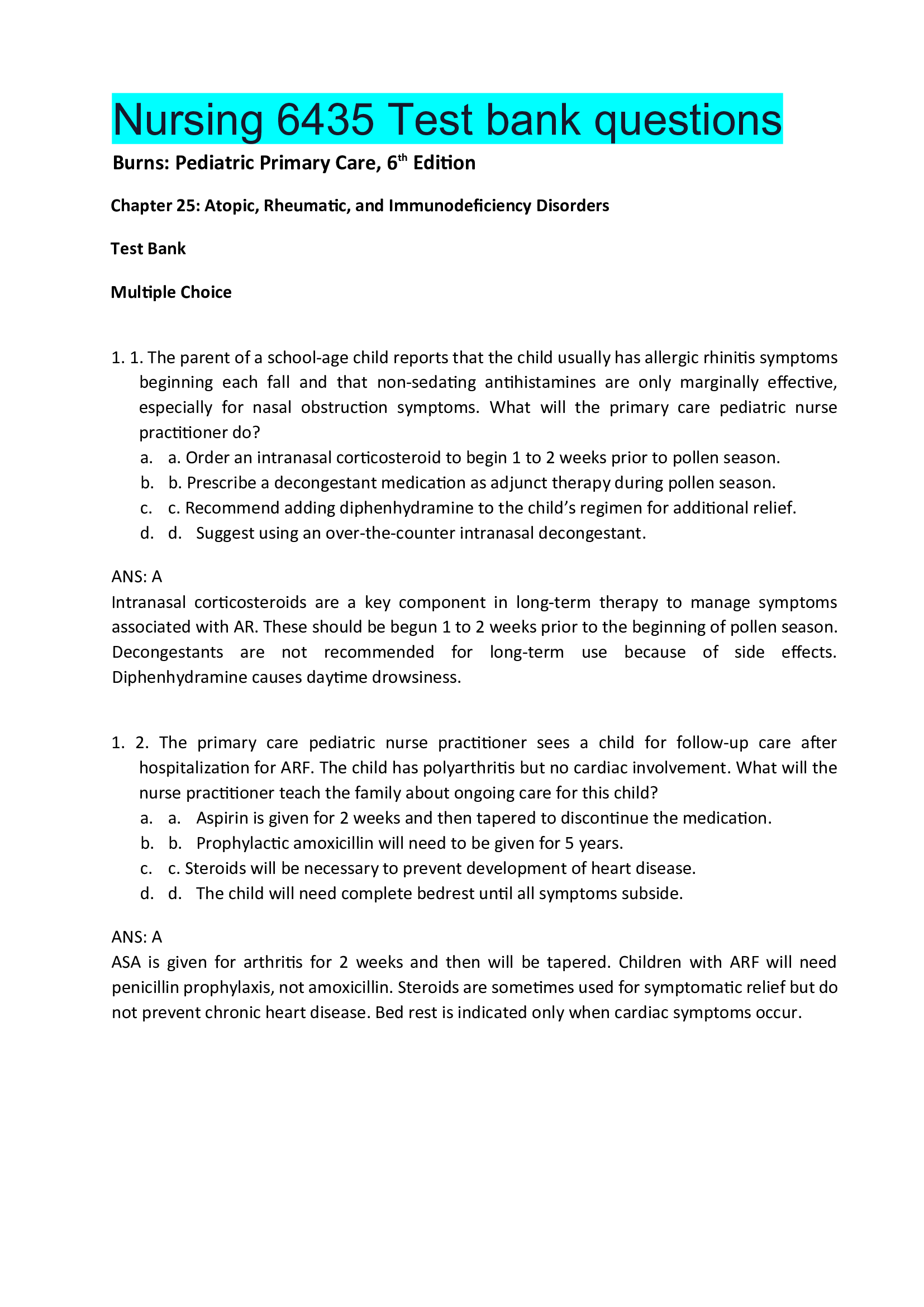
Nursing 6435 Test bank questions

Burns: Pediatric Primary Care, 6th Edition

Chapter 25: Atopic, Rheumatic, and Immunodeficiency Disorders

Test Bank

Multiple Choice

1. 1. The parent of a school-age child reports that the child usually has allergic rhinitis symptoms beginning each fall and that non-sedating antihistamines are only marginally effective, especially for nasal obstruction symptoms. What will the primary care pediatric nurse practitioner do?

a.      a. Order an intranasal corticosteroid to begin 1 to 2 weeks prior to pollen season.

b.      b. Prescribe a decongestant medication as adjunct therapy during pollen season.

c.       c. Recommend adding diphenhydramine to the child’s regimen for additional relief.

d.      d.   Suggest using an over-the-counter intranasal decongestant.

ANS: A

Intranasal corticosteroids are a key component in long-term therapy to manage symptoms associated with AR. These should be begun 1 to 2 weeks prior to the beginning of pollen season. Decongestants are not recommended for long-term use because of side effects. Diphenhydramine causes daytime drowsiness.

1. 2. The primary care pediatric nurse practitioner sees a child for follow-up care after hospitalization for ARF. The child has polyarthritis but no cardiac involvement. What will the nurse practitioner teach the family about ongoing care for this child?

a.      a.   Aspirin is given for 2 weeks and then tapered to discontinue the medication.

b.      b.   Prophylactic amoxicillin will need to be given for 5 years.

c.       c. Steroids will be necessary to prevent development of heart disease.

d.      d.   The child will need complete bedrest until all symptoms subside.

ANS: A

ASA is given for arthritis for 2 weeks and then will be tapered. Children with ARF will need penicillin prophylaxis, not amoxicillin. Steroids are sometimes used for symptomatic relief but do not prevent chronic heart disease. Bed rest is indicated only when cardiac symptoms occur.

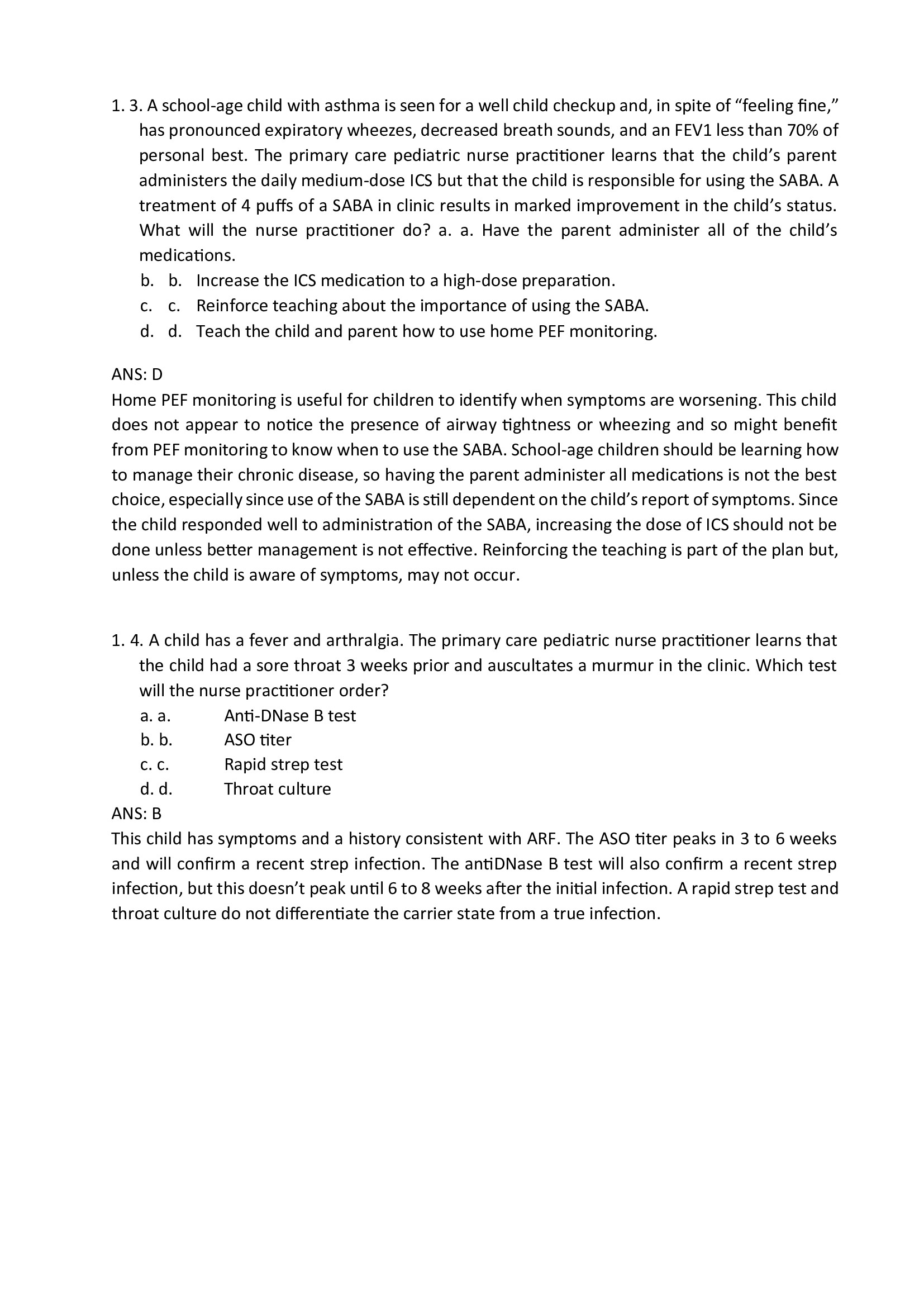
1. 3. A school-age child with asthma is seen for a well child checkup and, in spite of “feeling fine,” has pronounced expiratory wheezes, decreased breath sounds, and an FEV1 less than 70% of personal best. The primary care pediatric nurse practitioner learns that the child’s parent administers the daily medium-dose ICS but that the child is responsible for using the SABA. A treatment of 4 puffs of a SABA in clinic results in marked improvement in the child’s status. What will the nurse practitioner do? a. a. Have the parent administer all of the child’s medications.

b.      b.   Increase the ICS medication to a high-dose preparation.

c.       c.   Reinforce teaching about the importance of using the SABA.

d.      d.   Teach the child and parent how to use home PEF monitoring.

ANS: D

Home PEF monitoring is useful for children to identify when symptoms are worsening. This child does not appear to notice the presence of airway tightness or wheezing and so might benefit from PEF monitoring to know when to use the SABA. School-age children should be learning how to manage their chronic disease, so having the parent administer all medications is not the best choice, especially since use of the SABA is still dependent on the child’s report of symptoms. Since the child responded well to administration of the SABA, increasing the dose of ICS should not be done unless better management is not effective. Reinforcing the teaching is part of the plan but, unless the child is aware of symptoms, may not occur.

1. 4. A child has a fever and arthralgia. The primary care pediatric nurse practitioner learns that the child had a sore throat 3 weeks prior and auscultates a murmur in the clinic. Which test will the nurse practitioner order?

a. a.

Anti-DNase B test

b. b.

ASO titer

c. c.

Rapid strep test

d. d.

Throat culture

ANS: B

This child has symptoms and a history consistent with ARF. The ASO titer peaks in 3 to 6 weeks and will confirm a recent strep infection. The antiDNase B test will also confirm a recent strep infection, but this doesn’t peak until 6 to 8 weeks after the initial infection. A rapid strep test and throat culture do not differentiate the carrier state from a true infection.


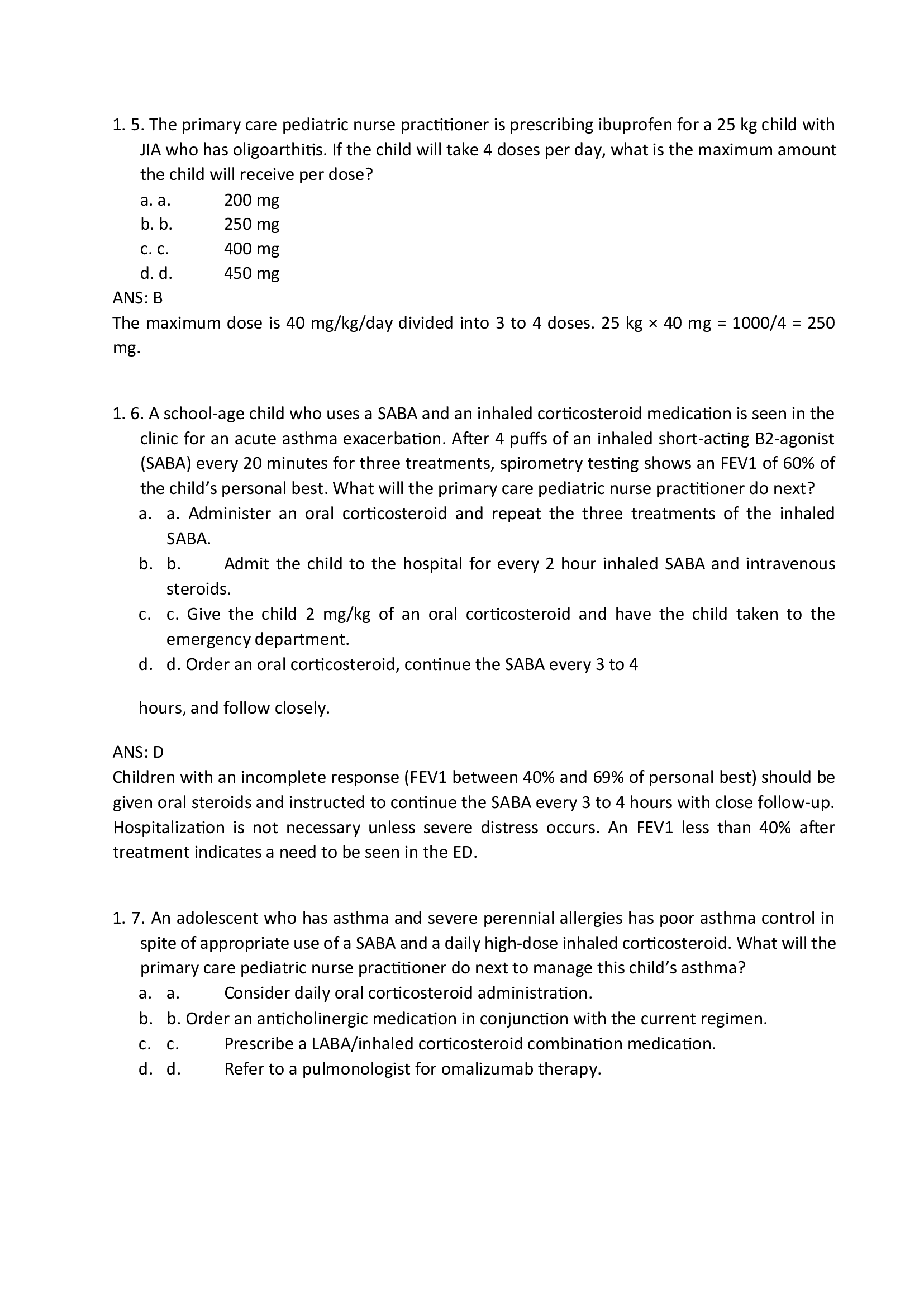
1. 5. The primary care pediatric nurse practitioner is prescribing ibuprofen for a 25 kg child with JIA who has oligoarthitis. If the child will take 4 doses per day, what is the maximum amount the child will receive per dose?

a. a.

200 mg

b. b.

250 mg

c. c.

400 mg

d. d.

450 mg

ANS: B

The maximum dose is 40 mg/kg/day divided into 3 to 4 doses. 25 kg × 40 mg = 1000/4 = 250 mg.

1. 6. A school-age child who uses a SABA and an inhaled corticosteroid medication is seen in the clinic for an acute asthma exacerbation. After 4 puffs of an inhaled short-acting B2-agonist (SABA) every 20 minutes for three treatments, spirometry testing shows an FEV1 of 60% of the child’s personal best. What will the primary care pediatric nurse practitioner do next?

a.      a. Administer an oral corticosteroid and repeat the three treatments of the inhaled SABA.

b.      b.         Admit the child to the hospital for every 2 hour inhaled SABA and intravenous steroids.

c.       c. Give the child 2 mg/kg of an oral corticosteroid and have the child taken to the emergency department.

d.      d. Order an oral corticosteroid, continue the SABA every 3 to 4

hours, and follow closely.

ANS: D

Children with an incomplete response (FEV1 between 40% and 69% of personal best) should be given oral steroids and instructed to continue the SABA every 3 to 4 hours with close follow-up. Hospitalization is not necessary unless severe distress occurs. An FEV1 less than 40% after treatment indicates a need to be seen in the ED.

1. 7. An adolescent who has asthma and severe perennial allergies has poor asthma control in spite of appropriate use of a SABA and a daily high-dose inhaled corticosteroid. What will the primary care pediatric nurse practitioner do next to manage this child’s asthma?

a.      a.         Consider daily oral corticosteroid administration.

b.      b. Order an anticholinergic medication in conjunction with the current regimen.

c.       c.          Prescribe a LABA/inhaled corticosteroid combination medication.

d.      d.         Refer to a pulmonologist for omalizumab therapy.

ANS: D

Children older than 12 years who have moderate to severe allergy-related asthma and who react to perennial allergens may benefit from omalizumab as a second-line treatment when symptoms are not controlled by ICSs. The PNP should refer children to a pulmonologist for such treatment. Daily oral corticosteroid medications are not recommended because of the adverse effects caused by prolonged use of this route. Anticholinergic medications are generally used for acute exacerbations during in-patient stays or in the ED. A LABA/ICS combination will not produce different results.

1. 8. A 4-month-old infant has a history of reddened, dry, itchy skin. The primary care pediatric nurse practitioner notes fine papules on the extensor aspect of the infant’s arms, anterior thighs, and lateral aspects of the cheeks. What is the initial treatment? a. a. Moisturizers

b.      b.         Oral antihistamines

c.       c.          Topical corticosteroids

d.      d.         Wet wrap therapy

ANS: A

Moisturization is the first-line therapy to interrupt the itch-scratch-itch cycle. Oral antihistamines are used mostly to allow sleep during nighttime pruritus. Topical corticosteroids are used if moisturization is not effective. Wet wrap therapy is used to treat flares with recalcitrant disease.

Contact the Seller

Please Sign In to contact this seller.


  • 👎  Report Copyright Violation

Frequently Asked Questions

What Do I Get When I Buy This Study Material?

+

When you buy a study material on Passing Grades, an instant download link will be sent directly to your email, giving you access to the file anytime after payment is completed.

Is Passing Grades a Trusted Platform?

+

Yes, Passing Grades is a reputable students’ marketplace with a secure payment system and reliable customer support. You can trust us to ensure a safe and seamless transaction experience.

Will I Be Stuck with a Subscription?

+

No, all purchases on Passing Grades are one-time transactions. You only pay for the notes you choose to buy, with no subscriptions or hidden fees attached.

Who Am I Buying These Study Materials From?

+

Passing Grades is a marketplace, which means you are purchasing the document from an individual vendor, not directly from us. We facilitate the payment and delivery process between you and the vendor.

Does Passing Grades Offer Free Study Materials?

+

Yes, sellers on Passing Grades have uploaded numerous free test banks, exams, practice questions, and class notes that can be downloaded at no cost.

Pasinggrades - Quality Study Materials

USD 15

    • Quality checked by Pasing Grades
    • 100% satisfaction guarantee
    • Seller: GradeA
Buy PDF $15

Seller Information

GradeA

Member since April 2021

  • icon
  • icon
  • icon
View Profile
  • total sales

    0
  • Favourites

    0
  • Comments

    0
    ( 0 Ratings )

Item Information

  • Uploaded

    22 May 2022

  • Updated

    24 October 2025

  • Category

    Nursing

  • Item Type

    exam

  • Tags

    Nursing 6435 NUR 6435

Related Exam Prep Guides by GradeA

Test Bank for Fundamentals of Corporate Finance 12th Edition By Stephen Ross and Randolph Westerfield and Bradford Jordan
View Document

Test Bank for Fundam...

  • GradeA

    GradeA

  • exam

Test Bank for Fundamentals of Corporate Finance 12th Edition By Stephen Ross and Randolph Westerfiel...

15 USD

0

0

[SOLUTION MANUAL) Fundamentals of Corporate Finance 12th Edition By Stephen Ross and Randolph Westerfield and Bradford Jordan
View Document

[SOLUTION MANUAL) Fu...

  • GradeA

    GradeA

  • exam

[SOLUTION MANUAL) Fundamentals of Corporate Finance 12th Edition By Stephen Ross and Randolph Wester...

15 USD

0

0

QMI1500 Assignment 02 2021 AS PER UPDATED TUTORIAL LETTER
View Document

QMI1500 Assignment 0...

  • GradeA

    GradeA

  • exam

QMI1500 Assignment 02 2021 AS PER UPDATED TUTORIAL LETTER...

15 USD

0

0

Purchase

Download link will be sent to this email immediately after purchase.

IMPORTANT LINKS

  • How To Upload Class Notes
  • Selling Tips
  • Passing Grades's Study Materials
  • Scholarships for International Students 2025

POPULAR CATEGORIES

  • Law
  • Accounting
  • English
  • Psychology
  • Business
  • Nursing
  • Computer Science
  • General

View Document

  • Blog
  • Contact
  • Delivery Policy
  • Latest Scholarships Around the World
  • How to Pass Bar Exams: Passing Grades’ Strategies
  • How to Study and Pass the CPA Exam
  • All Test Banks
  • Faq
  • Copyright Claims
  • Privacy Policy
  • Terms of Use

KNOWLEDGE BASE

  • How to Write A+ Grade Good Research Paper
  • How to Manage Stress During Exam Period
  • Best Time to Study
  • How to Pass NCLEX-RN Exam
  • How To Effectively Utilize Test Banks
  • Popular Shadow Health Exam Assessments
  • Popular HESI Case Studies
  • How to Prepare for a Nursing Career
  • The Importance Of Summaries in Exam Revisvion

© 2026 Pasing Grades. All rights reserved.