Pasing Grades
  • Start Selling
  • Blog
  • Contact
  • 0

    Your cart is empty!

English

  • English
  • Spanish
  • Arabic
Create Account Sign In
  • Library
    • New Prep Guides
    • Featured Prep Guides
    • Free Exam Prep Guides
    • Best sellers
  • General
  • Nursing
    • Research Paper
    • Case Study
    • Discussion Post
    • Assignment
    • Exam
    • Practice Questions and Answers
    • Test Bank
    • solutions manual
  • Accounting
    • Case Study
    • Thesis
    • Study Guide
    • Summary
    • Research Paper
    • test bank
  • English
    • Creative Writing
    • Research Paper
    • Summary
    • Rhetorics
    • Literature
    • Journal
    • Exam
    • Grammar
    • Discussion Post
    • Essay
  • Psychology
    • Hesi
    • Presentation
    • Essay
    • Summary
    • Study Guide
    • Essay
    • Solution Manual
    • Final Exam Review
    • Class Notes
    • test bank
  • Business
    • Lecture Notes
    • Solution Manual
    • Presentation
    • Business Plan
    • Class Notes
    • Experiment
    • Summary
    • Practice Questions
    • Study Guide
    • Case Study
    • test bank
    • Exam
  • More
    • Computer Science
    • Economics
    • Statistics
    • Engineering
    • Biology
    • Religious Studies
    • Physics
    • Chemistry
    • Mathematics
    • History
    • Sociology
    • Science
    • Philosophy
    • Law
  • Pages
    • About Us
    • Selling Tips
    • Delivery Policy
    • Faq
    • Privacy Policy
  • Flash Sale
  • Home
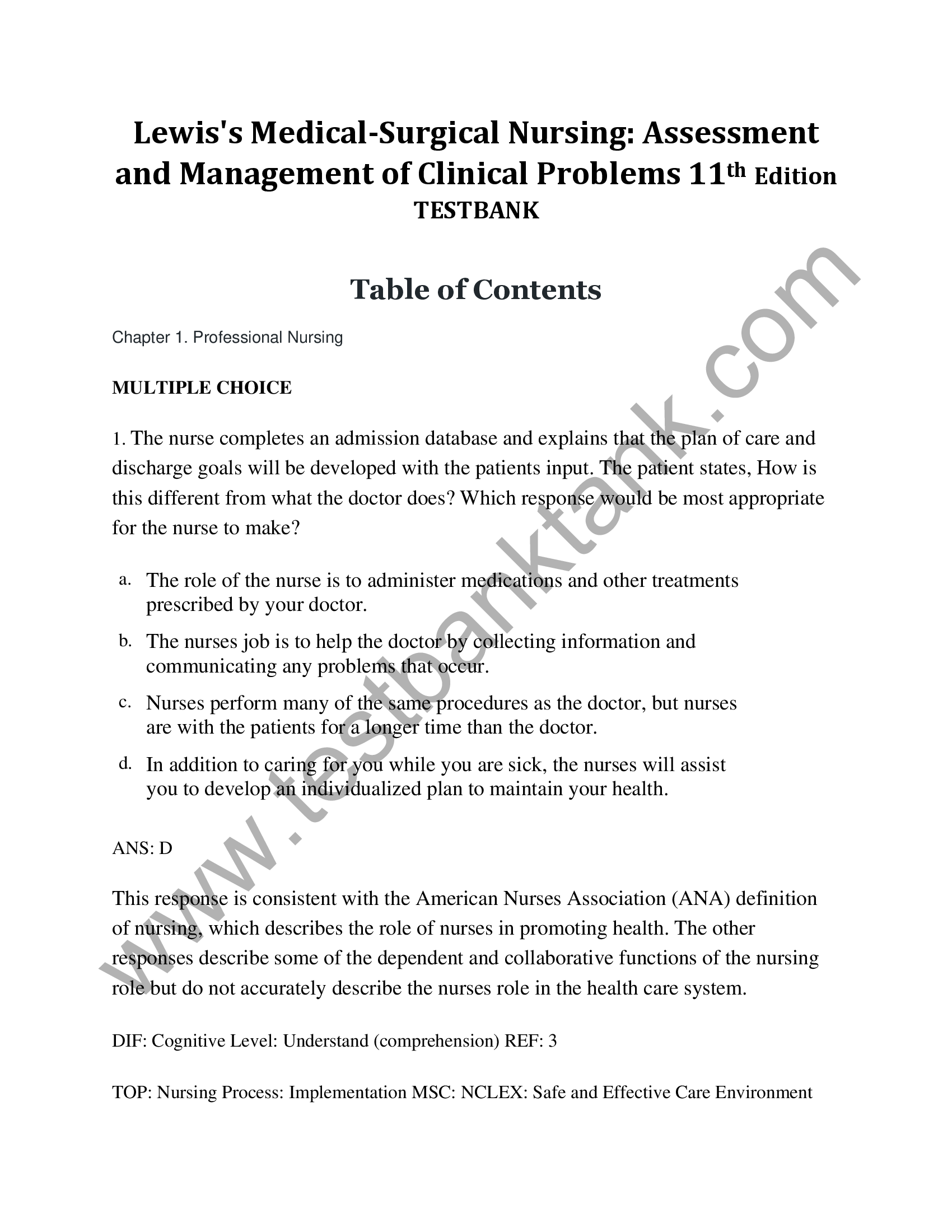
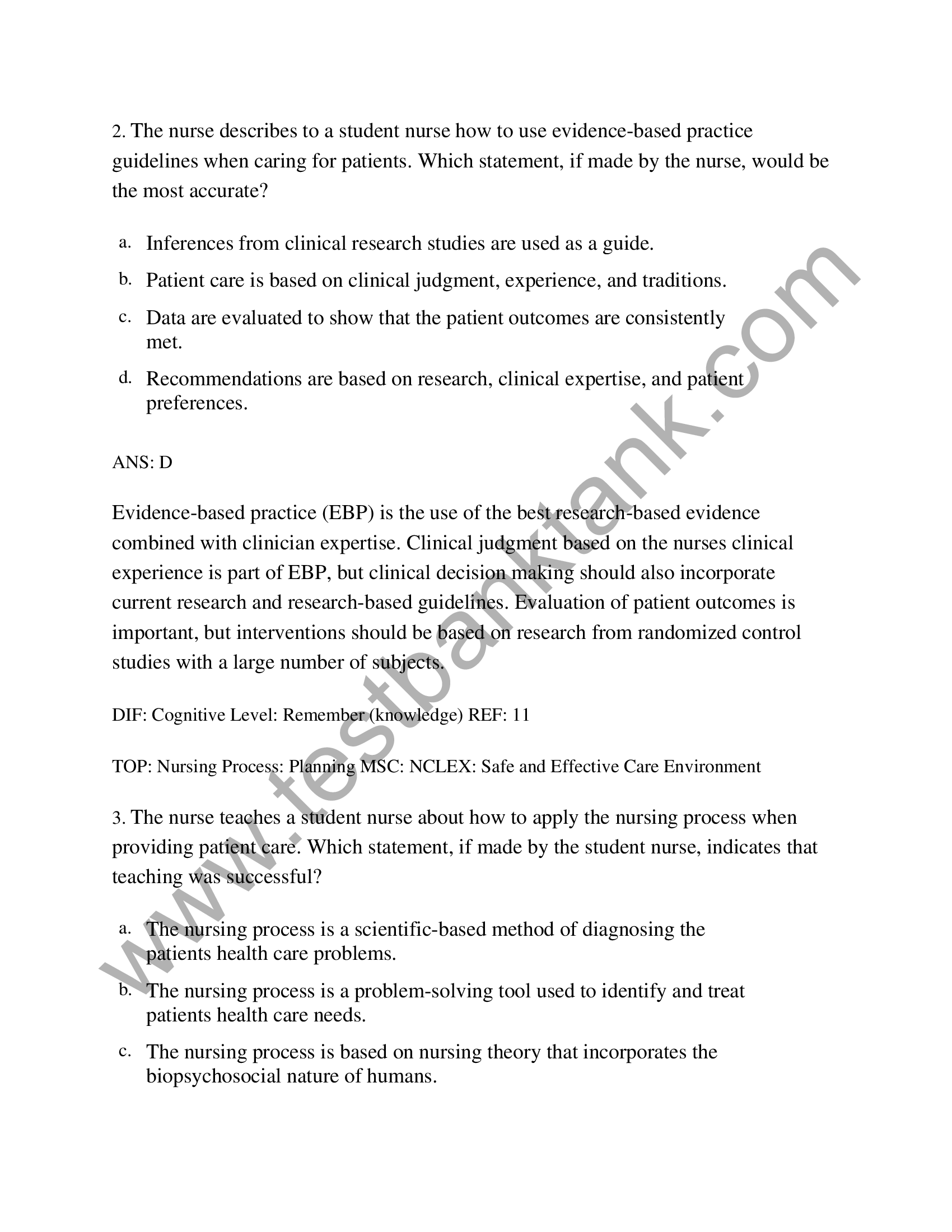
  • Lewis’s Medical Surgical Nursing 11th Edition Test Bank Latest (Questions + Answers + Rationale)

Lewis’s Medical Surgical Nursing 11th Edition Test Bank Latest (Questions + Answers + Rationale)

Preview page 1 Preview page 2 Preview page 3
Add To Favorites

Share this item Share this item

  • Item Details
  • Comments (0)
  • Reviews (0)
  • Contact Seller

Test Bank for Medical Surgical Nursing 11th Edition 

5. An alcohol-intoxicated patient with a penetrating wound to the abdomen is undergoing emergency surgery. What will the nurse expect the patient to need during the perioperative period?

a.   An increased dose of the general anesthetic medication

b.  Frequent monitoring for bleeding and respiratory complications

c.   Interventions to prevent withdrawal symptoms within a few hours

d.  Stimulation every hour to prevent prolonged postoperative sedation

ANS: B

Patients who are intoxicated at the time of surgery are at increased risk for problems with bleeding and respiratory complications such as aspiration. In an intoxicated patient, a lower dose of anesthesia is used because of the synergistic effect of the alcohol. Withdrawal is likely to occur later in the postoperative course because the medications used for anesthesia, sedation, and pain will delay withdrawal symptoms. The patient should be monitored frequently for oversedation but does not need to be stimulated.

6. A patient with alcohol dependence is admitted to the hospital with back pain following a fall. Twenty-four hours after admission, the patient becomes tremulous and anxious. Which action by the nurse is most appropriate?

a.   Insert an IV line and infuse fluids.

b.  Promote oral intake to 3000 mL/day.

c.   Provide a quiet, well-lit environment.

d.  Administer opioids to provide sedation.

ANS: C

The patients symptoms suggest acute alcohol withdrawal, and a quiet and well-lit environment will help decrease agitation, delusions, and hallucinations. There is no

indication that the patient is dehydrated. Benzodiazepines, rather than opioids, are used to prevent withdrawal. IV lines are avoided whenever possible.

7. A patient with a history of heavy alcohol use is diagnosed with acute gastritis. Which statement by the patient indicates a willingness to stop alcohol use?

a.   I am older and wiser now, and I think I can change my drinking behavior.

b.  Alcohol has never bothered my stomach before. I think I likely have the flu.

c.   My drinking is affecting my stomach, but some drugs will help me feel better.

d.  People say that I drink too much, but I really feel pretty good most of the time.

ANS: A

The statement I am older and wiser now, and I know I can change my drinking behavior indicates the patient expresses willingness to stop alcohol use and an initial commitment to changing alcohol intake behaviors. In the remaining statements, the patient recognizes that alcohol use is the reason for the gastritis but is not yet willing to make a change.

8. A patient who smokes a pack of cigarettes daily develops tachycardia and irritability on the second day after abdominal surgery. What is the nurses best action at this time?

a.   Escort the patient outside where smoking is allowed.

b.  Move the patient to a private room and allow smoking. c.   Tell the patient that this is a good time to quit smoking. d.  Request a prescription for a nicotine replacement agent.

ANS: D

Nicotine replacement agents should be prescribed for patients who smoke and are hospitalized to avoid withdrawal symptoms. Allowing the patient to smoke encourages ongoing smoking. Urging the patient to quit smoking is appropriate, but the first action should be to obtain appropriate medications to prevent withdrawal symptoms.

9. A patient who is admitted to the hospital for wound debridement admits to using fentanyl (Sublimaze) illegally. What finding does the nurse expect?

a.   Nausea and diarrhea

b.  Tremors and seizures

c.   Lethargy and disorientation

d.  Delusions and hallucinations

ANS: A

Symptoms of opioid withdrawal include gastrointestinal symptoms such as nausea, vomiting, and diarrhea. The other symptoms are seen during withdrawal from other substances such as alcohol, sedative-hypnotics, or stimulants.

10. A newly admitted patient complains of waking frequently during the night. The nurse observes the patient wearing a nicotine patch (Nicoderm CQ) on the right upper arm. Which action is best for the nurse to take?

a.   Question the patient about use of the patch at night.

b.  Suggest that the patient go to bed earlier in the evening.

c.   Ask the health care provider about prescribing a sedative drug for nighttime use.

d.  Remind the patient that the benefits of the patch outweigh the short-term insomnia.

Insomnia can occur when nicotine patches are used all night. This can be resolved by removing the patch in the evening. The other actions may be helpful in improving the patients sleep, but the initial action should be to ask about nighttime use of the patch and suggest removal of the patch at bedtime.

11. During physical assessment of a patient who has frequent nosebleeds, the nurse finds nasal sores and necrosis of the nasal septum. The nurse should ask the patient specifically about the use of which drug?

a.   Heroin

b.  Cocaine

c.   Tobacco

d.  Marijuana

ANS: B

When cocaine is inhaled, it causes ischemia of the nasal septum, leading to nasal sores and necrosis. These symptoms are not associated with the use of heroin, tobacco, or marijuana.

12. A patient admitted with shortness of breath and chest pain who is a pack-a-day smoker tells the nurse, I am just not ready to quit smoking yet. Which response by the nurse is best?

a.   This would be a really good time to quit.

b.  Your smoking is the cause of your chest pain.

c.   What health problems do you think smoking has caused?

d.  Are you familiar with the various nicotine replacement options?

ANS: C


The patient is in the precontemplation stage of change, and the nurses role is to assist the patient to become motivated to quit. The current Clinical Practice Guidelines


indicate that the nurse should ask the patient to identify any negative consequences from smoking. The responses This would be a really good time to quit and Your smoking is the cause of your chest pain express judgmental feelings by the nurse and are not likely to motivate the patient. Providing information about the various nicotine replacement options would be appropriate for a patient who has expressed a desire to quit smoking.


13. A disoriented and agitated patient comes to the emergency department and admits using methamphetamine. Vital signs are blood pressure 162/98, heart rate 142 and irregular, and respirations 32. Which action by the nurse ismost important?


a.   Reorient the patient at frequent intervals.


b.  Monitor the patients electrocardiogram (ECG) and vital signs.


c.   Keep the patient in a quiet and darkened room.


d.  Obtain a health history including prior drug use.


ANS: B


The priority is to ensure physiologic stability given that methamphetamine use can lead to complications such as myocardial infarction. The other actions are also appropriate but are not of as high a priority.


14. A 75-year-old patient is admitted for pancreatitis. Which tool would be the most

appropriate for the nurse to use during the admission assessment?


a.   Drug Abuse Screening Test (DAST-10)


b.  Clinical Institute Withdrawal Assessment of Alcohol Scale, Revised

(CIWA-Ar)


c.   Screening Test-Geriatric Version (SMAST-G)


d.  Mini-Mental State Examination


Because the abuse of alcohol is a common factor associated with the development of pancreatitis, the first assessment step is to screen for alcohol use using a validated screening questionnaire. The SMAST-G is a short-form alcoholism screening instrument tailored specifically to the needs of the older adult. If the patient scores positively on the SMAST-G, then the CIWA-Ar would be a useful tool for determining treatment. The DAST-10 provides more general information regarding substance use. The Mini-Mental State Examination is used to screen for cognitive impairment.


15. An older adult patient who has been taking alprazolam (Xanax) calls the clinic asking for a refill of the prescription 1 month before the alprazolam should need to be refilled. Which response by the nurse is best?


a.   The prescription cannot be refilled for another month. What happened to all of your pills?


b.  Do you have any muscle cramps and tremors if you dont take the medication frequently?


c.   I am concerned that you may be overusing the Xanax. Lets make an appointment for you to see the doctor.


d.  I will ask the doctor to prescribe a few more pills, but you will not be able to get any more for another month.


ANS: C


The patient should be assessed for problems that are causing overuse of alprazolam , such as anxiety or memory loss. The other responses by the nurse will not allow for the needed assessment and possible referral for support services or treatment of drug dependence.


16. A patient who has inhaled cocaine is admitted to the emergency department with palpitations and shortness of breath. What should the nurse do first?


a.   Obtain a 12-lead echocardiogram (ECG).


b.  Start oxygen at 4 L/minute.


c.   Draw blood for drug screening.


d.  Infuse normal saline at 100 mL/hr.


ANS: B


The priority here is to ensure that oxygenation is adequate. The other orders also should be accomplished as soon as possible but are not the first priority.


17. The nurse cares for an agitated patient who was admitted to the emergency department after taking a hallucinogenic drug and attempting to jump from a third- story window. Which nursing diagnosis should the nurse assign as the highest priority?


a.   Risk for injury related to altered perception


b.  Ineffective health maintenance related to drug use


c.   Powerlessness related to loss of behavioral control


d.  Ineffective denial related to lack of control of life situation


ANS: A


Although all the diagnoses may be appropriate for the patient, the highest priority is to address the patients immediate risk for injury.


18. A young adult patient comes to the emergency department with severe chest pain and agitation. Which action should the nurse take first?


a.   Give naloxone (Narcan) IV.


b.  Ask about any use of stimulant drugs.


c.   Assess orientation to person, place, and time.


d.  Check blood pressure, pulse, and respirations.


The patient has symptoms consistent with the use of cocaine or amphetamines and is at risk for fatal tachydysrhythmias or complications of hypertension such as stroke or myocardial infarction. The nurse also will ask about drug use and assess orientation, but these are not the priority actions. Naloxone may be given if the patient develops symptoms of central nervous system (CNS) depression, but this patients current symptoms indicate stimulant use.


19. A patient presents to the emergency department with a blood alcohol concentration (BAC) of 0.18%. After reviewing the medication orders, which drug should the nurse administer first?


a.   Thiamine (vitamin B1) 100 mg daily b.  Lorazepam (Ativan) 1 mg as needed c.   Folic acid (Vitamin B9) 0.4 mg daily

d.  Dextrose 5% in 0.45 saline at 125 mL/hr


ANS: A


Thiamine is given to all patients with alcohol intoxication to prevent Wernickes encephalopathy. Because Wernickes encephalopathy can be precipitated by the administration of glucose solutions, the thiamine should be given before (or concurrently with) the 5% dextrose solution. Lorazepam would not be appropriate while the patient still has an elevated BAC. Folic acid may also be administered, but is not as important as thiamine.


20. Which information is most important for the nurse to report to the health care provider about a patient who has been using varenicline (Chantix)?


a.   The patient continues to smoke a few cigarettes every day.


b.  The patient complains of headaches that occur almost daily. c.   The patient complains of new-onset sadness and depression. d.  The patient says, I have decided that I am not ready to quit.


Adverse effects of varenicline include depression and attempted suicide. The patients symptoms require immediate assessment and discontinuation of the drug. The other information will also be reported, but it does not indicate any life-threatening problems associated with the medication.


21. A patient who has a history of ongoing opioid abuse is hospitalized for surgery. After a visit by a friend, the nurse finds that the patient is unresponsive with pinpoint pupils. Which prescribed medication will the nurse administerimmediately?


a.   Naloxone (Narcan) b.   Diazepam (Valium) c.   Clonidine (Catapres)

d.  Methadone (Dolophine)


ANS: A


The patients assessment indicates an opioid overdose, and naloxone should be given to prevent respiratory arrest. The other medications may be used to decrease symptoms associated with opioid withdrawal but would not be appropriate for an overdose.


22. After receiving change-of-shift report on four patients who are undergoing substance abuse treatment, which patient will the nurse assess first?


a.   A patient who has just arrived for alcohol abuse treatment and states that the last drink was 3 hours ago


b.  A patient who is agitated and experiencing nausea, occasional vomiting, and diarrhea while withdrawing from heroin


c.   A patient who has tremors secondary to benzodiazepine withdrawal and whose last benzodiazepine use was 4 days ago


d.  A patient who is being treated for cocaine addiction and is irritable and disoriented, with a pulse rate of 112 beats/minute


The patients tremors indicate risk for seizures and possible cardiac/respiratory arrest, which can occur with withdrawal from sedative-hypnotics. The greatest risk for these complications is during days three to five after stopping the drug. Opioid and stimulant withdrawal is uncomfortable, but not life threatening. Symptoms of alcohol withdrawal do not occur until 4 to 6 hours after the last drink.


23. After the nurse receives report, which patient should the nurse assess first?


a.   Patient who has a respiratory rate of 14 after overdosing on oxycodone

(OxyContin)


b.  Patient admitted with cocaine use who has an irregular heart rate of 142 beats/minute


c.   Patient who is experiencing hallucinations and extreme anxiety after the use of marijuana


d.  Patient with a history of daily alcohol use who is complaining of insomnia and diaphoresis


ANS: B


Because the patient with cocaine use has symptoms suggestive of a possible fatal dysrhythmia, this patient should be assessed immediately. The other patients should also be seen as soon as possible, but their clinical manifestations do not suggest that life-threatening complications may be occurring.


24. Which nursing activity can the nurse delegate to unlicensed assistive personnel

(UAP) who are working in a family practice clinic?


a.   Make referrals to community substance abuse treatment centers.


b.  Teach patients about the use of prescribed nicotine replacement products.


c.   Administer and score the Alcohol Use Disorders Identification Test

(AUDIT).


d.  Obtain patient histories regarding alcohol, tobacco, and other substance abuse.


ANS: C


No clinical judgment is needed to administer the AUDIT, which is a written questionnaire that is given to patients for self-administration and scored based on patient answers. Making appropriate referrals, patient teaching, and obtaining a patient history all require critical thinking and RN education and scope of practice.


OTHER


1. A patient is admitted to the emergency department for treatment of a possible opioid overdose. Rank the nursing activities in the correct order from first activity to last activity. (Put a comma and a space between each answer choice [A, B, C, D, E]).


a. Initiate IV access.


b. Take a health history.


c. Obtain a toxicology screen.


d. Administer naloxone (Narcan).


e. Provide respiratory support with a bag-valve mask.


ANS:


E, A, D, C, B


Maintenance of the airway is the first priority for patients with possible depressant overdose. Opioid antagonists are given before toxicology testing is done because reversal of the opioid will prevent respiratory arrest. However, this will require IV access. The toxicology report will help guide further treatment for possible multiple substance ingestions. The health history will guide care after the initial emergency treatment phase.


Chapter 11. Inflammation and Healing


MULTIPLE CHOICE


1. The nurse assesses a patients surgical wound on the first postoperative day and notes redness and warmth around the incision. Which action by the nurse is most appropriate?


a.   Obtain wound cultures.


b.  Document the assessment.


c.   Notify the health care provider.


d.  Assess the wound every 2 hours.


ANS: B


The incisional redness and warmth are indicators of the normal initial (inflammatory) stage of wound healing by primary intention. The nurse should document the wound appearance and continue to monitor the wound. Notification of the health care provider, assessment every 2 hours, and obtaining wound cultures are not indicated because the healing is progressing normally.


2. A patient with an open leg wound has a white blood cell (WBC) count of 13, 500/L

and a band count of 11%. What action should the nurse take first?


a.   Obtain wound cultures.


b.  Start antibiotic therapy.


c.   Redress the wound with wet-to-dry dressings.


d.  Continue to monitor the wound for purulent drainage.


ANS: A


The increase in WBC count with the increased bands (shift to the left) indicates that the patient probably has a bacterial infection, and the nurse should obtain wound


cultures. Antibiotic therapy and/or dressing changes may be started, but cultures should be done first. The nurse will continue to monitor the wound, but additional actions are needed as well.


3. A patient with a systemic bacterial infection feels cold and has a shaking chill. Which assessment finding will the nurse expect next?


a.   Skin flushing


b.  Muscle cramps


c.   Rising body temperature


d.  Decreasing blood pressure


ANS: C


The patients complaints of feeling cold and shivering indicate that the hypothalamic set point for temperature has been increased and the temperature is increasing. Because associated peripheral vasoconstriction and sympathetic nervous system stimulation will occur, skin flushing and hypotension are not expected. Muscle cramps are not expected with chills and shivering or with a rising temperature.


4. A young adult patient who is receiving antibiotics for an infected leg wound has a temperature of 101.8 F (38.7 C). Which action by the nurse is most appropriate?


a.   Apply a cooling blanket.


b.  Notify the health care provider.


c.   Give the prescribed PRN aspirin (Ascriptin) 650 mg.


d.  Check the patients oral temperature again in 4 hours.


ANS: D

Mild to moderate temperature elevations (less than 103 F) do not harm the young adult patient and may benefit host defense mechanisms. The nurse should continue to monitor the temperature. Antipyretics are not indicated unless the patient is

Contact the Seller

Please Sign In to contact this seller.


  • 👎  Report Copyright Violation

Frequently Asked Questions

What Do I Get When I Buy This Study Material?

+

When you buy a study material on Passing Grades, an instant download link will be sent directly to your email, giving you access to the file anytime after payment is completed.

Is Passing Grades a Trusted Platform?

+

Yes, Passing Grades is a reputable students’ marketplace with a secure payment system and reliable customer support. You can trust us to ensure a safe and seamless transaction experience.

Will I Be Stuck with a Subscription?

+

No, all purchases on Passing Grades are one-time transactions. You only pay for the notes you choose to buy, with no subscriptions or hidden fees attached.

Who Am I Buying These Study Materials From?

+

Passing Grades is a marketplace, which means you are purchasing the document from an individual vendor, not directly from us. We facilitate the payment and delivery process between you and the vendor.

Does Passing Grades Offer Free Study Materials?

+

Yes, sellers on Passing Grades have uploaded numerous free test banks, exams, practice questions, and class notes that can be downloaded at no cost.

Pasinggrades - Quality Study Materials

USD 15

    • Quality checked by Pasing Grades
    • 100% satisfaction guarantee
    • Seller: mentor2000
Buy PDF $15

Seller Information

mentor2000

Member since April 2021

  • icon
  • icon
View Profile
  • total sales

    1
  • Favourites

    0
  • Comments

    0
    ( 0 Ratings )

Item Information

  • Uploaded

    18 December 2023

  • Updated

    01 October 2025

  • Category

    Nursing

  • Item Type

    test bank

  • Tags

    Lewis’s Medical Surgical Nursing 11th Edition Test Bank Latest 2024 2025

Related Exam Prep Guides by mentor2000

Test Bank for Essentials for Nursing Practice 8th Edition by Potter | All Chapters
View Document

Test Bank for Essent...

  • mentor2000

    mentor2000

  • test bank

Master nursing concepts with this study material; Test Bank for Essentials for Nursing Practice, 8th...

15 USD

0

1

A &P 1 MA278 BSC2 Final Module II Questions & Answers 2026 Update
View Document

A &P 1 MA278 BSC2 Fi...

  • mentor2000

    mentor2000

  • test bank

Prepare for success with A&P 1 MA278 BSC2 Final Module II 2024 Q&A. Boost your grades with this comp...

15 USD

0

1

ATI Comprehensive Predictor Exam 2026
View Document

ATI Comprehensive Pr...

  • mentor2000

    mentor2000

  • test bank

Prepare for success with the ATI Comprehensive Predictor Exam 2026. Access key practice questions to...

15 USD

0

1

Purchase

Download link will be sent to this email immediately after purchase.

IMPORTANT LINKS

  • How To Upload Class Notes
  • Selling Tips
  • Passing Grades's Study Materials
  • Scholarships for International Students 2026

POPULAR CATEGORIES

  • Law
  • Accounting
  • English
  • Psychology
  • Business
  • Nursing
  • Computer Science
  • General

View Document

  • Blog
  • Contact
  • Delivery Policy
  • Latest Scholarships Around the World
  • How to Pass Bar Exams: Passing Grades’ Strategies
  • How to Study and Pass the CPA Exam
  • All Test Banks
  • Faq
  • Copyright Claims
  • Privacy Policy
  • Terms of Use

KNOWLEDGE BASE

  • How to Write A+ Grade Good Research Paper
  • How to Manage Stress During Exam Period
  • Best Time to Study
  • How to Pass NCLEX-RN Exam
  • How To Effectively Utilize Test Banks
  • Popular Shadow Health Exam Assessments
  • Popular HESI Case Studies
  • How to Prepare for a Nursing Career
  • The Importance Of Summaries in Exam Revisvion

© 2026 Pasing Grades. All rights reserved.