Pasing Grades
  • Start Selling
  • Blog
  • Contact
  • 0

    Your cart is empty!

English

  • English
  • Spanish
  • Arabic
Create Account Sign In
  • Library
    • New Prep Guides
    • Featured Prep Guides
    • Free Exam Prep Guides
    • Best sellers
  • General
  • Nursing
    • Research Paper
    • Case Study
    • Discussion Post
    • Assignment
    • Exam
    • Practice Questions and Answers
    • Test Bank
    • solutions manual
  • Accounting
    • Case Study
    • Thesis
    • Study Guide
    • Summary
    • Research Paper
    • test bank
  • English
    • Creative Writing
    • Research Paper
    • Summary
    • Rhetorics
    • Literature
    • Journal
    • Exam
    • Grammar
    • Discussion Post
    • Essay
  • Psychology
    • Hesi
    • Presentation
    • Essay
    • Summary
    • Study Guide
    • Essay
    • Solution Manual
    • Final Exam Review
    • Class Notes
    • test bank
  • Business
    • Lecture Notes
    • Solution Manual
    • Presentation
    • Business Plan
    • Class Notes
    • Experiment
    • Summary
    • Practice Questions
    • Study Guide
    • Case Study
    • test bank
    • Exam
  • More
    • Computer Science
    • Economics
    • Statistics
    • Engineering
    • Biology
    • Religious Studies
    • Physics
    • Chemistry
    • Mathematics
    • History
    • Sociology
    • Science
    • Philosophy
    • Law
  • Pages
    • About Us
    • Selling Tips
    • Delivery Policy
    • Faq
    • Privacy Policy
  • Flash Sale
  • Home
  • LEV 3701 Law of Evidence Admissibility of Evidence Summary Exam Notes

LEV 3701 Law of Evidence Admissibility of Evidence Summary Exam Notes

Preview page 1 Preview page 2 Preview page 3
Add To Favorites

Share this item Share this item

  • Item Details
  • Comments (0)
  • Reviews (0)
  • Contact Seller
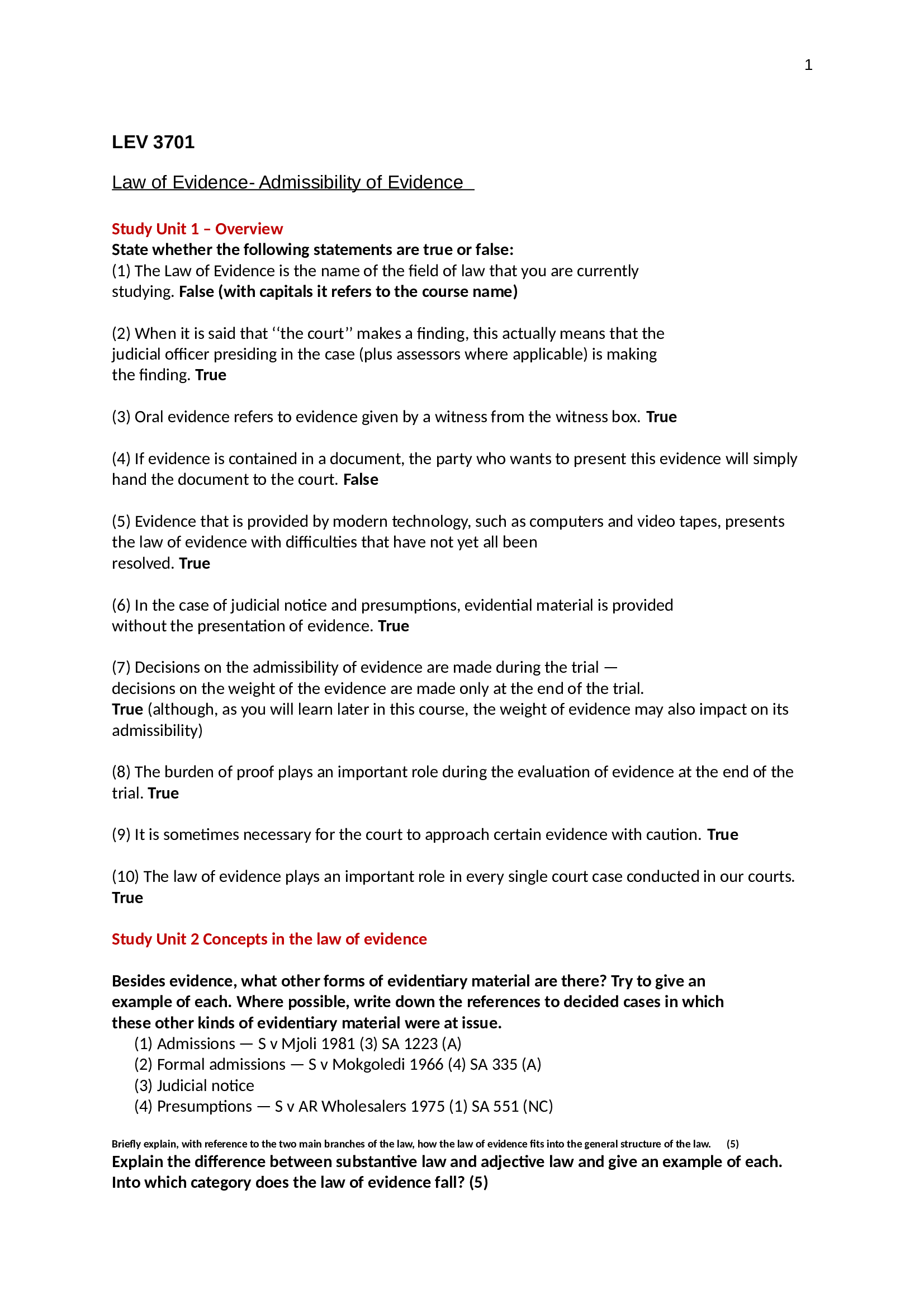
1 LEV 3701 Law of Evidence- Admissibility of Evidence Study Unit 1 – Overview State whether the following statements are true or false: (1) The Law of Evidence is the name of the field of law that you are currently studying. False (with capitals it refers to the course name) (2) When it is said that ‘‘the court’’ makes a finding, this actually means that the judicial officer presiding in the case (plus assessors where applicable) is making the finding. True (3) Oral evidence refers to evidence given by a witness from the witness box. True (4) If evidence is contained in a document, the party who wants to present this evidence will simply hand the document to the court. False (5) Evidence that is provided by modern technology, such as computers and video tapes, presents the law of evidence with difficulties that have not yet all been resolved. True (6) In the case of judicial notice and presumptions, evidential material is provided without the presentation of evidence. True (7) Decisions on the admissibility of evidence are made during the trial — decisions on the weight of the evidence are made only at the end of the trial. True (although, as you will learn later in this course, the weight of evidence may also impact on its admissibility) (8) The burden of proof plays an important role during the evaluation of evidence at the end of the trial. True (9) It is sometimes necessary for the court to approach certain evidence with caution. True (10) The law of evidence plays an important role in every single court case conducted in our courts. True Study Unit 2 Concepts in the law of evidence Besides evidence, what other forms of evidentiary material are there? Try to give an example of each. Where possible, write down the references to decided cases in which these other kinds of evidentiary material were at issue. (1) Admissions — S v Mjoli 1981 (3) SA 1223 (A) (2) Formal admissions — S v Mokgoledi 1966 (4) SA 335 (A) (3) Judicial notice (4) Presumptions — S v AR Wholesalers 1975 (1) SA 551 (NC) Briefly explain, with reference to the two main branches of the law, how the law of evidence fits into the general structure of the law. (5) Explain the difference between substantive law and adjective law and give an example of each. Into which category does the law of evidence fall? (5) 2 Substantive law covers one’s rights and obligations. It tells what one may or may not do. Criminal law is an example of substantive law. Adjective law (sometimes known as procedural law) prescribes the general procedure to be followed in court and legal transactions. Criminal procedure is an example of adjective law. Therefore, the law of evidence is part of adjective law. Briefly explain the relationship between “proof” and the law of evidence.(5) The law of evidence may be defined as that field of law which generally regulates the proof of facts in court. Proof therefore is central to the entire field of the law of evidence. Proof : having sufficient grounds for a finding on a point in issue. Proof of a fact means that the court has received probative material with regard to such fact and has accepted such fact as being the truth for purposes of the specific case Evidence : probative (evidentiary) material (oral, documentary or real evidence) which is produced in court. Evidence of a fact is not yet proof of such fact: the court must still decide whether or not such fact has been proved. Evidential material : material which goes to furnish proof Study unit 3 Sources of the law of evidence Historical source of the law of evidence: Procedural law of South Africa is mostly drawn from principles of English law and therefore regarded as the common law for the law of evidence in south Africa, consequently courts may have recourse to English law in the event of any uncertainty on an aspect of the law of evidence. Knowledge sources are a wider concept, covering not only the historical sources, but also relevant court cases creating binding law and applicable South African legislation eg the Criminal Procedure Act 51 of 1977 and the Civil Proceedings Evidence Act 25 of 1965 applying particularly to the law of evidence as well as the Constitution of the Republic of South Africa 1996 which is the highest source of law and its principal provisions affecting the law of evidence are the fundamental rights (‘‘Bill of Rights’’). (1) Write down the wording of section 252 of the Criminal Procedure Act 51 of 1977. Section 252 of CPA : The law as to the admissibility of evidence which was in force in respect of criminal proceedings on the thirtieth day of May 1961, shall apply in any case not expressly provided for by this Act or any other law. (2) Explain what is meant by a ‘‘residuary clause’’ in South African law. A residuary clause determines that foreign law has to be followed on topics for which no express local statutory provision had been made (Indirect incorporation). These are those sections in South African statutes which incorporate foreign law into South African law and thereby preserve that part of foreign law. Mention the principal provisions of the Constitution of the Republic of South Africa, 1996 that affect the law of evidence. (5) Section 35(1) of the Constitution provides that every arrested person shall have the right (1) to be informed, in an understandable language, that he or she has the right to remain silent, and about the consequences of making a statement (sec 35(1)(a) and (b)) (2) not to be compelled to make a confession or admission which could be used in evidence against him or her (sec 35(1)(c)) Section 35(2) provides for the rights of a detained person including the right (s 35(2)(a)) - to be informed promptly of the reason for being detained (s 35 (2)(b)) - to choose, and to consult with a legal practitioner, and to be informed of this right promptly 3 (s35(2)(c)) - to have a legal practitioner assigned to the detained person by the state and at state expense if substantial injustice would otherwise result, and to be informed of this right promptly Section 35(3) provides that every accused person shall have the right to a fair trial, which includes the right (1) to be informed of the charge with sufficient details to answer it (sec 35(3)(a)) (2) to be presumed innocent, to remain silent during the plea proceedings as well as during the trial, and not to testify during the trial (sec 35(3)(h)) and (3) to adduce and challenge evidence and not to be a compellable witness against himself or herself (sec 35(3)(I) and (j)) Section 35(5) provides that evidence obtained in a manner that violates any right in the Bill of Rights must be excluded if the admission of that evidence would render the trial unfair or would otherwise be detrimental to the administration of justice. Study unit 4 Relevance and admissibility of evidence . explain the meaning of relevance and its relationship with the admissibility of evidence . list the ‘‘facts in issue’’ in any given case . relate the admissibility of evidence to questions such as the reasonableness of inferences drawn from certain evidence and the prejudicial effect of admitting any evidence From your reading material, give at least two examples that show that evidence may be inadmissible, despite being relevant. a) If the evidence is privileged. b) If the evidence was obtained in breach of constitutional rights. Definition of relevance: There needs to be a logical connection between the issues of the case before the court and the evidence. According to: (1) Stephen: Essential elements are the following: two facts are related; one normally proves the other or renders it probable (or not); whether the fact is past, present or future; either by itself or with other facts. (2) The US Federal Rules of Evidence: Evidence which tends to make any fact of consequence to the action more, or less, probable than without the evidence In the case of S v Shabalala 1986 (4) SA 734 (A); (1) What is the main reason why the evidence about the behaviour of the police dog was not admitted in R v Trupedo 1920 AD 58? The probative value was too tenuous (flimsy), in other words not relevant. To draw inferences from dogs’ abilities is to enter a region of “conjecture and uncertainty”. (2) A number of writers have suggested that the decision in R v Trupedo does not mean that evidence about tracking dogs will always be inadmissible. In what way do they argue should the judgment be viewed? The judgment was decided on the facts of the particular case and inadequacy of scientific knowledge at the time. Modern information about the scenting ability of dogs and their training may justify admission of the evidence. (3) What role did the untrustworthiness of the evidence play in the court’s decision? The (extreme) untrustworthiness was of fundamental importance. If this element is sufficiently reduced the evidence would become admissible. 4 (4) Finally, the court warned that the distinction between weight and admissibility should not be blurred. What principle did the court establish in this connection? If the weight of the evidence is so inconsequential and relevance so problematic, it serves no purpose to accept the evidence. Read S v Mavuso 1987 (3) SA 499 (A) Answer the following questions: (1) Write down the ‘‘test’’ for relevance as stated in R v Mpanza 1915 AD 348 at 352. “[A]ny facts are so relevant if from their existence inferences may properly be drawn as to the existence of the fact in issue.” (2) Why was the assumption that the accused knew dagga because of his previous conviction for possession of dagga, a false one? Firstly, the previous conviction was a very long time ago. Secondly, the definition of “possession” at the time was so wide that a conviction could follow, even if the accused was merely found in the vicinity of the dagga. Study unit 5 Similar fact evidence Read R v Solomons 1959 (2) SA 352 (A Note that one of the more important additional aspects of the admissibility of evidence to come out of this judgment is that a piece of evidence may be inadmissible at one point in a trial, and become admissible at a later stage (or vice versa) Explain why the court eventually allowed the similar fact evidence. Identify the following in your answer: the facts in issue, the similar facts and the nexus between the similar facts and the facts in issue. Give a definition of similar fact evidence. Explain how similar fact evidence might be irrelevant at one stage of the trial, yet relevant at another stage, with reference to R v Solomons 1959 (2) SA 352 (A). (5) During examination-in-chief of a witness, the state wanted to submit evidence about two knife assaults which the accused had been involved in earlier on the night of the alleged crime. (This is the similar fact evidence). However, the court refused to admit this evidence because it was not sufficiently relevant at that stage. Even though there was a logical connection between the facts in issue and the similar fact evidence, the admission of the latter was not desirable. No reasonable inferences could be drawn from the similar fact evidence that could help to decide the facts which were in issue at that stage. Later on it transpired that there were additional facts in issue: the accused not only denied that he had been in possession of a knife, but also denied that he had been anywhere near the scene of the murder. He also lied about how he had obtained the jacket and the watch. The similar fact evidence was then admitted, because a reasonable inference could be drawn (from the similar fact evidence) on the new issues as to whether the accused had a knife in his possession, his alibi and how he had obtained the jacket and the watch. A nexus therefore existed between the similar fact evidence and the facts in issue. Fully discuss the admissibility of similar fact evidence. Also refer in your answer to a definition, examples and applicable cases. (10) Similar fact evidence is evidence about a fact which is similar to a fact in issue such as: 1. a previous conviction of shoplifting where an accused is charged with shoplifting; 2. the state alleges that the accused is a serial killer, the facts of any one of the murders will be similar to those related to all the other charges of murder; 3. the accused, in trying to dispute the admissibility of a confession made while he was in detention, wants to tender evidence that, on other occasions, the police have used improper means of investigation. 5 Similar fact evidence is generally inadmissible because it is irrelevant and can be potentially prejudicial to an accused in that he can be convicted, not because the crime in dispute has been proved, but because of his criminal propensity or bad character. Similar fact evidence will be admissible provided two elements are satisfied, namely: 1. There must be a logical connection (nexus) between the similar fact evidence (probans) and the facts in issue (probandum). 2. The similar fact evidence must have sufficient probative value to warrant its reception. There are a number of factors that may create the necessary link or nexus between the probans and the probandum such as: 1. Use of particular modus operandi or pattern of behaviour. 2. Improbability of change and proof of identity, where for example, you have two or more victims describing the incident in identical terms, the probability of all of them fabricating the incident seems highly improbable. In the Thompson v R case the accused had been charged with indecent assault on minor children, possession of pornographic photos etc. The evidence of the two boys was found admissible on the premise that it confirmed the offender’s identity and it was highly improbable that the two boys would have identified the offender by coincidence. 3. Common source, for example, if it can be established that the source of a particular commodity which is the subject-matter of the dispute comes from the same company etc. 4. Proximity of time and space, for example, similar fact evidence becomes relevant and admissible if the offender raises defence of an alibi and you can prove that a similar offence was committed at the same time and area on another occasion. 5. Cumulative effect - all the evidence taken together point to the likelihood of the two incidents being connected. 6. Similar fact evidence admissible only to rebut a defence that would be open to the accused, for example, if A stabs B and denies possession of the weapon, then similar fact evidence (previous stabbing) can be used to confirm the issue of possession and it is the accused who usually creates the nexus. Makin v Attorney General for New South Wales the application of the rules relating to the admissibility of similar fact evidence is illustrated where a husband and wife were charged with the murder of a child. Further investigations into the case revealed that the couple followed a particular modus operandi where they would adopt children in return for a sum of money which was inadequate to maintain them, that other bodies of children had been discovered in the houses previously occupied by the couple and that four women had testified to the fact that they had given their children up for adoption to the accused. The court allowed the evidence to disprove that the baby had died of natural causes and not to show that the accused had a certain disposition to kill babies and therefore that they had killed the child in question. A is accused of murder in that he stabbed the deceased to death between 22h00 and 22h45 on the night of 18th April 2005. The main state witness B, testifies that he accompanied A on the night in question and that A was involved in two separate, unrelated incidents earlier that same night, in which A had robbed two passers-by at knife-point. The attorney for the defence objects to evidence relating to these two occasions, arguing that this evidence had nothing to do with the charges against his client. If you were to be the judge adjudicating on this matter, what would be your admissibility ruling on this point? Would it affect your ruling if A later denies being in possession of a knife on the evening in question? (10) (check answer with lecturer) 6 The State also calls state witness C, who testifies that she accompanied the deceased on the evening in question and later identified A as the perpetrator from photographs that had been shown to her by the police. This question deals with similar fact evidence since the fact in issue involves stabbing and B’s testimony regarding two separate, unrelated incidents in which A had robbed two passers-by at knife-point is a similar fact. Similar fact evidence is evidence about a fact, which is similar to a fact in issue. General rule in terms of s210 of CPA: no evidence as to any fact, matter or thing shall be admissible which is irrelevant, immaterial and which can’t prove or disprove any point or fact in issue. However, Similar fact evidence is admissible in exceptional circumstances only i.e.: 1. There must be a logical connection (nexus) between the similar fact evidence and the facts in issue. 2. The admittance of similar fact evidence must be desirable Similar fact evidence is generally inadmissible because it is irrelevant and can be potentially prejudicial to an accused in that he can be convicted, not because the crime in dispute has been proved, but because of his criminal propensity or bad character. Similar fact evidence will be admissible provided two elements are satisfied, namely: 1. There must be a logical connection (nexus) between the similar fact evidence (probans) and the facts in issue (probandum). 2. The similar fact evidence must have sufficient probative value to warrant its reception. In DPP v Boardman it was stated that the general principle is that similar fact evidence will be admissible when the evidentiary value thereof outweighs the potential for prejudice. In R v Solomons the state wanted to submit evidence about two knife assaults which the accused had been involved in earlier on the night of the alleged crime. (This is the similar fact evidence). However, the court refused to admit this evidence because it was not sufficiently relevant at that stage. Even though there was a logical connection between the facts in issue and the similar fact evidence, the admission of the latter was not desirable. No reasonable inferences could be drawn from the similar fact evidence that could help to decide the facts which were in issue at that stage. Later on it transpired that there were additional facts in issue: the accused not only denied that he had been in possession of a knife, but also denied that he had been anywhere near the scene of the murder. He also lied about how he had obtained the jacket and the watch. The similar fact evidence was then admitted, because a reasonable inference could be drawn (from the similar fact evidence) on the new issues as to whether the accused had a knife in his possession, his alibi and how he had obtained the jacket and the watch. A nexus therefore existed between the similar fact evidence and the facts in issue. With regard to the case in question It would probably affect my initial ruling of inadmissibility of the similar fact evidence if A later denies being in possession of a knife on the evening in question because a reasonable inference could be drawn (from the similar fact evidence) on the new issues as to whether the accused had a knife in his possession. X is arrested and charged with the murder of a woman whom he had recently married. The victim was found dead in her bath. The investigating officer, a captain in the SAPS, tells X that the police are also investigating other murder cases against him and that he would possibly not be charged with the other murders if he confesses to the current charge against him. X goes ahead and confesses to the murder and also proceeds to point out a pair of gloves hidden away in his garage. This pair of gloves was allegedly used in the process of drowning the victim and has some of her hair attached to them. During the trial, however, the accused, who stands to benefit financially 7 from the woman’s death, alleges that the confession was not voluntarily done and also that the woman’s death resulted from an epileptic fit. The prosecution seeks to present evidence that two other women had died on subsequent dates shortly after having married to the accused and that both had died in their baths in circumstances very similar to those surrounding the death of the victim in the case at hand. In each case the accused also stood to benefit financially from their deaths. Would you allow this evidence? Fully discuss with reference to decided cases. (6) Similar fact evidence is evidence about a fact which is similar to a fact in issue. And such evidence is generally inadmissible because it is irrelevant and can be potentially prejudicial to an accused in that he can be convicted, not because the crime in dispute has been proved, but because of his criminal propensity or bad character. Similar fact evidence will be admissible provided two elements are satisfied, namely: 1. There must be a logical connection (nexus) between the similar fact evidence (probans) and the facts in issue (probandum). 2. The similar fact evidence must have sufficient probative value to warrant its reception. There are a number of factors that may create the necessary link or nexus between the probans and the probandum such as: 1. Use of particular modus operandi or pattern of behaviour. 2. Improbability of change and proof of identity, where for example, you have two or more victims describing the incident in identical terms, the probability of all of them fabricating the incident seems highly improbable. In the Thompson v R case the accused had been charged with indecent assault on minor children, possession of pornographic photos etc. The evidence of the two boys was found admissible on the premise that it confirmed the offender’s identity and it was highly improbable that the two boys would have identified the offender by coincidence. 3. Common source, for example, if it can be established that the source of a particular commodity which is the subject-matter of the dispute comes from the same company etc. 4. Proximity of time and space, for example, similar fact evidence becomes relevant and admissible if the offender raises defence of an alibi and you can prove that a similar offence was committed at the same time and area on another occasion. 5. Cumulative effect - all the evidence taken together point to the likelihood of the two incidents being connected. 6. Similar fact evidence admissible only to rebut a defence that would be open to the accused, for example, if A stabs B and denies possession of the weapon, then similar fact evidence (previous stabbing) can be used to confirm the issue of possession and it is the accused who usually creates the nexus. Makin v Attorney General for New South Wales the application of the rules relating to the admissibility of similar fact evidence is illustrated where a husband and wife were charged with the murder of a child. Further investigations into the case revealed that the couple followed a particular modus operandi where they would adopt children in return for a sum of money which was inadequate to maintain them, that other bodies of children had been discovered in the houses previously occupied by the couple and that four women had testified to the fact that they had given their children up for adoption to the accused. The court allowed the evidence to disprove that the baby had died of natural causes and not to show that the accused had a certain disposition to kill babies and therefore that they had killed the child in question. 8 In terms of the given facts the court will probably allow the evidence to disprove that the woman had died of epileptic fits and not to show that the accused had a certain disposition to kill woman for financial reasons and therefore the accused had killed the victim in question. Study unit 6 Character evidence Civil Matter; General rule: Usually inadmissible – this rule is based on the relevancy principle. Definition: Generally: only evidence of general reputation is relevant for the purposes of the law of evidence. In criminal matters; Character of the accused: s227(1) evidence on the character of an accused will be admissible or inadmissible if such evidence would have been admissible or inadmissible on the 30th May 1961 – (residuary clause). The accused's good character: The accused is always entitled to adduce evidence on his good character, either by testifying himself or by calling witness to testify on his behalf. The accused’s bad character: GR: inadmissible: But once the accused has adduced evidence as to his good character, the prosecution may respond by Adducing evidence of the accused’s bad character, Cross-examine the accused’s character witnesses and Cross-examine the accused, if he has given evidence as to his good character. Cross-examining the accused: (1) The initial part of section 197 protects an accused against answering certain questions (mostly questions asked by the prosecutor in cross-examination). Name the four categories of questions for which protection is granted. 1. That the accused has committed an offence other than the one he is charged with. 2. That the accused has been convicted of an offence other than the one he is charged with. 3. That the accused has been charged with an offence other than the one he is currently charged with. 4. That the accused is of bad character. (2) This protection falls away under the circumstances mentioned in section 197(a)–(d). Briefly discuss these circumstances in your own words. a) Attempting to indicate his own good character, or attacking the character of another party. b) Evidence against a co-accused or similar person. c) Proceedings under sections 240 or 241 of the Criminal Procedure Act (where the charge is one of receiving stolen property). d) The accused may be cross-examined as to previous offences if the purpose of such evidence is to show that he is guilty of the offence with which he is charged. This section confirms the similar fact rule. The accused’s previous convictions: s211 (1) What is the general rule regarding evidence of an accused’s previous convictions? (1) It is inadmissible. 9 (2) What are the two exceptions to the general rule? 1. where the Criminal Procedure Act 51 of 1977 expressly provides otherwise, or 2. where the previous conviction is an element of the crime with which the accused is charged. (3) Try to think of an example of the second exception mentioned in section 211 (3) Escaping from prison. (4) What does section 211 state about the cross-examination of the accused? (4) The accused may not be asked whether he has previously been convicted. What is the relationship between section 211 and the rule against the admissibility of similar fact evidence? Section 211 deals with any previous conviction. In the case of similar fact evidence, the previous conviction has to be similar to the current one. In the latter event, the principles governing the admissibility of similar fact evidence will take precedence over section 211, owing to the operation of section 252 of the Criminal Procedure Act, which applies the law that was in force on 30 May 1961. Character of the complainant: GR: prohibited (1) What does section 227(2) state about the court’s function when evidence of the character of a female complainant is to be led in cases of an indecent nature? (1) Such evidence may not be adduced, and such female shall not be questioned regarding her previous sexual history, except with the leave of the court, which leave shall not be granted unless the court is satisfied that such evidence or questioning is relevant. (2) Does the principle in question 1 also operate with regard to the crime for which the accused is being tried? (2) No, the proviso in section 227(2) states that the complainant’s prior sexual history with the accused “in respect of the offence which is being tried” is relevant, and may be adduced. (3) What does section 227(3) provide for? (3) Section 227(3) provides that before an application for leave in terms of subsection 227(2) is heard the court shall direct that any person whose presence is not necessary may not be present at the proceedings, and the court may direct that a female referred to in subsection 227(2) may not be present. (4) Are the stipulations of section 227 applicable to both male and female complainants? (4) Yes, section 227(4) makes the section 227 provisions also applicable to a male complainant. In S v M 2003 (1) SA 341 (SCA) at 354 the court identified the following factors which it will have regard to in a section 227(2) enquiry. It held that these factors will be proper for our courts to consider when judging whether or not evidence of the complainant's sexual history will be admissible and relevant A final-year law student is charged with the alleged rape of a fellow student. During the trial the victim testifies that the rape took place one night after a function on a deserted part of the campus. She explains that she was involved in a fierce struggle with her assailant, and identifies the accused as her attacker. During cross-examination it is put to her that she is lying because she couldn’t have noted the assailant’s identity properly. There was no moon on the night in question, and there are no lights on that part of the campus. The accused also cross-examines her about her sexual relations with various other men, and indicates that he intends calling witnesses in this regard. The prosecutor responds by calling the complainant’s flatmate, who testifies that the complainant gave her a similar version of the events that very same night. She also testifies to what the complainant said about the identity of her assailant. LEV 3701 Law of Evidence Admissibility of Evidence Summary Exam Notes

Contact the Seller

Please Sign In to contact this seller.


  • 👎  Report Copyright Violation

Frequently Asked Questions

What Do I Get When I Buy This Study Material?

+

When you buy a study material on Passing Grades, an instant download link will be sent directly to your email, giving you access to the file anytime after payment is completed.

Is Passing Grades a Trusted Platform?

+

Yes, Passing Grades is a reputable students’ marketplace with a secure payment system and reliable customer support. You can trust us to ensure a safe and seamless transaction experience.

Will I Be Stuck with a Subscription?

+

No, all purchases on Passing Grades are one-time transactions. You only pay for the notes you choose to buy, with no subscriptions or hidden fees attached.

Who Am I Buying These Study Materials From?

+

Passing Grades is a marketplace, which means you are purchasing the document from an individual vendor, not directly from us. We facilitate the payment and delivery process between you and the vendor.

Does Passing Grades Offer Free Study Materials?

+

Yes, sellers on Passing Grades have uploaded numerous free test banks, exams, practice questions, and class notes that can be downloaded at no cost.

Pasinggrades - Quality Study Materials

USD 6

    • Quality checked by Pasing Grades
    • 100% satisfaction guarantee
    • Seller: tutor_gesco
Buy PDF $6

Seller Information

tutor_gesco

Member since October 2021

  • icon
  • icon
View Profile
  • total sales

    0
  • Favourites

    0
  • Comments

    0
    ( 0 Ratings )

Item Information

  • Uploaded

    16 October 2021

  • Updated

    29 September 2025

  • Category

    General

  • Item Type

    exam

  • Tags

    LEV 3701 Law of Evidence Admissibility of Evidence Summary Exam Notes

Related Exam Prep Guides by tutor_gesco

TEST BANK FOR GENETICS ESSENTIALS CONCEPTS AND CONNECTIONS 4TH EDITION BY PIERCE
View Document

TEST BANK FOR GENETI...

  • tutor_gesco

    tutor_gesco

  • exam

TEST BANK FOR GENETICS ESSENTIALS CONCEPTS AND CONNECTIONS 4TH EDITION BY PIERCE...

6 USD

0

0

TEST BANK FOR ESSENTIALS OF THE LIVING WORLD 6TH EDITION BY JOHNSON
View Document

TEST BANK FOR ESSENT...

  • tutor_gesco

    tutor_gesco

  • exam

Master key biology concepts with the Test Bank for Essentials of the Living World, 6th Edition by Jo...

6 USD

0

0

Test Bank for Human Biology, 16e (Mader)
View Document

Test Bank for Human ...

  • tutor_gesco

    tutor_gesco

  • exam

Test Bank for Human Biology, 16e (Mader)...

6 USD

0

0

Purchase

Download link will be sent to this email immediately after purchase.

IMPORTANT LINKS

  • How To Upload Class Notes
  • Selling Tips
  • Passing Grades's Study Materials
  • Scholarships for International Students 2025

POPULAR CATEGORIES

  • Law
  • Accounting
  • English
  • Psychology
  • Business
  • Nursing
  • Computer Science
  • General

View Document

  • Blog
  • Contact
  • Delivery Policy
  • Latest Scholarships Around the World
  • How to Pass Bar Exams: Passing Grades’ Strategies
  • How to Study and Pass the CPA Exam
  • All Test Banks
  • Faq
  • Copyright Claims
  • Privacy Policy
  • Terms of Use

KNOWLEDGE BASE

  • How to Write A+ Grade Good Research Paper
  • How to Manage Stress During Exam Period
  • Best Time to Study
  • How to Pass NCLEX-RN Exam
  • How To Effectively Utilize Test Banks
  • Popular Shadow Health Exam Assessments
  • Popular HESI Case Studies
  • How to Prepare for a Nursing Career
  • The Importance Of Summaries in Exam Revisvion

© 2026 Pasing Grades. All rights reserved.