Pasing Grades
  • Start Selling
  • Blog
  • Contact
  • 0

    Your cart is empty!

English

  • English
  • Spanish
  • Arabic
Create Account Sign In
  • Library
    • New Prep Guides
    • Featured Prep Guides
    • Free Exam Prep Guides
    • Best sellers
  • General
  • Nursing
    • Research Paper
    • Case Study
    • Discussion Post
    • Assignment
    • Exam
    • Practice Questions and Answers
    • Test Bank
    • solutions manual
  • Accounting
    • Case Study
    • Thesis
    • Study Guide
    • Summary
    • Research Paper
    • test bank
  • English
    • Creative Writing
    • Research Paper
    • Summary
    • Rhetorics
    • Literature
    • Journal
    • Exam
    • Grammar
    • Discussion Post
    • Essay
  • Psychology
    • Hesi
    • Presentation
    • Essay
    • Summary
    • Study Guide
    • Essay
    • Solution Manual
    • Final Exam Review
    • Class Notes
    • test bank
  • Business
    • Lecture Notes
    • Solution Manual
    • Presentation
    • Business Plan
    • Class Notes
    • Experiment
    • Summary
    • Practice Questions
    • Study Guide
    • Case Study
    • test bank
    • Exam
  • More
    • Computer Science
    • Economics
    • Statistics
    • Engineering
    • Biology
    • Religious Studies
    • Physics
    • Chemistry
    • Mathematics
    • History
    • Sociology
    • Science
    • Philosophy
    • Law
  • Pages
    • About Us
    • Selling Tips
    • Delivery Policy
    • Faq
    • Privacy Policy
  • Flash Sale
  • Home
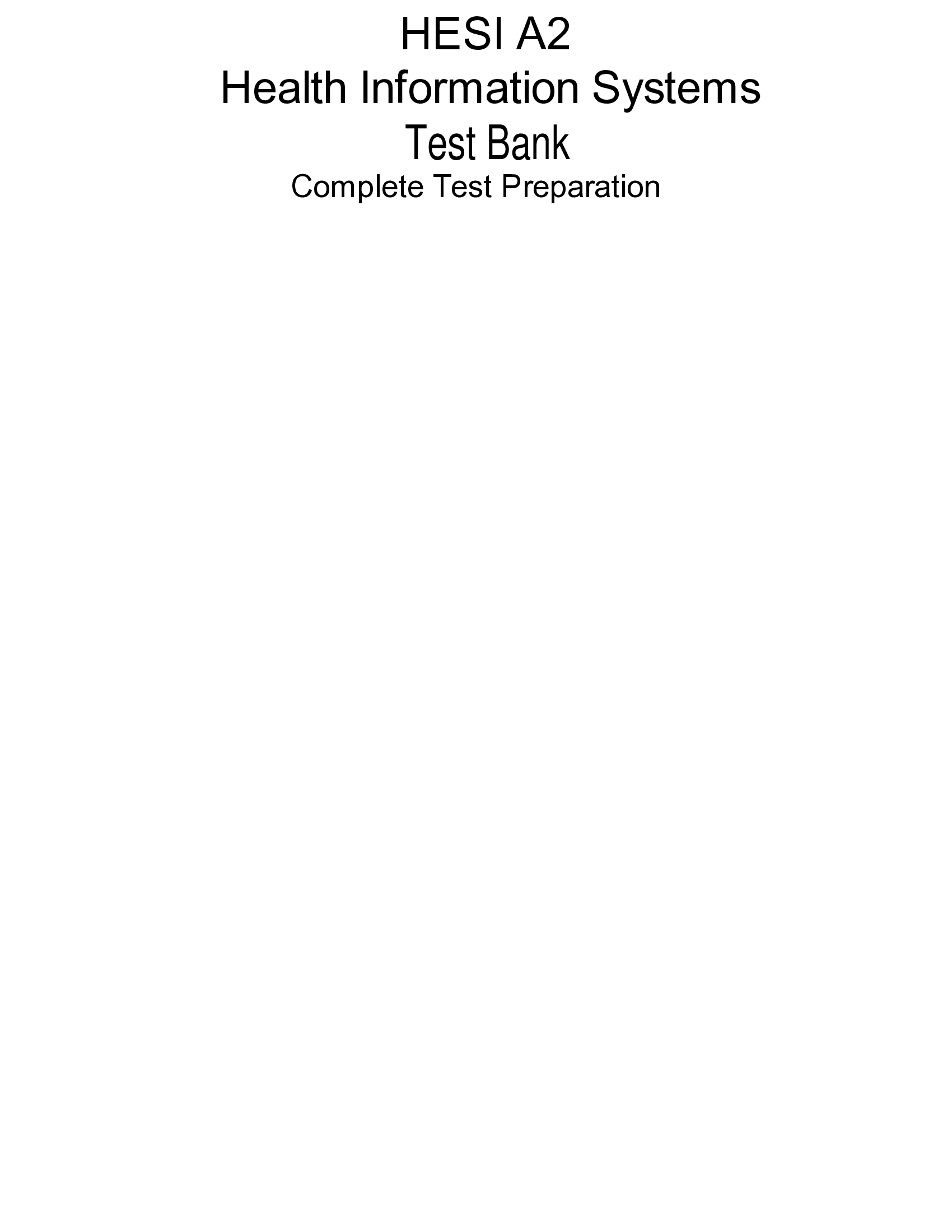
  • HESI A2 Health Education Systems TEST BANK

HESI A2 Health Education Systems TEST BANK

Preview page 1 Preview page 2 Preview page 3
Add To Favorites

Share this item Share this item

  • Item Details
  • Comments (0)
  • Reviews (0)
  • Contact Seller

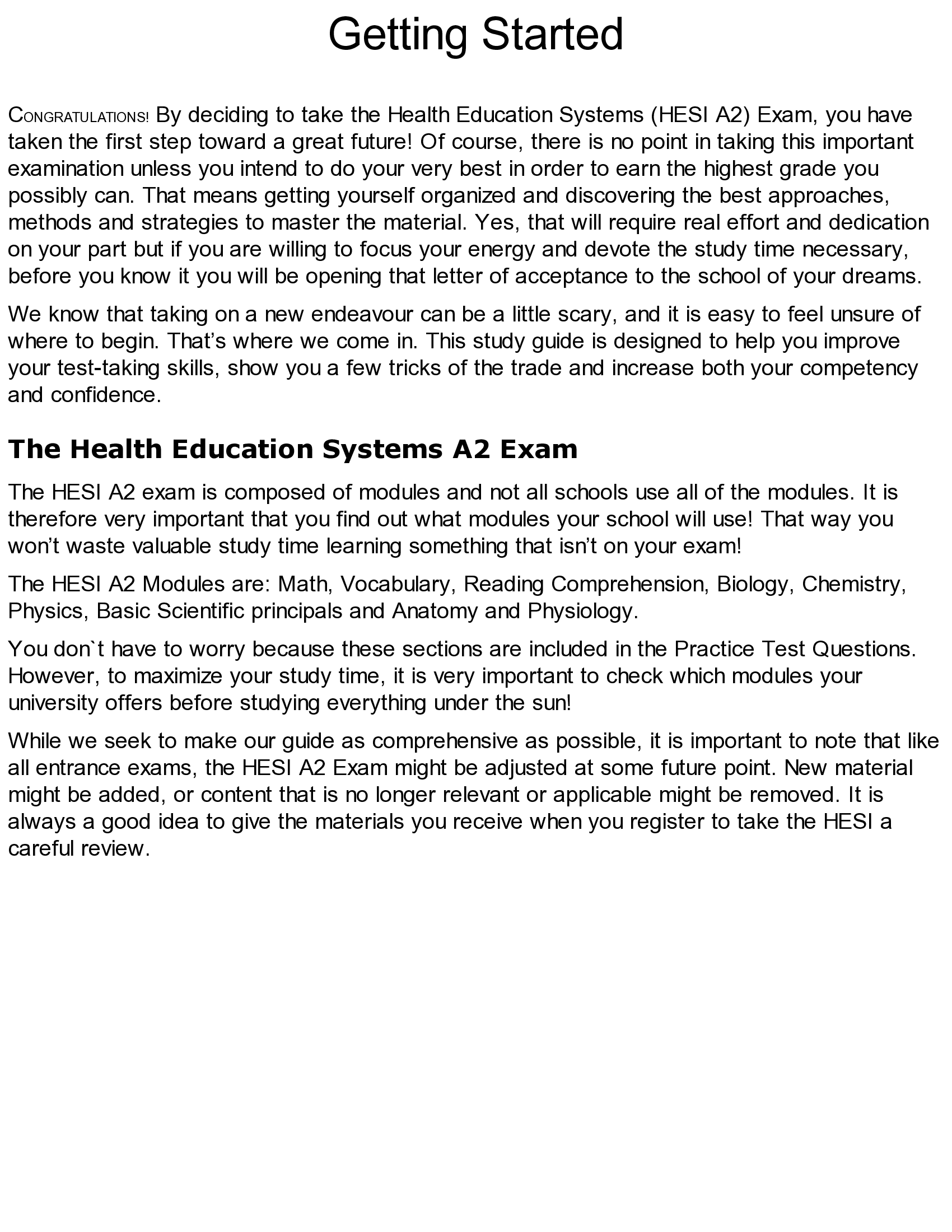
SECTION I - READING COMPREHENSION. Directions: The following questions are based on a number of reading passages. Each passage is followed by a series of questions. Read each passage carefully, and then answer the questions based on it. You may reread the passage as often as you wish. When you have finished answering the questions based on one passage, go right on to the next passage. Choose the best answer based on the information given and implied. Questions 1 – 4 refer to the following passage. Passage 1 - Infectious Disease An infectious disease is a clinically evident illness resulting from the presence of pathogenic agents, such as viruses, bacteria, fungi, protozoa, multi-cellular parasites, and unusual proteins known as prions. Infectious pathologies are also called communicable diseases or transmissible diseases, due to their potential of transmission from one person or species to another by a replicating agent (as opposed to a toxin). Transmission of an infectious disease can occur in many different ways. Physical contact, liquids, food, body fluids, contaminated objects, and airborne inhalation can all transmit infecting agents. Transmissible diseases that occur through contact with an ill person, or objects touched by them, are especially infective, and are sometimes referred to as contagious diseases. Communicable diseases that require a more specialized route of infection, such as through blood or needle transmission, or sexual transmission, are usually not regarded as contagious. The term infectivity describes the ability of an organism to enter, survive and multiply in the host, while the infectiousness of a disease indicates the comparative ease with which the disease is transmitted. An infection however, is not synonymous with an infectious disease, as an infection may not cause important clinical symptoms. 1 1. What can we infer from the first paragraph in this passage? a. Sickness from a toxin can be easily transmitted from one person to another. b. Sickness from an infectious disease can be easily transmitted from one person to another. c. Few sicknesses are transmitted from one person to another. d. Infectious diseases are easily treated. 2. What are two other names for infections’ pathologies? a. Communicable diseases or transmissible diseases b. Communicable diseases or terminal diseases c. Transmissible diseases or preventable diseases d. Communicative diseases or unstable diseases 3. What does infectivity describe? a. The inability of an organism to multiply in the host b. The inability of an organism to reproduce c. The ability of an organism to enter, survive and multiply in the host d. The ability of an organism to reproduce in the host 4. How do we know an infection is not synonymous with an infectious disease? a. Because an infectious disease destroys infections with enough time. b. Because an infection may not cause important clinical symptoms or impair host function. c. We do not. The two are synonymous. d. Because an infection is too fatal to be an infectious disease. Questions 5 – 8 refer to the following passage. Passage 2 - Viruses A virus (from the Latin virus meaning toxin or poison) is a small infectious agent that can replicate only inside the living cells of other organisms. Most viruses are too small to be seen directly with a microscope. Viruses infect all types of organisms, from animals and plants to bacteria and single-celled organisms. Unlike prions and viroids, viruses consist of two or three parts: all viruses have genes made from either DNA or RNA, all have a protein coat that protects these genes, and some have an envelope of fat that surrounds them when they are outside a cell. (Viroids do not have a protein coat and prions contain no RNA or DNA.) Viruses vary from simple to very complex structures. Most viruses are about one hundred times smaller than an average bacterium. The origins of viruses in the evolutionary history of life are unclear: some may have evolved from plasmids— pieces of DNA that can move between cells—while others may have evolved from bacteria. Viruses spread in many ways; plant viruses are often transmitted from plant to plant by insects that feed on sap, such as aphids, while animal viruses can be carried by blood-sucking insects. These disease-bearing organisms are known as vectors. Influenza viruses are spread by coughing and sneezing. HIV is one of several viruses transmitted through sexual contact and by exposure to infected blood. Viruses can infect only a limited range of host cells called the “host range”. This can be broad as when a virus is capable of infecting many species or narrow. 2 5. What can we infer from the first paragraph in this selection? a. A virus is the same as bacterium b. A person with excellent vision can see a virus with the naked eye c. A virus cannot be seen with the naked eye d. Not all viruses are dangerous 6. What types of organisms do viruses infect? a. Only plants and humans b. Only animals and humans c. Only disease-prone humans d. All types of organisms 7. How many parts do prions and viroids consist of? a. Two b. Three c. Either less than two or more than three d. Less than two 8. What is one common virus spread by coughing and sneezing? a. AIDS b. Influenza c. Herpes d. Tuberculosis Questions 9 – 11 refer to the following passage. Passage 3 – Clouds The first stage of a thunderstorm is the cumulus stage, or developing stage. In this stage, masses of moisture are lifted upwards into the atmosphere. The trigger for this lift can be insulation heating the ground producing thermals, areas where two winds converge, forcing air upwards, or where winds blow over terrain of increasing elevation. Moisture in the air rapidly cools into liquid drops of water, which appears as cumulus clouds. As the water vapor condenses into liquid, latent heat is released which warms the air, causing it to become less dense than the surrounding dry air. The warm air rises in an updraft through the process of convection (hence the term convective precipitation). This creates a low-pressure zone beneath the forming thunderstorm. In a typical thunderstorm, approximately 5×10 8 kg of water vapor is lifted, and the amount of energy released when this condenses is about equal to the energy used by a city of 100,000 in a month. 3 9. The cumulus stage of a thunderstorm is the a. The last stage of the storm b. The middle stage of the storm formation c. The beginning of the thunderstorm d. The period after the thunderstorm has ended 10. One of the ways the air is warmed is a. Air moving downwards, which will creates a high-pressure zone b. Air cooling and becoming less dense, causing it to rise c. Moisture moving downward toward the earth d. Heat created by water vapor condensing into liquid 11. Identify the correct sequence of events a. Warm air rises, water droplets condense, creating more heat, and the air rises further. b. Warm air rises and cools, water droplets condense, causing low pressure. c. Warm air rises and collects water vapor, the water vapor condenses as the air rises, which creates heat, and causes the air to rise further. d. None of the above. Questions 12 – 14 refer to the following passage. Passage 4 – US Weather Service The United States National Weather Service classifies thunderstorms as severe when they reach a predetermined level. Usually, this means the storm is strong enough to inflict wind or hail damage. In most of the United States, a storm is considered severe if winds reach over 50 knots (58 mph or 93 km/h), hail is ¾ inch (2 cm) diameter or larger, or if meteorologists report funnel clouds or tornadoes. In the Central Region of the United States National Weather Service, the hail threshold for a severe thunderstorm is 1 inch (2.5 cm) in diameter. Though a funnel cloud or tornado indicates the presence of a severe thunderstorm, the various meteorological agencies would issue a tornado warning rather than a severe thunderstorm warning in this case. Meteorologists in Canada define a severe thunderstorm as either having tornadoes, wind gusts of 90 km/h or greater, hail 2 centimeters in diameter or greater, rainfall more than 50 millimeters in 1 hour, or 75 millimeters in 3 hours.

Contact the Seller

Please Sign In to contact this seller.


  • 👎  Report Copyright Violation

Frequently Asked Questions

What Do I Get When I Buy This Study Material?

+

When you buy a study material on Passing Grades, an instant download link will be sent directly to your email, giving you access to the file anytime after payment is completed.

Is Passing Grades a Trusted Platform?

+

Yes, Passing Grades is a reputable students’ marketplace with a secure payment system and reliable customer support. You can trust us to ensure a safe and seamless transaction experience.

Will I Be Stuck with a Subscription?

+

No, all purchases on Passing Grades are one-time transactions. You only pay for the notes you choose to buy, with no subscriptions or hidden fees attached.

Who Am I Buying These Study Materials From?

+

Passing Grades is a marketplace, which means you are purchasing the document from an individual vendor, not directly from us. We facilitate the payment and delivery process between you and the vendor.

Does Passing Grades Offer Free Study Materials?

+

Yes, sellers on Passing Grades have uploaded numerous free test banks, exams, practice questions, and class notes that can be downloaded at no cost.

Pasinggrades - Quality Study Materials

USD 8

    • Quality checked by Pasing Grades
    • 100% satisfaction guarantee
    • Seller: mentor2000
Buy PDF $8

Seller Information

mentor2000

Member since April 2021

  • icon
  • icon
View Profile
  • total sales

    0
  • Favourites

    0
  • Comments

    0
    ( 0 Ratings )

Item Information

  • Uploaded

    24 February 2024

  • Updated

    27 April 2025

  • Category

    Nursing

  • Item Type

    test bank

  • Tags

    HESI A2 Health Education Systems TEST BANK

Related Exam Prep Guides by mentor2000

Test Bank for Essentials for Nursing Practice 8th Edition by Potter | All Chapters
View Document

Test Bank for Essent...

  • mentor2000

    mentor2000

  • test bank

Master nursing concepts with this study material; Test Bank for Essentials for Nursing Practice, 8th...

8 USD

0

0

A &P 1 MA278 BSC2 Final Module II Questions & Answers 2026 Update
View Document

A &P 1 MA278 BSC2 Fi...

  • mentor2000

    mentor2000

  • test bank

Prepare for success with A&P 1 MA278 BSC2 Final Module II 2024 Q&A. Boost your grades with this comp...

8 USD

0

0

ATI Comprehensive Predictor Exam 2026
View Document

ATI Comprehensive Pr...

  • mentor2000

    mentor2000

  • test bank

Prepare for success with the ATI Comprehensive Predictor Exam 2026. Access key practice questions to...

8 USD

0

0

Purchase

Download link will be sent to this email immediately after purchase.

IMPORTANT LINKS

  • How To Upload Class Notes
  • Selling Tips
  • Passing Grades's Study Materials
  • Scholarships for International Students 2026

POPULAR CATEGORIES

  • Law
  • Accounting
  • English
  • Psychology
  • Business
  • Nursing
  • Computer Science
  • General

View Document

  • Blog
  • Contact
  • Delivery Policy
  • Latest Scholarships Around the World
  • How to Pass Bar Exams: Passing Grades’ Strategies
  • How to Study and Pass the CPA Exam
  • All Test Banks
  • Faq
  • Copyright Claims
  • Privacy Policy
  • Terms of Use

KNOWLEDGE BASE

  • How to Write A+ Grade Good Research Paper
  • How to Manage Stress During Exam Period
  • Best Time to Study
  • How to Pass NCLEX-RN Exam
  • How To Effectively Utilize Test Banks
  • Popular Shadow Health Exam Assessments
  • Popular HESI Case Studies
  • How to Prepare for a Nursing Career
  • The Importance Of Summaries in Exam Revisvion

© 2026 Pasing Grades. All rights reserved.