
Pasing Grades
  • Start Selling
  • Blog
  • Contact
  • 0

    Your cart is empty!

English

  • English
  • Spanish
  • Arabic
Create Account Sign In
  • Library
    • New Prep Guides
    • Featured Prep Guides
    • Free Exam Prep Guides
    • Best sellers
  • General
  • Nursing
    • Research Paper
    • Case Study
    • Discussion Post
    • Assignment
    • Exam
    • Practice Questions and Answers
    • Test Bank
    • solutions manual
  • Accounting
    • Case Study
    • Thesis
    • Study Guide
    • Summary
    • Research Paper
    • test bank
  • English
    • Creative Writing
    • Research Paper
    • Summary
    • Rhetorics
    • Literature
    • Journal
    • Exam
    • Grammar
    • Discussion Post
    • Essay
  • Psychology
    • Hesi
    • Presentation
    • Essay
    • Summary
    • Study Guide
    • Essay
    • Solution Manual
    • Final Exam Review
    • Class Notes
    • test bank
  • Business
    • Lecture Notes
    • Solution Manual
    • Presentation
    • Business Plan
    • Class Notes
    • Experiment
    • Summary
    • Practice Questions
    • Study Guide
    • Case Study
    • test bank
    • Exam
  • More
    • Computer Science
    • Economics
    • Statistics
    • Engineering
    • Biology
    • Religious Studies
    • Physics
    • Chemistry
    • Mathematics
    • History
    • Sociology
    • Science
    • Philosophy
    • Law
  • Pages
    • About Us
    • Selling Tips
    • Delivery Policy
    • Faq
    • Privacy Policy
  • Flash Sale
  • Home
  • Psychiatric Mental Health Nursing 7th Edition Test Bank Norman Keltner

Psychiatric Mental Health Nursing 7th Edition Test Bank Norman Keltner

Preview page 1 Preview page 2 Preview page 3
Add To Favorites

Share this item Share this item

  • Item Details
  • Comments (0)
  • Reviews (0)
  • Contact Seller

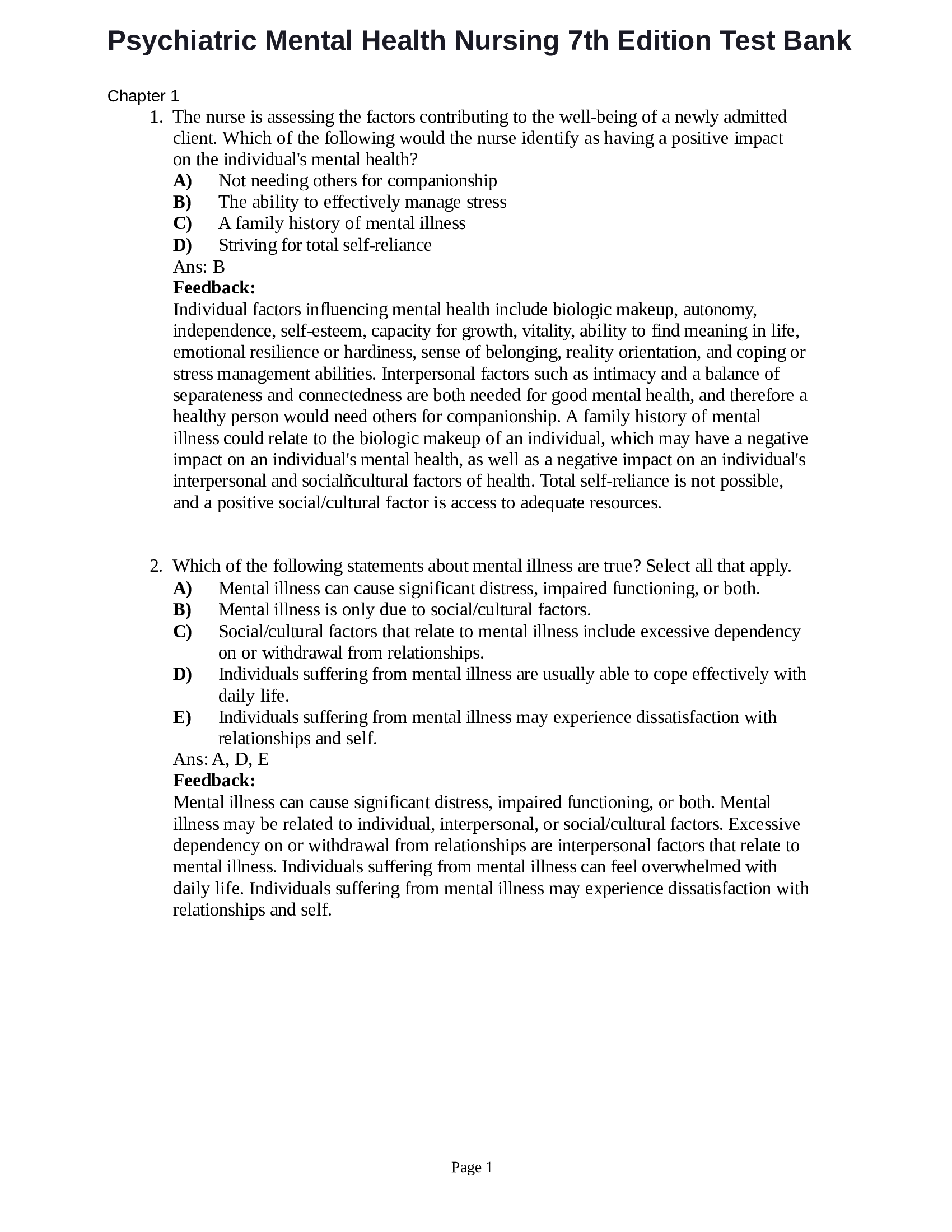
Psychiatric Mental Health Nursing 7th Edition Test Bank

Chapter 1

1. The nurse is assessing the factors contributing to the well-being of a newly admitted 

client. Which of the following would the nurse identify as having a positive impact

on the individual's mental health?

A) Not needing others for companionship

B) The ability to effectively manage stress

C) A family history of mental illness

D) Striving for total self-reliance

Ans: B

Feedback:

Individual factors influencing mental health include biologic makeup, autonomy, 

independence, self-esteem, capacity for growth, vitality, ability to find meaning in life, 

emotional resilience or hardiness, sense of belonging, reality orientation, and coping or 

stress management abilities. Interpersonal factors such as intimacy and a balance of 

separateness and connectedness are both needed for good mental health, and therefore a

healthy person would need others for companionship. A family history of mental 

illness could relate to the biologic makeup of an individual, which may have a negative

impact on an individual's mental health, as well as a negative impact on an individual's 

interpersonal and socialñcultural factors of health. Total self-reliance is not possible, 

and a positive social/cultural factor is access to adequate resources.

2. Which of the following statements about mental illness are true? Select all that apply.

A) Mental illness can cause significant distress, impaired functioning, or both.

B) Mental illness is only due to social/cultural factors.

C) Social/cultural factors that relate to mental illness include excessive dependency

on or withdrawal from relationships.

D) Individuals suffering from mental illness are usually able to cope effectively with

daily life.

E) Individuals suffering from mental illness may experience dissatisfaction with

relationships and self.

Ans: A, D, E

Feedback:

Mental illness can cause significant distress, impaired functioning, or both. Mental 

illness may be related to individual, interpersonal, or social/cultural factors. Excessive 

dependency on or withdrawal from relationships are interpersonal factors that relate to 

mental illness. Individuals suffering from mental illness can feel overwhelmed with 

daily life. Individuals suffering from mental illness may experience dissatisfaction with

relationships and self.

3. Which of the following are true regarding mental health and mental illness?

A) Behavior that may be viewed as acceptable in one culture is always

unacceptable in other cultures.

B) It is easy to determine if a person is mentally healthy or mentally ill.

C) In most cases, mental health is a state of emotional, psychological, and social 

wellness evidenced by satisfying interpersonal relationships, effective behavior

and coping, positive self-concept, and emotional stability.

D) Persons who engage in fantasies are mentally

ill. Ans: C

Feedback:

What one society may view as acceptable andappropriate behavior,another society may

see that as maladaptive, and inappropriate. Mental health and mental illness are difficult 

to define precisely. In most cases, mental health is a state of emotional, psychological, 

and social wellness evidenced by satisfying interpersonal relationships, effective 

behavior and coping, positive self-concept, and emotional stability. Persons who engage 

in fantasies may be mentally healthy, but the inability to distinguish reality from fantasy

is an individual factor that may contribute to mental illness.

4. A client grieving the recent loss of her husband asks if she is becoming mentally

ill because she is so sad. The nurse's best response would be,

A) ìYou may have a temporary mental illness because you are experiencing so much

pain.Ă®

B) ìYou are not mentally ill. This is an expected reaction to the loss you have

experienced.Ă®

C) ìWere you generally dissatisfied with your relationship before your husband's

death?Ă®

D) ìTry not to worry about that right now. You never know what the future brings.î

Ans: B

Feedback:

Mental illness includes general dissatisfaction with self, ineffective relationships, 

ineffective coping, and lack of personal growth. Additionally the behavior must not be 

culturally expected. Acute grief reactions are expected and therefore not considered 

mental illness. False reassurance or overanalysis does not accurately address the client's

concerns.

5. The nurse consults the DSM for which of the following purposes?

A) To devise a plan of care for a newly admitted client

B) To predict the client's prognosis of treatment outcomes

C) To document the appropriate diagnostic code in the client's medical record

D) To serve as a guide for client assessment

Ans: D

Feedback:

The DSM provides standard nomenclature, presents defining characteristics, and 

identifies underlying causes of mental disorders. It does not provide care plans or 

prognostic outcomes of treatment. Diagnosis of mental illness is not within the 

generalist RN's scope of practice, so documenting the code in the medical record would

be inappropriate.

6. Which would be a reason for a student nurse to use the DSM?

A) Identifying the medical diagnosis

B) Treat clients

C) Evaluate treatments

D) Understand the reason for the admission and the nature of psychiatric 

illnesses. Ans: D

Feedback:

Although student nurses do not use the DSM to diagnose clients, they will find it a 

helpful resource to understand the reason for the admission and to begin building 

knowledge about the nature of psychiatric illnesses. Identifying the medical diagnosis, 

treating, and evaluating treatments are not a part of the nursing process.

7. The legislation enacted in 1963 was largely responsible for which of the following 

shifts in care for the mentally ill?

A) The widespread use of community-based services

B) The advancement in pharmacotherapies

C) Increased access to hospitalization

D) Improved rights for clients in long-term institutional care

Ans: A

Feedback:

The Community Mental Health Centers Construction Act of 1963 accomplished the

release of individuals from long-term stays in state institutions, the decrease in 

admissions to hospitals, and the development of community-based services as an 

alternative to hospital care.

8. Which one of the following is a result of federal legislation?

A) Making it easier to commit people for mental health treatment against their will.

B) Making it more difficult to commit people for mental health treatment against

their will.

C) State mental institutions being the primary source of care for mentally ill persons.

D) Improved care for mentally ill persons.

Ans: B

Feedback:

Commitment laws changed in the early 1970s, making it more difficult to commit 

people for mental health treatment against their will. Deinstitutionalization 

accomplished the release of individuals from long-term stays in state institutions. 

Deinstitutionalization also had negative effects in that some mentally ill persons are 

subjected to the revolving door effect, which may limit care for mentally ill persons.

9. The goal of the 1963 Community Mental Health Centers Act was to

A) ensure patients' rights for the mentally ill.

B) deinstitutionalize state hospitals.

C) provide funds to build hospitals with psychiatric units.

D) treat people with mental illness in a humane fashion.

Ans: B

Feedback:

The 1963 Community Mental Health Centers Act intimated the movement toward 

treating those with mental illness in a less restrictive environment. This legislation 

resulted in the shift of clients with mental illness from large state institutions to care

based in thecommunity.Answer choices A, C, and D were notpurposes of the 1963

Community Mental Health Centers Act.

10. The creation of asylums during the 1800s was meant to

A) improve treatment of mental disorders.

B) provide food and shelter for the mentally ill.

C) punish people with mental illness who were believed to be possessed.

D) remove dangerous people with mental illness from the community.

Ans: B

Feedback:

The asylum was meant to be a safe haven with food, shelter, and humane treatment for 

the mentally ill. Asylums were not used to improve treatment of mental disorders or to 

punish mentally ill people who were believed to be possessed. The asylum was not 

created to remove the dangerously mentally ill from the community.

Contact the Seller

Please Sign In to contact this seller.


  • 👎  Report Copyright Violation

Frequently Asked Questions

What Do I Get When I Buy This Study Material?

+

When you buy a study material on Passing Grades, an instant download link will be sent directly to your email, giving you access to the file anytime after payment is completed.

Is Passing Grades a Trusted Platform?

+

Yes, Passing Grades is a reputable students’ marketplace with a secure payment system and reliable customer support. You can trust us to ensure a safe and seamless transaction experience.

Will I Be Stuck with a Subscription?

+

No, all purchases on Passing Grades are one-time transactions. You only pay for the notes you choose to buy, with no subscriptions or hidden fees attached.

Who Am I Buying These Study Materials From?

+

Passing Grades is a marketplace, which means you are purchasing the document from an individual vendor, not directly from us. We facilitate the payment and delivery process between you and the vendor.

Does Passing Grades Offer Free Study Materials?

+

Yes, sellers on Passing Grades have uploaded numerous free test banks, exams, practice questions, and class notes that can be downloaded at no cost.

Pasinggrades - Quality Study Materials

USD 10

    • Quality checked by Pasing Grades
    • 100% satisfaction guarantee
    • Seller: mentor2000
Buy PDF $10

Seller Information

mentor2000

Member since April 2021

  • icon
  • icon
View Profile
  • total sales

    0
  • Favourites

    0
  • Comments

    0
    ( 0 Ratings )

Item Information

  • Uploaded

    24 April 2021

  • Updated

    27 April 2025

  • Category

    Nursing

  • Item Type

    test bank

  • Tags

    Psychiatric Mental Health Nursing 7th Edition Test Bank Norman Keltner

Related Exam Prep Guides by mentor2000

Test Bank for Essentials for Nursing Practice 8th Edition by Potter | All Chapters
View Document

Test Bank for Essent...

  • mentor2000

    mentor2000

  • test bank

Master nursing concepts with this study material; Test Bank for Essentials for Nursing Practice, 8th...

10 USD

0

0

A &P 1 MA278 BSC2 Final Module II Questions & Answers 2026 Update
View Document

A &P 1 MA278 BSC2 Fi...

  • mentor2000

    mentor2000

  • test bank

Prepare for success with A&P 1 MA278 BSC2 Final Module II 2024 Q&A. Boost your grades with this comp...

10 USD

0

0

ATI Comprehensive Predictor Exam 2026
View Document

ATI Comprehensive Pr...

  • mentor2000

    mentor2000

  • test bank

Prepare for success with the ATI Comprehensive Predictor Exam 2026. Access key practice questions to...

10 USD

0

0

Purchase

Download link will be sent to this email immediately after purchase.

IMPORTANT LINKS

  • How To Upload Class Notes
  • Selling Tips
  • Passing Grades's Study Materials
  • Scholarships for International Students 2025

POPULAR CATEGORIES

  • Law
  • Accounting
  • English
  • Psychology
  • Business
  • Nursing
  • Computer Science
  • General

View Document

  • Blog
  • Contact
  • Delivery Policy
  • Latest Scholarships Around the World
  • How to Pass Bar Exams: Passing Grades’ Strategies
  • How to Study and Pass the CPA Exam
  • All Test Banks
  • Faq
  • Copyright Claims
  • Privacy Policy
  • Terms of Use

KNOWLEDGE BASE

  • How to Write A+ Grade Good Research Paper
  • How to Manage Stress During Exam Period
  • Best Time to Study
  • How to Pass NCLEX-RN Exam
  • How To Effectively Utilize Test Banks
  • Popular Shadow Health Exam Assessments
  • Popular HESI Case Studies
  • How to Prepare for a Nursing Career
  • The Importance Of Summaries in Exam Revisvion

© 2026 Pasing Grades. All rights reserved.