

Score release day has a specific energy. Some students refresh the College Board portal the moment it opens at 8 AM Eastern; others put it off for days because they'd rather not know. Either way, the number eventually shows up, and then you have to figure out what it actually means for you.
The 1–5 scale looks simple, but interpreting it correctly requires a bit more context than most students have going in.
What the Numbers Actually Mean
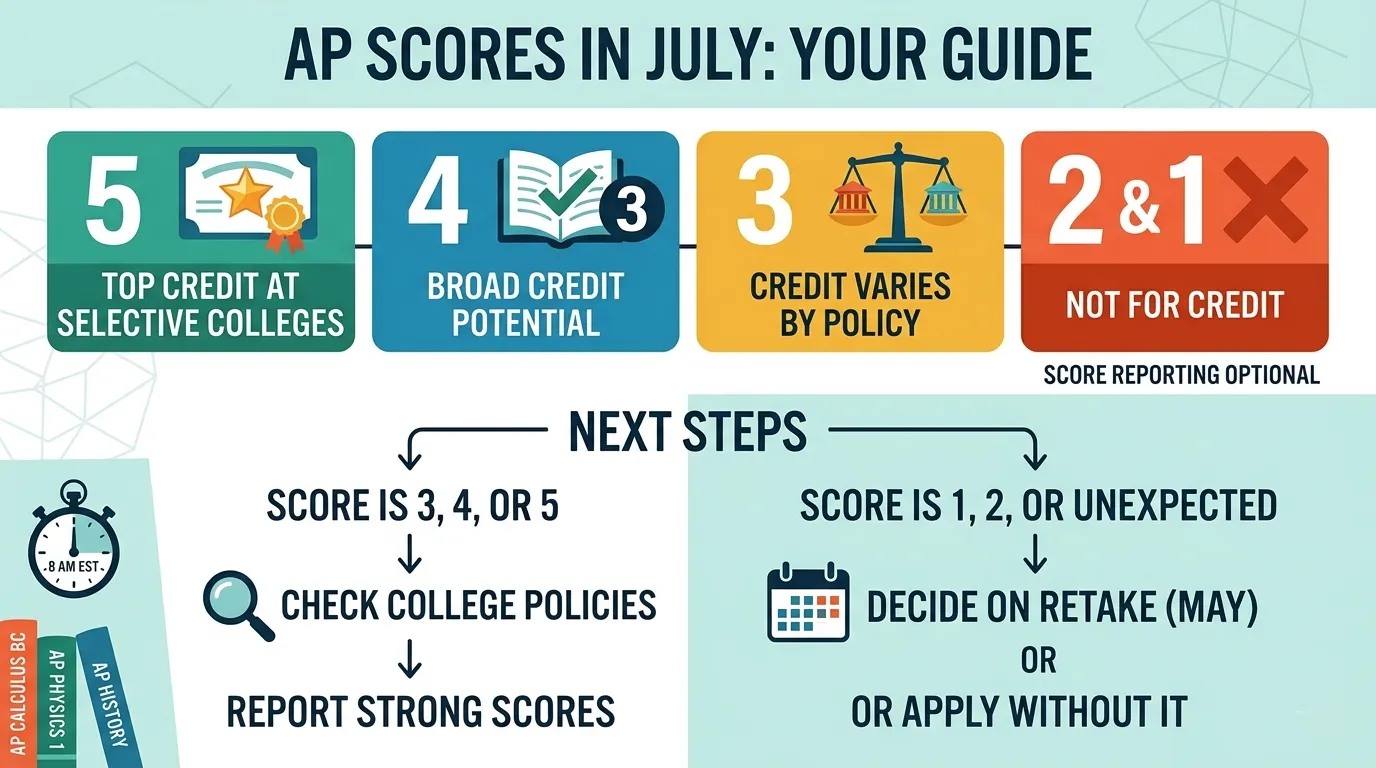
A 5 is the highest possible score and represents what College Board describes as "extremely well qualified." Roughly 10–20% of test-takers reach this threshold depending on the subject. AP Calculus BC tends to have a higher percentage of 5s than AP Physics 1, partly because the self-selection of who takes each exam differs significantly.
A 4 is "well qualified" and accepted for credit at most universities that take AP scores at all. In practical terms, a 4 on most exams will get you what you need.
A 3 is where things get complicated. College Board calls it "qualified," but credit policies vary so much between schools that a 3 might be worth nothing at your first-choice university and worth three credits at your safety school. This is genuinely worth looking up before you decide whether to send scores anywhere.
A 2 or 1 generally doesn't earn credit anywhere. Some students worry about whether a low score hurts them in admissions — typically it doesn't, as long as you didn't self-report it on your application. Score reporting to colleges is optional and separate from having taken the course.
Why Your Score Might Be Different From What You Expected
The raw-to-scaled score conversion isn't fixed. Every year, College Board adjusts the cutoffs based on overall exam performance. A year where the free response prompts were harder will typically have lower raw score cutoffs for each scaled score. This is why students who compare notes after the exam sometimes find that someone who felt more confident scored lower.
Before official results come out, a lot of students use historical curve estimates to get a rough sense of where they landed. Sites like APScoreHub offer score calculators based on past conversion tables — not official, but useful for understanding the general range. The actual official result might shift slightly, but it gives you something more concrete than pure uncertainty.
Sending Scores to Colleges
If you're a rising senior, you'll have the option to send AP scores to colleges on your list. A few things to know:
You're not required to send all of your scores. You can choose to send individual exams. If you got a 2 on AP World History sophomore year but a 5 on AP Calculus this spring, there's no reason to include the 2.
Most selective colleges say AP scores are optional or supplemental in the application review process — they look at whether you took rigorous courses and how you performed in them throughout the year. But a strong score can reinforce your application in the subject area you're planning to study.
International students applying to American universities sometimes have more flexibility here. AP scores can serve as a strong signal of academic preparedness in contexts where course grades from different school systems are harder to compare directly.
If Your Score Was Lower Than You Hoped
First: it's July. You have time.
If you're planning to retake the exam next May, it helps to get organized early, check the 2026 AP Exam Schedule for official dates and registration deadlines so you're not caught off guard. The gap between where you are and where you want to be is almost always closeable with more targeted preparation. Most students who underperform do so because they didn't practice enough free response questions, or because they mismanaged time on the multiple choice section. If statistics was one of your weaker spots, working through a cumulative AP Statistics study guide is one of the most efficient ways to close those gaps before next year.
The same logic applies to AP Psychology, students consistently point to one resource: the test bank for Myers' Psychology for the AP® Course. If you're prepping for a retake or getting ahead for next year, this is where most high scorers start.
If you're not planning to retake it, then the score is what it is. A 3 doesn't close doors at most schools, and a 2 on one exam in a subject that isn't your intended major isn't going to define your application.
What matters more than the score you got is what you do with the information.
0
290