
U.S. History College Essay Example: The United States as a Land of Opportunity
An evidence-based college history essay examining the Market Revolution, immigration, race, gender, and economic opportunity in nineteenth-century America.
The United States has always been regarded as a land of opportunity. This notion began in the 19th Century and grew stronger during the market revolution. The industrial and market revolution, especially in the northern states, presented many work opportunities. The revolution happened across the entire nation, and more farmers grew crops for self-sufficiency and profit. vast cities and factories arose in the North. This championed for enormous fortunes and the ballooning of the new middle class. As more people worked in the cash economy, they became free from the bondage of servitude. Most people were able to secure employment and could easily meet their financial needs. There was, however, a disparity between the white and people of color in realizing these opportunities. The whites were in an advantageous position compared to other races. This is well brought out by William J. Brown in his autobiography.
The concept of "opportunity" in antebellum America was deeply racialized and gendered from its inception. The Jacksonian era popularized the rhetoric of the self-made man, but this ideal was constructed almost exclusively for white Protestant men. Scholars like Scott Sandage (Born Losers: A History of Failure in America, Harvard UP, 2005) have shown that the discourse of opportunity simultaneously invented the category of failure, which fell disproportionately on those excluded from economic citizenship.
William J. Brown was born when the northern states were eliminating slavery. The era created a significant free black population that settled in seaports, such as New York, Providence, and Boston. Brown published his autobiography in 1883, which is approximately fifty years after the events described. He was elderly, impoverished, and blind at the time of writing. The temporal gap between experience and narration is significant for historical analysis and should be acknowledged. Additionally, Brown was the grandson of a slave owned by the Brown family after whom Brown University is named, a detail that adds important contextual irony to his account of blocked opportunity in Providence.
When Brown was of age and following the death of his mother, he decided to look for a place to learn a trade. It was, however, unfortunate that he always failed in his endeavor because of his race. His first call was on a first-class carpenter, Mr. Knowles. He wanted to see if he could be taken as an apprentice in the trade. Mr. Knowles, however, turned down his request. Brown tried working with a shoemaker, but the request was also turned down. Mr. Ira B Winsor attempted to secure a clerk position for Brown, but the uncle could not allow it because Brown was black Brown 1883).
Brown's attempt to apprentice as a carpenter, shoemaker, and clerk fits a well-documented pattern. Free Black workers in antebellum New England faced organized white working-class hostility as well as employer discrimination. White journeymen frequently threatened work stoppages if Black apprentices were taken on. This is documented in accounts of Providence, Boston, and New York — cities where free Black communities were concentrated, as the paper notes. Although there were opportunities to earn a living through a decent job, whites were disproportionately advantaged.
John Doyle, an Irish immigrant, wrote a letter to Fanny describing his experiences in America as an immigrant. The letter's content does not depict America as a land of opportunity. He tells Fanny that a person with the ability to make a living in his home country should not consider coming to the United States (Doyle, 1818).
Doyle was writing in 1818, before the major waves of Irish immigration that followed the Famine of 1845–1849. Irish immigrants in this early period were often skilled artisans and craftsmen, unlike the destitute famine refugees who came later. The different conditions facing these two waves of Irish immigration are historically important and should not be collapsed into a single "immigrant experience. An anonymous English immigrant also wrote an article on his displeasure upon reaching America and why he thought it was not a land of opportunity for immigrants.
For a broader look at how different immigrant groups experienced America, see The Arabs American History in the United States.
According to the article, immigrants crossed the Atlantic with many exaggerated notions of their importance and the good life they would encounter. Their expectation was less labor and fewer difficulties than they had previously endured("I was a cabinet-maker by trade": A Working Man's recollections of America, 1825-35 1846). The truth was, however opposite, and this was delusional about their American dream of opportunities.
The factory operative tracts of the 1840s emerged as a labor protest genre distinct from the more sanitized Lowell Offering, which was employer-sponsored. The tracts were written by women who had worked in mills and were aimed at generating public sympathy for labor reform. The article from the female factory worker shows that America is not a land of opportunity. According to her, much has been spoken and written on a woman's behalf, particularly in America. She complains that most women in the country had been destined to a state of servitude.
According to her, women of color were in a state where they could not breathe the balmy air. Others are in conditions that are more or less slaves to a system of labor requiring them to toil for long hours with limited time to attend to the wants of nature(The Lost Museum Archive, 1845). She also complains about the Christian faith in America and the irony of preaching benevolence and acting the opposite way. Such accounts show that although most immigrants came to America for opportunities as widely believed, the reality was different, and most never realized the so-called opportunities.
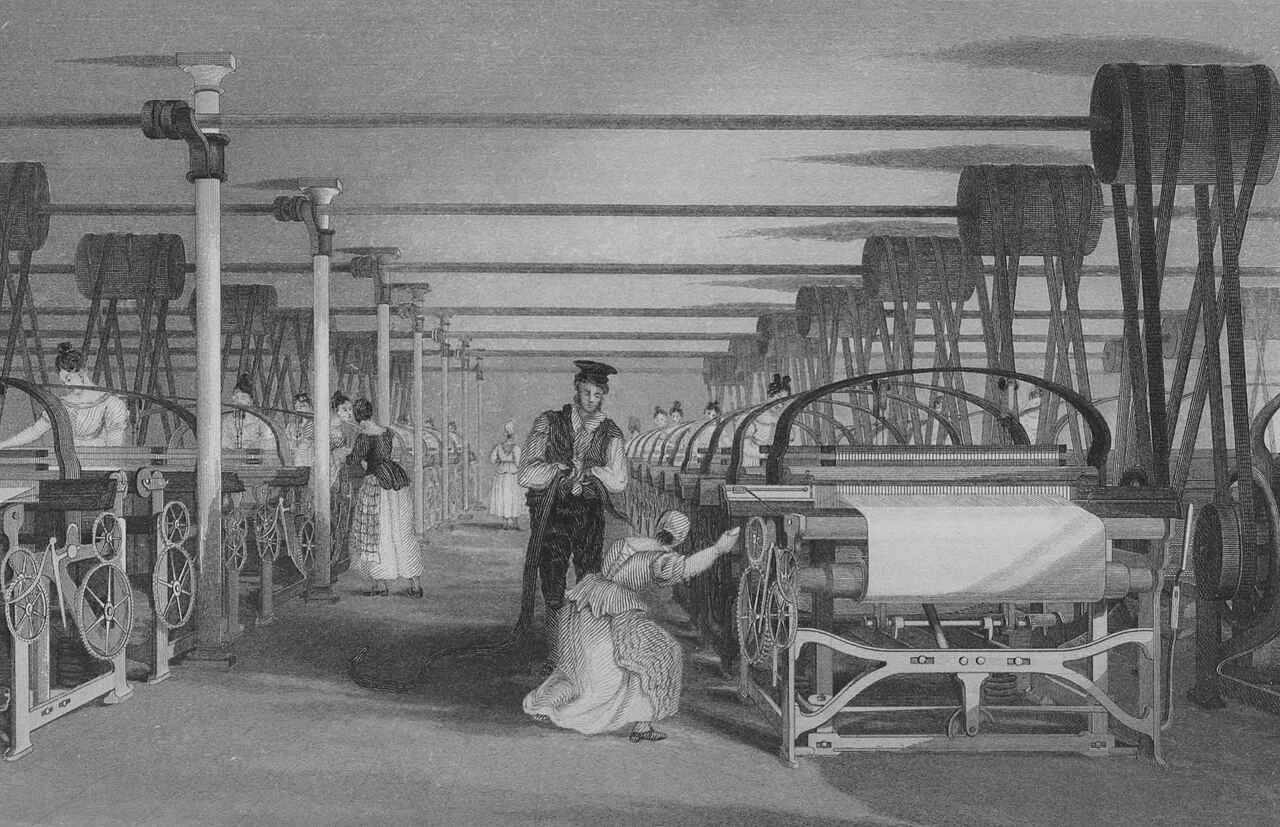
The market revolution came at a cost. The booming of the textile factories in the North increased the demand for the southern cotton. This accelerated slavery. The subsistence farmers from the North were made laborers to the markets’ whims. The market revolution created new personal wealth by exploding economic growth. The "New History of Capitalism" (NHC) school associated with Edward Baptist, Sven Beckert, Walter Johnson, and Seth Rockman has produced the most significant recent reinterpretation of the relationship between northern industrialization and southern slavery. Baptist's The Half Has Never Been Told (2014) argues that enslaved labor was the engine of American economic growth, not a peripheral system. Similarly, Beckert and Stelzner (2025) confirm that southern demand was a key factor in stimulating the growth of New England cotton textile manufacturing.
The revolution also sparked a series of devastating depressions and propertyless workers. Most people were thrown into low-wage labor and became trapped in endless poverty cycles. Immigrant women were forced to work for thirteen hours a day and six days a week, while others were forced into servitude (Locke & Wright, 2019).
The growth of textile factories rendered southern cotton cheap cloth. Even though the North had worked to eradicate slavery, the high demand for cotton and other raw materials from the factories increased the demand for slaves. The financial institutions provided enough finances to maintain profitability and the American slave system. As the economy grew, the market revolution pushed the United States in a new direction as it became a country of free slavery and labor. It also fueled a lot of wealth inequality and endless promise and untold perils.
For a deeper look at how these cycles of poverty persisted into modern America, see Understanding Homelessness in America.
Julianna’s article The Evils of Factory Life does not depict America as a land of opportunities. The Factory Tracts (1845) were published by the Lowell Female Labor Reform Association (LFLRA), one of the first women's labor organizations in American history. The LFLRA, led by Sarah Bagley, circulated these tracts as part of a campaign for the ten-hour workday. According to her, by the time young women work in factories for twelve months, they have lost all relish for fireside life comforts and the neatness attendant upon precision and order (Julianna, 1845). This depicts the evils of factory life. It was the dream of the immigrants that they would have a soft life in the land of opportunities. They were, however, disappointed by the state of things in the ground. They had to work for long hours and in unforgiving conditions that drained their physical and mental health. These conditions do not well represent America as a land of opportunities.
Elias Nason writes a letter to his parents describing the conditions in American factories and mills. He was born into a poor New England family. Like other young men from the same background, he was lucky to secure admission to a college in the region. After completing his college education, he worked as a teacher and still attended Brown University ( Nason, 1835). His letter is about financial conditions and textile factories and mills where many young women from New England secured work. According to him, the Unionville factory, where his sister worked, has never touched his pride and would therefore never have been proud that her sister worked in a cotton factory ( Nason, 1835).
The young women working in the factories, especially the cotton factories, were paid meager wages despite some of them being very intelligent. Nason pities the thousands of young women from his country who had been reduced to factory laborers for a livelihood. He adds that the cotton factories would be the last place for him to put his children. Nason's perspective is particularly noteworthy because it comes from an educated man from a poor background — a position that complicated his relationship to class identity. His contempt for cotton factory work reflects emerging middle-class professional values that distinguished "respectable" from "degraded" labor. His account of the financial status of the young women working in American mills and factories does not depict the nation as a land of opportunities. This is consistent with the other accounts. Although America was a great land of opportunities to the white population and citizens, the immigrants never realized these opportunities, and according to them, this was an illusion.
References
- Baptist, E. E. (2014). The half has never been told: Slavery and the making of American capitalism. Basic Books.
-
Beckert, S., & Stelzner, M. (2025). Slavery and Northern Industrialization. Yale University Department of Economics.
- Brown, W. J. (1883). The life of William J. Brown of Providence, RI, with personal recollections of incidents in Rhode Island. J. A. & R. A. Reid.
- Doyle, J. (1818). "Suffer for about the first six months after leaving home": John Doyle writes home to Ireland, 1818. History Matters: The U.S. Survey Course on the Web.
- Factory life as it is, by an operative. (1845). Lost Museum Archive, CUNY.
- Julianna. (1845). The evils of factory life. History Matters: The U.S. Survey Course on the Web.
- Locke, J. L., & Wright, B. (Eds.). (2019). The American Yawp: A massively collaborative open U.S. history textbook: Vol. 1. To 1877. Stanford University Press.
- Nason, E. (1835). "Factories are talked about as schools of vice": Elias Nason considers careers. History Matters: The U.S. Survey Course on the Web.
- Sandage, S. A. (2005). Born losers: A history of failure in America. Harvard University Press.
- "I was a cabinet-maker by trade": A working man's recollections of America, 1825–35. (1846). History Matters: The U.S. Survey Course on the Web.
Students looking to review these themes further can consult the American History Exam Study Guide.
0
135