Pasing Grades
  • Start Selling
  • Blog
  • Contact
  • 0

    Your cart is empty!

English

  • English
  • Spanish
  • Arabic
Create Account Sign In
  • Library
    • New Prep Guides
    • Featured Prep Guides
    • Free Exam Prep Guides
    • Best sellers
  • General
  • Nursing
    • Research Paper
    • Case Study
    • Discussion Post
    • Assignment
    • Exam
    • Practice Questions and Answers
    • Test Bank
    • solutions manual
  • Accounting
    • Case Study
    • Thesis
    • Study Guide
    • Summary
    • Research Paper
    • test bank
  • English
    • Creative Writing
    • Research Paper
    • Summary
    • Rhetorics
    • Literature
    • Journal
    • Exam
    • Grammar
    • Discussion Post
    • Essay
  • Psychology
    • Hesi
    • Presentation
    • Essay
    • Summary
    • Study Guide
    • Essay
    • Solution Manual
    • Final Exam Review
    • Class Notes
    • test bank
  • Business
    • Lecture Notes
    • Solution Manual
    • Presentation
    • Business Plan
    • Class Notes
    • Experiment
    • Summary
    • Practice Questions
    • Study Guide
    • Case Study
    • test bank
    • Exam
  • More
    • Computer Science
    • Economics
    • Statistics
    • Engineering
    • Biology
    • Religious Studies
    • Physics
    • Chemistry
    • Mathematics
    • History
    • Sociology
    • Science
    • Philosophy
    • Law
  • Pages
    • About Us
    • Selling Tips
    • Delivery Policy
    • Faq
    • Privacy Policy
  • Flash Sale
  • Home
  • Cumulative AP Exam Study Guide (Statistics)

Cumulative AP Exam Study Guide (Statistics)

Preview page 1 Preview page 2 Preview page 3
Add To Favorites

Share this item Share this item

  • Item Details
  • Comments (0)
  • Reviews (0)
  • Contact Seller

Cumulative AP Exam Study Guide (Statistics)

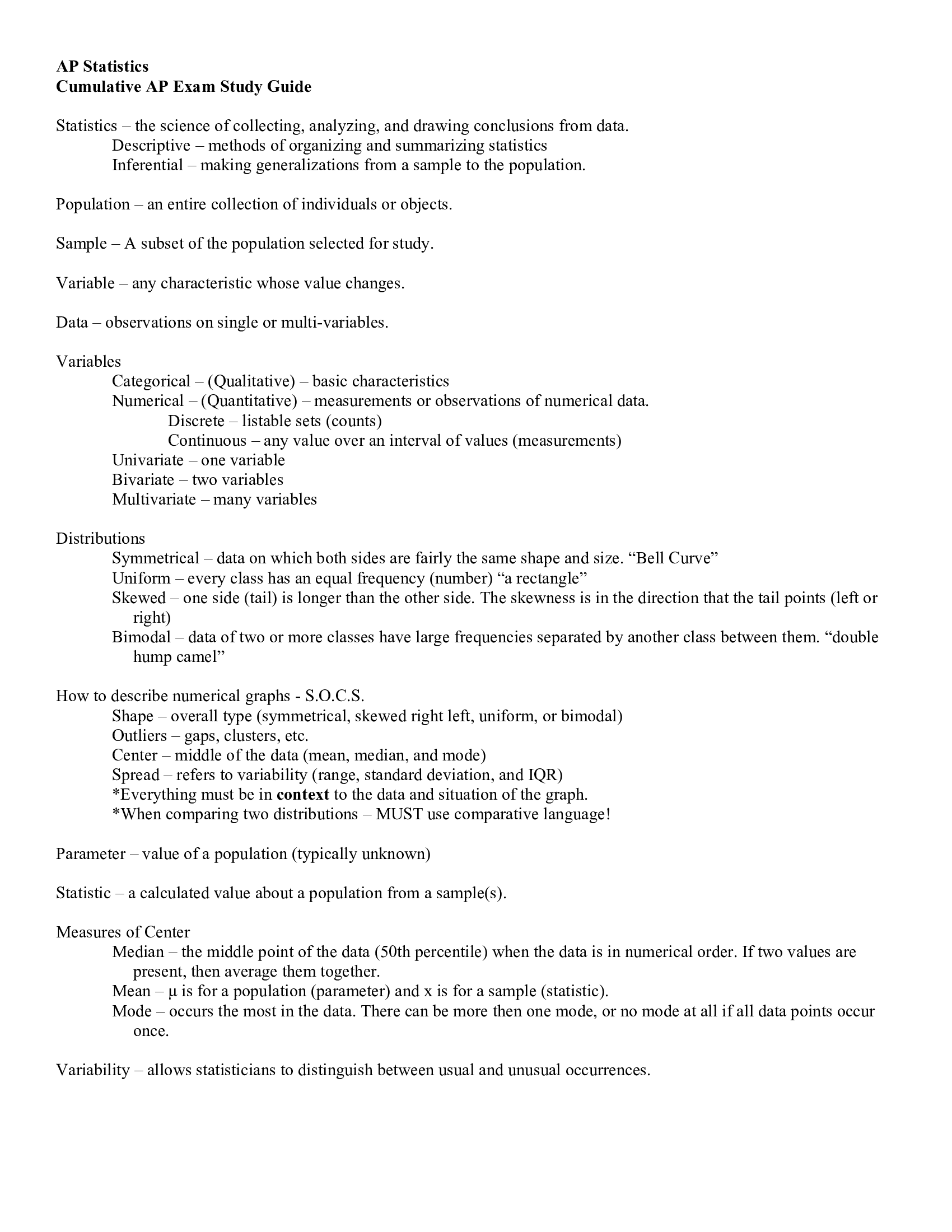
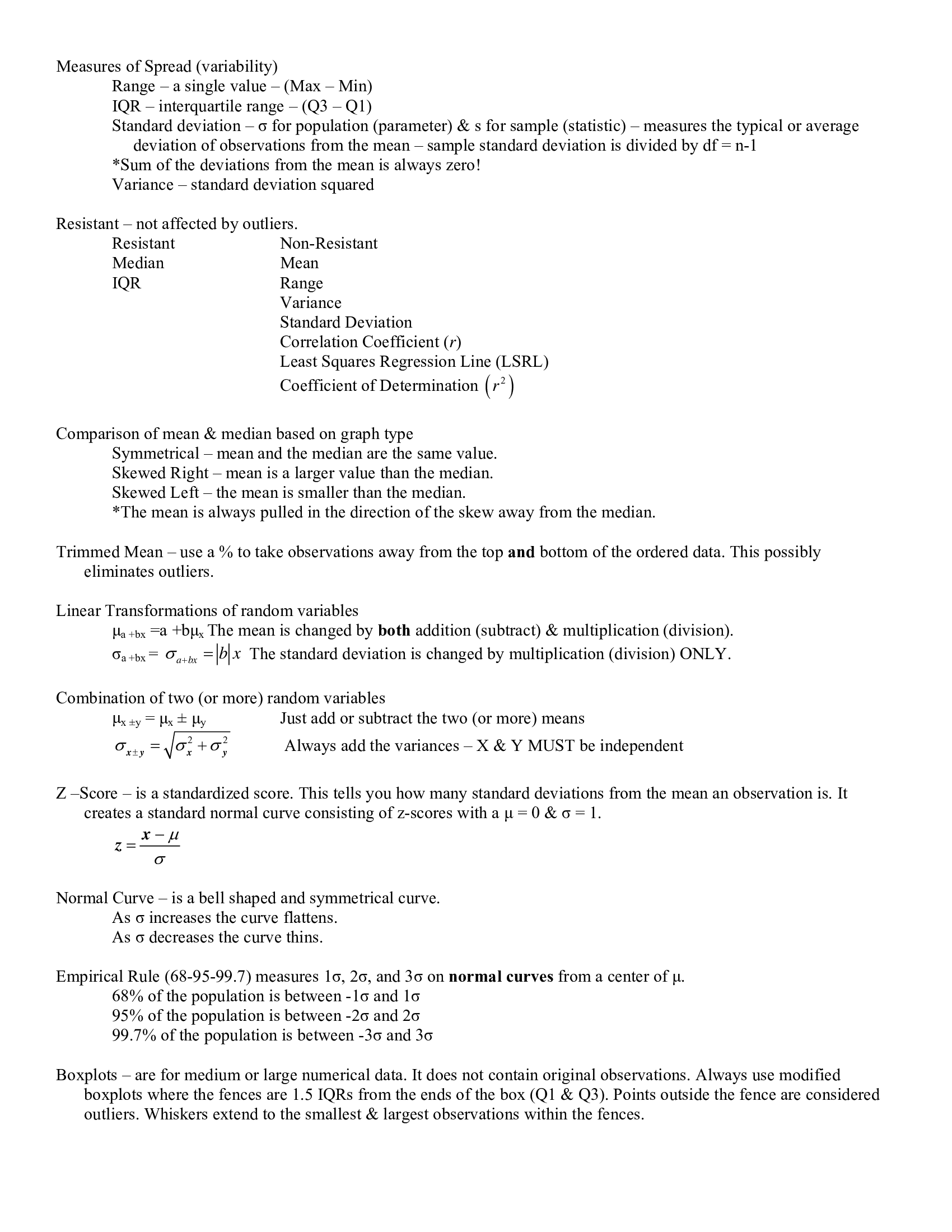
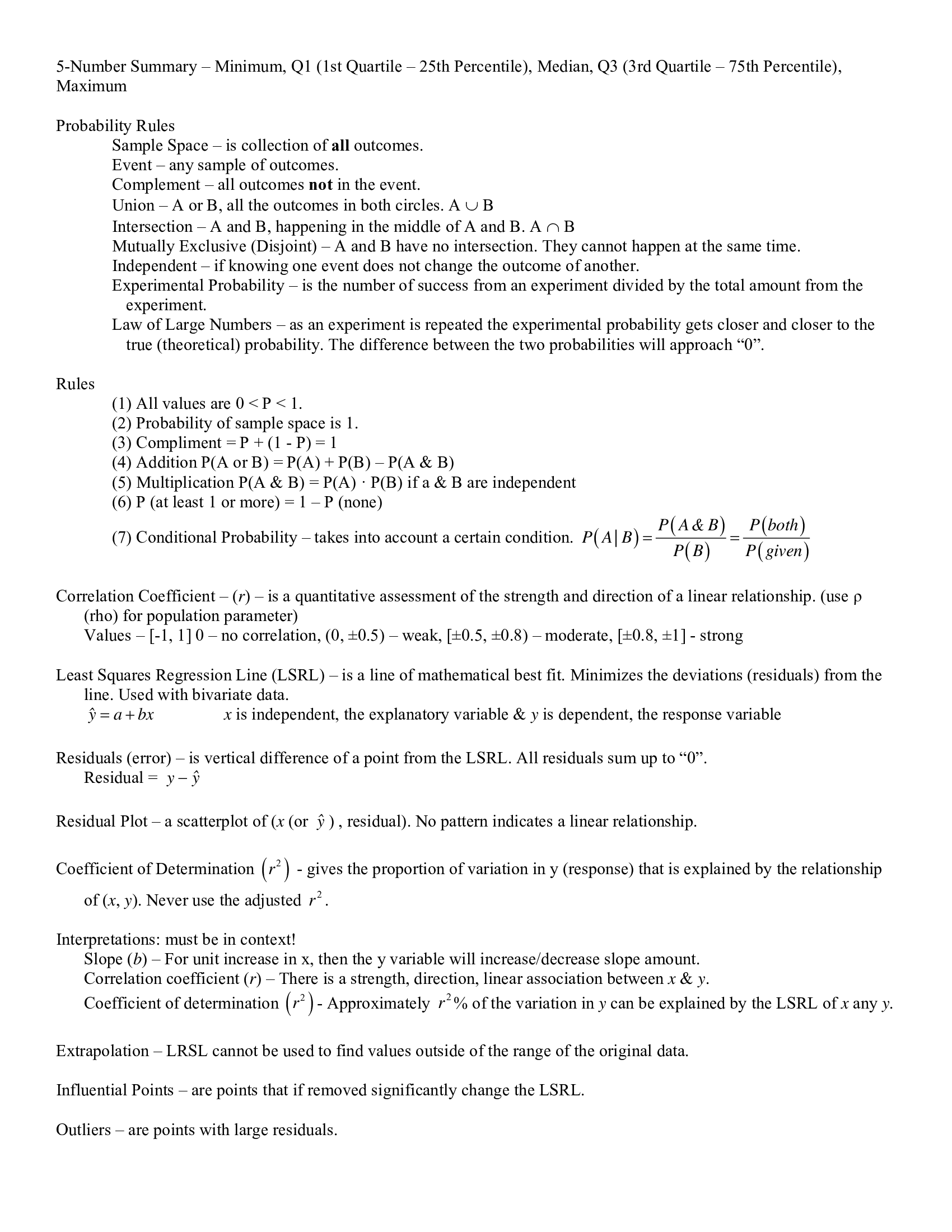
AP Statistics Cumulative AP Exam Study Guide Statistics – the science of collecting, analyzing, and drawing conclusions from data. Descriptive – methods of organizing and summarizing statistics Inferential – making generalizations from a sample to the population. Population – an entire collection of individuals or objects. Sample – A subset of the population selected for study. Variable – any characteristic whose value changes. Data – observations on single or multi-variables. Variables Categorical – (Qualitative) – basic characteristics Numerical – (Quantitative) – measurements or observations of numerical data. Discrete – listable sets (counts) Continuous – any value over an interval of values (measurements) Univariate – one variable Bivariate – two variables Multivariate – many variables Distributions Symmetrical – data on which both sides are fairly the same shape and size. “Bell Curve” Uniform – every class has an equal frequency (number) “a rectangle” Skewed – one side (tail) is longer than the other side. The skewness is in the direction that the tail points (left or right) Bimodal – data of two or more classes have large frequencies separated by another class between them. “double hump camel” How to describe numerical graphs - S.O.C.S. Shape – overall type (symmetrical, skewed right left, uniform, or bimodal) Outliers – gaps, clusters, etc. Center – middle of the data (mean, median, and mode) Spread – refers to variability (range, standard deviation, and IQR) *Everything must be in context to the data and situation of the graph. *When comparing two distributions – MUST use comparative language! Parameter – value of a population (typically unknown) Statistic – a calculated value about a population from a sample(s). Measures of Center Median – the middle point of the data (50th percentile) when the data is in numerical order. If two values are present, then average them together. Mean – μ is for a population (parameter) and x is for a sample (statistic). Mode – occurs the most in the data. There can be more then one mode, or no mode at all if all data points occur once. Variability – allows statisticians to distinguish between usual and unusual occurrences. Measures of Spread (variability) Range – a single value – (Max – Min) IQR – interquartile range – (Q3 – Q1) Standard deviation – σ for population (parameter) & s for sample (statistic) – measures the typical or average deviation of observations from the mean – sample standard deviation is divided by df = n-1 *Sum of the deviations from the mean is always zero! Variance – standard deviation squared Resistant – not affected by outliers. Resistant Non-Resistant Median Mean IQR Range Variance Standard Deviation Correlation Coefficient (r) Least Squares Regression Line (LSRL) Coefficient of Determination   2 r Comparison of mean & median based on graph type Symmetrical – mean and the median are the same value. Skewed Right – mean is a larger value than the median. Skewed Left – the mean is smaller than the median. *The mean is always pulled in the direction of the skew away from the median. Trimmed Mean – use a % to take observations away from the top and bottom of the ordered data. This possibly eliminates outliers. Linear Transformations of random variables μa +bx =a +bμx The mean is changed by both addition (subtract) & multiplication (division). σa +bx = a bx  b x   The standard deviation is changed by multiplication (division) ONLY. Combination of two (or more) random variables μx ±y = μx ± μy Just add or subtract the two (or more) means 2 2  x y     x y Always add the variances – X & Y MUST be independent Z –Score – is a standardized score. This tells you how many standard deviations from the mean an observation is. It creates a standard normal curve consisting of z-scores with a μ = 0 & σ = 1. x z     Normal Curve – is a bell shaped and symmetrical curve. As σ increases the curve flattens. As σ decreases the curve thins. Empirical Rule (68-95-99.7) measures 1σ, 2σ, and 3σ on normal curves from a center of μ. 68% of the population is between -1σ and 1σ 95% of the population is between -2σ and 2σ 99.7% of the population is between -3σ and 3σ Boxplots – are for medium or large numerical data. It does not contain original observations. Always use modified boxplots where the fences are 1.5 IQRs from the ends of the box (Q1 & Q3). Points outside the fence are considered outliers. Whiskers extend to the smallest & largest observations within the fences. 5-Number Summary – Minimum, Q1 (1st Quartile – 25th Percentile), Median, Q3 (3rd Quartile – 75th Percentile), Maximum Probability Rules Sample Space – is collection of all outcomes. Event – any sample of outcomes. Complement – all outcomes not in the event. Union – A or B, all the outcomes in both circles. A  B Intersection – A and B, happening in the middle of A and B. A  B Mutually Exclusive (Disjoint) – A and B have no intersection. They cannot happen at the same time. Independent – if knowing one event does not change the outcome of another. Experimental Probability – is the number of success from an experiment divided by the total amount from the experiment. Law of Large Numbers – as an experiment is repeated the experimental probability gets closer and closer to the true (theoretical) probability. The difference between the two probabilities will approach “0”. Rules (1) All values are 0 < P < 1. (2) Probability of sample space is 1. (3) Compliment = P + (1 - P) = 1 (4) Addition P(A or B) = P(A) + P(B) – P(A & B) (5) Multiplication P(A & B) = P(A) · P(B) if a & B are independent (6) P (at least 1 or more) = 1 – P (none) (7) Conditional Probability – takes into account a certain condition.           P A& B P both P A|B P B P given   Correlation Coefficient – (r) – is a quantitative assessment of the strength and direction of a linear relationship. (use ρ (rho) for population parameter) Values – [-1, 1] 0 – no correlation, (0, ±0.5) – weak, [±0.5, ±0.8) – moderate, [±0.8, ±1] - strong Least Squares Regression Line (LSRL) – is a line of mathematical best fit. Minimizes the deviations (residuals) from the line. Used with bivariate data. ˆ y a bx   x is independent, the explanatory variable & y is dependent, the response variable Residuals (error) – is vertical difference of a point from the LSRL. All residuals sum up to “0”. Residual = y y  ˆ Residual Plot – a scatterplot of (x (or ˆ y ) , residual). No pattern indicates a linear relationship. Coefficient of Determination   2 r - gives the proportion of variation in y (response) that is explained by the relationship of (x, y). Never use the adjusted 2 r . Interpretations: must be in context! Slope (b) – For unit increase in x, then the y variable will increase/decrease slope amount. Correlation coefficient (r) – There is a strength, direction, linear association between x & y. Coefficient of determination   2 r - Approximately 2 r % of the variation in y can be explained by the LSRL of x any y. Extrapolation – LRSL cannot be used to find values outside of the range of the original data. Influential Points – are points that if removed significantly change the LSRL. Outliers – are points with large residuals. 

Contact the Seller

Please Sign In to contact this seller.


  • 👎  Report Copyright Violation

Frequently Asked Questions

What Do I Get When I Buy This Study Material?

+

When you buy a study material on Passing Grades, an instant download link will be sent directly to your email, giving you access to the file anytime after payment is completed.

Is Passing Grades a Trusted Platform?

+

Yes, Passing Grades is a reputable students’ marketplace with a secure payment system and reliable customer support. You can trust us to ensure a safe and seamless transaction experience.

Will I Be Stuck with a Subscription?

+

No, all purchases on Passing Grades are one-time transactions. You only pay for the notes you choose to buy, with no subscriptions or hidden fees attached.

Who Am I Buying These Study Materials From?

+

Passing Grades is a marketplace, which means you are purchasing the document from an individual vendor, not directly from us. We facilitate the payment and delivery process between you and the vendor.

Does Passing Grades Offer Free Study Materials?

+

Yes, sellers on Passing Grades have uploaded numerous free test banks, exams, practice questions, and class notes that can be downloaded at no cost.

Pasinggrades - Quality Study Materials

USD 7

    • Quality checked by Pasing Grades
    • 100% satisfaction guarantee
    • Seller: mentor2000
Buy PDF $7

Seller Information

mentor2000

Member since April 2021

  • icon
  • icon
View Profile
  • total sales

    0
  • Favourites

    0
  • Comments

    0
    ( 0 Ratings )

Item Information

  • Uploaded

    08 May 2024

  • Updated

    29 September 2025

  • Category

    General

  • Item Type

    exam

  • Tags

    Cumulative AP Exam Study Guide (Statistics)

Related Exam Prep Guides by mentor2000

Test Bank for Essentials for Nursing Practice 8th Edition by Potter | All Chapters
View Document

Test Bank for Essent...

  • mentor2000

    mentor2000

  • exam

Master nursing concepts with this study material; Test Bank for Essentials for Nursing Practice, 8th...

7 USD

0

0

A &P 1 MA278 BSC2 Final Module II Questions & Answers 2026 Update
View Document

A &P 1 MA278 BSC2 Fi...

  • mentor2000

    mentor2000

  • exam

Prepare for success with A&P 1 MA278 BSC2 Final Module II 2024 Q&A. Boost your grades with this comp...

7 USD

0

0

ATI Comprehensive Predictor Exam 2026
View Document

ATI Comprehensive Pr...

  • mentor2000

    mentor2000

  • exam

Prepare for success with the ATI Comprehensive Predictor Exam 2026. Access key practice questions to...

7 USD

0

0

Purchase

Download link will be sent to this email immediately after purchase.

IMPORTANT LINKS

  • How To Upload Class Notes
  • Selling Tips
  • Passing Grades's Study Materials
  • Scholarships for International Students 2026

POPULAR CATEGORIES

  • Law
  • Accounting
  • English
  • Psychology
  • Business
  • Nursing
  • Computer Science
  • General

View Document

  • Blog
  • Contact
  • Delivery Policy
  • Latest Scholarships Around the World
  • How to Pass Bar Exams: Passing Grades’ Strategies
  • How to Study and Pass the CPA Exam
  • All Test Banks
  • Faq
  • Copyright Claims
  • Privacy Policy
  • Terms of Use

KNOWLEDGE BASE

  • How to Write A+ Grade Good Research Paper
  • How to Manage Stress During Exam Period
  • Best Time to Study
  • How to Pass NCLEX-RN Exam
  • How To Effectively Utilize Test Banks
  • Popular Shadow Health Exam Assessments
  • Popular HESI Case Studies
  • How to Prepare for a Nursing Career
  • The Importance Of Summaries in Exam Revisvion

© 2026 Pasing Grades. All rights reserved.