

What Is a Passing Grade in College? GPA Requirements, D Grades & Graduation Rules
One of the first questions students ask when the get their college admission is simple but very important.
What exactly counts as a passing grade?
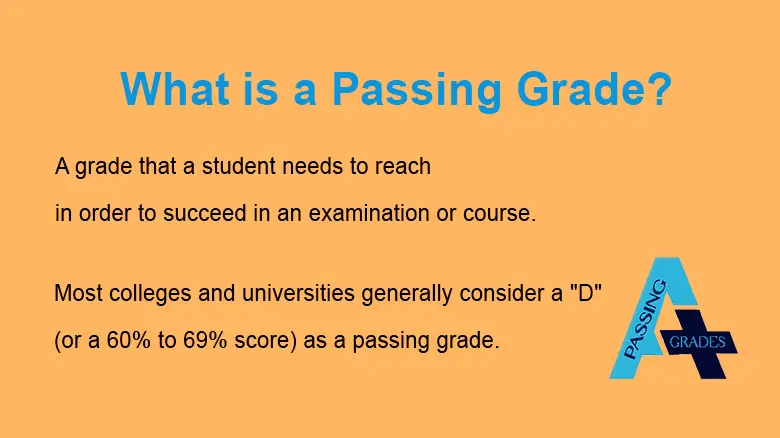
Usually, a D ranging between 60-69% is considered the lowest passing grade in majority of US colleges. As it will be evident in this article, success in college requires a lot of hard work for one to acquire passing grades.
Even though its established that D qualifies a student for the pass mark, still you have to score higher because even though a D can be a pass, it might bring challenges when matching up for your dream profession.
The US College Grading Scale Explained
Most colleges and universities in the United States follow the standard A–F letter grading system. Here is how the scale breaks down:
|
Letter Grade |
Percentage Range |
GPA Points |
What It Means |
|
A |
90–100% |
4.0 |
Excellent |
|
B |
80–89% |
3.0 |
Above average |
|
C |
70–79% |
2.0 |
Average |
|
D |
60–69% |
1.0 |
Below average - technically passing |
|
F |
Below 60% |
0.0 |
Failing |
Some schools use plus and minus variations (A+, A-, B+, etc.) with slightly adjusted GPA values. Note that the core scale above is the standard used in most institutions across the country and other parts of the world that have borrowed from the United States' grading system.
It is worth knowing that not every school uses letter grades exclusively as some institutions use a satisfactory/unsatisfactory (S/U) or pass/fail system for certain courses. Often, (S/U) or pass/fail system works differently and does not factor into your GPA the same way.
For example, the University of Arizona uses an alternative Superior/Pass/Fail (S/P/F) system for individual studies, thesis units, and pre-clerkship medical courses.
Under this system, passing grades are awarded to reflect completed work but are completely excluded from the student's cumulative GPA calculation.
Is a D Actually a Passing Grade in College?
The answer is Yes but you need to be carefull and not just aim to get a D since its a passing grade. As a student, you should always aim to get the highest grade possible as the old saying, aim at the sun, land on the moon. Aiming for a D is dangerous and this is the reason;
In many colleges, a D will get you the pass mark and earn you the course credit, however, it has consequences.
According to research from US Language Services (2026), a grade in the D range might count as a course pass but not toward your major.
When it comes to your major, it will be labeled unsatisfactory passing thus disqualifying you from transferring the credit In some cases, it might trigger academic probation if it drags your overall GPA below the 2.0 threshold.
In demanding programs like pre-med, engineering, or nursing, a D is often outright unacceptable. Many departments set their own minimum — a C or better is the floor most schools treat as a genuinely solid passing grade.
So while D is passing on paper, it is not passing in any meaningful academic sense if your goal is to graduate on time, keep your financial aid, or continue into advanced courses.
What Is a Passing GPA in College?
Your individual course grades feed into your cumulative grade point average (GPA), which is the number that determines your academic standing.
For undergraduates, a minimum GPA of 2.0 is required to maintain good academic standing at most US colleges and universities. Its also a requirement for a student to graduate. According to US News & World Report (2025), students must attain 2.0 standard to remain eligible for federal financial aid and to stay enrolled.
In the case where you fail to attain GPA of 2.0, you'll be risking academic warning, probation, or even suspension.
For graduate students, the bar is higher. Most graduate programs require a minimum GPA of 3.0, as confirmed by academic policies at institutions such as University of Arizona, Penn, and Duquesne.
A GPA of 3.15 or above roughly a B average is good and will not hinder you when it comes to applying for scholarships and graduate school.
Is a 65 a Passing Grade? Is a 69? Is a 74?
The table below presents some of the most asked questions by students in relation to Pasing Grades under the standard US system:
|
Score |
Passed? |
Letter & GPA Impact |
The Reality Check |
|
60 & 65 |
Yes |
D (1.0) |
Absolute bare minimum. You get the credit, but it drags your cumulative GPA down. |
|
69 |
Yes |
D+ (1.3) |
A borderline pass. It is risky and often won't count toward major requirements. |
|
74 |
Yes |
C- (1.7) |
A safe, solid pass. This protects your major track and keeps you in good standing. |
|
79 |
Yes |
C+ (2.3) |
Above average. This gives your GPA a healthy cushion for graduation. |
Again, whether passing is enough depends on your program, your school's policies, and whether the course counts toward your major.
Why a Passing Grade Is Not Always Good Enough
1. Financial Aid
To keep receiving federal student aid, you must meet Satisfactory Academic Progress (SAP) requirements each term. The National Student Clearinghouse Research Center (2025) shows that average college retention sits around 69.5%. The findings also indicated that academic struggles are a leading reason students withdraw.
2. Graduation Requirements
You need cumulative GPA of at least 2.0 to graduate. Boston University, Florida State among other institutions require a minimum of 2.0. If you get D, you wont graduate even those as we have seen it being grouped under passing grades.
3. Graduate School and Jobs
If you plan to apply to graduate school, a 2.0 GPA will hinder you since most programs require 3.0 or higher. During employment, some employers do check your GPA.
How Grading Works
In both high school and college, grading varies by professor and course. Some weight exams heavily. Others build your grade through assignments, quizzes, projects, and attendance. Some professors grade on a curve whereby they adjust the scale based on the overall class performance.
At the start of every semester, your professor will share a syllabus that outlines exactly how your grade is calculated. Read it. Understanding how your grade is built — and where the biggest point opportunities are — is the first real advantage you can give yourself.
Practical Tips to Stay Above Passing
You do not need a perfect 4.0. However, its imperative that you get a GPA that will keep you in good standing. There are several proven habits known to keep students above the passing grade.
The first habit is consistency. You need to be consistent when chasing any goal in life. Numerous studies have concluded that consistency beats talent all the time, its from this concept that even attendance is usually graded and in cases whereby its not graded, showing up in class is the easiest and efficient way of learning your course material.
Secondly, make it a habbit of asking your professors where you don't understand. This can be done effectively during office hours.
Spread your workload. Cramming before exams is less effective than reviewing material in shorter sessions over time. The research on spaced repetition and spaced learning clearly shows the importance of distributing your study sessions as it improves retention.
Effective study also requires you to find your best study hours. research shows that late morning and early evening are the ideal times to study for many students.
Its also important that you know when to seek for help where you find challenges in your course work. Most colleges offer free tutoring, writing centers, and academic advising.
Consider a retake strategy. If you earn a D or F in a course, many schools allow you to retake it and replace the original grade in your GPA calculation. Check your school's policy as it is a good option.
Frequently Asked Questions
Is a D a passing grade in college? At most colleges, yes. A D (60–69%) is technically passing. However, it may not count toward your major, it could jeopardize your GPA, and many programs require at least a C to move forward.
What is a passing GPA in college? A 2.0 GPA is the minimum for good academic standing and graduation eligibility at most US colleges. Anything below that puts you at risk of academic probation or dismissal.
Is a C a passing grade? Yes — and for most students, a C (70–79%, 2.0 GPA points) is the more practical standard for "passing" since it counts toward your major, supports your overall GPA, and keeps you on track.
What happens if I fail a class? Failing a course means earning an F (below 60%), which gives you 0 GPA points. It can lower your cumulative GPA, trigger academic probation, affect financial aid, and require you to retake the course to meet your degree requirements.
Does pass/fail affect your GPA? In most cases, no. A "pass" in a pass/fail course does not affect your GPA, but a "fail" typically does count as a zero. Always confirm this with your school's registrar before switching a course to pass/fail.
The Bottom Line
A passing grade in college is technically a D, 60% upward. But you should aim for is a C and above, which protects your GPA, keeps your financial aid intact, and gives you options when it comes to graduate school or employment. The grading system is designed to measure competence, and while just passing is possible, building the habits and using the resources available to you makes everything that comes after college considerably easier.
0
2847