

Why Taking Strategic Study Breaks Improves Memory Retention: The Neuroscience of Spaced Learning and the Pomodoro Technique.
Spending hours studying only to fail an exam is one of the most frustrating experiences a student can go through. The assumption most students make is that more study time equals better results but that is not entirely true.
Science is clear on this: studying smarter beats studying harder every time. One of the smartest things you can do when preparing for exams is to take strategic breaks.
Research shows that stepping away from your books at the right moments actually helps you retain more of what you study
The Brain Is Not Built for Marathon Sessions
The human brain is not designed to sustain deep focus for hours at a stretch. Research consistently shows that without proper rest intervals, cognitive performance declines. When you force yourself to study continuously, stress hormones like cortisol begin to rise, and elevated cortisol levels actively impair memory formation and recall. Simply, you can be studying harder thinking you are doing justice to yourself but in actual sense you are learning less which certainly isn't your goal.
What most students do not realize is that memory consolidation, the process by which your brain moves information from short-term to long-term storage, does not happen while you are actively studying. It happens during rest. The hippocampus, the brain region responsible for this transfer, requires downtime to do its job properly.
Skipping breaks does not give your brain more time to learn. It denies your brain the conditions it needs to remember. Its like putting a live fish on land and expect it to survive, it requires the right environment and so does your brain.
What Happens in the Brain During a Break
In a landmark study by researchers at the National Institutes of Health, scientists discovered that during short rest periods, the brain rapidly replays compressed versions of recently learned material. The more frequently this replay occurred during rest, the better participants performed when they returned to their tasks. As it turns out, rest is part of the active phase of learning, reason we insist on students to use spaced learning technique.
Separate neuroscience research out of the Max Planck Institute reinforced this finding, showing that spaced learning intervals study, rest, study, rest, cause the brain to reactivate the same neural pathways used during earlier learning sessions. This repetition strengthens the connections between neurons, making recall faster and more reliable. Continuous studying, by contrast, forces the brain to recruit different neurons each session, making retention weaker and less consistent.
The Pomodoro Technique: A Framework That Works
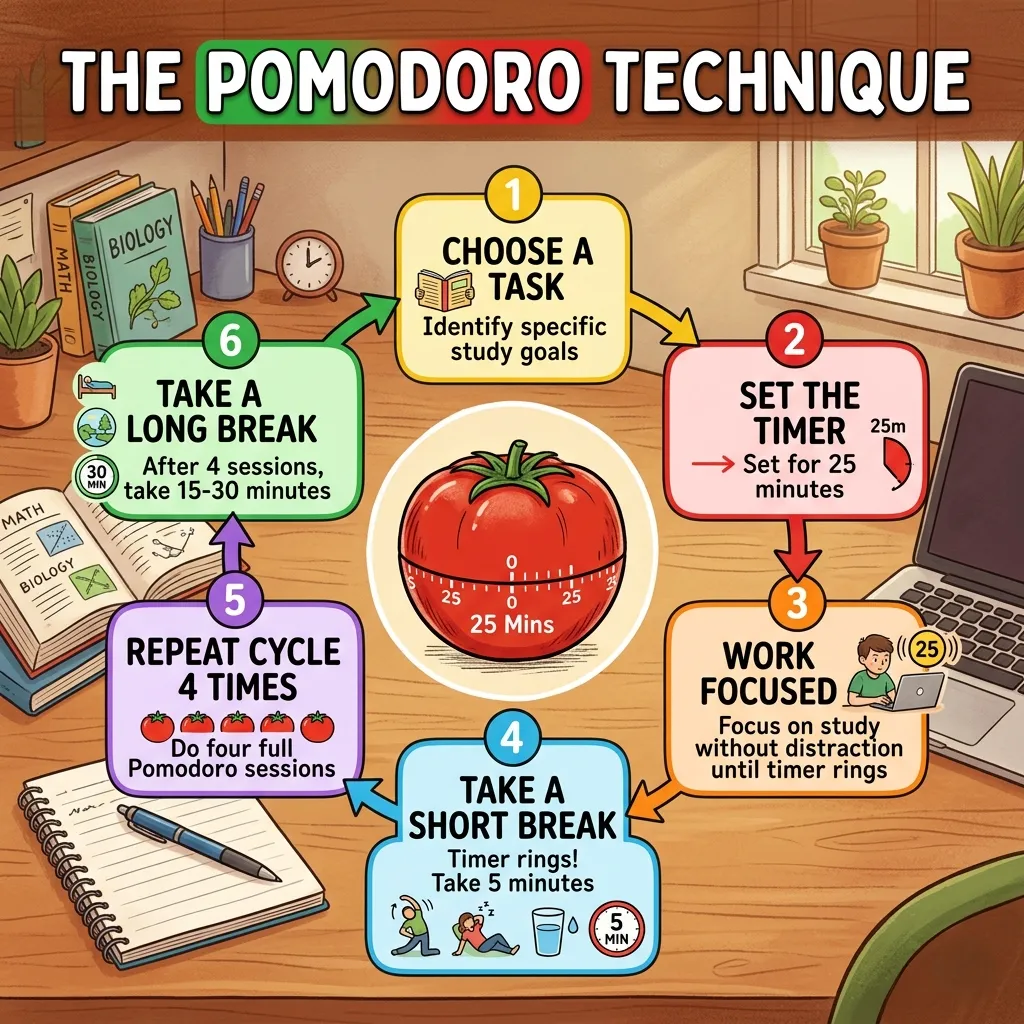
One of the most practical ways to build strategic breaks into your study routine is through the Pomodoro Technique, developed by Francesco Cirillo in the late 1980s. The method is straightforward: study with full focus for 25 minutes, then take a 5-minute break. After four such cycles, take a longer break of 15 to 30 minutes.
The results speak for themselves. A scoping review published on PubMed examining the Pomodoro Technique in anatomy students found that those who used it scored an average exam performance of 82%, compared to 70% in the control group.
Focus levels were also measurably higher, and reported fatigue was significantly lower. The technique works because it aligns with the brain's natural attention rhythms, giving it just enough challenge before allowing recovery.
What You Do During the Break Matters
Here is where most students leave value on the table. A study break is only restorative if it actually allows the brain to shift gears. Scrolling through social media or reading news feeds keeps the brain in a reactive, stimulated state that prevents true cognitive recovery. If exam stress is already weighing on you before your study session even begins, it is worth checking up strategies for managing stress during exams main reason being, unmanaged stress and poor break habits tend to reinforce each other. The goal of a break is a genuine change of sensory input.
Short physical movement, light stretching, stepping outside, or engaging with something low-stakes and mentally undemanding all help clear cognitive fatigue effectively.
Some students find that brief, casual digital entertainment offers the exact sensory shift they need. Platforms like Bdg Game provide a fast-paced, low-commitment option that many students turn to during their 5-minute Pomodoro windows.

This kind of spaced learning provides the student with enough stimulation to break the study monotony without pulling them into a lengthy session that disrupts their schedule.
The key distinction here is intentionality. A break with a clear end point recharges focus while an open-ended distraction drains it.
Practical Tips for Making Study Breaks Work
To get the most from your breaks, keep these principles in mind:
- Time them proactively. When you are studying regularly, for midterm or even final exams, do not wait until you feel exhausted. Schedule breaks before fatigue sets in.
- Keep short breaks short. Five minutes is enough to reset. Letting a quick break drift into thirty minutes undermines the entire system.
- Change your environment when possible. Even standing up and moving to a different spot signals to your brain that the work phase has paused.
- Use longer breaks for genuine recovery. After every four Pomodoros, step away for at least 15 minutes. Eat something, go outside, or do something physical.
Also read: What Is The Best Time To Study For Exams?
The Bottom Line
Studying without breaks feels productive, but the evidence is clear — it is not. Memory consolidation, neural replay, and cognitive recovery all require rest. Students who build strategic breaks into their routine do not study less. They study smarter, retain more, and arrive at their exams with minds that are genuinely prepared rather than simply exhausted.
The most effective study session you will ever have is not the longest one. It is the most strategically structured one.
0
173