Pasing Grades
  • Start Selling
  • Blog
  • Contact
  • 0

    Your cart is empty!

English

  • English
  • Spanish
  • Arabic
Create Account Sign In
  • Library
    • New Prep Guides
    • Featured Prep Guides
    • Free Exam Prep Guides
    • Best sellers
  • General
  • Nursing
    • Research Paper
    • Case Study
    • Discussion Post
    • Assignment
    • Exam
    • Practice Questions and Answers
    • Test Bank
    • solutions manual
  • Accounting
    • Case Study
    • Thesis
    • Study Guide
    • Summary
    • Research Paper
    • test bank
  • English
    • Creative Writing
    • Research Paper
    • Summary
    • Rhetorics
    • Literature
    • Journal
    • Exam
    • Grammar
    • Discussion Post
    • Essay
  • Psychology
    • Hesi
    • Presentation
    • Essay
    • Summary
    • Study Guide
    • Essay
    • Solution Manual
    • Final Exam Review
    • Class Notes
    • test bank
  • Business
    • Lecture Notes
    • Solution Manual
    • Presentation
    • Business Plan
    • Class Notes
    • Experiment
    • Summary
    • Practice Questions
    • Study Guide
    • Case Study
    • test bank
    • Exam
  • More
    • Computer Science
    • Economics
    • Statistics
    • Engineering
    • Biology
    • Religious Studies
    • Physics
    • Chemistry
    • Mathematics
    • History
    • Sociology
    • Science
    • Philosophy
    • Law
  • Pages
    • About Us
    • Selling Tips
    • Delivery Policy
    • Faq
    • Privacy Policy
  • Flash Sale
  • Home
  • Wall Street Prep Redbook Valuation: Corporate Finance Questions And Answers

Wall Street Prep Redbook Valuation: Corporate Finance Questions And Answers

Preview page 1 Preview page 2 Preview page 3
Add To Favorites

Share this item Share this item

  • Item Details
  • Comments (0)
  • Reviews (0)
  • Contact Seller
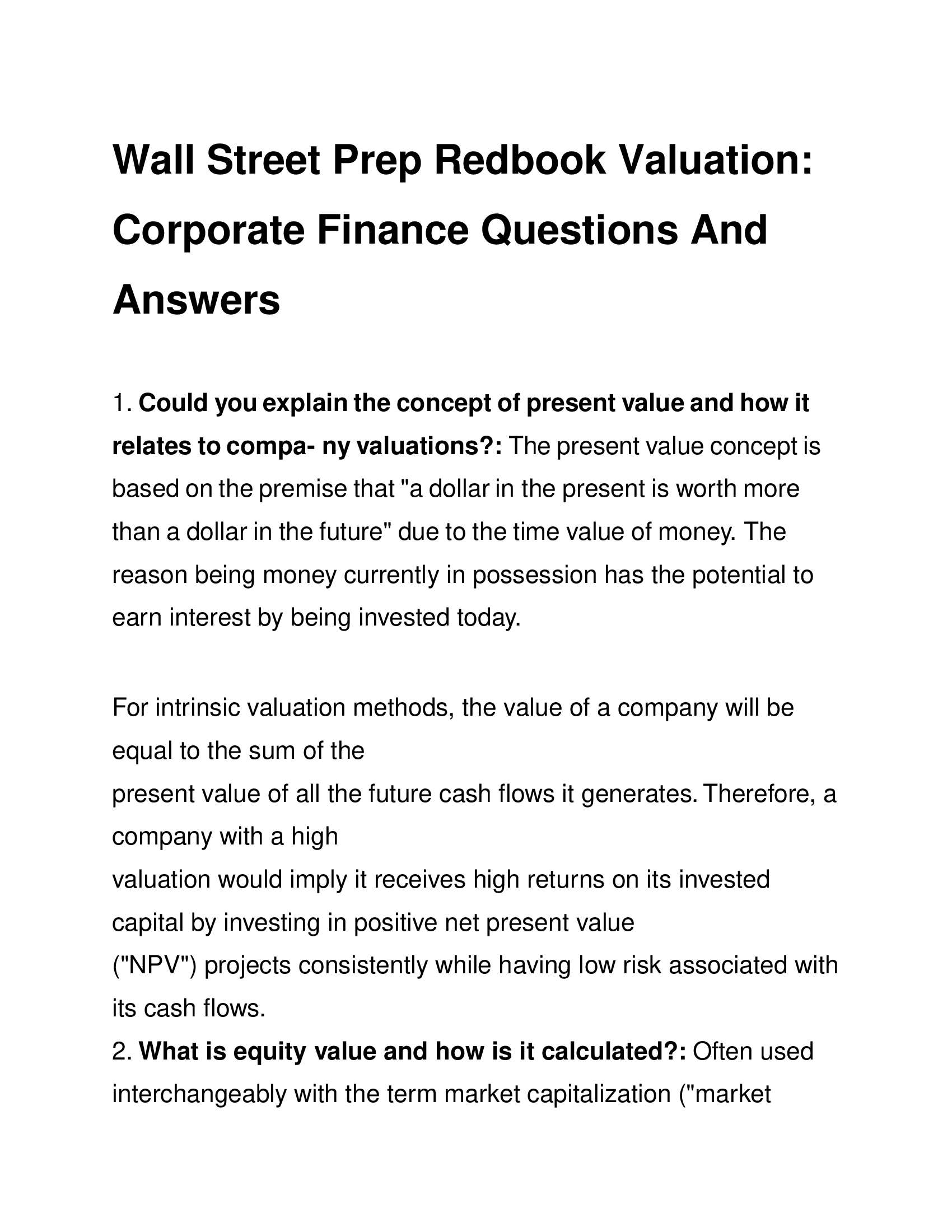
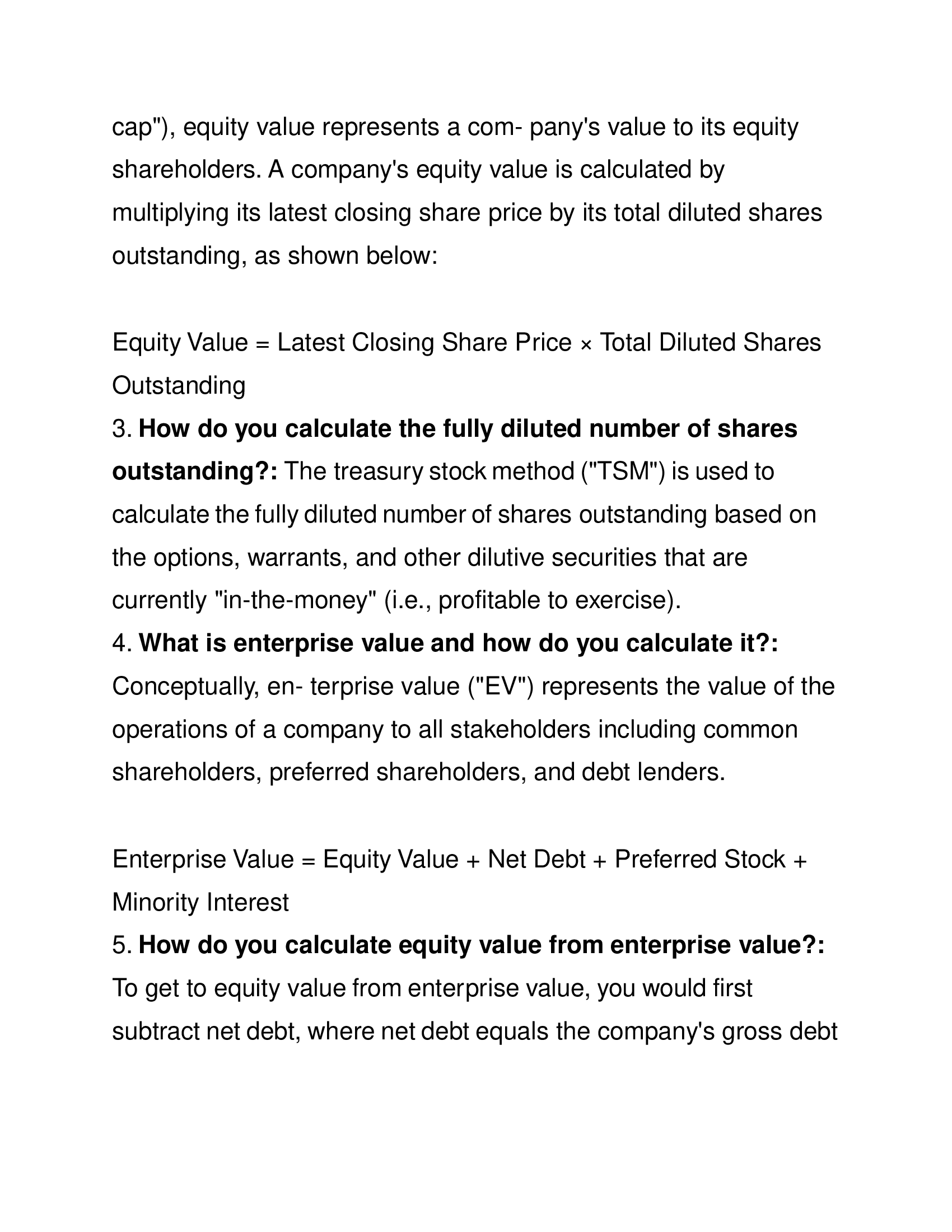
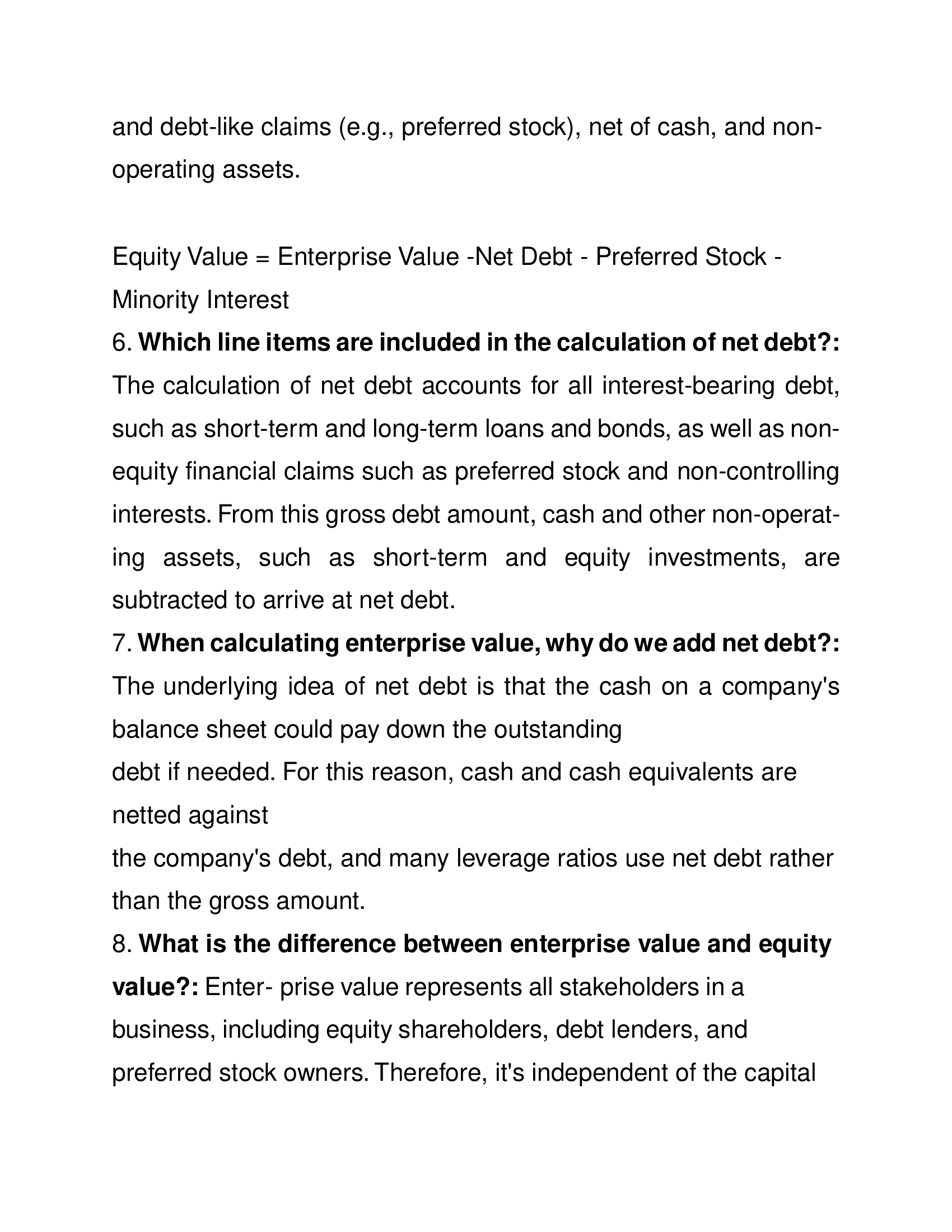
1. Could you explain the concept of present value and how it relates to compa- ny valuations?: The present value concept is based on the premise that "a dollar in the present is worth more than a dollar in the future" due to the time value of money. The reason being money currently in possession has the potential to earn interest by being invested today. For intrinsic valuation methods, the value of a company will be equal to the sum of the present value of all the future cash flows it generates. Therefore, a company with a high valuation would imply it receives high returns on its invested capital by investing in positive net present value ("NPV") projects consistently while having low risk associated with its cash flows. 2. What is equity value and how is it calculated?: Often used interchangeably with the term market capitalization ("market cap"), equity value represents a com- pany's value to its equity shareholders. A company's equity value is calculated by multiplying its latest closing share price by its total diluted shares outstanding, as shown below: Equity Value = Latest Closing Share Price Ă— Total Diluted Shares Outstanding 3. How do you calculate the fully diluted number of shares outstanding?: The treasury stock method ("TSM") is used to calculate the fully diluted number of shares outstanding based on the options, warrants, and other dilutive securities that are currently "in-the-money" (i.e., profitable to exercise). 4. What is enterprise value and how do you calculate it?: Conceptually, en- terprise value ("EV") represents the value of the operations of a company to all stakeholders including common shareholders, preferred shareholders, and debt lenders. Enterprise Value = Equity Value + Net Debt + Preferred Stock + Minority Interest 5. How do you calculate equity value from enterprise value?: To get to equity value from enterprise value, you would first subtract net debt, where net debt equals the company's gross debt and debt-like claims (e.g., preferred stock), net of cash, and non-operating assets. Equity Value = Enterprise Value -Net Debt - Preferred Stock - Minority Interest 6. Which line items are included in the calculation of net debt?: The calculation of net debt accounts for all interest-bearing debt, such as short-term and long-term loans and bonds, as well as non-equity financial claims such as preferred stock and non-controlling interests. From this gross debt amount, cash and other non-operat- ing assets, such as short-term and equity investments, are subtracted to arrive at net debt. 7. When calculating enterprise value, why do we add net debt?: The underlying idea of net debt is that the cash on a company's balance sheet could pay down the outstanding debt if needed. For this reason, cash and cash equivalents are netted against the company's debt, and many leverage ratios use net debt rather than the gross amount. 8. What is the difference between enterprise value and equity value?: Enter- prise value represents all stakeholders in a business, including equity shareholders, debt lenders, and preferred stock owners. Therefore, it's independent of the capital structure. In addition, enterprise value is closer to the actual value of the business since it accounts for all ownership stakes (as opposed to just equity owners).

Contact the Seller

Please Sign In to contact this seller.


  • 👎  Report Copyright Violation

Frequently Asked Questions

What Do I Get When I Buy This Study Material?

+

When you buy a study material on Passing Grades, an instant download link will be sent directly to your email, giving you access to the file anytime after payment is completed.

Is Passing Grades a Trusted Platform?

+

Yes, Passing Grades is a reputable students’ marketplace with a secure payment system and reliable customer support. You can trust us to ensure a safe and seamless transaction experience.

Will I Be Stuck with a Subscription?

+

No, all purchases on Passing Grades are one-time transactions. You only pay for the notes you choose to buy, with no subscriptions or hidden fees attached.

Who Am I Buying These Study Materials From?

+

Passing Grades is a marketplace, which means you are purchasing the document from an individual vendor, not directly from us. We facilitate the payment and delivery process between you and the vendor.

Does Passing Grades Offer Free Study Materials?

+

Yes, sellers on Passing Grades have uploaded numerous free test banks, exams, practice questions, and class notes that can be downloaded at no cost.

Pasinggrades - Quality Study Materials

USD 5

    • Quality checked by Pasing Grades
    • 100% satisfaction guarantee
    • Seller: tutor_gesco
Buy PDF $5

Seller Information

tutor_gesco

Member since October 2021

  • icon
  • icon
View Profile
  • total sales

    0
  • Favourites

    0
  • Comments

    0
    ( 0 Ratings )

Item Information

  • Uploaded

    16 December 2024

  • Updated

    29 September 2025

  • Category

    Business

  • Item Type

    exam

  • Tags

    Wall Street Prep Redbook Valuation Corporate Finance Questions And Answers

Related Exam Prep Guides by tutor_gesco

TEST BANK FOR GENETICS ESSENTIALS CONCEPTS AND CONNECTIONS 4TH EDITION BY PIERCE
View Document

TEST BANK FOR GENETI...

  • tutor_gesco

    tutor_gesco

  • exam

TEST BANK FOR GENETICS ESSENTIALS CONCEPTS AND CONNECTIONS 4TH EDITION BY PIERCE...

5 USD

0

0

TEST BANK FOR ESSENTIALS OF THE LIVING WORLD 6TH EDITION BY JOHNSON
View Document

TEST BANK FOR ESSENT...

  • tutor_gesco

    tutor_gesco

  • exam

Master key biology concepts with the Test Bank for Essentials of the Living World, 6th Edition by Jo...

5 USD

0

0

Test Bank for Human Biology, 16e (Mader)
View Document

Test Bank for Human ...

  • tutor_gesco

    tutor_gesco

  • exam

Test Bank for Human Biology, 16e (Mader)...

5 USD

0

0

Purchase

Download link will be sent to this email immediately after purchase.

IMPORTANT LINKS

  • How To Upload Class Notes
  • Selling Tips
  • Passing Grades's Study Materials
  • Scholarships for International Students 2026

POPULAR CATEGORIES

  • Law
  • Accounting
  • English
  • Psychology
  • Business
  • Nursing
  • Computer Science
  • General

View Document

  • Blog
  • Contact
  • Delivery Policy
  • Latest Scholarships Around the World
  • How to Pass Bar Exams: Passing Grades’ Strategies
  • How to Study and Pass the CPA Exam
  • All Test Banks
  • Faq
  • Copyright Claims
  • Privacy Policy
  • Terms of Use

KNOWLEDGE BASE

  • How to Write A+ Grade Good Research Paper
  • How to Manage Stress During Exam Period
  • Best Time to Study
  • How to Pass NCLEX-RN Exam
  • How To Effectively Utilize Test Banks
  • Popular Shadow Health Exam Assessments
  • Popular HESI Case Studies
  • How to Prepare for a Nursing Career
  • The Importance Of Summaries in Exam Revisvion

© 2026 Pasing Grades. All rights reserved.