Pasing Grades
  • Start Selling
  • Blog
  • Contact
  • 0

    Your cart is empty!

English

  • English
  • Spanish
  • Arabic
Create Account Sign In
  • Library
    • New Prep Guides
    • Featured Prep Guides
    • Free Exam Prep Guides
    • Best sellers
  • General
  • Nursing
    • Research Paper
    • Case Study
    • Discussion Post
    • Assignment
    • Exam
    • Practice Questions and Answers
    • Test Bank
    • solutions manual
  • Accounting
    • Case Study
    • Thesis
    • Study Guide
    • Summary
    • Research Paper
    • test bank
  • English
    • Creative Writing
    • Research Paper
    • Summary
    • Rhetorics
    • Literature
    • Journal
    • Exam
    • Grammar
    • Discussion Post
    • Essay
  • Psychology
    • Hesi
    • Presentation
    • Essay
    • Summary
    • Study Guide
    • Essay
    • Solution Manual
    • Final Exam Review
    • Class Notes
    • test bank
  • Business
    • Lecture Notes
    • Solution Manual
    • Presentation
    • Business Plan
    • Class Notes
    • Experiment
    • Summary
    • Practice Questions
    • Study Guide
    • Case Study
    • test bank
    • Exam
  • More
    • Computer Science
    • Economics
    • Statistics
    • Engineering
    • Biology
    • Religious Studies
    • Physics
    • Chemistry
    • Mathematics
    • History
    • Sociology
    • Science
    • Philosophy
    • Law
  • Pages
    • About Us
    • Selling Tips
    • Delivery Policy
    • Faq
    • Privacy Policy
  • Flash Sale
  • Home
  • USMLE Style Practice Questions and Answers From Neuroscience Blueprint Kaplan BRS

USMLE Style Practice Questions and Answers From Neuroscience Blueprint Kaplan BRS

Preview page 1 Preview page 2 Preview page 3
Add To Favorites

Share this item Share this item

  • Item Details
  • Comments (0)
  • Reviews (0)
  • Contact Seller

MEDICINE FINALS  Neuro Practice Questions 2 

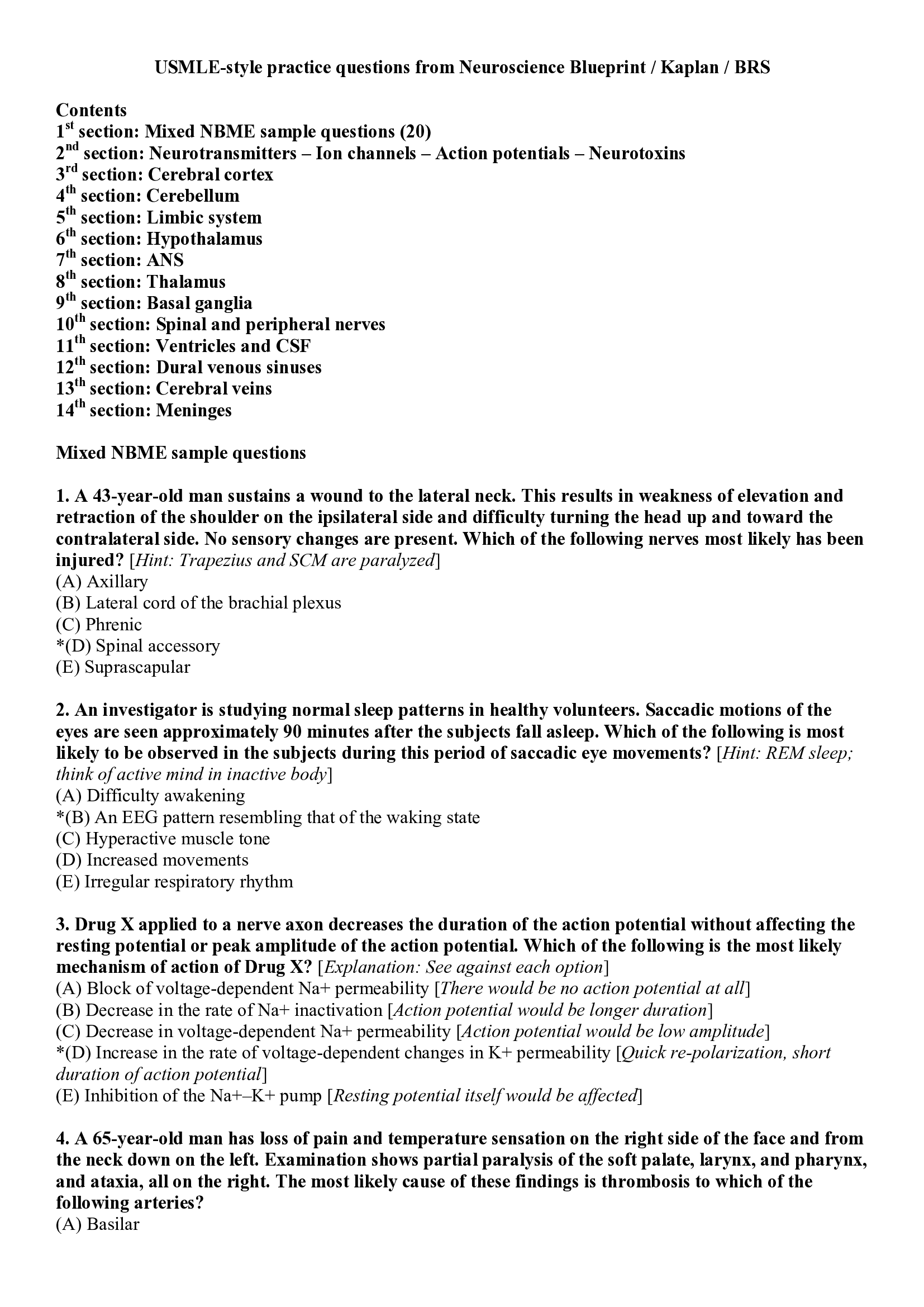
USMLE-style practice questions from Neuroscience Blueprint / Kaplan / BRS


Contents

1

st

 section: Mixed NBME sample questions (20)!

2

nd

 section: Neurotransmitters – Ion channels – Action potentials – Neurotoxins 

3

rd

 section: Cerebral cortex

4

th

 section: Cerebellum

5

th

 section: Limbic system

6

th

 section: Hypothalamus

7

th

 section: ANS

8

th

 section: Thalamus

9

th

 section: Basal ganglia

10

th

 section: Spinal and peripheral nerves

11

th

 section: Ventricles and CSF

12

th

 section: Dural venous sinuses

13

th

 section: Cerebral veins

14

th

 section: Meninges


Mixed NBME sample questions!


1. A 43-year-old man sustains a wound to the lateral neck. This results in weakness of elevation and

retraction of the shoulder on the ipsilateral side and difficulty turning the head up and toward the

contralateral side. No sensory changes are present. Which of the following nerves most likely has been

injured?!"Hint: Trapezius and SCM are paralyzed#!

$%&!%’())*+,!

$-&!.*/0+*)!12+3!24!/50!6+*15(*)!7)0’89!

$:&!;5+0<(1!

=$>&!?7(<*)!*110992+,!

$@&!?87+*91*78)*+!

!

2. An investigator is studying normal sleep patterns in healthy volunteers. Saccadic motions of the

eyes are seen approximately 90 minutes after the subjects fall asleep. Which of the following is most

likely to be observed in the subjects during this period of saccadic eye movements?!"Hint: REM sleep;

think of active mind in inactive body#!

$%&!>(44(18)/,!*A*B0<(<C!

=$-&!%<!@@D!7*//0+<!+090E6)(<C!/5*/!24!/50!A*B(<C!9/*/0!

$:&!F,70+*1/(G0!E891)0!/2<0!

$>&!H<1+0*903!E2G0E0</9!

$@&!H++0C8)*+!+097(+*/2+,!+5,/5E!

!

3. Drug X applied to a nerve axon decreases the duration of the action potential without affecting the

resting potential or peak amplitude of the action potential. Which of the following is the most likely

mechanism of action of Drug X?!"Explanation: See against each option#!

$%&!-)21B!24!G2)/*C0I3070<30</!J*K!70+E0*6()(/,!"There would be no action potential at all#!

$-&!>01+0*90!(<!/50!+*/0!24!J*K!(<*1/(G*/(2<!"Action potential would be longer duration#!!

$:&!>01+0*90!(<!G2)/*C0I3070<30</!J*K!70+E0*6()(/,!"Action potential would be low amplitude#!

=$>&!H<1+0*90!(<!/50!+*/0!24!G2)/*C0I3070<30</!15*<C09!(<!LK!70+E0*6()(/,!"Quick re-polarization, short

duration of action potential#!

$@&!H<5(6(/(2<!24!/50!J*KMLK!78E7!"Resting potential itself would be affected#!

!

4. A 65-year-old man has loss of pain and temperature sensation on the right side of the face and from

the neck down on the left. Examination shows partial paralysis of the soft palate, larynx, and pharynx,

and ataxia, all on the right. The most likely cause of these findings is thrombosis to which of the 

following arteries? 

$%&!-*9()*+!

=$-&!N(C5/!729/0+(2+!(<40+(2+!10+060))*+!

$:&!.04/!729/0+(2+!(<40+(2+!10+060))*+!

$>&!N(C5/!9870+(2+!10+060))*+!

$@&!.04/!9870+(2+!10+060))*+!

!

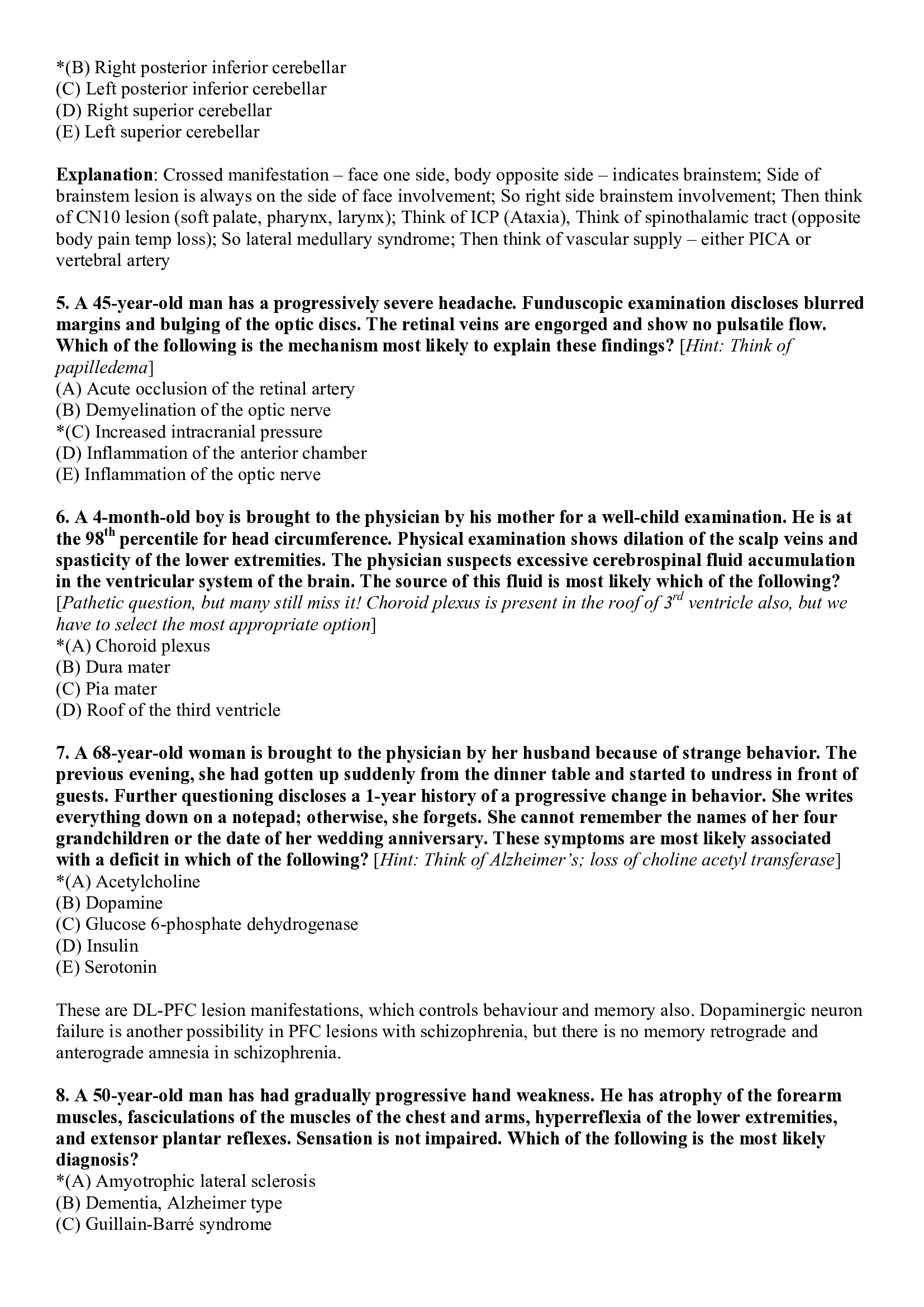
ExplanationO!:+29903!E*<(409/*/(2<!M!4*10!2<0!9(30P!623,!27729(/0!9(30!M!(<3(1*/09!6+*(<9/0EQ!?(30!24!

6+*(<9/0E!)09(2<!(9!*)A*,9!2<!/50!9(30!24!4*10!(<G2)G0E0</Q!?2!+(C5/!9(30!6+*(<9/0E!(<G2)G0E0</Q!R50<!/5(<B!

24!:JST!)09(2<!$924/!7*)*/0P!75*+,<’P!)*+,<’&Q!R5(<B!24!H:;!$%/*’(*&P!R5(<B!24!97(<2/5*)*E(1!/+*1/!$27729(/0!

623,!7*(<!/0E7!)299&Q!?2!)*/0+*)!E038))*+,!9,<3+2E0Q!R50<!/5(<B!24!G*918)*+!9877),!M!0(/50+!;H:%!2+!

G0+/06+*)!*+/0+,!

!

5. A 45-year-old man has a progressively severe headache. Funduscopic examination discloses blurred

margins and bulging of the optic discs. The retinal veins are engorged and show no pulsatile flow.

Which of the following is the mechanism most likely to explain these findings?!"Hint: Think of

papilledema#!

$%&!%18/0!211)89(2<!24!/50!+0/(<*)!*+/0+,!

$-&!>0E,0)(<*/(2<!24!/50!27/(1!<0+G0!

=$:&!H<1+0*903!(</+*1+*<(*)!7+0998+0!

$>&!H<4)*EE*/(2<!24!/50!*</0+(2+!15*E60+!

$@&!H<4)*EE*/(2<!24!/50!27/(1!<0+G0!

!

6. A 4-month-old boy is brought to the physician by his mother for a well-child examination. He is at

the 98

th

 percentile for head circumference. Physical examination shows dilation of the scalp veins and

spasticity of the lower extremities. The physician suspects excessive cerebrospinal fluid accumulation

in the ventricular system of the brain. The source of this fluid is most likely which of the following?!

"Pathetic question, but many still miss it! Choroid plexus is present in the roof of 3

rd

 ventricle also, but we

have to select the most appropriate option#!

=$%&!:52+2(3!7)0’89!

$-&!>8+*!E*/0+!

$:&!;(*!E*/0+!

$>&!N224!24!/50!/5(+3!G0</+(1)0!

!

7. A 68-year-old woman is brought to the physician by her husband because of strange behavior. The

previous evening, she had gotten up suddenly from the dinner table and started to undress in front of

guests. Further questioning discloses a 1-year history of a progressive change in behavior. She writes

everything down on a notepad; otherwise, she forgets. She cannot remember the names of her four

grandchildren or the date of her wedding anniversary. These symptoms are most likely associated

with a deficit in which of the following?!"Hint: Think of Alzheimer’s; loss of choline acetyl transferase#!

=$%&!%10/,)152)(<0!

$-&!>27*E(<0!

$:&!D)81290!UI752975*/0!305,3+2C0<*90!

$>&!H<98)(<!

$@&!?0+2/2<(<!

!

R5090!*+0!>.I;V:!)09(2<!E*<(409/*/(2<9P!A5(15!12</+2)9!605*G(28+!*<3!E0E2+,!*)92W!>27*E(<0+C(1!<08+2<!

4*()8+0!(9!*<2/50+!7299(6()(/,!(<!;V:!)09(2<9!A(/5!915(X275+0<(*P!68/!/50+0!(9!<2!E0E2+,!+0/+2C+*30!*<3!

*</0+2C+*30!*E<09(*!(<!915(X275+0<(*W!

!

8. A 50-year-old man has had gradually progressive hand weakness. He has atrophy of the forearm 

muscles, fasciculations of the muscles of the chest and arms, hyperreflexia of the lower extremities, 

and extensor plantar reflexes. Sensation is not impaired. Which of the following is the most likely

diagnosis?

=$%&!%E,2/+275(1!)*/0+*)!91)0+29(9!

$-&!>0E0</(*P!%)X50(E0+!/,70!

$:&!D8())*(<I-*++Y!9,<3+2E0!

$>&!Z8)/(7)0!10+06+*)!(<4*+1/9!

$@&!Z8)/(7)0!91)0+29(9!

!

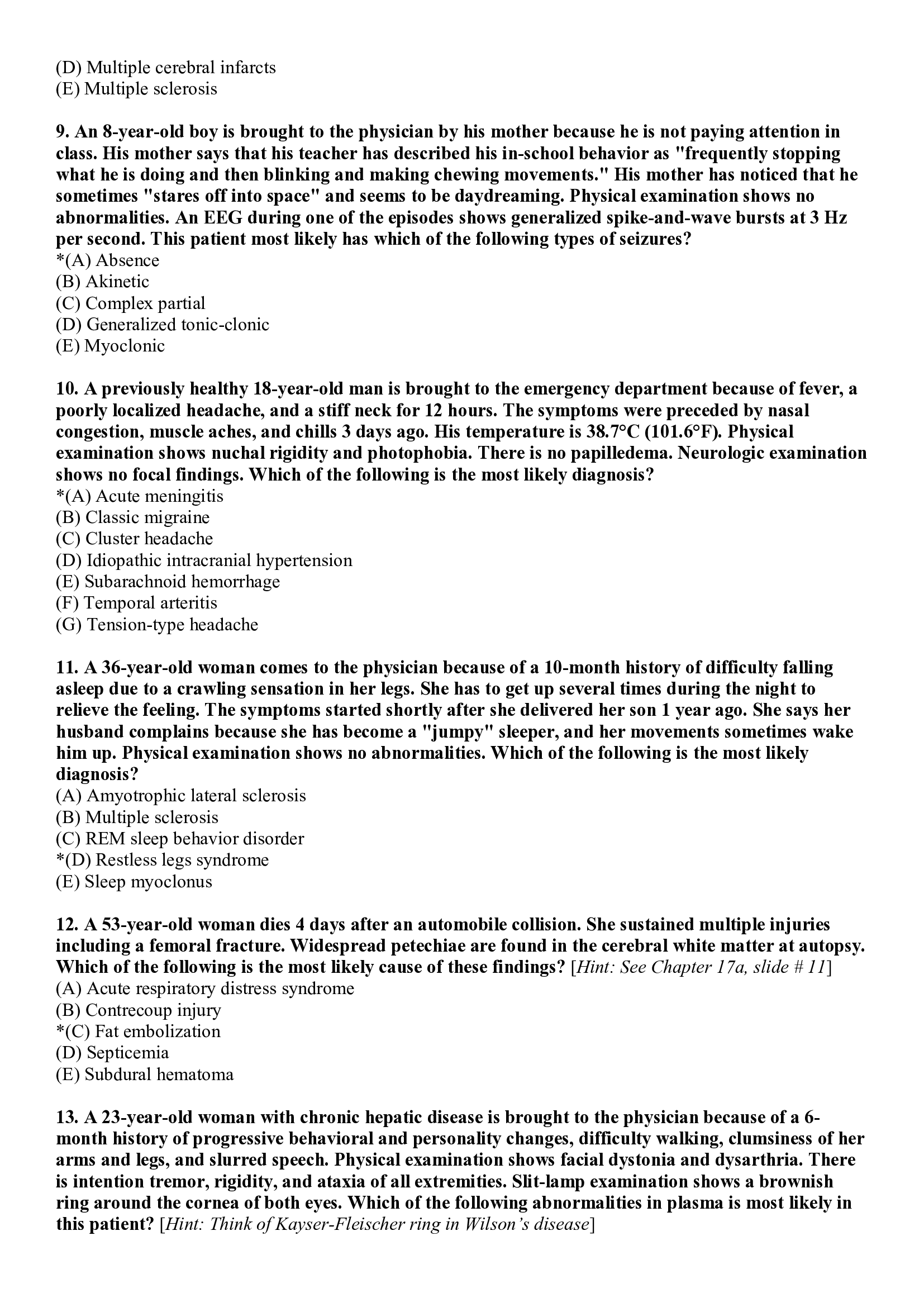
9. An 8-year-old boy is brought to the physician by his mother because he is not paying attention in

class. His mother says that his teacher has described his in-school behavior as "frequently stopping

what he is doing and then blinking and making chewing movements." His mother has noticed that he

sometimes "stares off into space" and seems to be daydreaming. Physical examination shows no

abnormalities. An EEG during one of the episodes shows generalized spike-and-wave bursts at 3 Hz

per second. This patient most likely has which of the following types of seizures?

=$%&!%690<10!

$-&!%B(<0/(1!

$:&!:2E7)0’!7*+/(*)!

$>&!D0<0+*)(X03!/2<(1I1)2<(1!

$@&!Z,21)2<(1!

!

10. A previously healthy 18-year-old man is brought to the emergency department because of fever, a

poorly localized headache, and a stiff neck for 12 hours. The symptoms were preceded by nasal

congestion, muscle aches, and chills 3 days ago. His temperature is 38.7°C (101.6°F). Physical

examination shows nuchal rigidity and photophobia. There is no papilledema. Neurologic examination

shows no focal findings. Which of the following is the most likely diagnosis?

=$%&!%18/0!E0<(<C(/(9!

$-&!:)*99(1!E(C+*(<0!

$:&!:)89/0+!50*3*150!

$>&!H3(27*/5(1!(</+*1+*<(*)!5,70+/0<9(2<!

$@&!?86*+*15<2(3!50E2++5*C0!

$V&!R0E72+*)!*+/0+(/(9!

$D&!R0<9(2<I/,70!50*3*150!

!

11. A 36-year-old woman comes to the physician because of a 10-month history of difficulty falling

asleep due to a crawling sensation in her legs. She has to get up several times during the night to

relieve the feeling. The symptoms started shortly after she delivered her son 1 year ago. She says her

husband complains because she has become a "jumpy" sleeper, and her movements sometimes wake

him up. Physical examination shows no abnormalities. Which of the following is the most likely

diagnosis?

$%&!%E,2/+275(1!)*/0+*)!91)0+29(9!

$-&!Z8)/(7)0!91)0+29(9!

$:&!N@Z!9)007!605*G(2+!3(92+30+!

=$>&!N09/)099!)0C9!9,<3+2E0!

$@&!?)007!E,21)2<89!

!

12. A 53-year-old woman dies 4 days after an automobile collision. She sustained multiple injuries

including a femoral fracture. Widespread petechiae are found in the cerebral white matter at autopsy.

Which of the following is the most likely cause of these findings?!"Hint: See Chapter 17a, slide # 11#!

$%&!%18/0!+097(+*/2+,!3(9/+099!9,<3+2E0!

$-&!:2</+01287!(<[8+,!

=$:&!V*/!0E62)(X*/(2<!

$>&!?07/(10E(*!

$@&!?8638+*)!50E*/2E*!

!

13. A 23-year-old woman with chronic hepatic disease is brought to the physician because of a 6-

month history of progressive behavioral and personality changes, difficulty walking, clumsiness of her

arms and legs, and slurred speech. Physical examination shows facial dystonia and dysarthria. There

is intention tremor, rigidity, and ataxia of all extremities. Slit-lamp examination shows a brownish 

ring around the cornea of both eyes. Which of the following abnormalities in plasma is most likely in 

this patient?!"Hint: Think of Kayser-Fleischer ring in Wilson’s disease#!

$%&!>01+0*903!1*)1(8E!12<10</+*/(2<!

=$-&!>01+0*903!10+8)27)*9E(<!12<10</+*/(2<!

$:&!>01+0*903!/+*<940++(<!12<10</+*/(2<!

$>&!H<1+0*903!*EE2<(8E!12<10</+*/(2<!

$@&!H<1+0*903!B0/2<09!

$V&!H<1+0*903!)*1/*/0!12<10</+*/(2<!

!

14. A new drug is developed that prevents the demyelinization occurring in the progress of multiple

sclerosis. The drug protects the cells responsible for the synthesis and maintenance of myelin in the

central nervous system. These cells are most likely which of the following?!"Another pathetic question!#!

$%&!%9/+21,/0!

$-&!@70<3,E*)!10))!

$:&!Z(1+2C)(*)!10))!

=$>&!\)(C230<3+21,/0!

$@&!?15A*<<!10))!

!

15. A 47-year-old man with Down syndrome is brought to the physician by his sister because of an 8month

history

of

regression

in

his

abilities.

The

sister

describes

a gradual

decline in his language skills

and

progressive fearfulness. The patient no longer remembers songs that he has known

for years, and

he

does

not

wish

to

participate

in

family

activities

anymore. Pathologic examination

of the brain

would

most likely show

which of

the

following

in

this

patient?!"Hint:

Think of association of Down’s


syndrome

with Alzheimer’s#!

$%&!>0729(/9!24!)2<CI15*(<!4*//,!*1(39!

$-&!H</+*10))8)*+!*+,)98)4*/*90!%!

$:&!.0A,!623(09!*<3!<(C+*)!*/+275,!

=$>&!J08+2<*)!7)*]809!*<3!/*<C)09!

$@&!;0+(G0<8)*+!(<4)*EE*/2+,!10))9!

!

16.

A 29-year-old man who emigrated from Scotland

3 years ago is brought

to the

emergency

department

because of severe shortness

of breath

for

2 hours.

He has a debilitating

condition

that

began

2 years ago with

an odd sticky feeling of his skin,

but

physical

examination

at that time showed


no

abnormalities. His condition has

progressed

to include

severe

major

depressive

disorder,

dementia,


unsteady

gait, difficulty walking,

and impaired coordination.

He now is confined to a wheelchair

and

has

severe

dementia

and

the

inability

to

speak.

There

is

no

family

history

of

a

similar

condition.

On


arrival,

his

respirations are 24/min,

and he dies shortly thereafter.

At autopsy, examination of the

brain

shows a spongiform encephalopathy. Which of

the following

is the most likely diagnosis?!"Hint:


Spongiform

encephalopathy

and

Scotland

are the

key words#!

$%&!>0E0</(*P!%)X50(E0+!/,70!

$-&!V+2</2/0E72+*)!30E0</(*!

$:&!;*+B(<92<!3(90*90!

$>&!;(1B!3(90*90!

=$@&!^*+(*</!:+08/X40)3/I_*B26!3(90*90!

!

17.

A 52-year-old woman

comes to the physician because

of gradual loss of feeling

in her feet during

the

past 6 months. She is a portrait painter. She has

a 23-year history of hypertension and a 20-year

history

of type 2 diabetes mellitus.

Menopause

occurred 1 year ago. She has smoked 2 packs of

cigarettes

daily

for

30 years.

She

took

an

oral contraceptive

for

20

years.

Current

medications

include


hormone

replacement therapy, diuretics, and an oral

hypoglycemic agent. Her blood

pressure is

135/85

mm Hg. Sensation to pinprick is decreased

over

both

feet.

Which

of the

following

is

the 

strongest predisposing risk factor of this new finding?!"Hint: Think of stocking and glove anesthesia in 

diabetes mellitus#!

$%&!F,70+/0<9(2<!

$-&!.2<CI/0+E!0’7298+0!/2!7*(</!48E09!

$:&!.2<CI/0+E!890!24!0’2C0<289!52+E2<09!

$>&!.2<CI/0+E!890!24!/26*112!

Contact the Seller

Please Sign In to contact this seller.


  • 👎  Report Copyright Violation

Frequently Asked Questions

What Do I Get When I Buy This Study Material?

+

When you buy a study material on Passing Grades, an instant download link will be sent directly to your email, giving you access to the file anytime after payment is completed.

Is Passing Grades a Trusted Platform?

+

Yes, Passing Grades is a reputable students’ marketplace with a secure payment system and reliable customer support. You can trust us to ensure a safe and seamless transaction experience.

Will I Be Stuck with a Subscription?

+

No, all purchases on Passing Grades are one-time transactions. You only pay for the notes you choose to buy, with no subscriptions or hidden fees attached.

Who Am I Buying These Study Materials From?

+

Passing Grades is a marketplace, which means you are purchasing the document from an individual vendor, not directly from us. We facilitate the payment and delivery process between you and the vendor.

Does Passing Grades Offer Free Study Materials?

+

Yes, sellers on Passing Grades have uploaded numerous free test banks, exams, practice questions, and class notes that can be downloaded at no cost.

Pasinggrades - Quality Study Materials

USD 8

    • Quality checked by Pasing Grades
    • 100% satisfaction guarantee
    • Seller: Angelicer
Buy PDF $8

Seller Information

Angelicer

Member since April 2021

  • icon
  • icon
View Profile
  • total sales

    0
  • Favourites

    0
  • Comments

    0
    ( 0 Ratings )

Item Information

  • Uploaded

    17 May 2024

  • Updated

    24 October 2025

  • Category

    Nursing

  • Item Type

    exam

  • Tags

    MEDICINE FINALS Neuro Practice Questions usmle kaplan study material passing grades questions and answers

Related Exam Prep Guides by Angelicer

Test Bank for Success in Practical Vocational Nursing 8th Edition by Knecht
View Document

Test Bank for Succes...

  • Angelicer

    Angelicer

  • exam

Enhance your study with the Test Bank for Success in Practical Vocational Nursing 8th Edition by Kne...

8 USD

0

0

Test Bank for Illustrated Anatomy of the Head and Neck 5th Edition by Fehrenbach
View Document

Test Bank for Illust...

  • Angelicer

    Angelicer

  • exam

Boost your understanding with the Test Bank for Illustrated Anatomy of the Head and Neck 5th Edition...

8 USD

0

0

ATI PEDS Proctored Exam Questions and Answers 2026 | Comprehensive Study Guide
View Document

ATI PEDS Proctored E...

  • Angelicer

    Angelicer

  • exam

Get the ATI PEDS Proctored Exam Questions and Answers for 2025. This comprehensive study guide offer...

8 USD

0

0

Purchase

Download link will be sent to this email immediately after purchase.

IMPORTANT LINKS

  • How To Upload Class Notes
  • Selling Tips
  • Passing Grades's Study Materials
  • Scholarships for International Students 2025

POPULAR CATEGORIES

  • Law
  • Accounting
  • English
  • Psychology
  • Business
  • Nursing
  • Computer Science
  • General

View Document

  • Blog
  • Contact
  • Delivery Policy
  • Latest Scholarships Around the World
  • How to Pass Bar Exams: Passing Grades’ Strategies
  • How to Study and Pass the CPA Exam
  • All Test Banks
  • Faq
  • Copyright Claims
  • Privacy Policy
  • Terms of Use

KNOWLEDGE BASE

  • How to Write A+ Grade Good Research Paper
  • How to Manage Stress During Exam Period
  • Best Time to Study
  • How to Pass NCLEX-RN Exam
  • How To Effectively Utilize Test Banks
  • Popular Shadow Health Exam Assessments
  • Popular HESI Case Studies
  • How to Prepare for a Nursing Career
  • The Importance Of Summaries in Exam Revisvion

© 2026 Pasing Grades. All rights reserved.