Pasing Grades
  • Start Selling
  • Blog
  • Contact
  • 0

    Your cart is empty!

English

  • English
  • Spanish
  • Arabic
Create Account Sign In
  • Library
    • New Prep Guides
    • Featured Prep Guides
    • Free Exam Prep Guides
    • Best sellers
  • General
  • Nursing
    • Research Paper
    • Case Study
    • Discussion Post
    • Assignment
    • Exam
    • Practice Questions and Answers
    • Test Bank
    • solutions manual
  • Accounting
    • Case Study
    • Thesis
    • Study Guide
    • Summary
    • Research Paper
    • test bank
  • English
    • Creative Writing
    • Research Paper
    • Summary
    • Rhetorics
    • Literature
    • Journal
    • Exam
    • Grammar
    • Discussion Post
    • Essay
  • Psychology
    • Hesi
    • Presentation
    • Essay
    • Summary
    • Study Guide
    • Essay
    • Solution Manual
    • Final Exam Review
    • Class Notes
    • test bank
  • Business
    • Lecture Notes
    • Solution Manual
    • Presentation
    • Business Plan
    • Class Notes
    • Experiment
    • Summary
    • Practice Questions
    • Study Guide
    • Case Study
    • test bank
    • Exam
  • More
    • Computer Science
    • Economics
    • Statistics
    • Engineering
    • Biology
    • Religious Studies
    • Physics
    • Chemistry
    • Mathematics
    • History
    • Sociology
    • Science
    • Philosophy
    • Law
  • Pages
    • About Us
    • Selling Tips
    • Delivery Policy
    • Faq
    • Privacy Policy
  • Flash Sale
  • Home
  • Diabetes Practice Questions 2026

Diabetes Practice Questions 2026

Preview page 1 Preview page 2 Preview page 3
Add To Favorites

Share this item Share this item

  • Item Details
  • Comments (0)
  • Reviews (0)
  • Contact Seller

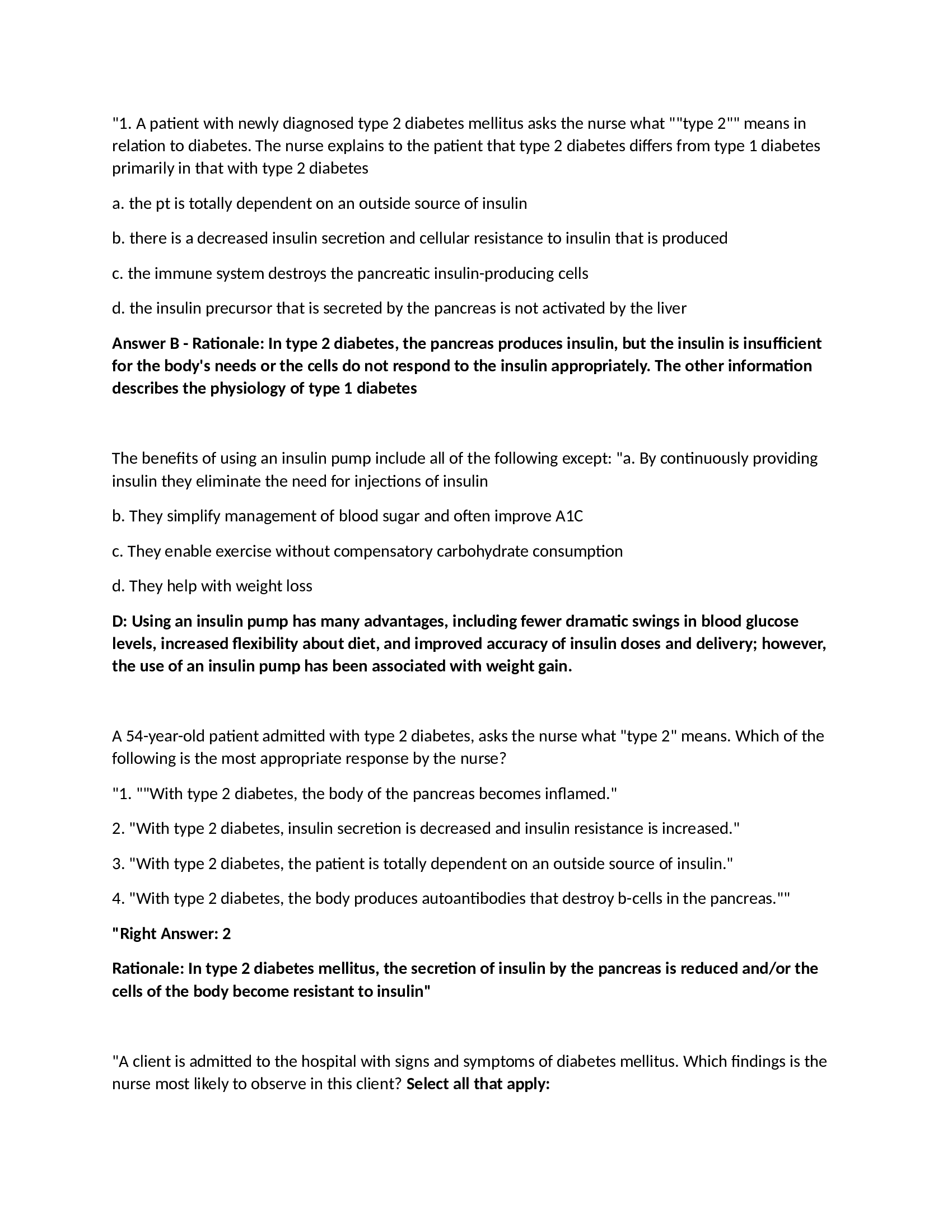
"1. A patient with newly diagnosed type 2 diabetes mellitus asks the nurse what ""type 2"" means in

relation to diabetes. The nurse explains to the patient that type 2 diabetes differs from type 1 diabetes

primarily in that with type 2 diabetes

a. the pt is totally dependent on an outside source of insulin

b. there is a decreased insulin secretion and cellular resistance to insulin that is produced

c. the immune system destroys the pancreatic insulin-producing cells

d. the insulin precursor that is secreted by the pancreas is not activated by the liver

Answer B - Rationale: In type 2 diabetes, the pancreas produces insulin, but the insulin is insufficient 

for the body's needs or the cells do not respond to the insulin appropriately. The other information

describes the physiology of type 1 diabetes

The benefits of using an insulin pump include all of the following except: "a. By continuously providing

insulin they eliminate the need for injections of insulin

b. They simplify management of blood sugar and often improve A1C

c. They enable exercise without compensatory carbohydrate consumption

d. They help with weight loss

D: Using an insulin pump has many advantages, including fewer dramatic swings in blood glucose 

levels, increased flexibility about diet, and improved accuracy of insulin doses and delivery; however,

the use of an insulin pump has been associated with weight gain.

A 54-year-old patient admitted with type 2 diabetes, asks the nurse what "type 2" means. Which of the

following is the most appropriate response by the nurse? 

"1. ""With type 2 diabetes, the body of the pancreas becomes inflamed."

2. "With type 2 diabetes, insulin secretion is decreased and insulin resistance is increased."

3. "With type 2 diabetes, the patient is totally dependent on an outside source of insulin."

4. "With type 2 diabetes, the body produces autoantibodies that destroy b-cells in the pancreas.""

"Right Answer: 2

Rationale: In type 2 diabetes mellitus, the secretion of insulin by the pancreas is reduced and/or the 

cells of the body become resistant to insulin"

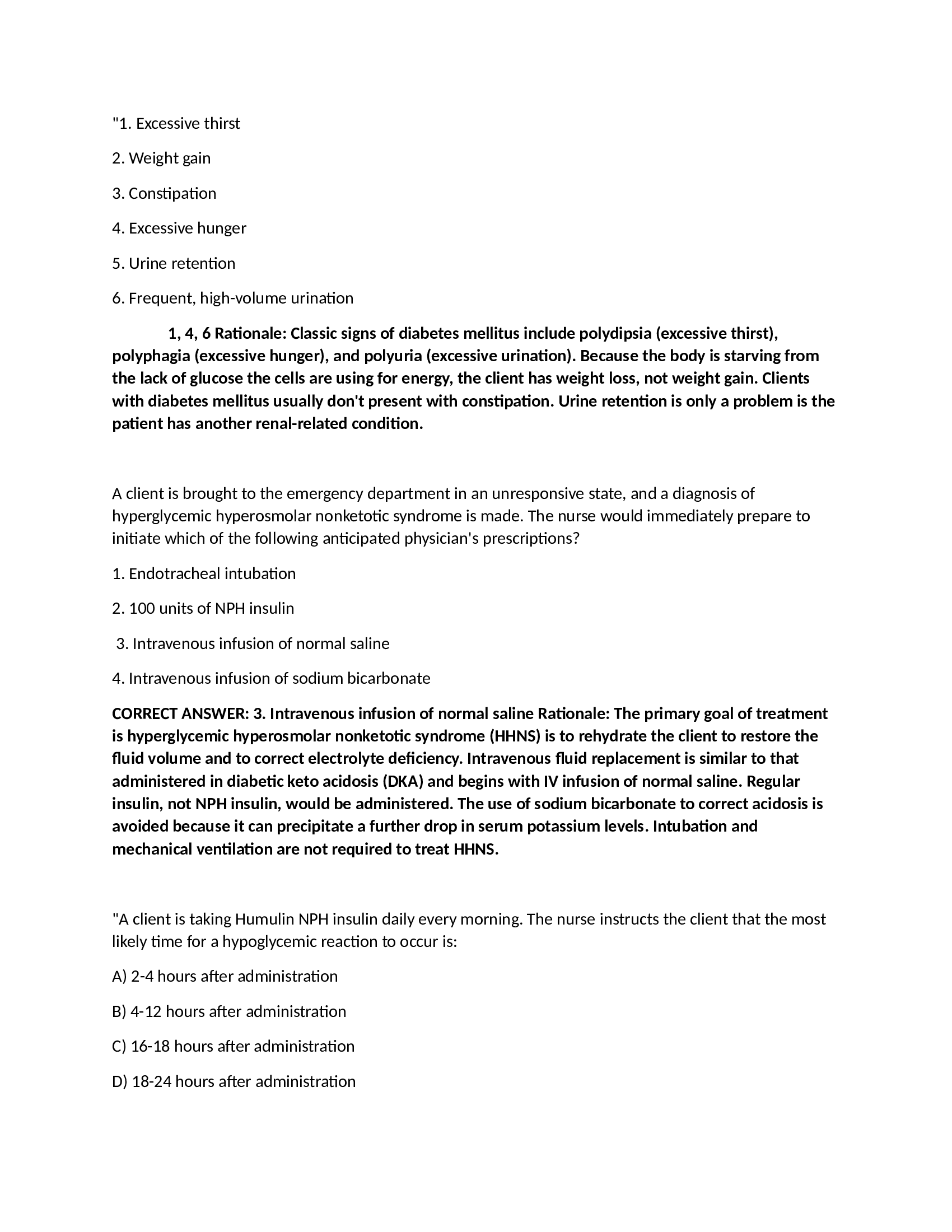
"A client is admitted to the hospital with signs and symptoms of diabetes mellitus. Which findings is the

nurse most likely to observe in this client? Select all that apply:

"1. Excessive thirst

2. Weight gain

3. Constipation

4. Excessive hunger

5. Urine retention

6. Frequent, high-volume urination

1, 4, 6 Rationale: Classic signs of diabetes mellitus include polydipsia (excessive thirst),

polyphagia (excessive hunger), and polyuria (excessive urination). Because the body is starving from

the lack of glucose the cells are using for energy, the client has weight loss, not weight gain. Clients

with diabetes mellitus usually don't present with constipation. Urine retention is only a problem is the

patient has another renal-related condition.

A client is brought to the emergency department in an unresponsive state, and a diagnosis of

hyperglycemic hyperosmolar nonketotic syndrome is made. The nurse would immediately prepare to

initiate which of the following anticipated physician's prescriptions? 

1. Endotracheal intubation

2. 100 units of NPH insulin

 3. Intravenous infusion of normal saline

4. Intravenous infusion of sodium bicarbonate

CORRECT ANSWER: 3. Intravenous infusion of normal saline Rationale: The primary goal of treatment 

is hyperglycemic hyperosmolar nonketotic syndrome (HHNS) is to rehydrate the client to restore the

fluid volume and to correct electrolyte deficiency. Intravenous fluid replacement is similar to that

administered in diabetic keto acidosis (DKA) and begins with IV infusion of normal saline. Regular

insulin, not NPH insulin, would be administered. The use of sodium bicarbonate to correct acidosis is

avoided because it can precipitate a further drop in serum potassium levels. Intubation and

mechanical ventilation are not required to treat HHNS.

"A client is taking Humulin NPH insulin daily every morning. The nurse instructs the client that the most

likely time for a hypoglycemic reaction to occur is:

A) 2-4 hours after administration

B) 4-12 hours after administration

C) 16-18 hours after administration

D) 18-24 hours after administration

B: Rationale: Humulin is an intermediate acting insulin. The onset of action is 1.5 hours, it peaks in 412

hours,

and

its

duration

is

24

hours.

Hypoglycemic

reactions

to

insulin

are

most

likely

to

occur

during

the

peak

time.

"A client who is started on metformin and glyburide would have initially presented with which

symptoms?

"a. Polydipsia, polyuria, and weight loss

 b. weight gain, tiredness, & bradycardia

 c. irritability, diaphoresis, and tachycardia

 d. diarrhea, abdominal pain, and weight loss

"a. Polydipsia, polyuria, and weight loss".  Symptoms of hyperglycemia include polydipsia, polyuria,

and weight loss. Metformin and sulfonylureas are commonly ordered medications.

 Weight gain, tiredness, and bradycardia are symptoms of hypothyroidism. 

 Irritability, diaphoresis, and tachycardia are symptoms of hypoglycemia.

 Symptoms of Crohn's disease include diarrhea, abdominal pain, and weight loss."

A client with diabetes mellitus demonstrates acute anxiety when first admitted for the treatment of

hyperglycemia. The most appropriate intervention to decrease the client's anxiety would be to 

1. administer a sedative

2. make sure the client knows all the correct medical terms to understand what is happening

3. ignore the signs and symptoms of anxiety so that they will soon disappear

4. convey empathy, trust, and respect toward the client

4. The most appropriate intervention is to address the client’s feelings related to the anxiety

A client with diabetes melllitus has a blood glucose of 644mg/dl. The nurse interprets that this client is

most at risk of developing which type of acid base imbalance? 

"A. Metabolic acidosis

B. Metabolic alkalosis

C. Respiratory Acidosis

D. Respiratory Alkalosis"

"Correct Answer: A, Metabolic Acidosis

Rationale: DM can lead to metabolic acidosis. When the body does not have sufficient circulating

insulin, the blood glucose level rises. At the same time, the cells of the body use all available glucose.

The body then breaks down glycogen and fat for fuel. The by-products of fat metabolism are acidotic

and can lead to the condition known as diabetic ketoacidosis."

A client with DKA is being treated in the ED. What would the nurse suspect?

1. Comatose state

2. Decreased Urine Output

3. Increased respirations and an increase in pH.

 4. Elevated blood glucose level and low plasma bicarbonate level.

Correct Answer: 4 

Rationale: In DKA the arteriole pH is lower than 7.35, plasma bicarbonate is lower than 15 mEq/L, the

blood glucose is higher than 250, and ketones are present in the blood and urine. The client would be

experiencing polyuria and Kussmauls respirations would be present. A comatose state may occur if

DKA is not treated.

A client with type I diabetes is placed on an insulin pump. The most appropriate short-term goal when

teaching this client to control the diabetes is:

 "1) adhere to the medical regimen

2) remain normoglycemic for 3 weeks

3) demonstrate the correct use of the administration equipment.

4) list 3 self care activities that are necessary to control the diabetes"

3.) is correct

"1) this is not a short-term goal

2) this is measurable, but it's a long-term goal

3) this is a short-term goal, client oriented, necessary for the client to control the diabetes, and

measurable when the client performs a return demonstration for the nurse

4) although this is measurable and a short-term goal, it is not the one with the greatest priority when

a client has an insulin pump that must be mastered before discharge"

"A diabetic patient has a serum glucose level of 824 mg/dL (45.7 mmol/L) and is unresponsive. Following

assessment of the patient, the nurse suspects diabetic ketoacidosis rather than hyperosmolar

hyperglycemic syndrome based on the finding of

"a. polyuria

b. severe dehydration

c. rapid, deep respirations )

d. decreased serum potassium"

C is correct, Signs and symptoms of DKA include manifestations of dehydration such as poor skin 

turgor, dry mucous membranes, tachycardia, and orthostatic hypotension. Early symptoms may

include lethargy and weakness. As the patient becomes severely dehydrated, the skin becomes dry

and loose, and the eyeballs become soft and sunken. Abdominal pain is another symptom of DKA that

may be accompanied by anorexia and vomiting. Kussmaul respirations (i.e., rapid, deep breathing

associated with dyspnea) are the body’s attempt to reverse metabolic acidosis through the exhalation

of excess carbon dioxide. Acetone is identified on the breath as a sweet, fruity odor. Laboratory

findings include a blood glucose level greater than 250 mg/dL, arterial blood pH less than 7.30, serum

bicarbonate level less than 15 mEq/L, and moderate to large ketone levels in the urine or blood 

ketones.

"A frail elderly patient with a diagnosis of type 2 diabetes mellitus has been ill with pneumonia. The

client’s intake has been very poor, and she is admitted to the hospital for observation and management

as needed. What is the most likely problem with this patient?

"A. Insulin resistance has developed.

B. Diabetic ketoacidosis is occurring.

C. Hypoglycemia unawareness is developing.

D. Hyperglycemic hyperosmolar non-ketotic coma.

D.  Illness, especially with the frail elderly patient whose appetite is poor, can result in dehydration 

and HHNC. Insulin resistance is indicated by a daily insulin requirement of 200 units or more. Diabetic

ketoacidosis, an acute metabolic condition, usually is caused by absent or markedly decreased

amounts of insulin.

A home health nurse is at the home of a client with diabetes and arthritis. The client has difficulty

drawing up insulin. It would be most appropriate for the nurse to refer the client to: 

"A) A social worker from the local hospital

B) An occupational therapist from the community center

C) A physical therapist from the rehabilitation agency

D) Another client with diabetes mellitus and takes insulin"

B) An occupational therapist can assist a client to improve the fine motor skills needed to prepare an 

insulin injection.

A nurse is caring for a client with type 1 diabetes mellitus. which client complaint would alert the nurse

to the presence of a possible hypoglycemic reaction? 

"1. Tremors

2. Anorexia

3. Hot, dry skin

4. Muscle cramps

1) tremors  decreased blood glucose levels produce autonomic nervous system symptoms, which are 

manifested classically as nervousness, irritability, and tremors. option 3 is more likely for

hyperglycemia, and options 2 and 4 are unrelated to the signs of hypoglycemia.

"A nurse is caring for a client admitted to the emergency department with diabetic ketoacidosis (DKA). In

the acute phase, the priority nursing action is to prepare to:

"A. Correct the acidosis

B. Administer 5% dextrose intravenously

C. Administer regular insulin intravenously

D. Apply a monitor for an electrocardiogram."

C. Administer regular insulin inraVenously Lack (absolute or relative) of insulin is the primary cause of 

DKA. Treatment consists of insulin administration (regular insulin), intravenous fluid administration

(normal saline initially), and potassium replacement, followed by correcting acidosis. Applying an

electrocardiogram monitor is not a priority action.

A nurse is caring for a client with type 1 diabetes mellitus. Which client complaint would alert the nurse

to the presence of a possible hypoglycemic reaction ?

A. Tremors

B. Anorexia

C. Hot, Dry skin

D. Muscle cramps

Correct Answer A Decreased blood glucose levels produce autonomic nervous system symptoms, 

which are manifested classically as nervousness, irritability, and tremors. Option C is more likely to

occur with hyperglycemia. Options B and D are unrelated to the signs of hyperglycemia

a nurse is interviewing a client with type 2 diabetes mellitus. which statement by the client indicated an

understanding of the treatment for this disorder? 

"1. ""i take oral insulin instead of shots""

2. ""by taking these medications I am able to eat more""

3. ""when I become ill, I need to increase the number of pills I take""

4. ""the medications I'm taking help release the insulin I already make""

4.)Clients with type 2 diabetes mellitus have decreased or impaired insulin secretion. Oral 

hypoglycemic agents are given to these clients to facilitate glucose uptake. Insulin injections may be

given during times of stress-induced hyperglycemia. Oral insulin is not available because of the

breakdown of the insulin by digestion. Options 1, 2 and 3 are incorrect

A nurse is preparing a plan of care for a client with diabetes mellitus who has hyperglycemia. The priority

nursing diagnosis would be: 

1. Deficient knowledge

2. Deficient fluid volume

3. Compromised family coping

 4. Imbalanced nutrition less than body requirements

2) deficient fluid volume An increased blood glucose level will cause the kidneys to excrete the glucose

in the urine. This glucose is accompanied by fluids and electrolytes, causing an osmotic diuresis

leading to dehydration. This fluid loss must be replaced when it becomes severe.

A nurse is preparing a teaching plan for a client with diabetes Mellitus regarding proper foot care. Which

instruction is included in the plan?

 1. Soak feet in hot water

2. apply a moisturizing lotion to dry feet but not between the toes

3. Always have a podiatrist cut your toenails, never cut them yourself

4. avoid using mild soap on the feet

2. The client is instructed to use a moisturizing lotion on the feet and to avoid applying the lotion 

between the toes.

"A nurse performs a physical assessment on a client with type 2 diabetes mellitus. Findings include a

fasting blood glucose of 120 mg/dL, temp of 101 F, pulse of 88 bpm, respirations of 22, and blood

pressure of 100/72. Which finding would be of most concern to the nurse?

"1. Pulse

2. Respiration

3. Temperature

4. Blood pressure"

3) temp. An elevated temperature may indicate infection. Infection is a leading cause of hyperglycemic

hyperosmolar nonketotic syndrome or diabetic ketoacidosis. The other findings noted in the question

are within normal limits.

"A nurse should recognize which symptom as a cardinal sign of diabetes mellitus?

"a. Nausea

b. Seizure

c. Hyperactivity

d. Frequent urination

"D. Frequent Urination

Polyphagia, polyuria, polydipsia, and weight loss are cardinal signs of DM. Other signs include 

irritability, shortened attention span, lowered frustration tolerance, fatigue, dry skin, blurred vision,

sores that are slow to heal, and flushed skin."

A patient is admitted with diabetes mellitus, has a glucose level of 380 mg/dl, and a moderate level of

ketones in the urine. As the nurse assesses for signs of ketoacidosis, which of the following respiratory

patterns would the nurse expect to find?"

A-Central apnea

B-Hypoventilation

C-Kussmaul respirations

D- Cheyne-Stokes respirations"

C-Kussmaul respirations.  In diabetic ketoacidosis, the lungs try to compensate for the acidosis by 

blowing off volatile acids and carbon dioxide. This leads to a pattern of Kussmaul respirations, which

are deep and nonlabored.

"A patient with type 1 diabetes has received diet instruction as part of the treatment plan. The nurse

determines a need for additional instruction when the patient says,

"a. ""I may have an occasional alcoholic drink if I include it in my meal plan.""

b. ""I will need a bedtime snack because I take an evening dose of NPH insulin.""

c. ""I will eat meals as scheduled, even if I am not hungry, to prevent hypoglycemia.""

d. ""I may eat whatever I want, as long as I use enough insulin to cover the calories.

"D. ""I may eat whatever I want, as long as I use enough insulin to cover the calories.""

Rationale: Most patients with type 1 diabetes need to plan diet choices very carefully. Patients who

are using intensified insulin therapy have considerable flexibility in diet choices but still should restrict

dietary intake of items such as fat, protein, and alcohol. The other patient statements are correct and

indicate good understanding of the diet instruction."

"An 18-year-old female client, 5'4'' tall, weighing 113 kg, comes to the

clinic for a non-healing wound on her lower leg, which she has had for two weeks. Which disease 

process should the nurse suspect the client is developing?

A. Type 1 diabetes

B. Type 2 diabetes

C. Gestational diabetes

D. Acanthosis nigricans"

CORRECT -->B. Type 2 diabetes is a disorder usually occurring around the age of 40, but it is now being 

detected in children and young adults as a result of obesity and sedentary lifestyles. Non-healing

wounds are a hallmark sign of type 2 diabetes. This client weights 248.6

 lbs and is short.

C. Gestational diabetes occurs during pregnancy. There is no mention of this.

D. Acanthosis nigricans (AN), dark pigmentation and skin creases in the neck is a sign of

hyperinsulinemia. The pancreas is secreting excess amounts of insulin as a result of excessive caloric

intake. It is identified in young children and is a precursor to the development of type 2 diabetes."

"An adolescent client with type I diabetes mellitus is admitted to the emergency department for

treatment of diabetic ketoacidosis. Which assessment findings should the nurse expect to note?

 "a) sweating and tremors

b) hunger and hypertension

c) cold, clammy skin and irritability

d) fruity breath and decreasing level of consciousness

Contact the Seller

Please Sign In to contact this seller.


  • 👎  Report Copyright Violation

Frequently Asked Questions

What Do I Get When I Buy This Study Material?

+

When you buy a study material on Passing Grades, an instant download link will be sent directly to your email, giving you access to the file anytime after payment is completed.

Is Passing Grades a Trusted Platform?

+

Yes, Passing Grades is a reputable students’ marketplace with a secure payment system and reliable customer support. You can trust us to ensure a safe and seamless transaction experience.

Will I Be Stuck with a Subscription?

+

No, all purchases on Passing Grades are one-time transactions. You only pay for the notes you choose to buy, with no subscriptions or hidden fees attached.

Who Am I Buying These Study Materials From?

+

Passing Grades is a marketplace, which means you are purchasing the document from an individual vendor, not directly from us. We facilitate the payment and delivery process between you and the vendor.

Does Passing Grades Offer Free Study Materials?

+

Yes, sellers on Passing Grades have uploaded numerous free test banks, exams, practice questions, and class notes that can be downloaded at no cost.

Pasinggrades - Quality Study Materials

USD 5

    • Quality checked by Pasing Grades
    • 100% satisfaction guarantee
    • Seller: mentor2000
Buy PDF $5

Seller Information

mentor2000

Member since April 2021

  • icon
  • icon
View Profile
  • total sales

    0
  • Favourites

    0
  • Comments

    0
    ( 0 Ratings )

Item Information

  • Uploaded

    05 January 2024

  • Updated

    05 January 2026

  • Category

    Nursing

  • Item Type

    questions & answers

  • Tags

    diabetes practice questions 2021 passing grades nursing

Related Exam Prep Guides by mentor2000

Test Bank for Essentials for Nursing Practice 8th Edition by Potter | All Chapters
View Document

Test Bank for Essent...

  • mentor2000

    mentor2000

  • questions & answers

Master nursing concepts with this study material; Test Bank for Essentials for Nursing Practice, 8th...

5 USD

0

0

A &P 1 MA278 BSC2 Final Module II Questions & Answers 2026 Update
View Document

A &P 1 MA278 BSC2 Fi...

  • mentor2000

    mentor2000

  • questions & answers

Prepare for success with A&P 1 MA278 BSC2 Final Module II 2024 Q&A. Boost your grades with this comp...

5 USD

0

0

ATI Comprehensive Predictor Exam 2026
View Document

ATI Comprehensive Pr...

  • mentor2000

    mentor2000

  • questions & answers

Prepare for success with the ATI Comprehensive Predictor Exam 2026. Access key practice questions to...

5 USD

0

0

Purchase

Download link will be sent to this email immediately after purchase.

IMPORTANT LINKS

  • How To Upload Class Notes
  • Selling Tips
  • Passing Grades's Study Materials
  • Scholarships for International Students 2025

POPULAR CATEGORIES

  • Law
  • Accounting
  • English
  • Psychology
  • Business
  • Nursing
  • Computer Science
  • General

View Document

  • Blog
  • Contact
  • Delivery Policy
  • Latest Scholarships Around the World
  • How to Pass Bar Exams: Passing Grades’ Strategies
  • How to Study and Pass the CPA Exam
  • All Test Banks
  • Faq
  • Copyright Claims
  • Privacy Policy
  • Terms of Use

KNOWLEDGE BASE

  • How to Write A+ Grade Good Research Paper
  • How to Manage Stress During Exam Period
  • Best Time to Study
  • How to Pass NCLEX-RN Exam
  • How To Effectively Utilize Test Banks
  • Popular Shadow Health Exam Assessments
  • Popular HESI Case Studies
  • How to Prepare for a Nursing Career
  • The Importance Of Summaries in Exam Revisvion

© 2026 Pasing Grades. All rights reserved.