Pasing Grades
  • Start Selling
  • Blog
  • Contact
  • 0

    Your cart is empty!

English

  • English
  • Spanish
  • Arabic
Create Account Sign In
  • Library
    • New Prep Guides
    • Featured Prep Guides
    • Free Exam Prep Guides
    • Best sellers
  • General
  • Nursing
    • Research Paper
    • Case Study
    • Discussion Post
    • Assignment
    • Exam
    • Practice Questions and Answers
    • Test Bank
    • solutions manual
  • Accounting
    • Case Study
    • Thesis
    • Study Guide
    • Summary
    • Research Paper
    • test bank
  • English
    • Creative Writing
    • Research Paper
    • Summary
    • Rhetorics
    • Literature
    • Journal
    • Exam
    • Grammar
    • Discussion Post
    • Essay
  • Psychology
    • Hesi
    • Presentation
    • Essay
    • Summary
    • Study Guide
    • Essay
    • Solution Manual
    • Final Exam Review
    • Class Notes
    • test bank
  • Business
    • Lecture Notes
    • Solution Manual
    • Presentation
    • Business Plan
    • Class Notes
    • Experiment
    • Summary
    • Practice Questions
    • Study Guide
    • Case Study
    • test bank
    • Exam
  • More
    • Computer Science
    • Economics
    • Statistics
    • Engineering
    • Biology
    • Religious Studies
    • Physics
    • Chemistry
    • Mathematics
    • History
    • Sociology
    • Science
    • Philosophy
    • Law
  • Pages
    • About Us
    • Selling Tips
    • Delivery Policy
    • Faq
    • Privacy Policy
  • Flash Sale
  • Home
  • Test Bank for Urinalysis and Body Fluids, 6th Edition, Susan King Strasinger, Marjorie Schaub Di Lorenzo

Test Bank for Urinalysis and Body Fluids, 6th Edition, Susan King Strasinger, Marjorie Schaub Di Lorenzo

Preview page 1 Preview page 2 Preview page 3
Add To Favorites

Share this item Share this item

  • Item Details
  • Comments (0)
  • Reviews (0)
  • Contact Seller
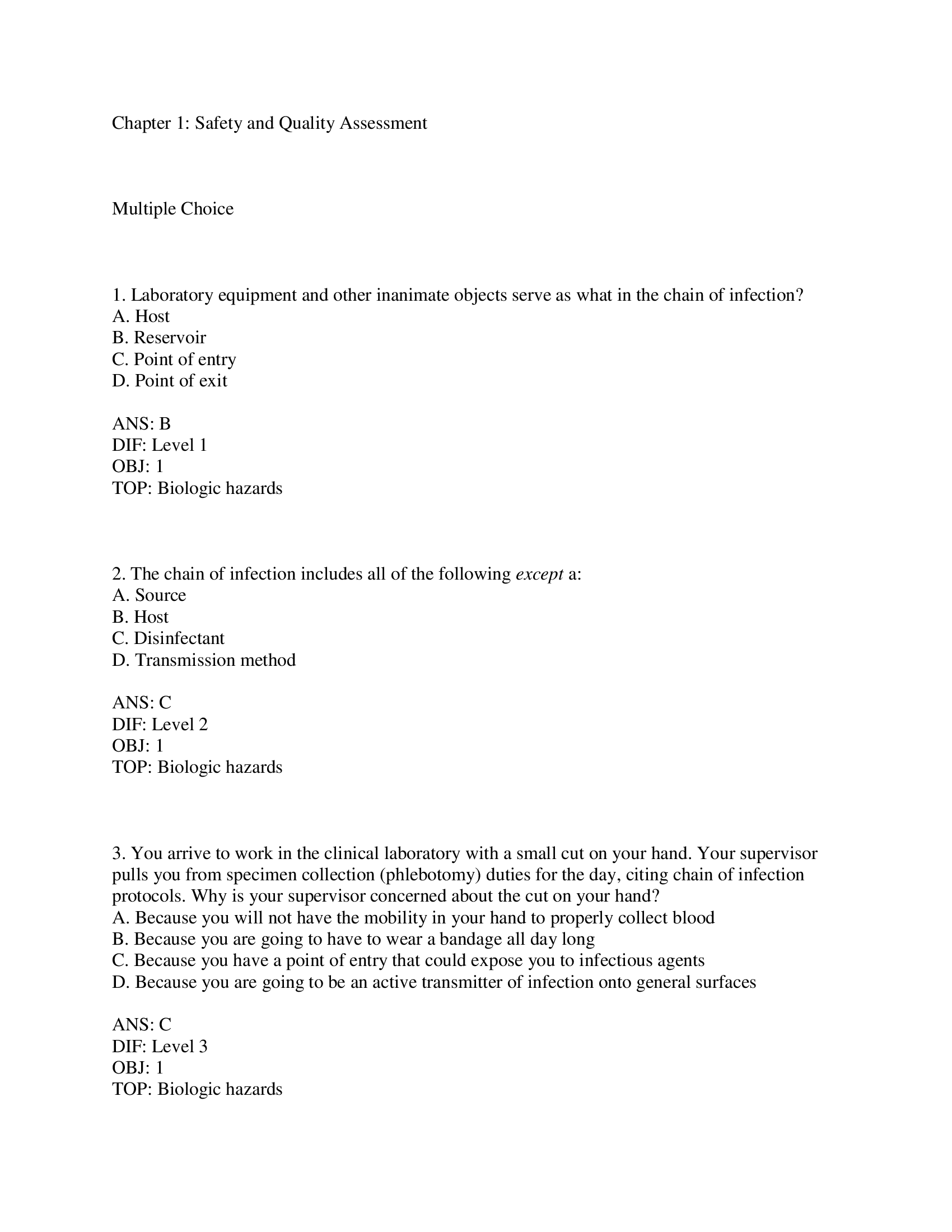
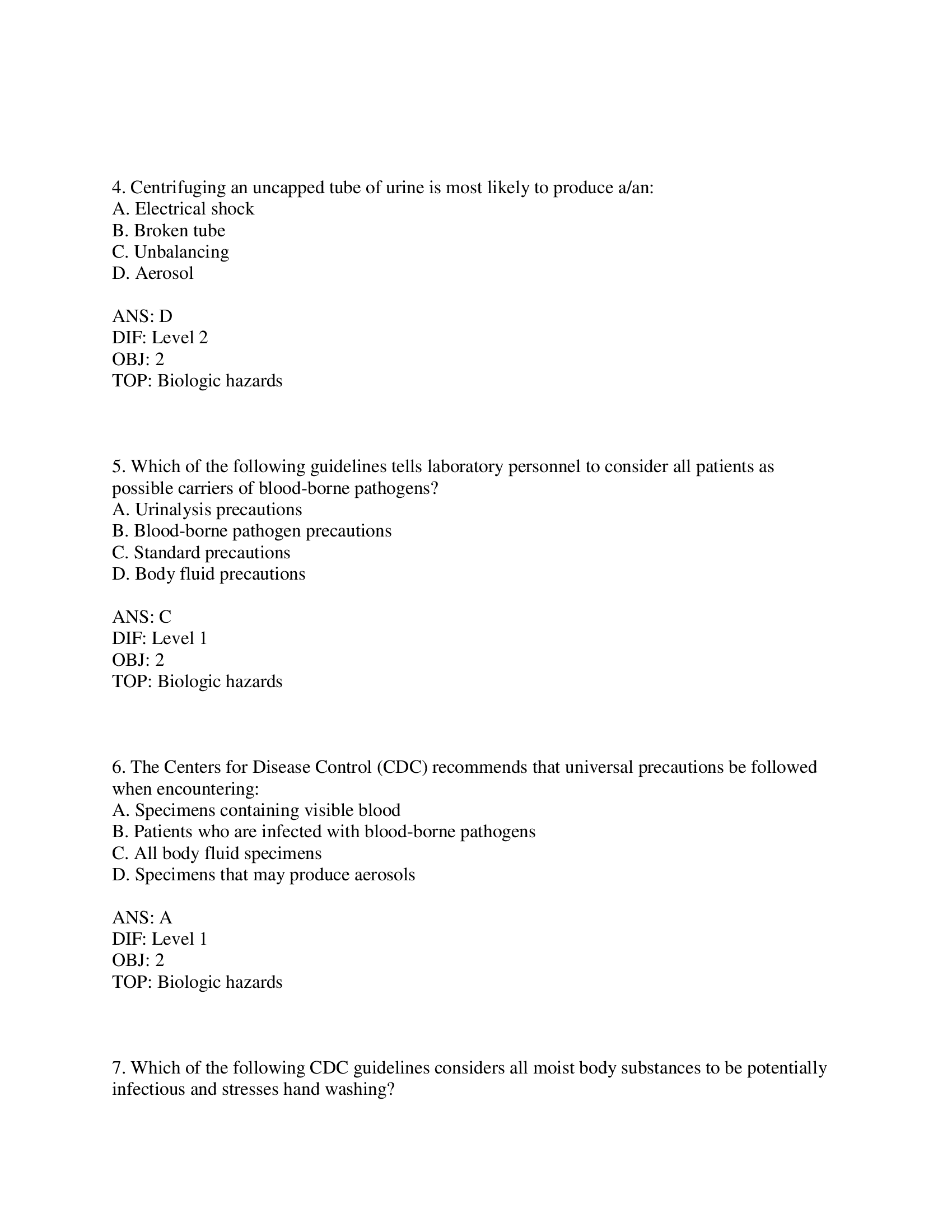
TEST BANK FOR URINALYSIS AND BODY FLUIDS, 6TH EDITION, SUSAN KING STRASINGER, MARJORIE SCHAUB DI LORENZO Chapter 1: Safety and Quality Assessment Multiple Choice 1. Laboratory equipment and other inanimate objects serve as what in the chain of infection? A. Host B. Reservoir C. Point of entry D. Point of exit ANS: B DIF: Level 1 OBJ: 1 TOP: Biologic hazards 2. The chain of infection includes all of the following except a: A. Source B. Host C. Disinfectant D. Transmission method ANS: C DIF: Level 2 OBJ: 1 TOP: Biologic hazards 3. You arrive to work in the clinical laboratory with a small cut on your hand. Your supervisor pulls you from specimen collection (phlebotomy) duties for the day, citing chain of infection protocols. Why is your supervisor concerned about the cut on your hand? A. Because you will not have the mobility in your hand to properly collect blood B. Because you are going to have to wear a bandage all day long C. Because you have a point of entry that could expose you to infectious agents D. Because you are going to be an active transmitter of infection onto general surfaces ANS: C DIF: Level 3 OBJ: 1 TOP: Biologic hazards 4. Centrifuging an uncapped tube of urine is most likely to produce a/an: A. Electrical shock B. Broken tube C. Unbalancing D. Aerosol ANS: D DIF: Level 2 OBJ: 2 TOP: Biologic hazards 5. Which of the following guidelines tells laboratory personnel to consider all patients as possible carriers of blood-borne pathogens? A. Urinalysis precautions B. Blood-borne pathogen precautions C. Standard precautions D. Body fluid precautions ANS: C DIF: Level 1 OBJ: 2 TOP: Biologic hazards 6. The Centers for Disease Control (CDC) recommends that universal precautions be followed when encountering: A. Specimens containing visible blood B. Patients who are infected with blood-borne pathogens C. All body fluid specimens D. Specimens that may produce aerosols ANS: A DIF: Level 1 OBJ: 2 TOP: Biologic hazards 7. Which of the following CDC guidelines considers all moist body substances to be potentially infectious and stresses hand washing? A. Universal precautions B. Body fluid precautions C. Standard precautions D. Health-care personnel standards ANS: C DIF: Level 1 OBJ: 3 TOP: Biologic hazards 8. The Occupational Exposure to Blood-Borne Pathogens Standard is: A. A guideline developed by the FDA B. An additional precaution associated with urinalysis C. A guideline recommended by the CDC D. A law enforced by Occupational Safety and Health Administration (OSHA) ANS: D DIF: Level 1 OBJ: 3 TOP: Biologic hazards 9. A laboratory worker who observes a red hand rash after removing gloves should: A. Avoid wearing gloves for 2 days B. Wash the hands with antimicrobial soap C. Apply cortisone cream to the hands D. Avoid wearing latex gloves in the future ANS: D DIF: Level 2 OBJ: 4 TOP: Biologic hazards 10. Plexiglas shields are used in the laboratory when urine tube specimens are being: A. Sorted according to lab B. Uncapped for analysis C. Centrifuged for analysis D. Observed for color characteristics ANS: B DIF: Level 2 OBJ: 4 TOP: Biologic hazards 11. A urine specimen received in the laboratory is leaking in a transport bag. What is the next course of action? A. It should be relabeled B. It should be rejected C. It should be processed with no special handling D. It should be poured into a clean container ANS: B DIF: Level 1 OBJ: 6 TOP: Biologic hazards 12. Lab coats worn in the urinalysis lab should: A. Be worn loosely over uniforms B. Have short sleeves C. Be completely buttoned D. Be worn at all times in and outside of the laboratory ANS: C DIF: Level 2 OBJ: 4 TOP: Biologic hazards 13. Proper hand washing includes all of the following procedures except: A. Rubbing to create a lather B. Using warm water C. Rinsing hands in a downward position D. Using a paper towel to turn on the water faucet ANS: D DIF: Level 2 OBJ: 5 TOP: Biologic hazards 14. The acceptable method for disposing of urine specimens is: A. Autoclaving in the entire collection B. Pouring down the sink followed by copious amounts of water C. Placing the specimen in a biohazard bag D. Diluting with sodium hypochlorite ANS: B DIF: Level 1 OBJ: 6 TOP: Biologic hazards 15. Disinfection of the sink in the urinalysis laboratory should be performed: A. On a daily basis B. When a positive bilirubin is detected C. Following an accidental spill D. By using dilute hydrochloric acid ANS: A DIF: Level 2 OBJ: 6 TOP: Biologic hazards 16. Safety precautions observed in the urinalysis laboratory include all of the following except: A. Wearing goggles or a face shield B. Checking tube balance in the centrifuge C. Centrifuging only uncapped tubes D. Wearing a fluid-resistant lab coat ANS: C DIF: Level 2 OBJ: 6 TOP: Biologic hazards 17. The source, method of transmission, and host are all deemed: A. Steps in the urinalysis B. Components of the chain of infection C. Problems encountered in urinalysis D. Considerations in urine specimen transport ANS: B DIF: Level 1 OBJ: 1 TOP: Biologic hazards 18. Which of the following is a practice that all laboratory workers must avoid? A. Changing gloves that are soiled B. Centrifuging conical tubes C. Moving puncture-resistant containers D. Manually recapping needles ANS: D DIF: Level 1 OBJ: 6 TOP: Sharp hazards 19. Before using a water hose on a burning chemical cabinet, a firefighter would visually check that what is posted on the outside of the cabinet? A. National Fire Protection Association (NFPA) symbol B. Material Safety Data Sheet (MSDS) C. Chemical Hygiene Plan D. Occupational Safety and Health Administration manual ANS: A DIF: Level 1 OBJ: 8 TOP: Chemical hazards 20. Immediate information concerning the health hazards, flammability, and reactivity of a chemical can be obtained from the: A. MSDS B. NFPA symbol C. CDC D. OSHA ANS: B DIF: Level 2 OBJ: 8 TOP: Chemical hazards 21. Laboratory personnel wear special monitory badges when working frequently with which of the following hazards? A. Biologic B. Chemical C. Radioactive D. Explosive ANS: C DIF: Level 1 OBJ: 9 TOP: Radioactive hazards 22. When encountering a person experiencing an electrical shock, the first thing to do is: A. Turn off the circuit breaker for area B. Lower the person's head below the heart C. Wrap the person in a wet fire blanket D. Move the person away from the electrical object ANS: A DIF: Level 2 OBJ: 9 TOP: Electrical hazards 23. When a fire is discovered in the laboratory, you should do all of the following except: A. Activate the fire alarm B. Evacuate the area using the stairs C. Use an appropriate fire extinguisher D. Leave the door open when evacuating ANS: D DIF: Level 2 OBJ: 10 TOP: Fire hazards 24. The acronym RACE is used when encountering a/an: A. Fire B. Chemical spill C. Electrical shock D. Needlestick ANS: A DIF: Level 1 OBJ: 10 TOP: Fire hazards 25. Which of the following items found in the laboratory should be securely fastened to a nonmovable object? A. Biohazard bags B. Compressed gas cylinders C. Chemical spill kits D. Radiation detectors ANS: B DIF: Level 1 OBJ: 7 TOP: Fire hazards 26. The most commonly available fire extinguisher in a hospital is: A. Type A B. Type B C. Type C D. Type ABC ANS: D DIF: Level 1 OBJ: 9 TOP: Fire hazards 27. When using a fire extinguisher, which action do you perform first? A. Point the nozzle B. Pull the pin C. Protect the patient samples D. Position the extinguisher ANS: B DIF: Level 2 OBJ: 10 TOP: Fire hazards 28. Variables that are included in a quality assurance program include all of the following except: A. Pre-examination B. Clinical C. Examination D. Post-examination ANS: B DIF: Level 1 OBJ: 12 TOP: Quality assessment 29. Clinical laboratory personnel have the least control over which of the following conditions? A. Pre-examination variables B. Examination variables C. Post-examination variables D. Post-discharge variables ANS: A DIF: Level 2 OBJ: 12 TOP: Quality assessment 30. When you receive a specimen and a requisition form that do not match, you should: A. Notify the personnel who collected the specimen B. Test the specimen and note the error on the requisition C. Immediately discard the specimen D. Analyze the error and make appropriate changes to the label ANS: A DIF: Level 2 OBJ: 12 TOP: Quality assessment 31. When a critical value is obtained in the laboratory: A. The test should be repeated B. The pathologist should be notified C. A new specimen must be requested D. The result must be reported to the health-care provider ANS: D DIF: Level 2 OBJ: 12 TOP: Quality assessment 32. The ability to obtain the published result on a control sample is referred to as: A. Precision B. Accuracy C. Standardization D. Reliability ANS: B DIF: Level 1 OBJ: 13 TOP: Quality assessment 33. Obtaining the same result after testing the same specimen three times is called test: A. Reliability B. Quality control C. Precision D. Accuracy ANS: C DIF: Level 1 OBJ: 13 TOP: Quality assessment 34. The highest acceptable range for confidence limits in the clinical laboratory is: A. ±1 SD B. ±2 SD C. ±3 SD D. ±4 SD ANS: C DIF: Level 1 OBJ: 13 TOP: Quality assessment 35. A procedure with a coefficient of variation of 10% is considered: A. Reliable B. Precise C. Confident D. Imprecise ANS: D DIF: Level 2 OBJ: 13 TOP: Quality assessment 36. When plotted on a Levy-Jennings chart, a control that has been left on the counter overnight instead of being refrigerated might show a/an: A. Shift B. Increased CV C. Trend D. Change in precision ANS: A DIF: Level 2 OBJ: 13 TOP: Quality assessment 37. Proficiency testing should be performed: A. When control results exceed the confidence limits B. By personnel performing the tests routinely C. By the laboratory supervisor only D. During an accreditation site inspection ANS: B DIF: Level 2 OBJ: 13 TOP: Quality assessment 38. The least regulated level of Clinical Laboratory Improvement Amendments (CLIA) testing categories is: A. Waived B. Provider-performed microscopy C. Moderate-complexity D. High-complexity ANS: A DIF: Level 1 OBJ: 13 TOP: Quality assessment 39. A urinalysis laboratory that subscribes to an external proficiency testing program from which all samples are tested by the supervisor is an example of: A. Right things done right B. Wrong things done wrong C. Right things done wrong D. Wrong things done right ANS: C DIF: Level 3 OBJ: 13 TOP: Quality assessment True/False 40. Personnel in the urinalysis laboratory are best protected from blood-borne pathogen exposure when following standard precautions. ANS: True DIF: Level 2 OBJ: 3 TOP: Biologic hazards 41. It is not necessary to change gloves when performing tasks on the same patient. ANS: False DIF: Level 1 OBJ: 4 TOP: Biologic hazards 42. OSHA requires employers to provide free immunization for hepatitis B virus (HBV) to workers in urinalysis. ANS: True DIF: Level 1 OBJ: 3 TOP: Biologic hazards 43. Hands should be washed before and after testing each urine specimen. ANS: False DIF: Level 2 OBJ: 5 TOP: Biologic hazards 44. A paper towel used to absorb a urine spill is discarded in a biohazard container. ANS: True DIF: Level 2 OBJ: 6 TOP: Biologic hazards 45. It is acceptable to recap a needle on a syringe containing urine, but not blood. ANS: False DIF: Level 2 OBJ: 6 TOP: Sharp hazards 46. Only nontoxic chemicals can be pipetted by mouth. ANS: False DIF: Level 1 OBJ: 7 TOP: Chemical hazards 47. The MSDS should be provided to laboratories by chemical manufacturers or vendors. ANS: True DIF: Level 1 OBJ: 7 TOP: Chemical hazards 48. Electrical current can pass through glass and wood. ANS: False DIF: Level 2 OBJ: 9 TOP: Electrical hazards 49. Flammable chemicals must be stored in explosion-proof refrigerators. ANS: True DIF: Level 1 OBJ: 7 TOP: Fire hazards 50. When lifting heavy objects, laboratory workers should bend their knees. ANS: True DIF: Level 1 OBJ: 2 TOP: Physical hazards Matching Match the burning material with the type of fire: A. Type A B. Type B C. Type C D. Type D 51. Electrical 52. Organic chemicals 53. Combustible metals 54. Wood 51. ANS: C DIF: Level 1 OBJ: 9 TOP: Fire hazards 52. ANS: B DIF: Level 1 OBJ: 9 TOP: Fire hazards 53. ANS: D DIF: Level 1 OBJ: 9 TOP: Fire hazards 54. ANS: A DIF: Level 1 OBJ: 9 TOP: Fire hazards Match the following safety hazards with the possible injury: A. Carcinogen exposure B. Strained back C. Viral infection D. Shock 55. Biologic 56. Chemical 57. Electrical 58. Physical 55. ANS: C DIF: Level 1 OBJ: 2 TOP: Biologic hazards 56. ANS: A DIF: Level 1 OBJ: 7 TOP: Chemical hazards 57. ANS: D DIF: Level 1 OBJ: 9 TOP: Electrical hazards 58. ANS: B DIF: Level 1 OBJ: 2 TOP: Physical hazards Short Answer 59. State the six components of the chain of infection. ANS: Infectious agent, reservoir, portal of exit, means of transmission, portal of entry, susceptible host DIF: Level 1 OBJ: 1 TOP: Biologic hazards 60. Who is responsible for laundering nondisposable lab coats? ANS: Employer DIF: Level 2 OBJ: 2 TOP: Biologic hazards 61. When gloves are removed, what is the next action taken? ANS: Hand sanitizing DIF: Level 2 OBJ: 5 TOP: Biologic hazards 62. What two activities are paper towels used for when washing the hands? ANS: Drying the hands and turning off the water DIF: Level 2 OBJ: 5 TOP: Biologic hazards 63. Name three blood-borne pathogens. ANS: HBV, HCV, and HIV DIF: Level 1 OBJ: 3 TOP: Biologic hazards 64. What document does OSHA require all laboratories to have on file when using hazardous chemicals? ANS: Chemical hygiene plan DIF: Level 1 OBJ: 7 TOP: Chemical hazards 65. What are the diamond-shaped, color-coded labels placed on chemical cabinets in the urinalysis lab called? ANS: NFPA symbols DIF: Level 1 OBJ: 8 TOP: Chemical hazards 66. A laboratory worker who is pregnant should avoid areas designated by what hazard symbol? ANS: Radioactive DIF: Level 1 OBJ: 9 TOP: Radioactive hazards 67. Describe the type of shoes that should be worn in the laboratory. ANS: Comfortable, closed-toe DIF: Level 1 OBJ: 2 TOP: Physical hazards

Contact the Seller

Please Sign In to contact this seller.


  • 👎  Report Copyright Violation

Frequently Asked Questions

What Do I Get When I Buy This Study Material?

+

When you buy a study material on Passing Grades, an instant download link will be sent directly to your email, giving you access to the file anytime after payment is completed.

Is Passing Grades a Trusted Platform?

+

Yes, Passing Grades is a reputable students’ marketplace with a secure payment system and reliable customer support. You can trust us to ensure a safe and seamless transaction experience.

Will I Be Stuck with a Subscription?

+

No, all purchases on Passing Grades are one-time transactions. You only pay for the notes you choose to buy, with no subscriptions or hidden fees attached.

Who Am I Buying These Study Materials From?

+

Passing Grades is a marketplace, which means you are purchasing the document from an individual vendor, not directly from us. We facilitate the payment and delivery process between you and the vendor.

Does Passing Grades Offer Free Study Materials?

+

Yes, sellers on Passing Grades have uploaded numerous free test banks, exams, practice questions, and class notes that can be downloaded at no cost.


Pasinggrades - Quality Study Materials

USD 15

    • Quality checked by Pasing Grades
    • 100% satisfaction guarantee
    • Seller: Pasing-Grades
Buy PDF $15

Seller Information

Pasing-Grades

Member since May 2021

  • icon
View Profile
  • total sales

    0
  • Favourites

    0
  • Comments

    0
    ( 0 Ratings )

Item Information

  • Uploaded

    27 August 2023

  • Updated

    01 October 2025

  • Category

    Nursing

  • Item Type

    test bank

  • Tags

    Test Bank for Urinalysis and Body Fluids 6th Edition Susan King Strasinger Marjorie Schaub Di Lorenzo

Related Exam Prep Guides by Pasing-Grades

Understanding Anatomy and Physiology; A Visual, Auditory, Interactive Approach by Gale. S. Thompson
View Document

Understanding Anatom...

  • Pasing-Grades

    Pasing-Grades

  • test bank

Third Edition: Understanding Anatomy and Physiology; A Visual, Auditory, Interactive Approach by Gal...

15 USD

0

0

Workbook to Accompany Understanding Anatomy & Physiology: A Visual, Auditory, Interactive Approach by Gale Sloan Thompson RN
View Document

Workbook to Accompan...

  • Pasing-Grades

    Pasing-Grades

  • test bank

Workbook to Accompany Understanding Anatomy & Physiology: A Visual, Auditory, Interactive Approach b...

15 USD

0

0

Test Bank for Fundamentals of Nursing 10th Edition by Taylor
View Document

Test Bank for Fundam...

  • Pasing-Grades

    Pasing-Grades

  • test bank

Get now the Test Bank for Fundamentals of Nursing 10th Edition by Taylor. Instant PDF Download....

15 USD

0

0

Purchase

Download link will be sent to this email immediately after purchase.

IMPORTANT LINKS

  • How To Upload Class Notes
  • Selling Tips
  • Passing Grades's Study Materials
  • Scholarships for International Students 2025

POPULAR CATEGORIES

  • Law
  • Accounting
  • English
  • Psychology
  • Business
  • Nursing
  • Computer Science
  • General

View Document

  • Blog
  • Contact
  • Delivery Policy
  • Latest Scholarships Around the World
  • How to Pass Bar Exams: Passing Grades’ Strategies
  • How to Study and Pass the CPA Exam
  • All Test Banks
  • Faq
  • Copyright Claims
  • Privacy Policy
  • Terms of Use

KNOWLEDGE BASE

  • How to Write A+ Grade Good Research Paper
  • How to Manage Stress During Exam Period
  • Best Time to Study
  • How to Pass NCLEX-RN Exam
  • How To Effectively Utilize Test Banks
  • Popular Shadow Health Exam Assessments
  • Popular HESI Case Studies
  • How to Prepare for a Nursing Career
  • The Importance Of Summaries in Exam Revisvion

© 2026 Pasing Grades. All rights reserved.