Pasing Grades
  • Start Selling
  • Blog
  • Contact
  • 0

    Your cart is empty!

English

  • English
  • Spanish
  • Arabic
Create Account Sign In
  • Library
    • New Prep Guides
    • Featured Prep Guides
    • Free Exam Prep Guides
    • Best sellers
  • General
  • Nursing
    • Research Paper
    • Case Study
    • Discussion Post
    • Assignment
    • Exam
    • Practice Questions and Answers
    • Test Bank
    • solutions manual
  • Accounting
    • Case Study
    • Thesis
    • Study Guide
    • Summary
    • Research Paper
    • test bank
  • English
    • Creative Writing
    • Research Paper
    • Summary
    • Rhetorics
    • Literature
    • Journal
    • Exam
    • Grammar
    • Discussion Post
    • Essay
  • Psychology
    • Hesi
    • Presentation
    • Essay
    • Summary
    • Study Guide
    • Essay
    • Solution Manual
    • Final Exam Review
    • Class Notes
    • test bank
  • Business
    • Lecture Notes
    • Solution Manual
    • Presentation
    • Business Plan
    • Class Notes
    • Experiment
    • Summary
    • Practice Questions
    • Study Guide
    • Case Study
    • test bank
    • Exam
  • More
    • Computer Science
    • Economics
    • Statistics
    • Engineering
    • Biology
    • Religious Studies
    • Physics
    • Chemistry
    • Mathematics
    • History
    • Sociology
    • Science
    • Philosophy
    • Law
  • Pages
    • About Us
    • Selling Tips
    • Delivery Policy
    • Faq
    • Privacy Policy
  • Flash Sale
  • Home
  • TEST BANK FOR UNDERSTANDING PATHOPHYSIOLOGY 6TH EDITION BY SUE HUENTHER AND MCCANE

TEST BANK FOR UNDERSTANDING PATHOPHYSIOLOGY 6TH EDITION BY SUE HUENTHER AND MCCANE

Preview page 1 Preview page 2 Preview page 3
Add To Favorites

Share this item Share this item

  • Item Details
  • Comments (0)
  • Reviews (0)
  • Contact Seller

SAMPLE 


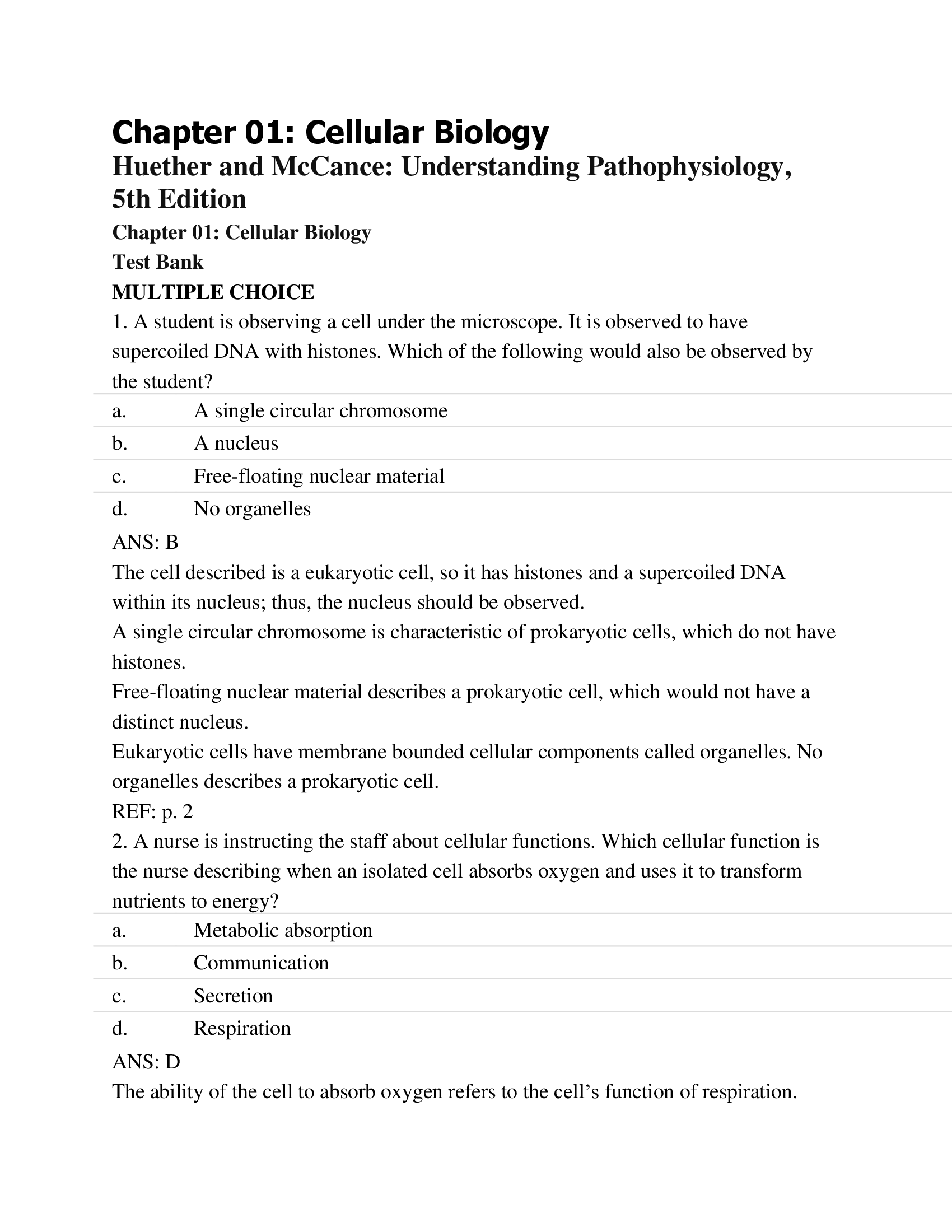
Chapter 01: Cellular Biology 

Huether and McCance: Understanding Pathophysiology,

5th Edition 

Chapter 01: Cellular Biology 

Test Bank 

MULTIPLE CHOICE 

1. A student is observing a cell under the microscope. It is observed to have

supercoiled DNA with histones. Which of the following would also be observed by

the student? 

a. 

A single circular chromosome 

b. 

A nucleus 

c. 

Free-floating nuclear material 

d. 

No organelles 

ANS: B 

The cell described is a eukaryotic cell, so it has histones and a supercoiled DNA

within its nucleus; thus, the nucleus should be observed. 

A single circular chromosome is characteristic of prokaryotic cells, which do not have

histones. 

Free-floating nuclear material describes a prokaryotic cell, which would not have a

distinct nucleus. 

Eukaryotic cells have membrane bounded cellular components called organelles. No

organelles describes a prokaryotic cell. 

REF: p. 2 

2. A nurse is instructing the staff about cellular functions. Which cellular function is

the nurse describing when an isolated cell absorbs oxygen and uses it to transform

nutrients to energy? 

a. Metabolic absorption 

b. 

Communication 

c. 

Secretion 

d. 

Respiration 

ANS: D 

The ability of the cell to absorb oxygen refers to the cell’s function of respiration. 


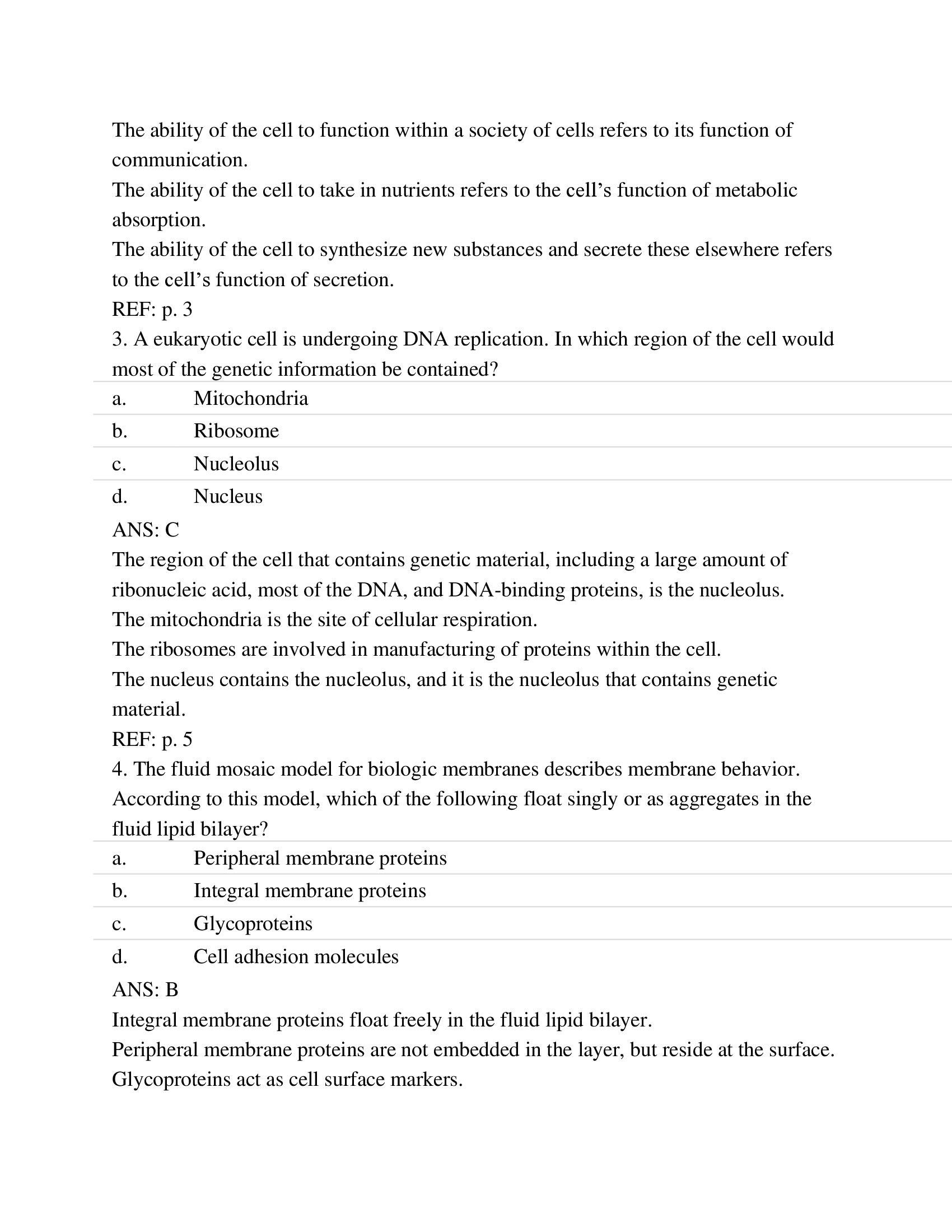
The ability of the cell to function within a society of cells refers to its function of

communication. 

The ability of the cell to take in nutrients refers to the cell’s function of metabolic

absorption. 

The ability of the cell to synthesize new substances and secrete these elsewhere refers

to the cell’s function of secretion. 

REF: p. 3 

3. A eukaryotic cell is undergoing DNA replication. In which region of the cell would

most of the genetic information be contained? 

a. Mitochondria 

b. 

Ribosome 

c. 

Nucleolus 

d. 

Nucleus 

ANS: C 

The region of the cell that contains genetic material, including a large amount of

ribonucleic acid, most of the DNA, and DNA-binding proteins, is the nucleolus. 

The mitochondria is the site of cellular respiration. 

The ribosomes are involved in manufacturing of proteins within the cell. 

The nucleus contains the nucleolus, and it is the nucleolus that contains genetic

material. 

REF: p. 5 

4. The fluid mosaic model for biologic membranes describes membrane behavior.

According to this model, which of the following float singly or as aggregates in the

fluid lipid bilayer? 

a. 

Peripheral membrane proteins 

b. 

Integral membrane proteins 

c. 

Glycoproteins 

d. 

Cell adhesion molecules 

ANS: B 

Integral membrane proteins float freely in the fluid lipid bilayer. 

Peripheral membrane proteins are not embedded in the layer, but reside at the surface. 

Glycoproteins act as cell surface markers. 


Cell adhesion molecules are on the outside of the membrane and allow cells to hook

together. 

REF: p. 6 

5. Which of the following can bind to plasma membrane receptors? 

a. 

Oxygen 

b. 

Ribosomes 

c. 

Amphipathic lipids 

d. 

Ligands 

ANS: D 

Ligands are specific molecules that can bind with receptors on the cell membrane. 

Oxygen moves by diffusion; it does not bind to receptors. 

Ribosomes make proteins and are not involved in binding. 

Amphipathic lipids are a portion of the cell membrane. 

REF: p. 11 

6. A nurse is reviewing a report from a patient with metastatic cancer. What finding

would support the diagnosis of metastatic cancer? Alterations in extracellular matrix

that include: 

a. 

Decreased fibronectin 

b. 

Increased collagen 

c. 

Decreased elastin 

d. 

Increased glycoproteins 

ANS: A 

Reduced amounts of fibronectin are found in some types of cancerous cells, allowing

cancer cells to travel, or metastasize. 

Collagen provides strength, and its breakdown is associated with osteoarthritis, not

cancer. 

Elastin is found in the lungs and allows tissues to stretch; it is not associated with

cancerous cells. 

Decreased, not increased, glycoproteins are associated with cancerous cells. 

REF: p. 8 

7. Which form of cell communication is used to relate to other cells in direct physical

contact? 


a. 

Cell junction 

b. 

Gap junction 

c. 

Desmosomes 

d. 

Tight junctions 

ANS: A 

Cell junctions hold cells together and permit molecules to pass from cell to cell. 

Gap junctions allow communication from the inside of one cell to the inside of

another. 

Desmosomes are not involved in communication, but allow cells to hold together. 

Tight junctions are barriers that prevent movement of some substances and leakages

of others. 

REF: p. 9 

8. Pancreatic beta cells secrete insulin, which inhibits secretion of glucagon from

neighboring alpha cells. This action is an example of which of the following signaling

types? 

a. 

Paracrine 

b. 

Autocrine 

c. 

Neurohormonal 

d. 

Hormonal 

ANS: A 

Paracrine signaling involves the release of local chemical mediators that are quickly

taken up, destroyed, or immobilized, as in the case of insulin and the inhibition of the

secretion of glucagon. 

When cells produce signals that they themselves respond to, autocrine signaling is

used. 

Neurohormonal signaling involves secretion of hormones into the bloodstream by

neurosecretory hormones. 

Hormonal signaling involves specialized endocrine cells that secrete hormone

chemicals released by one set of cells that travel through the tissue through the

bloodstream to produce a response in other sets of cells. 

REF: p. 11 

9. In cellular metabolism, each enzyme has a high affinity for a: 


a. 

Solute 

b. 

Substrate 

c. 

Receptor 

d. 

Ribosome 

ANS: B 

Each enzyme has a high affinity for a substrate, a specific substance converted to a

product of the reaction. 

Solutes are small particles that pass through the cell membrane. 

A receptor is a site on the cell wall that allows transport into the cell. 

Ribosomes are located inside the cell and are not related to the work of enzymes. 

REF: p. 13 

10. An athlete runs a marathon, after which his muscles feel fatigued and unable to

contract. The athlete asks the nurse why this happened. How should the nurse

respond? A deficiency in ________ can cause impaired muscle contraction. 

a. 

GTP 

b. 

AMP 

c. 

ATP 

d. 

GMP 

ANS: C 

The cell uses ATP for muscle contraction. when it is deficient, impaired muscle

contraction results. 

GTP is involved in cell signaling, not muscle contraction. 

AMP is not involved in muscle contraction. 

GMP is not involved in muscle contraction. 

REF: p. 13 

11. Which phase of catabolism produces the most ATP? 

a. 

Digestion 

b. 

Glycolysis 

c. 

Oxidation 

d. 

Citric acid cycle 

ANS: D 

Most of the ATP is generated during the citric acid cycle. 


Larger molecules are broken down into smaller units during digestion; no ATP is

produced during this cycle. 

During glycolysis, two molecules of ATP are produced from each glucose molecule,

but the most ATP is produced during the citric acid cycle. 

Oxidation is part of the glycolysis process and ATP is produced, but more ATP is

produced during the citric acid cycle. 

REF: p. 13 

12. A nurse is teaching the staff about the three phases of cellular catabolism. Which

of the following should the nurse include? 

a. 

Digestion, glycolysis and oxidation, and the citric acid cycle 

b. 

Diffusion, osmosis, and mediated transport 

c. 

S phase, G phase, and M phase 

d. Metabolic absorption, respiration, and excretion 

ANS: A 

Digestion, glycolysis and oxidation, and the citric acid cycle are the three phases of

cellular catabolism. 

Diffusion, osmosis, and mediated transport are parts of the movement of fluids in and

out of cells. 

The S, G, and M phases are phases of cellular division, not catabolism. 

Metabolic absorption, respiration, and excretion are functions of the cell. 

REF: p. 13 

13. A runner has depleted all the oxygen available for muscle energy. Which of the

following will facilitate his continued muscle performance? 

a. 

Electron-transport chain 

b. 

Aerobic glycolysis 

c. 

Anaerobic glycolysis 

d. 

Oxidative phosphorylation 

ANS: C 

When no oxygen is available, anaerobic glycolysis occurs. 

The electron-transport chain is part of the citric acid cycle. 

Aerobic glycolysis involves the presence of oxygen. 


Oxidative phosphorylation is the mechanism by which the energy produced from

carbohydrates, fats, and proteins is transferred to ATP. It is not part of muscle

performance. 

REF: p. 14 

14. The faculty member asked the student to identify the appropriate term for the

movement of small, electrically uncharged molecules through a semipermeable

barrier. Which answer indicates the nursing student understood the teaching? 

a. 

Osmosis 

b. 

Diffusion 

c. 

Hydrostatic pressure 

d. 

Active transport 

ANS: B 

Diffusion is the movement of a solute molecule from an area of greater solute

concentration to an area of lesser solute concentration. 

Osmosis is the movement of water across a semipermeable membrane from a region

of higher water concentration to one of lower concentration. 

Hydrostatic pressure is the force of fluid against a cell membrane. Within the vascular

system, this pressure is the blood pressure. 

In active transport, molecules move up a concentration gradient. This process requires

energy. 

REF: p. 15 

15. A nurse is teaching a patient about fluid and electrolytes. Which of the following

indicates the teaching was successful regarding electrolytes? Electrolytes are: 

a. 

Small lipid-soluble molecules 

b. 

Large protein molecules 

c. Micronutrients used to produce ATP 

d. 

Electrically charged molecules 

ANS: D 

Electrolytes are electrically charged molecules. 

Electrolytes are not lipid soluble. 

Electrolytes are not made up of protein. 

Electrolytes do not have a role in the production of ATP. 


REF: p. 15 

16. A nurse is reading a chart and sees the term oncotic pressure. The nurse recalls

that oncotic pressure (colloid osmotic pressure) is determined by: 

a. 

Concentration of sodium 

b. 

Plasma proteins 

c. 

Hydrostatic pressure 

d. 

Availability of membrane transporter proteins 

ANS: B 

Oncotic pressure is determined by the effect of colloids or plasma proteins. 

The concentration of sodium plays a role in tonicity. 

Hydrostatic pressure is the force within a vessel. 

Membrane transporter proteins are involved in active transport within a concentration

gradient. 

REF: p. 16 

17. A patient has a body fluid of 300 mOsm/kg. This lab result is measuring: 

a. 

Osmolality 

b. 

Osmolarity 

c. 

Osmotic pressure 

d. 

Oncotic pressure 

ANS: A 

Osmolality measures the number of milliosmoles per kilogram of water, or the

concentration of molecules per weight of water. 

Osmolarity measures the number of milliosmoles per liter of solution, or the

concentration 

of molecules per volume of solution. 

Osmotic pressure is the amount of hydrostatic pressure required to oppose the osmotic

movement of water. 

Oncotic pressure is from plasma proteins, not body fluids. 

REF: p. 16 

18. In teaching a patient with cirrhosis, which information should the nurse include

regarding cholesterol? 

a. 

Cholesterol decreases the membrane fluidity of the erythrocyte, which reduces its ability to


b. 

Cholesterol decreases the membrane fluidity of erythrocytes, which reduces its ability to ca

c. 

Cholesterol increases the membrane fluidity of erythrocytes, which allows binding of excess

d. 

Cholesterol increases the membrane fluidity of erythrocytes, which prolongs its life span b

ANS: A 

In cirrhosis, the cholesterol content of the red blood cell’s plasma membrane

increases, causing a decrease in membrane fluidity that seriously affects the cell’s

ability to transport oxygen. 

In cirrhosis, for example, the cholesterol content of the red blood cell’s plasma

membrane increases, causing a decrease in membrane fluidity that seriously affects

the cell’s ability to transport oxygen, not hemoglobin; the hemoglobin carries the

oxygen. 

In cirrhosis, for example, the cholesterol content of the red blood cell’s plasma

membrane increases, causing a decrease in membrane fluidity that seriously affects

the cell’s ability to transport oxygen; it does not bind excess glucose. 

In cirrhosis, for example, the cholesterol content of the red blood cell’s plasma

membrane increases, causing a decrease in membrane fluidity that seriously affects

the cell’s ability to transport oxygen. It does not prolong the life of the RBC and could

decrease it. 

REF: p. 7 

19. A nurse is discussing the movement of fluid across the arterial end of capillary

membranes into the interstitial fluid surrounding the capillary. Which process of fluid

movement is the nurse describing? 

a. 

Hydrostatic pressure 

b. 

Osmosis 

c. 

Diffusion 

d. 

Active transport 

ANS: A 

Blood reaching the capillary bed has a hydrostatic pressure of 25 to 30 mm Hg, which

is sufficient force to push water across the thin capillary membranes into the

interstitial space. 

Osmosis involves the movement of fluid from an area of higher concentration to an

area of lower concentration. It does not involve pressure or force. It is related to

hydrostatic pressure. 


Contact the Seller

Please Sign In to contact this seller.


  • 👎  Report Copyright Violation

Frequently Asked Questions

What Do I Get When I Buy This Study Material?

+

When you buy a study material on Passing Grades, an instant download link will be sent directly to your email, giving you access to the file anytime after payment is completed.

Is Passing Grades a Trusted Platform?

+

Yes, Passing Grades is a reputable students’ marketplace with a secure payment system and reliable customer support. You can trust us to ensure a safe and seamless transaction experience.

Will I Be Stuck with a Subscription?

+

No, all purchases on Passing Grades are one-time transactions. You only pay for the notes you choose to buy, with no subscriptions or hidden fees attached.

Who Am I Buying These Study Materials From?

+

Passing Grades is a marketplace, which means you are purchasing the document from an individual vendor, not directly from us. We facilitate the payment and delivery process between you and the vendor.

Does Passing Grades Offer Free Study Materials?

+

Yes, sellers on Passing Grades have uploaded numerous free test banks, exams, practice questions, and class notes that can be downloaded at no cost.

Pasinggrades - Quality Study Materials

USD 15

    • Quality checked by Pasing Grades
    • 100% satisfaction guarantee
    • Seller: mentor2000
Buy PDF $15

Seller Information

mentor2000

Member since April 2021

  • icon
  • icon
View Profile
  • total sales

    0
  • Favourites

    0
  • Comments

    0
    ( 0 Ratings )

Item Information

  • Uploaded

    22 May 2022

  • Updated

    24 October 2025

  • Category

    Nursing

  • Item Type

    test bank

  • Tags

    Test Bank Nursing Pathophysiology

Related Exam Prep Guides by mentor2000

Test Bank for Essentials for Nursing Practice 8th Edition by Potter | All Chapters
View Document

Test Bank for Essent...

  • mentor2000

    mentor2000

  • test bank

Master nursing concepts with this study material; Test Bank for Essentials for Nursing Practice, 8th...

15 USD

0

0

A &P 1 MA278 BSC2 Final Module II Questions & Answers 2026 Update
View Document

A &P 1 MA278 BSC2 Fi...

  • mentor2000

    mentor2000

  • test bank

Prepare for success with A&P 1 MA278 BSC2 Final Module II 2024 Q&A. Boost your grades with this comp...

15 USD

0

0

ATI Comprehensive Predictor Exam 2026
View Document

ATI Comprehensive Pr...

  • mentor2000

    mentor2000

  • test bank

Prepare for success with the ATI Comprehensive Predictor Exam 2026. Access key practice questions to...

15 USD

0

0

Purchase

Download link will be sent to this email immediately after purchase.

IMPORTANT LINKS

  • How To Upload Class Notes
  • Selling Tips
  • Passing Grades's Study Materials
  • Scholarships for International Students 2025

POPULAR CATEGORIES

  • Law
  • Accounting
  • English
  • Psychology
  • Business
  • Nursing
  • Computer Science
  • General

View Document

  • Blog
  • Contact
  • Delivery Policy
  • Latest Scholarships Around the World
  • How to Pass Bar Exams: Passing Grades’ Strategies
  • How to Study and Pass the CPA Exam
  • All Test Banks
  • Faq
  • Copyright Claims
  • Privacy Policy
  • Terms of Use

KNOWLEDGE BASE

  • How to Write A+ Grade Good Research Paper
  • How to Manage Stress During Exam Period
  • Best Time to Study
  • How to Pass NCLEX-RN Exam
  • How To Effectively Utilize Test Banks
  • Popular Shadow Health Exam Assessments
  • Popular HESI Case Studies
  • How to Prepare for a Nursing Career
  • The Importance Of Summaries in Exam Revisvion

© 2026 Pasing Grades. All rights reserved.