Pasing Grades
  • Start Selling
  • Blog
  • Contact
  • 0

    Your cart is empty!

English

  • English
  • Spanish
  • Arabic
Create Account Sign In
  • Library
    • New Prep Guides
    • Featured Prep Guides
    • Free Exam Prep Guides
    • Best sellers
  • General
  • Nursing
    • Research Paper
    • Case Study
    • Discussion Post
    • Assignment
    • Exam
    • Practice Questions and Answers
    • Test Bank
    • solutions manual
  • Accounting
    • Case Study
    • Thesis
    • Study Guide
    • Summary
    • Research Paper
    • test bank
  • English
    • Creative Writing
    • Research Paper
    • Summary
    • Rhetorics
    • Literature
    • Journal
    • Exam
    • Grammar
    • Discussion Post
    • Essay
  • Psychology
    • Hesi
    • Presentation
    • Essay
    • Summary
    • Study Guide
    • Essay
    • Solution Manual
    • Final Exam Review
    • Class Notes
    • test bank
  • Business
    • Lecture Notes
    • Solution Manual
    • Presentation
    • Business Plan
    • Class Notes
    • Experiment
    • Summary
    • Practice Questions
    • Study Guide
    • Case Study
    • test bank
    • Exam
  • More
    • Computer Science
    • Economics
    • Statistics
    • Engineering
    • Biology
    • Religious Studies
    • Physics
    • Chemistry
    • Mathematics
    • History
    • Sociology
    • Science
    • Philosophy
    • Law
  • Pages
    • About Us
    • Selling Tips
    • Delivery Policy
    • Faq
    • Privacy Policy
  • Flash Sale
  • Home
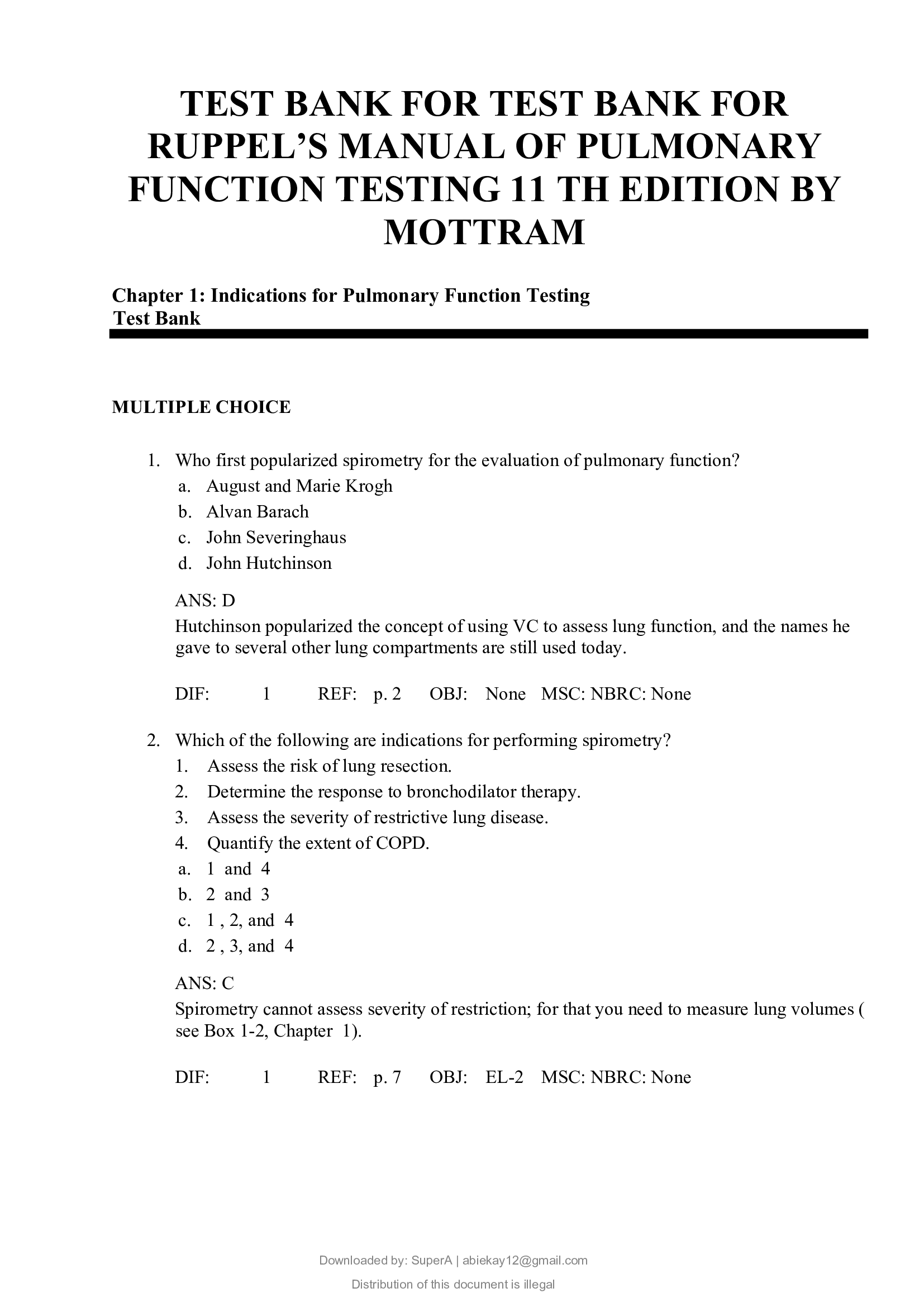
  • TEST BANK FOR TEST BANK FOR RUPPEL’S MANUAL OF PULMONARY FUNCTION TESTING 11 TH EDITION BY MOTTRAM

TEST BANK FOR TEST BANK FOR RUPPEL’S MANUAL OF PULMONARY FUNCTION TESTING 11 TH EDITION BY MOTTRAM

Preview page 1 Preview page 2 Preview page 3
Add To Favorites

Share this item Share this item

  • Item Details
  • Comments (0)
  • Reviews (0)
  • Contact Seller

MULTIPLE CHOICE

1.      Who first popularized spirometry for the evaluation of pulmonary function?

a.       August and Marie Krogh

b.      Alvan Barach

c.       John Severinghaus

d.      John Hutchinson

ANS: D

Hutchinson popularized the concept of using VC to assess lung function, and the names he gave to several other lung compartments are still used today.

DIF:           1          REF:    p. 2      OBJ:    None   MSC: NBRC: None

2.      Which of the following are indications for performing spirometry?

1.        Assess the risk of lung resection.

2.        Determine the response to bronchodilator therapy.

3.        Assess the severity of restrictive lung disease.

4.        Quantify the extent of COPD.

a.       1  and  4

b.      2  and  3

c.       1 , 2, and  4

d.      2 , 3, and  4

ANS: C

Spirometry cannot assess severity of restriction; for that you need to measure lung volumes ( see Box 1-2, Chapter  1).

DIF:           1          REF:    p. 7      OBJ:    EL-2    MSC: NBRC: None

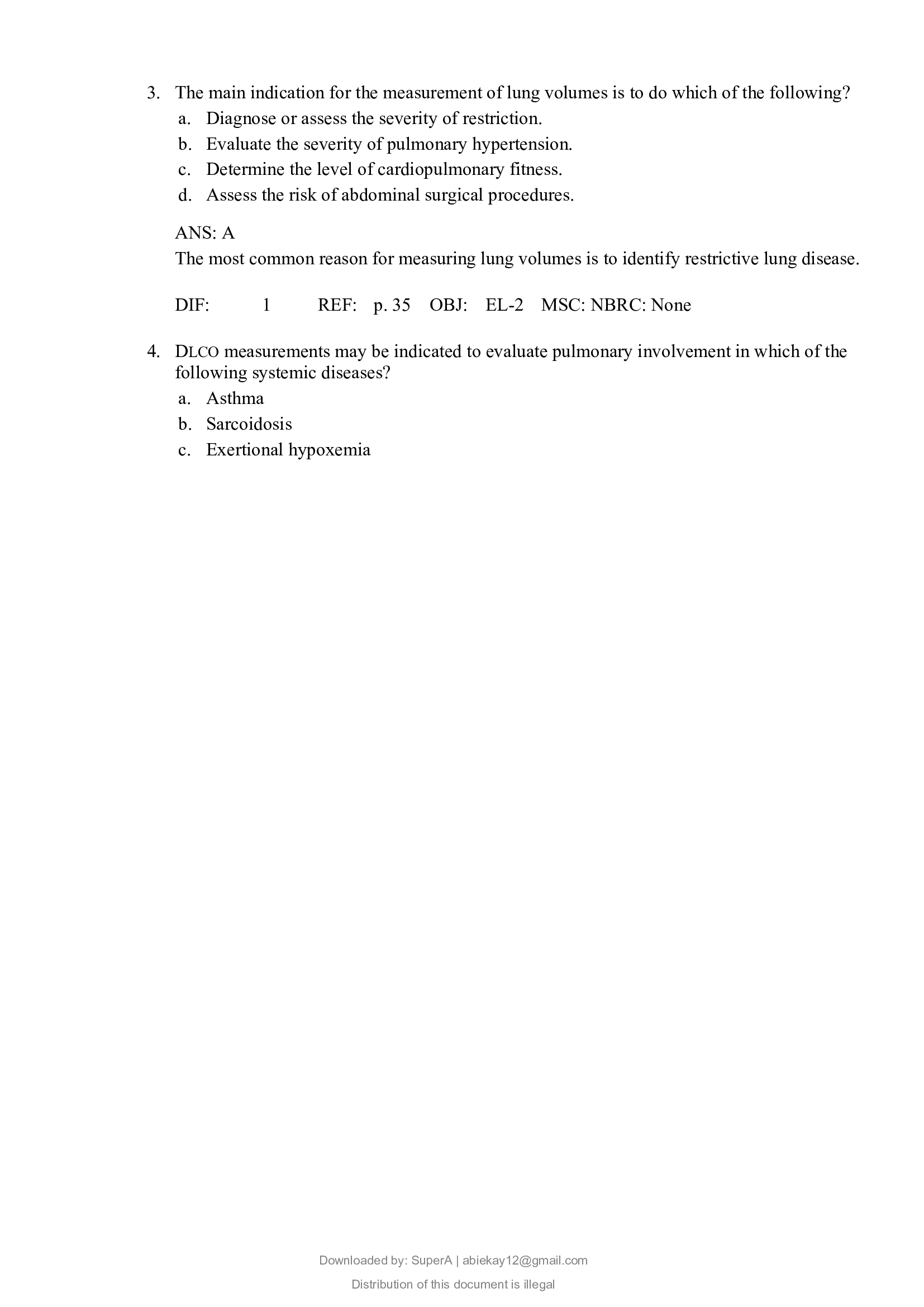
3.      The main indication for the measurement of lung volumes is to do which of the following?

a.       Diagnose or assess the severity of restriction.

b.      Evaluate the severity of pulmonary hypertension.

c.       Determine the level of cardiopulmonary fitness.

d.      Assess the risk of abdominal surgical procedures.

ANS: A

The most common reason for measuring lung volumes is to identify restrictive lung disease.

DIF:           1          REF:    p. 35    OBJ:    EL-2    MSC: NBRC: None

4.      DLCO measurements may be indicated to evaluate pulmonary involvement in which of the following systemic diseases?

a.       Asthma

b.      Sarcoidosis

c.       Exertional hypoxemia


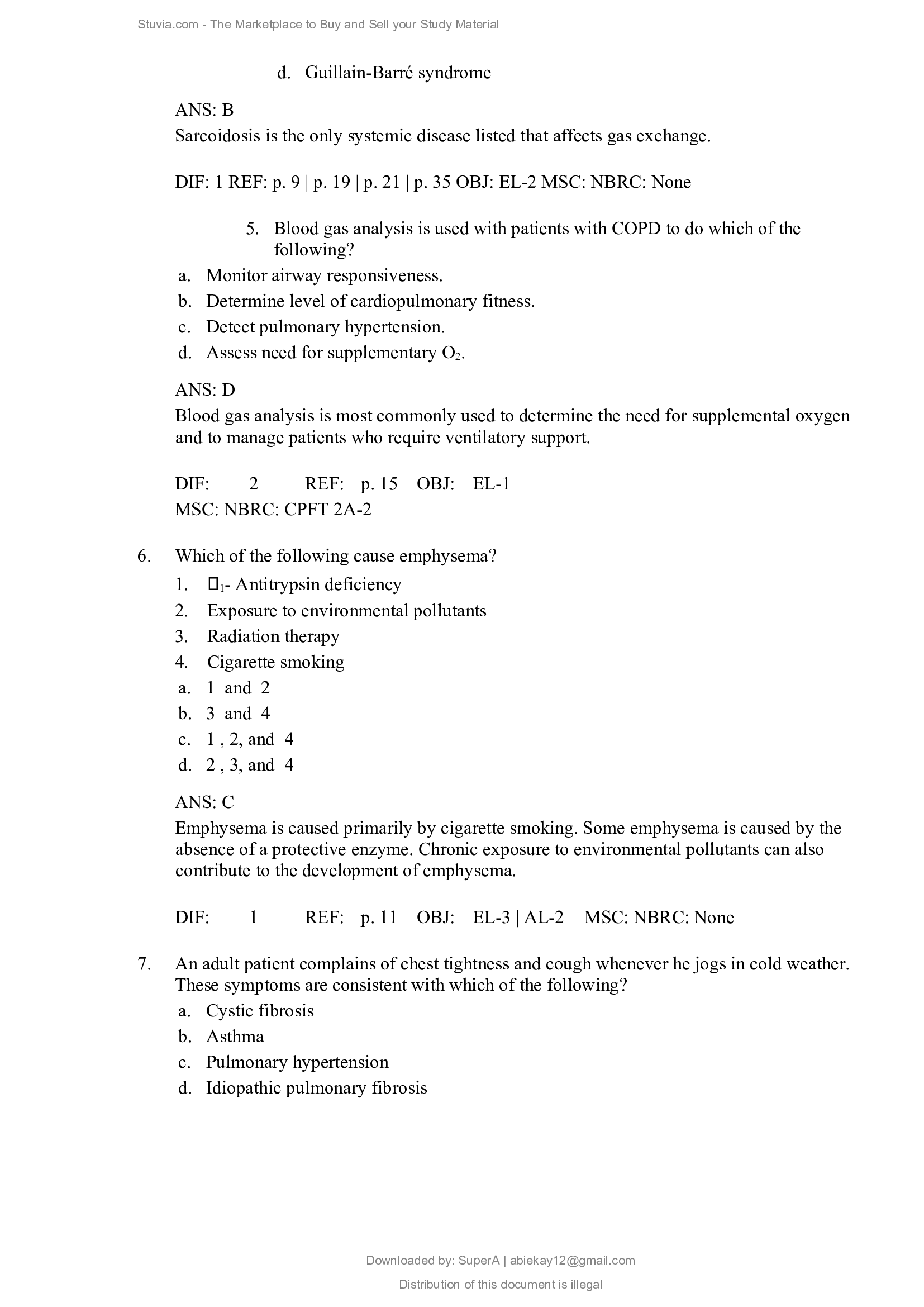
d.      Guillain-Barré syndrome

ANS: B

Sarcoidosis is the only systemic disease listed that affects gas exchange.

DIF: 1 REF: p. 9 | p. 19 | p. 21 | p. 35 OBJ: EL-2 MSC: NBRC: None

5.      Blood gas analysis is used with patients with COPD to do which of the following?

a.       Monitor airway responsiveness.

b.      Determine level of cardiopulmonary fitness.

c.       Detect pulmonary hypertension.

d.      Assess need for supplementary O2.

ANS: D

Blood gas analysis is most commonly used to determine the need for supplemental oxygen and to manage patients who require ventilatory support.

DIF:        2          REF:    p. 15    OBJ:    EL-1

MSC: NBRC: CPFT 2A-2

6.          Which of the following cause emphysema?

1.        1- Antitrypsin deficiency

2.        Exposure to environmental pollutants

3.        Radiation therapy

4.        Cigarette smoking

a.       1  and  2

b.      3  and  4

c.       1 , 2, and  4

d.      2 , 3, and  4

ANS: C

Emphysema is caused primarily by cigarette smoking. Some emphysema is caused by the absence of a protective enzyme. Chronic exposure to environmental pollutants can also contribute to the development of emphysema.

DIF:        1          REF:    p. 11    OBJ:    EL-3 | AL-2    MSC: NBRC: None

7.          An adult patient complains of chest tightness and cough whenever he jogs in cold weather. These symptoms are consistent with which of the following?

a.       Cystic fibrosis

b.      Asthma

c.       Pulmonary hypertension

d.      Idiopathic pulmonary fibrosis

ANS: B

Agents or events that cause an asthmatic episode are called triggers (see Box 1-7, Chapter 1). Antigens such as animal dander, pollens, and dusts are the most common triggers. Other common triggers include exposure to air pollutants and exercise in cold or dry air.

DIF:        2          REF:    p. 16    OBJ:    EL-3    MSC: NBRC: None

8.          Which of the following statements concerning tumors in the upper airway is true?

a.       There may be variable or fixed obstruction.

b.      Fixed obstruction will be present.

c.       Variable obstruction will be present.

d.      Small airway obstruction will result.

ANS: A

Tumors involving the upper airway may cause variable or fixed obstruction.

DIF:        2          REF:    p. 19    OBJ:    EL-2

MSC: NBRC: CPFT 3C-3

9.          Sarcoidosis is a systemic disorder that usually causes which of the following?

a.       A restrictive ventilatory defect

b.      An obstructive ventilatory defect

c.       Hyperreactive airways

d.      Primary pulmonary hypertension

ANS: A

Restriction is often associated with the following: interstitial lung diseases, including idiopathic fibrosis, pneumoconioses, and sarcoidosis.

DIF:        1          REF:    p. 19 | p. 21     OBJ:    EL-3    MSC: NBRC: None

10.      For which of the following conditions might pulmonary function testing be contraindicated? a.    Vocal cord dysfunction

b.      Untreated pneumothorax

c.       Congestive heart failure (CHF)

d.      Bronchiolitis obliterans

ANS: B

Pulmonary function tests are usually contraindicated in the presence of pneumothorax. However, undiagnosed pneumothorax may present a risk if pulmonary function studies are performed.

DIF:        1          REF:    p. 23    OBJ:    EL-4

MSC: NBRC: CPFT 2B-6

11.      Which of the following correctly describe(s) appropriate physical measurements before pulmonary function testing?

1.        Actual body weight should be used to calculate predicted values.

2.        Standing height should be measured when the patient is barefoot.

3.        Arm span should be used instead of height for a patient with kyphosis.

4.        Age should be recorded to the nearest decade (10 years ).

a.       1  only

b.      2  and  3

c.       1 , 2, and  4

d.      1 , 2, 3, and  4

ANS: B

Various physical measurements are required for estimating each patient’s expected level of pulmonary function. Age to the nearest month, height to the nearest 0.1 cm, and weight are usually recorded in addition to the patient’s gender. Race or ethnic origin should also be recorded. (Although body weight is recorded, it is not used to calculate predicted values.)

DIF:        1          REF:    p. 29    OBJ:    None

MSC: NBRC: CPFT 3A-20

12.      In addition to explaining the procedure for each pulmonary function test to the patient, the pulmonary function technologist should do which of the following?

a.       Briefly explain the physiologic basis of the test.

b.      Demonstrate the correct performance of the test maneuver.

c.       Limit feedback to the patient to reduce the placebo effect.

d.      Explain the exact number of efforts that will be required for each test.

ANS: B

In addition to a description of the test, the maneuver should always be demonstrated.

DIF:        1          REF:    p. 32    OBJ:    None

MSC: NBRC: CPFT 2B-6

13.      The single-breath diffusing capacity test was first described by:

a.       John Severinghaus

b.      August and Marie Krogh

c.       Robert Hyatt

d.      Leland Clark

ANS: B

The basis for the modern single-breath diffusing capacity (DLCO) test was described by August and Marie Krogh in 1911.

DIF:        1          REF:    p. 5      OBJ:    None   MSC: NBRC: None

14.      DLCO measurements may be indicated to evaluate gas exchange abnormality in which of the following?

a.       Ketoacidosis

b.      Myasthenia gravis

c.       Interstitial lung disease

d.      Bronchitis

ANS: C

The other options do not affect the alveolar capillary membrane interface.

DIF:        1          REF:    p. 9      OBJ:    EL-2    MSC: NBRC: None

15.      Vocal cord dysfunction will typically affect the flow-volume loop in what way?

a.       Blunt the expiratory portion of the curve

b.      Blunt both the inspiratory and expiratory portions of the curve

c.       Blunt the inspiratory portion of the curve

Have no effect on the curve but cause inspiratory stridor


Contact the Seller

Please Sign In to contact this seller.


  • 👎  Report Copyright Violation

Frequently Asked Questions

What Do I Get When I Buy This Study Material?

+

When you buy a study material on Passing Grades, an instant download link will be sent directly to your email, giving you access to the file anytime after payment is completed.

Is Passing Grades a Trusted Platform?

+

Yes, Passing Grades is a reputable students’ marketplace with a secure payment system and reliable customer support. You can trust us to ensure a safe and seamless transaction experience.

Will I Be Stuck with a Subscription?

+

No, all purchases on Passing Grades are one-time transactions. You only pay for the notes you choose to buy, with no subscriptions or hidden fees attached.

Who Am I Buying These Study Materials From?

+

Passing Grades is a marketplace, which means you are purchasing the document from an individual vendor, not directly from us. We facilitate the payment and delivery process between you and the vendor.

Does Passing Grades Offer Free Study Materials?

+

Yes, sellers on Passing Grades have uploaded numerous free test banks, exams, practice questions, and class notes that can be downloaded at no cost.


Pasinggrades - Quality Study Materials

USD 14

    • Quality checked by Pasing Grades
    • 100% satisfaction guarantee
    • Seller: mentor2000
Buy PDF $14

Seller Information

mentor2000

Member since April 2021

  • icon
  • icon
View Profile
  • total sales

    0
  • Favourites

    0
  • Comments

    0
    ( 0 Ratings )

Item Information

  • Uploaded

    25 February 2024

  • Updated

    29 September 2025

  • Category

    Nursing

  • Item Type

    exam

  • Tags

    TEST BANK FOR TEST BANK FOR RUPPEL’S MANUAL OF PULMONARY FUNCTION TESTING 11 TH EDITION BY MOTTRAM

Related Exam Prep Guides by mentor2000

Test Bank for Essentials for Nursing Practice 8th Edition by Potter | All Chapters
View Document

Test Bank for Essent...

  • mentor2000

    mentor2000

  • exam

Master nursing concepts with this study material; Test Bank for Essentials for Nursing Practice, 8th...

14 USD

0

0

A &P 1 MA278 BSC2 Final Module II Questions & Answers 2026 Update
View Document

A &P 1 MA278 BSC2 Fi...

  • mentor2000

    mentor2000

  • exam

Prepare for success with A&P 1 MA278 BSC2 Final Module II 2024 Q&A. Boost your grades with this comp...

14 USD

0

0

ATI Comprehensive Predictor Exam 2026
View Document

ATI Comprehensive Pr...

  • mentor2000

    mentor2000

  • exam

Prepare for success with the ATI Comprehensive Predictor Exam 2026. Access key practice questions to...

14 USD

0

0

Purchase

Download link will be sent to this email immediately after purchase.

IMPORTANT LINKS

  • How To Upload Class Notes
  • Selling Tips
  • Passing Grades's Study Materials
  • Scholarships for International Students 2025

POPULAR CATEGORIES

  • Law
  • Accounting
  • English
  • Psychology
  • Business
  • Nursing
  • Computer Science
  • General

View Document

  • Blog
  • Contact
  • Delivery Policy
  • Latest Scholarships Around the World
  • How to Pass Bar Exams: Passing Grades’ Strategies
  • How to Study and Pass the CPA Exam
  • All Test Banks
  • Faq
  • Copyright Claims
  • Privacy Policy
  • Terms of Use

KNOWLEDGE BASE

  • How to Write A+ Grade Good Research Paper
  • How to Manage Stress During Exam Period
  • Best Time to Study
  • How to Pass NCLEX-RN Exam
  • How To Effectively Utilize Test Banks
  • Popular Shadow Health Exam Assessments
  • Popular HESI Case Studies
  • How to Prepare for a Nursing Career
  • The Importance Of Summaries in Exam Revisvion

© 2026 Pasing Grades. All rights reserved.