Pasing Grades
  • Start Selling
  • Blog
  • Contact
  • 0

    Your cart is empty!

English

  • English
  • Spanish
  • Arabic
Create Account Sign In
  • Library
    • New Prep Guides
    • Featured Prep Guides
    • Free Exam Prep Guides
    • Best sellers
  • General
  • Nursing
    • Research Paper
    • Case Study
    • Discussion Post
    • Assignment
    • Exam
    • Practice Questions and Answers
    • Test Bank
    • solutions manual
  • Accounting
    • Case Study
    • Thesis
    • Study Guide
    • Summary
    • Research Paper
    • test bank
  • English
    • Creative Writing
    • Research Paper
    • Summary
    • Rhetorics
    • Literature
    • Journal
    • Exam
    • Grammar
    • Discussion Post
    • Essay
  • Psychology
    • Hesi
    • Presentation
    • Essay
    • Summary
    • Study Guide
    • Essay
    • Solution Manual
    • Final Exam Review
    • Class Notes
    • test bank
  • Business
    • Lecture Notes
    • Solution Manual
    • Presentation
    • Business Plan
    • Class Notes
    • Experiment
    • Summary
    • Practice Questions
    • Study Guide
    • Case Study
    • test bank
    • Exam
  • More
    • Computer Science
    • Economics
    • Statistics
    • Engineering
    • Biology
    • Religious Studies
    • Physics
    • Chemistry
    • Mathematics
    • History
    • Sociology
    • Science
    • Philosophy
    • Law
  • Pages
    • About Us
    • Selling Tips
    • Delivery Policy
    • Faq
    • Privacy Policy
  • Flash Sale
  • Home
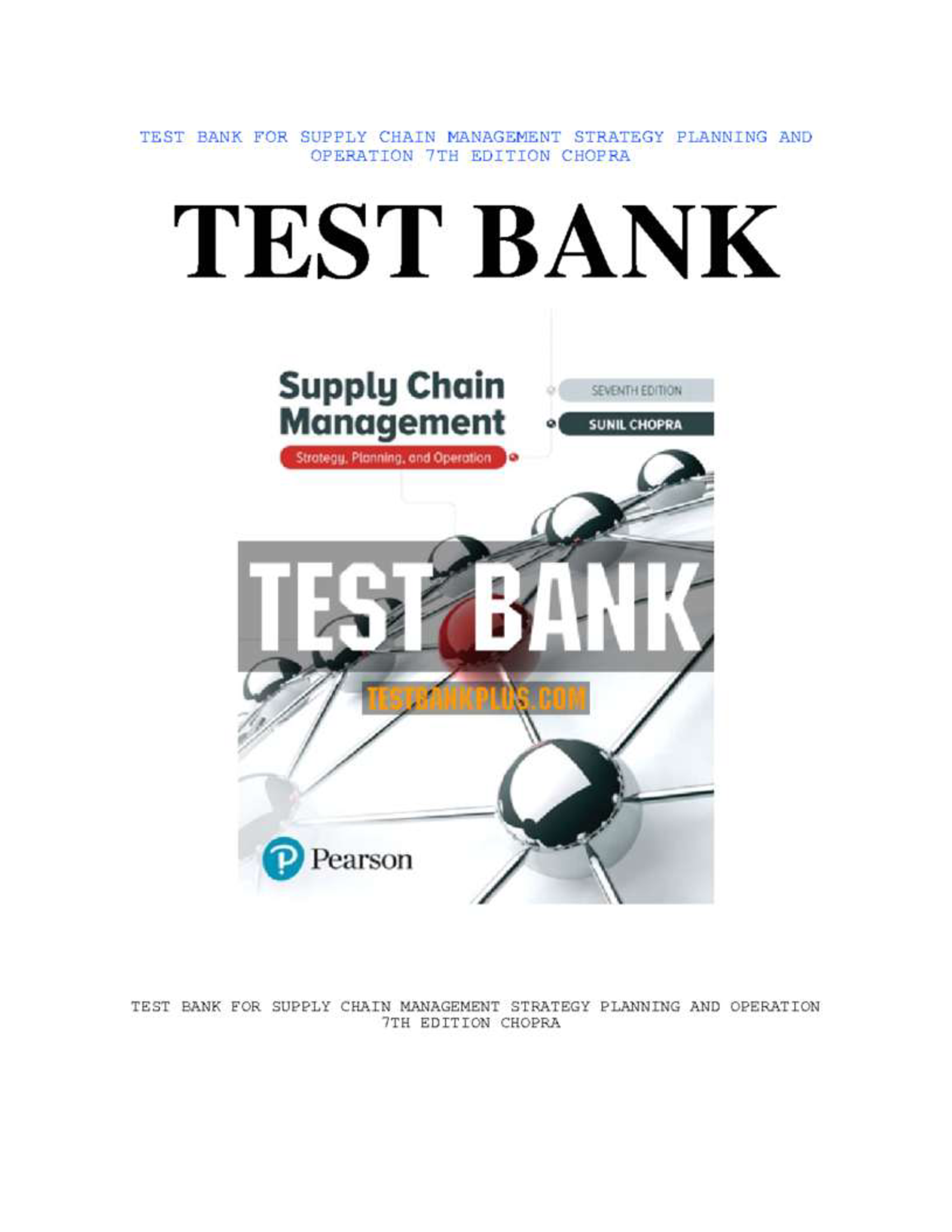
  • Test Bank for Supply Chain Management 7th Edition Sunil Chopra

Test Bank for Supply Chain Management 7th Edition Sunil Chopra

Preview page 1 Preview page 2 Preview page 3
Add To Favorites

Share this item Share this item

  • Item Details
  • Comments (0)
  • Reviews (0)
  • Contact Seller

Supply Chain Management 7th Edition Test Bank

40) The manufacturer and supplier participate in the A) procurement cycle.

B)   replenishment cycle.

C)   manufacturing cycle.

D)  life cycle.

Answer:  A

Diff: 2

Topic:  1.4: Process Views of a Supply Chain

AACSB:  Application of knowledge

Objective:  LO 1.3: Describe the cycle and push/pull views along with the macro processes of a supply chain.

41) The relationship between the manufacturer and supplier during the procurement cycle is very similar to the relationship between A) customer and retailer.

B)  retailer and distributor.

C)  distributor and manufacturer.

Answer:  C

Diff: 2

Topic:  1.4: Process Views of a Supply Chain

AACSB:  Application of knowledge

Objective:  LO 1.3: Describe the cycle and push/pull views along with the macro processes of a supply chain.

42) The cycle view of the supply chain is useful when considering operational decisions because A) it categorizes processes based on whether they are initiated in response to or in anticipation of customer orders.

B)   it specifies the roles and responsibilities of each member of the supply chain.

C)   processes are identified as either reactive or speculative.

D)  it focuses on processes that are external to the firm.

Answer:  B

Diff: 3

Topic:  1.4: Process Views of a Supply Chain

AACSB:  Application of knowledge

Objective:  LO 1.3: Describe the cycle and push/pull views along with the macro processes of a supply chain.

43) The push/pull view of the supply chain is useful when considering strategic decisions relating to supply chain design because

A)  it categorizes processes based on whether they are initiated in response to or in anticipation of customer orders.

B)   it specifies the roles and responsibilities of each member of the supply chain.

C)   it clearly defines the processes involved and the owners of each process.

D)  it focuses on processes that are external to the firm.

Answer:  A

Diff: 2

Topic:  1.4: Process Views of a Supply Chain

AACSB:  Application of knowledge

Objective:  LO 1.3: Describe the cycle and push/pull views along with the macro processes of a supply chain.

44) Which of the following statements about pull processes is accurate? A) They may also be referred to as speculative processes.

B)   Execution is initiated in anticipation of customer orders.

C)   At the time of execution, demand must be forecast.

D)  They may also be referred to as reactive processes.

Answer:  D

Diff: 2

Topic:  1.4: Process Views of a Supply Chain

AACSB:  Application of knowledge

Objective:  LO 1.3: Describe the cycle and push/pull views along with the macro processes of a supply chain.

45) Which of the following statements about push processes is accurate? A) They may also be referred to as speculative processes.

B)   Execution is initiated in response to customer orders.

C)   At the time of execution, demand is known with certainty.

D)  They may also be referred to as reactive processes.

Answer:  A

Diff: 2

Topic:  1.4: Process Views of a Supply Chain

AACSB:  Application of knowledge

Objective:  LO 1.3: Describe the cycle and push/pull views along with the macro processes of a supply chain.


46) Supply chain macro processes include which of the following?

A)  Internal Relationship Management (IRM)

B)   Customer Relationship Management (CRM)

C)   External Relationship Management (ERM)

D)  Supplier Relationship Management (SCRM)

Answer:  B

Diff: 2

Topic:  1.4: Process Views of a Supply Chain

AACSB:  Application of knowledge

Objective:  LO 1.3: Describe the cycle and push/pull views along with the macro processes of a supply chain.


47) Supply chain macro processes include which of the following?

A)  Internal Relationship Management (IRM)

B)   External Relationship Management (ERM)

C)   Supplier Relationship Management (SRM)

D)  Customer Relationship Management (CRM)

Answer:  C

Diff: 2

Topic:  1.4: Process Views of a Supply Chain

AACSB:  Application of knowledge

Objective:  LO 1.3: Describe the cycle and push/pull views along with the macro processes of a supply chain.

48) Activities involved in the Customer Relationship Management (CRM) macro process include A) planning of internal production and storage.

B)   order fulfillment.

C)   marketing.

D)  supply planning.

Answer:  C

Diff: 2

Topic:  1.4: Process Views of a Supply Chain

AACSB:  Application of knowledge

Objective:  LO 1.3: Describe the cycle and push/pull views along with the macro processes of a supply chain.


49) Activities involved in the Internal Supply Chain Management (ISCM) macro process include  A) marketing.

B)   order fulfillment.

C)   sales.

D)  order management.

Answer:  B

Diff: 3

Topic:  1.4: Process Views of a Supply Chain

AACSB:  Application of knowledge

Objective:  LO 1.3: Describe the cycle and push/pull views along with the macro processes of a supply chain.


50) Activities involved in the Supplier Relationship Management (SRM) macro process include A) planning of internal production and storage.

B)   order fulfillment.

C)   supplier evaluation and selection.

D)  order management.

Answer:  C

Diff: 2

Topic:  1.4: Process Views of a Supply Chain

AACSB:  Application of knowledge

Objective:  LO 1.3: Describe the cycle and push/pull views along with the macro processes of a supply chain.


51) The activities associated with planning typically occur during which macro process?

A)  SRM

B)   ISCM

C)   DRM D) CRM

Answer:  B

Diff: 2

Topic:  1.4: Process Views of a Supply Chain

AACSB:  Application of knowledge

Objective:  LO 1.3: Describe the cycle and push/pull views along with the macro processes of a supply chain.

52) A key supply chain difference between Gateway and Apple is that 

A)  Gateway's stores currently carry a large variety of products made by other manufacturers, while Apple carries only Apple products.

B)  Apple has always carried product in their stores while at one time Gateway stores carried no inventory. 

C)  Gateway has always used a push system while Apple has always used a pull system.

D)  Gateway has no suppliers, preferring to make everything in-house, while Apple buys many of their components from suppliers.

Answer:  B

Diff: 2

Topic:  1.5: Examples of Supply Chains

AACSB:  Application of knowledge

Objective:  LO 1.4: Identify important issues and decisions to be addresses in a supply chain.


53) Zara's supply chain strategy

A)  results in supply more closely matching customer demand.

B)   results in longer lead times for store order fulfillment, primarily due to shipping time.

C)   of purely online sales reduces the costs that they would incur with a brick and mortar store system.

D)  of high volume but low cost apparel requires production well in advance of the actual selling season for each garment type.

Answer:  A

Diff: 2

Topic:  1.5: Examples of Supply Chains

AACSB:  Application of knowledge

Objective:  LO 1.4: Identify important issues and decisions to be addresses in a supply chain.


54) Toyota's global complementation strategy

A)  calls for plants to be devoted to the production of vehicles for only the local market.

B)   dictates that parts plants be built to supply all of the needs for each vehicle production plant worldwide.

C)   requires that a single parts plant, for example, for brakes, export brake components to all of its vehicle assembly plants worldwide.

D)  mandates that plants can produce vehicles for export to markets that remain strong when the local market weakens.

Answer:  D

Diff: 3

Topic:  1.5: Examples of Supply Chains

AACSB:  Application of knowledge

Objective:  LO 1.4: Identify important issues and decisions to be addresses in a supply chain.

1.3   Essay Questions


1)  What are the major components of a supply chain and what is their overall goal? Answer:  A supply chain consists of all parties involved, directly or indirectly, in fulfilling a customer request. The supply chain includes not only the manufacturer and suppliers, but also transporters, warehouses, retailers, and even customers themselves. Within each organization, such as a manufacturer, the supply chain includes all functions involved in receiving and filling a customer request. These functions include, but are not limited to, new product development, marketing, operations, distribution, finance, and customer service. The objective of every supply chain should be to maximize the net value generated.

Diff: 2

Topic:  1.1: What Is a Supply Chain?

AACSB:  Application of knowledge

Objective:  LO 1.1: Discuss the goal of a supply chain and explain the impact of supply chain decisions on the success of a firm.


2)  What are the three flows in a supply chain and which direction is the flow? Discuss an example used in the book that illustrates the three flows.

Answer:  The three flows are information, product and funds. Information and product flow both ways between the supplier stage and customer stage. Funds typically flow from the customer stage up to the supplier stage. Examples will vary; Apple is used as the example in conjunction with Figure 1-2.

Diff: 2

Topic:  1.1: What Is a Supply Chain?

AACSB:  Application of knowledge

Objective:  LO 1.1: Discuss the goal of a supply chain and explain the impact of supply chain decisions on the success of a firm.


3)  Explain why supply chain flows are important.

Answer:  Supply chain flows are important, because there is a close connection between the design and management of supply chain flows (product, information, and cash) and the success of a supply chain. The success of many companies can be directly traced to the design and management of an appropriate supply chain. The failure of many businesses can be linked directly to their inability to effectively design and manage supply chain flows.

Diff: 2

Topic:  1.3: Decision Phases in a Supply Chain

AACSB:  Application of knowledge

Objective:  LO 1.2: Define the three key supply chain decision phases and explain the significance of each one.

4)  Explain the 3 decision phases (categories) that must be made in a successful supply chain.  Answer:  The 3 decision phases that occur within a supply chain are supply chain strategy (or design), supply chain planning and supply chain operation. Decisions relate to the flow of information, product and funds. The difference between categories depends upon the frequency of each decision and the time frame over which it has an impact. During the supply chain strategy phase, a company determines what the chain's configurations will be, how resources will be allocated, and what processes each stage will perform. This will establish the structure of the supply chain for several years. Supply chain planning deals with decisions with a time frame from 3 months up to a year. The planning phase must work within the constraints established in the strategy phase. Planning decisions include which markets to supply from which locations, subcontracting of manufacturing, inventory policies and timing and size of marketing promotions. The supply chain operation phase operates on a weekly or daily time horizon and deals with decisions concerning individual customer orders.

Diff: 3

Topic:  1.3: Decision Phases in a Supply Chain

AACSB:  Application of knowledge

Objective:  LO 1.2: Define the three key supply chain decision phases and explain the significance of each one.


5)  Describe the cycle view of the processes within a supply chain.

Answer:  The cycle view divides the supply chain into a series of 4 cycles between the 5

different stages of a supply chain. The cycles are the customer order cycle, replenishment cycle, manufacturing cycle and procurement cycle. The customer order cycle occurs at the customer/retailer interface and includes all processes directly involved in receiving and filling the customer. The replenishment cycle occurs at the retailer/distributor interface and includes all processes involved in replenishing retailer inventory. The manufacturing cycle typically occurs at the distributor/manufacturer (or retailer/manufacturer) interface and includes all processes involved in replenishing distributor (or retailer) inventory. The procurement cycle occurs at the manufacturer/supplier interface and includes all processes necessary to ensure that the materials are available for manufacturing according to schedule.

Diff: 2

Topic:  1.4: Process Views of a Supply Chain

AACSB:  Application of knowledge

Objective:  LO 1.3: Describe the cycle and push/pull views along with the macro processes of a supply chain.


6) Explain the push/pull view of the processes within a supply chain.

Answer:  The push/pull view of the supply chain divides supply chain processes into two categories based on whether they are executed in response to a customer order or in anticipation of customer orders. Pull processes are initiated in response to a customer order. Push processes are initiated and performed in anticipation of customer orders. The push/pull boundary separates push processes from pull processes. This view is very useful when considering strategic decisions relating to supply chain design, because it forces a more global consideration of supply chain processes as they relate to the customer.

Diff: 2

Topic:  1.4: Process Views of a Supply Chain

AACSB:  Application of knowledge

Objective:  LO 1.3: Describe the cycle and push/pull views along with the macro processes of a supply chain.

7) Explain the three macro processes within a supply chain.

Answer:  All processes within a supply chain can be classified into three macro processes which are Customer Relationship Management (CRM), Internal Supply Chain Management (ISCM), and Supplier Relationship Management (SRM). Customer Relationship Management (CRM) includes all processes that focus on the interface between the firm and its customers such as marketing, sales, call center management and order management. Internal Supply Chain Management (ISCM) includes all processes that are internal to the firm such as finalization of demand and supply plans, preparation of inventory management policies, order fulfillment and planning of capacity. Supplier Relationship Management (SRM) includes all processes that focus on the interface between a firm and its suppliers such as evaluation and selection of suppliers, negotiation of supply terms and communication regarding new products and orders.

Diff: 2

Topic:  1.4: Process Views of a Supply Chain

AACSB:  Application of knowledge

Objective:  LO 1.3: Describe the cycle and push/pull views along with the macro processes of a supply chain.


8) Discuss the differences of push and pull supply chain processes.

Answer:  Processes in a supply chain fall into one of two categories depending on the timing of their execution relative to end customer demand. With pull processes, execution is initiated in response to a customer order. With push processes, execution is initiated in anticipation of customer orders based on a forecast. Pull processes may also be referred to as reactive processes because they react to customer demand. Push processes may also be referred to as speculative processes because they respond to speculated (or forecasted) rather than actual demand. The push/pull boundary in a supply chain separates push processes from pull processes. Push processes operate in an uncertain environment because customer demand is not yet known. Pull processes operate in an environment in which customer demand is known. They are, however, often constrained by inventory and capacity decisions that were made in the push phase.

Diff: 3

Topic:  1.4: Process Views of a Supply Chain

AACSB:  Analytical thinking

Objective:  LO 1.3: Describe the cycle and push/pull views along with the macro processes of a supply chain.

Contact the Seller

Please Sign In to contact this seller.


  • 👎  Report Copyright Violation

Frequently Asked Questions

What Do I Get When I Buy This Study Material?

+

When you buy a study material on Passing Grades, an instant download link will be sent directly to your email, giving you access to the file anytime after payment is completed.

Is Passing Grades a Trusted Platform?

+

Yes, Passing Grades is a reputable students’ marketplace with a secure payment system and reliable customer support. You can trust us to ensure a safe and seamless transaction experience.

Will I Be Stuck with a Subscription?

+

No, all purchases on Passing Grades are one-time transactions. You only pay for the notes you choose to buy, with no subscriptions or hidden fees attached.

Who Am I Buying These Study Materials From?

+

Passing Grades is a marketplace, which means you are purchasing the document from an individual vendor, not directly from us. We facilitate the payment and delivery process between you and the vendor.

Does Passing Grades Offer Free Study Materials?

+

Yes, sellers on Passing Grades have uploaded numerous free test banks, exams, practice questions, and class notes that can be downloaded at no cost.

Pasinggrades - Quality Study Materials

USD 15

    • Quality checked by Pasing Grades
    • 100% satisfaction guarantee
    • Seller: Angelicer
Buy PDF $15

Seller Information

Angelicer

Member since April 2021

  • icon
  • icon
View Profile
  • total sales

    0
  • Favourites

    0
  • Comments

    0
    ( 0 Ratings )

Item Information

  • Uploaded

    12 July 2025

  • Updated

    12 July 2025

  • Category

    Business

  • Item Type

    test bank

  • Tags

    Test Bank for Supply Chain Management 7th Edition Sunil Chopra

Related Exam Prep Guides by Angelicer

Test Bank for Success in Practical Vocational Nursing 8th Edition by Knecht
View Document

Test Bank for Succes...

  • Angelicer

    Angelicer

  • test bank

Enhance your study with the Test Bank for Success in Practical Vocational Nursing 8th Edition by Kne...

15 USD

0

0

Test Bank for Illustrated Anatomy of the Head and Neck 5th Edition by Fehrenbach
View Document

Test Bank for Illust...

  • Angelicer

    Angelicer

  • test bank

Boost your understanding with the Test Bank for Illustrated Anatomy of the Head and Neck 5th Edition...

15 USD

0

0

ATI PEDS Proctored Exam Questions and Answers 2026 | Comprehensive Study Guide
View Document

ATI PEDS Proctored E...

  • Angelicer

    Angelicer

  • test bank

Get the ATI PEDS Proctored Exam Questions and Answers for 2025. This comprehensive study guide offer...

15 USD

0

0

Purchase

Download link will be sent to this email immediately after purchase.

IMPORTANT LINKS

  • How To Upload Class Notes
  • Selling Tips
  • Passing Grades's Study Materials
  • Scholarships for International Students 2025

POPULAR CATEGORIES

  • Law
  • Accounting
  • English
  • Psychology
  • Business
  • Nursing
  • Computer Science
  • General

View Document

  • Blog
  • Contact
  • Delivery Policy
  • Latest Scholarships Around the World
  • How to Pass Bar Exams: Passing Grades’ Strategies
  • How to Study and Pass the CPA Exam
  • All Test Banks
  • Faq
  • Copyright Claims
  • Privacy Policy
  • Terms of Use

KNOWLEDGE BASE

  • How to Write A+ Grade Good Research Paper
  • How to Manage Stress During Exam Period
  • Best Time to Study
  • How to Pass NCLEX-RN Exam
  • How To Effectively Utilize Test Banks
  • Popular Shadow Health Exam Assessments
  • Popular HESI Case Studies
  • How to Prepare for a Nursing Career
  • The Importance Of Summaries in Exam Revisvion

© 2026 Pasing Grades. All rights reserved.