Pasing Grades
  • Start Selling
  • Blog
  • Contact
  • 0

    Your cart is empty!

English

  • English
  • Spanish
  • Arabic
Create Account Sign In
  • Library
    • New Prep Guides
    • Featured Prep Guides
    • Free Exam Prep Guides
    • Best sellers
  • General
  • Nursing
    • Research Paper
    • Case Study
    • Discussion Post
    • Assignment
    • Exam
    • Practice Questions and Answers
    • Test Bank
    • solutions manual
  • Accounting
    • Case Study
    • Thesis
    • Study Guide
    • Summary
    • Research Paper
    • test bank
  • English
    • Creative Writing
    • Research Paper
    • Summary
    • Rhetorics
    • Literature
    • Journal
    • Exam
    • Grammar
    • Discussion Post
    • Essay
  • Psychology
    • Hesi
    • Presentation
    • Essay
    • Summary
    • Study Guide
    • Essay
    • Solution Manual
    • Final Exam Review
    • Class Notes
    • test bank
  • Business
    • Lecture Notes
    • Solution Manual
    • Presentation
    • Business Plan
    • Class Notes
    • Experiment
    • Summary
    • Practice Questions
    • Study Guide
    • Case Study
    • test bank
    • Exam
  • More
    • Computer Science
    • Economics
    • Statistics
    • Engineering
    • Biology
    • Religious Studies
    • Physics
    • Chemistry
    • Mathematics
    • History
    • Sociology
    • Science
    • Philosophy
    • Law
  • Pages
    • About Us
    • Selling Tips
    • Delivery Policy
    • Faq
    • Privacy Policy
  • Flash Sale
  • Home
  • Test Bank for Nursing Research Methods and Critical Appraisal for Evidence Based Practice 10th Edition by Geri Lobiondo Wood

Test Bank for Nursing Research Methods and Critical Appraisal for Evidence Based Practice 10th Edition by Geri Lobiondo Wood

Preview page 1 Preview page 2 Preview page 3
Add To Favorites

Share this item Share this item

  • Item Details
  • Comments (0)
  • Reviews (0)
  • Contact Seller

Test Bank for Nursing Research Methods and Critical Appraisal for Evidence Based Practice 10th Edition by Geri Lobiondo Wood || Passing Grades' Study Material

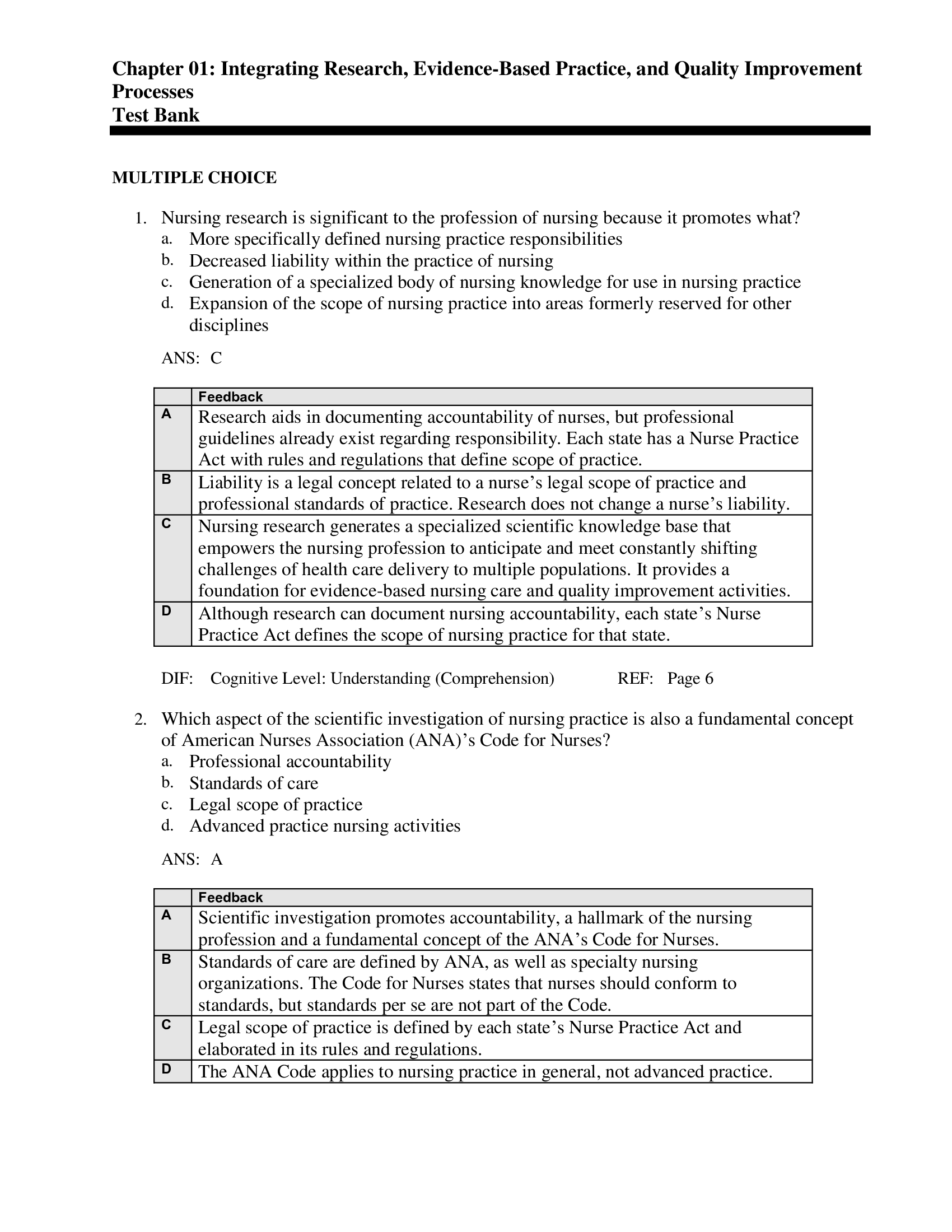
Chapter 01: Integrating Research, Evidence-Based Practice, and Quality Improvement

Processes

Test Bank

MULTIPLE CHOICE

 1.

Nursing research is significant to the profession of nursing because it promotes what?

a. More specifically defined nursing practice responsibilities

b. Decreased liability within the practice of nursing

c. Generation of a specialized body of nursing knowledge for use in nursing practice

d. Expansion of the scope of nursing practice into areas formerly reserved for other

disciplines

ANS: C

Feedback

A Research aids in documenting accountability of nurses, but professional 

guidelines already exist regarding responsibility. Each state has a Nurse Practice

Act with rules and regulations that define scope of practice.

B Liability is a legal concept related to a nurse’s legal scope of practice and

professional standards of practice. Research does not change a nurse’s liability.

C Nursing research generates a specialized scientific knowledge base that

empowers the nursing profession to anticipate and meet constantly shifting

challenges of health care delivery to multiple populations. It provides a

foundation for evidence-based nursing care and quality improvement activities.

D Although research can document nursing accountability, each state’s Nurse

Practice Act defines the scope of nursing practice for that state.

DIF: Cognitive Level: Understanding (Comprehension) REF: Page 6

 2.

Which aspect of the scientific investigation of nursing practice is also a fundamental concept

of American Nurses Association (ANA)’s Code for Nurses?

a. Professional accountability

b. Standards of care

c. Legal scope of practice

d. Advanced practice nursing activities

ANS: A

Feedback

A Scientific investigation promotes accountability, a hallmark of the nursing 

profession and a fundamental concept of the ANA’s Code for Nurses.

B Standards of care are defined by ANA, as well as specialty nursing

organizations. The Code for Nurses states that nurses should conform to

standards, but standards per se are not part of the Code.

C Legal scope of practice is defined by each state’s Nurse Practice Act and

elaborated in its rules and regulations.

D The ANA Code applies to nursing practice in general, not advanced practice.

DIF: Cognitive Level: Remembering (Knowledge) REF: Page 6

 3.

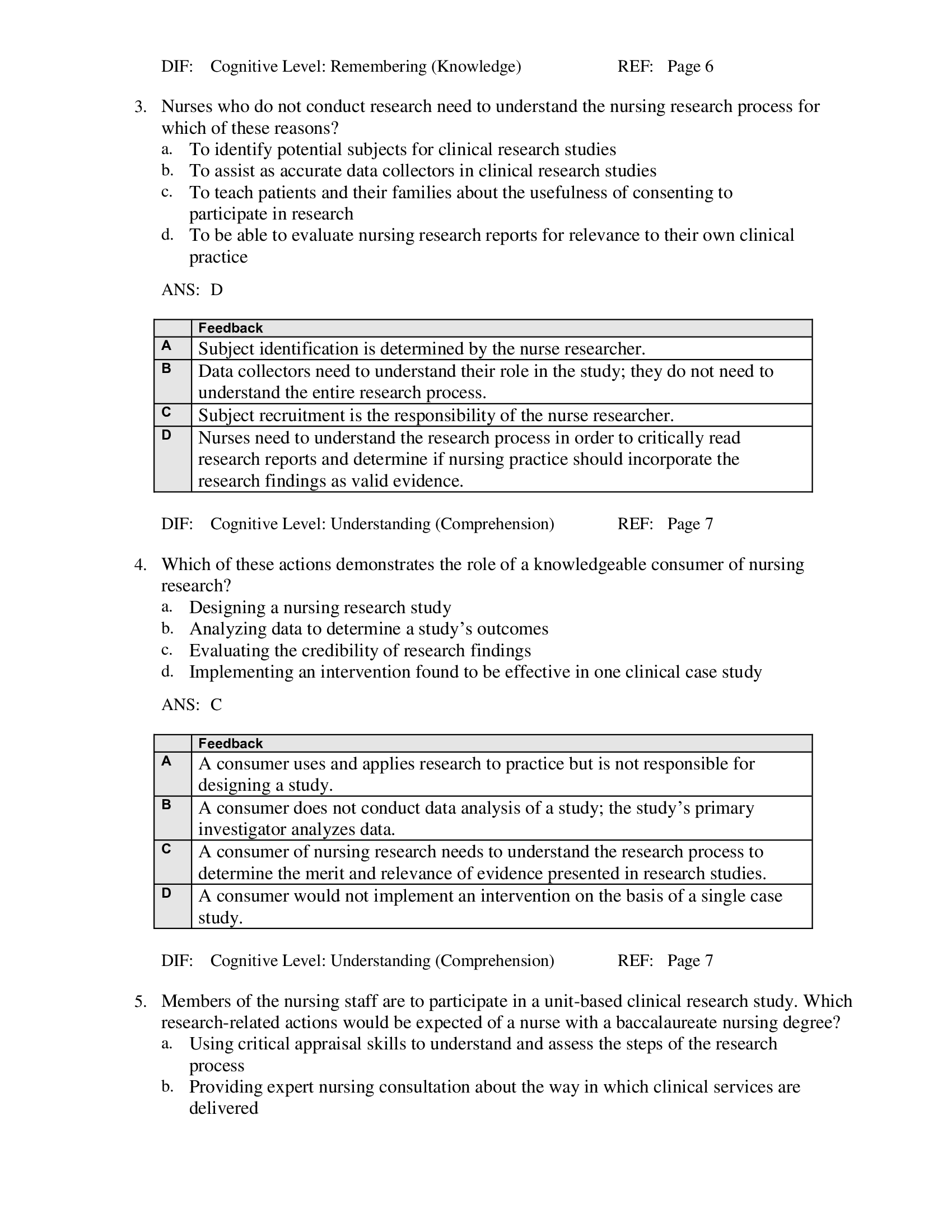
Nurses who do not conduct research need to understand the nursing research process for

which of these reasons?

a. To identify potential subjects for clinical research studies

b. To assist as accurate data collectors in clinical research studies

c. To teach patients and their families about the usefulness of consenting to

participate in research

d. To be able to evaluate nursing research reports for relevance to their own clinical

practice

ANS: D

Feedback

A Subject identification is determined by the nurse researcher.

B Data collectors need to understand their role in the study; they do not need to

understand the entire research process.

C Subject recruitment is the responsibility of the nurse researcher.

D Nurses need to understand the research process in order to critically read

research reports and determine if nursing practice should incorporate the

research findings as valid evidence.

DIF: Cognitive Level: Understanding (Comprehension) REF: Page 7

 4.

Which of these actions demonstrates the role of a knowledgeable consumer of nursing

research?

a. Designing a nursing research study

b. Analyzing data to determine a study’s outcomes

c. Evaluating the credibility of research findings

d. Implementing an intervention found to be effective in one clinical case study

ANS: C

Feedback

A A consumer uses and applies research to practice but is not responsible for 

designing a study.

B A consumer does not conduct data analysis of a study; the study’s primary

investigator analyzes data.

C A consumer of nursing research needs to understand the research process to

determine the merit and relevance of evidence presented in research studies.

D A consumer would not implement an intervention on the basis of a single case

study.

DIF: Cognitive Level: Understanding (Comprehension) REF: Page 7

 5.

Members of the nursing staff are to participate in a unit-based clinical research study. Which

research-related actions would be expected of a nurse with a baccalaureate nursing degree?

a. Using critical appraisal skills to understand and assess the steps of the research

process

b. Providing expert nursing consultation about the way in which clinical services are

delivered

c. Developing research methods to monitor and evaluate the quality of nursing

practice in the clinical setting

d. Providing leadership in the application of scientific knowledge to nursing

practice

ANS: A

Feedback

A A baccalaureate-prepared nurse should be able to use skills of critical appraisal 

to both understand and appraise the steps of the research process.

B Nurses prepared at the baccalaureate level in nursing are at the bedside

implementing protocols, whereas expert consultation is generally reserved for

nurses prepared at the master’s or higher-degree level (advanced education).

C Developing research methods is generally reserved for nurses with advanced

education.

D Providing leadership in research application is generally reserved for nurses with

advanced education.

 6.

Which statement describes the role of the nurse in research?

a. Nurses must be prepared at the baccalaureate or higher level of education to have

any role in nursing research.

b. Nurses with master’s or higher levels of education are solely responsible for

applying research to clinical practice.

c. The research role of nurses prepared at both baccalaureate and master’s levels of

education includes critical appraisal skills.

d. Regardless of the nursing education level, only the nurse with the most

comprehensive understanding of statistical methods should interpret research

findings.

ANS: C

Feedback

A Having a role in nursing research or implementing findings is not limited to 

nurses with baccalaureate or higher levels of education.

B Nurses with master’s or higher levels of education provide leadership to

supervise how research findings are applied in the clinical area. However, all

levels of nurses can apply research findings to practice.

C To use research in evidence-based practice, the nurse must not necessarily be

able to conduct research but should be able to understand and appraise the steps

of the research process to read the research literature critically and use it to

inform clinical decisions.

D Data analysis is usually conducted by nurses with master’s or higher levels of

education. However, interpretation of research findings can be performed by any

nurse who can critically analyze the research performed.

 7.

What is the primary value of evidence-based nursing practice?

a. Implementing the most cost-effective nursing practices when providing patient

care

b. Incorporating research findings with clinical expertise when individualizing

patient care

c. Separating nursing research as unique from the research of other disciplines

d. Developing new nursing theories to promote the growth of nursing science

ANS: B

Feedback

A Cost-effective nursing interventions can occur based on evidence, but it is not 

the primary value of evidence-based nursing practice.

B Evidence-based practice allows the nurse to systematically integrate the best

available research evidence with individual clinical expertise, as well as the

patient’s values and preferences, when making clinical decisions.

C Developing a unique body of nursing knowledge is important, but it is not the

primary value of developing evidence-based nursing practice. Also, nurse

researchers should be able to collaborate with researchers in other disciplines.

D Developing abstract nursing theory is important, but evidence-based nursing is

focused on the more concrete application of knowledge in clinical practice.

 8.

A novice nurse researcher is comparing the processes used in nursing research and in

evidence-based practice. What differences, if any, exist between the two processes?

a. As scientific processes, they are fundamentally the same and should result in

parallel outcomes.

b. Both processes involve testing a question with an appropriate design and specific

methodology.

c. In a research study the question is tested with an appropriate design and specific

methodology, whereas in evidence-based practice the question is used to search

the research literature to find answers.

d. In evidence-based practice, qualitative studies are critically appraised to answer a

clinical question, whereas in nursing research, quantitative studies are reviewed to

provide a foundation for the study.

ANS: C

Feedback

A The research process and the evidence-based practice process, though similar, 

have fundamental differences as well.

B This definition applies to the research process, not the evidence-based practice

process.

C Nursing research includes developing a design for a study, whether quantitative

or qualitative, reviewing the literature, and carrying out a specific methodology

to find answers to a question. In contrast, evidence-based practice includes a

review of completed research studies to identify answers to a clinical question.

D Both the research process and the evidence-based practice process include

critical review of quantitative and qualitative studies.

 9.

A nurse is analyzing a research article. Where in the article is the nurse likely to find the

research question and study purpose?

a. Introduction

b. Data analysis

c. Findings

d. Data collection

ANS: A

Feedback

A The research question and study purpose is generally found early in the report: 

in the abstract, the introduction, or at the end of the literature review or

conceptual framework section.

B The research question and study purpose are defined before the data analysis

section of the research article.

C The research question and study purpose are defined before the findings section

of the research article.

D The research question and study purpose are defined before the data collection

section of the research article.

DIF: Cognitive Level: Understanding (Comprehension) REF: Page 18

 10.

The nurse researcher is conducting a research study using subjects who will be interviewed

regarding their experience with postpartum depression. For which of these reasons would the

researcher select a qualitative, rather than a quantitative, research design?

a. Quantitative research is usually conducted in natural settings using data that are

words rather than numbers.

b. Qualitative research seeks to explain cause-and-effect relationships between

variables.

c. Quantitative research typically uses a convenience sample, seeking to answer a

clinical question about a human experience.

d. Qualitative research collects data from a small number of subjects, allowing for

in-depth study of a phenomenon.

ANS: D

Feedback

A Qualitative, not quantitative, research is usually conducted in natural settings 

using data that are words rather than numbers.

B Quantitative, not qualitative, research seeks to explain cause-and-effect

relationships between variables.

C Qualitative, not quantitative, research seeks to answer a question about a human

experience.

D Qualitative research typically collects data from a small number of subjects, thus

allowing for in-depth study of a phenomenon while using a subjective approach.

 11.

The nurse is analyzing a research article. To determine if an integrative review was performed

as part of the study, the nurse must understand that this type of review is what?

a. A summary of research studies on a focused topic that used a specific statistical

methodology

b. A synthesis of the research and theoretical literature on a specific area without a

statistical analysis

c. A synthesis of qualitative articles on a focused topic using a specific qualitative

methodology

d. A summary of articles in an attempt to develop a clinical practice statement or

clinical guidelines

ANS: B

Feedback

A Meta-analysis summarizes articles on a focused topic that used a specific 

methodology.

B An integrative review is a synthesis of research or theoretical literature on a

specific area that follows specific steps of literature integration without

statistical analysis.

C Meta-synthesis is a synthesis of qualitative articles on a focused topic using

specific qualitative methodology.

D Clinical guidelines are practice statements designed to assist clinicians about

health care decisions for specific conditions or situations.

DIF: Cognitive Level: Remembering (Knowledge) REF: Page 21

 12.

When assessing the strength of a body of evidence used in a research study for consistency,

the nurse should determine what?

a. Extent to which the study’s design, implementation, and analysis minimize bias

b. Number of studies that have evaluated the research question, including overall

sample size across studies

c. Degree to which studies with similar and different designs investigated the same

research questions and report similar findings

d. Significance of the findings based on the statistical methods used for data analysis

ANS: C

Feedback

A Quality refers to the extent to which the study’s design, implementation, and 

analysis minimize bias.

B Quantity refers to the number of studies that have evaluated the research

question, including overall sample size across studies.

C Consistency is the degree to which studies that had similar and different designs

(but investigate the same research question) reported similar findings.

D Quantity refers to the strength of the findings in the statistical analyses.

 13.

The nurse is analyzing a qualitative research article. In which section of the article is the nurse

likely to find a summary of legal-ethical issues considered in the study?

a. Data collection or procedures

b. Findings or results

c. Discussion or implications

d. Abstract or introduction

ANS: A

Feedback

A Legal-ethical issues are typically discussed in the article’s data collection or 

procedures section, usually when discussing the sample.

B The research results are typically found in the findings or results sections.

C Recommendations are typically found in the discussion or implications sections.

D The research question and study purpose are typically found in the abstract or

introduction.

DIF: Cognitive Level: Remembering (Knowledge) REF: Page 10

 14.

The nurse is analyzing a qualitative research article. In which section of the article should the

nurse expect to find a discussion of the research findings?

a. Procedures

b. Methods

c. Sample

d. Results

ANS: D

Feedback

A Data analysis is typically included in the data analysis or procedures section.

B Instruments and their validity and reliability are included in the methods or

instruments sections.

C The research sample and legal-ethical issues are included in the sample or

subjects section.

D The discussion of the findings will be located in the results or discussion section.

 15.

The nurse is using the critical reading process to analyze a research article. The nurse

identifies the main theme of the article and states it in two sentences, using the nurse’s own

words. The nurse is using a strategy to promote which type of understanding?

a. Preliminary

b. Comprehensive

c. Analysis

d. Synthesis

ANS: B

Feedback

A Strategies for preliminary understanding include such activities as using a 

dictionary and identifying key variables of the study.

B Strategies for comprehensive understanding include restating the main idea or

theme of the article in one’s own words.

C Strategies for analysis understanding include using criteria to critique the steps

of the research process used in the study.

D Strategies for synthesis understanding include writing a summary of the

strengths and weaknesses of the study.

DIF: Cognitive Level: Understanding (Comprehension) REF: Page 11

 16.

The nurse is using the critical reading process to analyze a research article. The nurse is using

a list of criteria to determine how well the researcher performed each step of the research

process. The nurse is using a strategy to promote which type of understanding?

a. Preliminary

b. Comprehensive

c. Analysis

d. Synthesis

ANS: C

Feedback

A Strategies for preliminary understanding include such activities as highlighting 

or underlining identified steps of the research process.

B Strategies for comprehensive understanding include restating the main idea or 

theme of the article in one’s own words.

C Strategies for analysis understanding include using criteria to critique the steps

of the research process used in the study.

D Strategies for synthesis understanding include writing a summary of the

strengths and weaknesses of the study.

 17.

Which of the following is a critical step for the quality improvement process in health care

settings?

a. Outlining general long-range goals

b. Identifying current successful practices

c. Testing practice changes slowly and tentatively

d. Adopting a practice change as a new standard of care

ANS: D

Feedback

A Quality improvement includes identifying specific, immediate goals, not 

long-range goals.

B The quality improvement process includes identifying practices that pose

problems, rather than identifying successful practices.

C Quality improvement includes testing practice changes rapidly, not slowly.

D The goal of quality improvement activities is to bring about changes in practice

that will make a positive difference in patient care. Therefore, adopting a

practice change is a critical step in the process.

DIF: Cognitive Level: Remembering (Knowledge) REF: Page 22

MULTIPLE RESPONSE

 1.

Which statement(s) describe the actions of the baccalaureate nurse graduate as a participant in

the nursing research process? (Select all that apply.)

a. Administering care at the bedside according to a research protocol

b. Providing leadership by helping others apply scientific knowledge to practice

c. Sharing with nursing colleagues research findings that are pertinent to practice

d. Designing and conducting nursing research studies

e. Functioning as a primary investigator for a research study

ANS: A, C

Feedback

Correct Following a research protocol at the bedside is an activity consistent with 

the practice of a nurse prepared at the baccalaureate level.

Sharing research evidence with colleagues is an activity consistent with 

the practice of a nurse prepared at the baccalaureate level.

Incorrect Leadership related to scientific investigation is more appropriate for a

nurse prepared at the master’s or higher degree level

Designing and conducting research studies are activities more appropriate

for a nurse with doctoral preparation.

Functioning as a primary investigator is an activity appropriate for a nurse

with doctoral preparation.

 2.

Which aspects of the nursing research process are common to nurses at all educational levels?

(Select all that apply.)

a. Disseminating research findings in research reports

b. Maintaining the protection of patients who are subjects in a study

c. Using one’s expertise to develop theoretical explanations for findings

d. Knowing the relationship between research and nursing practice

e. Being a member of a collaborative team that applies research to practice

ANS: B, D, E

Feedback

Correct All nurses are responsible for protecting the rights of patients.

All nurses should be aware that research is related to practice.

All nurses can be a part of a clinical team that applies research to practice.

Incorrect Disseminating research in scientific reports is an activity generally

performed by nurses with master’s or higher educational preparation.

Developing theoretical explanations for findings is an activity generally

performed by nurses with master’s or higher educational preparation.

DIF: Cognitive Level: Understanding (Comprehension) REF: Page 7

 3.

For the baccalaureate nursing student, education in nursing research has which outcomes?

(Select all that apply.)

a. Mastering the development of research protocols

b. Gaining basic understanding of the research process

c. Learning how research is related to clinical nursing practice

d. Developing skill as a primary investigator in research

e. Becoming a knowledgeable consumer of nursing research

ANS: B, C, E

Feedback

Correct The student should gain an initial understanding of the importance of 

research in nursing practice.

The student should learn how research is related to clinical nursing

practice.

The student should learn skills in the critical analysis of research to assist 

in decisions about applying research findings in nursing practice.

Incorrect Mastery of research protocol development is generally attained at the

master’s or higher degree level of education.

Developing skill as a primary investigator is generally attained at the

doctoral level of education.

 4.

Developing nurse researchers at a younger age is a priority for the future in the nursing

profession for which reasons? (Select all that apply.)

a. Enhancing the discipline’s scientific development

b. Increasing the longevity of research careers

c. Receiving more research funding for professional organizations

d. Promoting mentoring opportunities for novice researchers

e. Increasing nursing’s role in pharmaceutical research

ANS: A, B, D

Feedback

Correct Developing young researchers increases the number of researchers 

contributing to the science of the discipline.

Introducing nurses to research at a younger age allows them sufficient

time to develop in-depth research programs in their careers.

Introducing nurses to research at a younger age allows them time and

opportunity to be mentored by experienced researchers, as well as to learn

to become mentors themselves.

Incorrect Younger researchers do not guarantee research monies.

Pharmaceutical studies are medical research and are not considered

nursing research studies.

DIF: Cognitive Level: Understanding (Comprehension) REF: Page 7

Contact the Seller

Please Sign In to contact this seller.


  • 👎  Report Copyright Violation

Frequently Asked Questions

What Do I Get When I Buy This Study Material?

+

When you buy a study material on Passing Grades, an instant download link will be sent directly to your email, giving you access to the file anytime after payment is completed.

Is Passing Grades a Trusted Platform?

+

Yes, Passing Grades is a reputable students’ marketplace with a secure payment system and reliable customer support. You can trust us to ensure a safe and seamless transaction experience.

Will I Be Stuck with a Subscription?

+

No, all purchases on Passing Grades are one-time transactions. You only pay for the notes you choose to buy, with no subscriptions or hidden fees attached.

Who Am I Buying These Study Materials From?

+

Passing Grades is a marketplace, which means you are purchasing the document from an individual vendor, not directly from us. We facilitate the payment and delivery process between you and the vendor.

Does Passing Grades Offer Free Study Materials?

+

Yes, sellers on Passing Grades have uploaded numerous free test banks, exams, practice questions, and class notes that can be downloaded at no cost.

Pasinggrades - Quality Study Materials

USD 16

    • Quality checked by Pasing Grades
    • 100% satisfaction guarantee
    • Seller: Angelicer
Buy PDF $16

Seller Information

Angelicer

Member since April 2021

  • icon
  • icon
View Profile
  • total sales

    2
  • Favourites

    0
  • Comments

    0
    ( 0 Ratings )

Item Information

  • Uploaded

    22 October 2023

  • Updated

    21 June 2025

  • Category

    Accounting

  • Item Type

    test bank

  • Tags

    Test Bank Nursing Research Methods nursing study material EBP practice questions latest edition

Related Exam Prep Guides by Angelicer

Test Bank for Success in Practical Vocational Nursing 8th Edition by Knecht
View Document

Test Bank for Succes...

  • Angelicer

    Angelicer

  • test bank

Enhance your study with the Test Bank for Success in Practical Vocational Nursing 8th Edition by Kne...

16 USD

0

2

Test Bank for Illustrated Anatomy of the Head and Neck 5th Edition by Fehrenbach
View Document

Test Bank for Illust...

  • Angelicer

    Angelicer

  • test bank

Boost your understanding with the Test Bank for Illustrated Anatomy of the Head and Neck 5th Edition...

16 USD

0

2

ATI PEDS Proctored Exam Questions and Answers 2026 | Comprehensive Study Guide
View Document

ATI PEDS Proctored E...

  • Angelicer

    Angelicer

  • test bank

Get the ATI PEDS Proctored Exam Questions and Answers for 2025. This comprehensive study guide offer...

16 USD

0

2

Purchase

Download link will be sent to this email immediately after purchase.

IMPORTANT LINKS

  • How To Upload Class Notes
  • Selling Tips
  • Passing Grades's Study Materials
  • Scholarships for International Students 2025

POPULAR CATEGORIES

  • Law
  • Accounting
  • English
  • Psychology
  • Business
  • Nursing
  • Computer Science
  • General

View Document

  • Blog
  • Contact
  • Delivery Policy
  • Latest Scholarships Around the World
  • How to Pass Bar Exams: Passing Grades’ Strategies
  • How to Study and Pass the CPA Exam
  • All Test Banks
  • Faq
  • Copyright Claims
  • Privacy Policy
  • Terms of Use

KNOWLEDGE BASE

  • How to Write A+ Grade Good Research Paper
  • How to Manage Stress During Exam Period
  • Best Time to Study
  • How to Pass NCLEX-RN Exam
  • How To Effectively Utilize Test Banks
  • Popular Shadow Health Exam Assessments
  • Popular HESI Case Studies
  • How to Prepare for a Nursing Career
  • The Importance Of Summaries in Exam Revisvion

© 2026 Pasing Grades. All rights reserved.