Pasing Grades
  • Start Selling
  • Blog
  • Contact
  • 0

    Your cart is empty!

English

  • English
  • Spanish
  • Arabic
Create Account Sign In
  • Library
    • New Prep Guides
    • Featured Prep Guides
    • Free Exam Prep Guides
    • Best sellers
  • General
  • Nursing
    • Research Paper
    • Case Study
    • Discussion Post
    • Assignment
    • Exam
    • Practice Questions and Answers
    • Test Bank
    • solutions manual
  • Accounting
    • Case Study
    • Thesis
    • Study Guide
    • Summary
    • Research Paper
    • test bank
  • English
    • Creative Writing
    • Research Paper
    • Summary
    • Rhetorics
    • Literature
    • Journal
    • Exam
    • Grammar
    • Discussion Post
    • Essay
  • Psychology
    • Hesi
    • Presentation
    • Essay
    • Summary
    • Study Guide
    • Essay
    • Solution Manual
    • Final Exam Review
    • Class Notes
    • test bank
  • Business
    • Lecture Notes
    • Solution Manual
    • Presentation
    • Business Plan
    • Class Notes
    • Experiment
    • Summary
    • Practice Questions
    • Study Guide
    • Case Study
    • test bank
    • Exam
  • More
    • Computer Science
    • Economics
    • Statistics
    • Engineering
    • Biology
    • Religious Studies
    • Physics
    • Chemistry
    • Mathematics
    • History
    • Sociology
    • Science
    • Philosophy
    • Law
  • Pages
    • About Us
    • Selling Tips
    • Delivery Policy
    • Faq
    • Privacy Policy
  • Flash Sale
  • Home
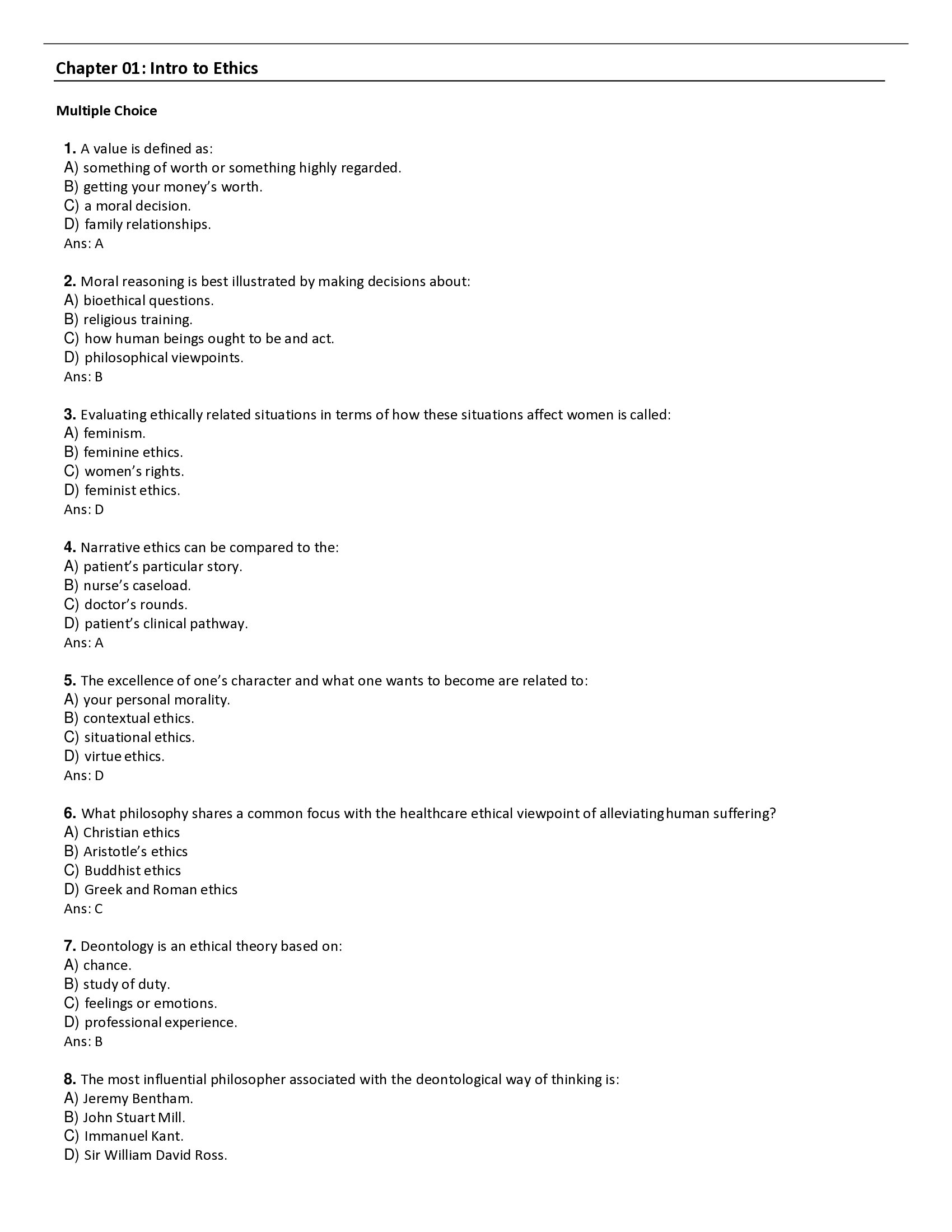
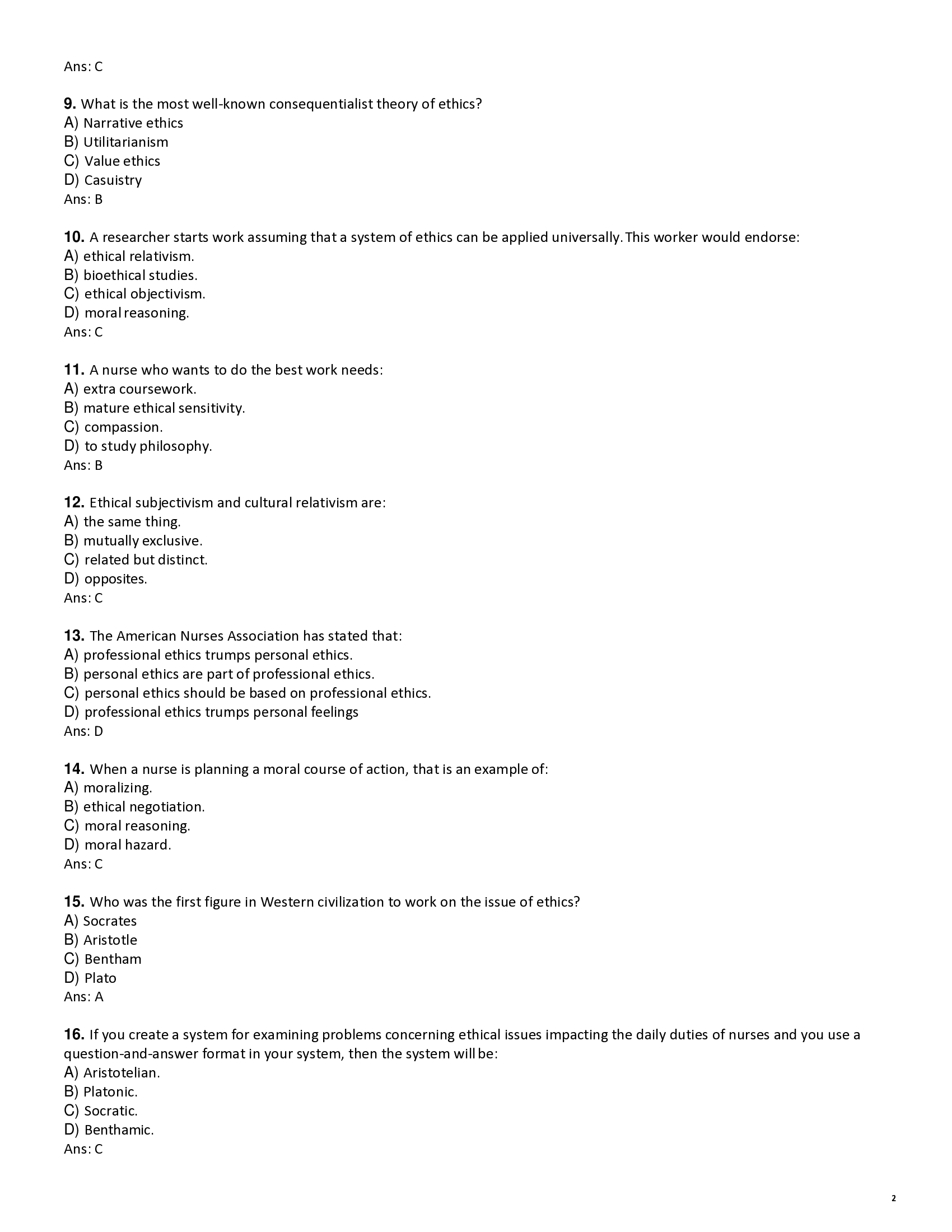
  • Test bank for Nursing Ethics Across the Curriculum and Into Practice 5th Edition Butts

Test bank for Nursing Ethics Across the Curriculum and Into Practice 5th Edition Butts

Preview page 1 Preview page 2 Preview page 3
Add To Favorites

Share this item Share this item

  • Item Details
  • Comments (0)
  • Reviews (0)
  • Contact Seller
Test bank for Nursing Ethics Across the Curriculum and Into Practice 5th Edition Butts Chapter 4 Quiz Reproductive Issues and Nursing Ethics Multiple Choice 1. In the past, when doctors and nurses cared for a pregnant woman, they considered in detail the mother and fetus as: A. two distinctly separate people. B. one patient. C. mother and fetus. D. a maternal partnership. 2. Now, doctors and nurses are to consider the pregnant woman as two distinctly separate entities, providing dual care for each. This circumstance leads to: A. more ethical dilemmas. B. no ethical dilemmas. C. more lawsuits. D. better quality of care for both entities. 3. What is health care is generally considered in the United States? A. Welfare right B. Patient right C. Human right D. Liberty right 4. Abortion in the United States is legal today because of: A. Jim Crow laws B. Brown vs. BOE C. Roe vs. Wade D. Planned Parenthood of America 5. Since 1980, how many registered abortions have there been worldwide? A. 3 billion B. 1.5 billion C. 1.7 million D. 5 million 6. The central ethical dilemma of the abortion debate centers on: A. morality. B. birth control. C. religion. D. rights. 7. Most of those identifying as pro-choice say that the central issue is: A. when life begins. B. control of a woman's body. C. the timing of personhood. D. the desirability of abortion. 8. Most pro-life supporters believe that: A. life begins at conception and that the embryo and fetus are persons. B. men and women should only have sex for procreation. C. abortion is permissible in cases of rape or incest. D. women who want to have an abortion should travel to a distant country for it. 9. What are the names of the two types of emergency contraceptives that are classed as early abortion? A. RU860 and Plan C B. RU486 and Plan B C. Depoprovera and Ortho-Novum D. AM486 and Plan A 10. About what percentage of babies born in the United States is conceived using assisted reproductive technology (ART)? A. 25% B. 37% C. 7% D. 1% 11. Bergum’s four themes that define relational ethics are found in which list? A. Engagement, moral space, understanding, and environment B. Responsibility, care, understanding, and embodiment C. Environment, embodiment, mutual respect, and engagement D. Rights, responsibilities, coercion, and confidence 12. Nurses wishing to have a firm grasp of the issue of moral standing will need to: A. follow what a physician says. B. talk extensively with colleagues. C. do extensive outside reading. D. use the key points in the textbook. 13. Which exemplifies a maternal–fetal conflict? A. A mother needing chemotherapy for cancer B. A mother being prescribed prenatal vitamin shots C. Making a mother as comfortable as possible while in labor D. Moving a newborn to the nursery for observation right after birth 14. A mother who smokes crack cocaine during pregnancy A. creates a maternal–fetal conflict. B. will probably go to prison. C. is trying to abort. D. is trying to avoid labor pains. 15. The first test-tube baby was born in: A. 1963. B. 1978. C. 1982. D. 1993. 16. If a patient uses reproductive services, she is among about what proportion of the U.S. population? A. 1 in 3 B. 1 in 5 C. 1 in 8 D. 1 in 10 17. If Bob and Cathy start trying to conceive on January 1 of 2018, when will continued failure be classified as infertility? A. April 1, 2018 B. July 1, 2018 C. October 1, 2018 D. January 1, 2019 18. Which places both sperm and eggs together in the fallopian tubes? A. in vitro fertilization (IVF) B. gamete intrafallopian transfer (GIFT) C. Intracytoplasmic sperm injection (ICSI) D. zygote intrafallopian transfer (ZIFT) True/False 1. True or False? Phenylketonuria cannot be detected using chorionic villus sampling. 2. True or False? A needle is used to withdraw amniotic membrane tissue in gamete intrafallopian transfer (GIFT). Chapter 5 Quiz – Infant and Child Ethics Multiple Choice 1. Empathy is closely related to what other ethical principle? A) Morality B) Compassion C) Autonomy D) Feminism 2. The values and virtues associated with a care-focused feminist approach to ethics are traditionally associated with: A) good mothering. B) moral nursing. C) the feminist movement. D) the neonatal intensive care unit (NICU). 3. A mothering person is someone who provides childcare as a significant part of their life. They are: A) female. B) male. C) male or female. D) a neonatal intensive care unit (NICU) nurse. 4. It is the responsibility of mothers to establish what between themselves and their children? A) compassion B) honesty C) trust D) a connection 5. What is the most commonly accepted ethical standard that underlies surrogate decision making for children? A) Substituted judgment B) Best interest C) Power of attorney D) Living will preferences 6. The best interest standard is established using: A) living will preferences. B) parent wishes. C) quality-of-life assessment. D) clinical pathways. 7. The most common form of child abuse falls under the category of: A) physical abuse. B) emotional abuse. C) neglect. D) sexual abuse. 8. Patient confidentiality is waived in the instance of: A) a positive HIV test. B) felony records on the part of the parent. C) suspected child abuse. D) corporal punishment. 9. What is it called when parents of an impaired neonate continue asking nurses and physicians whether continued treatment is worthwhile and suggest withdrawing hydration to hasten death? A) Neglect B) A Baby Doe case C) Roe vs. Wade D) Physical abuse 10. Children often perceive their own health-related quality of life to be what than their parents or health professionals’ perceptions? A) much less B) the same C) higher D) slightly less 11. If you treat 100 children in a typical U.S. population, how many will be from immigrant families? A) 5 B) 10 C) 25 D) 33 Ans: C 12. About how many children died worldwide each hour of 2016? A) 300 B) 500 C) 650 D) 750 13. Deaths of children under age 5 have dropped by about how much since 1990? A) 10% B) 25% C) 50% D) 75% 14. At what age is a child most likely to die (averaging across the world)? A) 7 days B) 2 months C) 3 months D) 1 year 15. About what percentage of parents are comfortable with the safety of vaccinations? A) 25% B) 40% C) 50% D) 70% 16. A parent could be credibly accused of child abuse by creating a risk of what level of harm? A) Any B) Moderate C) Serious D) Certain True/False 1. True or False? Some animals are born completely independent of the mother but still vulnerable. 2. True or False? Basic trust versus basic mistrust is Erickson's first stage of psychosocial development. 3. True or False? Parents generally see healthcare providers as technicians and feel competent to direct these providers as they see fit. 4. True or False? A child arrives in the emergency room, and you are told by the emergency medical technician (EMT) that the child has been abused by one parent and that both parents are present. The mother is most likely guilty. Chapter 6 Quiz Adolescent Nursing Ethics Multiple Choice 1. In general, a hallmark of adolescent behavior is: A) risk taking. B) drug use. C) sexual activity. D) skipping school. 2. The three critical health behaviors that have consistently been connected to death and disabilities in adolescents are: A) dropping out of high school, self-mutilation, and gang-related activity. B) violence, use of alcohol and drugs, and risky sexual activity. C) unprotected sexual activity, poor grades, and lack of engagement in extracurricular activities. D) bullying, cigarette smoking, and binge eating. 3. Mindfulness and effective listening strategies mean that the nurse is: A) keeping confidentiality by not repeating what is said to other people. B) paying attention to what is being said and then giving a signal of awareness and understanding to the speaker. C) writing down what the speaker says and putting the notes in the medical record. D) informing the parents or legal guardians of specific details of what is said by the speaker. Ans: B 4. A critical factor in the nurse–adolescent relationship is: A) quality time. B) boundaries. C) respect. D) fairness. 5. Prevention education programs for adolescents should focus on what two ethical principles? A) Beneficence and nonmaleficence B) Human rights and neoethics C) Principlism and women’s rights D) Bioethics and maternalism 6. A top concern for adolescents, particularly in developing countries is: A) lack of vaccinations. B) abortions. C) acquiring HIV and other sexually transmitted infections (STIs). D) homosexuality. 7. Traditionally, adolescents have equated “having sex” with: A) all sexual activity, including kissing. B) sexual intercourse alone. C) unprotected sexual intercourse. D) foreplay. 8. Sexual education as defined today was seldom taught in the United States until: A) the sexual revolution of the 1960s. B) Margaret Sanger’s campaign for birth control in the 1920s. C) the start of the 1950s. D) the HIV and AIDS epidemic in the 1980s. 9. Aggressiveness in early childhood, rebelliousness, unconventionality, and having high-risk friends could be early indicators of the potential for: A) alcohol and drug abuse. B) promiscuity. C) poor grades. D) limited career options. 10. By grade 3, what percentage of girls views their weight as an enormous issue? A) 82% B) 22% C) 42% D) 12% 11. In the United States, the exception to an adolescent’s autonomy over medical records involves the issue of: A) abortion. B) sexual activity. C) birth control. D) sexually transmitted infections. 12. A teen who continually discusses famous cases of suicide and what it must feel like is said to have a(n): A) suicidal ideation. B) tendency toward violence. C) obsessive compulsive disorder. D) social phobia. 13. Middle adolescence takes place in what age range? A) 8–10 B) 10–12 C) 12–16 D) 14–18 14. A parent whose child is 8 years old will probably see what in the parent–child relationship within a few years? A) Closeness B) Disharmony C) Collaboration D) Clear communication 15. A 15-year-old boy will have what at the core of his life? A) Status B) Growth C) Prosperity D) Relationships 16. What is the term for freedom from intrusion into one's personal information? A) Trust B) Privacy C) Ideation D) Mindfulness True/False 1. True or False? A healthcare provider who secretly records a teen's story violates trust. 2. True or False? A frightened, sick runaway teen should be assured of unlimited confidentiality. 3. True or False? A 14-year-old who has a clear, self-articulated vision of what she wants from health care and why may have moral self-government. 4. True or False? A teen who smokes, drinks alcohol, and swims laps has two health risk behaviors. Chapter 7 Quiz Adult Health Nursing Ethics Multiple Choice 1. A patient’s written or unwritten approval of a provider’s medical treatment or nurse’s health care regimen in known as: A) concordance. B) adherence. C) compliance. D) coercion. 2. When promoting healthy behaviors, ethical physicians and nurses must: A) be attuned to patients’ freedom to self-determination. B) provide paternalistic care. C) provide the most cost-effective treatment. D) penalize patients for unhealthy behaviors. 3. The application of what has the potential to reduce cultural conflicts? A) Adoption theory B) Adaptation theory C) Advanced theory D) Associated theory 4. What ethical competency is especially important for building a trustworthy relationship with patients who experience chronic disease and illness? A) Paternalism B) Advocacy C) Compliance D) Self-determination 5. Every day in the United States, approximately how many people receive an organ transplant? A) 100 B) 75 C) 50

Contact the Seller

Please Sign In to contact this seller.


  • 👎  Report Copyright Violation

Frequently Asked Questions

What Do I Get When I Buy This Study Material?

+

When you buy a study material on Passing Grades, an instant download link will be sent directly to your email, giving you access to the file anytime after payment is completed.

Is Passing Grades a Trusted Platform?

+

Yes, Passing Grades is a reputable students’ marketplace with a secure payment system and reliable customer support. You can trust us to ensure a safe and seamless transaction experience.

Will I Be Stuck with a Subscription?

+

No, all purchases on Passing Grades are one-time transactions. You only pay for the notes you choose to buy, with no subscriptions or hidden fees attached.

Who Am I Buying These Study Materials From?

+

Passing Grades is a marketplace, which means you are purchasing the document from an individual vendor, not directly from us. We facilitate the payment and delivery process between you and the vendor.

Does Passing Grades Offer Free Study Materials?

+

Yes, sellers on Passing Grades have uploaded numerous free test banks, exams, practice questions, and class notes that can be downloaded at no cost.

Pasinggrades - Quality Study Materials

USD 17

    • Quality checked by Pasing Grades
    • 100% satisfaction guarantee
    • Seller: Eddah-Nafula
Buy PDF $17

Seller Information

Eddah-Nafula

Member since June 2021

  • icon
  • icon
  • icon
View Profile
  • total sales

    0
  • Favourites

    0
  • Comments

    0
    ( 0 Ratings )

Item Information

  • Uploaded

    15 June 2023

  • Updated

    21 April 2025

  • Category

    Nursing

  • Item Type

    test bank

  • Tags

    Test bank for Nursing Ethics Across the Curriculum and Into Practice 5th Edition Butts

Related Exam Prep Guides by Eddah-Nafula

HESI Pharmacology V2 – Practice Questions (120) Latest 2026
View Document

HESI Pharmacology V2...

  • Eddah-Nafula

    Eddah-Nafula

  • test bank

HESI Pharmacology V2 – Practice Questions (120) Latest 2025...

17 USD

0

0

AIN2601 ASSIGNMENT 1 QUESTIONS AND ANSWERS 100 CORRECT (2021)
View Document

AIN2601 ASSIGNMENT 1...

  • Eddah-Nafula

    Eddah-Nafula

  • test bank

AIN2601 ASSIGNMENT 1 QUESTIONS AND ANSWERS 100 CORRECT (2021)...

17 USD

0

0

Ashley Davis patho objectives 5,6,7,20
View Document

Ashley Davis patho o...

  • Eddah-Nafula

    Eddah-Nafula

  • test bank

Ashley Davis patho objectives 5,6,7,20...

17 USD

0

0

Purchase

Download link will be sent to this email immediately after purchase.

IMPORTANT LINKS

  • How To Upload Class Notes
  • Selling Tips
  • Passing Grades's Study Materials
  • Scholarships for International Students 2026

POPULAR CATEGORIES

  • Law
  • Accounting
  • English
  • Psychology
  • Business
  • Nursing
  • Computer Science
  • General

View Document

  • Blog
  • Contact
  • Delivery Policy
  • Latest Scholarships Around the World
  • How to Pass Bar Exams: Passing Grades’ Strategies
  • How to Study and Pass the CPA Exam
  • All Test Banks
  • Faq
  • Copyright Claims
  • Privacy Policy
  • Terms of Use

KNOWLEDGE BASE

  • How to Write A+ Grade Good Research Paper
  • How to Manage Stress During Exam Period
  • Best Time to Study
  • How to Pass NCLEX-RN Exam
  • How To Effectively Utilize Test Banks
  • Popular Shadow Health Exam Assessments
  • Popular HESI Case Studies
  • How to Prepare for a Nursing Career
  • The Importance Of Summaries in Exam Revisvion

© 2026 Pasing Grades. All rights reserved.