Pasing Grades
  • Start Selling
  • Blog
  • Contact
  • 0

    Your cart is empty!

English

  • English
  • Spanish
  • Arabic
Create Account Sign In
  • Library
    • New Prep Guides
    • Featured Prep Guides
    • Free Exam Prep Guides
    • Best sellers
  • General
  • Nursing
    • Research Paper
    • Case Study
    • Discussion Post
    • Assignment
    • Exam
    • Practice Questions and Answers
    • Test Bank
    • solutions manual
  • Accounting
    • Case Study
    • Thesis
    • Study Guide
    • Summary
    • Research Paper
    • test bank
  • English
    • Creative Writing
    • Research Paper
    • Summary
    • Rhetorics
    • Literature
    • Journal
    • Exam
    • Grammar
    • Discussion Post
    • Essay
  • Psychology
    • Hesi
    • Presentation
    • Essay
    • Summary
    • Study Guide
    • Essay
    • Solution Manual
    • Final Exam Review
    • Class Notes
    • test bank
  • Business
    • Lecture Notes
    • Solution Manual
    • Presentation
    • Business Plan
    • Class Notes
    • Experiment
    • Summary
    • Practice Questions
    • Study Guide
    • Case Study
    • test bank
    • Exam
  • More
    • Computer Science
    • Economics
    • Statistics
    • Engineering
    • Biology
    • Religious Studies
    • Physics
    • Chemistry
    • Mathematics
    • History
    • Sociology
    • Science
    • Philosophy
    • Law
  • Pages
    • About Us
    • Selling Tips
    • Delivery Policy
    • Faq
    • Privacy Policy
  • Flash Sale
  • Home
  • Test Bank for Nursing Assistant 12th Edition by Acello

Test Bank for Nursing Assistant 12th Edition by Acello

Preview page 1 Preview page 2 Preview page 3
Add To Favorites

Share this item Share this item

  • Item Details
  • Comments (0)
  • Reviews (0)
  • Contact Seller

Test Bank for Nursing Assistant 12th Edition by Acello

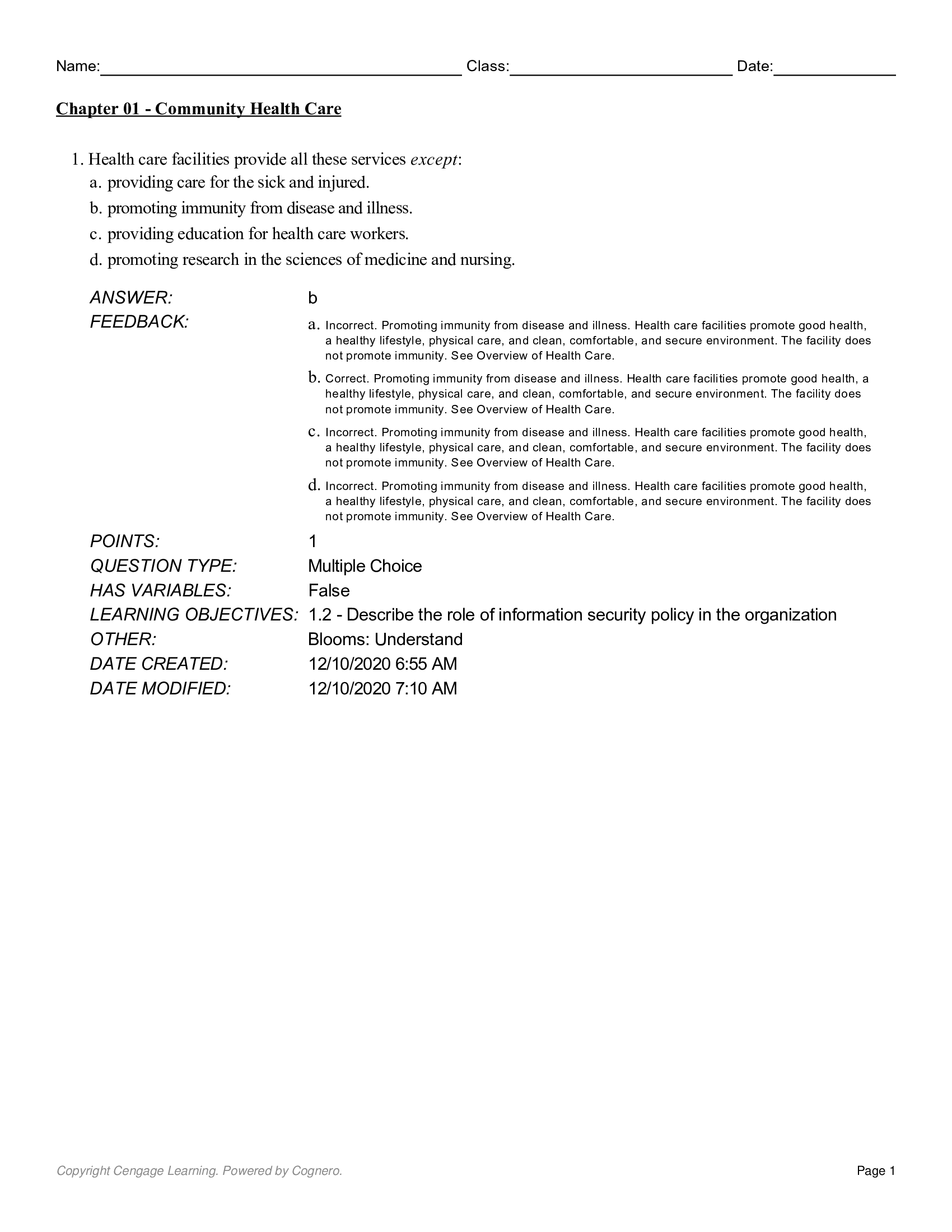
1.     Health care facilities provide all these services except:

a.  providing care for the sick and injured.

b.  promoting immunity from disease and illness.

c.  providing education for health care workers.

d.  promoting research in the sciences of medicine and nursing.

ANSWER: 

b

FEEDBACK: 

a.  Incorrect. Promoting immunity from disease and illness. Health care facilities promote good health, a healthy lifestyle, physical care, and clean, comfortable, and secure environment. The facility does not promote immunity. See Overview of Health Care.

b.  Correct. Promoting immunity from disease and illness. Health care facilities promote good health, a healthy lifestyle, physical care, and clean, comfortable, and secure environment. The facility does not promote immunity. See Overview of Health Care.

c.  Incorrect. Promoting immunity from disease and illness. Health care facilities promote good health, a healthy lifestyle, physical care, and clean, comfortable, and secure environment. The facility does not promote immunity. See Overview of Health Care.

d.  Incorrect. Promoting immunity from disease and illness. Health care facilities promote good health, a healthy lifestyle, physical care, and clean, comfortable, and secure environment. The facility does not promote immunity. See Overview of Health Care.

POINTS: 

1

QUESTION TYPE: 

Multiple Choice

HAS VARIABLES: 

False

LEARNING OBJECTIVES:  1.2 - Describe the role of information security policy in the organization

OTHER: 

Blooms: Understand

DATE CREATED: 

12/10/2020 6:55 AM

DATE MODIFIED: 

12/10/2020 7:10 AM

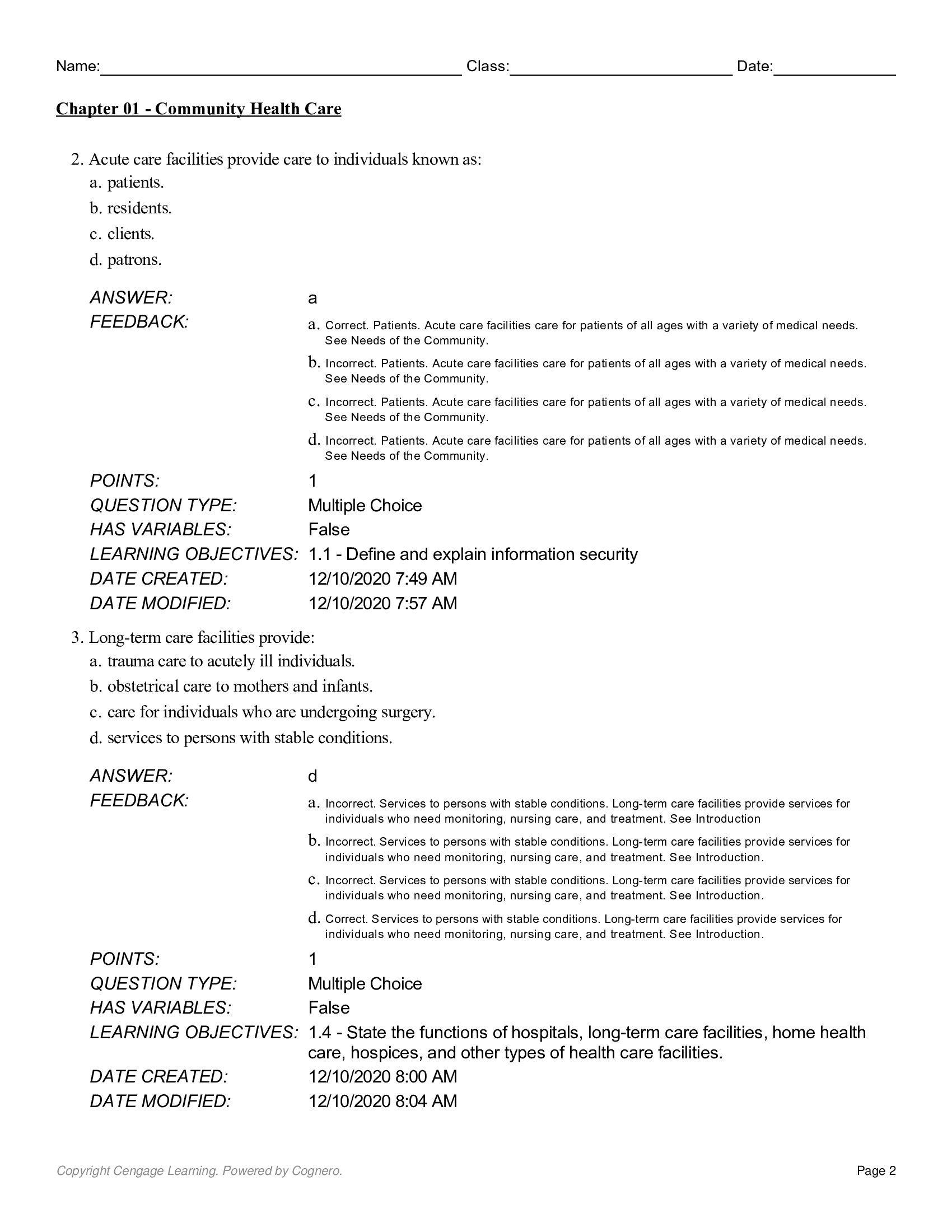
2.     Acute care facilities provide care to individuals known as: a. patients.

b.  residents.

c.  clients.

d.  patrons.

ANSWER: 

a

FEEDBACK: 

a.  Correct. Patients. Acute care facilities care for patients of all ages with a variety of medical needs. See Needs of the Community.

b.  Incorrect. Patients. Acute care facilities care for patients of all ages with a variety of medical needs. See Needs of the Community.

c.  Incorrect. Patients. Acute care facilities care for patients of all ages with a variety of medical needs. See Needs of the Community.

d.  Incorrect. Patients. Acute care facilities care for patients of all ages with a variety of medical needs. See Needs of the Community.

POINTS: 

1

QUESTION TYPE: 

Multiple Choice

HAS VARIABLES: 

False

LEARNING OBJECTIVES:  1.1 - Define and explain information security

       DATE CREATED:                 12/10/2020 7:49 AM

        DATE MODIFIED:                12/10/2020 7:57 AM

3.     Long-term care facilities provide:

a.  trauma care to acutely ill individuals.

b.  obstetrical care to mothers and infants.

c.  care for individuals who are undergoing surgery.

d.  services to persons with stable conditions.

ANSWER: 

d

FEEDBACK: 

a.  Incorrect. Services to persons with stable conditions. Long-term care facilities provide services for individuals who need monitoring, nursing care, and treatment. See Introduction

b.  Incorrect. Services to persons with stable conditions. Long-term care facilities provide services for individuals who need monitoring, nursing care, and treatment. See Introduction.

c.  Incorrect. Services to persons with stable conditions. Long-term care facilities provide services for individuals who need monitoring, nursing care, and treatment. See Introduction.

d.  Correct. Services to persons with stable conditions. Long-term care facilities provide services for individuals who need monitoring, nursing care, and treatment. See Introduction.

POINTS: 

1

QUESTION TYPE: 

Multiple Choice

HAS VARIABLES: 

False

LEARNING OBJECTIVES:  1.4 - State the functions of hospitals, long-term care facilities, home health


care, hospices, and other types of health care facilities.

DATE CREATED: 

12/10/2020 8:00 AM

DATE MODIFIED: 

12/10/2020 8:04 AM

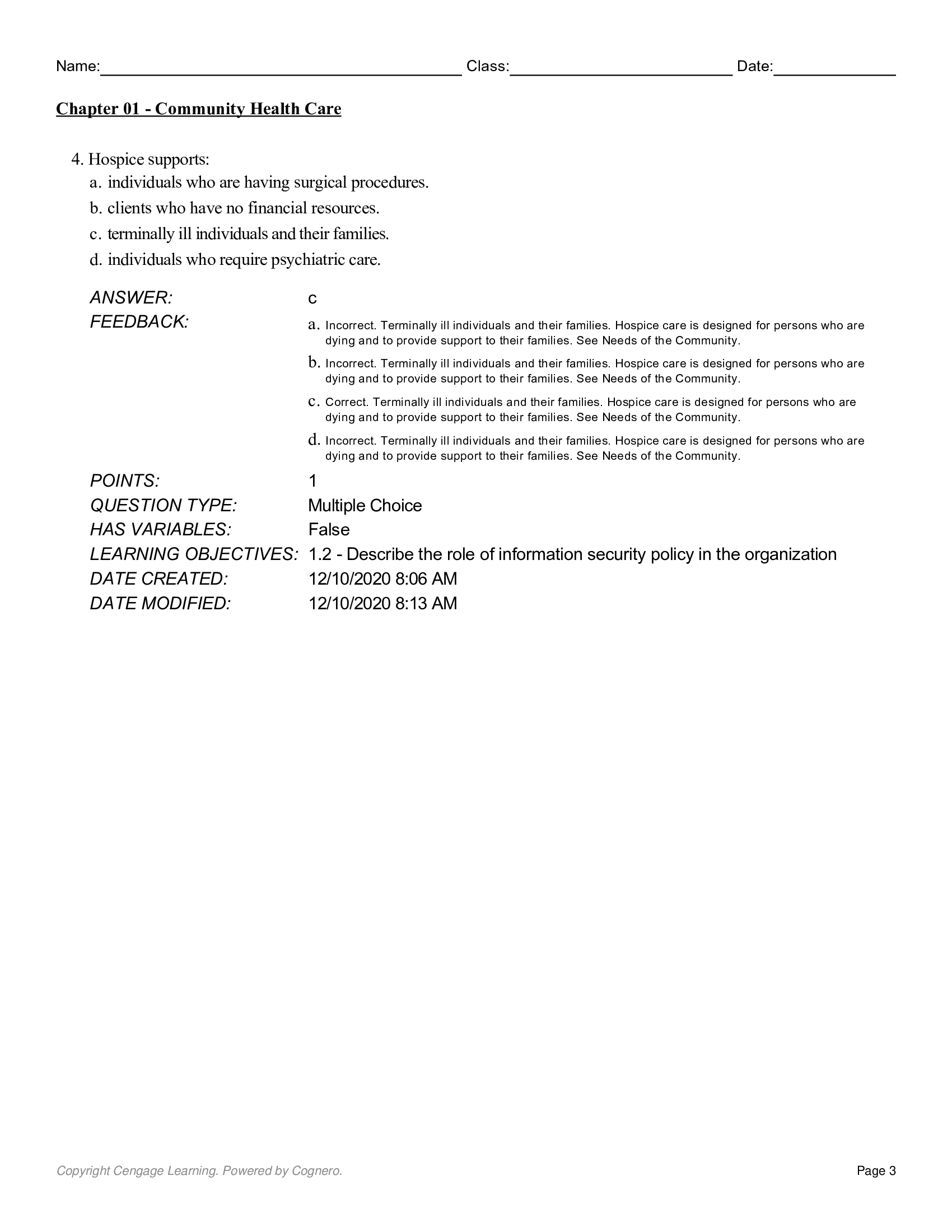
4.     Hospice supports:

a.  individuals who are having surgical procedures.

b.  clients who have no financial resources.

c.  terminally ill individuals and their families.

d.  individuals who require psychiatric care.

ANSWER: 

c

FEEDBACK: 

a.  Incorrect. Terminally ill individuals and their families. Hospice care is designed for persons who are dying and to provide support to their families. See Needs of the Community.

b.  Incorrect. Terminally ill individuals and their families. Hospice care is designed for persons who are dying and to provide support to their families. See Needs of the Community.

c.  Correct. Terminally ill individuals and their families. Hospice care is designed for persons who are dying and to provide support to their families. See Needs of the Community.

d.  Incorrect. Terminally ill individuals and their families. Hospice care is designed for persons who are dying and to provide support to their families. See Needs of the Community.

POINTS: 

1

QUESTION TYPE: 

Multiple Choice

HAS VARIABLES: 

False

LEARNING OBJECTIVES:  1.2 - Describe the role of information security policy in the organization

       DATE CREATED:                 12/10/2020 8:06 AM

        DATE MODIFIED:                12/10/2020 8:13 AM

5.     Long-term acute care hospitals:

a.  are comparable to long-term care nursing facilities.

b.  provide services to unstable, short-term patients.

c.  accept patients with a good chance for improvement.

d.  provide acute, complex care for terminally ill patients.

ANSWER: 

c

FEEDBACK: 

a.  Incorrect. Accept patients with a good chance for improvement. Long-term acute care hospitals are a rapidly growing segment of the health care market. The facility is licensed as a hospital but is designed for patients who are expected to stay 25 days or more. The patient must have a medically complex condition, need acute care services, and have a good chance of improvement. See Community Health Care Services.

b.  Incorrect. Accept patients with a good chance for improvement. Long-term acute care hospitals are a rapidly growing segment of the health care market. The facility is licensed as a hospital but is designed for patients who are expected to stay 25 days or more. The patient must have a medically complex condition, need acute care services, and have a good chance of improvement. See Community Health Care Services.

c.  Correct. Accept patients with a good chance for improvement. Long-term acute care hospitals are a rapidly growing segment of the health care market. The facility is licensed as a hospital but is designed for patients who are expected to stay 25 days or more. The patient must have a medically complex condition, need acute care services, and have a good chance of improvement. See Community Health Care Services.

d.  Incorrect. Accept patients with a good chance for improvement. Long-term acute care hospitals are a rapidly growing segment of the health care market. The facility is licensed as a hospital but is designed for patients who are expected to stay 25 days or more. The patient must have a medically complex condition, need acute care services, and have a good chance of improvement. See Community Health Care Services.

POINTS: 

1

QUESTION TYPE: 

Multiple Choice

HAS VARIABLES: 

False

LEARNING OBJECTIVES:  1.4 - State the functions of hospitals, long-term care facilities, home health


care, hospices, and other types of health care facilities.

OTHER: 

Blooms: Understand

DATE CREATED: 

12/10/2020 8:14 AM

DATE MODIFIED: 

12/10/2020 8:19 AM

6.     Magnet hospitals:

a.  recognize outstanding physician services.

b.  recognize excellence in nursing care.

c.  comprise about 30 percent of all facilities.

d.  focus on negative outcomes of care.

ANSWER: 

b

FEEDBACK: 

a.  Incorrect. Recognize excellence in nursing care. The Magnet Program for Excellence in Nursing Services is based on quality indicators and standards of nursing practice. See Accreditation.

b.  Correct. Recognize excellence in nursing care. The Magnet Program for Excellence in Nursing Services is based on quality indicators and standards of nursing practice. See Accreditation.

c.  Incorrect. Recognize excellence in nursing care. The Magnet Program for Excellence in Nursing Services is based on quality indicators and standards of nursing practice. See Accreditation.

d.  Incorrect. Recognize excellence in nursing care. The Magnet Program for Excellence in Nursing Services is based on quality indicators and standards of nursing practice. See Accreditation.

POINTS: 

1

QUESTION TYPE: 

Multiple Choice

HAS VARIABLES: 

False

LEARNING OBJECTIVES:  1.4 - State the functions of hospitals, long-term care facilities, home health


care, hospices, and other types of health care facilities.

DATE CREATED: 

12/10/2020 8:21 AM

DATE MODIFIED: 

12/10/2020 8:24 AM

7.     Health care is financed by all of these except:

a.  the Health Care Financing Association.

b.  private insurance plans.

c.  governmental programs.

d.  health maintenance organizations.

ANSWER: 

a

FEEDBACK: 

a.  Correct. The Health Care Financing Association. Health care is paid for by insurance—HMOs; out-ofpocket payments; and U.S. government payments such as Medicare, Medicaid, Veterans Administration. See Financing Health Care.

b.  Incorrect. The Health Care Financing Association. Health care is paid for by insurance—HMOs; outof-pocket payments; and U.S. government payments such as Medicare, Medicaid, Veterans Administration. See Financing Health Care.

c.  Incorrect. The Health Care Financing Association. Health care is paid for by insurance—HMOs; outof-pocket payments; and U.S. government payments such as Medicare, Medicaid, Veterans Administration. See Financing Health Care.

d.  Incorrect. The Health Care Financing Association. Health care is paid for by insurance—HMOs; outof-pocket payments; and U.S. government payments such as Medicare, Medicaid, Veterans Administration. See Financing Health Care.

POINTS: 

1

QUESTION TYPE: 

Multiple Choice

HAS VARIABLES: 

False

LEARNING OBJECTIVES:  1.6 - List at least five ways by which health care costs are paid.

       DATE CREATED:                 12/10/2020 8:47 AM

        DATE MODIFIED:                12/10/2020 8:52 AM

8.     Cost containment:

a.  is not a priority for the health care worker.

b.  involves saving money from a paycheck.

c.  requires workers to use costly supplies.

d.  involves avoiding waste and minimizing expenses.

ANSWER: 

d

FEEDBACK: 

a.  Incorrect. Involves avoiding waste and minimizing expenses. Cost containment is a priority, which means that the maximum benefit of health care must be achieved for every dollar spent. Each worker must do everything possible to avoid waste and keep costs down. See Financing Health Care.

b.  Incorrect. Involves avoiding waste and minimizing expenses. Cost containment is a priority, which means that the maximum benefit of health care must be achieved for every dollar spent. Each worker must do everything possible to avoid waste and keep costs down. See Financing Health Care.

c.  Incorrect. Involves avoiding waste and minimizing expenses. Cost containment is a priority, which means that the maximum benefit of health care must be achieved for every dollar spent. Each worker must do everything possible to avoid waste and keep costs down. See Financing Health Care.

d.  Correct. Involves avoiding waste and minimizing expenses. Cost containment is a priority, which means that the maximum benefit of health care must be achieved for every dollar spent. Each worker must do everything possible to avoid waste and keep costs down. See Financing Health Care.

POINTS: 

1

QUESTION TYPE: 

Multiple Choice

HAS VARIABLES: 

False

LEARNING OBJECTIVES:  1.6 - List at least five ways by which health care costs are paid.

       DATE CREATED:                 12/10/2020 8:53 AM

        DATE MODIFIED:                12/10/2020 8:57 AM

9.     An important concern in health care is:

a.  preserving life at all costs.

b.  withholding expensive care from the elderly.

c.  maintaining and enhancing quality of life.

d.  humanizing care only for young patients.

ANSWER: 

c

FEEDBACK: 

a.  Incorrect. Maintaining and enhancing quality of life. Quality of life has become an important concern in health care delivery. Some decisions are made with the patient’s future quality of life in mind. See Overview of Health Care.

b.  Incorrect. Maintaining and enhancing quality of life. Quality of life has become an important concern in health care delivery. Some decisions are made with the patient’s future quality of life in mind. See Overview of Health Care.

c.  Correct. Maintaining and enhancing quality of life. Quality of life has become an important concern in health care delivery. Some decisions are made with the patient’s future quality of life in mind. See Overview of Health Care.

d.  Incorrect. Maintaining and enhancing quality of life. Quality of life has become an important concern in health care delivery. Some decisions are made with the patient’s future quality of life in mind. See Overview of Health Care.

POINTS: 

1

QUESTION TYPE: 

Multiple Choice

HAS VARIABLES: 

False

LEARNING OBJECTIVES:  1.2 - Describe the role of information security policy in the organization

OTHER: 

Blooms: Understand

DATE CREATED: 

12/10/2020 8:58 AM

DATE MODIFIED: 

12/10/2020 9:01 AM

10. Medicare payment to the acute care facility is based on:

a.  the actual cost of providing care.

b.  diagnosis related groups.

c.  a rate equivalent to private insurance.

d.  a uniform procedural payment scale.

ANSWER: 

b

FEEDBACK: 

a.  Incorrect. Diagnosis related groups. Medicare payment is based on diagnosis related groups (DRGs). The actual cost of care is not considered. Rather, payment is based on studies that were done to determine the average length of stay required for various medical diagnoses, procedures, and treatments. See Financing Health Care.

b.  Correct. Diagnosis related groups. Medicare payment is based on diagnosis related groups (DRGs). The actual cost of care is not considered. Rather, payment is based on studies that were done to determine the average length of stay required for various medical diagnoses, procedures, and treatments. See Financing Health Care.

c.  Incorrect. Diagnosis related groups. Medicare payment is based on diagnosis related groups (DRGs). The actual cost of care is not considered. Rather, payment is based on studies that were done to determine the average length of stay required for various medical diagnoses, procedures, and treatments. See Financing Health Care.

d.  Incorrect. Diagnosis related groups. Medicare payment is based on diagnosis related groups (DRGs). The actual cost of care is not considered. Rather, payment is based on studies that were done to determine the average length of stay required for various medical diagnoses, procedures, and treatments. See Financing Health Care.

POINTS: 

1

QUESTION TYPE: 

Multiple Choice

HAS VARIABLES: 

False

LEARNING OBJECTIVES:  1.6 - List at least five ways by which health care costs are paid.

       DATE CREATED:                 12/10/2020 9:07 AM

        DATE MODIFIED:                12/10/2020 9:10 AM

11. A review and evaluation to ensure that the facility maintains acceptable standards of practice is a: a. survey.

b.  license.

c.  certification.

d.  utilization review.

ANSWER: 

a

FEEDBACK: 

a.  Correct. Survey. Surveyors during a survey, review facility policy and procedure and determine whether the staff are following them. See Regulatory Agencies.

b.  Incorrect. Survey. Surveyors during a survey, review facility policy and procedure and determine whether the staff are following them. See Regulatory Agencies.

c.  Incorrect. Survey. Surveyors during a survey, review facility policy and procedure and determine whether the staff are following them. See Regulatory Agencies.

d.  Incorrect. Survey. Surveyors during a survey, review facility policy and procedure and determine whether the staff are following them. See Regulatory Agencies.

POINTS: 

1

QUESTION TYPE: 

Multiple Choice

HAS VARIABLES: 

False

LEARNING OBJECTIVES:  1.7 - State the purpose of health care facility surveys.

       DATE CREATED:                 12/10/2020 9:12 AM

        DATE MODIFIED:                12/10/2020 9:17 AM

12. The governmental agency that protects the health and safety of employees is: a. TJC.

b.  HCFA

c.  the health department.

d.  OSHA.

ANSWER: 

d

FEEDBACK: 

a.  Incorrect. OSHA. The Occupational Safety and Health Administration (OSHA) is a government agency that protects the health and safety of employees. See Accreditation.

b.  Incorrect. OSHA. The Occupational Safety and Health Administration (OSHA) is a government agency that protects the health and safety of employees. See Accreditation.

c.  Incorrect. OSHA. The Occupational Safety and Health Administration (OSHA) is a government agency that protects the health and safety of employees. See Accreditation.

d.  Correct. OSHA. The Occupational Safety and Health Administration (OSHA) is a government agency that protects the health and safety of employees. See Accreditation.

POINTS: 

1

QUESTION TYPE: 

Multiple Choice

HAS VARIABLES: 

False

LEARNING OBJECTIVES:  1.3 - Identify and explain the basic concepts and phases of risk management

       DATE CREATED:                 12/10/2020 9:28 AM

        DATE MODIFIED:                12/10/2020 9:32 AM

13. A written notice that informs the facility of violations of OSHA rules is a: a. citation.

b.  survey.

c.  certification.

d.  review.

ANSWER: 

a

FEEDBACK: 

a.  Correct. Citation. During a survey, if the inspector identifies unsafe conditions, the agency will receive a citation or fine. A citation is a written notice that informs the facility of its violation of OSHA rules. See Accreditation.

b.  Incorrect. Citation. During a survey, if the inspector identifies unsafe conditions, the agency will receive a citation or fine. A citation is a written notice that informs the facility of its violation of OSHA rules. See Accreditation.

c.  Incorrect. Citation. During a survey, if the inspector identifies unsafe conditions, the agency will receive a citation or fine. A citation is a written notice that informs the facility of its violation of OSHA rules. See Accreditation.

d.  Incorrect. Citation. During a survey, if the inspector identifies unsafe conditions, the agency will receive a citation or fine. A citation is a written notice that informs the facility of its violation of OSHA rules. See Accreditation.

POINTS: 

1

QUESTION TYPE: 

Multiple Choice

HAS VARIABLES: 

False

LEARNING OBJECTIVES:  1.7 - State the purpose of health care facility surveys.

OTHER: 

Blooms: Remember

DATE CREATED: 

12/10/2020 9:34 AM

DATE MODIFIED: 

12/10/2020 9:39 AM

14. The purpose of the quality assurance (QA) committee is to:

a.  write deficiencies of the staff.

b.  create a good paper trail.

c.  identify and correct problems.

d.  develop material safety data sheets.

ANSWER: 

c

FEEDBACK: 

a.  Incorrect. Identify and correct problems. All health care facilities have a program called quality assurance (QA). The QA committee conducts internal reviews to identify problems and then find and implement solutions. See Quality Assurance.

b.  Incorrect. Identify and correct problems. All health care facilities have a program called quality assurance (QA). The QA committee conducts internal reviews to identify problems and then find and implement solutions. See Quality Assurance.

c.  Correct. Identify and correct problems. All health care facilities have a program called quality assurance (QA). The QA committee conducts internal reviews to identify problems and then find and implement solutions. See Quality Assurance.

d.  Incorrect. Identify and correct problems. All health care facilities have a program called quality assurance (QA). The QA committee conducts internal reviews to identify problems and then find and implement solutions. See Quality Assurance.

POINTS: 

1

QUESTION TYPE: 

Multiple Choice

HAS VARIABLES: 

False

LEARNING OBJECTIVES:  1.7 - State the purpose of health care facility surveys.

       DATE CREATED:                 12/10/2020 9:43 AM

        DATE MODIFIED:                12/10/2020 9:50 AM

15. A staff member who has received training to perform more than one kind of work is considered: a. patient focused.

b.  multiskilled.

c.  transitional.

d.  accredited.

ANSWER: 

b

FEEDBACK: 

a.  Incorrect. Multiskilled. Staff members may become multiskilled workers by cross-training to perform additional skills. Multiskilled workers can perform many functions, enabling them to do more than one kind of work. See Overview of Health Care.

b.  Correct. Multiskilled. Staff members may become multiskilled workers by cross-training to perform additional skills. Multiskilled workers can perform many functions, enabling them to do more than one kind of work. See Overview of Health Care.

c.  Incorrect. Multiskilled. Staff members may become multiskilled workers by cross-training to perform additional skills. Multiskilled workers can perform many functions, enabling them to do more than one kind of work. See Overview of Health Care.

d.  Incorrect. Multiskilled. Staff members may become multiskilled workers by cross-training to perform additional skills. Multiskilled workers can perform many functions, enabling them to do more than one kind of work. See Overview of Health Care.

POINTS: 

1

QUESTION TYPE: 

Multiple Choice

HAS VARIABLES: 

False

LEARNING OBJECTIVES:  1.1 - Define and explain information security

       DATE CREATED:                 12/10/2020 10:03 AM

        DATE MODIFIED:                12/10/2020 10:08 AM

16. Which is an advantage of cross-training a nursing assistant?

a.  Cross-trained nursing assistants can perform all health care skills.

b.  Cross-trained nursing assistants can only perform specific tasks.

c.  Cross-trained nursing assistants help reduce patient waiting time.

d.  Cross-trained nursing assistants can make decisions for patients.

ANSWER: 

c

FEEDBACK: 

a.  Incorrect. Cross-trained nursing assistants help reduce patient waiting time. A nursing assistant may be cross-trained to draw blood and/or obtain electrocardiograms. This type of cross-training avoids the need to transfer the patient to another department for care and reduces the waiting time for necessary tests and other services. See Overview of Health Care.

b.  Incorrect. Cross-trained nursing assistants help reduce patient waiting time. A nursing assistant may be cross-trained to draw blood and/or obtain electrocardiograms. This type of cross-training avoids the need to transfer the patient to another department for care and reduces the waiting time for necessary tests and other services. See Overview of Health Care.

c.  Correct. Cross-trained nursing assistants help reduce patient waiting time. A nursing assistant may be cross-trained to draw blood and/or obtain electrocardiograms. This type of cross-training avoids the need to transfer the patient to another department for care and reduces the waiting time for necessary tests and other services. See Overview of Health Care.

d.  Incorrect. Cross-trained nursing assistants help reduce patient waiting time. A nursing assistant may be cross-trained to draw blood and/or obtain electrocardiograms. This type of cross-training avoids the need to transfer the patient to another department for care and reduces the waiting time for necessary tests and other services. See Overview of Health Care.

POINTS: 

1

QUESTION TYPE: 

Multiple Choice

HAS VARIABLES: 

False

LEARNING OBJECTIVES:  1.5 - Name at least five departments within a hospital and describe their


functions.

DATE CREATED: 

12/10/2020 9:43 PM

DATE MODIFIED: 

12/10/2020 9:47 PM

17. Why is employment of nursing assistants in the United States expected to grow rapidly?

a.  Because the overall U.S. population is increasing.

b.  Because the elderly population is increasing.

c.  Because more people are expected to immigrate to the United States.

d.  Because of rapid advances in health care technologies.

ANSWER: 

b

FEEDBACK: 

a.  Incorrect. Because the elderly population is increasing. People are living longer. People who are aging need more services. The demand for nursing assistants is high and is expected to continue growing rapidly because of a large increase in the elderly population. This is much faster than the average for all occupations. See Overview of Health Care.

b.  Correct. Because the elderly population is increasing. People are living longer. People who are aging need more services. The demand for nursing assistants is high and is expected to continue growing rapidly because of a large increase in the elderly population. This is much faster than the average for all occupations. See Overview of Health Care.

c.  Incorrect. Because the elderly population is increasing. People are living longer. People who are aging need more services. The demand for nursing assistants is high and is expected to continue growing rapidly because of a large increase in the elderly population. This is much faster than the average for all occupations. See Overview of Health Care.

d.  Incorrect. Because the elderly population is increasing. People are living longer. People who are aging need more services. The demand for nursing assistants is high and is expected to continue growing rapidly because of a large increase in the elderly population. This is much faster than the average for all occupations. See Overview of Health Care.

POINTS: 

1

QUESTION TYPE: 

Multiple Choice

HAS VARIABLES: 

False

LEARNING OBJECTIVES:  1.3 - Identify and explain the basic concepts and phases of risk management

OTHER: 

Blooms: Understand

DATE CREATED: 

12/10/2020 9:54 PM

DATE MODIFIED: 

12/10/2020 9:59 PM

18. Which is not an example of preventive care?

a.  Prenatal care

b.  Annual physical examinations

c.  Emergency treatment

d.  Immunizations

ANSWER: 

c

FEEDBACK: 

a.  Incorrect. Emergency treatment. Emergency care is for sudden illness or injury and not considered preventive care. See Needs of the Community.

b.  Incorrect. Emergency treatment. Emergency care is for sudden illness or injury and not considered preventive care. See Needs of the Community.

c.  Correct. Emergency treatment. Emergency care is for sudden illness or injury and not considered preventive care. See Needs of the Community.

d.  Incorrect. Emergency treatment. Emergency care is for sudden illness or injury and not considered preventive care. See Needs of the Community.

POINTS: 

1

QUESTION TYPE: 

Multiple Choice

HAS VARIABLES: 

False

LEARNING OBJECTIVES:  1.8 - Describe patient-focused care.

       DATE CREATED:                 12/10/2020 10:00 PM

        DATE MODIFIED:                 12/10/2020 10:03 PM

19. Which individual would be considered a health care consumer?

a.  A hospital patient

b.  A client receiving home care

c.  A resident of a long-term care facility

d.  All of the above

ANSWER: 

d

FEEDBACK: 

a.  Incorrect. All of the above. Persons receiving health care are called health care consumers. See Needs of the Community.

b.  Incorrect. All of the above. Persons receiving health care are called health care consumers. See Needs of the Community.

c.  Incorrect. All of the above. Persons receiving health care are called health care consumers. See Needs of the Community.

d.  Correct. All of the above. Persons receiving health care are called health care consumers. See Needs of the Community.

POINTS: 

1

QUESTION TYPE: 

Multiple Choice

HAS VARIABLES: 

False

LEARNING OBJECTIVES:  1.8 - Describe patient-focused care.

       DATE CREATED:                 12/10/2020 10:04 PM

        DATE MODIFIED:                 12/10/2020 10:07 PM

20. A patient who is experiencing a stroke has which type of condition? a. Acute

b.  Chronic

c.  Orthopedic

d.  Psychiatric

ANSWER: 

a

FEEDBACK: 

a.  Correct. Acute. An acute illness or injury comes on suddenly and requires intense, immediate treatment. Heart attacks, severe burns, and strokes are examples of acute conditions. See Community Health Care Services.

b.  Incorrect. Acute. An acute illness or injury comes on suddenly and requires intense, immediate treatment. Heart attacks, severe burns, and strokes are examples of acute conditions. See Community Health Care Services.

c.  Incorrect. Acute. An acute illness or injury comes on suddenly and requires intense, immediate treatment. Heart attacks, severe burns, and strokes are examples of acute conditions. See Community Health Care Services.

d.  Incorrect. Acute. An acute illness or injury comes on suddenly and requires intense, immediate treatment. Heart attacks, severe burns, and strokes are examples of acute conditions. See Community Health Care Services.

POINTS: 

1

QUESTION TYPE: 

Multiple Choice

HAS VARIABLES: 

False

LEARNING OBJECTIVES:  1.1 - Define and explain information security

       DATE CREATED:                 12/10/2020 10:09 PM

        DATE MODIFIED:                 12/10/2020 10:12 PM

21. A long-term care facility would be most likely to provide care to a resident who has which condition? a. Urinary tract infection

b.  Allergies

c.  Severe burns

d.  Parkinson’s disease

ANSWER: 

d

FEEDBACK: 

a.  Incorrect. Parkinson’s disease. Long-term care is necessary for some persons who have chronic conditions. Chronic illness is one that is treatable but not curable and is expected to require lifelong care. Alzheimer’s disease and Parkinson’s disease are examples. See Community Health Care Services.

b.  Incorrect. Parkinson’s disease. Long-term care is necessary for some persons who have chronic conditions. Chronic illness is one that is treatable but not curable and is expected to require lifelong care. Alzheimer’s disease and Parkinson’s disease are examples. See Community Health Care Services.

c.  Incorrect. Parkinson’s disease. Long-term care is necessary for some persons who have chronic conditions. Chronic illness is one that is treatable but not curable and is expected to require lifelong care. Alzheimer’s disease and Parkinson’s disease are examples. See Community Health Care Services.

d.  Correct. Parkinson’s disease. Long-term care is necessary for some persons who have chronic conditions. Chronic illness is one that is treatable but not curable and is expected to require lifelong care. Alzheimer’s disease and Parkinson’s disease are examples. See Community Health Care Services.

POINTS: 

1

QUESTION TYPE: 

Multiple Choice

HAS VARIABLES: 

False

LEARNING OBJECTIVES:  1.4 - State the functions of hospitals, long-term care facilities, home health


care, hospices, and other types of health care facilities.

OTHER: 

Blooms: Understand

DATE CREATED: 

12/10/2020 10:21 PM

DATE MODIFIED: 

12/10/2020 10:25 PM

22. In an assisted living facility, the majority of care is provided by:

a.  registered nurses.

b.  medical assistants.

c.  personal care assistants.

d.  physicians.

ANSWER: 

c

FEEDBACK: 

a.  Incorrect. Personal care assistants. An assisted living facility is a type of long-term care for people who can move about but may need help with some activities of daily living. See Community Health Care Services.

b.  Incorrect. Personal care assistants. An assisted living facility is a type of long-term care for people who can move about but may need help with some activities of daily living. See Community Health Care Services.

c.  Correct. Personal care assistants. An assisted living facility is a type of long-term care for people who can move about but may need help with some activities of daily living. See Community Health Care Services.

d.  Incorrect. Personal care assistants. An assisted living facility is a type of long-term care for people who can move about but may need help with some activities of daily living. See Community Health Care Services.

POINTS: 

1

QUESTION TYPE: 

Multiple Choice

HAS VARIABLES: 

False

LEARNING OBJECTIVES:  1.4 - State the functions of hospitals, long-term care facilities, home health


care, hospices, and other types of health care facilities.

DATE CREATED: 

12/10/2020 10:26 PM

DATE MODIFIED: 

12/10/2020 10:29 PM

23. What is the purpose of respite care?

a.  To care for individuals with developmental disabilities

b.  To assist with activities of daily living

c.  To offer rehabilitative care following surgery

d.  To allow a caregiver time off

ANSWER: 

d

FEEDBACK: 

a.  Incorrect. To allow a caregiver time off. Caring for individuals who are sick and injured can be draining, especially if it is a family member providing the care. Respite allows this and maintains safety of the individual needing care. See Community Health Care Services.

b.  Incorrect. To allow a caregiver time off. Caring for individuals who are sick and injured can be draining, especially if it is a family member providing the care. Respite allows this and maintains safety of the individual needing care. See Community Health Care Services.

c.  Incorrect. To allow a caregiver time off. Caring for individuals who are sick and injured can be draining, especially if it is a family member providing the care. Respite allows this and maintains safety of the individual needing care. See Community Health Care Services.

d.  Correct. To allow a caregiver time off. Caring for individuals who are sick and injured can be draining, especially if it is a family member providing the care. Respite allows this and maintains safety of the individual needing care. See Community Health Care Services.

POINTS: 

1

QUESTION TYPE: 

Multiple Choice

HAS VARIABLES: 

False

LEARNING OBJECTIVES:  1.4 - State the functions of hospitals, long-term care facilities, home health


care, hospices, and other types of health care facilities.

DATE CREATED: 

12/10/2020 10:29 PM

DATE MODIFIED: 

12/10/2020 10:33 PM

24. Moving a patient between different care sites as a person’s needs change is called a: a. coordination.

b.  restorative service.

c.  transition.

d.  patient-focus.

ANSWER: 

c

FEEDBACK: 

a.  Incorrect. Transition. A transition is the movement of a patient between various locations in which care is given as their needs change. This may involve moving within the same care facility or moving to a completely different location, such as a long-term care facility or home. See Transitions.

b.  Incorrect. Transition. A transition is the movement of a patient between various locations in which care is given as their needs change. This may involve moving within the same care facility or moving to a completely different location, such as a long-term care facility or home. See Transitions.

c.  Correct. Transition. A transition is the movement of a patient between various locations in which care is given as their needs change. This may involve moving within the same care facility or moving to a completely different location, such as a long-term care facility or home. See Transitions.

d.  Incorrect. Transition. A transition is the movement of a patient between various locations in which care is given as their needs change. This may involve moving within the same care facility or moving to a completely different location, such as a long-term care facility or home. See Transitions.

POINTS: 

1

QUESTION TYPE: 

Multiple Choice

HAS VARIABLES: 

False

LEARNING OBJECTIVES:  1.9 - Explain why transitional care is important.

       DATE CREATED:                 12/10/2020 10:34 PM

        DATE MODIFIED:                 12/10/2020 10:37 PM

25. Which is an example of a specialized service that is offered by a hospital? a. Critical care

b.  Pharmacy

c.  Obstetrics

d.  Postanesthesia recovery

ANSWER: 

b

FEEDBACK: 

a.  Incorrect. Pharmacy. Registered pharmacists in a hospital provide all medications and intravenous therapy solutions. See Hospital Organization.

b.  Correct. Pharmacy. Registered pharmacists in a hospital provide all medications and intravenous therapy solutions. See Hospital Organization.

c.  Incorrect. Pharmacy. Registered pharmacists in a hospital provide all medications and intravenous therapy solutions. See Hospital Organization.

d.  Incorrect. Pharmacy. Registered pharmacists in a hospital provide all medications and intravenous therapy solutions. See Hospital Organization.

POINTS: 

1

QUESTION TYPE: 

Multiple Choice

HAS VARIABLES: 

False

LEARNING OBJECTIVES:  1.5 - Name at least five departments within a hospital and describe their


functions.

OTHER: 

Blooms: Remember

DATE CREATED: 

12/10/2020 10:38 PM

DATE MODIFIED: 

12/10/2020 10:42 PM

26. A catheter infection that a patient develops while hospitalized is considered: a. a preventable event.

b.  a chronic illness.

c.  a trauma.

d.  all of the above.

ANSWER: 

a

FEEDBACK: 

a.  Correct. A preventable event. Proper cleaning of the catheter will prevent infection. See Needs of the Community.

b.  Incorrect. A preventable event. Proper cleaning of the catheter will prevent infection. See Needs of the Community.

c.  Incorrect. A preventable event. Proper cleaning of the catheter will prevent infection. See Needs of the Community.

d.  Incorrect. A preventable event. Proper cleaning of the catheter will prevent infection. See Needs of the Community.

POINTS: 

1

QUESTION TYPE: 

Multiple Choice

HAS VARIABLES: 

False

LEARNING OBJECTIVES:  1.8 - Describe patient-focused care.

       DATE CREATED:                 12/10/2020 10:43 PM

        DATE MODIFIED:                 12/10/2020 10:49 PM

27. Which statement about Medicare is correct?

a.  Medicare is a state-run government program.

b.  Medicare pays a portion of health care costs for persons 65 years and over.

c.  Medicare pays health care costs for pregnant women.

d.  Medicare pays health care costs for individuals who fall into certain income categories.

ANSWER: 

b

FEEDBACK: 

a.  Incorrect. Medicare pays a portion of health care costs for persons 65 years and over. Medicare is a federal government program. See Financing Health Care.

b.  Correct. Medicare pays a portion of health care costs for persons 65 years and over. Medicare is a federal government program. See Financing Health Care.

c.  Incorrect. Medicare pays a portion of health care costs for persons 65 years and over. Medicare is a federal government program. See Financing Health Care.

d.  Incorrect. Medicare pays a portion of health care costs for persons 65 years and over. Medicare is a federal government program. See Financing Health Care.

POINTS: 

1

QUESTION TYPE: 

Multiple Choice

HAS VARIABLES: 

False

LEARNING OBJECTIVES:  1.6 - List at least five ways by which health care costs are paid.

       DATE CREATED:                 12/10/2020 10:50 PM

        DATE MODIFIED:                 12/10/2020 10:55 PM

28. One of the goals of the Affordable Care Act (ACA) is to:

a.  provide free health care to patients who enroll in medical research studies.

b.  pay for the health care of dependents and survivors of persons who are in active military service.

c.  fund reproductive health care for members of both sexes.

d.  require insurance companies to cover people with preexisting medical conditions.

ANSWER: 

d

FEEDBACK: 

a.  Incorrect. Require insurance companies to cover people with preexisting medical conditions. The Affordable Care Act ensures that people have access to health insurance. See Financing Health Care.

b.  Incorrect. Require insurance companies to cover people with preexisting medical conditions. The Affordable Care Act ensures that people have access to health insurance. See Financing Health Care.

c.  Incorrect. Require insurance companies to cover people with preexisting medical conditions. The Affordable Care Act ensures that people have access to health insurance. See Financing Health Care.

d.  Correct. Require insurance companies to cover people with preexisting medical conditions. The Affordable Care Act ensures that people have access to health insurance. See Financing Health Care.

POINTS: 

1

QUESTION TYPE: 

Multiple Choice

HAS VARIABLES: 

False

LEARNING OBJECTIVES:  1.6 - List at least five ways by which health care costs are paid.

       DATE CREATED:                 12/10/2020 10:56 PM

        DATE MODIFIED:                12/10/2020 11:00 PM

29. A voluntary process in which a professional organization recognizes a facility for demonstrating its ability to meet certain quality standards and criteria is called: a. licensure.

b.  certification.

c.  accreditation.

d.  inspection.

ANSWER: 

c

FEEDBACK: 

a.  Incorrect. Accreditation. Accreditation is a voluntary process in which a professional organization recognizes a facility for demonstrating its ability to meet certain quality standards and criteria. See Accreditation.

b.  Incorrect. Accreditation. Accreditation is a voluntary process in which a professional organization recognizes a facility for demonstrating its ability to meet certain quality standards and criteria. See Accreditation.

c.  Correct. Accreditation. Accreditation is a voluntary process in which a professional organization recognizes a facility for demonstrating its ability to meet certain quality standards and criteria. See Accreditation.

d.  Incorrect. Accreditation. Accreditation is a voluntary process in which a professional organization recognizes a facility for demonstrating its ability to meet certain quality standards and criteria. See Accreditation.

POINTS: 

1

QUESTION TYPE: 

Multiple Choice

HAS VARIABLES: 

False

LEARNING OBJECTIVES:  1.1 - Define and explain information security

OTHER: 

Blooms: Remember

DATE CREATED: 

12/10/2020 11:01 PM

DATE MODIFIED: 

12/10/2020 11:04 PM

30. Each time a patient is transitioned from one care area to another there are increases in risks. Transitioning: a. increases communication.

b.  ensures better care.

c.  increases the chances of errors.

d.  ensures private rooms.

ANSWER: 

c

FEEDBACK: 

a.  Incorrect. Increases the chances of errors. Each transition increases the risk of poor communication, lack of coordination, and potential for errors. See Transitions

b.  Incorrect. Increases the chances of errors. Each transition increases the risk of poor communication, lack of coordination, and potential for errors. See Transitions.

c.  Correct. Increases the chances of errors. Each transition increases the risk of poor communication, lack of coordination, and potential for errors. See Transitions.

d.  Incorrect. Increases the chances of errors. Each transition increases the risk of poor communication, lack of coordination, and potential for errors. See Transitions.

POINTS: 

1

QUESTION TYPE: 

Multiple Choice

HAS VARIABLES: 

False

LEARNING OBJECTIVES:  1.9 - Explain why transitional care is important.

OTHER: 

Blooms: Understand

DATE CREATED: 

12/10/2020 11:05 PM

DATE MODIFIED: 

12/10/2020 11:10 PM

31. Managed care services:

a.  provide care to persons 65 and older.

b.  require DRGs.

c.  manage health care services efficiently at the lowest cost.

d.  were popular but do not exist anymore.

ANSWER: 

c

FEEDBACK: 

a.  Incorrect. Manage health care services efficiently at the lowest cost. Managed care was popular in the 1990s with the goal to manage health care services and keep costs down. See Overview of Health Care.

b.  Incorrect. Manage health care services efficiently at the lowest cost. Managed care was popular in the 1990s with the goal to manage health care services and keep costs down. See Overview of Health Care.

c.  Correct. Manage health care services efficiently at the lowest cost. Managed care was popular in the 1990s with the goal to manage health care services and keep costs down. See Overview of Health Care.

d.  Incorrect. Manage health care services efficiently at the lowest cost. Managed care was popular in the 1990s with the goal to manage health care services and keep costs down. See Overview of Health Care.

POINTS: 

1

QUESTION TYPE: 

Multiple Choice

HAS VARIABLES: 

False

LEARNING OBJECTIVES:  1.6 - List at least five ways by which health care costs are paid.

       DATE CREATED:                 12/10/2020 11:11 PM

        DATE MODIFIED:                12/10/2020 11:15 PM

32. Patient length of stay and discharge is determined by the:

a.  diagnosis, condition, and insurance.

b.  patient, if they want to stay longer.

c.  nurse, if they feel patient needs to stay longer.

d.  hospital, if they want to have the patient stay.

ANSWER: 

a

FEEDBACK: 

a.  Correct. Diagnosis, condition, and insurance. Patients are discharged earlier to reduce costs when care can be given more economically in a facility or at home. See Overview of Health Care.

b.  Incorrect. Diagnosis, condition, and insurance. Patients are discharged earlier to reduce costs when care can be given more economically in a facility or at home. See Overview of Health Care.

c.  Incorrect. Diagnosis, condition, and insurance. Patients are discharged earlier to reduce costs when care can be given more economically in a facility or at home. See Overview of Health Care.

d.  Incorrect. Diagnosis, condition, and insurance. Patients are discharged earlier to reduce costs when care can be given more economically in a facility or at home. See Overview of Health Care.

POINTS: 

1

QUESTION TYPE: 

Multiple Choice

HAS VARIABLES: 

False

LEARNING OBJECTIVES:  1.6 - List at least five ways by which health care costs are paid.

       DATE CREATED:                 12/10/2020 11:16 PM

        DATE MODIFIED:                12/10/2020 11:19 PM

33. Long-term care facilities provide services to individuals:

a.  with stable chronic illnesses.

b.  that wish to be cared for in their homes.

c.  with acute illnesses.

d.  who need X-rays or tests.

ANSWER: 

a

FEEDBACK: 

a.  Correct. With stable chronic illnesses. A long-term care facility provides care to persons whose conditions are stable but who require monitoring, nursing care, and treatments. Parkinson’s disease falls within the definition of a chronic illness requiring care from a long-term care facility. See Introduction.

b.  Incorrect. With stable chronic illnesses. A long-term care facility provides care to persons whose conditions are stable but who require monitoring, nursing care, and treatments. Parkinson’s disease falls within the definition of a chronic illness requiring care from a long-term care facility. See Introduction.

c.  Incorrect. With stable chronic illnesses. A long-term care facility provides care to persons whose conditions are stable but who require monitoring, nursing care, and treatments. Parkinson’s disease falls within the definition of a chronic illness requiring care from a long-term care facility. See Introduction.

d.  Incorrect. With stable chronic illnesses. A long-term care facility provides care to persons whose conditions are stable but who require monitoring, nursing care, and treatments. Parkinson’s disease falls within the definition of a chronic illness requiring care from a long-term care facility. See Introduction.

POINTS: 

1

QUESTION TYPE: 

Multiple Choice

HAS VARIABLES: 

False

LEARNING OBJECTIVES:  1.4 - State the functions of hospitals, long-term care facilities, home health


care, hospices, and other types of health care facilities.

OTHER: 

Blooms: Understand

DATE CREATED: 

12/10/2020 11:20 PM

DATE MODIFIED: 

12/10/2020 11:23 PM

34. Rehabilitation is a service that provides care for:

a.  sudden illnesses.

b.  the terminally ill.

c.  persons to regain abilities.

d.  children.

ANSWER: 

c

FEEDBACK: 

a.  Incorrect. Persons to regain abilities. The goal of rehabilitation is to restore the patient to the highest possible level of function. See Community Health Care Services.

b.  Incorrect. Persons to regain abilities. The goal of rehabilitation is to restore the patient to the highest possible level of function. See Community Health Care Services.

c.  Correct. Persons to regain abilities. The goal of rehabilitation is to restore the patient to the highest possible level of function. See Community Health Care Services.

d.  Incorrect. Persons to regain abilities. The goal of rehabilitation is to restore the patient to the highest possible level of function. See Community Health Care Services.

POINTS: 

1

QUESTION TYPE: 

Multiple Choice

HAS VARIABLES: 

False

LEARNING OBJECTIVES:  1.4 - State the functions of hospitals, long-term care facilities, home health care, hospices, and other types of health care facilities.

       DATE CREATED:                 12/10/2020 11:24 PM

        DATE MODIFIED:                12/10/2020 11:27 PM

35. What department of the hospital cares for newborn infants and their mothers? a. Medical surgical

b.  Obstetrics

c.  Pharmacy

d.  Pediatric

ANSWER: 

b

FEEDBACK: 

a.  Incorrect. Obstetrics. The obstetric department cares for newborns and their mothers. This department includes labor and delivery, postpartum, and nursery. See Hospital Organization.

b.  Correct. Obstetrics. The obstetric department cares for newborns and their mothers. This department includes labor and delivery, postpartum, and nursery. See Hospital Organization.

c.  Incorrect. Obstetrics. The obstetric department cares for newborns and their mothers. This department includes labor and delivery, postpartum, and nursery. See Hospital Organization.

d.  Incorrect. Obstetrics. The obstetric department cares for newborns and their mothers. This department includes labor and delivery, postpartum, and nursery. See Hospital Organization.

POINTS: 

1

QUESTION TYPE: 

Multiple Choice

HAS VARIABLES: 

False

LEARNING OBJECTIVES:  1.5 - Name at least five departments within a hospital and describe their


functions.

DATE CREATED: 

12/10/2020 11:28 PM

DATE MODIFIED: 

12/10/2020 11:32 PM

36. Health maintenance organizations are a:

a.  type of insurance.

b.  hospital group.

c.  long-term care facility

d.  nursing organization.

ANSWER: 

a

FEEDBACK: 

a.  Correct. Type of insurance. A health maintenance organization (HMO) is a type of prepaid insurance. See Financing Health Care.

b.  Incorrect. Type of insurance. A health maintenance organization (HMO) is a type of prepaid insurance. See Financing Health Care.

c.  Incorrect. Type of insurance. A health maintenance organization (HMO) is a type of prepaid insurance. See Financing Health Care.

d.  Incorrect. Type of insurance. A health maintenance organization (HMO) is a type of prepaid insurance. See Financing Health Care.

POINTS: 

1

QUESTION TYPE: 

Multiple Choice

HAS VARIABLES: 

False

LEARNING OBJECTIVES:  1.6 - List at least five ways by which health care costs are paid.

       DATE CREATED:                 12/10/2020 11:33 PM

        DATE MODIFIED:                12/10/2020 11:38 PM

37. Transition care includes:

a.  assisting the patient out of bed to a chair

b.  assisting the patient to walk to different units.

c.  providing important information to the patient’s next care provider.

d.  not informing family due to confidentiality laws.

ANSWER: 

c

FEEDBACK: 

a.  Incorrect. Providing important information to the patient’s next care provider. Each transition increases the risk of poor communication, lack of coordination, and potential for errors. See Transitions.

b.  Incorrect. Providing important information to the patient’s next care provider. Each transition increases the risk of poor communication, lack of coordination, and potential for errors. See Transitions.

c.  Correct. Providing important information to the patient’s next care provider. Each transition increases the risk of poor communication, lack of coordination, and potential for errors. See Transitions.

d.  Incorrect. Providing important information to the patient’s next care provider. Each transition increases the risk of poor communication, lack of coordination, and potential for errors. See Transitions.

POINTS: 

1

QUESTION TYPE: 

Multiple Choice

HAS VARIABLES: 

False

LEARNING OBJECTIVES:  1.9 - Explain why transitional care is important.

OTHER: 

Blooms: Understand

DATE CREATED: 

12/10/2020 11:40 PM

DATE MODIFIED: 

12/10/2020 11:44 PM

38. Individuals who receive care in their homes are called:

a.  patients.

b.  residents.

c.  aging.

d.  clients.

ANSWER: 

d

FEEDBACK: 

a.  Incorrect. Clients. Clients are individuals who receive care in their homes. See Needs of the Community.

b.  Incorrect. Clients. Clients are individuals who receive care in their homes. See Needs of the Community.

c.  Incorrect. Clients. Clients are individuals who receive care in their homes. See Needs of the Community.

d.  Correct. Clients. Clients are individuals who receive care in their homes. See Needs of the Community.

POINTS: 

1

QUESTION TYPE: 

Multiple Choice

HAS VARIABLES: 

False

LEARNING OBJECTIVES:  1.1 - Define and explain information security

       DATE CREATED:                 12/10/2020 11:45 PM

        DATE MODIFIED:                12/10/2020 11:50 PM

39. A pediatric hospital cares for:

a.  children from birth to age 18.

b.  newborns and their mothers.

c.  elderly over age 65.

d.  individuals of all ages after surgery.

ANSWER: 

a

FEEDBACK: 

a.  Correct. Children from birth to age 18. Pediatric hospitals only care for children. See Community Health Care Services.

b.  Incorrect. Children from birth to age 18. Pediatric hospitals only care for children. See Community Health Care Services.

c.  Incorrect. Children from birth to age 18. Pediatric hospitals only care for children. See Community Health Care Services.

d.  Incorrect. Children from birth to age 18. Pediatric hospitals only care for children. See Community Health Care Services.

POINTS: 

1

QUESTION TYPE: 

Multiple Choice

HAS VARIABLES: 

False

LEARNING OBJECTIVES:  1.5 - Name at least five departments within a hospital and describe their


functions.

DATE CREATED: 

12/10/2020 11:51 PM

DATE MODIFIED: 

12/10/2020 11:58 PM

40. The health care facility must:

a.  provide free health care.

b.  offer private rooms to anyone who asks.

c.  hold a state certification, which permits it to conduct business.

d.  hold Magnet status.

ANSWER: 

c

FEEDBACK: 

a.  Incorrect. Hold a state certification, which permits it to conduct business. Facilities possess a certification, which is necessary to collect Medicare and Medicaid payments. See Regulatory Agencies.

b.  Incorrect. Hold a state certification, which permits it to conduct business. Facilities possess a certification, which is necessary to collect Medicare and Medicaid payments. See Regulatory Agencies.

c.  Correct. Hold a state certification, which permits it to conduct business. Facilities possess a certification, which is necessary to collect Medicare and Medicaid payments. See Regulatory Agencies.

d.  Incorrect. Hold a state certification, which permits it to conduct business. Facilities possess a certification, which is necessary to collect Medicare and Medicaid payments. See Regulatory Agencies.

POINTS: 

1

QUESTION TYPE: 

Multiple Choice

HAS VARIABLES: 

False

LEARNING OBJECTIVES:  1.2 - Describe the role of information security policy in the organization

       DATE CREATED:                 12/11/2020 12:00 AM

        DATE MODIFIED:                12/11/2020 12:07 AM

Contact the Seller

Please Sign In to contact this seller.


  • 👎  Report Copyright Violation

Frequently Asked Questions

What Do I Get When I Buy This Study Material?

+

When you buy a study material on Passing Grades, an instant download link will be sent directly to your email, giving you access to the file anytime after payment is completed.

Is Passing Grades a Trusted Platform?

+

Yes, Passing Grades is a reputable students’ marketplace with a secure payment system and reliable customer support. You can trust us to ensure a safe and seamless transaction experience.

Will I Be Stuck with a Subscription?

+

No, all purchases on Passing Grades are one-time transactions. You only pay for the notes you choose to buy, with no subscriptions or hidden fees attached.

Who Am I Buying These Study Materials From?

+

Passing Grades is a marketplace, which means you are purchasing the document from an individual vendor, not directly from us. We facilitate the payment and delivery process between you and the vendor.

Does Passing Grades Offer Free Study Materials?

+

Yes, sellers on Passing Grades have uploaded numerous free test banks, exams, practice questions, and class notes that can be downloaded at no cost.

Pasinggrades - Quality Study Materials

USD 15

    • Quality checked by Pasing Grades
    • 100% satisfaction guarantee
    • Seller: mentor2000
Buy PDF $15

Seller Information

mentor2000

Member since April 2021

  • icon
  • icon
View Profile
  • total sales

    0
  • Favourites

    0
  • Comments

    0
    ( 0 Ratings )

Item Information

  • Uploaded

    22 May 2022

  • Updated

    18 May 2025

  • Category

    Nursing

  • Item Type

    test bank

  • Tags

    Test Bank for Nursing Assistant 12th Edition by Acello

Related Exam Prep Guides by mentor2000

Test Bank for Essentials for Nursing Practice 8th Edition by Potter | All Chapters
View Document

Test Bank for Essent...

  • mentor2000

    mentor2000

  • test bank

Master nursing concepts with this study material; Test Bank for Essentials for Nursing Practice, 8th...

15 USD

0

0

A &P 1 MA278 BSC2 Final Module II Questions & Answers 2026 Update
View Document

A &P 1 MA278 BSC2 Fi...

  • mentor2000

    mentor2000

  • test bank

Prepare for success with A&P 1 MA278 BSC2 Final Module II 2024 Q&A. Boost your grades with this comp...

15 USD

0

0

ATI Comprehensive Predictor Exam 2026
View Document

ATI Comprehensive Pr...

  • mentor2000

    mentor2000

  • test bank

Prepare for success with the ATI Comprehensive Predictor Exam 2026. Access key practice questions to...

15 USD

0

0

Purchase

Download link will be sent to this email immediately after purchase.

IMPORTANT LINKS

  • How To Upload Class Notes
  • Selling Tips
  • Passing Grades's Study Materials
  • Scholarships for International Students 2025

POPULAR CATEGORIES

  • Law
  • Accounting
  • English
  • Psychology
  • Business
  • Nursing
  • Computer Science
  • General

View Document

  • Blog
  • Contact
  • Delivery Policy
  • Latest Scholarships Around the World
  • How to Pass Bar Exams: Passing Grades’ Strategies
  • How to Study and Pass the CPA Exam
  • All Test Banks
  • Faq
  • Copyright Claims
  • Privacy Policy
  • Terms of Use

KNOWLEDGE BASE

  • How to Write A+ Grade Good Research Paper
  • How to Manage Stress During Exam Period
  • Best Time to Study
  • How to Pass NCLEX-RN Exam
  • How To Effectively Utilize Test Banks
  • Popular Shadow Health Exam Assessments
  • Popular HESI Case Studies
  • How to Prepare for a Nursing Career
  • The Importance Of Summaries in Exam Revisvion

© 2026 Pasing Grades. All rights reserved.