Pasing Grades
  • Start Selling
  • Blog
  • Contact
  • 0

    Your cart is empty!

English

  • English
  • Spanish
  • Arabic
Create Account Sign In
  • Library
    • New Prep Guides
    • Featured Prep Guides
    • Free Exam Prep Guides
    • Best sellers
  • General
  • Nursing
    • Research Paper
    • Case Study
    • Discussion Post
    • Assignment
    • Exam
    • Practice Questions and Answers
    • Test Bank
    • solutions manual
  • Accounting
    • Case Study
    • Thesis
    • Study Guide
    • Summary
    • Research Paper
    • test bank
  • English
    • Creative Writing
    • Research Paper
    • Summary
    • Rhetorics
    • Literature
    • Journal
    • Exam
    • Grammar
    • Discussion Post
    • Essay
  • Psychology
    • Hesi
    • Presentation
    • Essay
    • Summary
    • Study Guide
    • Essay
    • Solution Manual
    • Final Exam Review
    • Class Notes
    • test bank
  • Business
    • Lecture Notes
    • Solution Manual
    • Presentation
    • Business Plan
    • Class Notes
    • Experiment
    • Summary
    • Practice Questions
    • Study Guide
    • Case Study
    • test bank
    • Exam
  • More
    • Computer Science
    • Economics
    • Statistics
    • Engineering
    • Biology
    • Religious Studies
    • Physics
    • Chemistry
    • Mathematics
    • History
    • Sociology
    • Science
    • Philosophy
    • Law
  • Pages
    • About Us
    • Selling Tips
    • Delivery Policy
    • Faq
    • Privacy Policy
  • Flash Sale
  • Home
  • Test Bank for Microbiology with Diseases by Taxonomy 6th Edition by Bauman

Test Bank for Microbiology with Diseases by Taxonomy 6th Edition by Bauman

Preview page 1 Preview page 2 Preview page 3
Add To Favorites

Share this item Share this item

  • Item Details
  • Comments (0)
  • Reviews (0)
  • Contact Seller

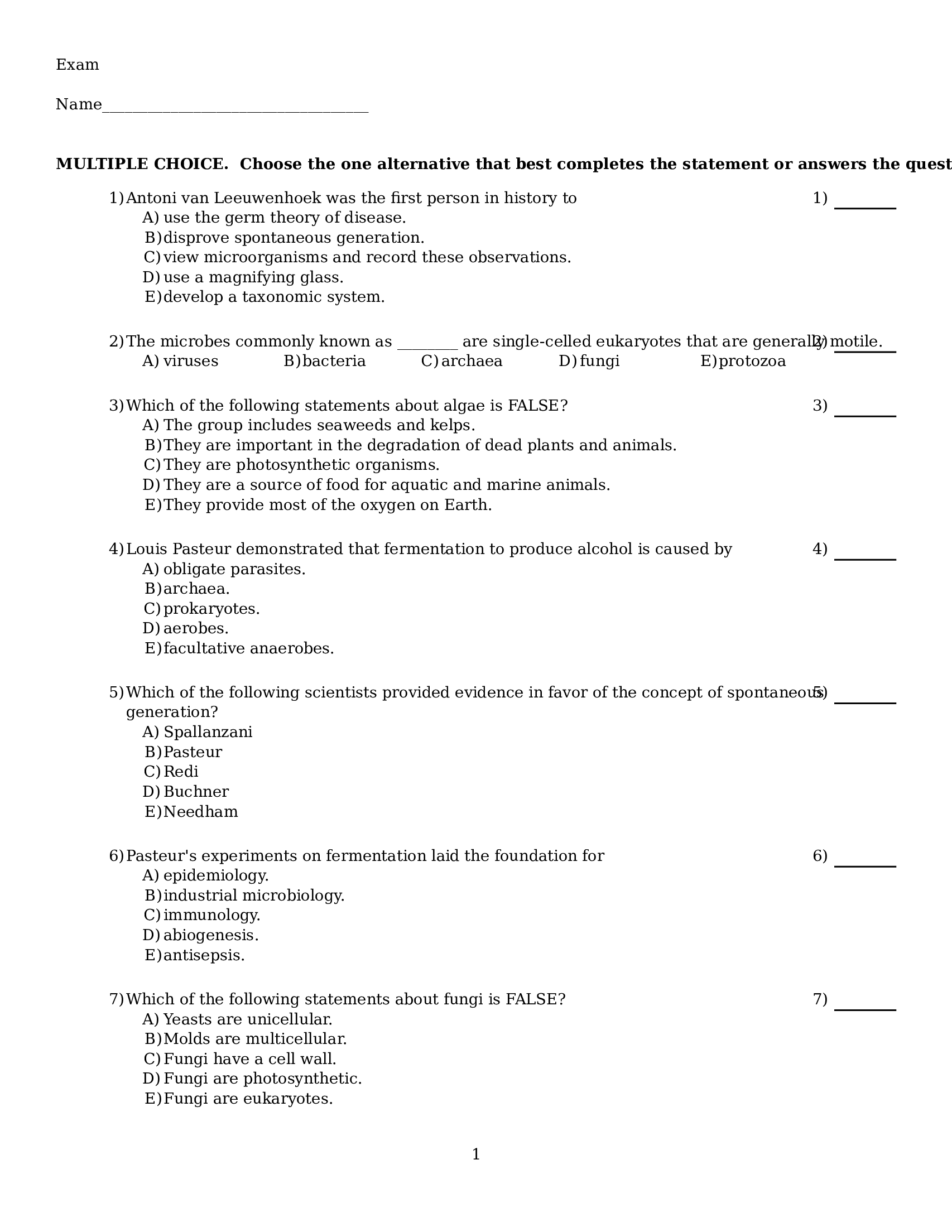
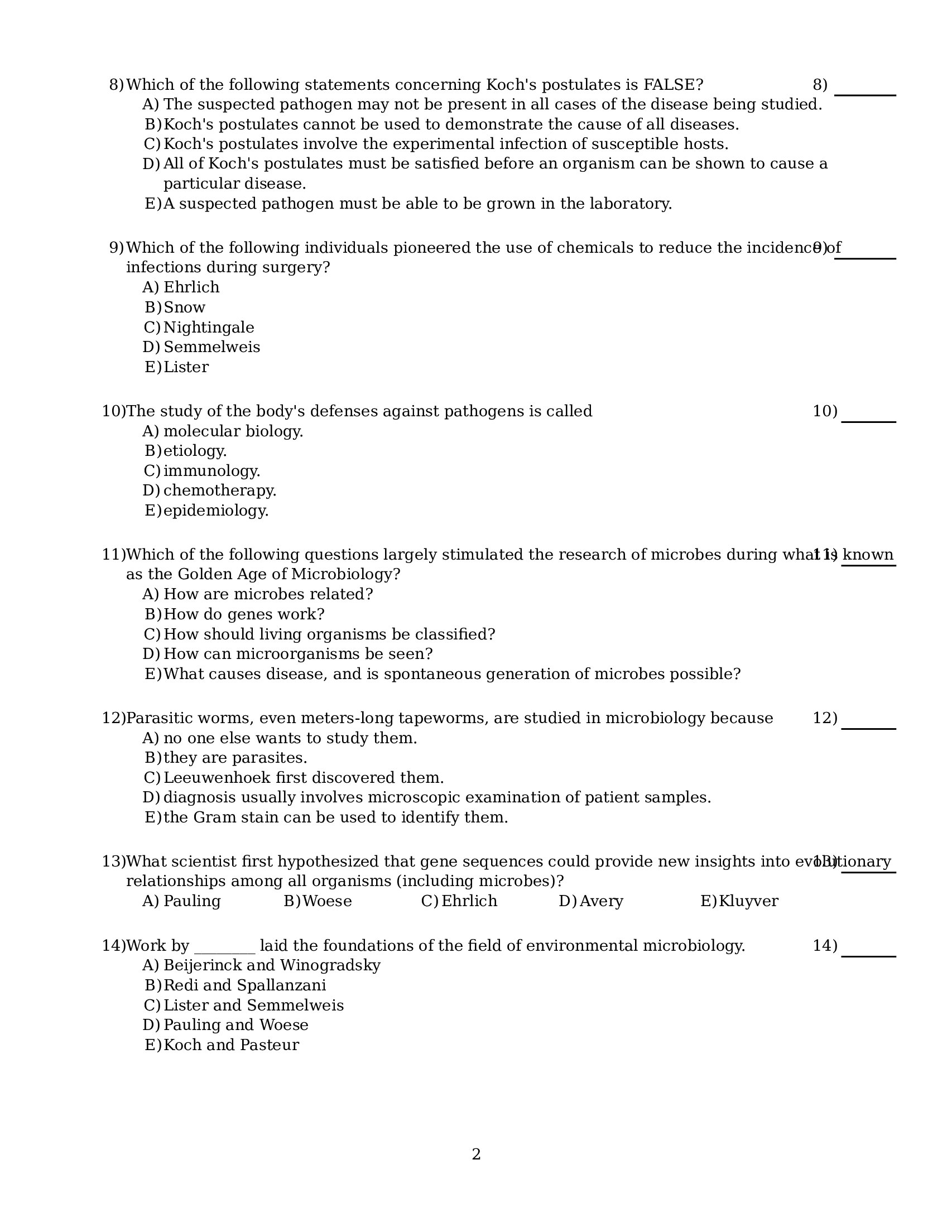
Test Bank for Microbiology with Diseases by Taxonomy 6th Edition by Bauman TEST BANK FOR MICROBIOLOGY WITH DISEASES BY TAXONOMY 6TH EDITION BY BAUMAN Microbiology with Diseases by Taxonomy, 6e (Bauman) Chapter 1 A Brief History of Microbiology 1.1 Multiple Choice Questions 1) Antoni van Leeuwenhoek was the first person in history to A) use a magnifying glass. B) develop a taxonomic system. C) view microorganisms and record these observations. D) disprove spontaneous generation. E) use the germ theory of disease. Answer: C Bloom's Taxonomy: Knowledge Section: The Early Years of Microbiology Learning Outcome: 1.1 2) The microbes commonly known as ________ are single-celled eukaryotes that are generally motile. A) archaea B) bacteria C) fungi D) protozoa E) viruses Answer: D Bloom's Taxonomy: Comprehension Section: The Early Years of Microbiology Learning Outcome: 1.3 3) Which of the following statements about algae is FALSE? A) The group includes seaweeds and kelps. B) They are photosynthetic organisms. C) They provide most of the oxygen on Earth. D) They are important in the degradation of dead plants and animals. E) They are a source of food for aquatic and marine animals. Answer: D Bloom's Taxonomy: Comprehension Section: The Early Years of Microbiology Learning Outcome: 1.3 1 Copyright © 2020 Pearson Education, Inc. 4) Louis Pasteur demonstrated that fermentation to produce alcohol is caused by A) aerobes. B) facultative anaerobes. C) obligate parasites. D) archaea. E) prokaryotes. Answer: B Bloom's Taxonomy: Knowledge Section: The Golden Age of Microbiology Learning Outcome: 1.6 5) Which of the following scientists provided evidence in favor of the concept of spontaneous generation? A) Pasteur B) Needham C) Redi D) Buchner E) Spallanzani Answer: B Bloom's Taxonomy: Knowledge Section: The Golden Age of Microbiology Learning Outcome: 1.7 6) Pasteur's experiments on fermentation laid the foundation for A) industrial microbiology. B) epidemiology. C) immunology. D) abiogenesis. E) antisepsis. Answer: A Bloom's Taxonomy: Comprehension Section: The Golden Age of Microbiology Learning Outcome: 1.10 7) Which of the following statements about fungi is FALSE? A) Fungi are eukaryotes. B) Molds are multicellular. C) Fungi have a cell wall. D) Fungi are photosynthetic. E) Yeasts are unicellular. Answer: D Bloom's Taxonomy: Comprehension Section: The Golden Age of Microbiology Learning Outcome: 1.3 2 Copyright © 2020 Pearson Education, Inc. 8) Which of the following contribute to the successful application of Koch's postulates? A) The development of the compound microscope. B) The theory of abiogenesis. C) The ability to record the appearance of bacteria photographically. D) The development of simple bacterial staining techniques. E) The development of techniques for sterile transfer of bacteria. Answer: E Bloom's Taxonomy: Application Section: The Golden Age of Microbiology Learning Outcome: 1.13 9) Which of the following individuals pioneered the use of chemicals to reduce the incidence of infections during surgery? A) Nightingale B) Snow C) Ehrlich D) Lister E) Semmelweis Answer: D Bloom's Taxonomy: Comprehension Section: The Golden Age of Microbiology Learning Outcome: 1.16 10) The technique developed by Hans Christian Gram is important for bacterial A) etiology. B) identification. C) classification. D) isolation. E) epidemiology. Answer: B Bloom's Taxonomy: Knowledge Section: The Golden Age of Microbiology Learning Outcome: 1.15 11) The use of chemical agents to harm or kill microbes is A) immunology. B) chemotherapy. C) epidemiology. D) serology. E) biotechnology. Answer: B Bloom's Taxonomy: Knowledge Section: The Golden Age of Microbiology Learning Outcome: 1.18 3 Copyright © 2020 Pearson Education, Inc. 12) Parasitic worms, even meters-long tapeworms, are studied in microbiology because A) they are parasites. B) diagnosis usually involves microscopic examination of patient samples. C) the Gram stain can be used to identify them. D) Leeuwenhoek first discovered them. E) no one else wants to study them. Answer: B Bloom's Taxonomy: Comprehension Section: The Early Years of Microbiology Learning Outcome: 1.4 13) Which of the following areas of investigation is considered a major driver of modern microbiology? A) microbial classification B) industrial microbiology C) the etiology of infectious disease D) genetics E) food preparation Answer: D Bloom's Taxonomy: Comprehension Section: The Modern Age of Microbiology Learning Outcome: 1.19 14) Work by ________ laid the foundations of immunology with the development of vaccines. A) Redi and Spallanzani B) Koch and Pasteur C) Jenner and Pasteur D) Lister and Semmelweis E) Pauling and Woese Answer: C Bloom's Taxonomy: Comprehension Section: The Golden Age of Microbiology Learning Outcome: 1.17 15) According to Kluyver and van Niel, which of the following are TRUE of basic biochemical reactions? A) They are shared by all living things. B) There are an unlimited number of them. C) They primarily involve the transfer of electrons and ions. D) Basic biochemical reactions shared by all living things primarily involve transfer of electrons and hydrogen ions. E) They primarily involve transfers of chemical groups. Answer: D Bloom's Taxonomy: Application Section: The Modern Age of Microbiology Learning Outcome: 1.19 4 Copyright © 2020 Pearson Education, Inc. 16) Semmelweis advocated handwashing as a method of preventing which of the following diseases? A) cholera B) puerperal fever C) smallpox D) anthrax E) syphilis Answer: B Bloom's Taxonomy: Application Section: The Golden Age of Microbiology Learning Outcome: 1.16 17) Paul Ehrlich used chemotherapy to treat A) cholera. B) cancer. C) anthrax. D) smallpox. E) syphilis. Answer: E Bloom's Taxonomy: Comprehension Section: The Golden Age of Microbiology Learning Outcome: 1.18 18) Which of the following is NOT a characteristic of viruses? A) They are visible with a light microscope. B) They are acellular. C) They are composed of genetic material and protein. D) They are typically smaller than prokaryotic cells. E) They are obligatory parasites. Answer: A Bloom's Taxonomy: Comprehension Section: The Early Years of Microbiology Learning Outcome: 1.3 19) The first true vaccine protected against disease caused by a(n) ________ pathogen. A) bacterial B) protozoal C) fungal D) viral E) archaeal Answer: D Bloom's Taxonomy: Application Section: The Golden Age of Microbiology Learning Outcome: 1.17 5 Copyright © 2020 Pearson Education, Inc. 20) All of the following individuals were involved in improving public health in the 19th century EXCEPT A) Snow. B) Spallanzani. C) Nightingale. D) Semmelweis. E) Lister. Answer: B Bloom's Taxonomy: Comprehension Section: The Golden Age of Microbiology Learning Outcome: 1.16 21) Which of the following types of microbe was NOT observed by Leeuwenhoek? A) fungus B) protozoan C) prokaryote D) alga E) virus Answer: E Bloom's Taxonomy: Knowledge Section: The Early Years of Microbiology Learning Outcome: 1.2 22) Inserting a gene from the hepatitis B virus into yeast so that the yeast produces a viral protein is an example of A) etiology. B) genetic engineering. C) immunology. D) microbial genetics. E) gene therapy. Answer: B Bloom's Taxonomy: Application Section: The Modern Age of Microbiology Learning Outcome: 1.19 23) Which of the following was NOT an aspect of Pasteur's experiments to disprove spontaneous generation? A) The necks of the flasks he used were bent into an S-shape. B) He boiled the infusions to kill any microbes present. C) The flasks were incubated for very long periods of time. D) The flasks were free of microbes until they were opened. E) The flasks he used were sealed with corks. Answer: E Bloom's Taxonomy: Application Section: The Golden Age of Microbiology Learning Outcome: 1.8 6 Copyright © 2020 Pearson Education, Inc. 24) Identification of bacteria in the laboratory usually begins with the ________ for placement in one of two large groups of bacteria. A) Koch's stain B) Gram stain C) Pasteur fermentation test D) Petri stain E) Ehrlich magic test Answer: B Bloom's Taxonomy: Comprehension Section: The Golden Age of Microbiology Learning Outcome: 1.15 25) Which of the following is NOT a characteristic of protozoa? A) Most exhibit asexual reproduction. B) They are single-celled organisms. C) They are eukaryotic organisms. D) They are all photosynthetic. E) They frequently possess cilia or flagella. Answer: D Bloom's Taxonomy: Comprehension Section: The Early Years of Microbiology Learning Outcome: 1.4 26) Whose search for chemicals that would kill microbes without harming humans was the foundation for chemotherapy? A) Ehrlich B) Koch C) Gram D) Lister E) Pasteur Answer: A Bloom's Taxonomy: Comprehension Section: The Golden Age of Microbiology Learning Outcome: 1.18 27) The work of Eduard Buchner and the discovery of enzymes laid the foundations for the field of A) biochemistry. B) epidemiology. C) immunology. D) mycology. E) genetics. Answer: A Bloom's Taxonomy: Comprehension Section: The Golden Age of Microbiology Learning Outcome: 1.12 7 Copyright © 2020 Pearson Education, Inc. 28) What is the correct order for the application of Koch's postulates? I. Inoculate suspect agent into test subject and observe that subject develops disease of interest. II. Isolate and culture suspect agent in the laboratory. III. Find suspect agent is every case of disease of interest but not in healthy hosts. IV. Recover and isolate suspect agent from test subject. A) III, I, IV, II B) IV, I, III, II C) I, II, III, IV D) III, II, I, IV E) IV, I, II, III Answer: D Bloom's Taxonomy: Analysis Section: The Golden Age of Microbiology Learning Outcome: 1.14 29) John Snow's research during a cholera outbreak in London laid the foundation for which of the following branches of microbiology? A) infection control only B) epidemiology only C) immunology only D) both infection control and epidemiology E) infection control, epidemiology, and immunology Answer: D Bloom's Taxonomy: Application Section: The Golden Age of Microbiology Learning Outcome: 1.16 30) Robert Koch was involved in research on all of the following topics EXCEPT A) the cause of anthrax. B) the cause of fermentation. C) development of a method to determine the cause of an infectious disease. D) the cause of tuberculosis. E) techniques for isolating microbes in the laboratory. Answer: B Bloom's Taxonomy: Comprehension Section: The Golden Age of Microbiology Learning Outcome: 1.13 8 Copyright © 2020 Pearson Education, Inc. 31) Which of the following is an INCORRECT pairing? A) protozoa; multicellular B) fungi; cell walls C) algae; aquatic and marine habitats D) prokaryotes; no nuclei E) viruses; acellular parasites Answer: A Bloom's Taxonomy: Comprehension Section: The Early Years of Microbiology Learning Outcome: 1.3 32) What was the first disease shown to be bacterial in origin? A) yellow fever B) cholera C) anthrax D) malaria E) tuberculosis Answer: C Bloom's Taxonomy: Application Section: The Golden Age of Microbiology Learning Outcome: 1.13 33) The work of Lister, Nightingale, and Semmelweis all contributed to controlling infectious disease by A) developing techniques for isolating pathogens. B) developing methods for reducing healthcare-associated infections (HAIs). C) identifying the sources of infectious agents. D) determining the taxonomic relationships among microbes. E) developing vaccines. Answer: B Bloom's Taxonomy: Application Section: The Golden Age of Microbiology Learning Outcome: 1.16 34) Who discovered penicillin? A) Fleming B) Ehrlich C) Kitasato D) Pasteur E) Domagk Answer: A Bloom's Taxonomy: Knowledge Section: The Modern Age of Microbiology Learning Outcome: 1.18 9 Copyright © 2020 Pearson Education, Inc. 35) The principle of disinfection to reduce HAIs (healthcare associated infections) among patients was initially introduced by A) L. Pasteur and R. Koch. B) I. Semmelweis and J. Lister. C) P. Erhlich and A. Fleming. D) J. Snow and R. Koch. E) E. Jenner and L. Pasteur. Answer: B Bloom's Taxonomy: Comprehension Section: The Modern Age of Microbiology Learning Outcome: 1.16 36) Microorganisms characterized by the absence of a nucleus are called A) fungi. B) pathogens. C) eukaryotes. D) prokaryotes. E) viruses. Answer: D Bloom's Taxonomy: Knowledge Section: The Early Years of Microbiology Learning Outcome: 1.5 37) The term that literally means "against putrefaction" is A) antisepsis. B) prokaryote. C) chemotherapy. D) recombinant technology. E) nosocomial. Answer: A Bloom's Taxonomy: Knowledge Section: The Golden Age of Microbiology Learning Outcome: 1.16 38) The experiments conducted by John T. Needham using infusions were interpreted as supporting the theory of A) antisepsis. B) bioremediation. C) spontaneous generation. D) etiology. E) chemotherapy. Answer: C Bloom's Taxonomy: Comprehension Section: The Golden Age of Microbiology Learning Outcome: 1.6 10 Copyright © 2020 Pearson Education, Inc. 39) An explanation of observations and data supported by the experimental results of many scientists for many years is A) a theory. B) a hypothesis. C) scientific method. D) popular opinion. E) a control group. Answer: A Bloom's Taxonomy: Knowledge Section: The Golden Age of Microbiology Learning Outcome: 1.9 40) The work of ________ on fermentation led to the discovery that enzymes are responsible for the chemical reactions that occur in cells. A) Lister B) Koch C) Pasteur D) Buchner E) Woese Answer: D Bloom's Taxonomy: Comprehension Section: The Golden Age of Microbiology Learning Outcome: 1.12 41) The term for the use of microorganisms to restore damaged environments is A) epidemiology. B) bioremediation. C) chemotherapy. D) serology. E) ecology. Answer: B Bloom's Taxonomy: Comprehension Section: The Modern Age of Microbiology Learning Outcome: 1.20 42) The term ________ involves the study of the blood components that fight infection. A) antisepsis B) chemotherapy C) etiology D) serology E) bioremediation Answer: D Bloom's Taxonomy: Application Section: The Modern Age of Microbiology Learning Outcome: 1.20 11 Copyright © 2020 Pearson Education, Inc. 43) The field of ________ is a thoroughly modern discipline that has led to new ways to treat infectious disease. A) recombinant DNA technology B) epidemiology C) immunology D) serology E) biochemistry Answer: A Bloom's Taxonomy: Comprehension Section: The Golden Age of Microbiology Learning Outcome: 1.21 1.2 True/False Questions 1) Protozoa are also called prokaryotes. Answer: FALSE Bloom's Taxonomy: Knowledge Section: The Early Years of Microbiology Learning Outcome: 1.4 2) Single-celled organisms known as diatoms have glasslike walls and are a type of algae. Answer: TRUE Bloom's Taxonomy: Knowledge Section: The Early Years of Microbiology Learning Outcome: 1.4 3) The production of human blood-clotting factor by E. coli is an example of bioremediation. Answer: FALSE Bloom's Taxonomy: Comprehension Section: The Modern Age of Microbiology Learning Outcome: 1.19 4) Louis Pasteur is considered the Father of Microbiology because of the many carefully conducted experiments and observations he made with microbes. Answer: TRUE Bloom's Taxonomy: Comprehension Section: The Golden Age of Microbiology Learning Outcome: 1.11 5) Gene therapy is a modern approach to preventing infectious disease. Answer: FALSE Bloom's Taxonomy: Comprehension Section: The Modern Age of Microbiology Learning Outcome: 1.21 12 Copyright © 2020 Pearson Education, Inc. 6) Koch's postulates can be used to determine the causes of infectious diseases. Answer: TRUE Bloom's Taxonomy: Comprehension Section: The Golden Age of Microbiology Learning Outcome: 1.14 7) Joseph Lister reduced the incidence of wound infections in health care settings by using chlorinated lime water. Answer: FALSE Bloom's Taxonomy: Comprehension Section: The Golden Age of Microbiology Learning Outcome: 1.16 8) Robert Koch sought a "magic bullet" for the treatment of disease caused by bacteria. Answer: FALSE Bloom's Taxonomy: Comprehension Section: The Golden Age of Microbiology Learning Outcome: 1.13 9) Fermentation can occur in the absence of living cells. Answer: TRUE Bloom's Taxonomy: Comprehension Section: The Golden Age of Microbiology Learning Outcome: 1.12 10) Lazzaro Spallanzani was the first scientist to provide evidence disproving the spontaneous generation of microorganisms. Answer: TRUE Bloom's Taxonomy: Comprehension Section: The Golden Age of Microbiology Learning Outcome: 1.8 1.3 Short Answer Questions 1) The amateur scientist (Koch/Leeuwenhoek/Pasteur) made his own microscopes and first reported the existence of microbes. Answer: Leeuwenhoek Bloom's Taxonomy: Knowledge Section: The Early Years of Microbiology Learning Outcome: 1.1 2) A cell that contains a nucleus is called a(n) (prokaryotic/archaeal/eukaryotic) cell. Answer: eukaryotic Bloom's Taxonomy: Knowledge Section: The Early Years of Microbiology Learning Outcome: 1.5 13 Copyright © 2020 Pearson Education, Inc. 3) A(n) (photosynthetic/algae/plant) organism makes its own food using light energy. Answer: photosynthetic Bloom's Taxonomy: Comprehension Section: The Early Years of Microbiology Learning Outcome: 1.3 4) Microbes that cause infectious disease are called (pathogens/germs/viruses). Answer: pathogens Bloom's Taxonomy: Knowledge Section: The Golden Age of Microbiology Learning Outcome: 1.13 5) Single-celled eukaryotes that feed on other organisms and have a cell wall are (algae/fungi/protozoa). Answer: fungi Bloom's Taxonomy: Knowledge Section: The Early Years of Microbiology Learning Outcome: 1.4 6) A scientist conducts experiments to test a(n) (observation/hypothesis/theory). Answer: hypothesis Bloom's Taxonomy: Knowledge Section: The Golden Age of Microbiology Learning Outcome: 1.9 7) The work of (Needham/Redi/Spallanzani) using infusions in sealed vials provided strong evidence that spontaneous generation does not occur. Answer: Spallanzani Bloom's Taxonomy: Comprehension Section: The Golden Age of Microbiology Learning Outcome: 1.8 8) Research done in Robert Koch's laboratory laid the foundation for (epidemiology/immunology/etiology), the study of the body's defenses against disease. Answer: immunology Bloom's Taxonomy: Knowledge Section: The Modern Age of Microbiology Learning Outcome: 1.19 9) A (colony/habitat/biofilm) is a mixed population of microbes growing together on surfaces. Answer: biofilm Bloom's Taxonomy: Comprehension Section: The Modern Age of Microbiology Learning Outcome: 1.19 14 Copyright © 2020 Pearson Education, Inc. 10) Spallanzani's experiments contradicted the experiments of (Needham/Redi/Pasteur) on spontaneous generation. Answer: Needham Bloom's Taxonomy: Knowledge Section: The Golden Age of Microbiology Learning Outcome: 1.7 11) Ignaz Semmelweis demonstrated the importance of (antisepsis/vaccination/washing) as a means of preventing disease transmission. Answer: washing Bloom's Taxonomy: Comprehension Section: The Golden Age of Microbiology Learning Outcome: 1.16 12) A term synonymous with immunization, (vaccination/infection) is derived from the Latin name of the cowpox virus. Answer: vaccination Bloom's Taxonomy: Comprehension Section: The Golden Age of Microbiology Learning Outcome: 1.11 13) The use of chemicals to treat diseases such as bacterial infections is called (gene therapy/chemotherapy). Answer: chemotherapy Bloom's Taxonomy: Knowledge Section: The Golden Age of Microbiology Learning Outcome: 1.16 14) The work of Oswald Avery, George Beadle, Edward Tatum and many others into the role of DNA laid the foundations of (microbial genetics/microbiology/recombinant DNA technology). Answer: microbial genetics Bloom's Taxonomy: Comprehension Section: The Modern Age of Microbiology Learning Outcome: 1.19 15) The (physiology/metabolism) of an organism is all the chemical reactions that take place in the organism. Answer: metabolism Bloom's Taxonomy: Knowledge Section: The Golden Age of Microbiology Learning Outcome: 1.12 15 Copyright © 2020 Pearson Education, Inc. 1.4 Essay Questions 1) You are a young 

Contact the Seller

Please Sign In to contact this seller.


  • 👎  Report Copyright Violation

Frequently Asked Questions

What Do I Get When I Buy This Study Material?

+

When you buy a study material on Passing Grades, an instant download link will be sent directly to your email, giving you access to the file anytime after payment is completed.

Is Passing Grades a Trusted Platform?

+

Yes, Passing Grades is a reputable students’ marketplace with a secure payment system and reliable customer support. You can trust us to ensure a safe and seamless transaction experience.

Will I Be Stuck with a Subscription?

+

No, all purchases on Passing Grades are one-time transactions. You only pay for the notes you choose to buy, with no subscriptions or hidden fees attached.

Who Am I Buying These Study Materials From?

+

Passing Grades is a marketplace, which means you are purchasing the document from an individual vendor, not directly from us. We facilitate the payment and delivery process between you and the vendor.

Does Passing Grades Offer Free Study Materials?

+

Yes, sellers on Passing Grades have uploaded numerous free test banks, exams, practice questions, and class notes that can be downloaded at no cost.


Pasinggrades - Quality Study Materials

USD 17

    • Quality checked by Pasing Grades
    • 100% satisfaction guarantee
    • Seller: mentor2000
Buy PDF $17

Seller Information

mentor2000

Member since April 2021

  • icon
  • icon
View Profile
  • total sales

    0
  • Favourites

    0
  • Comments

    0
    ( 0 Ratings )

Item Information

  • Uploaded

    30 September 2022

  • Updated

    29 September 2025

  • Category

    Nursing

  • Item Type

    exam

  • Tags

    test bank microbiology

Related Exam Prep Guides by mentor2000

Test Bank for Essentials for Nursing Practice 8th Edition by Potter | All Chapters
View Document

Test Bank for Essent...

  • mentor2000

    mentor2000

  • exam

Master nursing concepts with this study material; Test Bank for Essentials for Nursing Practice, 8th...

17 USD

0

0

A &P 1 MA278 BSC2 Final Module II Questions & Answers 2026 Update
View Document

A &P 1 MA278 BSC2 Fi...

  • mentor2000

    mentor2000

  • exam

Prepare for success with A&P 1 MA278 BSC2 Final Module II 2024 Q&A. Boost your grades with this comp...

17 USD

0

0

ATI Comprehensive Predictor Exam 2026
View Document

ATI Comprehensive Pr...

  • mentor2000

    mentor2000

  • exam

Prepare for success with the ATI Comprehensive Predictor Exam 2026. Access key practice questions to...

17 USD

0

0

Purchase

Download link will be sent to this email immediately after purchase.

IMPORTANT LINKS

  • How To Upload Class Notes
  • Selling Tips
  • Passing Grades's Study Materials
  • Scholarships for International Students 2025

POPULAR CATEGORIES

  • Law
  • Accounting
  • English
  • Psychology
  • Business
  • Nursing
  • Computer Science
  • General

View Document

  • Blog
  • Contact
  • Delivery Policy
  • Latest Scholarships Around the World
  • How to Pass Bar Exams: Passing Grades’ Strategies
  • How to Study and Pass the CPA Exam
  • All Test Banks
  • Faq
  • Copyright Claims
  • Privacy Policy
  • Terms of Use

KNOWLEDGE BASE

  • How to Write A+ Grade Good Research Paper
  • How to Manage Stress During Exam Period
  • Best Time to Study
  • How to Pass NCLEX-RN Exam
  • How To Effectively Utilize Test Banks
  • Popular Shadow Health Exam Assessments
  • Popular HESI Case Studies
  • How to Prepare for a Nursing Career
  • The Importance Of Summaries in Exam Revisvion

© 2026 Pasing Grades. All rights reserved.