Pasing Grades
  • Start Selling
  • Blog
  • Contact
  • 0

    Your cart is empty!

English

  • English
  • Spanish
  • Arabic
Create Account Sign In
  • Library
    • New Prep Guides
    • Featured Prep Guides
    • Free Exam Prep Guides
    • Best sellers
  • General
  • Nursing
    • Research Paper
    • Case Study
    • Discussion Post
    • Assignment
    • Exam
    • Practice Questions and Answers
    • Test Bank
    • solutions manual
  • Accounting
    • Case Study
    • Thesis
    • Study Guide
    • Summary
    • Research Paper
    • test bank
  • English
    • Creative Writing
    • Research Paper
    • Summary
    • Rhetorics
    • Literature
    • Journal
    • Exam
    • Grammar
    • Discussion Post
    • Essay
  • Psychology
    • Hesi
    • Presentation
    • Essay
    • Summary
    • Study Guide
    • Essay
    • Solution Manual
    • Final Exam Review
    • Class Notes
    • test bank
  • Business
    • Lecture Notes
    • Solution Manual
    • Presentation
    • Business Plan
    • Class Notes
    • Experiment
    • Summary
    • Practice Questions
    • Study Guide
    • Case Study
    • test bank
    • Exam
  • More
    • Computer Science
    • Economics
    • Statistics
    • Engineering
    • Biology
    • Religious Studies
    • Physics
    • Chemistry
    • Mathematics
    • History
    • Sociology
    • Science
    • Philosophy
    • Law
  • Pages
    • About Us
    • Selling Tips
    • Delivery Policy
    • Faq
    • Privacy Policy
  • Flash Sale
  • Home
  • Test Bank for Marriages and Families Changes, Choices, and Constraints, 9th Edition Nijole V. Benokraitis, University of Baltimore

Test Bank for Marriages and Families Changes, Choices, and Constraints, 9th Edition Nijole V. Benokraitis, University of Baltimore

Preview page 1 Preview page 2 Preview page 3
Add To Favorites

Share this item Share this item

  • Item Details
  • Comments (0)
  • Reviews (0)
  • Contact Seller

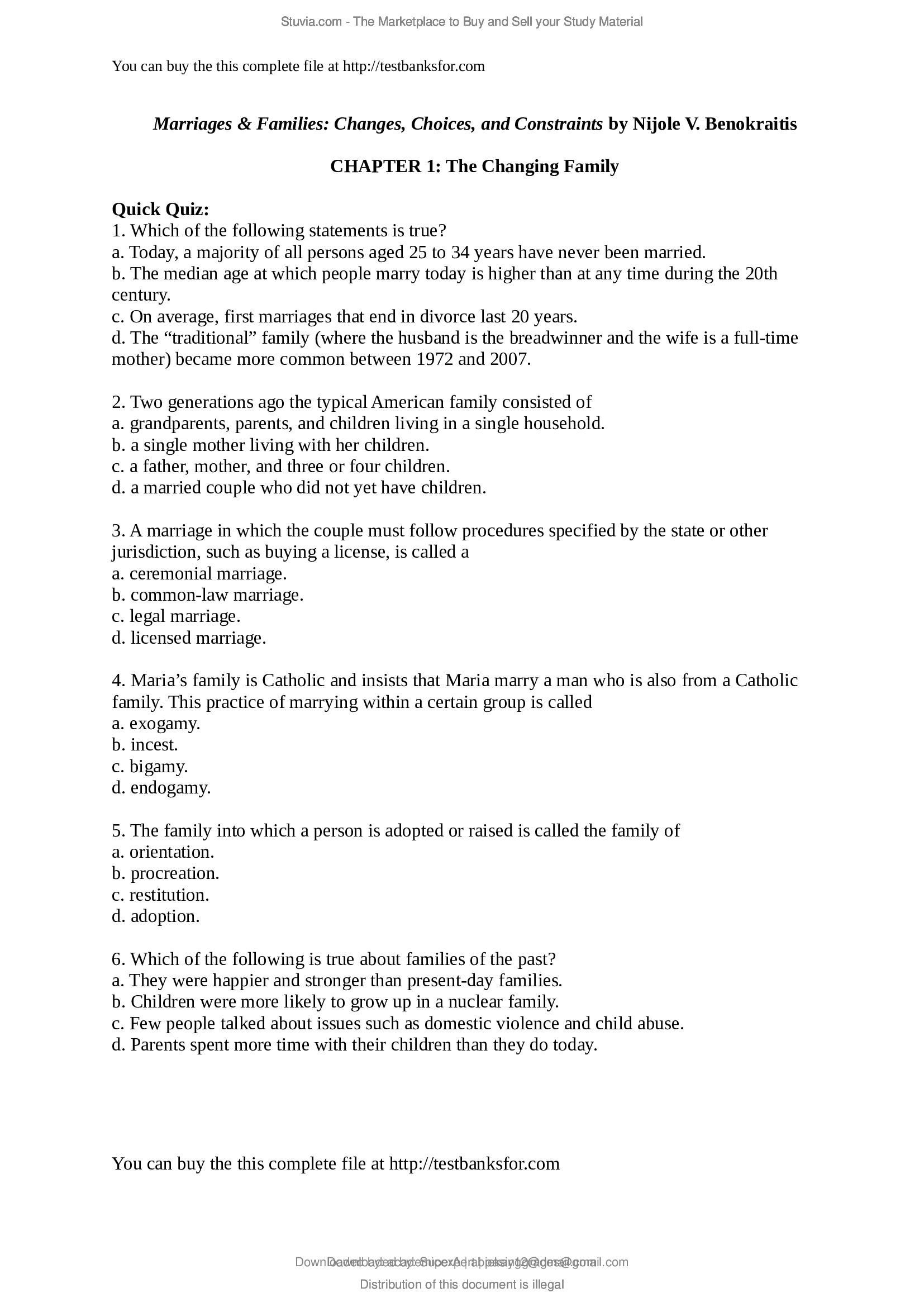
Marriages & Families: Changes, Choices, and Constraints by Nijole V. Benokraitis

CHAPTER 1: The Changing Family

Quick Quiz:

1. Which of the following statements is true?

a.  Today, a majority of all persons aged 25 to 34 years have never been married.

b.  The median age at which people marry today is higher than at any time during the 20th century.

c.  On average, first marriages that end in divorce last 20 years.

d.  The “traditional” family (where the husband is the breadwinner and the wife is a full-time mother) became more common between 1972 and 2007.

2. Two generations ago the typical American family consisted of

a.  grandparents, parents, and children living in a single household.

b.  a single mother living with her children.

c.   a father, mother, and three or four children.

d.  a married couple who did not yet have children.

3. A marriage in which the couple must follow procedures specified by the state or other jurisdiction, such as buying a license, is called a a. ceremonial marriage.

b.  common-law marriage.

c.   legal marriage.

d.  licensed marriage.

4. Maria’s family is Catholic and insists that Maria marry a man who is also from a Catholic family. This practice of marrying within a certain group is called

a.  exogamy.                   

b.  incest.          

c.   bigamy.

d.  endogamy.

5. The family into which a person is adopted or raised is called the family of a. orientation.               

b.  procreation.               

c.   restitution.

d.  adoption.

6. Which of the following is true about families of the past?

a.  They were happier and stronger than present-day families.

b.  Children were more likely to grow up in a nuclear family.

c.   Few people talked about issues such as domestic violence and child abuse.

d.  Parents spent more time with their children than they do today.

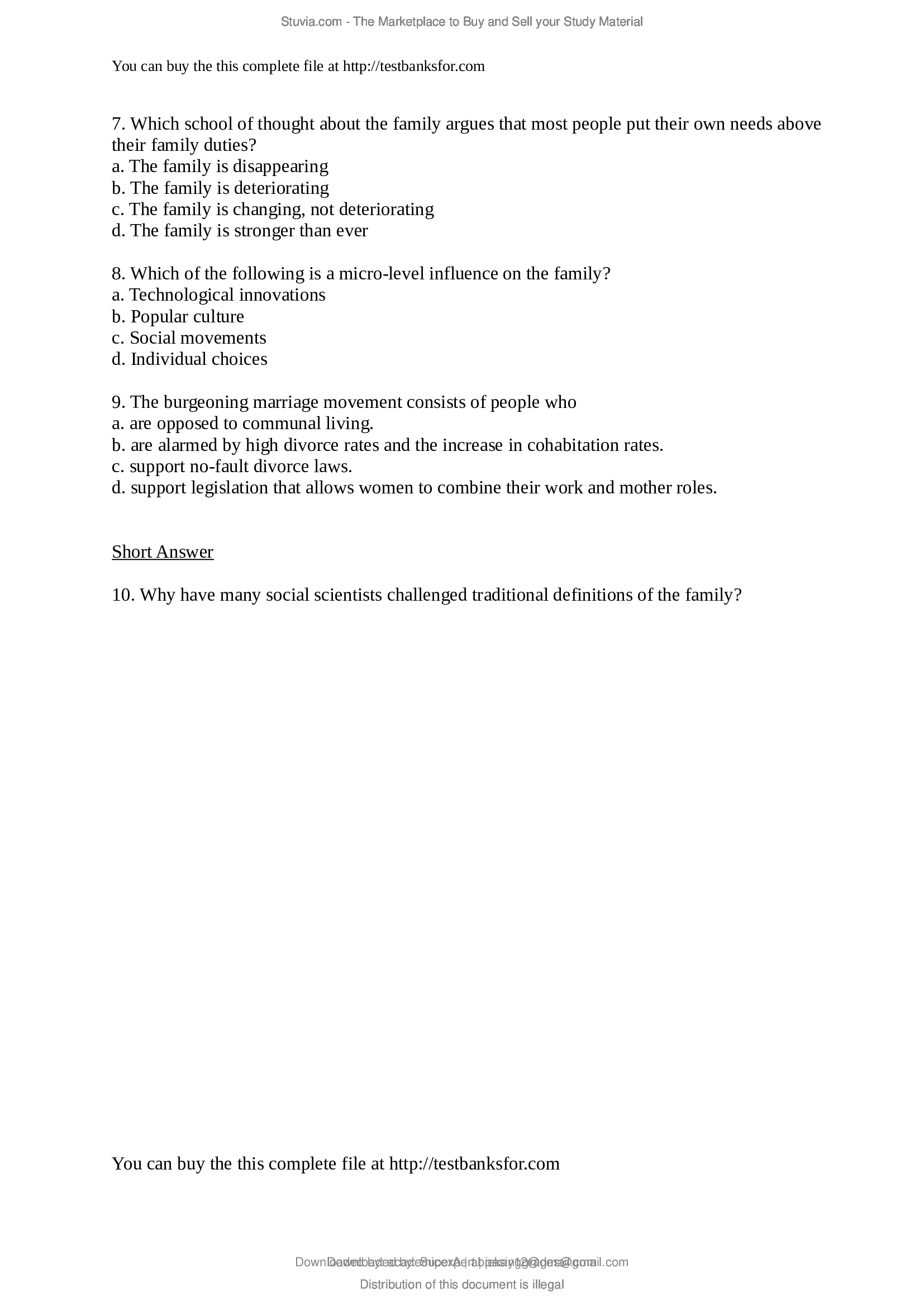
7. Which school of thought about the family argues that most people put their own needs above their family duties?

a.  The family is disappearing

b.  The family is deteriorating

c.   The family is changing, not deteriorating

d.  The family is stronger than ever

8. Which of the following is a micro-level influence on the family?

a.  Technological innovations

b.  Popular culture

c.   Social movements

d.  Individual choices

9. The burgeoning marriage movement consists of people who

a.  are opposed to communal living.

b.  are alarmed by high divorce rates and the increase in cohabitation rates.

c.   support no-fault divorce laws.

d.  support legislation that allows women to combine their work and mother roles.

Short Answer

10. Answer: Because they exclude a number of diverse groups that also consider themselves family, such as childfree couples, cohabiting couples, foster parents and their charges, elderly sisters living together, gay and lesbian couples with or without children, and grandparents raising their grandchildren.

Chapter heading/page #: What is a Family?/p.5

Question type: Conceptual; Question level: Moderate

TEST QUESTIONS: CHAPTER 1 The Changing Family

Multiple Choice Questions

1. Since 1970, the percentage of single-parent households as a percentage of all households a. has gone down.

b.  has gone up.

c.   has stayed the same.

d.  is unknown.

(Factual; answer: b; page 3)

2. The traditional definition of the “family” has included all of the following characteristics except

a.  being emotionally committed to one another

b.  living together

c.   forming an economic unit

d.  bearing and raising children

(Conceptual; answer: a; page 4)

3. A primary group is characterized by

a.  impersonal relationships.

b.  few emotional ties to one another

c.   close, intimate interaction.

d.  short-term relationships.

(Conceptual; answer: c; page 7)

4. “A socially approved mating relationship that people expect to be stable and enduring” is a definition of

a.  parents.                   

b.  family.                    

c.   marriage

d.  courtship

(Conceptual; answer: c; page 7)

5. A marriage in which the couple must follow procedures specified by the state or other jurisdiction, such as buying a license, is called a a. ceremonial marriage.

b.  common-law marriage.

c.   legal marriage.

d.  licensed marriage

(Conceptual; answer: a; page 8)

6. Generally the requirements for establishing a common-law marriage include all of the following EXCEPT

a.  living together for a significant period of time.

b.  getting blood tests.

c.   presenting oneself as part of a married couple.

d.  intending to marry.

(Conceptual; answer: b; page 8)

7. Bigamy occurs when

a.  a married partner is unfaithful to his or her spouse.

b.  people have children without being married.

c.   a person marries a second person while a first marriage is still legal.

d.  people live together without being married.

(Conceptual; answer: c; page 8)

8. Why is there no universal definition of the family?

a.  Very few people live in families anymore.

b.  Social scientists do not have enough data about the family to create a definition.

c.   Contemporary household arrangements are very complex.

d.  It is difficult to determine what types of families actually exist.

(Conceptual; answer: c; page 4)

9. According to the U.S. Census Bureau’s definition of family, which of the following groups would NOT be considered a family? a. elderly sisters living together

b.  a gay or lesbian couple living together

c.   a single father living with his biological children

d.  a married couple living with their adopted children

(Applied; answer: b; page 4)

10. The text defines a family as an intimate group of two or more people who do all of the following EXCEPT possibly

a.  live together in a committed relationship.

b.  care for one another and any children.

c.   share activities and close emotional ties.

d.  marry.

(Conceptual; answer: d; page 4-5)

16. Supplying material resources for the family, such as food, shelter, and clothing, is part of the family’s __________ function. a. socialization

b.  economic security.

c.   emotional support

d.  procreation

(Conceptual; answer: b; page 6)

17. According to Charles Horton Cooley, groups that are characterized by close, long-lasting, intimate, and fact-to-face interactions are called a. secondary groups.

b.  families.

c.   primary groups.

d.  teammates.

(Conceptual; answer: c; page 17)

18. A(n) __________ is a category of people who have a similar standing or rank in society based on their wealth, education, power, prestige, and other valued resources. a. social class

b.  family of origin

c.   kinship system

d.  extended family

(Conceptual; answer: a; page 7)

19. Shelby married Tracy and had two children. Tracy and the children are Shelby’s family of a. orientation.      

b.  recognition.

c.   origin.

d.  procreation

(Applied; answer: d;      page 11)

20. A network of people who are related by blood, marriage, or adoption is called a(n) a. extended family.                        

b.  kinship system.             

c.   family of orientation.

d.  family of origin.

(Conceptual; answer: b; page 11)

21. The family form which consists of parents and children, as well as other kin such as uncles, aunts, nieces and nephews, cousins, and grandparents is called the a. nuclear family.

b.  family of procreation.

c.   family of orientation.

d.  extended family.

(Conceptual; answer: d; page 8)

22. The family form that is most common in much of the world is the

a.  nuclear family.

b.  extended family.

c.   family of procreation.

d.  blended family.

(Factual; answer: b; page 8)

23. The type of marriage in which one person is married exclusively to another person is called a. polygamy.                   

b.  nuclear.               

c.   primary.

d.  monogamy.

(Conceptual; answer: d; page 10)

24. The term “serial monogamy” refers to a situation in which a person

a.  marries several people over their lifetime but is only married to one person at a time.

b.  is married exclusively to one person for their entire lifetime.

c.   is married to two or more persons at the same time.

d.  cohabits rather than remarries after a divorce.

(Conceptual; answer: a; page 10)

25. Marriages in which either the husband or the wife has two or more spouses is called a. polygamy.                   

b.  polygyny.                   

c.   polyandry.

d.  monogamy.

(Conceptual; answer: a; page 10)

26. A woman who has more than one husband is practicing

a.  polygamy.                   

b.  polygyny.                   

c.   polyandry.

d.  monogamy.

(Conceptual; answer: c; page 10)

27. Polyandry may have existed in societies 

a.  where matriarchy is the predominate family form.

b.  in which there is a shortage of men.

c.   with plentiful access to food.

d.  where it is difficult to accumulate property.

(Factual; answer: d; page 10)

28. Jamal and Tanya have just married and moved into an apartment of their own to live by themselves as a couple. This residency pattern is called a. patrilocal.

b.  matrilocal.

c.   neolocal.

d.  bilocal.

(Applied; answer: c; page 9)

29. Kelly and Anthony have just married and moved in with Anthony’s parents. This residency patterns is called a. patrilocal.


Contact the Seller

Please Sign In to contact this seller.


  • 👎  Report Copyright Violation

Frequently Asked Questions

What Do I Get When I Buy This Study Material?

+

When you buy a study material on Passing Grades, an instant download link will be sent directly to your email, giving you access to the file anytime after payment is completed.

Is Passing Grades a Trusted Platform?

+

Yes, Passing Grades is a reputable students’ marketplace with a secure payment system and reliable customer support. You can trust us to ensure a safe and seamless transaction experience.

Will I Be Stuck with a Subscription?

+

No, all purchases on Passing Grades are one-time transactions. You only pay for the notes you choose to buy, with no subscriptions or hidden fees attached.

Who Am I Buying These Study Materials From?

+

Passing Grades is a marketplace, which means you are purchasing the document from an individual vendor, not directly from us. We facilitate the payment and delivery process between you and the vendor.

Does Passing Grades Offer Free Study Materials?

+

Yes, sellers on Passing Grades have uploaded numerous free test banks, exams, practice questions, and class notes that can be downloaded at no cost.

Pasinggrades - Quality Study Materials

USD 15

    • Quality checked by Pasing Grades
    • 100% satisfaction guarantee
    • Seller: Eddah-Nafula
Buy PDF $15

Seller Information

Eddah-Nafula

Member since June 2021

  • icon
  • icon
  • icon
View Profile
  • total sales

    1
  • Favourites

    1
  • Comments

    0
    ( 0 Ratings )

Item Information

  • Uploaded

    22 May 2022

  • Updated

    20 June 2025

  • Category

    General

  • Item Type

    test bank

  • Tags

    Test Bank Marriages and Families Changes Choices and Constraints 9th Edition Nijole V. Benokraitis University of Baltimore

Related Exam Prep Guides by Eddah-Nafula

HESI Pharmacology V2 – Practice Questions (120) Latest 2026
View Document

HESI Pharmacology V2...

  • Eddah-Nafula

    Eddah-Nafula

  • test bank

HESI Pharmacology V2 – Practice Questions (120) Latest 2025...

15 USD

1

1

AIN2601 ASSIGNMENT 1 QUESTIONS AND ANSWERS 100 CORRECT (2021)
View Document

AIN2601 ASSIGNMENT 1...

  • Eddah-Nafula

    Eddah-Nafula

  • test bank

AIN2601 ASSIGNMENT 1 QUESTIONS AND ANSWERS 100 CORRECT (2021)...

15 USD

1

1

Ashley Davis patho objectives 5,6,7,20
View Document

Ashley Davis patho o...

  • Eddah-Nafula

    Eddah-Nafula

  • test bank

Ashley Davis patho objectives 5,6,7,20...

15 USD

1

1

Purchase

Download link will be sent to this email immediately after purchase.

IMPORTANT LINKS

  • How To Upload Class Notes
  • Selling Tips
  • Passing Grades's Study Materials
  • Scholarships for International Students 2026

POPULAR CATEGORIES

  • Law
  • Accounting
  • English
  • Psychology
  • Business
  • Nursing
  • Computer Science
  • General

View Document

  • Blog
  • Contact
  • Delivery Policy
  • Latest Scholarships Around the World
  • How to Pass Bar Exams: Passing Grades’ Strategies
  • How to Study and Pass the CPA Exam
  • All Test Banks
  • Faq
  • Copyright Claims
  • Privacy Policy
  • Terms of Use

KNOWLEDGE BASE

  • How to Write A+ Grade Good Research Paper
  • How to Manage Stress During Exam Period
  • Best Time to Study
  • How to Pass NCLEX-RN Exam
  • How To Effectively Utilize Test Banks
  • Popular Shadow Health Exam Assessments
  • Popular HESI Case Studies
  • How to Prepare for a Nursing Career
  • The Importance Of Summaries in Exam Revisvion

© 2026 Pasing Grades. All rights reserved.