Pasing Grades
  • Start Selling
  • Blog
  • Contact
  • 0

    Your cart is empty!

English

  • English
  • Spanish
  • Arabic
Create Account Sign In
  • Library
    • New Prep Guides
    • Featured Prep Guides
    • Free Exam Prep Guides
    • Best sellers
  • General
  • Nursing
    • Research Paper
    • Case Study
    • Discussion Post
    • Assignment
    • Exam
    • Practice Questions and Answers
    • Test Bank
    • solutions manual
  • Accounting
    • Case Study
    • Thesis
    • Study Guide
    • Summary
    • Research Paper
    • test bank
  • English
    • Creative Writing
    • Research Paper
    • Summary
    • Rhetorics
    • Literature
    • Journal
    • Exam
    • Grammar
    • Discussion Post
    • Essay
  • Psychology
    • Hesi
    • Presentation
    • Essay
    • Summary
    • Study Guide
    • Essay
    • Solution Manual
    • Final Exam Review
    • Class Notes
    • test bank
  • Business
    • Lecture Notes
    • Solution Manual
    • Presentation
    • Business Plan
    • Class Notes
    • Experiment
    • Summary
    • Practice Questions
    • Study Guide
    • Case Study
    • test bank
    • Exam
  • More
    • Computer Science
    • Economics
    • Statistics
    • Engineering
    • Biology
    • Religious Studies
    • Physics
    • Chemistry
    • Mathematics
    • History
    • Sociology
    • Science
    • Philosophy
    • Law
  • Pages
    • About Us
    • Selling Tips
    • Delivery Policy
    • Faq
    • Privacy Policy
  • Flash Sale
  • Home
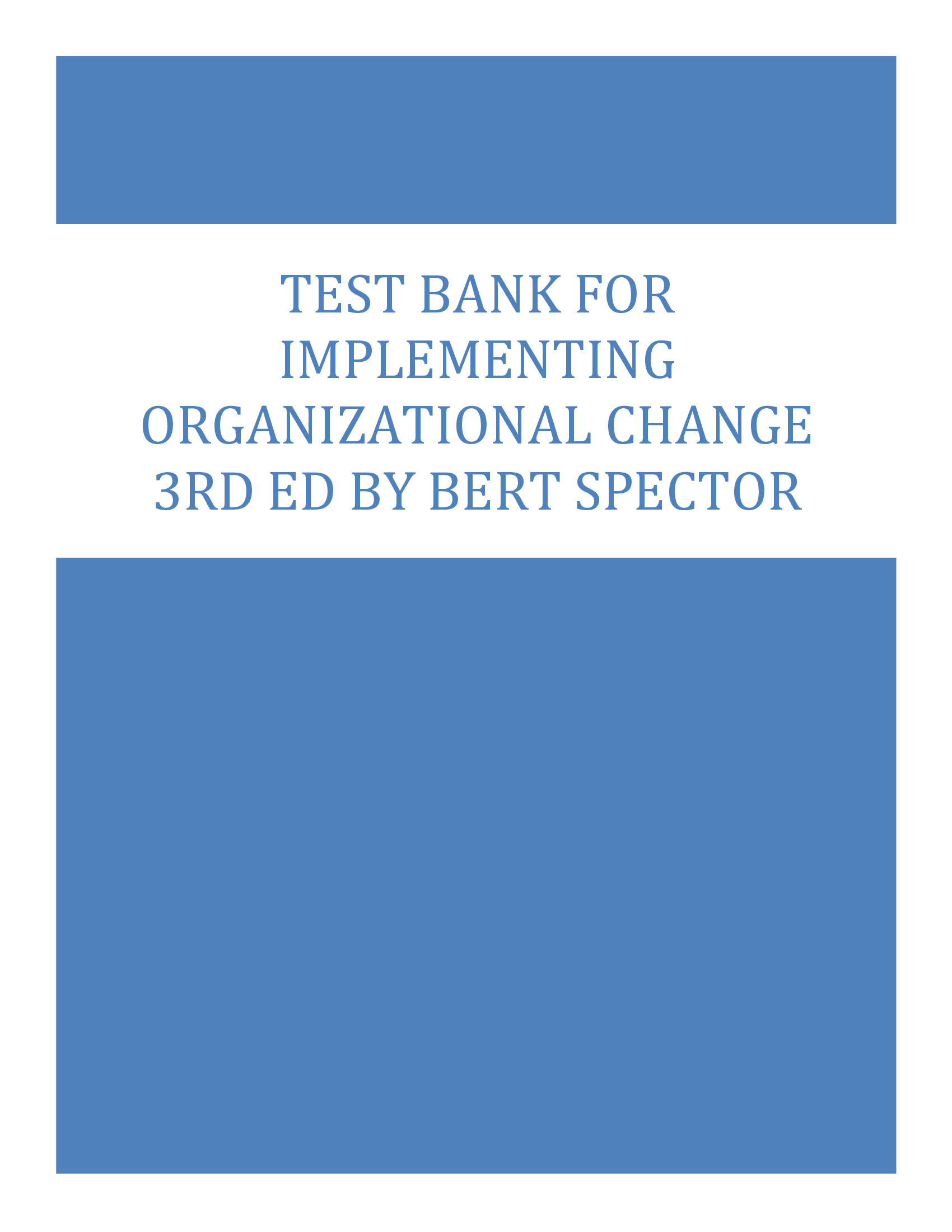
  • Test Bank for Implementing Organizational Change 3rd Edition by Bert Spector

Test Bank for Implementing Organizational Change 3rd Edition by Bert Spector

Preview page 1 Preview page 2 Preview page 3
Add To Favorites

Share this item Share this item

  • Item Details
  • Comments (0)
  • Reviews (0)
  • Contact Seller

Test Bank for Implementing Organizational Change 3rd Edition by Bert Spector

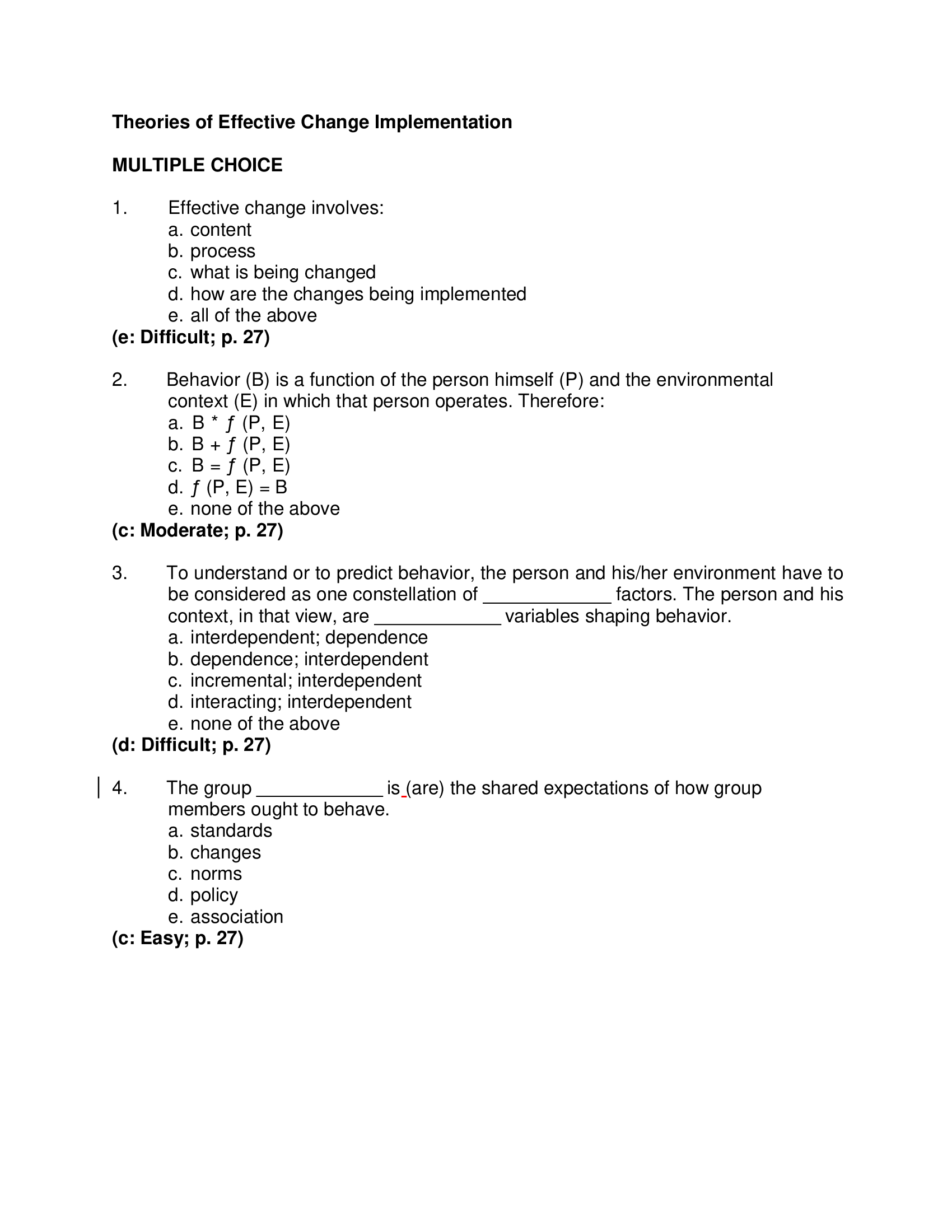
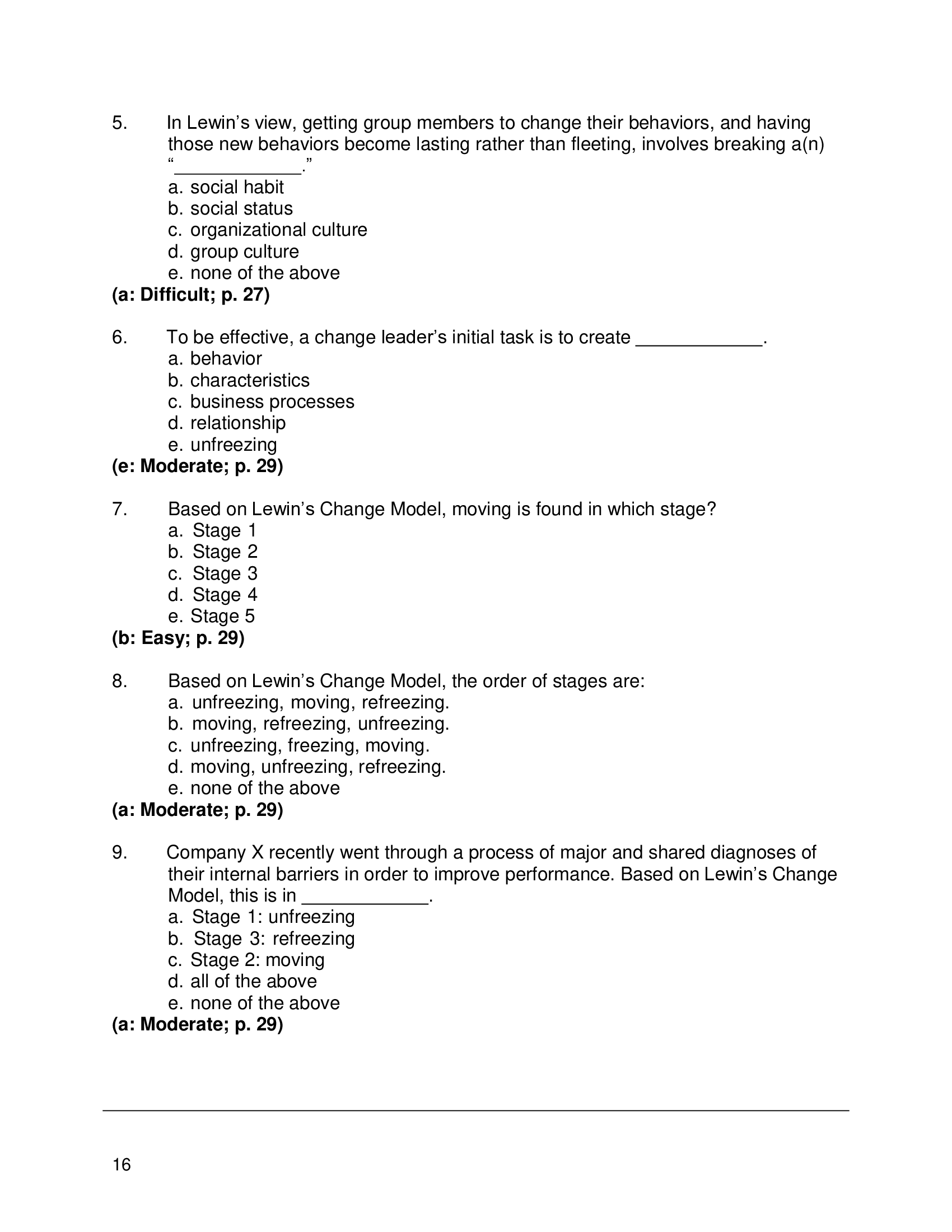
TEST BANK FOR IMPLEMENTING ORGANIZATIONAL CHANGE 3RD ED BY BERT SPECTOR Theories of Effective Change Implementation MULTIPLE CHOICE 1. Effective change involves: a. content b. process c. what is being changed d. how are the changes being implemented e. all of the above (e: Difficult; p. 27) 2. Behavior (B) is a function of the person himself (P) and the environmental context (E) in which that person operates. Therefore: a. B * ƒ (P, E) b. B + ƒ (P, E) c. B = ƒ (P, E) d. ƒ (P, E) = B e. none of the above (c: Moderate; p. 27) 3. To understand or to predict behavior, the person and his/her environment have to be considered as one constellation of factors. The person and his context, in that view, are variables shaping behavior. a. interdependent; dependence b. dependence; interdependent c. incremental; interdependent d. interacting; interdependent e. none of the above (d: Difficult; p. 27) 4. The group is (are) the shared expectations of how group members ought to behave. a. standards b. changes c. norms d. policy e. association (c: Easy; p. 27) 5. In Lewin’s view, getting group members to change their behaviors, and having those new behaviors become lasting rather than fleeting, involves breaking a(n) “ .” a. social habit b. social status c. organizational culture d. group culture e. none of the above (a: Difficult; p. 27) 6. To be effective, a change leader’s initial task is to create . a. behavior b. characteristics c. business processes d. relationship e. unfreezing (e: Moderate; p. 29) 7. Based on Lewin’s Change Model, moving is found in which stage? a. Stage 1 b. Stage 2 c. Stage 3 d. Stage 4 e. Stage 5 (b: Easy; p. 29) 8. Based on Lewin’s Change Model, the order of stages are: a. unfreezing, moving, refreezing. b. moving, refreezing, unfreezing. c. unfreezing, freezing, moving. d. moving, unfreezing, refreezing. e. none of the above (a: Moderate; p. 29) 9. Company X recently went through a process of major and shared diagnoses of their internal barriers in order to improve performance. Based on Lewin’s Change Model, this is in . a. Stage 1: unfreezing b. Stage 3: refreezing c. Stage 2: moving d. all of the above e. none of the above (a: Moderate; p. 29) 16 10. ABC Inc. recently trained employees for newly required skills. This is an example of Lewin’s Change Model, in . a. Stage 1: unfreezing b. Stage 3: refreezing c. Stage 2: moving d. all of the above e. none of the above (c: Moderate; p. 29) 11. Company X recently merged with Company Y. After extensive discussions with employees from both companies, a new direction was identified. The executives decided to create a new structure to reinforce this move. This is an example of Lewin’s Change Model in which stage? a. Stage 1: unfreezing b. Stage 3: refreezing c. Stage 2: moving d. all of the above e. none of the above (b: Moderate; p. 30) 12. offers a complex and systemic perspective on how and why people behave and organizations operate. a. organizational behavior b. organizational development c. organizational change d. organizational policy e. none of the above (b: Moderate; p. 30) 13. The effectiveness of organizations will be determined by a state of congruence between people, process, structure, values, and environment. Such underlying assumption is based on which organizational development perspectives? a. system perspective b. alignment perceptive c. participation perspective d. teamwork perspective e. problem-solving perspective (b: Moderate; p. 31) 14. take(s) as a starting point for change the work that needs to be undertaken in order for a unit to achieve outstanding performance. a. task assignment b. shifts in organizational effectiveness c. performance perspective d. task alignment e. none of the above (d: Difficult; p. 38) 15. Which of the following is NOT considered to be a part of the external environment based on the Congruence Model of Effectiveness? a. company’s financial position b. labor market c. government regulations d. customer trends e. none of the above (a: Difficult; p. 32) 16. In the Congruence Model of Effectiveness, the Internal Context refers to: a. organizational purpose. b. strategy. c. business model. d. organizational design. e. all of the above (e: Moderate; p. 32) 17. According to Lewin, the way to motivate an individual to change is to create a sense of with the . a. best; satisfaction; organization b. worst; satisfaction; organization c. optimum; equilibrium; status quo d. only; disequilibrium; status quo (d: Moderate; p. 27) 18. Effective organizational change starts with: a. working to motivate the individual. b. changing the context of individual behavior. c. calling in diagnostic consultants. d. getting funding for the change. e. none of the above (b: Moderate; p. 29) 19. The term “unfreezing” refers to: a. creating a warmer, more personal climate in the organization. b. mutual engagement. c. creating dissatisfaction with the status quo. d. using conflict resolution to resolve longstanding problems in the organization. e. none of the above (c: Moderate; p. 29) 20. In managing change, conflict: a. is always a positive force. b. is never a positive force. c. should be avoided at all cost. d. should be managed collaboratively. (d: Difficult; p. 34) 21. is a programmatic change in which specific programs are used as the centerpiece of implementation. a. content-driven change b. organization development c. process-driven change d. task alignment (a: Moderate; p. 35) 22. is an approach to change that emphasizes the methods of conceiving, introducing and institutionalizing new behaviors. a. content-driven change b. organization development c. process-driven change d. task alignment (c: Moderate; p. 35) 23 . In process-driven change, is used as a rather than a of new behaviors. a. content; driver; reinforcer b. process; reinforcer; driver c. content; reinforcer; driver d. driver; content; process (c: Difficult; p. 35) 24. Which of the following is NOT an attribute of content-driven change? a. it is both tangible and measurable b. it is popular c. it is standardized d. it is based on shared diagnosis (d: Moderate; p. 36) 25. Which of the following best describes the alternative to content-driven change? a. employee involvement b. employee involvement and task alignment c. task alignment d. measurement and assessment (b: Difficult; p. 40) 26. Change implementation should start with shared diagnosis because: a. it is cheaper to have everyone work on it. b. it is faster to do it together. c. it creates agreement about the requirements for change. d. diagnostic processes frequently contain errors. (c: Moderate; p. 41) 27. People alignment is the process of: a. reimbursing employees for visits to the chiropractor. b. matching the attributes of employees with company strategy. c. aligning performance with strategy. d. assisting people with new skills sets. (b: Easy; p. 43) 28. Which of the following is NOT a part of people alignment? a. assessment of employees b. recruitment and promotion c. removal and replacement d. retraining e. promotion (d: Difficult; pp. 43-44) 29. Mutual engagement is best described as: a. a process of building dialogue and commitment among stakeholders. b. romantic relationships between two or more partners. c. the alignment of all processes and structures in the organization. d. the willingness to question assumptions and ideas. (a: Moderate; p. 46) 30. Using the model of effective change implementation, beginning a change process with a new structure, such as a balanced scorecard measuring system, would be considered: a. an accurate, content-driven move. b. an implementation trap. c. a process-driven approach. d. an example of task alignment. (b: Difficult; pp. 45-46) TRUE / FALSE 31. To break the “social habits” that support current patterns of behaviors, effective implementation needs to start with dissatisfaction, disequilibrium and discomfort. (True: Easy; p. 28) 32. Moving refers to members of a group who move from one set of behaviors to another. (True: Moderate; p. 29) 33. The three stages in Lewin’s model are unfreezing, moving and refreezing. (True: Easy; p. 29) 34. To break the social habits that support existing patterns of behavior, start with creating dissatisfaction and discomfort. (True: Moderate; p. 28) 35. Telling employees why they need to change will not make them change. (True: Easy; p. 27) 36. In order to implement change, focus on individual behaviors first and then on group norms. (False: Moderate; p. 27) 37. The underlying assumption for the systems perspective is that outstanding performance depends on interactions between and among the multiple elements of organization; between the people, processes, structure, and values of the organization; and between the organization and its external environment. (True: Moderate; p. 31) 38. The underlying assumption for the alignment perceptive is that the effectiveness of organizations will be determined by a state of congruence between people, process, structure, values and environment. (True: Moderate; p. 31) 39. Based on the congruence model, organizational effectiveness relies on the alignment between the internal context, the external environment and the patterns of employee behavior. (True: Easy; p. 32) 40. The organization’s internal context refers to patterns of employee behavior. (False: Easy; p. 32) 41. The organization’s external environment refers to the culture and climate of the organization. (False: Moderate; p. 32) 42. Because organizational employees get paid, they are not considered to be a part of the stakeholders of the organization. (False: Easy; p. 33) 43. The multiple stakeholder perspective represents in part an ethical view of the role of business organizations in the community. (True: Moderate; p. 33) 44. Content-driven change creates an organizational climate in which employees will be motivated to adopt new behaviors consistent with the strategic direction of the organization. (False: Moderate; pp. 35-36) 45. Content-driven change is both tangible and measurable. (True: Easy; p. 37) 46. A task-aligned approach to change implementation motivates people to change their behaviors by focusing on the big picture and feelings of connectedness. (False: Moderate; pp. 38-39) 47. Kicking off change implementation with shared diagnosis builds dissatisfaction with the status quo. (True: Moderate; p. 42) 48. Asking employees to enact new behaviors can be supported by organizational help in learning new skills. (True: Easy; p. 44) 49. Effective change implementation does not require new skills and competencies on the part of the organization’s employees. (False: Easy; p. 44) 50. Mutual engagement occurs at the shared diagnosis stage but not during people alignment stage. (False: Moderate; p. 44) ESSAY QUESTIONS 51. What are the two key concepts proposed by Lewin? Because an individual’s behavior is a function both of that person’s psychology and his environmental context, the most effective way to create lasting behavioral change is to change that environmental context. Before behavioral change can occur, let alone become institutionalized, forces must be exerted to create disequilibrium in the status quo. (Moderate; p. 27) 52. Discuss Lewin’s approach to behavior (including the formula). Lewin’s approach to behavior explained the influence of context with a simple formula: B = ƒ (P, E). Behavior (B) is a function of the person herself (P) and the environmental context (E) in which that person operates. “In this equation,” wrote Lewin, “the person (P) and his environment (E) have to be viewed as variables which are mutually dependent upon each other. To understand or to predict behavior, the person and his environment have to be considered as one constellation of interdependent factors.” The person and his context, in that view, are interdependent variables shaping behavior. (Difficult; p. 27) 53. Explain the concept of unfreezing, moving and refreezing. To be effective, a change leader’s initial task is to create what Lewin called unfreezing—that is all forms for learning and change start with some form of dissatisfaction or frustration. The second stage of Lewin’s model involves moving, whereby members of the group move from one set of behaviors to another. Those new behaviors must become permanent, for at least a desired period of time. That is the refreezing stage where a newly created equilibrium “is made relatively secure against change. Refreezing is the stage, where social system components become congruent with, and thus support, intended change in one or more components.” (Easy; p. 29) 54. Explain the field of organizational development. The field of organizational development (OD) soon coalesced around emergent learnings from behavioral and social sciences to inform approaches to planned organizational change. There are 10 key perspectives and assumptions that underlie the field. OD offers a complex and systemic perspective on how and why people behave and organizations operate. For that reason, OD provides particular insight into the process of changing people’s behavior and organizations’ operations. Three insights in particular help advance an understanding of effective change implementation: organizations as open systems, multiple stakeholders, and effective management of conflict. (Moderate; pp. 30-34) 55. Identify the 10 perspectives identified in organizational development and the relevant underlying assumptions. Systems perspective Outstanding performance depends on interactions between and among the multiple elements of the organization; between the people, processes, structure, and values of the organization; and between the organization and its external environment. Alignment perceptive The effectiveness of organizations will be determined by a state of congruence between people, process, structure, values, and environment. Participation perspective People will become more committed to implementing solutions if they have been involved in the problemsolving process. Social capital perspective To achieve outstanding performance, organizational leaders seek to create a network of interdependent relationships that provides the basis for trust, cooperation, and collective action. Teamwork perspective Accepting shared purpose and responsibility for interdependent tasks enhances coordination, commitment, and creativity and supports outstanding performance. Multiple stakeholder perspective Outstanding performance requires that organizational leaders balance the expectations of multiple stakeholders: shareholders, employees, customers, suppliers, host community, labor unions, trade associations, governments, etc. Problem-solving perspective Conflicts over task issues can increase the quality of decisions if they occur in an environment of collaboration and trust. Open communications perspective Open and candid communication, especially upward in the hierarchy, creates the opportunity for learning and development while building trust and collaboration. Evolution/ revolution perspective Organizations must develop competencies to engage in both incremental (evolutionary) and fundamental (revolutionary) change. Process facilitation perspective Individuals who reside outside of the organizational hierarchy can become both facilitators and teachers of effective implementation processes in partnership with organizational members. (Moderate; p. 31) 56. Describe the Congruence Model of Effectiveness. This model suggests that effective organizations work on aligning 3 key elements: the internal context of the organization (purpose, strategy, business model, organizational design), the external environment (stakeholder expectations, labor market, technology shifts, government, etc.) and patterns of employee behavior (roles, responsibilities, interactions). (Moderate; p. 32) 57. Describe Spector’s sequential model of effective change implementation. This model begins by advocating for process-driven change which argues that change will be more effective if it is built on involvement and commitment, and if it focuses on aligning employee tasks with the strategic direction of the organization. To build commitment, the model advocates beginning with shared diagnosis so that all parties will agree on the need to change and the direction for change. Also, the model advocates mutual engagement in all stages, which in turn requires mutuality, reciprocity, advocacy and inquiry. The model itself has 4 steps: 1. Redesigning roles, responsibilities and relationships and key in this step is the idea of task alignment. 2. Help which involves offering training and mentoring to employees in order to assist in the process of learning new behaviors. 3. People alignment which deals with assessment, promotion, replacement and recruitment as ways to make sure the people are in the proper place to support the changes. 4. Systems and structures which deals with aligning reporting relationships, compensation, information and measurement and control to ensure that all of these elements effectively reinforce the new behaviors and activities. The model is a sequential model and cautions against implementation traps, which include switching the steps in the model and skipping the essential requirements of shared diagnosis and mutual engagement. (Difficult; p.41) Scenario-Based Questions You are the CEO in a large and trendy interior design firm, servicing both corporate and wealthy individual clients. Your organization’s excellent reputation is built on the edgy design offered by your talented and creative designers. Recently, however, you have started to lose clients due to complaints about customer service. It seems that the designers of late have become more interested in their own individual reputation and fame than in the clients’ needs. Also, your firm has received negative press for its unwillingness to embrace green and sustainable design standards. Your top executive team has decided to make client service the new corporate priority and it has called a meeting to announce this new strategy. 58. Using Spector’s model, this meeting should focus on: a. clearly outlining the new strategy and its implications for people and structures. b. developing a step-by-step process for measuring client service. c. aligning the internal, external and employee environment. d. involving everybody in shared diagnosis first. (d: Difficult; p. 41) 59. Your employees are not happy with your announcement about the new strategy. While they realize that there are issues with customer service, they question the top executives’ decision to make service the new priority, arguing that a focus on service will hurt the quality of their design. Your response is: a. to explain way their actions created the problem b. to engage in discussion and dialogue c. to observe the most vocal opponents and plan a firing strategy d. to move along as planned, keeping focused on the end goal e. none of the above (b: Difficult; p. 46) 60. One of the options for your new strategy is a program in customer service training. You have seen this program in action at one of your competitors and it worked beautifully there. You should decide: a. to purchase this program because it is ready to go and it will give you some focus and structure in the change process. b. to purchase this program because it worked well for your competitor and you must keep up with changes in the environment. c. to work within the company to develop your own program for customer service recognizing that there are no ready-made solutions. d. none of the above (c: Moderate; p. 45) 

GSEC 401 Exam Questions and Answers 2024GSEC 401 Exam Questions and Answers 2024

GSEC 401 Exam Questions and Answers 2024

GSEC 401 Exam Questions and Answers 2024

Contact the Seller

Please Sign In to contact this seller.


  • 👎  Report Copyright Violation

Frequently Asked Questions

What Do I Get When I Buy This Study Material?

+

When you buy a study material on Passing Grades, an instant download link will be sent directly to your email, giving you access to the file anytime after payment is completed.

Is Passing Grades a Trusted Platform?

+

Yes, Passing Grades is a reputable students’ marketplace with a secure payment system and reliable customer support. You can trust us to ensure a safe and seamless transaction experience.

Will I Be Stuck with a Subscription?

+

No, all purchases on Passing Grades are one-time transactions. You only pay for the notes you choose to buy, with no subscriptions or hidden fees attached.

Who Am I Buying These Study Materials From?

+

Passing Grades is a marketplace, which means you are purchasing the document from an individual vendor, not directly from us. We facilitate the payment and delivery process between you and the vendor.

Does Passing Grades Offer Free Study Materials?

+

Yes, sellers on Passing Grades have uploaded numerous free test banks, exams, practice questions, and class notes that can be downloaded at no cost.


Pasinggrades - Quality Study Materials

USD 15

    • Quality checked by Pasing Grades
    • 100% satisfaction guarantee
    • Seller: Gradepush
Buy PDF $15

Seller Information

Gradepush

Member since December 2023

  • icon
  • icon
View Profile
  • total sales

    0
  • Favourites

    0
  • Comments

    0
    ( 0 Ratings )

Item Information

  • Uploaded

    05 August 2024

  • Updated

    21 June 2025

  • Category

    No category

  • Item Type

    test bank

  • Tags

    Test Bank for Implementing Organizational Change 3rd Edition by Bert Spector

Related Exam Prep Guides by Gradepush

NR 509 Week 1 Quiz 2026 Real Test
View Document

NR 509 Week 1 Quiz 2...

  • Gradepush

    Gradepush

  • test bank

NR 509 Week 1 Quiz 2025: Test your knowledge on holistic health, subjective vs. objective data, and ...

15 USD

0

0

NR 509 Week 2 Quiz 2026 Real Test
View Document

NR 509 Week 2 Quiz 2...

  • Gradepush

    Gradepush

  • test bank

NR 509 Week 2 Quiz 2025: Evaluate your understanding of physical assessment techniques, including in...

15 USD

0

0

NR 509 Week 3 Quiz 2026 Real Test
View Document

NR 509 Week 3 Quiz 2...

  • Gradepush

    Gradepush

  • test bank

NR 509 Week 3 Quiz 2025 focuses on key musculoskeletal concepts such as joint movements, flexion, an...

15 USD

0

0

Purchase

Download link will be sent to this email immediately after purchase.

IMPORTANT LINKS

  • How To Upload Class Notes
  • Selling Tips
  • Passing Grades's Study Materials
  • Scholarships for International Students 2026

POPULAR CATEGORIES

  • Law
  • Accounting
  • English
  • Psychology
  • Business
  • Nursing
  • Computer Science
  • General

View Document

  • Blog
  • Contact
  • Delivery Policy
  • Latest Scholarships Around the World
  • How to Pass Bar Exams: Passing Grades’ Strategies
  • How to Study and Pass the CPA Exam
  • All Test Banks
  • Faq
  • Copyright Claims
  • Privacy Policy
  • Terms of Use

KNOWLEDGE BASE

  • How to Write A+ Grade Good Research Paper
  • How to Manage Stress During Exam Period
  • Best Time to Study
  • How to Pass NCLEX-RN Exam
  • How To Effectively Utilize Test Banks
  • Popular Shadow Health Exam Assessments
  • Popular HESI Case Studies
  • How to Prepare for a Nursing Career
  • The Importance Of Summaries in Exam Revisvion

© 2026 Pasing Grades. All rights reserved.