Pasing Grades
  • Start Selling
  • Blog
  • Contact
  • 0

    Your cart is empty!

English

  • English
  • Spanish
  • Arabic
Create Account Sign In
  • Library
    • New Prep Guides
    • Featured Prep Guides
    • Free Exam Prep Guides
    • Best sellers
  • General
  • Nursing
    • Research Paper
    • Case Study
    • Discussion Post
    • Assignment
    • Exam
    • Practice Questions and Answers
    • Test Bank
    • solutions manual
  • Accounting
    • Case Study
    • Thesis
    • Study Guide
    • Summary
    • Research Paper
    • test bank
  • English
    • Creative Writing
    • Research Paper
    • Summary
    • Rhetorics
    • Literature
    • Journal
    • Exam
    • Grammar
    • Discussion Post
    • Essay
  • Psychology
    • Hesi
    • Presentation
    • Essay
    • Summary
    • Study Guide
    • Essay
    • Solution Manual
    • Final Exam Review
    • Class Notes
    • test bank
  • Business
    • Lecture Notes
    • Solution Manual
    • Presentation
    • Business Plan
    • Class Notes
    • Experiment
    • Summary
    • Practice Questions
    • Study Guide
    • Case Study
    • test bank
    • Exam
  • More
    • Computer Science
    • Economics
    • Statistics
    • Engineering
    • Biology
    • Religious Studies
    • Physics
    • Chemistry
    • Mathematics
    • History
    • Sociology
    • Science
    • Philosophy
    • Law
  • Pages
    • About Us
    • Selling Tips
    • Delivery Policy
    • Faq
    • Privacy Policy
  • Flash Sale
  • Home
  • Test Bank for Genetics A Conceptual Approach, 7th Edition Benjamin Pierce

Test Bank for Genetics A Conceptual Approach, 7th Edition Benjamin Pierce

Preview page 1 Preview page 2 Preview page 3
Add To Favorites

Share this item Share this item

  • Item Details
  • Comments (0)
  • Reviews (0)
  • Contact Seller

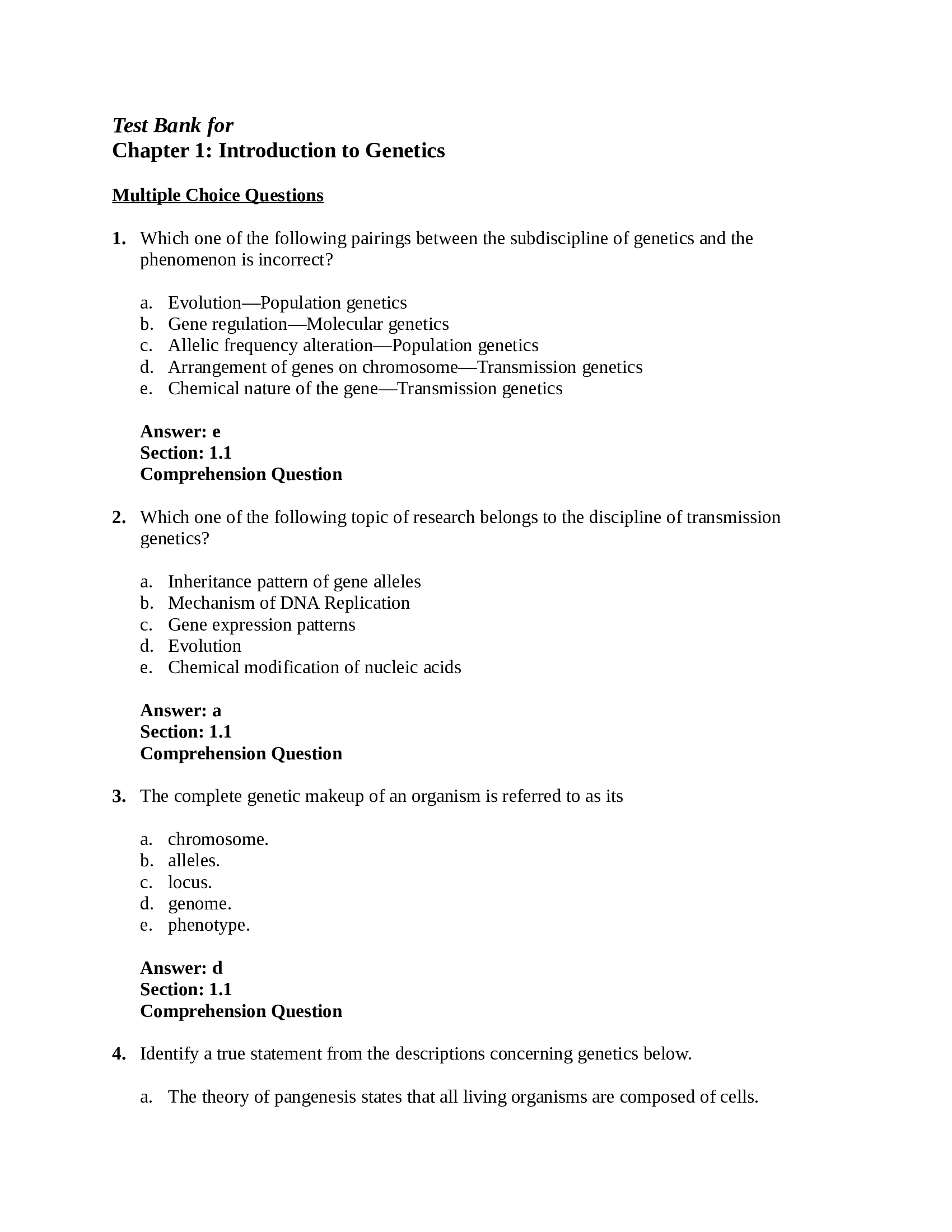
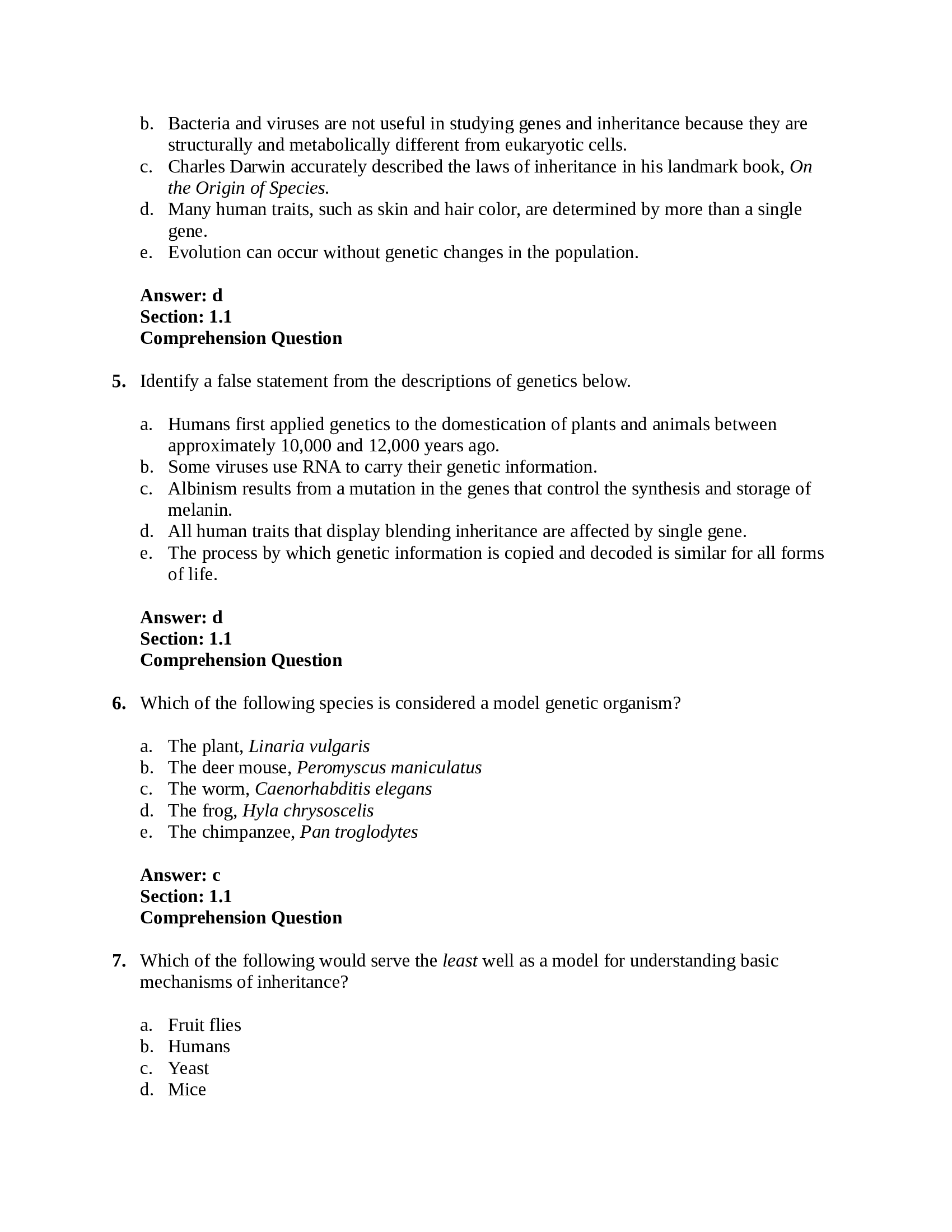
TEST BANK GENETICS A CONCEPTUAL APPROACH, 7E BENJAMIN PIERCE Test Bank for Chapter 1: Introduction to Genetics Multiple Choice Questions 1. Which one of the following pairings between the subdiscipline of genetics and the phenomenon is incorrect? a. Evolution—Population genetics b. Gene regulation—Molecular genetics c. Allelic frequency alteration—Population genetics d. Arrangement of genes on chromosome—Transmission genetics e. Chemical nature of the gene—Transmission genetics Answer: e Section: 1.1 Comprehension Question 2. Which one of the following topic of research belongs to the discipline of transmission genetics? a. Inheritance pattern of gene alleles b. Mechanism of DNA Replication c. Gene expression patterns d. Evolution e. Chemical modification of nucleic acids Answer: a Section: 1.1 Comprehension Question 3. The complete genetic makeup of an organism is referred to as its a. chromosome. b. alleles. c. locus. d. genome. e. phenotype. Answer: d Section: 1.1 Comprehension Question 4. Identify a true statement from the descriptions concerning genetics below. a. The theory of pangenesis states that all living organisms are composed of cells. b. Bacteria and viruses are not useful in studying genes and inheritance because they are structurally and metabolically different from eukaryotic cells. c. Charles Darwin accurately described the laws of inheritance in his landmark book, On the Origin of Species. d. Many human traits, such as skin and hair color, are determined by more than a single gene. e. Evolution can occur without genetic changes in the population. Answer: d Section: 1.1 Comprehension Question 5. Identify a false statement from the descriptions of genetics below. a. Humans first applied genetics to the domestication of plants and animals between approximately 10,000 and 12,000 years ago. b. Some viruses use RNA to carry their genetic information. c. Albinism results from a mutation in the genes that control the synthesis and storage of melanin. d. All human traits that display blending inheritance are affected by single gene. e. The process by which genetic information is copied and decoded is similar for all forms of life. Answer: d Section: 1.1 Comprehension Question 6. Which of the following species is considered a model genetic organism? a. The plant, Linaria vulgaris b. The deer mouse, Peromyscus maniculatus c. The worm, Caenorhabditis elegans d. The frog, Hyla chrysoscelis e. The chimpanzee, Pan troglodytes Answer: c Section: 1.1 Comprehension Question 7. Which of the following would serve the least well as a model for understanding basic mechanisms of inheritance? a. Fruit flies b. Humans c. Yeast d. Mice e. Zebrafish Answer: b Section: 1.1 Comprehension Question 8. Which of the following statements is true? a. Each subdiscipline of genetics is very specific as to what is explored and does not overlap with the other subdisciplines. b. All phenotypes or traits are always determined by multiple genes. c. Albinism rises from the overexpression of the gene that controls the synthesis and storage of melanin. d. Humans make excellent model organisms, as a variety of traits are well-defined. e. None of the statements above are true. Answer: e Section: 1.1 Application Question 9. Which of the following statements is correct? a. All genomes are encoded in DNA only. b. All genomes are encoded in nucleic acids. c. All genomes are encoded in proteins only. d. The genetic instructions are decoded completely differently in each organism. e. The molecular mechanism suggests life evolved from multiple primordial ancestors. Answer: b Section: 1.1 Application Question 10. Which of the following theories of inheritance is currently considered true? a. Germ-plasm theory b. Pangenesis c. Blending inheritance d. Inheritance of acquired characteristics e. None of the above is considered true based on new evidence. Answer: a Section: 1.2 Comprehension Question 11. Which one of the following topics belongs to a different subdiscipline of genetics when compared to the rest? a. Mechanism of gene regulation b. Allele frequencies of certain gene in different environments c. Transcription d. Chemical alternation of chromosomes e. Mechanism of DNA repairs and maintenance Answer: b Section: 1.2 Comprehension Question 12. Which of the following theories of inheritance is no longer accepted as true? a. Pangenesis b. Blending inheritance c. Inheritance of acquired characteristics d. Preformationism e. None of the above is currently considered true. Answer: e Section: 1.2 Comprehension Question 13. Which of the following correctly describes the cell theory? a. Genetic information from different parts of the body travels to the reproductive organs. b. The cell is the compositional and functional unit of all life. c. Inside the germ cells, there exists a fully formed miniature adult which enlarges in the course of development d. The genetic material itself blends, which cannot be separated out in figure generations. e. Traits acquired in a person’s lifetime become incorporated into the person’s hereditary information, which will be passed onto their offspring. Answer: b Section: 1.2 Comprehension Question 14. Which of the following examples of scientist and their contribution is matched incorrectly? a. Watson and Crick—chemical structure of DNA b. Mendel—principles of heredity using pea plants c. Gilbert and Sanger—DNA sequencing methods d. Morgan—polymerase chain reaction e. Sutton—genes on chromosomes as units of inheritance Answer: d Section: 1.2 Comprehension Question 15. Choose the correct match between the scientist and the field of genetics that they made the contribution to. a. Haldane and Wright—transmission genetics b. Mendel—molecular genetics c. Gilbert and Sanger—population genetics d. Darwin—molecular genetics e. Morgan—transmission genetics Answer: e Section: 1.2 Comprehension Question 16. The first complete DNA sequence of a non-viral, free-living organism was obtained for a. a bacterium in 1900. b. a bacterium in 1945. c. a bacterium in 1995. d. humans in 1990. e. humans in 2000. Answer: c Section: 1.2 Comprehension Question 17. The three-dimensional structure of DNA was first deciphered based on the work of a. James Watson. b. Francis Crick. c. Maurice Wilkins. d. Rosalind Franklin. e. All of the above Answer: e Section: 1.2 Comprehension Question 18. Which of the following scientists contributed significantly to the foundations of population genetics? a. James Watson b. Thomas Hunt Morgan c. Ronald Fisher d. Charles Darwin Answer: c Section: 1.2 Comprehension Question 19. Which of the following scientists contributed significantly to the foundations of molecular genetics? a. James Watson b. Thomas Hunt Morgan c. John B. S. Haldane d. Charles Darwin Answer: a Section: 1.2 Comprehension Question 20. Which of the following scientists contributed significantly to the foundations of transmission genetics? a. James Watson b. Thomas Hunt Morgan c. John B. S. Haldane d. Charles Darwin Answer: b Section: 1.2 Comprehension Question 21. The contribution Charles Darwin made to biology was to a. demonstrate the connection between Mendel’s principles of inheritance and evolution. b. propose that evolution occurs by natural selection. c. develop the theory of evolution, based on earlier theories of population genetics. d. connect the fields of evolution and molecular genetics. Answer: b Section: 1.2 Comprehension Question 22. _______________ combines molecular biology and computer science. a. Single-nucleotide polymorphism b. MicroRNAs c. Polymerase chain reaction d. Bioinformatics e. Eukaryotics Answer: d Section: 1.2 Comprehension Question 23. A measurable or observable trait or characteristic is called a a. phenotype. b. genotype. c. single-nucleotide polymorphism. d. Small interfering RNA. e. gene bank. Answer: a Section: 1.2 Comprehension Question 24. The complete genetic makeup of any organism is referred to as a. phylogeny. b. pheynotype. c. genome. d. genotype. e. single-nucleotide polymorphism. Answer: c Section: 1.2 Comprehension Question 25. A change in allele frequency within a population over time leads to a. a genome. b. a phenotype. c. a genotype. d. mutations. e. evolution. Answer: e Section: 1.3 Comprehension Question 26. Genetic information can be carried in which of the following biomolecules? a. Proteins b. DNA and not RNA c. RNA and not DNA d. Either DNA or RNA e. Proteins and not RNA Answer: d Section: 1.3 Comprehension Question 27. Which correctly shows the flow of genetic information during gene expression? a. RNA → DNA → protein b. Protein → DNA → RNA c. DNA → RNA → protein d. DNA → protein → DNA e. None of the above Answer: c Section: 1.3 Comprehension Question 28. The contribution of Gilbert and Sanger to modern genetics was to a. develop the PCR technique. b. discover DNA in the nucleus of cells. c. describe the structure of DNA. d. show that genes were made of DNA. e. develop a method for sequencing DNA. Answer: e Section: 1.3 Comprehension Question 29. Which of the following is not a part of a single nucleotide? a. Nitrogenous base b. Sugar c. Hydrogen bond d. Phosphate Answer: c Section: 1.3 Comprehension Question 30. A form of a gene that has a slightly different sequence than other forms of the same gene but encodes the same type of an RNA or protein, is called a(n) a. locus. b. allele. c. homologous chromosome. d. heterozygote. e. homozygote. Answer: b Section: 1.3 Comprehension Question 31. __________is a change in allele frequency of a population over time. a. Blending inheritance b. Preformation c. Genome d. Evolution e. Phenotype Answer: d Section: 1.3 Comprehension Question 32. Permanent, heritable changes in genetic information (DNA) are called a. evolution. b. defects. c. SNP. d. alleles. e. mutations. Answer: e Section: 1.3 Comprehension Question 33. Within cells, genes are located on structures called a. genomes. b. chromosomes. c. phenotypes. d. genotypes. e. alleles. Answer: b Section: 1.3 Comprehension Question Short Answer Questions 34. Albinism is rare in most human populations, occurring at a frequency of about 1 in 20,000 people. However, the trait occurs at a frequency of 1 in 200 in certain Hopi villages of Black Mesa in Arizona. Explain in terms of natural selection why albinism is so rare in most human populations. Answer: In most populations, there is fairly strong selection against albinism because albinos don’t produce melanin, causing their skin cells not to be protected from the damaging effects of sunlight. Also, the lack of melanin in their eyes causes them to have poor eyesight. Finally, in most cultures albinos are seen as abnormal, and they are not normally sought out for marriage and mating. Therefore, in most populations the alleles that cause albinism are selected against, and they decrease in frequency or are kept at a low level, causing the recessive trait to be rare. Introduction Application Question 35. Albinism is rare in most human populations, occurring at a frequency of about 1 in 20,000 people. However, the trait occurs at a frequency of 1 in 200 in certain Hopi villages of Black Mesa in Arizona. Explain in terms of natural selection why the trait is so much more common among the Hopis of Black Mesa. Answer: Albinos occupy a privileged position among the Hopis of Black Mesa. In this culture, albinos are viewed as especially pretty, clean, and intelligent, and they often occupy positions of leadership. Albinos are celebrated in the villages as a sign of purity of Hopi blood in the community. Furthermore, albinos are often excused from normal male field labor because of their sensitivity to sunlight, causing them to be left behind in the village with the women during the daytime. This allows them extra mating opportunities compared to the other men of the village. Therefore, the alleles that cause albinism are either selected for in this culture or at least not selected against as strongly as in other cultures, allowing the trait to occur at a much higher frequency. Introduction Application Question 36. Albinism is rare in most human populations, occurring at a frequency of about 1 in 20,000 people. However, the trait occurs at a frequency of 1 in 200 in certain Hopi villages of Black Mesa in Arizona.In light of this example and others that you might be aware of, critique the idea that a particular allele is either beneficial (adaptive) or harmful (maladaptive). Answer: This example and others show that the effect of a particular allele cannot be evaluated outside of the context of the environment of the population in which the allele exists. A particular allele might be harmful in one environment but beneficial in another environment. Although we know of some alleles that seem to be harmful in all current environments, they might have been beneficial in the past or might be in the future. Introduction Application Question 37. List some traits of a species that make it ideal as a genetic model organism. Answer: (1) Short generation time (2) Sufficient numbers of progeny for study (3) Adaptability to a laboratory environment (4) Ability to be inexpensively housed and propagated (5) Small size Section 1.1 Application Question 38. The fruit fly Drosophila melanogaster is an important model system for studying inheritance in animals and genetic control of animal development, including humans. If researchers ultimately want to understand a biological process in humans, why might they want to study the process in fruit flies first? Answer: Researchers might want to study the process in fruit flies first because it would likely be easier to study it in fruit flies, and what is discovered in fruit flies might apply to humans. Fruit flies have been used for over 100 years as a model system to study animal genetics and development. Section 1.1 Application Question 39. The fruit fly Drosophila melanogaster is an important model system for studying inheritance in animals and genetic control of animal development, including humans. Evaluate fruit flies as a model system for human biology. What are their strengths and weaknesses as a model system? Answer: Strengths – Fruit flies have proven to be an excellent model system for studying aspects of biology that they share with humans. Fruit flies are simpler in structure and physiology than humans and have a much simpler genome. They are small and easy to raise, they have a short generation time, and they produce a large number of offspring. Their chromosomes have been mapped and their genomes analyzed extensively. It is relatively easy to isolate and study mutants that are defective in specific processes of interest. These characteristics make them ideal for genetic studies of biological processes. Weaknesses – Some aspects of fruit fly genetics and development are not shared with humans. Therefore, some features discovered in fruit flies will not apply directly to humans. Also, humans have many features that fruit flies lack. Fruit flies will not serve well as a model system for studying these features of human biology. Section 1.1 Application Question 40. What common features of heredity suggest that all life on Earth evolved from a common ancestor? Answer: Despite the remarkable diversity of life on Earth, all genomes are encoded in nucleic acids. With few exceptions, the genetic code is common to all forms of life. Finally, the process by which genetic information is copied and decoded is remarkably similar for all forms of life. Section 1.1 Application Question 41. Why might bacteria and viruses be good model organisms for studying the basics of inheritance? Describe two advantages over studying genetics in mice, dogs, or humans. Answer: Bacteria and viruses have their genetic material (DNA) organized into genes, just like other organisms, so the basics of inheritance are the same in bacteria and viruses, as in other organisms. The genetic systems of bacteria and viruses are simpler when compared to higher eukaryotic organisms such as mice, dogs, or humans: they have fewer genes, fewer chromosomes, and less DNA. Bacteria and viruses reproduce more quickly than higher eukaryotic organisms: the generation time is shorter than for mice, dogs, or humans. Bacteria and viruses are easy and less expensive to grow (take up less space, have less complicated nutritional needs) than vertebrates. Section 1.1 Application Question 42. Many good ideas in science ultimately turn out to be incorrect. The author mentions several such ideas in the history of genetics. In your own words, state one idea in the history of genetics that turned out to be incorrect. Answer: Answers will vary but might include pangenesis, inheritance of acquired characteristics, preformationism, or blending inheritance, which are all described in Section 1.1. Pangenesis – The idea that information needed to encode each body structure is stored in that structure and transported to the reproductive organs and passed to the embryo at conception. Inheritance of acquired characteristics – The idea that traits acquired through use during one’s lifetime can be passed to one’s offspring. Preformationism – The idea that the sperm or egg carries a tiny preformed person whose development simply involves enlargement. Blending inheritance – The idea that the genetic material is a fluid that gets blended during sexual reproduction between a male and female, resulting in the production of traits in the offspring that are blended intermediates of those of the parents. Section 1.1 Application Question

Contact the Seller

Please Sign In to contact this seller.


  • 👎  Report Copyright Violation

Frequently Asked Questions

What Do I Get When I Buy This Study Material?

+

When you buy a study material on Passing Grades, an instant download link will be sent directly to your email, giving you access to the file anytime after payment is completed.

Is Passing Grades a Trusted Platform?

+

Yes, Passing Grades is a reputable students’ marketplace with a secure payment system and reliable customer support. You can trust us to ensure a safe and seamless transaction experience.

Will I Be Stuck with a Subscription?

+

No, all purchases on Passing Grades are one-time transactions. You only pay for the notes you choose to buy, with no subscriptions or hidden fees attached.

Who Am I Buying These Study Materials From?

+

Passing Grades is a marketplace, which means you are purchasing the document from an individual vendor, not directly from us. We facilitate the payment and delivery process between you and the vendor.

Does Passing Grades Offer Free Study Materials?

+

Yes, sellers on Passing Grades have uploaded numerous free test banks, exams, practice questions, and class notes that can be downloaded at no cost.


Pasinggrades - Quality Study Materials

USD 15

    • Quality checked by Pasing Grades
    • 100% satisfaction guarantee
    • Seller: mentor2000
Buy PDF $15
icon This item was featured on Pasing Grades

Seller Information

mentor2000

Member since April 2021

  • icon
  • icon
  • icon
View Profile
  • total sales

    1
  • Favourites

    0
  • Comments

    0
    ( 0 Ratings )

Item Information

  • Uploaded

    12 January 2024

  • Updated

    01 October 2025

  • Category

    Nursing

  • Item Type

    test bank

  • Tags

    Test Bank Genetics A Conceptual Approach 7th Edition Benjamin Pierce

Related Exam Prep Guides by mentor2000

Test Bank for Essentials for Nursing Practice 8th Edition by Potter | All Chapters
View Document

Test Bank for Essent...

  • mentor2000

    mentor2000

  • test bank

Master nursing concepts with this study material; Test Bank for Essentials for Nursing Practice, 8th...

15 USD

0

1

A &P 1 MA278 BSC2 Final Module II Questions & Answers 2026 Update
View Document

A &P 1 MA278 BSC2 Fi...

  • mentor2000

    mentor2000

  • test bank

Prepare for success with A&P 1 MA278 BSC2 Final Module II 2024 Q&A. Boost your grades with this comp...

15 USD

0

1

ATI Comprehensive Predictor Exam 2026
View Document

ATI Comprehensive Pr...

  • mentor2000

    mentor2000

  • test bank

Prepare for success with the ATI Comprehensive Predictor Exam 2026. Access key practice questions to...

15 USD

0

1

Purchase

Download link will be sent to this email immediately after purchase.

IMPORTANT LINKS

  • How To Upload Class Notes
  • Selling Tips
  • Passing Grades's Study Materials
  • Scholarships for International Students 2025

POPULAR CATEGORIES

  • Law
  • Accounting
  • English
  • Psychology
  • Business
  • Nursing
  • Computer Science
  • General

View Document

  • Blog
  • Contact
  • Delivery Policy
  • Latest Scholarships Around the World
  • How to Pass Bar Exams: Passing Grades’ Strategies
  • How to Study and Pass the CPA Exam
  • All Test Banks
  • Faq
  • Copyright Claims
  • Privacy Policy
  • Terms of Use

KNOWLEDGE BASE

  • How to Write A+ Grade Good Research Paper
  • How to Manage Stress During Exam Period
  • Best Time to Study
  • How to Pass NCLEX-RN Exam
  • How To Effectively Utilize Test Banks
  • Popular Shadow Health Exam Assessments
  • Popular HESI Case Studies
  • How to Prepare for a Nursing Career
  • The Importance Of Summaries in Exam Revisvion

© 2026 Pasing Grades. All rights reserved.