Pasing Grades
  • Start Selling
  • Blog
  • Contact
  • 0

    Your cart is empty!

English

  • English
  • Spanish
  • Arabic
Create Account Sign In
  • Library
    • New Prep Guides
    • Featured Prep Guides
    • Free Exam Prep Guides
    • Best sellers
  • General
  • Nursing
    • Research Paper
    • Case Study
    • Discussion Post
    • Assignment
    • Exam
    • Practice Questions and Answers
    • Test Bank
    • solutions manual
  • Accounting
    • Case Study
    • Thesis
    • Study Guide
    • Summary
    • Research Paper
    • test bank
  • English
    • Creative Writing
    • Research Paper
    • Summary
    • Rhetorics
    • Literature
    • Journal
    • Exam
    • Grammar
    • Discussion Post
    • Essay
  • Psychology
    • Hesi
    • Presentation
    • Essay
    • Summary
    • Study Guide
    • Essay
    • Solution Manual
    • Final Exam Review
    • Class Notes
    • test bank
  • Business
    • Lecture Notes
    • Solution Manual
    • Presentation
    • Business Plan
    • Class Notes
    • Experiment
    • Summary
    • Practice Questions
    • Study Guide
    • Case Study
    • test bank
    • Exam
  • More
    • Computer Science
    • Economics
    • Statistics
    • Engineering
    • Biology
    • Religious Studies
    • Physics
    • Chemistry
    • Mathematics
    • History
    • Sociology
    • Science
    • Philosophy
    • Law
  • Pages
    • About Us
    • Selling Tips
    • Delivery Policy
    • Faq
    • Privacy Policy
  • Flash Sale
  • Home
  • Test Bank for Genetics A Conceptual Approach 6th Edition by Pierce

Test Bank for Genetics A Conceptual Approach 6th Edition by Pierce

Preview page 1 Preview page 2 Preview page 3
Add To Favorites

Share this item Share this item

  • Item Details
  • Comments (0)
  • Reviews (0)
  • Contact Seller

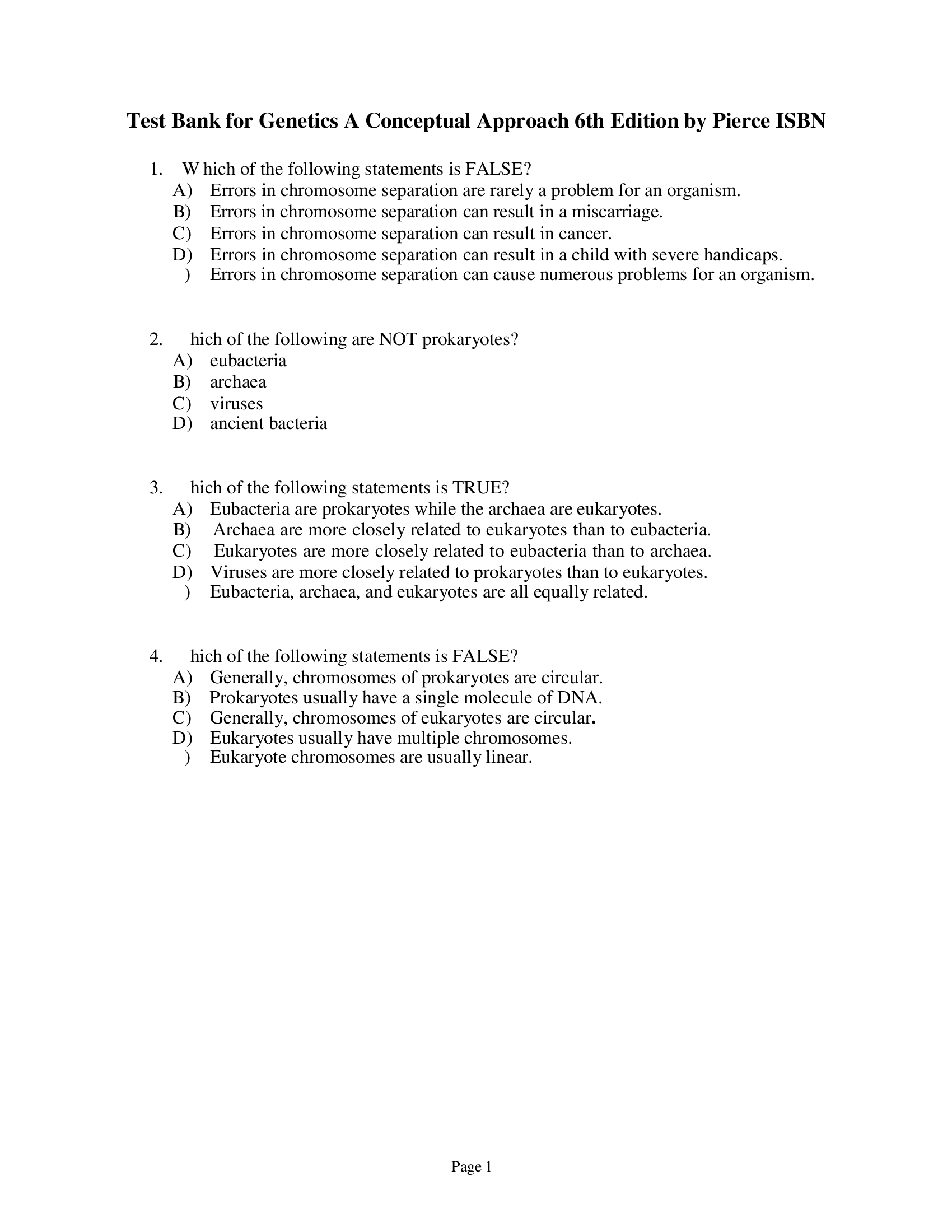
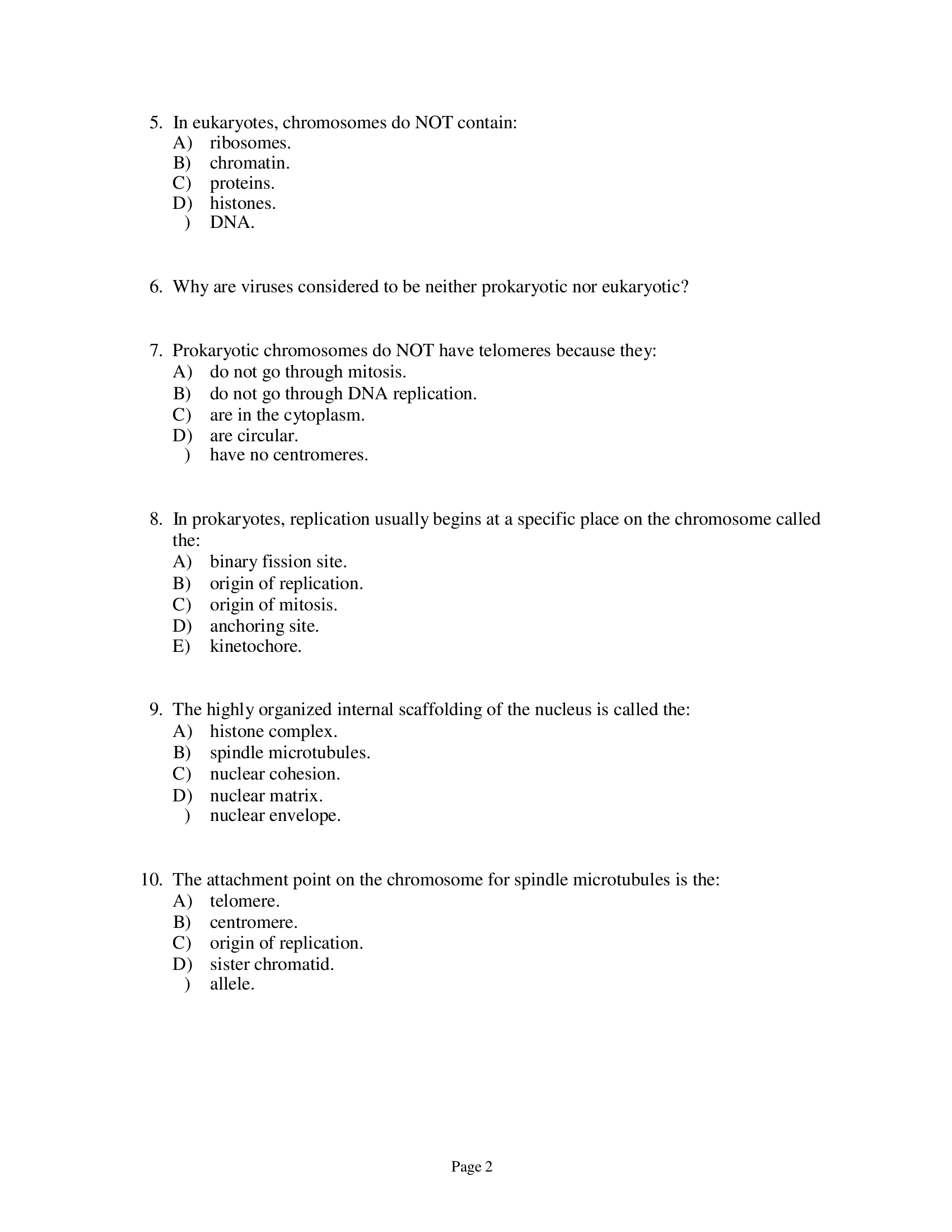
Test Bank for Genetics A Conceptual Approach 6th Edition by Pierce Test Bank for Genetics A Conceptual Approach 6th Edition by Pierce ISBN 1. W hich of the following statements is FALSE? A) Errors in chromosome separation are rarely a problem for an organism. B) Errors in chromosome separation can result in a miscarriage. C) Errors in chromosome separation can result in cancer. D) Errors in chromosome separation can result in a child with severe handicaps. ) Errors in chromosome separation can cause numerous problems for an organism. 2. hich of the following are NOT prokaryotes? A) eubacteria B) archaea C) viruses D) ancient bacteria 3. hich of the following statements is TRUE? A) Eubacteria are prokaryotes while the archaea are eukaryotes. B) Archaea are more closely related to eukaryotes than to eubacteria. C) Eukaryotes are more closely related to eubacteria than to archaea. D) Viruses are more closely related to prokaryotes than to eukaryotes. ) Eubacteria, archaea, and eukaryotes are all equally related. 4. hich of the following statements is FALSE? A) Generally, chromosomes of prokaryotes are circular. B) Prokaryotes usually have a single molecule of DNA. C) Generally, chromosomes of eukaryotes are circular. D) Eukaryotes usually have multiple chromosomes. ) Eukaryote chromosomes are usually linear. Page 2 5. In eukaryotes, chromosomes do NOT contain: A) ribosomes. B) chromatin. C) proteins. D) histones. ) DNA. 6. Why are viruses considered to be neither prokaryotic nor eukaryotic? 7. Prokaryotic chromosomes do NOT have telomeres because they: A) do not go through mitosis. B) do not go through DNA replication. C) are in the cytoplasm. D) are circular. ) have no centromeres. 8. In prokaryotes, replication usually begins at a specific place on the chromosome called the: A) binary fission site. B) origin of replication. C) origin of mitosis. D) anchoring site. E) kinetochore. 9. The highly organized internal scaffolding of the nucleus is called the: A) histone complex. B) spindle microtubules. C) nuclear cohesion. D) nuclear matrix. ) nuclear envelope. 10. The attachment point on the chromosome for spindle microtubules is the: A) telomere. B) centromere. C) origin of replication. D) sister chromatid. ) allele. Page 3 11. The process of splitting the cytoplasm, which separates one cell into two, is termed: A) cytokinesis. B) mitosis. C) anaphase. D) diakinesis. ) fusion. 12. In order to be functional, a eukaryotic chromosome requires all of the following XCEPT: A) a centromere. B) origins of replication. C) a plasmid. D) telomeres. 13. Diploid cells are cells with chromosomes. A) a single set of B) circular C) two sets of D) many sets of ) three sets of 14. If a healthy cell passes the G1/S checkpoint: A) it will enter the G0 stage of the cell cycle. B) DNA will be replicated. C) it will not divide. D) it will proceed immediately to cytokinesis. ) it will die. 15. hich of the following does NOT occur during the G2 phase of the cell cycle? A) The G2/M checkpoint is reached. B) DNA replication and error checking are completed. C) The cell completes preparation for mitosis. D) The cell divides. ) All of these occur during the G2 phase of the cell cycle. Page 4 16. hich of the following occurs during prometaphase? A) The chromosomes align in a single plane. B) DNA is replicated. C) Microtubules attach to the kinetochores. D) Mitotic spindles form. ) The two sister chromatids separate. 17. hromosome movement during anaphase is a result of: A) disassembly of tubulin molecules by molecular motor proteins. B) kinetochore shortening causing chromosomes to pull apart. C) metaphasal plate splitting resulting in chromosomal disassembly. D) the cohesion protein attaching to the centromeres of sister chromatids. ) cilia movement inside the cellular structure. 18. chromosome with a centromere at the very end is called: A) submetacentric. B) metacentric. C) acrocentric. D) acentric. ) telocentric. 19. A dividing eukaryotic cell is treated with a drug that inhibits the molecular motors associated with kinetochores. At which cell cycle stage would it stop? A) G1 B) S C) G2 D) M (metaphase) E) M (telophase) Page 5 20. In tissue from the intestinal epithelium of a frog, the following proportions of cells were found at each stage of the cell cycle: Stage Proportion of Cells Interphase 0.90 Prophase 0.04 Prometaphase 0.02 Metaphase 0.01 Anaphase 0.02 Telophase 0.01 If the entire cell cycle in frog epithelium cells requires 20 hours for completion, what is the average duration of each stage? A) 18 hours for interphase, 0.4 hour for prophase, 0.2 hour for prometaphase, 0.2 hour for metaphase, 0.2 hour for anaphase, 0.4 hour for telophase B) 1.8 hours for interphase, 0.8 hour for prophase, 0.2 hour for prometaphase, 0.2 hour for metaphase, 0.2 hour for anaphase, 0.8 hour for telophase C) 18 hours for interphase, 0.8 hour for prophase, 0.4 hour for prometaphase, 0.2 hour for metaphase, 0.4 hour for anaphase, 0.2 hour for telophase D) 9 hours for interphase, 0.8 hour for prophase, 0.2 hour for prometaphase, 0.2 hour for metaphase, 0.6 hour for anaphase, 0.4 hour for telophase E) 18 hours for interphase, 0.8 hour for prophase, 0.6 hour for prometaphase, 0.2 hour for metaphase, 0.2 hour for anaphase, 0.8 hour for telophase Page 6 21. Which of the following are errors in the accompanying drawing of mitotic anaphase? (Select all that apply.) A) It appears that homologous chromosomes rather than sister chromatids are separating. B) Sister chromatids do not have identical alleles for the B gene. C) Two alleles of the same gene (D and d) are on the same chromosome. D) No alleles of the A gene are on the homologous chromosome. E) Genes A and B are on the same chromosome. 22. The centromere divides a chromosome into two sections or “arms.” A chromosome is found to have two arms of equal lengths. Such a chromosome can be BEST described as: A) telocentric. B) circular. C) acrocentric. D) metacentric. E) homologous. Page 7 23. Somatic cancer cells often are unstable and divide inappropriately (divide when they should not be dividing). In addition such cells often contain losses of some chromosomes and extra copies of other chromosomes. Defects in which of the following may be partially responsible for the aberrant behavior of cancer cells? (Select all that apply.) A) spindle-assembly checkpoint B) G1/S checkpoint C) homologous chromosome pairing D) crossing over 24. Which chromosome in the following figure is MOST likely to be described as acrocentric? A) (a) B) (b) C) (c) D) (d) E) Chromosomes (a) and (b) are both acrocentric. 25. Why is mitosis important within the cell cycle? 26. Explain why mitosis does not produce genetic variation and how meiosis leads to the production of tremendous genetic variation. 27. Microscopy to look at a cell's chromosomes is often done when the cell is in mitotic metaphase. For example, karyotyping (extracting chromosomes from a single cell and photographing them to look for abnormalities) is performed on metaphase, rather than interphase, cells. Why? 28. List and briefly describe three major cell cycle checkpoints. For each checkpoint, predict the consequences if the checkpoint fails to work properly. Page 8 29. Describe what is happening to chromosomes during the five substages of prophase I. 30. Describe the difference between the centromere and kinetochore. 31. Describe the difference between G1 and G2 of the cell cycle. 32. (a) Draw a pair of acrocentric homologous chromosomes as they would appear in G2. Indicate centromeres with a small circle, and place the alleles A and a on each of the chromatids. (b) Draw the same chromosomes as they would appear in G1. Place the alleles A and a on each of the chromatids. Page 9 33. The cells illustrated here belong to a species with a diploid chromosome number of four. Each of the following cells is in which stage of mitosis or meiosis? Page 10 34. Using the following choices, indicate the CORRECT phase(s) in parts a–e. 1. meiosis I prophase 2. meiosis I anaphase 3. meiosis II prophase 4. meiosis II anaphase 5. mitosis prophase 6. mitosis anaphase a. Chromosomes are in unseparated, sister-chromatid form at the end of phase(s) . b. Chromosomes condense during . c. Sister chromatids separate during . d. Chromosomes are randomly partitioned during , contributing to genetic diversity. e. Crossing over (genetic recombination) occurs in . 35. List two differences and two similarities between mitosis and meiosis. 36. c he cells of a mature pea plant have 14 chromosomes. In a pea plant ovary, how many romosomes would the nucleus of a megaspore contain? A) 3 1 /2 B) 7 C) 14 D) 21 ) 30 37. he cells of a mature pea plant have 14 chromosomes. How many chromosomes does a ucleus in the pea endosperm contain? A) 3 1 /2 B) 7 C) 14 D) 21 ) 30 38. hich of the following processes is unique to plants? A) meiosis B) double fertilization C) crossing over D) haploid gametes ) spermatogenesis Page 11 39. Suppose that a diploid cell contains 8 chromosomes (2n = 8). How many different c mbinations in the gametes are possible? A) 2 B) 4 C) 8 D) 16 ) 64 40. The following figure shows a chromosomal separation taking place. The letters stand for genes; capital and lowercase letters stand for different alleles. The diploid chromosome number in this organism is four. What process is shown? A) anaphase of mitosis B) telophase of meiosis I C) anaphase of meiosis I D) telophase of mitosis E) anaphase of meiosis II 41. In a flowering plant, the male part of the flower (the stamen) produces haploid microspores that divide by to eventually produce sperm. A) mitosis B) meiosis C) gametogenesis D) spermatogenesis E) fertilization Page 12 A) 21 B) 42 C) 84 D) 126 E) 168 42. In a typical flowering plant, a pollen grain that lands on a stigma grows a pollen tube to deliver (how many?) sperm to the ovary. Fusion of a sperm with an egg produces a n cell called a . A) 1; 1; zygote B) 2; 1; megasporocyte C) 2; 2; zygote D) 1; 2; microsporocyte E) 1; 2; megasporocyte 43. o provide food for the developing embryo, a tissue called endosperm is produced rough double fertilization. Endosperm has a ploidy of: A) 1n. B) 2n. C) 3n. D) 4n. ) 5n. 44. hat might be the result if the breakdown of the shugoshin protein were premature? A) The cohesion protein would hold the chromosome arms together longer. B) The separation of homologous chromosomes would occur prematurely. C) The separation of sister chromatids would occur prematurely. D) Spindle fibers would not form. ) Sister chromatids would never separate. 45. A diploid somatic cell from a rat has a total of 42 chromosomes (2n = 42). As in humans, sex chromosomes determine sex: XX in females and XY in males. What is the total number of telomeres in a rat cell in G2? A) 21 B) 42 C) 84 D) 126 E) 168 46. A diploid somatic cell from a rat has a total of 42 chromosomes (2n = 42). As in humans, sex chromosomes determine sex: XX in females and XY in males. What is the total number of chromosomes present in the cell during metaphase I of meiosis? Page 13 47. A diploid somatic cell from a rat has a total of 42 chromosomes (2n = 42). As in humans, sex chromosomes determine sex: XX in females and XY in males. What is the total number of chromosomes in a polar body cell from a rat? A) 21 B) 40 C) 41 D) 42 E) 84 48. A geneticist observes 10 pairs of homologous chromosomes at metaphase I of meiosis in a newly discovered species of flowering plant. How many chromosomes should be found in a microsporocyte? A) 20 B) 10 C) 5 D) 40 E) 2 49. Assume that cells that are about to undergo meiosis are treated with a chemical that blocks crossing over but does not affect the cells in any other way, and four viable cells are produced by the two divisions of meiosis. What will be the consequence of such a treatment? A) The four products of meiosis will be genetically identical. B) The four products of meiosis will all be genetically unique. C) All the chromosomes of two of the products of meiosis will have chromosomes that are paternal in origin but the other two products will have chromosomes that are of both paternal and maternal origins. D) All the chromosomes of two of the products of meiosis will have chromosomes that are maternal in origin but the other two products will have chromosomes that are of both paternal and maternal origins. E) Two of the products will be genetically identical but genetically different from the other two products, which will also be genetically identical. Page 14 50. A “mistake” is happening during meiosis I in the following figure. Assume the second meiotic division is normal. How many chromosomes would be expected in the four cellular products of this meiotic event? A) All four cells would have four chromosomes. B) All four cells would have three chromosomes. C) Two cells would have three chromosomes and two cells would have five chromosomes. D) Two cells would have six chromosome and two cells would have 10 chromosomes. E) One cell would have three chromosomes, one cell would have five chromosomes, and two cells would have four chromosomes. 51. Humans have 23 pairs of chromosomes. Rarely, an egg is produced with 46 c romosomes instead of 23. How might such an egg have originated? A) When the first polar body divides in meiosis II, all the chromatids go to one daughter cell. B) When the secondary oocyte divides in meiosis II, all the chromatids go to one daughter cell. C) When the second polar body divides in meiosis II, all the chromatids go to one daughter cell. D) When the primary oocyte divides in meiosis I, all the chromosomes go to the first polar body. ) When the secondary oocyte divides in meiosis I, all the chromatids go to the second polar body. Page 15 52. Assume that the diploid or 2n number of chromosomes is 18 for a certain species of a imal. How many DNA molecules will be found in metaphase II for this species? A) 9 B) 18 C) 36 D) 72 ) 24 53. During prophase I of meiosis, crossing over is indicated by what microscopically visible structure? 54. What is one feature of meiosis that produces genetic variability in gametes? In two or three sentences, explain how this feature causes genetic uniqueness. 55. Describe the difference between homologous chromosomes and sister chromatids. 56. Describe the difference between meiosis I and meiosis II. 57. Describe the difference between the sporophyte and gametophyte. 58. What events during sexual reproduction are significant in contributing to genetic diversity? 59. Write all possible genotypes of each of the cells resulting from mitosis and meiosis of a cell of the genotype shown below. Page 16 60. A diploid, eukaryotic cell in interphase has these two pairs of homologous chromosomes with the indicated arrangement of alleles: Draw the chromosomes at the end of (a) prophase of mitosis and (b) prophase I (of meiosis I) with the most likely crossing-over events. Indicate placement of alleles on the chromosomes. 61. A diploid, eukaryotic cell in interphase has these two pairs of homologous chromosomes with the indicated arrangement of alleles: Draw the chromosomes at the end of telophase of (a) mitosis and (b) meiosis II. Indicate placement of alleles on the chromosomes. 62. (a) Compare and contrast spermatogenesis and oogenesis in animals. For each process, be sure to include information about division of the nucleus, allocation of chromosomes to the various products, and division of the cytoplasm. (b) Why is the difference in cytoplasmic division between spermatogenesis and oogenesis important to reproduction, considering the different roles of sperm and eggs in reproduction? 63. (a) Describe the changing role of cohesin during the mitotic cell cycle. (b) Explain the importance of regulation of cohesin activity to normal cell division. 

Contact the Seller

Please Sign In to contact this seller.


  • 👎  Report Copyright Violation

Frequently Asked Questions

What Do I Get When I Buy This Study Material?

+

When you buy a study material on Passing Grades, an instant download link will be sent directly to your email, giving you access to the file anytime after payment is completed.

Is Passing Grades a Trusted Platform?

+

Yes, Passing Grades is a reputable students’ marketplace with a secure payment system and reliable customer support. You can trust us to ensure a safe and seamless transaction experience.

Will I Be Stuck with a Subscription?

+

No, all purchases on Passing Grades are one-time transactions. You only pay for the notes you choose to buy, with no subscriptions or hidden fees attached.

Who Am I Buying These Study Materials From?

+

Passing Grades is a marketplace, which means you are purchasing the document from an individual vendor, not directly from us. We facilitate the payment and delivery process between you and the vendor.

Does Passing Grades Offer Free Study Materials?

+

Yes, sellers on Passing Grades have uploaded numerous free test banks, exams, practice questions, and class notes that can be downloaded at no cost.

Pasinggrades - Quality Study Materials

USD 15

    • Quality checked by Pasing Grades
    • 100% satisfaction guarantee
    • Seller: Daniel-Onyapidi
Buy PDF $15

Seller Information

Daniel-Onyapidi

Member since October 2023

  • icon
View Profile
  • total sales

    0
  • Favourites

    0
  • Comments

    0
    ( 0 Ratings )

Item Information

  • Uploaded

    10 November 2023

  • Updated

    21 June 2025

  • Category

    Accounting

  • Item Type

    test bank

  • Tags

    Test Bank for Genetics A Conceptual Approach 6th Edition by Pierce

Related Exam Prep Guides by Daniel-Onyapidi

Test Bank for Surgical Technology 9th Edition by Kotcher Fuller
View Document

Test Bank for Surgic...

  • Daniel-Onyapidi

    Daniel-Onyapidi

  • test bank

Test Bank for Surgical Technology 9th Edition by Kotcher Fuller...

15 USD

0

0

Test Bank for Genetics A Conceptual Approach, 8th Edition Benjamin Pierce
View Document

Test Bank for Geneti...

  • Daniel-Onyapidi

    Daniel-Onyapidi

  • test bank

Instant download pdf of Test Bank for Genetics A Conceptual Approach, 8th Edition Benjamin Pierce...

15 USD

0

0

Test Bank Sociology, A Down-To-Earth Approach, 14th Edition Jim M. Henslin
View Document

Test Bank Sociology,...

  • Daniel-Onyapidi

    Daniel-Onyapidi

  • test bank

Test Bank Sociology, A Down-To-Earth Approach, 14th Edition Jim M. Henslin...

15 USD

0

0

Purchase

Download link will be sent to this email immediately after purchase.

IMPORTANT LINKS

  • How To Upload Class Notes
  • Selling Tips
  • Passing Grades's Study Materials
  • Scholarships for International Students 2025

POPULAR CATEGORIES

  • Law
  • Accounting
  • English
  • Psychology
  • Business
  • Nursing
  • Computer Science
  • General

View Document

  • Blog
  • Contact
  • Delivery Policy
  • Latest Scholarships Around the World
  • How to Pass Bar Exams: Passing Grades’ Strategies
  • How to Study and Pass the CPA Exam
  • All Test Banks
  • Faq
  • Copyright Claims
  • Privacy Policy
  • Terms of Use

KNOWLEDGE BASE

  • How to Write A+ Grade Good Research Paper
  • How to Manage Stress During Exam Period
  • Best Time to Study
  • How to Pass NCLEX-RN Exam
  • How To Effectively Utilize Test Banks
  • Popular Shadow Health Exam Assessments
  • Popular HESI Case Studies
  • How to Prepare for a Nursing Career
  • The Importance Of Summaries in Exam Revisvion

© 2026 Pasing Grades. All rights reserved.