Pasing Grades
  • Start Selling
  • Blog
  • Contact
  • 0

    Your cart is empty!

English

  • English
  • Spanish
  • Arabic
Create Account Sign In
  • Library
    • New Prep Guides
    • Featured Prep Guides
    • Free Exam Prep Guides
    • Best sellers
  • General
  • Nursing
    • Research Paper
    • Case Study
    • Discussion Post
    • Assignment
    • Exam
    • Practice Questions and Answers
    • Test Bank
    • solutions manual
  • Accounting
    • Case Study
    • Thesis
    • Study Guide
    • Summary
    • Research Paper
    • test bank
  • English
    • Creative Writing
    • Research Paper
    • Summary
    • Rhetorics
    • Literature
    • Journal
    • Exam
    • Grammar
    • Discussion Post
    • Essay
  • Psychology
    • Hesi
    • Presentation
    • Essay
    • Summary
    • Study Guide
    • Essay
    • Solution Manual
    • Final Exam Review
    • Class Notes
    • test bank
  • Business
    • Lecture Notes
    • Solution Manual
    • Presentation
    • Business Plan
    • Class Notes
    • Experiment
    • Summary
    • Practice Questions
    • Study Guide
    • Case Study
    • test bank
    • Exam
  • More
    • Computer Science
    • Economics
    • Statistics
    • Engineering
    • Biology
    • Religious Studies
    • Physics
    • Chemistry
    • Mathematics
    • History
    • Sociology
    • Science
    • Philosophy
    • Law
  • Pages
    • About Us
    • Selling Tips
    • Delivery Policy
    • Faq
    • Privacy Policy
  • Flash Sale
  • Home
  • Test Bank for Genetics A Conceptual Approach, 8th Edition Benjamin Pierce

Test Bank for Genetics A Conceptual Approach, 8th Edition Benjamin Pierce

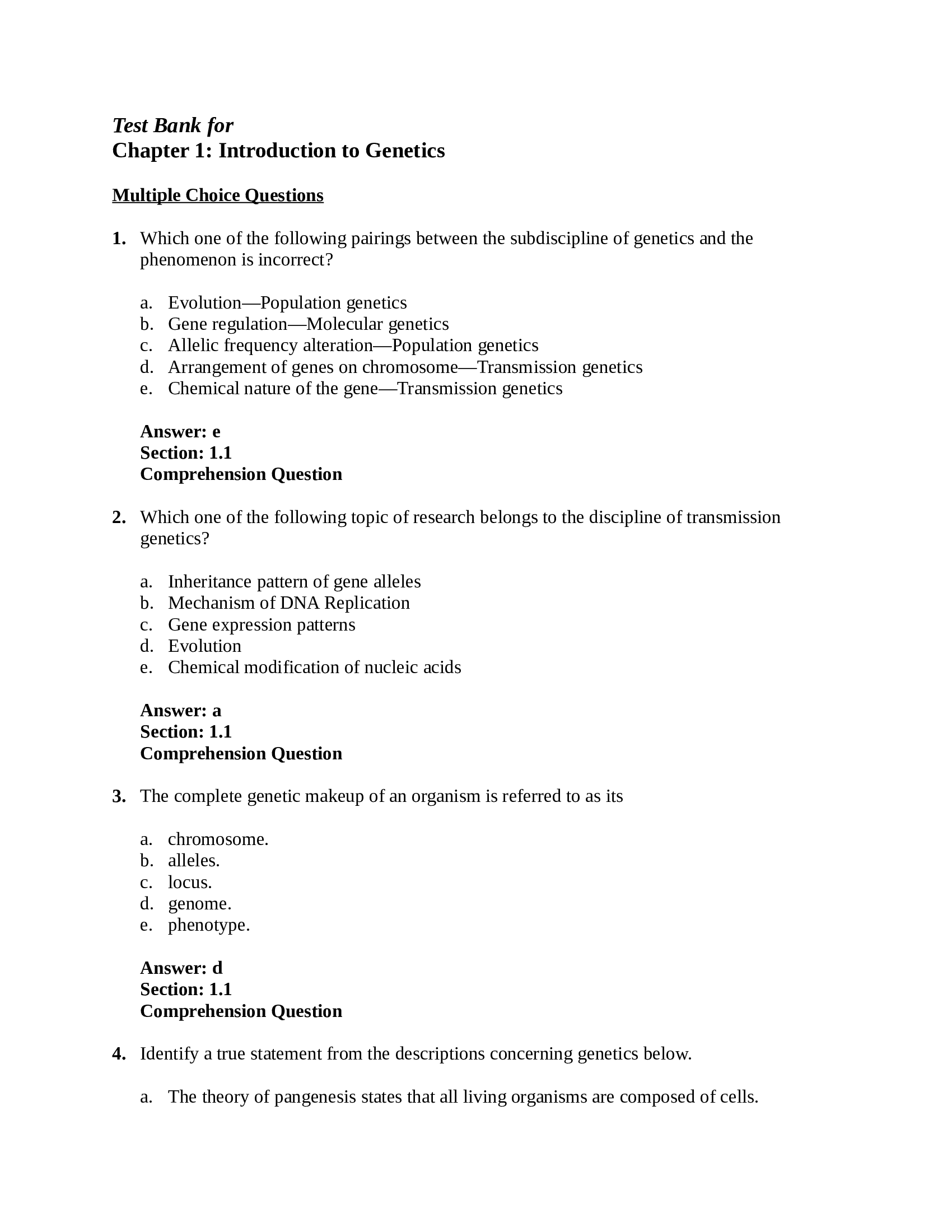
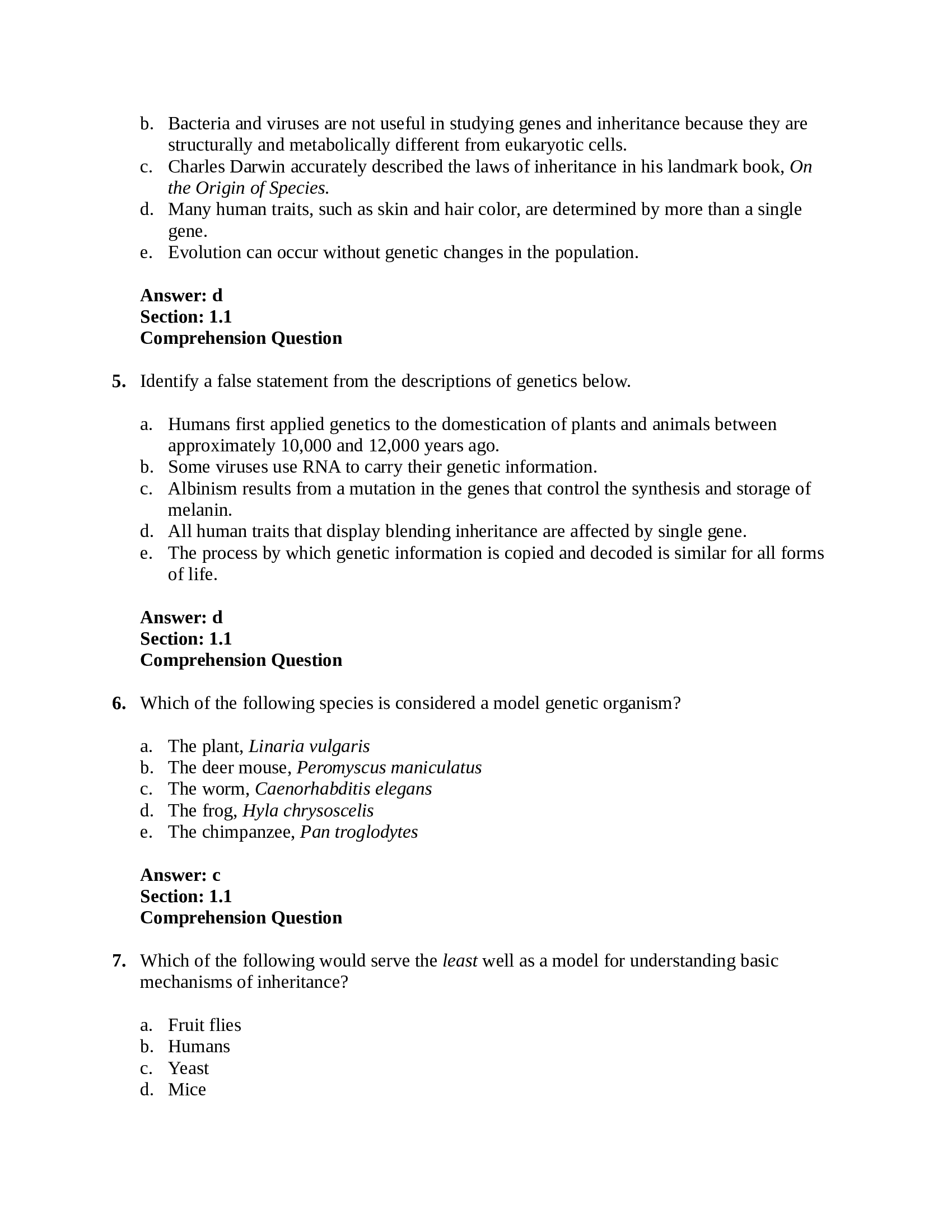
Preview page 1 Preview page 2 Preview page 3
Add To Favorites

Share this item Share this item

  • Item Details
  • Comments (0)
  • Reviews (0)
  • Contact Seller

Test Bank for Genetics A Conceptual Approach, 8th Edition Benjamin Pierce

43. Many good ideas in science ultimately turn out to be incorrect. The author mentions several such ideas in the history of genetics. Why do you think this particular idea was widely accepted by scholars of that time? Include in your answer some evidence in favor of the idea, observations that seemed to support the idea, or other rationale for accepting the idea. Answer: Answers will vary but should include specific evidence or observations that support the idea. Examples: Pangenesis – It is reasonable to assume that the information needed to build a structure must reside in that structure. It is less obvious that the information might also reside in other structures. Therefore, it is reasonable to envision the information being stored in each structure and transported to the reproductive structures before being passed to the next generation. Inheritance of acquired characteristics – Observations to support this view would have been commonplace. For example, a man with a muscular physique would often have sons with muscular physiques. A talented musician often produced children with musical talent. Preformationism – It would have been hard for people before the late 1800s to imagine how a complex organism could build itself from a single undifferentiated cell. Indeed, the problem has occupied developmental biologists for over 100 years. Preformationism is easier to understand. Add to that the poor optics of microscopes at that time, and it is easy to understand how early biologists might have thought they could see a preformed person in a sperm or an egg, such as in Figure 1.11. Blending inheritance – For example, a mating between a tall person and a short person producing a person of medium stature might have suggested blending inheritance. Section 1.1 Application Question 44. Many good ideas in science ultimately turn out to be incorrect. The author mentions several such ideas in the history of genetics. Summarize the evidence that ultimately caused the idea to be rejected by modern geneticists. Answer: Answers will vary but should include specific evidence or observations that do not support the idea. Pangenesis – Observations of animals with body parts lost to injury producing normal offspring would not support pangenesis. Inheritance of acquired characteristics – Experiments were conducted in which body parts were removed and normal offspring were produced, showing that the acquired characteristic was not inherited. Also, experiments in which offspring are raised in an environment different from that of their parents and do not develop their parents’ traits would suggest that the environment influences development of these traits. Preformationism – Eventually better microscopes were produced that proved that gametes do not contain preformed people. Also, we eventually came to understand that both sperm and eggs contribute genetic information during sexual reproduction. Blending inheritance – Mendel showed that genes behave as particles that are not blended or changed during inheritance. Section 1.1 Application Question 45. List and describe two significant events in the history of genetics that occurred during the twentieth century. Answer: 1900: Mendel’s previously published work on pea plants, which stated basic principles of inheritance, was rediscovered. 1902: Sutton proposed that genes are located on chromosomes. 1910: Thomas Hunt Morgan began studies of transmission genetics, using fruit fly mutants. 1930s: Fisher, Haldane, and Wright outlined the founding principles of population genetics. 1940s: Organization of chromosomes and genes were studied using bacteria and viruses. 1940s–1950s: Evidence was accumulated for DNA as the genetic material; Watson and Crick described the DNA structure. 1966: The relationship between chemical structure of DNA and amino acid sequence of proteins was determined. 1973: The first recombinant DNA experiments were conducted. 1977: The Gilbert and Sanger methods for DNA sequencing were published. 1986: Mullis developed PCR. 1990: The first use of gene therapy was used in humans. 1990s: The Human Genome Project was started. 1995: The first genome of a free-living organism was sequenced (Haemophilus influenzae). 1996: The first genome of a eukaryote was sequenced (yeast). 2000–present: The human genome sequence was released. Section 1.2 Comprehension Question 46. Write a paragraph explaining why genetics is considered a young science, even though people have been applying genetic principles for thousands of years. Answer: Techniques for the observation of cells have been available only since the late 1500s, when the first microscopes were produced. The observation of chromosomes has been possible for only a century and a half. The widespread systematic study of genes and inheritance has been conducted only in the twentieth century, since the rediscovery of Mendel's work in 1900. The structure of DNA was determined only in the mid-twentieth century. Many molecular genetic techniques, like PCR, have been developed only in the last few decades. However, without understanding the nature of chromosomes and genes, plant and animal breeders have been applying the principles of inheritance for thousands of years, to obtain desired characteristics in domesticated organisms. Section 1.2 Application Question 47. What common-sense observation makes the theory of preformationism unlikely? Answer: Preformationism states that the egg or sperm carries a miniature adult, which would mean that all characteristics come from either the mother or father. Simple observation shows that offspring have traits from both parents. Section 1.2 Application Question 48. What common-sense observation makes the theory of acquired characteristics unlikely? Answer: This theory states that characteristics acquired during one's lifetime are passed to offspring. However, anatomical changes, like the loss of a limb, or the removal of a mouse's tail, are not seen in offspring. Section 1.2 Application Question 49. Which features distinguish a prokaryotic cell from a eukaryotic cell? Answer: Prokaryotic cells lack a nuclear membrane and possess no true membrane bounded cell organelles, whereas eukaryotic cells possess a nucleus and membrane bounded organelles such as chloroplasts and mitochondria. Section 1.3 Application Question 50. What common-sense observation makes the theory of blending inheritance unlikely? Answer: This theory states that genetic information is mixed in an offspring and never separated. Some traits, however, disappear from one generation to the next, only to reappear in a subsequent generation. Section 1.3 Application Question 51. Describe one way in which discoveries in genetics currently impact your daily life apart from this course. Answer: Answers will vary, but the best answers will include one or more specific discoveries in genetics and describe how they affect the student personally. Examples could come from those listed in section 1.1 or from the students’ background knowledge. This question and Questions 52 and 53 will work best if students are asked to consider ahead of time how these discoveries might impact their lives. For example, students might discuss the role of genetics and genetic technology in the Green Revolution of the 1950s and 1960s, which greatly expanded food production throughout the world, making food more efficient, more affordable, and more available to world populations. A much smaller part of the world’s population work in agriculture, freeing up more people for work in other industries. They might also discuss the use of genetically modified crops in agriculture, including a significant proportion of corn and soybeans in the United States and other countries. Sections 1.1–1.3 Application Question 52. Describe one way in which discoveries in genetics will likely impact your life in the future. Answer: An example would be the use of genetic tests in medical practice. Genetic tests are already fairly commonplace and will become more common in the near future. In the future, most people will be offered one or more genetic tests as part of their ordinary medical care. They will need to understand the basis of the tests and their limitations, as well as how to interpret results and how to use the information provided. Sections 1.1–1.3 Application Question 53. Describe a discovery in genetics or an area of current research that you are concerned about that might have a negative impact on your life in the future. Explain why you think it might have a negative impact on you personally. Answer: Again, answers will vary, but an example is the possible abuse of genetic information about individuals that is becoming more available. Many people worry that results from genetic tests, for example, could be used to discriminate against individuals in the workplace and in the insurance marketplace. The Genetic Information Nondiscrimination Act offers limited protection against genetic discrimination, but the possibility of negative consequences from such tests remains.

Contact the Seller

Please Sign In to contact this seller.


  • 👎  Report Copyright Violation

Frequently Asked Questions

What Do I Get When I Buy This Study Material?

+

When you buy a study material on Passing Grades, an instant download link will be sent directly to your email, giving you access to the file anytime after payment is completed.

Is Passing Grades a Trusted Platform?

+

Yes, Passing Grades is a reputable students’ marketplace with a secure payment system and reliable customer support. You can trust us to ensure a safe and seamless transaction experience.

Will I Be Stuck with a Subscription?

+

No, all purchases on Passing Grades are one-time transactions. You only pay for the notes you choose to buy, with no subscriptions or hidden fees attached.

Who Am I Buying These Study Materials From?

+

Passing Grades is a marketplace, which means you are purchasing the document from an individual vendor, not directly from us. We facilitate the payment and delivery process between you and the vendor.

Does Passing Grades Offer Free Study Materials?

+

Yes, sellers on Passing Grades have uploaded numerous free test banks, exams, practice questions, and class notes that can be downloaded at no cost.

Pasinggrades - Quality Study Materials

USD 18

    • Quality checked by Pasing Grades
    • 100% satisfaction guarantee
    • Seller: Daniel-Onyapidi
Buy PDF $18

Seller Information

Daniel-Onyapidi

Member since October 2023

  • icon
View Profile
  • total sales

    0
  • Favourites

    0
  • Comments

    0
    ( 0 Ratings )

Item Information

  • Uploaded

    03 October 2023

  • Updated

    01 October 2025

  • Category

    Accounting

  • Item Type

    test bank

  • Tags

    Test Bank for Genetics A Conceptual Approach 8th Edition Benjamin Pierce

Related Exam Prep Guides by Daniel-Onyapidi

Test Bank for Surgical Technology 9th Edition by Kotcher Fuller
View Document

Test Bank for Surgic...

  • Daniel-Onyapidi

    Daniel-Onyapidi

  • test bank

Test Bank for Surgical Technology 9th Edition by Kotcher Fuller...

18 USD

0

0

Test Bank Sociology, A Down-To-Earth Approach, 14th Edition Jim M. Henslin
View Document

Test Bank Sociology,...

  • Daniel-Onyapidi

    Daniel-Onyapidi

  • test bank

Test Bank Sociology, A Down-To-Earth Approach, 14th Edition Jim M. Henslin...

18 USD

0

0

Test Bank for Introduction to Management Science, 6e Frederick. Hillier, Mark Hillier
View Document

Test Bank for Introd...

  • Daniel-Onyapidi

    Daniel-Onyapidi

  • test bank

Test Bank for Introduction to Management Science, 6e Frederick. Hillier, Mark Hillier...

18 USD

0

0

Purchase

Download link will be sent to this email immediately after purchase.

IMPORTANT LINKS

  • How To Upload Class Notes
  • Selling Tips
  • Passing Grades's Study Materials
  • Scholarships for International Students 2025

POPULAR CATEGORIES

  • Law
  • Accounting
  • English
  • Psychology
  • Business
  • Nursing
  • Computer Science
  • General

View Document

  • Blog
  • Contact
  • Delivery Policy
  • Latest Scholarships Around the World
  • How to Pass Bar Exams: Passing Grades’ Strategies
  • How to Study and Pass the CPA Exam
  • All Test Banks
  • Faq
  • Copyright Claims
  • Privacy Policy
  • Terms of Use

KNOWLEDGE BASE

  • How to Write A+ Grade Good Research Paper
  • How to Manage Stress During Exam Period
  • Best Time to Study
  • How to Pass NCLEX-RN Exam
  • How To Effectively Utilize Test Banks
  • Popular Shadow Health Exam Assessments
  • Popular HESI Case Studies
  • How to Prepare for a Nursing Career
  • The Importance Of Summaries in Exam Revisvion

© 2026 Pasing Grades. All rights reserved.