Pasing Grades
  • Start Selling
  • Blog
  • Contact
  • 0

    Your cart is empty!

English

  • English
  • Spanish
  • Arabic
Create Account Sign In
  • Library
    • New Prep Guides
    • Featured Prep Guides
    • Free Exam Prep Guides
    • Best sellers
  • General
  • Nursing
    • Research Paper
    • Case Study
    • Discussion Post
    • Assignment
    • Exam
    • Practice Questions and Answers
    • Test Bank
    • solutions manual
  • Accounting
    • Case Study
    • Thesis
    • Study Guide
    • Summary
    • Research Paper
    • test bank
  • English
    • Creative Writing
    • Research Paper
    • Summary
    • Rhetorics
    • Literature
    • Journal
    • Exam
    • Grammar
    • Discussion Post
    • Essay
  • Psychology
    • Hesi
    • Presentation
    • Essay
    • Summary
    • Study Guide
    • Essay
    • Solution Manual
    • Final Exam Review
    • Class Notes
    • test bank
  • Business
    • Lecture Notes
    • Solution Manual
    • Presentation
    • Business Plan
    • Class Notes
    • Experiment
    • Summary
    • Practice Questions
    • Study Guide
    • Case Study
    • test bank
    • Exam
  • More
    • Computer Science
    • Economics
    • Statistics
    • Engineering
    • Biology
    • Religious Studies
    • Physics
    • Chemistry
    • Mathematics
    • History
    • Sociology
    • Science
    • Philosophy
    • Law
  • Pages
    • About Us
    • Selling Tips
    • Delivery Policy
    • Faq
    • Privacy Policy
  • Flash Sale
  • Home
  • Test Bank for Foundations and Adult Health Nursing 9th Edition by Cooper

Test Bank for Foundations and Adult Health Nursing 9th Edition by Cooper

Preview page 1 Preview page 2 Preview page 3
Add To Favorites

Share this item Share this item

  • Item Details
  • Comments (0)
  • Reviews (0)
  • Contact Seller

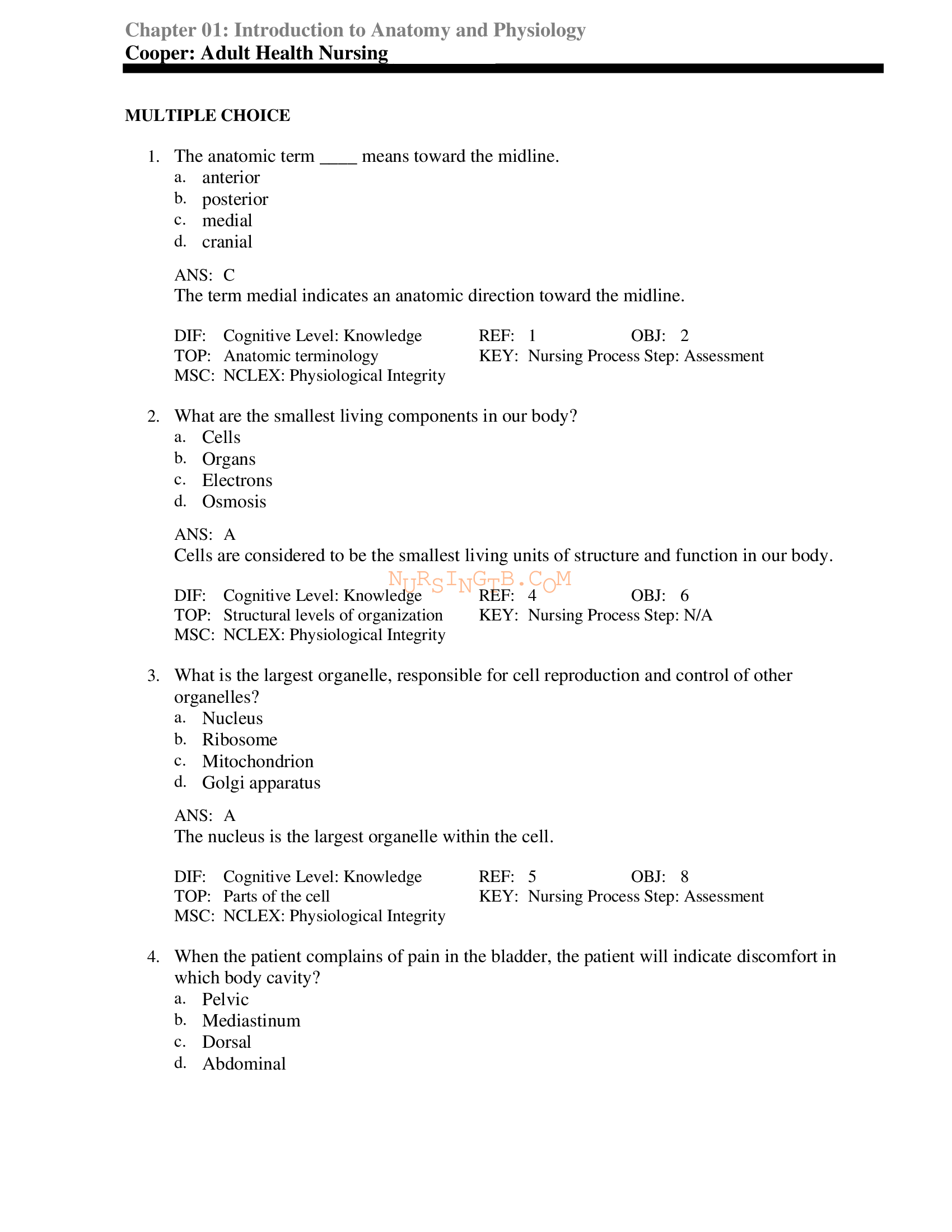
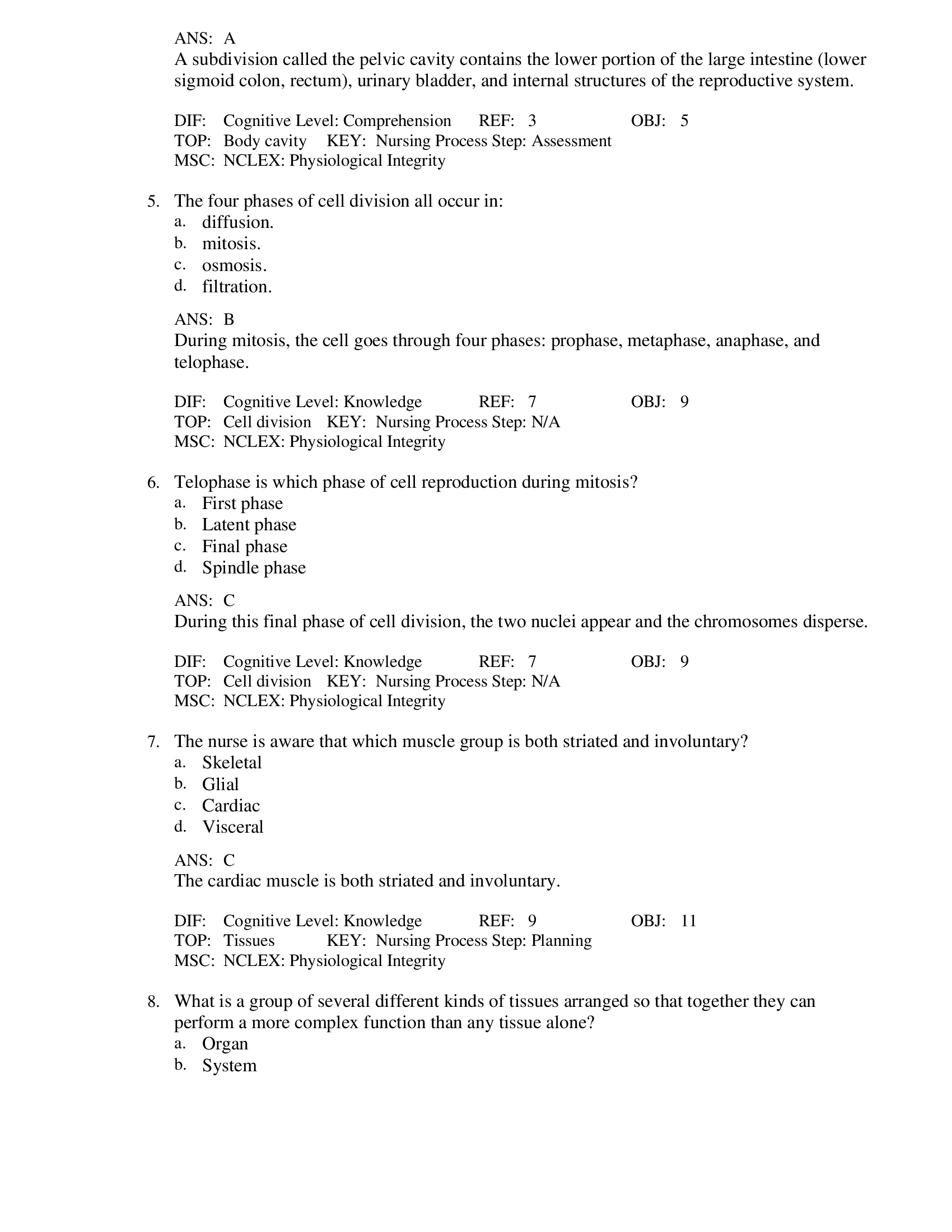
Test Bank for Foundations and Adult Health Nursing 9th Edition by Cooper Chapter 01: Introduction to Anatomy and Physiology Cooper: Adult Health Nursing MULTIPLE CHOICE 1. The anatomic term ____ means toward the midline. a. anterior b. posterior c. medial d. cranial ANS: C The term medial indicates an anatomic direction toward the midline. DIF: Cognitive Level: Knowledge REF: 1 OBJ: 2 TOP: Anatomic terminology KEY: Nursing Process Step: Assessment MSC: NCLEX: Physiological Integrity 2. What are the smallest living components in our body? a. Cells b. Organs c. Electrons d. Osmosis ANS: A Cells are considered to be the smallest living units of structure and function in our body. DIF: Cognitive Level: Knowledge REF: 4 OBJ: 6 TOP: Structural levels of organization KEY: Nursing Process Step: N/A MSC: NCLEX: Physiological Integrity 3. What is the largest organelle, responsible for cell reproduction and control of other organelles? a. Nucleus b. Ribosome c. Mitochondrion d. Golgi apparatus ANS: A The nucleus is the largest organelle within the cell. DIF: Cognitive Level: Knowledge REF: 5 OBJ: 8 TOP: Parts of the cell KEY: Nursing Process Step: Assessment MSC: NCLEX: Physiological Integrity 4. When the patient complains of pain in the bladder, the patient will indicate discomfort in which body cavity? a. Pelvic b. Mediastinum c. Dorsal d. Abdominal ANS: A A subdivision called the pelvic cavity contains the lower portion of the large intestine (lower sigmoid colon, rectum), urinary bladder, and internal structures of the reproductive system. DIF: Cognitive Level: Comprehension REF: 3 OBJ: 5 TOP: Body cavity KEY: Nursing Process Step: Assessment MSC: NCLEX: Physiological Integrity 5. The four phases of cell division all occur in: a. diffusion. b. mitosis. c. osmosis. d. filtration. ANS: B During mitosis, the cell goes through four phases: prophase, metaphase, anaphase, and telophase. DIF: Cognitive Level: Knowledge REF: 7 OBJ: 9 TOP: Cell division KEY: Nursing Process Step: N/A MSC: NCLEX: Physiological Integrity 6. Telophase is which phase of cell reproduction during mitosis? a. First phase b. Latent phase c. Final phase d. Spindle phase ANS: C During this final phase of cell division, the two nuclei appear and the chromosomes disperse. DIF: Cognitive Level: Knowledge REF: 7 OBJ: 9 TOP: Cell division KEY: Nursing Process Step: N/A MSC: NCLEX: Physiological Integrity 7. The nurse is aware that which muscle group is both striated and involuntary? a. Skeletal b. Glial c. Cardiac d. Visceral ANS: C The cardiac muscle is both striated and involuntary. DIF: Cognitive Level: Knowledge REF: 9 OBJ: 11 TOP: Tissues KEY: Nursing Process Step: Planning MSC: NCLEX: Physiological Integrity 8. What is a group of several different kinds of tissues arranged so that together they can perform a more complex function than any tissue alone? a. Organ b. System c. Cell d. Endoplasmic reticulum ANS: A When several kinds of tissues are united to perform a more complex function than any tissue alone, they are called organs. DIF: Cognitive Level: Knowledge REF: 11 OBJ: 7 TOP: Organs KEY: Nursing Process Step: N/A MSC: NCLEX: Physiological Integrity 9. What traits describe visceral muscles? a. Smooth and voluntary b. Smooth and involuntary c. Striated and voluntary d. Striated and involuntary ANS: B Visceral (smooth) muscles will not function at will; thus, they act involuntarily. DIF: Cognitive Level: Knowledge REF: 9 OBJ: 7 TOP: Tissues KEY: Nursing Process Step: Assessment MSC: NCLEX: Physiological Integrity 10. How are the thoracic and abdominal cavities separated? a. By the pleura b. By the diaphragm c. By the sagittal plane d. By the peritoneum ANS: B The diaphragm (a muscle directly beneath the lungs) separates the ventral cavity into the thoracic (chest) and abdominal cavities. DIF: Cognitive Level: Knowledge REF: 2 OBJ: 3 TOP: Ventral cavity KEY: Nursing Process Step: Assessment MSC: NCLEX: Physiological Integrity 11. What is the broad section of biology dealing with the description of human structure? a. Hematology b. Anatomy c. Kinesiology d. Physiology ANS: B Anatomy is the study, classification, and description of the structure and organs of the body. DIF: Cognitive Level: Knowledge REF: 1 OBJ: 1 TOP: Terminology KEY: Nursing Process Step: N/A MSC: NCLEX: Physiological Integrity 12. ____ explains the processes and functions of many structures of the body and how they interact with one another. a. Anatomy b. Mitosis c. Filtration d. Physiology ANS: D Physiology explains the processes and functions of the various structures and how they interrelate with one another. DIF: Cognitive Level: Knowledge REF: 1 OBJ: 1 TOP: Terminology KEY: Nursing Process Step: N/A MSC: NCLEX: Physiological Integrity 13. The anatomic structure that is not in the thoracic cavity is/are the _____. a. heart b. lungs c. blood vessels d. transverse colon ANS: D The transverse colon is located in the abdominal cavity. DIF: Cognitive Level: Comprehension REF: 3 OBJ: 5 TOP: Thoracic cavity KEY: Nursing Process Step: Assessment MSC: NCLEX: Physiological Integrity 14. When several organs and parts are grouped together for certain functions, they form: a. tissues. b. systems. c. cells. d. membranes. ANS: B A system is an organization of varying numbers and kinds of organs arranged so that together they can perform complex functions for the body. DIF: Cognitive Level: Knowledge REF: 4 OBJ: 7 TOP: Systems KEY: Nursing Process Step: Assessment MSC: NCLEX: Physiological Integrity 15. What are the distinct surface proteins of the plasma membrane essential in determining? a. Tissue typing b. Blood count c. Effectiveness of a drug d. Sexual maturity ANS: A The plasma membrane has distinct surface proteins as coming from one individual. This is the basis for the procedure of tissue typing to determine compatibility before an organ transplant. DIF: Cognitive Level: Comprehension REF: 5 OBJ: 12 TOP: Cells KEY: Nursing Process Step: Assessment MSC: NCLEX: Physiological Integrity 16. In anatomic terminology, posterior means toward the: a. tail. b. head. c. back. d. trunk. ANS: C The posterior is toward the back. DIF: Cognitive Level: Knowledge REF: 1 OBJ: 2 TOP: Anatomic terminology KEY: Nursing Process Step: Assessment MSC: NCLEX: Physiological Integrity 17. What does the transverse body plane divide? a. The front and back (coronal) of the body b. The body lengthwise (two equal halves) c. The superior and inferior portions of the body d. The body into axial and appendicular ANS: C The transverse plane cuts the body horizontally into the sagittal and the frontal planes, dividing the body into caudal and cranial portions. DIF: Cognitive Level: Knowledge REF: 2 OBJ: 3 TOP: Body planes KEY: Nursing Process Step: Assessment MSC: NCLEX: Physiological Integrity 18. Caudal is defined as toward the _ a. head b. feet c. tail d. chest ANS: C Caudal is a directional word that indicates toward the “tail,” the distal portion of the spine. DIF: Cognitive Level: Knowledge REF: 1 OBJ: 3 TOP: Anatomic terminology KEY: Nursing Process Step: Assessment MSC: NCLEX: Physiological Integrity 19. What is the term for movement of water from an area of lower solute concentration to an area of higher solute concentration? a. Absorption b. Filtration c. Diffusion d. Osmosis ANS: D Osmosis is the passage of water from less concentrated solution to more concentrated solution. DIF: Cognitive Level: Knowledge REF: 8 OBJ: 10 TOP: Transport processes KEY: Nursing Process Step: Assessment MSC: NCLEX: Physiological Integrity 20. What is the type of tissue composed of cells that contract in response to a message from the brain or spinal cord? a. Epithelial b. Connective c. Membrane d. Muscle ANS: D Muscle tissue is composed of cells that contract in response to a message from the brain or spinal cord. DIF: Cognitive Level: Knowledge REF: 9 OBJ: 7 TOP: Tissues KEY: Nursing Process Step: Assessment MSC: NCLEX: Physiological Integrity 21. What is the type of tissue associated with the storage of fat? a. Areolar tissue b. Adipose tissue c. Osseous tissue d. Muscle tissue ANS: B Adipose tissue is associated with the important function of storing fat. DIF: Cognitive Level: Knowledge REF: 10 OBJ: 11 TOP: Tissues KEY: Nursing Process Step: Assessment MSC: NCLEX: Physiological Integrity 22. What are the thin sheets of tissue that lubricate and line the body surfaces that open to the outside environment? a. Mucous membranes b. Serous membranes c. Cytoplasm d. Involuntary visceral muscles ANS: A Mucous membranes secrete mucus. They line the body surfaces that open to the outside environment. DIF: Cognitive Level: Knowledge REF: 9 OBJ: 7 TOP: Tissues KEY: Nursing Process Step: Assessment MSC: NCLEX: Physiological Integrity 23. What is the process by which a cell digests a foreign material by surrounding it? a. Pinocytosis b. Phagocytosis c. Absorption d. Diffusion ANS: B Phagocytosis is the process that permits a cell to engulf or surround any foreign material and digest it. DIF: Cognitive Level: Knowledge REF: 7 OBJ: 10 TOP: Active transport processes KEY: Nursing Process Step: Assessment MSC: NCLEX: Physiological Integrity 24. Active transport in the movement of ions and other water-soluble particles across cell membranes requires that the body uses its: a. rapid filtration. b. charged diffusion. c. a chemical pump. d. osmosis. ANS: C Active transport of ions and other water-soluble particles of the cell membrane require a chemical pump, such as insulin, to move glucose into the cell. DIF: Cognitive Level: Comprehension REF: 7 OBJ: 10 TOP: Active transport processes KEY: Nursing Process Step: Assessment MSC: NCLEX: Physiological Integrity 25. What is the term for the passage of water containing dissolved materials through a membrane as the result of a greater mechanical force on one side? a. Metabolism b. Mitosis c. Filtration d. Osmosis ANS: C Filtration is the movement of water and particles through a membrane by a force from either pressure or gravity. DIF: Cognitive Level: Knowledge REF: 8 OBJ: 10 TOP: Passive transport processes KEY: Nursing Process Step: Assessment MSC: NCLEX: Physiological Integrity 26. The nurse is aware that when a patient complains of pain in the epigastric region, the source of the pain is most likely to be a disorder involving the: a. gallbladder. b. transverse colon. c. stomach. d. appendix. ANS: C The epigastric region of the abdomen is comprised of parts of the right and left lobes of the liver and a large portion of the stomach. DIF: Cognitive Level: Comprehension REF: 3 OBJ: 5 TOP: Epigastric region KEY: Nursing Process Step: Assessment MSC: NCLEX: Physiological Integrity 27. What are tissues that cover the outside of the body and some internal structures? a. Connective b. Epithelial c. Nerve d. Muscle ANS: B Epithelial tissue covers the outside of the body and some of the internal structures. DIF: Cognitive Level: Knowledge REF: 8 OBJ: 7 TOP: Tissues KEY: Nursing Process Step: Assessment MSC: NCLEX: Physiological Integrity 28. When the nurse assesses an arm in proximal to distal order, the assessment is performed from: a. the shoulder to the fingers. b. front to back. c. fingers to the center of the body. d. center of the body to the fingers. ANS: A Proximal is nearest the origin of the structure. Distal is farthest from the origin of the structure. DIF: Cognitive Level: Comprehension REF: 2 OBJ: 3 TOP: Anatomic terminology KEY: Nursing Process Step: Assessment MSC: NCLEX: Physiological Integrity 29. What is the function of epithelial membranes? a. Secretes mucus, lines ends of bones, and lines bursae. b. Lines ends of bones, secretes synovial fluid, and lines internal surfaces of organs. c. Covers the wall of lower digestive tract, secretes mucus, and lines lungs, peritoneum, and pericardium. d. Lines lungs, peritoneum, and pericardium, and secretes synovial fluid. ANS: C The epithelial membrane secretes mucus, lines the lungs, peritoneum, and pericardium, and covers the wall of the lower digestive tract. The synovial membrane secretes synovial fluid to prevent friction between joints and the ends of bones, and lines the bursae found between moving body parts. DIF: Cognitive Level: Knowledge REF: 9 OBJ: 7 TOP: Tissues KEY: Nursing Process Step: Assessment MSC: NCLEX: Physiological Integrity 30. The nurse explains that pinocytosis is a process by which cells: a. divide. b. take in extracellular fluid. c. use a chemical pump. d. convert mitochondria. ANS: B Downloaded by: SuperA | abiekay12@gmail.comDownloaded by: SUCCEEDGRADES | abbieclin@gmail.comDownloaded by: SUCCEEDGRADES | abbieclin@gmail.com Pinocytosis is a process by which the cell wall makes an indentation allowing extracellular fluid to fill in, then encloses it into the cell. DIF: Cognitive Level: Comprehension REF: 7 OBJ: 10 TOP: Pinocytosis KEY: Nursing Process Step: Implementation MSC: NCLEX: Physiological Integrity 31. What is the most complex structural level of organization of the body? a. Body as a whole b. Cellular c. Organs d. Chemical ANS: A The structural levels of organization progress from the least complex (chemical) through cells, tissues, organs, systems to the most complex (the body as a whole). DIF: Cognitive Level: Comprehension REF: 3 OBJ: 6 TOP: Structural levels of organization KEY: Nursing Process Step: N/A MSC: NCLEX: N/A 32. Using a poster, the nurse demonstrates the protection of the nucleus. Which layer is the most superficial? a. Endoplasmic reticulum b. Nuclear membrane c. Plasma membrane d. Cytoplasm ANS: C N U R S I N G T B.C O M The most superficial covering of the nucleus is the plasma membrane, under which is the cytoplasm containing the endoplasmic reticulum, nuclear membrane, and nucleus. DIF: Cognitive Level: Application REF: 5 OBJ: 8 TOP: Protective covering of nucleus KEY: Nursing Process Step: Implementation MSC: NCLEX: Physiological Integrity MULTIPLE RESPONSE 1. Which are among the 11 body systems? (Select all that apply.) a. Lymphatic b. Cellular c. Digestive d. Reproductive e. Accessory f. Spinal cord ANS: A, C, D There are 11 body systems: integumentary, respiratory, skeletal, digestive, muscular, nervous, endocrine, urinary, reproductive, cardiovascular, and lymphatic. DIF: Cognitive Level: Knowledge REF: 12 OBJ: 7 TOP: Body systems KEY: Nursing Process Step: Assessment MSC: NCLEX: Physiological Integrity 2. Which of the following are characteristics of visceral muscles? (Select all that apply.) a. Involuntary b. Smooth c. Striated d. Independent from the spinal cord e. Voluntary f. Present in the blood vessels ANS: A, B, F Smooth muscles are smooth, involuntary, and respond to messages from the spinal cord. DIF: Cognitive Level: Application REF: 9 OBJ: 7 TOP: Voluntary muscle KEY: Nursing Process Step: Assessment MSC: NCLEX: Physiological Integrity 3. Which of the following are passive transport mechanisms that move material across the cell membranes? (Select all that apply.) a. Diffusion b. Evaporation c. Filtration d. Osmosis e. Mitosis f. Anaphase ANS: A, C, D The passive transport systems are diffusion, filtration, and osmosis. DIF: Cognitive Level: Comprehension REF: 8 OBJ: 10 TOP: Passive transport system KEY: Nursing Process Step: Assessment MSC: NCLEX: Physiological Integrity 4. The nurse clarifies that the dorsal cavity is composed of the: (Select all that apply.) a. Descending colon b. Kidneys c. Gallbladder d. Brain e. Pancreas f. Spinal cavities ANS: D, F The dorsal cavity is composed of the brain and the spinal cavities. The spinal cavities hold the cord and the meninges. DIF: Cognitive Level: Comprehension REF: 3 OBJ: 5 TOP: Dorsal cavity KEY: Nursing Process Step: Implementation MSC: NCLEX: Physiological Integrity COMPLETION 1. The nurse clarifies that the three functions of epithelial tissue are protection,___________, and secretion. ANS: absorption The function of epithelial tissue is protection by covering the body and preventing invasion; absorption by absorbing material; and secretion by secreting mucus to line and moisten the body surfaces. DIF: Cognitive Level: Comprehension REF: 11 OBJ: 7 TOP: Epithelial tissue function KEY: Nursing Process Step: Implementation MSC: NCLEX: Physiological Integrity 2. The nurse explains that ___________are small saclike structures inside the cell that digest compounds that have invaded the cell. ANS: lysosomes Lysosomes are small saclike structures inside the cell that digest compounds that have invaded the cell. DIF: Cognitive Level: Knowledge REF: 6 OBJ: 8 TOP: Lysosomes KEY: Nursing Process Step: Implementation MSC: NCLEX: Physiological Integrity 3. The body plane that divides the body into the ventral and dorsal section is the_________ plane. ANS: coronal The coronal plane divides the body into ventral and dorsal (front and back) sections. DIF: Cognitive Level: Comprehension REF: 2 OBJ: 3 TOP: Coronal plane KEY: Nursing Process Step: Assessment MSC: NCLEX: Physiological Integrity Chapter 02: Legal and Ethical Aspects of Nursing Cooper: Foundations of Nursing MULTIPLE CHOICE 1. When a nurse becomes involved in a legal action, the first step to occur is that a document is filed in an appropriate court. What is this document called? a. Deposition b. Appeal c. Complaint d. Summons ANS: C A document called a complaint is filed in an appropriate court as the first step in litigation. A deposition is when witnesses are required to undergo questioning by the attorneys. An appeal is a request for a review of a decision by a higher court. A summons is a court order that notifies the defendant of the legal action. DIF: Cognitive Level: Knowledge REF: 24 OBJ: 1 TOP: Legal KEY: Nursing Process Step: N/A MSC: NCLEX: N/A 2. The nurse caring for a patient in the acute care setting assumes responsibility for a patient’s care. What is this legally binding situation? a. Nurse-patient relationship b. Accountability c. Advocacy d. Standard of care ANS: A When the nurse assumes responsibility for a patient’s care, the nurse-patient relationship is formed. This is a legally binding “contract” for which the nurse must take responsibility. Accountability is being responsible for one’s own actions. An advocate is one who defends or pleads a cause or issue on behalf of another. Standards of care define acts whose performance is required, permitted, or prohibited. DIF: Cognitive Level: Comprehension REF: 24 OBJ: 3 TOP: Legal KEY: Nursing Process Step: N/A MSC: NCLEX: N/A 3. What are the universal guidelines that define appropriate measures for all nursing interventions? a. Scope of practice b. Advocacy c. Standard of care d. Prudent practice ANS: C

Contact the Seller

Please Sign In to contact this seller.


  • 👎  Report Copyright Violation

Frequently Asked Questions

What Do I Get When I Buy This Study Material?

+

When you buy a study material on Passing Grades, an instant download link will be sent directly to your email, giving you access to the file anytime after payment is completed.

Is Passing Grades a Trusted Platform?

+

Yes, Passing Grades is a reputable students’ marketplace with a secure payment system and reliable customer support. You can trust us to ensure a safe and seamless transaction experience.

Will I Be Stuck with a Subscription?

+

No, all purchases on Passing Grades are one-time transactions. You only pay for the notes you choose to buy, with no subscriptions or hidden fees attached.

Who Am I Buying These Study Materials From?

+

Passing Grades is a marketplace, which means you are purchasing the document from an individual vendor, not directly from us. We facilitate the payment and delivery process between you and the vendor.

Does Passing Grades Offer Free Study Materials?

+

Yes, sellers on Passing Grades have uploaded numerous free test banks, exams, practice questions, and class notes that can be downloaded at no cost.


Pasinggrades - Quality Study Materials

USD 17

    • Quality checked by Pasing Grades
    • 100% satisfaction guarantee
    • Seller: Pasing-Grades
Buy PDF $17

Seller Information

Pasing-Grades

Member since May 2021

  • icon
View Profile
  • total sales

    0
  • Favourites

    0
  • Comments

    0
    ( 0 Ratings )

Item Information

  • Uploaded

    29 August 2024

  • Updated

    29 August 2024

  • Category

    Nursing

  • Item Type

    test bank

  • Tags

    Test Bank for Foundations and Adult Health Nursing 9th Edition by Cooper

Related Exam Prep Guides by Pasing-Grades

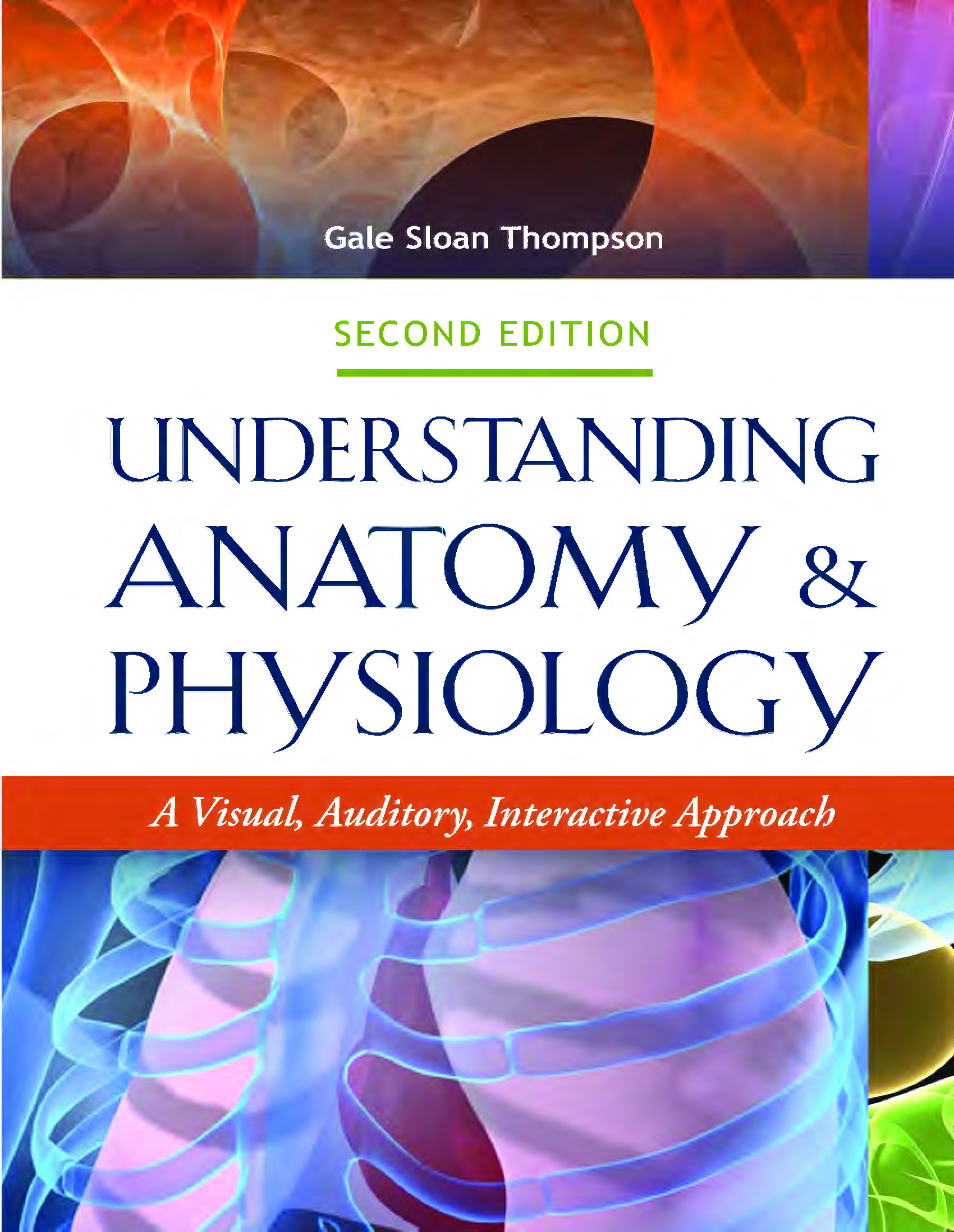
Understanding Anatomy and Physiology; A Visual, Auditory, Interactive Approach by Gale. S. Thompson
View Document

Understanding Anatom...

  • Pasing-Grades

    Pasing-Grades

  • test bank

Third Edition: Understanding Anatomy and Physiology; A Visual, Auditory, Interactive Approach by Gal...

17 USD

0

0

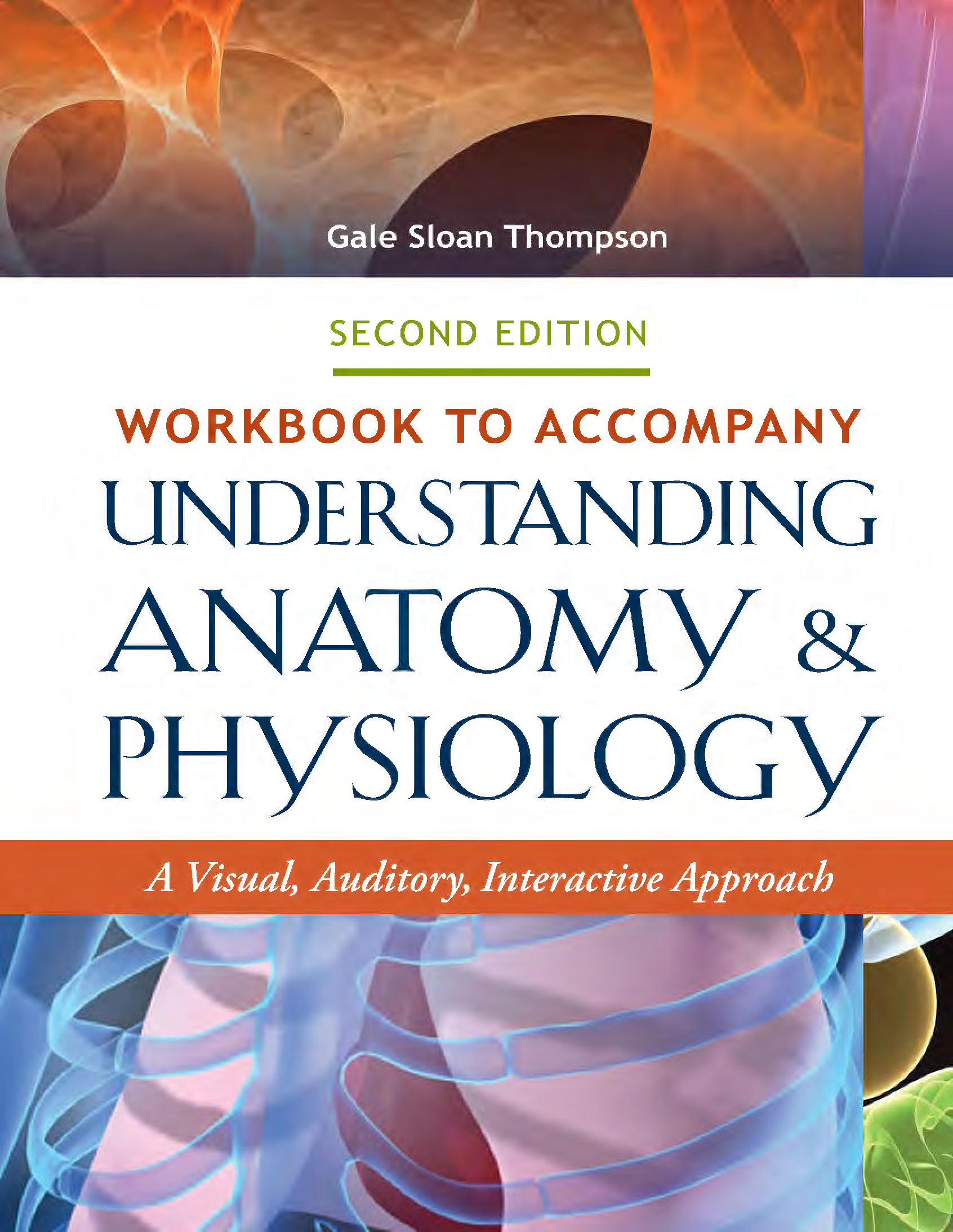
Workbook to Accompany Understanding Anatomy & Physiology: A Visual, Auditory, Interactive Approach by Gale Sloan Thompson RN
View Document

Workbook to Accompan...

  • Pasing-Grades

    Pasing-Grades

  • test bank

Workbook to Accompany Understanding Anatomy & Physiology: A Visual, Auditory, Interactive Approach b...

17 USD

0

0

Test Bank for Fundamentals of Nursing 10th Edition by Taylor
View Document

Test Bank for Fundam...

  • Pasing-Grades

    Pasing-Grades

  • test bank

Get now the Test Bank for Fundamentals of Nursing 10th Edition by Taylor. Instant PDF Download....

17 USD

0

0

Purchase

Download link will be sent to this email immediately after purchase.

IMPORTANT LINKS

  • How To Upload Class Notes
  • Selling Tips
  • Passing Grades's Study Materials
  • Scholarships for International Students 2026

POPULAR CATEGORIES

  • Law
  • Accounting
  • English
  • Psychology
  • Business
  • Nursing
  • Computer Science
  • General

View Document

  • Blog
  • Contact
  • Delivery Policy
  • Latest Scholarships Around the World
  • How to Pass Bar Exams: Passing Grades’ Strategies
  • How to Study and Pass the CPA Exam
  • All Test Banks
  • Faq
  • Copyright Claims
  • Privacy Policy
  • Terms of Use

KNOWLEDGE BASE

  • How to Write A+ Grade Good Research Paper
  • How to Manage Stress During Exam Period
  • Best Time to Study
  • How to Pass NCLEX-RN Exam
  • How To Effectively Utilize Test Banks
  • Popular Shadow Health Exam Assessments
  • Popular HESI Case Studies
  • How to Prepare for a Nursing Career
  • The Importance Of Summaries in Exam Revisvion

© 2026 Pasing Grades. All rights reserved.