Pasing Grades
  • Start Selling
  • Blog
  • Contact
  • 0

    Your cart is empty!

English

  • English
  • Spanish
  • Arabic
Create Account Sign In
  • Library
    • New Prep Guides
    • Featured Prep Guides
    • Free Exam Prep Guides
    • Best sellers
  • General
  • Nursing
    • Research Paper
    • Case Study
    • Discussion Post
    • Assignment
    • Exam
    • Practice Questions and Answers
    • Test Bank
    • solutions manual
  • Accounting
    • Case Study
    • Thesis
    • Study Guide
    • Summary
    • Research Paper
    • test bank
  • English
    • Creative Writing
    • Research Paper
    • Summary
    • Rhetorics
    • Literature
    • Journal
    • Exam
    • Grammar
    • Discussion Post
    • Essay
  • Psychology
    • Hesi
    • Presentation
    • Essay
    • Summary
    • Study Guide
    • Essay
    • Solution Manual
    • Final Exam Review
    • Class Notes
    • test bank
  • Business
    • Lecture Notes
    • Solution Manual
    • Presentation
    • Business Plan
    • Class Notes
    • Experiment
    • Summary
    • Practice Questions
    • Study Guide
    • Case Study
    • test bank
    • Exam
  • More
    • Computer Science
    • Economics
    • Statistics
    • Engineering
    • Biology
    • Religious Studies
    • Physics
    • Chemistry
    • Mathematics
    • History
    • Sociology
    • Science
    • Philosophy
    • Law
  • Pages
    • About Us
    • Selling Tips
    • Delivery Policy
    • Faq
    • Privacy Policy
  • Flash Sale
  • Home
  • Test Bank for Exploring Family Theories 4th Edition by Suzanne R. Smith , Raeann R. Hamon

Test Bank for Exploring Family Theories 4th Edition by Suzanne R. Smith , Raeann R. Hamon

Preview page 1 Preview page 2 Preview page 3
Add To Favorites

Share this item Share this item

  • Item Details
  • Comments (0)
  • Reviews (0)
  • Contact Seller
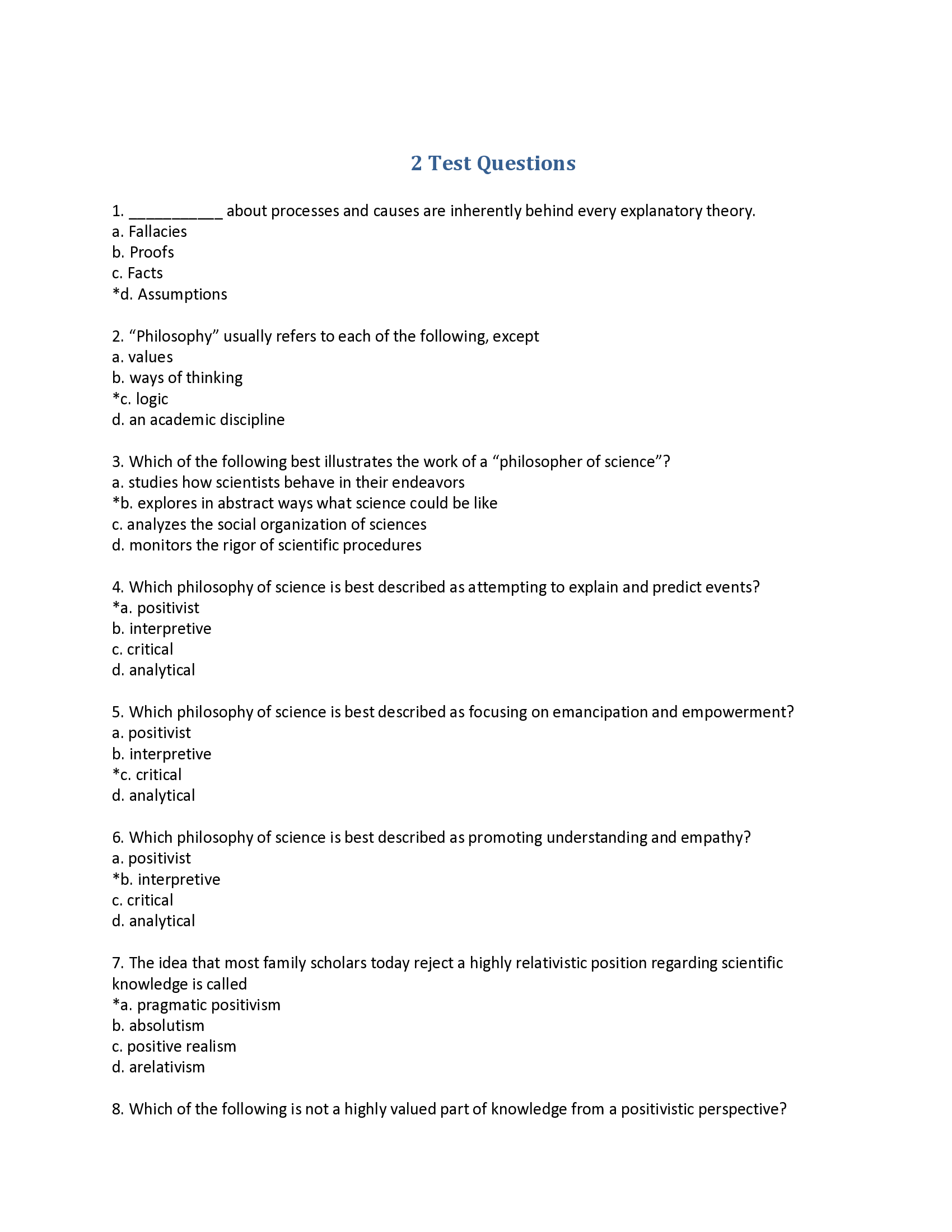
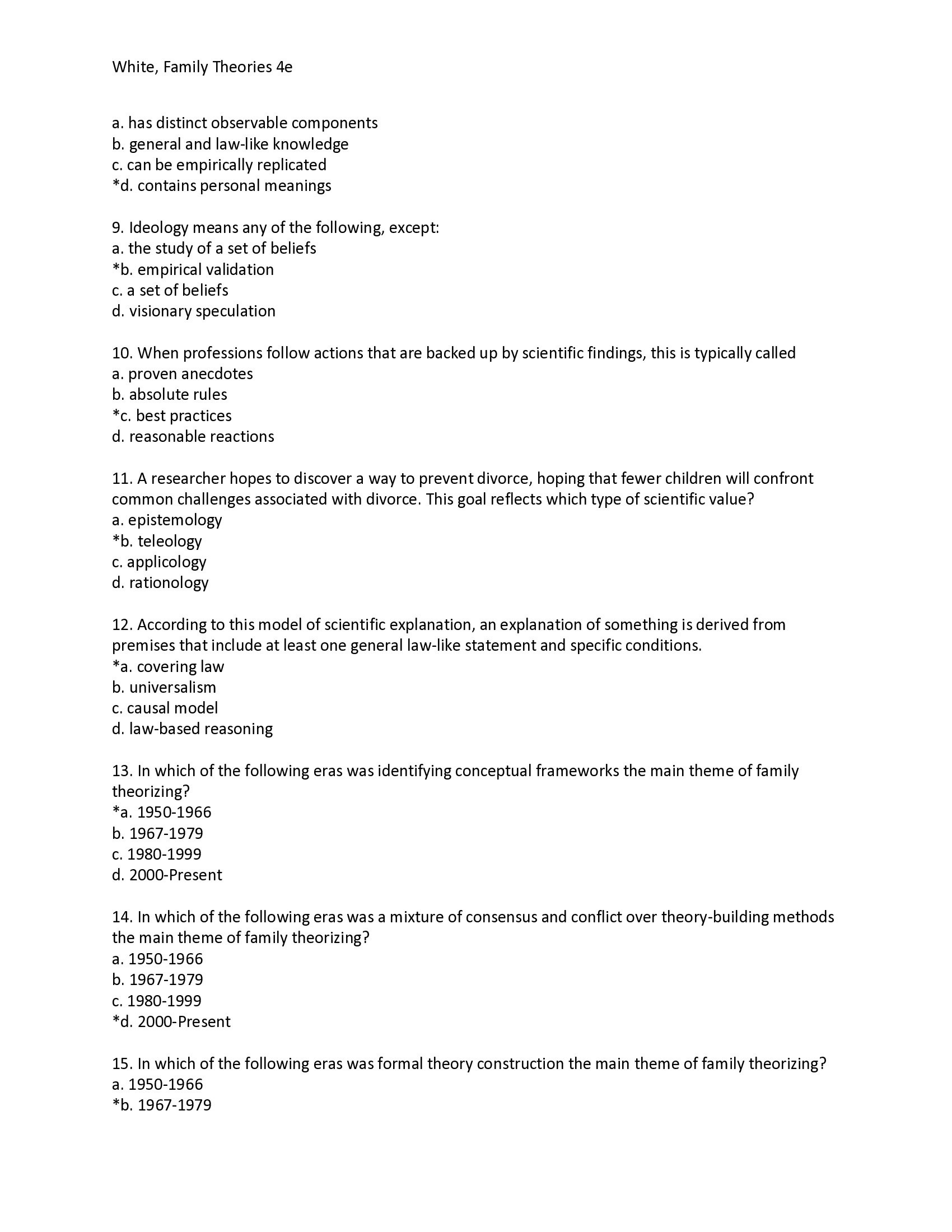
TEST BANK FOR EXPLORING FAMILY THEORIES 4TH EDITION BY SUZANNE R. SMITH , RAEANN R. HAMON 2 Test Questions 1. ___________ about processes and causes are inherently behind every explanatory theory. a. Fallacies b. Proofs c. Facts *d. Assumptions 2. “Philosophy” usually refers to each of the following, except a. values b. ways of thinking *c. logic d. an academic discipline 3. Which of the following best illustrates the work of a “philosopher of science”? a. studies how scientists behave in their endeavors *b. explores in abstract ways what science could be like c. analyzes the social organization of sciences d. monitors the rigor of scientific procedures 4. Which philosophy of science is best described as attempting to explain and predict events? *a. positivist b. interpretive c. critical d. analytical 5. Which philosophy of science is best described as focusing on emancipation and empowerment? a. positivist b. interpretive *c. critical d. analytical 6. Which philosophy of science is best described as promoting understanding and empathy? a. positivist *b. interpretive c. critical d. analytical 7. The idea that most family scholars today reject a highly relativistic position regarding scientific knowledge is called *a. pragmatic positivism b. absolutism c. positive realism d. arelativism 8. Which of the following is not a highly valued part of knowledge from a positivistic perspective? White, Family Theories 4e a. has distinct observable components b. general and law-like knowledge c. can be empirically replicated *d. contains personal meanings 9. Ideology means any of the following, except: a. the study of a set of beliefs *b. empirical validation c. a set of beliefs d. visionary speculation 10. When professions follow actions that are backed up by scientific findings, this is typically called a. proven anecdotes b. absolute rules *c. best practices d. reasonable reactions 11. A researcher hopes to discover a way to prevent divorce, hoping that fewer children will confront common challenges associated with divorce. This goal reflects which type of scientific value? a. epistemology *b. teleology c. applicology d. rationology 12. According to this model of scientific explanation, an explanation of something is derived from premises that include at least one general law-like statement and specific conditions. *a. covering law b. universalism c. causal model d. law-based reasoning 13. In which of the following eras was identifying conceptual frameworks the main theme of family theorizing? *a. 1950-1966 b. 1967-1979 c. 1980-1999 d. 2000-Present 14. In which of the following eras was a mixture of consensus and conflict over theory-building methods the main theme of family theorizing? a. 1950-1966 b. 1967-1979 c. 1980-1999 *d. 2000-Present 15. In which of the following eras was formal theory construction the main theme of family theorizing? a. 1950-1966 *b. 1967-1979 White, Family Theories 4e c. 1980-1999 d. 2000-Present 16. In which of the following eras was pluralism the main theme of family theorizing? a. 1950-1966 b. 1967-1979 *c. 1980-1999 d. 2000-Present 17. To help promote formal family theory construction, Wes Burr did all of the following except a. spearheaded two volumes based on propositions and general theories. b. proposed a section on theory within the National Council on Family Relations. *c. developed a family theory that reflected what was known about families at the time. d. help create a workshop on theory construction at an annual conference. 18. During its peak, pluralism was typically viewed as a sign of a. regression in scientific understanding. b. declining respect for a variety of perspectives and philosophies. c. unifying principles within family disciplines. *d. a fragmentation and specialization of scholarly interests. 19. Within this philosophy of science, it is generally accepted that objectivity is possible. *a. positivist b. interpretive c. critical d. analytical 20. Within this philosophy of science, subjective meaning attributed to events is central. a. positivist *b. interpretive c. critical d. analytical 21. Within this philosophy of science, emphasis is placed on who has control over shaping knowledge. a. positivist b. interpretive *c. critical d. analytical 22. Philosophers generally do not rely principally on empirical methods for giving credibility to their ideas. *a. True b. False 23. Historically speaking, philosophy has influenced all sciences except the physical sciences. a. True *b. False White, Family Theories 4e 24. “Pragmatic positivism” reflects the idea that most family scholars believe in absolute truth. a. True *b. False 25. The authors caution that ideologies may influence how family scholars respond to a theory but ideologies are not inherently within scientific theories themselves. *a. True b. False 26. Pragmatism suggests that the assumptions one has are linked to one’s purpose for scientific discovery. *a. True b. False 27. A major turning point in the development of family theory took place around 1950. *a. True b. False 28. In the modern era, the family scholarly community has become increasingly similar and is moving more and more in a single way of thinking about families. a. True *b. False 29. It is clear that trends toward pluralism in theory development and scholarship have become universally embraced today. a. True *b. False 30. If one does not fully embrace pluralism and post-modernism, one therefore assumes that absolute truth is knowable. a. True *b. False 31. Briefly compare and contrast the goals of family scientists who hold each of the following philosophies of science: positivistic, interpretive, and critical. a. Answer should include positivism being about explanation and prediction, interpretive about understanding and empathy, and critical about emancipation and empowerment. 32. Explain how a scientific theory can be useful to people with different ideologies. a. Answer should focus on how a theory is distinct from ideology, but can be used in a variety of ways to further differing agendas that promote specific outcomes. 33. Explain why the scientific method may fall short of establishing what is actually true. a. Answer should include issues of disproving rather than proving hypotheses, that there is no universal scientific method—it is not completely clear what makes knowledge scientific. 34. Explain why it appears that family theorizing will not result in “one grand theoretical scheme to explain everything about families.” White, Family Theories 4e a. Answer should include ideas about pluralism having become more popular, about the trend toward min-theories and narrowly-focused theories, about trends toward interpretive and critical philosophies over positivistic philosophy.

Contact the Seller

Please Sign In to contact this seller.


  • 👎  Report Copyright Violation

Frequently Asked Questions

What Do I Get When I Buy This Study Material?

+

When you buy a study material on Passing Grades, an instant download link will be sent directly to your email, giving you access to the file anytime after payment is completed.

Is Passing Grades a Trusted Platform?

+

Yes, Passing Grades is a reputable students’ marketplace with a secure payment system and reliable customer support. You can trust us to ensure a safe and seamless transaction experience.

Will I Be Stuck with a Subscription?

+

No, all purchases on Passing Grades are one-time transactions. You only pay for the notes you choose to buy, with no subscriptions or hidden fees attached.

Who Am I Buying These Study Materials From?

+

Passing Grades is a marketplace, which means you are purchasing the document from an individual vendor, not directly from us. We facilitate the payment and delivery process between you and the vendor.

Does Passing Grades Offer Free Study Materials?

+

Yes, sellers on Passing Grades have uploaded numerous free test banks, exams, practice questions, and class notes that can be downloaded at no cost.

Pasinggrades - Quality Study Materials

USD 16

    • Quality checked by Pasing Grades
    • 100% satisfaction guarantee
    • Seller: Daniel-Onyapidi
Buy PDF $16

Seller Information

Daniel-Onyapidi

Member since October 2023

  • icon
View Profile
  • total sales

    0
  • Favourites

    0
  • Comments

    0
    ( 0 Ratings )

Item Information

  • Uploaded

    10 February 2024

  • Updated

    01 October 2025

  • Category

    No category

  • Item Type

    solution manual

  • Tags

    Test Bank for Exploring Family Theories 4th Edition by Suzanne R. Smith Raeann R. Hamon

Related Exam Prep Guides by Daniel-Onyapidi

Test Bank for Surgical Technology 9th Edition by Kotcher Fuller
View Document

Test Bank for Surgic...

  • Daniel-Onyapidi

    Daniel-Onyapidi

  • solution manual

Test Bank for Surgical Technology 9th Edition by Kotcher Fuller...

16 USD

0

0

Test Bank for Genetics A Conceptual Approach, 8th Edition Benjamin Pierce
View Document

Test Bank for Geneti...

  • Daniel-Onyapidi

    Daniel-Onyapidi

  • solution manual

Instant download pdf of Test Bank for Genetics A Conceptual Approach, 8th Edition Benjamin Pierce...

16 USD

0

0

Test Bank Sociology, A Down-To-Earth Approach, 14th Edition Jim M. Henslin
View Document

Test Bank Sociology,...

  • Daniel-Onyapidi

    Daniel-Onyapidi

  • solution manual

Test Bank Sociology, A Down-To-Earth Approach, 14th Edition Jim M. Henslin...

16 USD

0

0

Purchase

Download link will be sent to this email immediately after purchase.

IMPORTANT LINKS

  • How To Upload Class Notes
  • Selling Tips
  • Passing Grades's Study Materials
  • Scholarships for International Students 2025

POPULAR CATEGORIES

  • Law
  • Accounting
  • English
  • Psychology
  • Business
  • Nursing
  • Computer Science
  • General

View Document

  • Blog
  • Contact
  • Delivery Policy
  • Latest Scholarships Around the World
  • How to Pass Bar Exams: Passing Grades’ Strategies
  • How to Study and Pass the CPA Exam
  • All Test Banks
  • Faq
  • Copyright Claims
  • Privacy Policy
  • Terms of Use

KNOWLEDGE BASE

  • How to Write A+ Grade Good Research Paper
  • How to Manage Stress During Exam Period
  • Best Time to Study
  • How to Pass NCLEX-RN Exam
  • How To Effectively Utilize Test Banks
  • Popular Shadow Health Exam Assessments
  • Popular HESI Case Studies
  • How to Prepare for a Nursing Career
  • The Importance Of Summaries in Exam Revisvion

© 2026 Pasing Grades. All rights reserved.