Pasing Grades
  • Start Selling
  • Blog
  • Contact
  • 0

    Your cart is empty!

English

  • English
  • Spanish
  • Arabic
Create Account Sign In
  • Library
    • New Prep Guides
    • Featured Prep Guides
    • Free Exam Prep Guides
    • Best sellers
  • General
  • Nursing
    • Research Paper
    • Case Study
    • Discussion Post
    • Assignment
    • Exam
    • Practice Questions and Answers
    • Test Bank
    • solutions manual
  • Accounting
    • Case Study
    • Thesis
    • Study Guide
    • Summary
    • Research Paper
    • test bank
  • English
    • Creative Writing
    • Research Paper
    • Summary
    • Rhetorics
    • Literature
    • Journal
    • Exam
    • Grammar
    • Discussion Post
    • Essay
  • Psychology
    • Hesi
    • Presentation
    • Essay
    • Summary
    • Study Guide
    • Essay
    • Solution Manual
    • Final Exam Review
    • Class Notes
    • test bank
  • Business
    • Lecture Notes
    • Solution Manual
    • Presentation
    • Business Plan
    • Class Notes
    • Experiment
    • Summary
    • Practice Questions
    • Study Guide
    • Case Study
    • test bank
    • Exam
  • More
    • Computer Science
    • Economics
    • Statistics
    • Engineering
    • Biology
    • Religious Studies
    • Physics
    • Chemistry
    • Mathematics
    • History
    • Sociology
    • Science
    • Philosophy
    • Law
  • Pages
    • About Us
    • Selling Tips
    • Delivery Policy
    • Faq
    • Privacy Policy
  • Flash Sale
  • Home
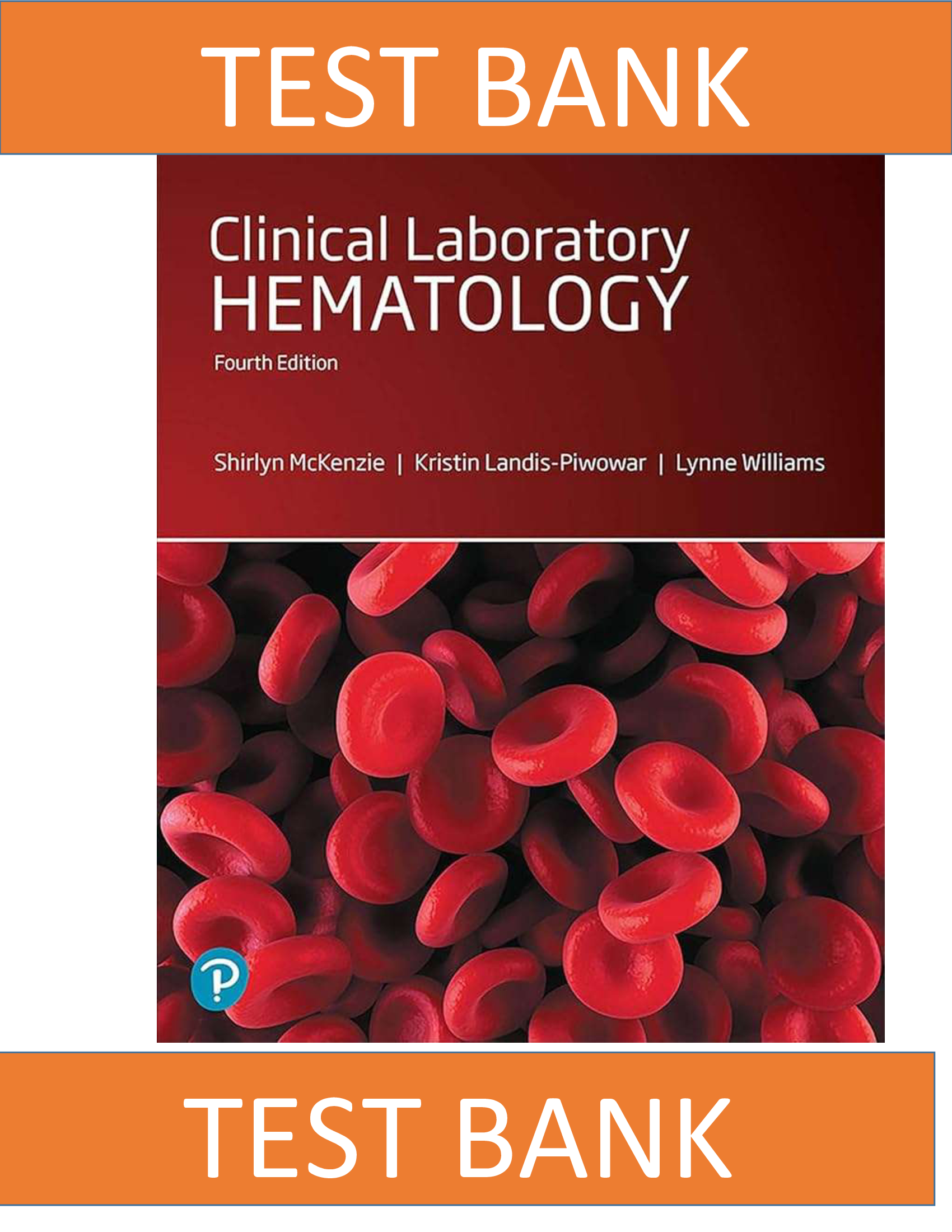
  • Test Bank for Clinical Laboratory Hematology, 4th Edition, Shirlyn McKenzie, Lynne Williams

Test Bank for Clinical Laboratory Hematology, 4th Edition, Shirlyn McKenzie, Lynne Williams

Preview page 1 Preview page 2 Preview page 3
Add To Favorites

Share this item Share this item

  • Item Details
  • Comments (0)
  • Reviews (0)
  • Contact Seller

Clinical Laboratory Hematology, 4th Edition Test Bank (PDF)

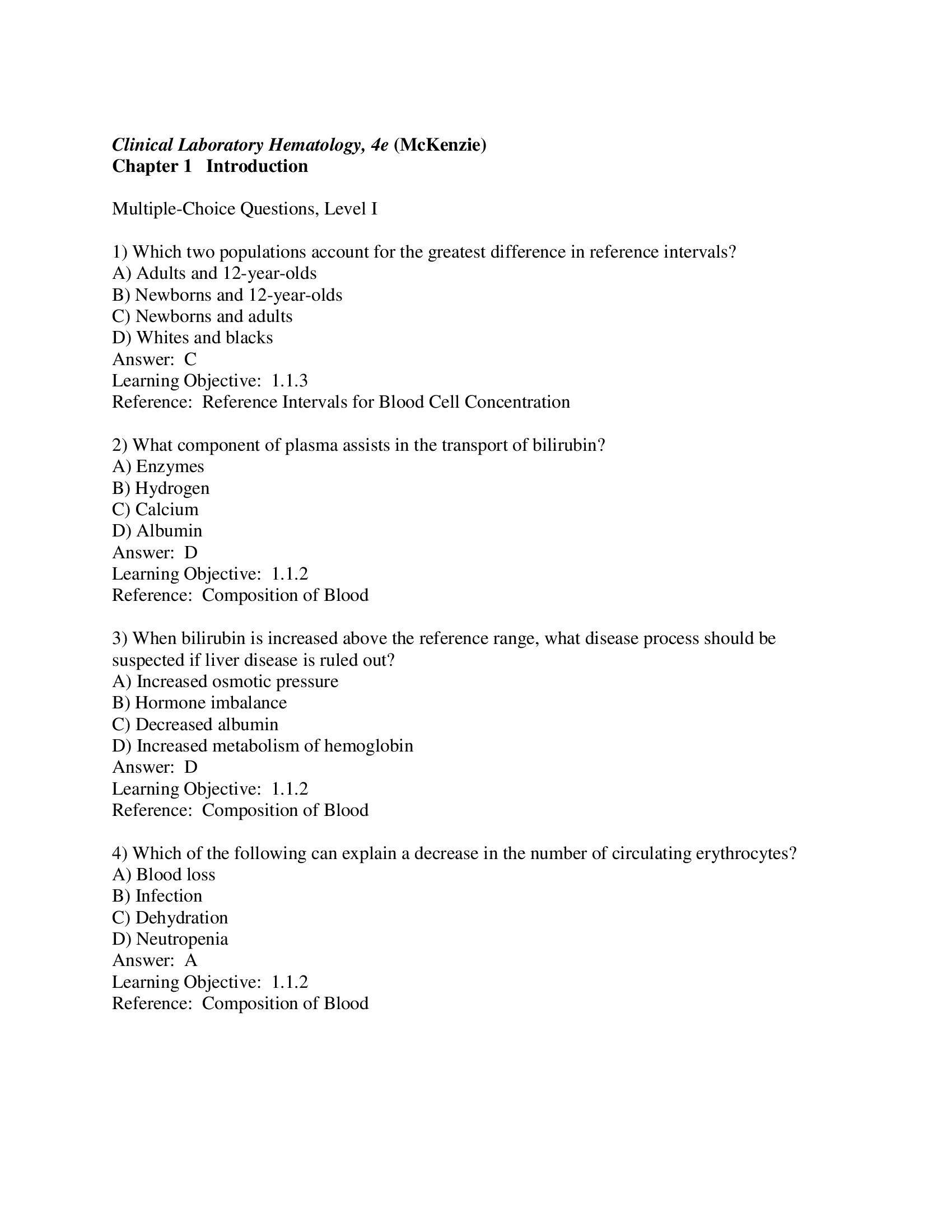
1) Which two populations account for the greatest difference in reference intervals? 

A)  Adults and 12-year-olds

B)   Newborns and 12-year-olds

C)   Newborns and adults

D)  Whites and blacks

Answer:  C

Learning Objective:  1.1.3

Reference:  Reference Intervals for Blood Cell Concentration

2) What component of plasma assists in the transport of bilirubin? 

A)  Enzymes

B)   Hydrogen

C)   Calcium

D)  Albumin

Answer:  D

Learning Objective:  1.1.2

Reference:  Composition of Blood


3) When bilirubin is increased above the reference range, what disease process should be suspected if liver disease is ruled out? 

A)  Increased osmotic pressure

B)   Hormone imbalance

C)   Decreased albumin

D)  Increased metabolism of hemoglobin

Answer:  D

Learning Objective:  1.1.2

Reference:  Composition of Blood


4) Which of the following can explain a decrease in the number of circulating erythrocytes?  A) Blood loss

B)  Infection

C)  Dehydration D) Neutropenia

Answer:  A

Learning Objective:  1.1.2

Reference:  Composition of Blood


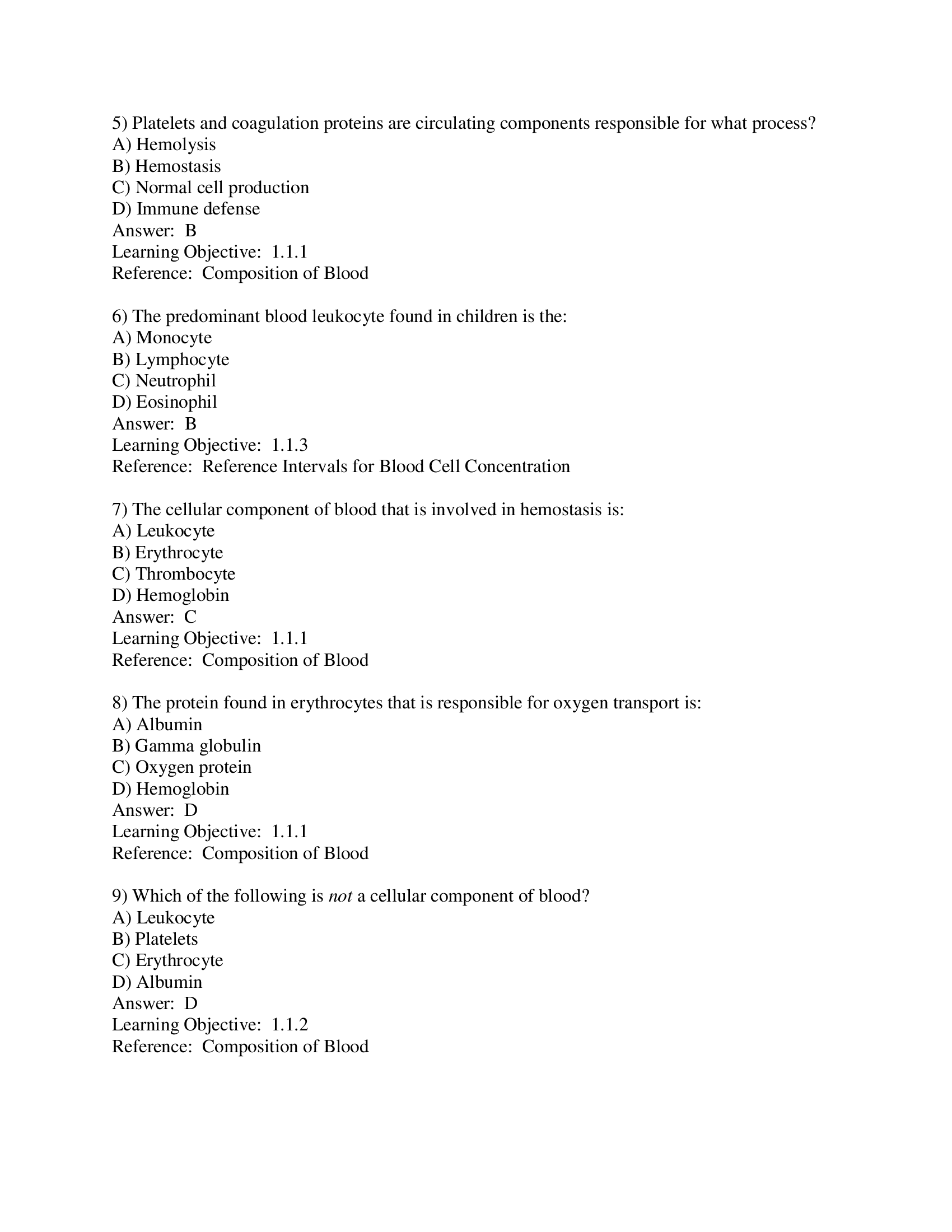
5) Platelets and coagulation proteins are circulating components responsible for what process?  A) Hemolysis

B)   Hemostasis

C)   Normal cell production

D)  Immune defense

Answer:  B

Learning Objective:  1.1.1

Reference:  Composition of Blood


6) The predominant blood leukocyte found in children is the: 

A)  Monocyte

B)   Lymphocyte

C)   Neutrophil

D)  Eosinophil

Answer:  B

Learning Objective:  1.1.3

Reference:  Reference Intervals for Blood Cell Concentration


7) The cellular component of blood that is involved in hemostasis is: 

A)  Leukocyte

B)   Erythrocyte

C)   Thrombocyte

D)  Hemoglobin

Answer:  C

Learning Objective:  1.1.1

Reference:  Composition of Blood


8) The protein found in erythrocytes that is responsible for oxygen transport is: 

A)  Albumin

B)   Gamma globulin

C)   Oxygen protein

D)  Hemoglobin

Answer:  D

Learning Objective:  1.1.1

Reference:  Composition of Blood


9) Which of the following is not a cellular component of blood? 

A)  Leukocyte

B)   Platelets

C)   Erythrocyte

D)  Albumin

Answer:  D

Learning Objective:  1.1.2

Reference:  Composition of Blood


10) The liquid portion of blood is called ________ and makes up about ________ (percentage) of the total blood volume: 

A)  Bilirubin; 4%

B)   Plasma; 55%

C)   Erythrocytes; 65%

D)  Cellular elements; 45%

Answer:  B

Learning Objective:  1.1.2

Reference:  Composition of Blood


11) An abnormal test result is defined as: 

A)  The opposite of a normal test result

B)   A value that is outside the reference interval for a particular analyte

C)   Only those values that fall below the reference interval for multiple analytes

D)  Only those values that are above the reference interval for a single analyte

Answer:  B

Learning Objective:  1.1.5

Reference:  Investigation of a Hematologic Problem

12) Which of the following is not a role of the clinical laboratory professional? 

A)  Correlate lab results with appropriate disease states

B)   Correlate lab results with disease pathophysiology

C)   Correlate lab results with treatment

D)  Order reflex tests

Answer:  D

Learning Objective:  1.1.5

Reference:  Investigation of a Hematologic Problem


13) Which of the following is a hematology screening test?

A)  Complete blood count (CBC)

B)   Activated partial thromboplastin time (APTT)

C)   Osmotic pressure

D)  Chloride concentration Answer:  A

Learning Objective:  1.1.6

Reference:  Investigation of a Hematologic Problem


14) Which of the following represents an event in the pre-examination phase of laboratory testing? 

A)  Reporting of results

B)   Interpretation of laboratory data

C)   Performing a test procedure

D)  Labeling a blood collection tube 

Answer:  D

Learning Objective:  1.1.7

Reference:  Investigation of a Hematologic Problem


15) Irradiated packed red blood cells are used to:

A)  decrease bleeding when there is a deficiency or abnormal function of platelets

B)   decrease the risk of febrile nonhemolytic transfusion reaction

C)   reduce the risk of graft-versus-host disease

D)  treat the neutropenic patient who is septic and unresponsive to antimicrobials and who has chance of marrow recovery

Answer:  C

Learning Objective:  1.1.2

Reference:  Blood Component Therapy


16) The term for the process of blood cells passing through blood vessel walls into surrounding tissues is:

A)  Osmosis

B)   Capillary action

C)   Vasoconstriction

D)  Diapedesis

Answer:  D

Learning Objective:  1.1.1

Reference:  Composition of Blood


17) Which of the following is an expected finding in a newborn? 

A)  WBC count = 2 × 10⁹/L

B)   PLT count = 100 × 109/L

C)   Hemoglobin = 17.0 g/dL

D)  RBC count = 3.50 × 10⁹/L Answer:  C

Learning Objective:  1.1.3

Reference:  Reference Intervals for Blood Cell Concentration


18) Which of the following blood cell components would be most influenced in a patient with an infection of the tonsils (tonsillitis)? 

A)  Leukocyte

B)   Erythrocyte

C)   Thrombocyte

D)  Hemoglobin 

Answer:  A

Learning Objective:  1.1.1

Reference:  Composition of Blood


19) When decreased in concentration, which of the following formed elements could result in hypoxia?  A) Leukocytes

B)   Erythrocytes

C)   Platelets

D)  None of the above

Answer:  B

Learning Objective:  1.1.1

Reference:  Composition of Blood


20) Which component of blood passes through blood vessel walls into surrounding tissues to defend the body against invading foreign antigens? 

A)  Red blood cells

B)   Platelets

C)   Leukocytes

D)  Gamma globulin

Answer:  C

Learning Objective:  1.1.1

Reference:  Composition of Blood


21) Which of the following blood constituents is associated with increased red blood cell destruction?

A)  Bilirubin

B)   Albumin

C)   Blood urea nitrogen

D)  Immunoglobulin

Answer:  A

Learning Objective:  1.1.1

Reference:  Composition of Blood


22) All of the following must be considered when establishing a reference interval for a group of individuals except:  A) The geographic area

B)  Age of the population

C)  Occupations of the population

D)  Sex of the population Answer:  C

Learning Objective:  1.1.3

Reference:  Reference Intervals for Blood Cell Concentration


23) Which of the following tests could be reflexed as the result of an abnormal prothrombin time? 

A)  Molecular analysis of clotting factors

B)   Complete blood count

C)   Measurement of albumin

D)  Hemoglobin analysis

Answer:  A

Learning Objective:  1.1.5

Reference:  Investigation of a Hematologic Problem


24) Which of the following could be reflexed as the result of decreased RBC indices on a screening CBC?

A)  Serum iron studies to rule out Iron Deficiency Anemia

B)   Platelet aggregation studies to rule out disorders of hemostasis

C)   Urine Culture and Sensitivity to rule out infection

D)  Thyroid function studies to rule out thyroid gland disorders

Answer:  A

Learning Objective:  1.1.5

Reference:  Investigation of a Hematologic Problem


25) Patients who are unable to dissolve a fibrin blood clot are likely to present with which of the following pathologies?

A)  Anemia

B)   Bleeding

C)   Thrombosis

D)  Leukemia

Answer:  C

Learning Objective:  1.1.4

Reference:  Hemostasis


26) An unlabeled blood collection tube is delivered to the hematology laboratory. The laboratory professional requests a redraw because an error in which phase of laboratory testing has occurred?  A) Pre-examination

B)   Examination

C)   Post-examination

D)  Analytical

Answer:  A

Learning Objective:  1.1.7

Reference:  Investigation of a Hematologic Problem


Short-Answer Questions


1)  Explain how a reference interval is determined. 

Answer:  A reference interval for a given geographical region is determined by calculating the mean for a group of "normal healthy" individuals. Conditions that must be considered include physiologic differences in a given population as well as the geographic area. Once the mean has been determined, a calculation to determine the standard deviation must be performed. The range is calculated by taking the mean and 2 standard deviations above and below the mean value.  Learning Objective:  1.1.3

Reference:  Reference Intervals for Blood Cell Concentration


2)  Compare expected hemoglobin values and WBC counts between infants and adults.

Answer:  Hemoglobin values and WBC counts are higher in infants and children than in adults. 

Learning Objective:  1.1.3

Reference:  Reference Intervals for Blood Cell Concentration


3)  Explain how the hemostatic pathway is activated in times of need. 

Answer:  Traumatic events to body tissue stimulate the activation of repair mechanisms. As a result of both external and internal stimuli, the hemostatic pathway becomes activated in stages called primary and secondary hemostasis and fibrinolysis.

Learning Objective:  1.1.4

Reference:  Hemostasis


4)  Give two reasons for transfusing leukoreduced, packed red blood cells. 

Answer:  Reasons for transfusing leukoreduced packed red blood cells are to decrease the risk of febrile nonhemolytic transfusion reactions, to decrease the risk of HLA sensitization, and to decrease the risk of CMV transmission. 

Learning Objective:  1.1.2

Reference:  Blood Component Therapy


5)  Explain how screening tests and reflexing testing are related. 

Answer:  In an attempt to reach a cost-effective and efficient diagnosis, a physician's investigation into a hematologic or hemostatic problem begins with screening tests. The results of these tests provide the clues to the diagnosis. Depending on the results of screening tests, more specific tests (reflex tests) can be ordered. The laboratory professional can aid the physician in choosing the appropriate reflex tests that will narrow the scope for the patient diagnosis.

Learning Objective:  1.1.5, 1.1.6

Reference:  Investigation of a Hematologic Problem


6)  Explain how algorithmic protocols are used for follow-up testing.

Answer:  Reflex test protocols are often designed as testing algorithms. These algorithms are follow-up tests that can include not only hematologic tests but also chemical, immunologic, microbiologic, and/or molecular analysis. As scientists learn more about the pathophysiology and treatment of hematologic disease and hemostasis, the number of tests designed to assist in diagnosis expands and, without testing guidelines, the cost can increase due to inappropriate and unnecessary test selection. Errors in selection of the most appropriate laboratory tests and interpretation of results can result in misdiagnosis or treatment errors and is a major source of poor patient outcomes. Algorithms are increasingly important to aid in diagnosis due to the vast number and complexity of tests available to the physician.

Learning Objective:  1.1.8

Reference:  The Value of Laboratory Testing

Contact the Seller

Please Sign In to contact this seller.


  • 👎  Report Copyright Violation

Frequently Asked Questions

What Do I Get When I Buy This Study Material?

+

When you buy a study material on Passing Grades, an instant download link will be sent directly to your email, giving you access to the file anytime after payment is completed.

Is Passing Grades a Trusted Platform?

+

Yes, Passing Grades is a reputable students’ marketplace with a secure payment system and reliable customer support. You can trust us to ensure a safe and seamless transaction experience.

Will I Be Stuck with a Subscription?

+

No, all purchases on Passing Grades are one-time transactions. You only pay for the notes you choose to buy, with no subscriptions or hidden fees attached.

Who Am I Buying These Study Materials From?

+

Passing Grades is a marketplace, which means you are purchasing the document from an individual vendor, not directly from us. We facilitate the payment and delivery process between you and the vendor.

Does Passing Grades Offer Free Study Materials?

+

Yes, sellers on Passing Grades have uploaded numerous free test banks, exams, practice questions, and class notes that can be downloaded at no cost.

Pasinggrades - Quality Study Materials

USD 15

    • Quality checked by Pasing Grades
    • 100% satisfaction guarantee
    • Seller: Angelicer
Buy PDF $15

Seller Information

Angelicer

Member since April 2021

  • icon
  • icon
View Profile
  • total sales

    1
  • Favourites

    0
  • Comments

    0
    ( 0 Ratings )

Item Information

  • Uploaded

    12 July 2025

  • Updated

    15 August 2025

  • Category

    Nursing

  • Item Type

    test bank

  • Tags

    Test Bank for Clinical Laboratory Hematology 4th Edition

Related Exam Prep Guides by Angelicer

Test Bank for Success in Practical Vocational Nursing 8th Edition by Knecht
View Document

Test Bank for Succes...

  • Angelicer

    Angelicer

  • test bank

Enhance your study with the Test Bank for Success in Practical Vocational Nursing 8th Edition by Kne...

15 USD

0

1

Test Bank for Illustrated Anatomy of the Head and Neck 5th Edition by Fehrenbach
View Document

Test Bank for Illust...

  • Angelicer

    Angelicer

  • test bank

Boost your understanding with the Test Bank for Illustrated Anatomy of the Head and Neck 5th Edition...

15 USD

0

1

ATI PEDS Proctored Exam Questions and Answers 2026 | Comprehensive Study Guide
View Document

ATI PEDS Proctored E...

  • Angelicer

    Angelicer

  • test bank

Get the ATI PEDS Proctored Exam Questions and Answers for 2025. This comprehensive study guide offer...

15 USD

0

1

Purchase

Download link will be sent to this email immediately after purchase.

IMPORTANT LINKS

  • How To Upload Class Notes
  • Selling Tips
  • Passing Grades's Study Materials
  • Scholarships for International Students 2025

POPULAR CATEGORIES

  • Law
  • Accounting
  • English
  • Psychology
  • Business
  • Nursing
  • Computer Science
  • General

View Document

  • Blog
  • Contact
  • Delivery Policy
  • Latest Scholarships Around the World
  • How to Pass Bar Exams: Passing Grades’ Strategies
  • How to Study and Pass the CPA Exam
  • All Test Banks
  • Faq
  • Copyright Claims
  • Privacy Policy
  • Terms of Use

KNOWLEDGE BASE

  • How to Write A+ Grade Good Research Paper
  • How to Manage Stress During Exam Period
  • Best Time to Study
  • How to Pass NCLEX-RN Exam
  • How To Effectively Utilize Test Banks
  • Popular Shadow Health Exam Assessments
  • Popular HESI Case Studies
  • How to Prepare for a Nursing Career
  • The Importance Of Summaries in Exam Revisvion

© 2026 Pasing Grades. All rights reserved.