
Pasing Grades
  • Start Selling
  • Blog
  • Contact
  • 0

    Your cart is empty!

English

  • English
  • Spanish
  • Arabic
Create Account Sign In
  • Library
    • New Prep Guides
    • Featured Prep Guides
    • Free Exam Prep Guides
    • Best sellers
  • General
  • Nursing
    • Research Paper
    • Case Study
    • Discussion Post
    • Assignment
    • Exam
    • Practice Questions and Answers
    • Test Bank
    • solutions manual
  • Accounting
    • Case Study
    • Thesis
    • Study Guide
    • Summary
    • Research Paper
    • test bank
  • English
    • Creative Writing
    • Research Paper
    • Summary
    • Rhetorics
    • Literature
    • Journal
    • Exam
    • Grammar
    • Discussion Post
    • Essay
  • Psychology
    • Hesi
    • Presentation
    • Essay
    • Summary
    • Study Guide
    • Essay
    • Solution Manual
    • Final Exam Review
    • Class Notes
    • test bank
  • Business
    • Lecture Notes
    • Solution Manual
    • Presentation
    • Business Plan
    • Class Notes
    • Experiment
    • Summary
    • Practice Questions
    • Study Guide
    • Case Study
    • test bank
    • Exam
  • More
    • Computer Science
    • Economics
    • Statistics
    • Engineering
    • Biology
    • Religious Studies
    • Physics
    • Chemistry
    • Mathematics
    • History
    • Sociology
    • Science
    • Philosophy
    • Law
  • Pages
    • About Us
    • Selling Tips
    • Delivery Policy
    • Faq
    • Privacy Policy
  • Flash Sale
  • Home
  • Test Bank for Child Health Nursing 3rd Edition Bindler

Test Bank for Child Health Nursing 3rd Edition Bindler

Preview page 1 Preview page 2 Preview page 3
Add To Favorites

Share this item Share this item

  • Item Details
  • Comments (0)
  • Reviews (0)
  • Contact Seller

Child Health Nursing 3rd Edition Bindler Test Bank

OUTLINE OF TEXT MATERIAL  

I. Managers and Economics

A. Motivate why managers should study economics.

B. Managers need to understand both microeconomics and macroeconomics as they make decisions.  

C.  The textbook presents both areas and integrates them from a managerial standpoint.

II. Case for Analysis: Micro- and Macroeconomic Influences on the Global Automobile Industry. The case illustrates how microeconomic and macroeconomic factors influence managerial decisions.

A.  Macroeconomic points:

1.  The case demonstrates how a manufacturing industry is influenced by the currency exchange rate

(a) A strong Japanese yen and a weak US dollar motivate the Japanese auto makers to shift their production to the US

2.  The case demonstrates the impact of foreign investment on the economy

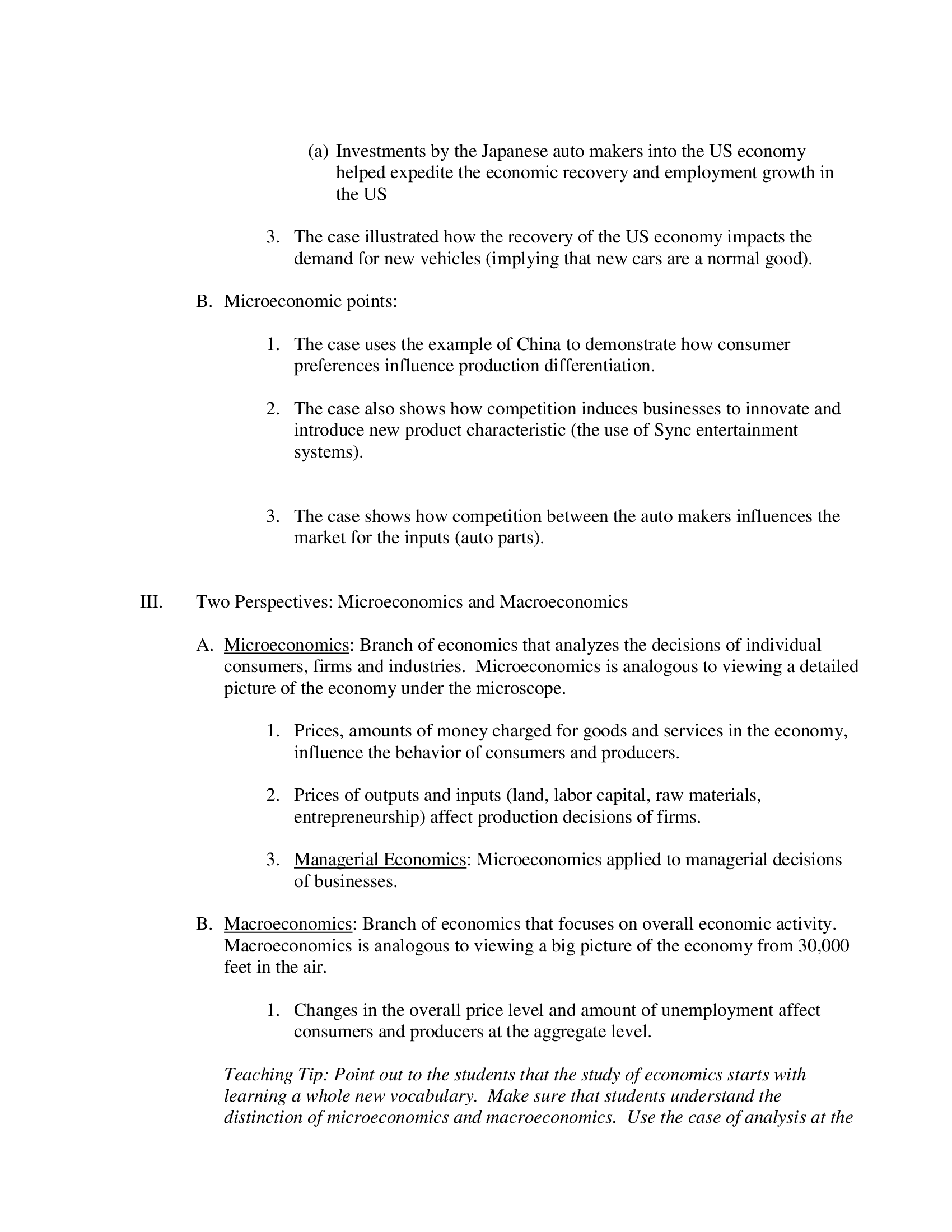
(a) Investments by the Japanese auto makers into the US economy helped expedite the economic recovery and employment growth in the US

3.  The case illustrated how the recovery of the US economy impacts the demand for new vehicles (implying that new cars are a normal good).

B.  Microeconomic points:

1. The case uses the example of China to demonstrate how consumer preferences influence production differentiation. 

2. The case also shows how competition induces businesses to innovate and introduce new product characteristic (the use of Sync entertainment systems).

3. The case shows how competition between the auto makers influences the market for the inputs (auto parts).

III.  Two Perspectives: Microeconomics and Macroeconomics

A. Microeconomics: Branch of economics that analyzes the decisions of individual consumers, firms and industries.  Microeconomics is analogous to viewing a detailed picture of the economy under the microscope.

1. Prices, amounts of money charged for goods and services in the economy, influence the behavior of consumers and producers.

2. Prices of outputs and inputs (land, labor capital, raw materials, entrepreneurship) affect production decisions of firms.

3. Managerial Economics: Microeconomics applied to managerial decisions of businesses.

B. Macroeconomics: Branch of economics that focuses on overall economic activity.  Macroeconomics is analogous to viewing a big picture of the economy from 30,000 feet in the air.

1.  Changes in the overall price level and amount of unemployment affect consumers and producers at the aggregate level.

Teaching Tip: Point out to the students that the study of economics starts with learning a whole new vocabulary.  Make sure that students understand the distinction of microeconomics and macroeconomics.  Use the case of analysis at the start of the chapter to ask them which factors are microeconomic or macroeconomic.

IV.  Microeconomic Influences on Managers

A. Relative Price: The price of one good in relation to the price of another good.

1. Consumers respond to relative prices (prices of Japanese cars relative to those of their US competitors)

2. Businesses choose their input combinations based on the relative prices of the inputs (wages in Japan relative to wages in the US; the price of one material versus the price of a substitute material and so on)

3. Non-price factors and their impact on the cost to the consumer (the cost of financing a car purchase)

B. Product specifications and the consumer preferences (Chinese market versus US market)

Teaching Tip: Make sure the students understand what relative prices are rather than absolute prices.  A good example is a trip to Wal-Mart or any grocery store when one decides how expensive a particular product is by comparing prices of similar products.  An example is the comparison of the prices of oranges to grapefruit.

C. The strategic decisions of managers depend on the market structure.

1. Markets: The mechanisms used for the buying and selling of products.  There are four markets used in microeconomics, ranging from perfect competition, monopolistic competition, oligopoly, to monopoly.

2. Perfect Competition:  Market structure characterized by a large number of firms that sell an undifferentiated product, with easy entry into the market and complete information available for all participants.  

(a)   Each firm is considered a “price-taker” that has no influence on the market price of the product.  

(b) Profits signal new firms to enter the market until all profits are competed away as new firms enter the market to capture the excess profit.

(c) Profit: Total revenue to the firm from the sales of its product minus the total cost of production.

3. Market Power: Ability of a firm to influence the market price of its product and strategies to earn large profits over time.

4.  Imperfect Competition: Market structures of monopoly, oligopoly and monopolistic competition in which firms have some market power.

5. Monopoly: Market structure characterized by a single firm producing a good with no close substitutes.

(a) Barriers to entry (structural, legal or regulatory) exist that prevent other firms from entering the market easily. 

(b) A firm with market power is considered a “price maker” and has to lower prices to sell more output.

6. Monopolistic Competition: Market structure in which many firms have some degree of market power and produce differentiated products. 

7.  Oligopoly: Market structure in which a small number of large firms dominate the market.  These firms have market power but must consider their rivals’ actions into account when developing strategies.

8. In the case of analysis, Ford, GM, Honda, Toyota and their major competitors are multinational firms that have significant market power and are not perfectly competitive.  

Teaching Tip: Discuss the different markets in our economy and have the students decide which of the four market structures each belongs to.  For example, what market structures do the following belong to: wheat, clothing, cereal, soft drink, auto, and local electricity?

D. The goal of firms is profit maximization.  Firms develop strategies to earn the highest profits possible.  

V. Macroeconomic Influences on Managers

A. The circular flow model demonstrates the flow of expenditures between households and firms at the aggregate level.

1.  Consumers buy goods and services produced by firms in the output market.

2. Consumers supply inputs (land, labor, capital equipment and entrepreneurship) to firms in the resource market.  They receive payments for these inputs in the form of wages, rent, interest and profits.

3. Absolute Price Level:  Measure of the overall price level in the economy.

Teaching Tip: Make sure the students understand what the absolute price level is.  The Consumer Price Index is one such measure that is constructed from the prices of various goods and services.  

B.  The circular flow model is used to analyze spending behavior in the economy.

1. Gross Domestic Product (GDP): The comprehensive measure of the total market value of all currently produced final goods and services within a country in a given period of time by domestic and foreign supplied resources:

(a) Personal Consumption Expenditures (C) by households on durable and non-durable goods and services.

(b) Gross Private Domestic Investment Spending (I) on non-residential structures, equipment, and software in addition to residential structures and inventories.

(c) Government Consumption Expenditures and Gross Investment (G) at the federal, state and local levels.

(d) Net Export Spending (F), or Export Spending (X) minus Import Spending (M).

2.  GDP=C+I+G+F or GDP=C+I+G+(X-M)

C.  Factors affecting macro spending behavior.

1.  Changes in consumption and investment behavior in the private sector.

2.   Monetary policy and fiscal policy.

(a) Monetary Policy: Policies adapted by the country’s central bank that influence the money supply, interest rates, and the amount of funds available for loans, which , in turn, influence consumer and business spending.  

(b)  Fiscal Policy: Changes in taxing and spending by the executive and legislative branches of a country’s national government that can be used to either stimulate or restrain the economy.

3.  Changes in the foreign sector including the exchange rate (the US dollar exchange rate against the Japanese yen and the implications on the behavior of the Japanese auto makers).

Contact the Seller

Please Sign In to contact this seller.


  • 👎  Report Copyright Violation

Frequently Asked Questions

What Do I Get When I Buy This Study Material?

+

When you buy a study material on Passing Grades, an instant download link will be sent directly to your email, giving you access to the file anytime after payment is completed.

Is Passing Grades a Trusted Platform?

+

Yes, Passing Grades is a reputable students’ marketplace with a secure payment system and reliable customer support. You can trust us to ensure a safe and seamless transaction experience.

Will I Be Stuck with a Subscription?

+

No, all purchases on Passing Grades are one-time transactions. You only pay for the notes you choose to buy, with no subscriptions or hidden fees attached.

Who Am I Buying These Study Materials From?

+

Passing Grades is a marketplace, which means you are purchasing the document from an individual vendor, not directly from us. We facilitate the payment and delivery process between you and the vendor.

Does Passing Grades Offer Free Study Materials?

+

Yes, sellers on Passing Grades have uploaded numerous free test banks, exams, practice questions, and class notes that can be downloaded at no cost.


Pasinggrades - Quality Study Materials

USD 15

    • Quality checked by Pasing Grades
    • 100% satisfaction guarantee
    • Seller: Angelicer
Buy PDF $15

Seller Information

Angelicer

Member since April 2021

  • icon
  • icon
View Profile
  • total sales

    0
  • Favourites

    0
  • Comments

    0
    ( 0 Ratings )

Item Information

  • Uploaded

    12 July 2025

  • Updated

    12 July 2025

  • Category

    Nursing

  • Item Type

    test bank

  • Tags

    Test Bank for Child Health Nursing 3rd Edition Bindler

Related Exam Prep Guides by Angelicer

Test Bank for Success in Practical Vocational Nursing 8th Edition by Knecht
View Document

Test Bank for Succes...

  • Angelicer

    Angelicer

  • test bank

Enhance your study with the Test Bank for Success in Practical Vocational Nursing 8th Edition by Kne...

15 USD

0

0

Test Bank for Illustrated Anatomy of the Head and Neck 5th Edition by Fehrenbach
View Document

Test Bank for Illust...

  • Angelicer

    Angelicer

  • test bank

Boost your understanding with the Test Bank for Illustrated Anatomy of the Head and Neck 5th Edition...

15 USD

0

0

ATI PEDS Proctored Exam Questions and Answers 2026 | Comprehensive Study Guide
View Document

ATI PEDS Proctored E...

  • Angelicer

    Angelicer

  • test bank

Get the ATI PEDS Proctored Exam Questions and Answers for 2025. This comprehensive study guide offer...

15 USD

0

0

Purchase

Download link will be sent to this email immediately after purchase.

IMPORTANT LINKS

  • How To Upload Class Notes
  • Selling Tips
  • Passing Grades's Study Materials
  • Scholarships for International Students 2025

POPULAR CATEGORIES

  • Law
  • Accounting
  • English
  • Psychology
  • Business
  • Nursing
  • Computer Science
  • General

View Document

  • Blog
  • Contact
  • Delivery Policy
  • Latest Scholarships Around the World
  • How to Pass Bar Exams: Passing Grades’ Strategies
  • How to Study and Pass the CPA Exam
  • All Test Banks
  • Faq
  • Copyright Claims
  • Privacy Policy
  • Terms of Use

KNOWLEDGE BASE

  • How to Write A+ Grade Good Research Paper
  • How to Manage Stress During Exam Period
  • Best Time to Study
  • How to Pass NCLEX-RN Exam
  • How To Effectively Utilize Test Banks
  • Popular Shadow Health Exam Assessments
  • Popular HESI Case Studies
  • How to Prepare for a Nursing Career
  • The Importance Of Summaries in Exam Revisvion

© 2026 Pasing Grades. All rights reserved.