Pasing Grades
  • Start Selling
  • Blog
  • Contact
  • 0

    Your cart is empty!

English

  • English
  • Spanish
  • Arabic
Create Account Sign In
  • Library
    • New Prep Guides
    • Featured Prep Guides
    • Free Exam Prep Guides
    • Best sellers
  • General
  • Nursing
    • Research Paper
    • Case Study
    • Discussion Post
    • Assignment
    • Exam
    • Practice Questions and Answers
    • Test Bank
    • solutions manual
  • Accounting
    • Case Study
    • Thesis
    • Study Guide
    • Summary
    • Research Paper
    • test bank
  • English
    • Creative Writing
    • Research Paper
    • Summary
    • Rhetorics
    • Literature
    • Journal
    • Exam
    • Grammar
    • Discussion Post
    • Essay
  • Psychology
    • Hesi
    • Presentation
    • Essay
    • Summary
    • Study Guide
    • Essay
    • Solution Manual
    • Final Exam Review
    • Class Notes
    • test bank
  • Business
    • Lecture Notes
    • Solution Manual
    • Presentation
    • Business Plan
    • Class Notes
    • Experiment
    • Summary
    • Practice Questions
    • Study Guide
    • Case Study
    • test bank
    • Exam
  • More
    • Computer Science
    • Economics
    • Statistics
    • Engineering
    • Biology
    • Religious Studies
    • Physics
    • Chemistry
    • Mathematics
    • History
    • Sociology
    • Science
    • Philosophy
    • Law
  • Pages
    • About Us
    • Selling Tips
    • Delivery Policy
    • Faq
    • Privacy Policy
  • Flash Sale
  • Home
  • Test Bank for Child Development an Active Learning Approach, 3rd Edition, Laura E. Levine, Joyce Munsch

Test Bank for Child Development an Active Learning Approach, 3rd Edition, Laura E. Levine, Joyce Munsch

Preview page 1 Preview page 2 Preview page 3
Add To Favorites

Share this item Share this item

  • Item Details
  • Comments (0)
  • Reviews (0)
  • Contact Seller

TEST BANK FOR CHILD DEVELOPMENT AN ACTIVE LEARNING APPROACH, 3RD EDITION, LAURA E. LEVINE, JOYCE MUNSCH/

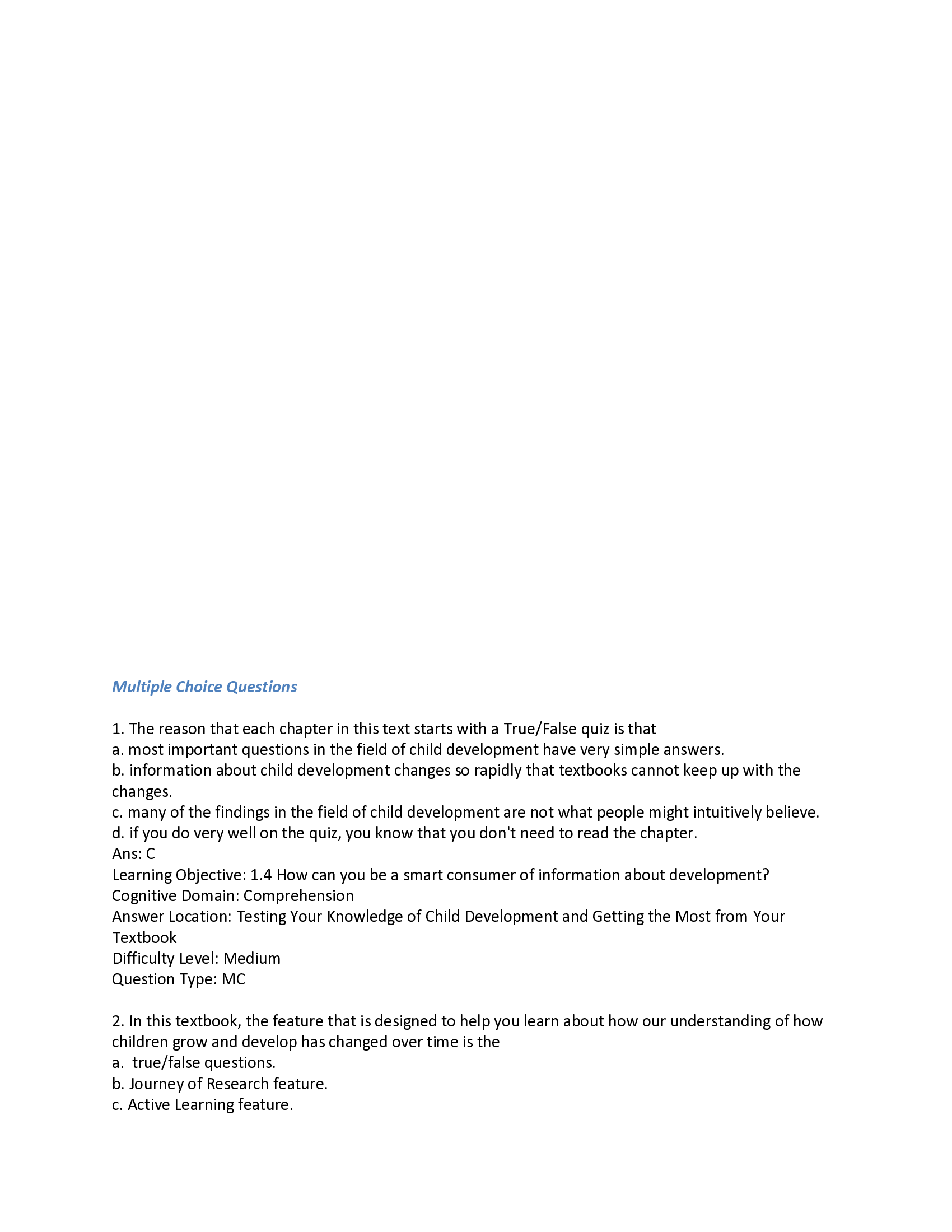
Multiple Choice Questions 


1. The reason that each chapter in this text starts with a True/False quiz is that

a. most important questions in the field of child development have very simple answers. 

b. information about child development changes so rapidly that textbooks cannot keep up with the

changes.

c. many of the findings in the field of child development are not what people might intuitively believe. 

d. if you do very well on the quiz, you know that you don't need to read the chapter.

Ans: C

Learning Objective: 1.4 How can you be a smart consumer of information about development? 

Cognitive Domain: Comprehension

Answer Location: Testing Your Knowledge of Child Development and Getting the Most from Your

Textbook

Difficulty Level: Medium

Question Type: MC


2. In this textbook, the feature that is designed to help you learn about how our understanding of how

children grow and develop has changed over time is the

a.  true/false questions.

b. Journey of Research feature. 

c. Active Learning feature. 


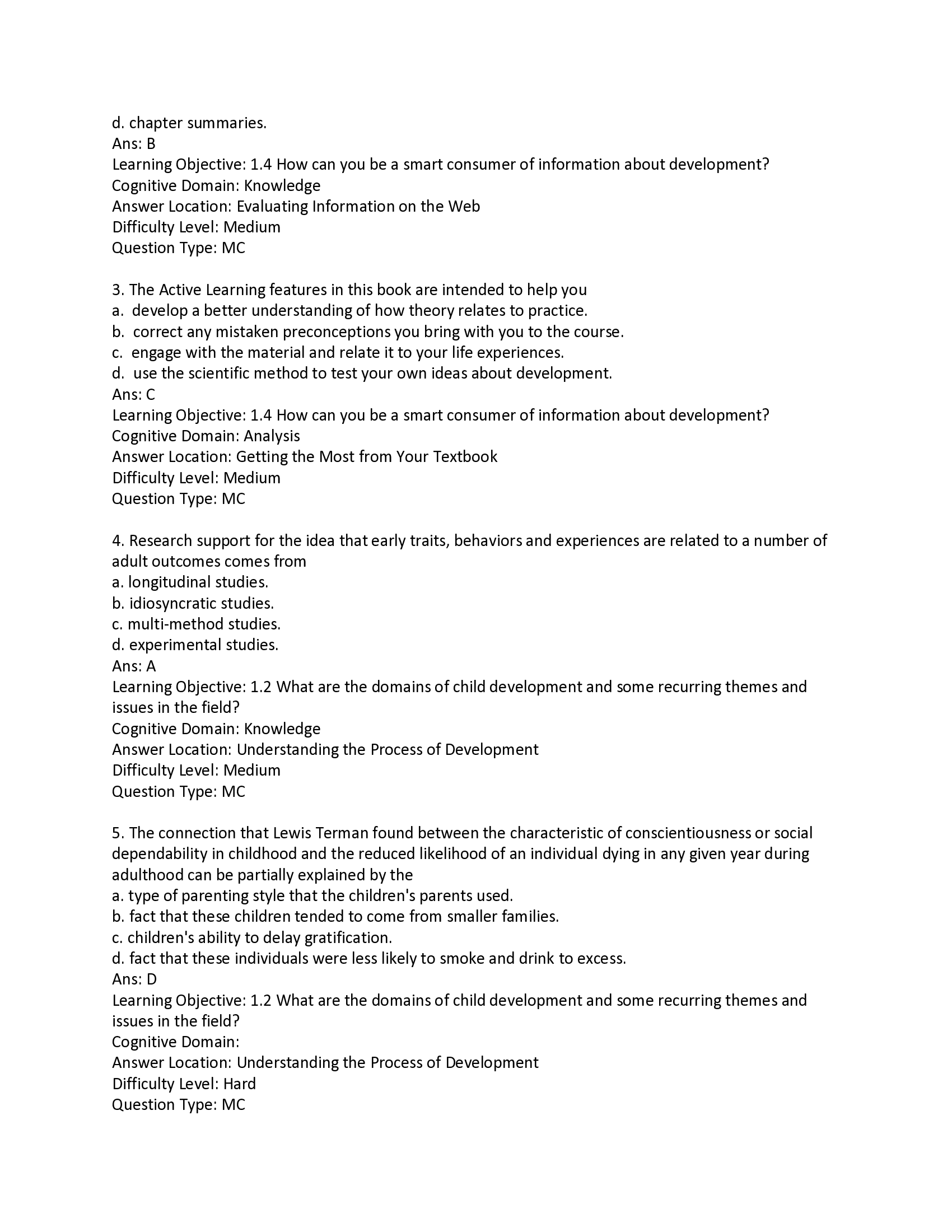
d. chapter summaries.

Ans: B

Learning Objective: 1.4 How can you be a smart consumer of information about development? 

Cognitive Domain: Knowledge

Answer Location: Evaluating Information on the Web

Difficulty Level: Medium

Question Type: MC


3. The Active Learning features in this book are intended to help you

a.  develop a better understanding of how theory relates to practice.

b.  correct any mistaken preconceptions you bring with you to the course.

c.  engage with the material and relate it to your life experiences. 

d.  use the scientific method to test your own ideas about development.

Ans: C

Learning Objective: 1.4 How can you be a smart consumer of information about development? 

Cognitive Domain: Analysis

Answer Location: Getting the Most from Your Textbook

Difficulty Level: Medium

Question Type: MC


4. Research support for the idea that early traits, behaviors and experiences are related to a number of

adult outcomes comes from

a. longitudinal studies. 

b. idiosyncratic studies.

c. multi-method studies.

d. experimental studies.

Ans: A

Learning Objective: 1.2 What are the domains of child development and some recurring themes and

issues in the field?

Cognitive Domain: Knowledge

Answer Location: Understanding the Process of Development

Difficulty Level: Medium

Question Type: MC


5. The connection that Lewis Terman found between the characteristic of conscientiousness or social

dependability in childhood and the reduced likelihood of an individual dying in any given year during

adulthood can be partially explained by the 

a. type of parenting style that the children's parents used.

b. fact that these children tended to come from smaller families.

c. children's ability to delay gratification.

d. fact that these individuals were less likely to smoke and drink to excess. 

Ans: D

Learning Objective: 1.2 What are the domains of child development and some recurring themes and

issues in the field?

Cognitive Domain:

Answer Location: Understanding the Process of Development

Difficulty Level: Hard

Question Type: MC 


6. Which of the following is not a characteristic of a teenage parent?

a. Teen parents are less likely to talk to their infants.

b. Teen parents are less likely to use physical punishment to discipline their children.

c. Teen parents are more likely to have unrealistic expectations regarding their child’s development.

d. Teen parents are more likely play with their infants.  

Ans: D

Learning Objective: 1.1 Who needs to have a good understanding of child development? And why?

Cognitive Domain: Analysis

Answer Location: Parents and Family Members

Difficulty Level: Hard

Question Type: MC


7. Which of the following statements reflects the opinion expressed by the neuroscientist Charles

Nelson about the importance of the early stages of development?

a. A person's character traits are pretty much fixed and determined by the age of 6.

b. While early childhood is relatively important, it is adolescence that is the most important

developmental stage.

c. The first 3 years of life are important but it is the ongoing circumstances of children’s lives that affect

how they develop. 

d. Each stage of development is more important than the ones that preceded it.

Ans: C

Learning Objective: 1.2 What are the domains of child development and some recurring themes and

issues in the field?

Cognitive Domain: Analysis

Answer Location: Understanding the Process of Development

Difficulty Level: Hard 

Question Type: MC


8. The emotional bond that develops between an infant and the infant's caregivers during the first year

of life is called

a. affective regulation.

b. attachment.

c. active niche picking.

d. scaffolding.

Ans: B

Learning Objective: 1.2 What are the domains of child development and some recurring themes and

issues in the field?

Cognitive Domain: Knowledge

Answer Location: Ages and Stages

Difficulty Level: Easy

Question Type: MC


9. As researchers continued to study the children who were part of the Minnesota Parent-Child Project

as they entered adulthood, the researchers realized that 

a. they already had all the information that they needed to predict adult adjustment by the time the

children were age 6.

b. to their surprise early attachment had little or no effect on children’s later social development.  


c. attachment predicted early social relationships, but was not related to any of the other development

outcomes they studied.

d. attachment set the initial conditions for peer relationships, but other experiences played an

important role in how the children developed. 

Ans: D

Learning Objective: 1.1 Who needs to have a good understanding of child development? And why?

Cognitive Domain: Analysis

Answer Location: Understanding the Process of Development 

Difficulty Level: Hard

Question Type: MC


10. The conclusion drawn from the most recent longitudinal research on attachment conducted by

Sroufe and his colleagues was that

a. there is a straight line in development from early attachment relationships to the nature of adult

relationships.

b. there is a straight line in development from adolescent romantic relationships to adult relationships.

c. the nature of adult relationships was related to early attachment as well as the nature of early peer

relationships. 

d. there is no strong reliable relationship between early attachment and later social relationships.

Ans: C

Learning Objective: 1.2 What are the domains of child development and some recurring themes and

issues in the field?

Cognitive Domain: Comprehension

Answer Location: Understanding the Process of Development

Difficulty Level: Medium

Question Type: MC


11. The physical, cognitive and social-emotional domains of development

a. continually interact with each other so that development in one domain impacts and influences

development in the other domains.

b. develop in ways that are largely independent of each other.

c. are linked together in such a way that advances in one domain hold back development in other

domains.

d. are so co-mingled that we cannot talk about development in the different domains separately.

Ans: A

Learning Objective: 1.2 What are the domains of child development and some recurring themes and

issues in the field?

Cognitive Domain: Analysis

Answer Location: Domains of Development

Difficulty Level: Medium

Question Type: MC


12. The way that children can process information changes as they get older. This is a

a. quantitative change in development.

b. qualitative change in development. 

c. accumulative change in development.

d. transactive change in development.

Ans: B 


Learning Objective: 1.2 What are the domains of child development and some recurring themes and

issues in the field?

Cognitive Domain: Comprehension

Answer Location: Continuous Versus Stage-like Development

Difficulty Level: Easy

Question Type: MC


13. _____________ includes the influence of what we bring to development as a result of our genetic

inheritance.

b. Nurture

b. Nature 

c. Qualitative change

c. Quantitative change

Ans: B

Learning Objective: 1.2 What are the domains of child development and some recurring themes and

issues in the field?

Cognitive Domain: Knowledge

Answer Location: Nature and Nurture

Difficulty Level: Easy

Question Type: MC


14. _____________ includes the experiences we have and the learning that occurs as we move through

development.

a. Nurture 

b. Nature

c. Qualitative change

d. Quantitative change

Ans: A

Learning Objective: 1.2 What are the domains of child development and some recurring themes and

issues in the field?

Cognitive Domain: Knowledge

Answer Location: Nature and Nurture

Difficulty Level: Easy

Question Type: MC


15. The quality of the caregiving that you received while growing up is an example of __________ and

your potential ability to learn how to use language is an example of __________.

a. nature; nature

b. nurture; nurture

c. nature; nurture

d. nurture; nature 

Ans: D

Learning Objective: 1.2 What are the domains of child development and some recurring themes and

issues in the field?

Cognitive Domain: Application

Answer Location: Nature and Nurture

Difficulty Level: Medium

Question Type: MC 


16. The rapid increase in height that adolescents experience when they go through the adolescent

growth spurt is an example of a(n)

a. stage theory.

b. quantitative change. 

c. qualitative change.

d. equifinality.

Ans: B

Learning Objective: 1.2 What are the domains of child development and some recurring themes and

issues in the field?

Cognitive Domain: Application

Answer Location: Continuous Versus Stage-like Development

Difficulty Level: Medium

Question Type: MC


17. Which of the following is the best example of a qualitative change in development?

a. Children grow taller but also become heavier as they get older.

b. Older children have larger vocabularies than younger children.

c. Children can run faster and farther as they get older.

d. Adolescents become more systematic in the way they go about solving problems. 

Ans: D

Learning Objective: 1.2 What are the domains of child development and some recurring themes and

issues in the field? 

Cognitive Domain: Application

Answer Location: Continuous Versus Stage-like Development

Difficulty Level: Medium

Question Type: MC


18. Stage theories describe

a. qualitative changes. 

b. long-term changes.

c. significant changes.

d. physiological changes.

Ans: A

Learning Objective: 1.2 What are the domains of child development and some recurring themes and

issues in the field?

Cognitive Domain: Comprehension

Answer Location: Continuous Versus Stage-like Development

Difficulty Level: Easy

Question Type: MC


19. Characteristics such as anxiety, shyness, and aggression tend to be

a. unstable over time, but often find the same form of expression.

b. stable over time, as reflected in the same expression of these traits.

c. stable over time, but how these characteristics are expressed changes. 

d. unstable over time, and often takes different forms of expression.

Ans: C 


Learning Objective: 1.2 What are the domains of child development and some recurring themes and

issues in the field?

Cognitive Domain: Analysis

Answer Location: Stability Versus Change

Difficulty Level: Hard

Question Type: MC


20. If we say that there is no one right way to raise a child, we are endorsing the principle of

a. multilinearity.

b. longitudinality.

c. equifinality. 

d. constructivism.

Ans: C

Learning Objective: 1.2 What are the domains of child development and some recurring themes and

issues in the field?

Cognitive Domain: Knowledge

Answer Location: Individual Differences

Difficulty Level: Hard

Question Type: MC


21. Among children who suffer early deprivation, we see a variety of developmental outcomes. Some

children do quite well, but others are more negatively affected. This is the principle of

a. multifinality. 

b. constructivism.

c. determinism.

d. functionality.

Ans: A

Learning Objective: 1.2 What are the domains of child development and some recurring themes and

issues in the field?

Cognitive Domain: Comprehension

Answer Location: Individual Differences

Difficulty Level: Medium

Question Type: MC


22. The field of developmental psychopathology

a. searches for the genetic cause of the problems we see in development.

b. sees behavioral and emotional disorders as distortions of normal development. 

c. identifies the source of problem behavior in children's early learning experiences.

d. focuses on the consequences of maladaptive behavior.

Ans: B

Learning Objective: 1.2 What are the domains of child development and some recurring themes and

issues in the field?

Cognitive Domain: Comprehension

Answer Location: Individual Differences

Difficulty Level: Medium

Question Type: MC


23. When we consider how a child’s characteristics, such as their age, gender, or ethnicity, impact on

their development, we are

a. searching for universal patterns of behavior.

b. examining the resiliency that children bring to their development.

c. looking at how individual differences modify general patterns of development.

d. identifying the predictable stages of development that children move through.

Ans: C

Learning Objective: 1.2 What are the domains of child development and some recurring themes and

issues in the field?

Cognitive Domain: Comprehension

Answer Location: Individual Differences

Difficulty Level: Medium

Question Type: MC


24. The theory of behaviorism views the child as

a. an active explorer of the environment who creates his or her own understanding of the world.

b. a passive recipient of the attempts of others to control the child's behavior. 

c. an active participant in the process of producing his or her own development.

d. a force that actively shapes the behavior of the adults in the child's life.

Ans: B

Learning Objective: 1.2 What are the domains of child development and some recurring themes and

issues in the field?

Cognitive Domain: Comprehension

Answer Location: The Role of the Child in Development

Difficulty Level: Medium

Question Type: MC


25. The Russian psychologist Lev Vygotsky described learning as

a. a collaborative process between the child and more experienced adults or peers. 

b. something that others impose upon the child through the use of rewards and punishments.

c. the optimal fit between the characteristics of the child and the demands of the environment.

d. a child-directed process that is motivated by the child's internal drives.

Ans: A

Learning Objective: 1.2 What are the domains of child development and some recurring themes and

issues in the field?

Cognitive Domain: Knowledge

Answer Location: The Role of the Child in Development

Difficulty Level: Medium

Question Type: MC


26. A child who is very active and enjoys the challenge of competing with others will be more likely to

join an athletic team at school than to join the chorus or the French Club. This is an example of

a. scaffolding.

b. cultural transmission.

c. multifinality.

d. active niche-picking. 

Ans: D 


Learning Objective: 1.2 What are the domains of child development and some recurring themes and

issues in the field? 

Cognitive Domain: Application

Answer Location: The Role of the Child in Development

Difficulty Level: Medium

Question Type: MC


27. When incarcerated parents took part in the The Family Nurturing Program, a parent education

program, they showed all of the following benefits except which of the following?

a. They spent more time with their infants upon release from prison.

b. They became more empathic.

c. They became less punitive.

d. They developed more realistic expectations for their children.

Ans: A

Learning Objective: 1.1 Who needs to have a good understanding of child development? And why?

Cognitive Domain: Analysis

Answer Location: Parents and Family Members

Difficulty Level: Hard

Question Type: MC


28. When we talk about the impact of culture or socioeconomic status on child development, we are

looking at the _________ of development. 

a. contexts 

b. domains

c. variables

d. content 

Ans: A

Learning Objective: 1.3 What are the contexts for child development?

Cognitive Domain: Knowledge

Answer Location: Contexts of Development

Difficulty Level: Easy

Question Type: MC


29. Cross-cultural research

a. has shown that there is nothing in development that is truly universal.

b. finds that stage theories apply equally well in any culture that we study.

c. has shown that early development is very similar across cultures, but that later development shows

great diversity.

d. finds both universal processes that apply across cultures as well as important cultural differences. 

Ans: D

Learning Objective: 1.3 What are the contexts for child development?

Cognitive Domain: Comprehension

Answer Location: Culture

Difficulty Level: Medium

Question Type: MC


30. Socioeconomic status (SES) is an important context for development because 

a. it is related to the amount of resources that a family has to support their children’s development.  


b. it allows us to easily classify the families that we study.

c. it is a family characteristic that is stable and does not change over time. 

d. it has different meanings depending upon the culture in which it occurs.

Ans: A

Learning Objective: 1.3 What are the contexts for child development?

Cognitive Domain: Comprehension

Answer Location: Family

Difficulty Level: Easy

Question Type: MC


31. You can have confidence in information that you find in scientific journals because

a. all of the information is new.

b. a lot of people believe the information.

c. articles typically go through a peer review process before they are published.

d. the people who write scientific articles have university degrees.

Ans: C

Learning Objective: 1.4 How can you be a smart consumer of information about development? 

Cognitive Domain: Comprehension

Answer Location: Knowing Your Sources

Difficulty Level: Medium

Question Type: MC


32. The importance of the peer review process is that

a. everyone has an equal chance of getting their research published in a journal.

b. the research has been reviewed by professionals who are knowledgeable about the topic before the

research is published.

c. research findings are published in multiple journals so that the results are widely disseminated.

d. only well-established ideas will appear in the research literature.

Ans: B

Learning Objective: 1.4 How can you be a smart consumer of information about development? 

Cognitive Domain: Comprehension

Answer Location: Knowing Your Sources

Difficulty Level: Medium

Question Type: MC


33. Because a science is an organized body of knowledge

a. there must be consensus about the accuracy of new information before it can be added to that body

of knowledge.

b. we should only trust new information that comes from people who have a great deal of experience in

the field.

c. all information that enters that body of knowledge must apply across the board to everyone.

d. it changes over time as new and more accurate information is added to our understanding. 

Ans: D

Learning Objective: 1.4 How can you be a smart consumer of information about development? 

Cognitive Domain: Comprehension

Answer Location: Becoming a Critical Thinker

Difficulty Level: Hard

Question Type: MC 


34. It is important that scientific findings can be replicated. This means that

a. other scientists must review the research and agree that it was correctly done and that the

conclusions are warranted.

b. others have been able to repeat the research with the same or similar results. 

c. the results have been able published in a well-respected research journal.

d. the conclusions can be generalized to a large group of people.

Ans: B

Learning Objective: 1.4 How can you be a smart consumer of information about development? 

Cognitive Domain: Comprehension

Answer Location: Becoming a Critical Thinker

Difficulty Level: Medium

Question Type: MC


35. You can become a critical thinker about research in child development if you

a. seek out divergent opinions from credible sources on topics that interest you.

b. rely upon your own life experiences because they are your best source of information.

c. reject ideas that are new or different from the way we have thought about a topic in the past.

d. agree with what most people think about a topic.

Ans: A

Learning Objective: 1.4 How can you be a smart consumer of information about development? 

Cognitive Domain: Application

Answer Location: Becoming a Critical Thinker

Difficulty Level: Medium

Question Type: MC


36. We should not generalize the findings from a study to the general population unless

a. the research agrees with your personal experiences.

b. the findings apply to every individual who was in the study. 

c. longitudinal research has tracked the individuals over time.

d. the sample is representative of the group we want to understand. 

Ans: D

Learning Objective: 1.4 How can you be a smart consumer of information about development? 

Cognitive Domain: Comprehension

Answer Location: Guarding Against Generalizations

Difficulty Level: Medium

Question Type: MC


37. What can you correctly conclude when you read that research has found that playing violent video

games is associated with aggressive behavior in children?

a. As a group, children who play violent video games are more likely to behave aggressively than

children who don’t play violent video games. 

b. Children should not be allowed to play violent video games.

c. Boys should not be allowed to play violent video games.

d. Children who play violent video games will behave aggressively.

Ans: A

Learning Objectives: 1.4 How can you be a smart consumer of information about development? 

Cognitive Domain: Application 


Answer Location: Evaluating Information on the Web

Difficulty Level: Medium

Question Type: MC


38. We tend to notice things that we expect to see and to disregard things that we aren't expecting. This

tendency is called

a. a generalization fallacy.

b. a perceptual bias. 

c. niche picking.

d. sample bias.

Ans: B

Learning Objectives: 1.4 How can you be a smart consumer of information about development? 

Cognitive Domain: Knowledge

Answer Location: Avoiding Perceptual Bias

Difficulty Level: Medium

Question Type: MC


39. Most of your life you have heard people say that you can’t teach an old dog new tricks. When you

hear this you should remember that 

a. you shouldn’t expect too much from older people.

b. there are enough anecdotal stories to support this statement so we can believe it.  

c. this is a bit of folk wisdom that needs to be tested scientifically before we accept it. 

d. people would only say this if the idea had been supported by a substantial amount of scientific

evidence. 

Ans: C

Learning Objectives: 1.4 How can you be a smart consumer of information about development? 

Cognitive Domain: Application

Answer Location: Avoiding Perceptual Bias

Difficulty Level: Medium

Question Type: MC


40. Teen parents are particularly able to benefit from intervention programs that provide information on

child development because they

a. are more open and receptive to new ideas than older parents.

b. usually have larger families than older parents.

c. are less likely to know what to expect of children than older parents. 

d. are more impressionable than older parents.

Ans: C

Learning Objectives: 1.1 Who needs to have a good understanding of child development? And why?

Cognitive Domain: Comprehension

Answer Location: Parents and Family Members

Difficulty Level: Medium

Question Type: MC


41. Teens are more likely than older parents to have a baby

a. to prove that they can take care of themselves without anyone else's help.

b. so they can pass along cultural traditions and values.

c. as a way to establishing their financial independence. 


d. because they are looking for someone who will love them unconditionally. 

Ans: D

Learning Objectives: 1.1 Who needs to have a good understanding of child development? And why?

Cognitive Domain: Comprehension

Answer Location: Parents and Family Members

Difficulty Level: Medium

Question Type: MC


42. Child therapy and family therapy are two ways to try to

a. prevent problems from developing.

b. address existing problems. 

c. develop social policies that support children and families. 

d. identify problems before they become serious. 

Ans: B

Learning Objectives: 1.1 Who needs to have a good understanding of child development? And why?

Cognitive Domain: Comprehension

Answer Location: Child Development Professionals

Difficulty Level: Hard

Question Type: MC


43. Once a problem that is having a negative effect on a child's development is identified, help often

comes in the form of a(n)

a. associate's program.

b. intervention program. 

c. educational program.

d. self-actualization program.

Ans: B

Learning Objectives: 1.1 Who needs to have a good understanding of child development? And why?

Cognitive Domain: Comprehension

Answer Location: Child Development Professionals

Difficulty Level: Medium

Question Type: MC


44. Which of the following would be the most helpful resource for a student who is looking for

information on careers working with children and families?

a. Occupational Outlook Handbook prepared by the Bureau of Labor Statistics 

b. The Consumer Price Index prepared by the Department of Labor

c. The Annual Report on the Well-Being of Children prepared by the Forum on Child and Family Statistics

d. The Dynamics of the American Workforce Report prepared by the Department of Labor

Ans: A

Learning Objectives: 1.1 Who needs to have a good understanding of child development? And why?

Cognitive Domain: Application

Answer Location: How Much Do You Know About Careers in Child Development?

Difficulty Level: Medium

Question Type: MC


45. In the Occupational Outlook Handbook, you can find all of the following information about careers

EXCEPT  


a. The training and qualifications need for a particular career

b. Information on average earnings

c. Information on other related careers

d. Where you can apply for jobs 

Ans: D

Learning Objectives: 1.1 Who needs to have a good understanding of child development? And why?

Cognitive Domain: Knowledge

Answer Location: How Much Do You Know About Careers in Child Development?

Difficulty Level: Hard

Question Type: MC


46. Research conducted by Dr. Walter Gilliam resulted in an increase in the number of mental health

consultants available to work with preschool children. Dr. Gilliam's research had this impact because

a. it used a large, representative sample of preschool children.

b. his research was published in a well-respected scientific journal.

c. his research convinced legislators to create social policy that provided these services. 

d. everyone recognizes that early childhood is the most important period in development.

Ans: C

Learning Objectives: 1.1 Who needs to have a good understanding of child development? And why?

Cognitive Domain: Application

Answer Location: Policymakers

Difficulty Level: Hard

Question Type: MC


47. The RAND Corporation, The Annie E. Casey Foundation, and The Future of Children are all

a. organizations that devote resources to informing legislators and the public about issues that affect

children. 

b. multi-national corporations that raise funds to support worthy causes related to children.

c. educational think tanks that work toward the implementation of educational reform.

d. organizations that oversee the publication and dissemination of research conducted by independent

researchers.

Ans: A

Learning Objectives: 1.1 Who needs to have a good understanding of child development? And why?

Cognitive Domain: Knowledge

Answer Location: Social Policy Affecting Children and Adolescents

Difficulty Level: Medium

Question Type: MC


48. The Special Supplemental Nutrition Program for Women, Infants, and Children (WIC) Program is an

example of:

a. Development in context

b. Social policy in action

c. Development intervention

d. Anti-bias programming

Ans: B

Learning Objectives: 1.1 Who needs to have a good understanding of child development? And why?

Cognitive Domain: Application

Answer Location: Social Policy Affecting Children and Adolescents 


Difficulty Level: Medium

Question Type: MC


49. Understanding that depression may result from biological and genetic processes, but also from early

traumatic experiences means that you understand the concept of _____.

a.  multifinality

b. equifinality

c. psychopathway

d. convergence

Ans: B

Learning Objectives: 1.2 What are the domains of child development and some recurring themes and

issues in the field?

Cognitive Domain: Comprehension

Answer Location: Individual Differences

Difficulty Level: Medium

Question Type: MC


50. Understanding that children who are victims of abuse can have many different long-term outcomes

that can include depression but also resiliency and healing means that you understand the concept of

_____.

a.  multifinality

b. equifinality

c. psychopathway

d. convergence

Ans: A

Learning Objectives: 1.2 What are the domains of child development and some recurring themes and

issues in the field?

Cognitive Domain: Comprehension

Answer Location: Individual Differences

Difficulty Level: Medium

Question Type: MC


True/False Questions

1. In order for information to be considered “scientific” information, it should be information that

stays the same over time.

a. True

b. False

Ans: B

Learning Objectives: 1.4 How can you be a smart consumer of information about development? 

Cognitive Domain: Comprehension

Answer Location: Becoming a Critical Thinker

Difficulty Level: Medium

Question Type: TF


2. Early experiences are the ones that have the most important and long lasting effects on

development. 


a. True

b. False 

Ans: B

Learning Objectives: 1.2 What are the domains of child development and some recurring themes and

issues in the field?

Cognitive Domain: Comprehension

Answer Location: Understanding the Process of Development

Difficulty Level: Medium

Question Type: TF


3. Promoting the optimal development of children and adolescents is a primary goal of professionals

who work in the field of education.

a. True 

b. False 

Ans: A

Learning Objectives: 1.1 Who needs to have a good understanding of child development? And why?

Cognitive Domain: Knowledge

Answer Location: Child Development Professionals

Difficulty Level: Easy

Question Type: TF


4. The mission of the Future of Children is “to advance research and solutions to overcome the barriers

to success, help communities demonstrate what works and influence decision makers to invest in

strategies based on solid evidence.”

a. True 

b. False

Ans: B

Learning Objectives: 1.1 Who needs to have a good understanding of child development? And why?

Cognitive Domain: Knowledge

Answer Location: Social Policy Affecting Children and Adolescents

Difficulty Level: Easy

Question Type: TF


5. The basic form of the brain is set down in the first years of life, but experiences throughout life

continue to affect it.

a. True 

b. False

Ans: A

Learning Objective: 1.2 What are the domains of child development and some recurring themes and

issues in the field?

Cognitive Domain: Comprehension

Answer Location: Understanding the Process of Development

Difficulty Level: Medium 

Question Type: TF


6. There is a straight line from the quality of infant attachment to adult developmental outcomes.

a. True

b. False  


Ans: B

Learning Objective: 1.2 What are the domains of child development and some recurring themes and

issues in the field?

Cognitive Domain: Comprehension

Answer Location: Understanding the Process of Development

Difficulty Level: Medium 

Question Type: TF


7. Changes in the way that we think, understand and reason about the world is the domain of socialemotional

development.


a.


True

b. False

Ans: B

Learning Objective: 1.2 What are the domains of child development and some recurring themes and

issues in the field?

Cognitive Domain: Knowledge

Answer Location: Domains of Development

Difficulty Level: Hard 

Question Type: TF


8. Physical characteristics such as height or eye color are largely determined by the genes we inherit

from our parents.

a. True

b. False 

Ans: A

Learning Objective: 1.3 What are the contexts for child development?

Cognitive Domain: Analysis

Answer Location: Nature and Nurture

Difficulty Level: Medium 

Question Type: TF


9. In any stage theory, the quality of what happens at one stage is different from what happens at

other stages.

a. True 

b. False

Ans: A

Learning Objective: 1.3 What are the contexts for child development?

Cognitive Domain: Comprehension

Answer Location: Continuous Versus Stage-like Development

Difficulty Level: Easy 

Question Type: TF


10. Although there is both stability and change in development, stability is the most prominent

characteristic in development.

a. True

b. False

Ans: B

Learning Objective: 1.3 What are the contexts for child development? 


Cognitive Domain: Knowledge

Answer Location: Stability Versus Change

Difficulty Level: Medium

Question Type: TF


11. It is possible for the same pathways through development to lead to different outcomes.

a. True 

b. False 

Ans: A

Learning Objective: 1.3 What are the contexts for child development?

Cognitive Domain: Comprehension

Answer Location: Individual Differences

Difficulty Level: Medium 

Question Type: TF


12. The Swiss psychologist Jean Piaget said that we should see children as active participants in their

own development.

a. True 

b. False

Ans: A

Learning Objective: 1.3 What are the contexts for child development?

Cognitive Domain: Comprehension

Answer Location: The Role of the Child in Development

Difficulty Level: Medium

Question Type: TF


13. A family’s socioeconomic status is important because it largely determines the amount of resources

the family will have to support their children’s development. 

a. True

b. False

Ans: A

Learning Objective: 1.3 What are the contexts for child development?

Cognitive Domain: Comprehension

Answer Location: Family

Difficulty Level: Medium

Question Type: TF


14. You should know something about the qualifications of people who present themselves as experts

on child development before you accept what they are saying.

a. True

b. False 

Ans: A

Learning Objective: 1.1 Who needs to have a good understanding of child development? And why?

Cognitive Domain: Comprehension

Answer Location: Child Development Professionals

Difficulty Level: Easy

Question Type: TF


15. Development is a mixture of both nature and nurture.

a. True

b. False 

Ans: B

Learning Objective: 1.3 What are the contexts for child development?

Cognitive Domain: Comprehension

Answer Location: Nature and Nurture

Difficulty Level: Easy 

Question Type: TF


16. You should be careful about gathering information about child development from too many sources

because it will only result in confusion.

a. True

b. False

Ans: B

Learning Objective: 1.4 How can you be a smart consumer of information about development? 

Cognitive Domain: Comprehension

Answer Location: Knowing Your Sources

Difficulty Level: Medium 

Question Type: TF


17. It is appropriate to generalize results from one study to other populations similar to the sample used

in it.

a. True 

b. False  

Ans: A

Learning Objective: 1.4 How can you be a smart consumer of information about development? 

Cognitive Domain: Comprehension

Answer Location: Guarding Against Generalizations

Difficulty Level: Medium 

Question Type: TF


18. It is easier to remember ideas that challenge your expectations than to remember those that fit your

expectations.

a. True

b. False 

Ans: B

Learning Objective: 1.4 How can you be a smart consumer of information about development? 

Cognitive Domain: Comprehension

Answer Location: Avoiding Perceptual Bias

Difficulty Level: Medium 

Question Type: TF


Essay Questions


1. Compare and give an example of how both early and later development in childhood and

adolescence are important for how we develop as adults.

Ans: Varies

Learning Objective: Learning Objective: 1.1 Who needs to have a good understanding of child

development? And why?

Cognitive Domain: Comprehension

Answer Location: Understanding the Process of Development

Difficulty Level: Medium

Question Type: ESS 

2. Describe three domains of development and explain how they interact.

Ans: Varies

Learning Objective: 1.2 What are the domains of child development and some recurring themes and

issues in the field?

Cognitive Domain: Comprehension

Answer Location: Domains of Development

Difficulty Level: Easy

Question Type: ESS 

3. Describe what is meant by nature and nurture.

Ans: Varies

Learning Objective: 1.2 What are the domains of child development and some recurring themes and

issues in the field?

Cognitive Domain: Comprehension

Answer Location: Nature and Nurture

Difficulty Level: Medium

Question Type: ESS 

4. Describe the difference between continuous and stage-like change in child development.

Ans: Varies

Learning Objective: 1.2 What are the domains of child development and some recurring themes and

issues in the field?

Cognitive Domain: Comprehension

Answer Location: Continuous Versus Stage-like Development

Difficulty Level: Easy

Question Type: ESS 

5. What is developmental psychopathology? How do the concepts of equifinality and multifinality

relate to the study of developmental psychopathology?

Ans: Varies

Learning Objective: 1.2 What are the domains of child development and some recurring themes and

issues in the field?

Cognitive Domain: Comprehension

Answer Location: Individual Differences

Difficulty Level: Medium

Question Type: ESS 

6. Describe how a child plays an active role in his or her own development.

Ans: Varies 


Learning Objective: 1.2 What are the domains of child development and some recurring themes and

issues in the field?

Cognitive Domain: Application

Answer Location: The Role of the Child in Development

Difficulty Level: Medium

Question Type: ESS 

7. The socioeconomic status of a child’s family plays an important role in children’s development.

Describe several factors related to socioeconomic status that affect a child’s academic achievement.

Ans: Varies

Learning Objective: 1.3 What are the contexts for child development? 

Cognitive Domain: Comprehension

Answer Location: Family

Difficulty Level: Medium

Question Type: ESS 

8. Mary tells you “I was spanked when I was a child and I turned out all right, so I plan to do the same

with my children”. How would you find and evaluate information to tell whether this is a good idea.

Ans: Varies

Learning Objective: 1.4 How can you be a smart consumer of information about development? 

Cognitive Domain: Application

Answer Location: Knowing Your Sources

Difficulty Level: Hard

Question Type: ESS 

9. Many people believe that the study of child development is just “all common sense.” Is this true?

Why or why not?

Ans: Varies

Learning Objective: 1.4 How can you be a smart consumer of information about development? 

Cognitive Domain: Analysis

Answer Location: Avoiding Perceptual Bias

Difficulty Level: Medium

Question Type: ESS


10. Children’s lives are affected by those who interact directly with them. However, even more children

are affected by laws, policies and programs established at a national or local level. Describe two

programs that have had a major impact on children’s lives.

Ans: Varies

Learning Objective: Learning Objective: 1.1 Who needs to have a good understanding of child

development? And why?

Cognitive Domain: Application

Answer Location: Policymakers

Difficulty Level: Medium

Question Type: ESS

Contact the Seller

Please Sign In to contact this seller.


  • 👎  Report Copyright Violation

Frequently Asked Questions

What Do I Get When I Buy This Study Material?

+

When you buy a study material on Passing Grades, an instant download link will be sent directly to your email, giving you access to the file anytime after payment is completed.

Is Passing Grades a Trusted Platform?

+

Yes, Passing Grades is a reputable students’ marketplace with a secure payment system and reliable customer support. You can trust us to ensure a safe and seamless transaction experience.

Will I Be Stuck with a Subscription?

+

No, all purchases on Passing Grades are one-time transactions. You only pay for the notes you choose to buy, with no subscriptions or hidden fees attached.

Who Am I Buying These Study Materials From?

+

Passing Grades is a marketplace, which means you are purchasing the document from an individual vendor, not directly from us. We facilitate the payment and delivery process between you and the vendor.

Does Passing Grades Offer Free Study Materials?

+

Yes, sellers on Passing Grades have uploaded numerous free test banks, exams, practice questions, and class notes that can be downloaded at no cost.


Pasinggrades - Quality Study Materials

USD 15

    • Quality checked by Pasing Grades
    • 100% satisfaction guarantee
    • Seller: Darling
Buy PDF $15

Seller Information

Darling

Member since September 2021

  • icon
  • icon
View Profile
  • total sales

    0
  • Favourites

    0
  • Comments

    0
    ( 0 Ratings )

Item Information

  • Uploaded

    21 April 2023

  • Updated

    19 June 2025

  • Category

    Nursing

  • Item Type

    test bank

  • Tags

    test bank exam questions and answers nursing chamberlain college of nursing

Related Exam Prep Guides by Darling

TEST BANK FOR ACCOUNTING INFORMATION SYSTEMS, 15TH EDITION BY ROMNEY, STEINBART, SUMMERS, WOOD
View Document

TEST BANK FOR ACCOUN...

  • Darling

    Darling

  • test bank

TEST BANK FOR ACCOUNTING INFORMATION SYSTEMS, 15TH EDITION BY ROMNEY, STEINBART, SUMMERS, WOOD...

15 USD

0

0

TEST BANK FOR PUBLIC FINANCE IN CANADA 5TH EDITION BY ROSEN, GAYER, SNODDON
View Document

TEST BANK FOR PUBLIC...

  • Darling

    Darling

  • test bank

TEST BANK FOR PUBLIC FINANCE IN CANADA 5TH EDITION BY ROSEN, GAYER, SNODDON...

15 USD

0

0

Test Bank For Essentials of Psychiatric Mental Health Nursing 8th Edition Concepts of Care in Evidence- Based Practice 8th Edition Morgan Townsend
View Document

Test Bank For Essent...

  • Darling

    Darling

  • test bank

Test Bank For Essentials of Psychiatric Mental Health Nursing 8th Edition Concepts of Care in Eviden...

15 USD

0

0

Purchase

Download link will be sent to this email immediately after purchase.

IMPORTANT LINKS

  • How To Upload Class Notes
  • Selling Tips
  • Passing Grades's Study Materials
  • Scholarships for International Students 2025

POPULAR CATEGORIES

  • Law
  • Accounting
  • English
  • Psychology
  • Business
  • Nursing
  • Computer Science
  • General

View Document

  • Blog
  • Contact
  • Delivery Policy
  • Latest Scholarships Around the World
  • How to Pass Bar Exams: Passing Grades’ Strategies
  • How to Study and Pass the CPA Exam
  • All Test Banks
  • Faq
  • Copyright Claims
  • Privacy Policy
  • Terms of Use

KNOWLEDGE BASE

  • How to Write A+ Grade Good Research Paper
  • How to Manage Stress During Exam Period
  • Best Time to Study
  • How to Pass NCLEX-RN Exam
  • How To Effectively Utilize Test Banks
  • Popular Shadow Health Exam Assessments
  • Popular HESI Case Studies
  • How to Prepare for a Nursing Career
  • The Importance Of Summaries in Exam Revisvion

© 2026 Pasing Grades. All rights reserved.