Pasing Grades
  • Start Selling
  • Blog
  • Contact
  • 0

    Your cart is empty!

English

  • English
  • Spanish
  • Arabic
Create Account Sign In
  • Library
    • New Prep Guides
    • Featured Prep Guides
    • Free Exam Prep Guides
    • Best sellers
  • General
  • Nursing
    • Research Paper
    • Case Study
    • Discussion Post
    • Assignment
    • Exam
    • Practice Questions and Answers
    • Test Bank
    • solutions manual
  • Accounting
    • Case Study
    • Thesis
    • Study Guide
    • Summary
    • Research Paper
    • test bank
  • English
    • Creative Writing
    • Research Paper
    • Summary
    • Rhetorics
    • Literature
    • Journal
    • Exam
    • Grammar
    • Discussion Post
    • Essay
  • Psychology
    • Hesi
    • Presentation
    • Essay
    • Summary
    • Study Guide
    • Essay
    • Solution Manual
    • Final Exam Review
    • Class Notes
    • test bank
  • Business
    • Lecture Notes
    • Solution Manual
    • Presentation
    • Business Plan
    • Class Notes
    • Experiment
    • Summary
    • Practice Questions
    • Study Guide
    • Case Study
    • test bank
    • Exam
  • More
    • Computer Science
    • Economics
    • Statistics
    • Engineering
    • Biology
    • Religious Studies
    • Physics
    • Chemistry
    • Mathematics
    • History
    • Sociology
    • Science
    • Philosophy
    • Law
  • Pages
    • About Us
    • Selling Tips
    • Delivery Policy
    • Faq
    • Privacy Policy
  • Flash Sale
  • Home
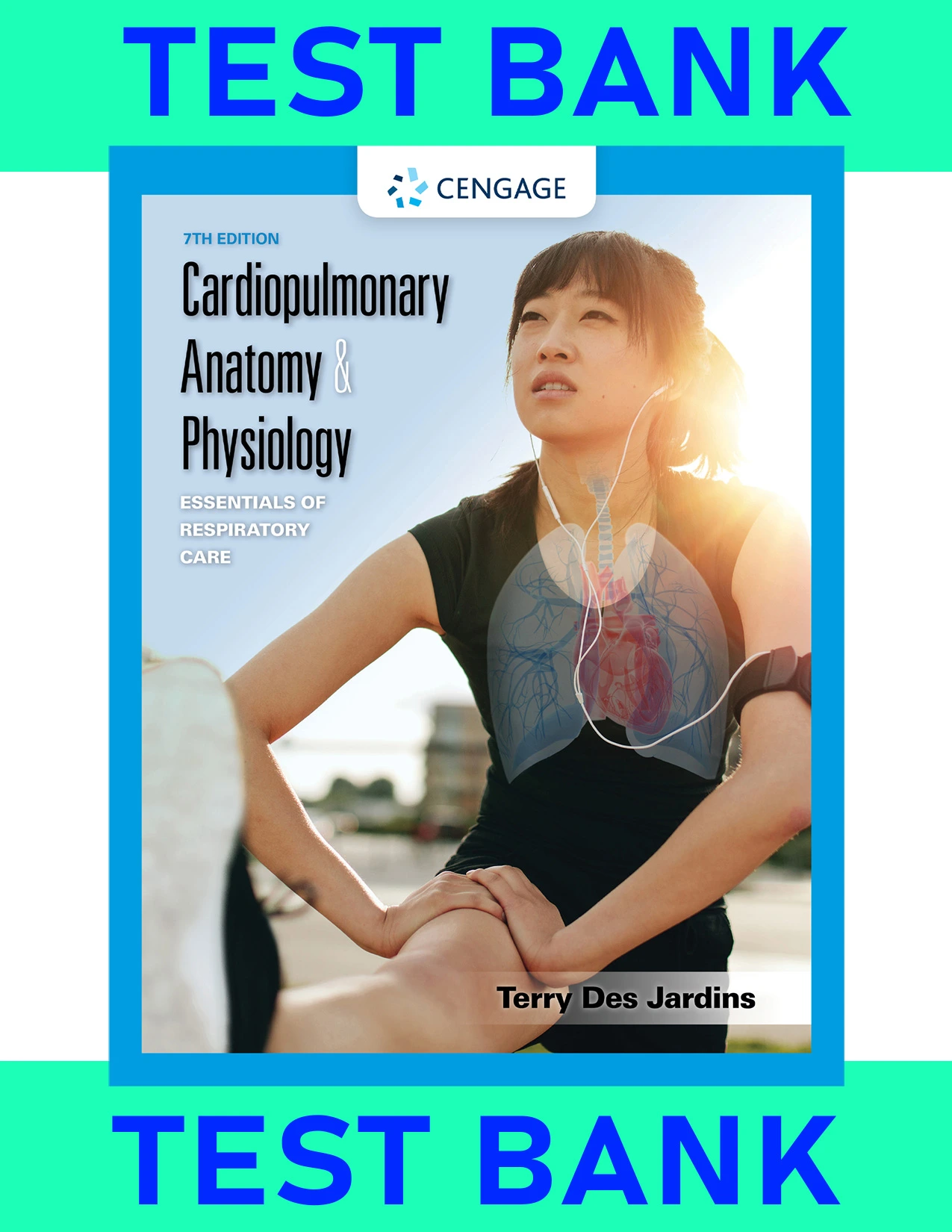
  • Test Bank for Cardiopulmonary Anatomy and Physiology Essentials of Respiratory Care 7th Edition by Des Jardin

Test Bank for Cardiopulmonary Anatomy and Physiology Essentials of Respiratory Care 7th Edition by Des Jardin

Preview page 1 Preview page 2 Preview page 3
Add To Favorites

Share this item Share this item

  • Item Details
  • Comments (0)
  • Reviews (0)
  • Contact Seller

Test Bank for Cardiopulmonary Anatomy and Physiology Essentials of Respiratory Care 7th Edition by Des Jardin


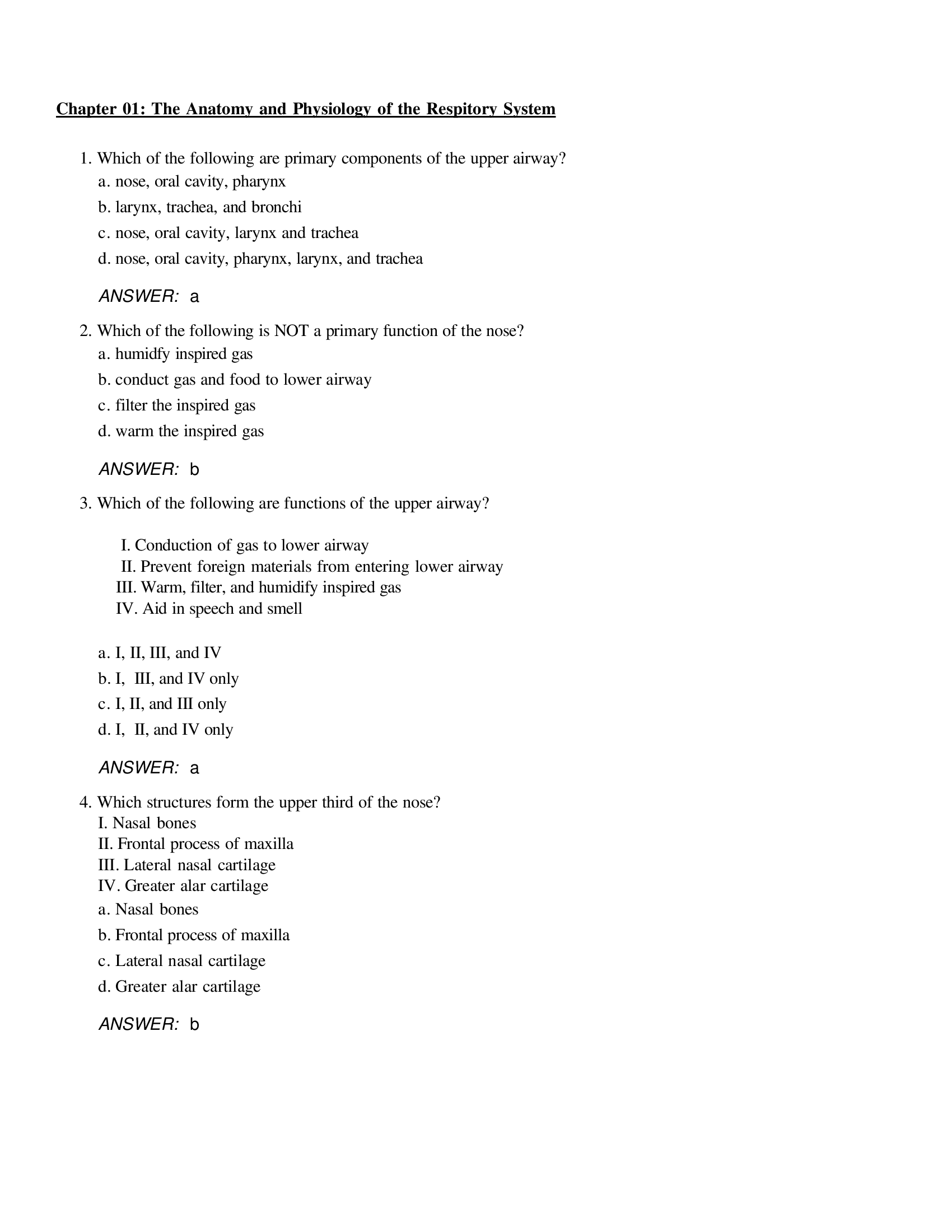
1.         Which of the following are primary components of the upper airway?

a.   nose, oral cavity, pharynx

b.  larynx, trachea, and bronchi

c.   nose, oral cavity, larynx and trachea

d.  nose, oral cavity, pharynx, larynx, and trachea


ANSWER:  a

2.         Which of the following is NOT a primary function of the nose?

a.   humidfy inspired gas

b.  conduct gas and food to lower airway

c.   filter the inspired gas

d.  warm the inspired gas


ANSWER:  b

3.         Which of the following are functions of the upper airway?


I.    Conduction of gas to lower airway

II.  Prevent foreign materials from entering lower airway

III.          Warm, filter, and humidify inspired gas IV. Aid in speech and smell


a.   I, II, III, and IV

b.  I,  III, and IV only

c.   I, II, and III only

d.  I,  II, and IV only


ANSWER:  a

4.         Which structures form the upper third of the nose?

I.                       Nasal bones

II.                    Frontal process of maxilla

III.                  Lateral nasal cartilage IV. Greater alar cartilage a. Nasal bones

b.  Frontal process of maxilla

c.  Lateral nasal cartilage

d.  Greater alar cartilage


ANSWER:  b

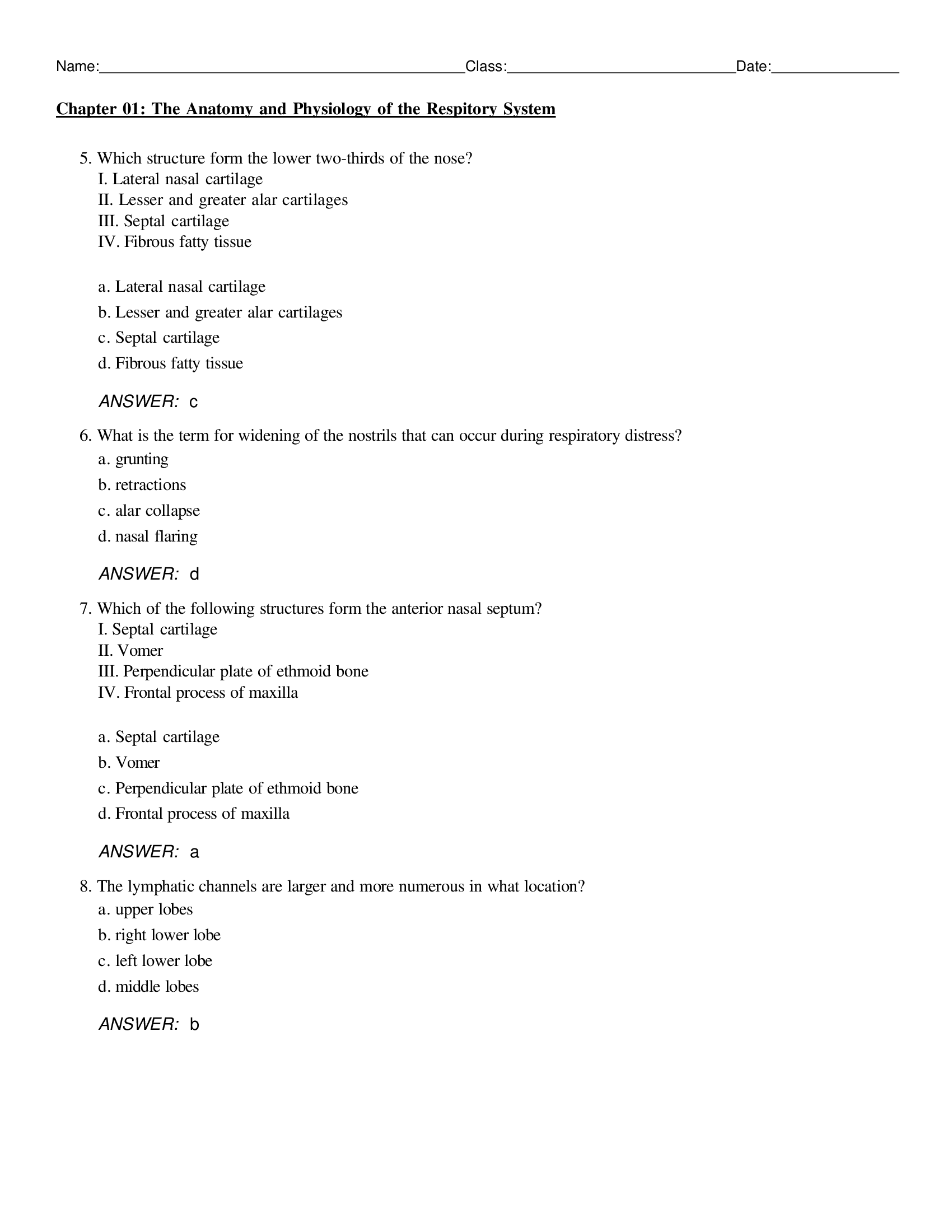
5.         Which structure form the lower two-thirds of the nose?

I.     Lateral nasal cartilage

II.  Lesser and greater alar cartilages

III.                  Septal cartilage IV. Fibrous fatty tissue


a.   Lateral nasal cartilage

b.  Lesser and greater alar cartilages

c.   Septal cartilage

d.  Fibrous fatty tissue


ANSWER:  c

6.         What is the term for widening of the nostrils that can occur during respiratory distress? a. grunting

b.  retractions

c.  alar collapse

d.  nasal flaring


ANSWER:  d

7.         Which of the following structures form the anterior nasal septum?

I.    Septal cartilage

II. Vomer

III.                  Perpendicular plate of ethmoid bone IV. Frontal process of maxilla


a.   Septal cartilage

b.  Vomer

c.   Perpendicular plate of ethmoid bone

d.  Frontal process of maxilla


ANSWER:  a

8.         The lymphatic channels are larger and more numerous in what location?

a.   upper lobes

b.  right lower lobe

c.   left lower lobe

d.  middle lobes


ANSWER:  b

9.         What is the term for the openings created by the alae nasi and septal cartilage? a. nares

b.  glottis

c.  vestibule

d.  choana


ANSWER:  a

10.     What type of epithelium lines the anterior third of the nasal cavity?

a.   cuboidal

b.  pseudostratified ciliated columnar

c.   stratified squamous

d.  pseudostratified ciliated squamous


ANSWER:  c

11.     In which structure would vibrissae normally be found?

a.   oropharynx

b.  laryngopharynx

c.   nasal cavity

d.  trachea


ANSWER:  c

12.     What is the submucosal layer of the tracheobronchial tree?

a.   lamina propria

b.  cartilaginous layer

c.   epithelial lining

d.  mucous blanket


ANSWER:  a

13.     What is another term for conchae?

a.   alae

b.  choana

c.   vestibule

d.  turbinates


ANSWER:  d

14.     Where is the olfactory region located in the nasal cavity?

a.   choana

b.  vestibule

c.   superior and middle turbinates

d.  middle and inferior turbinates


ANSWER:  c

15.     Which of the following sinuses are considered to be paranasal sinuses?

I.    Maxillary

II.  Frontal

III.                  Ethmoid IV. Sphenoid


a.   Maxillary

b.  Frontal

c.   Ethmoid

d.  Sphenoid


ANSWER:  a

16.     What effect, if any, would be expected from the topical application of phenylephrine on the nasal mucosa? a. vasoconstriction

b.  vasodilation

c.  no known effect

d.  bronchospasm


ANSWER:  a

17.     Among pediatric patients, in which age range is epistaxis most prevalent? a. 10-14 years

b.  2-10 years

c.  8-16 years

d.  newborn -2 years


ANSWER:  b

18.     Approximately what portion of the sense of taste is reliant upon the sense of smell? a. 60%

b.  80%

c.   40%

d.  20%


ANSWER:  b

19.     Which of the following can cause sinusitis?

I.    Upper respiratory infection

II.  Dental infection

III.                  Air travel IV. Scuba diving


a.   Upper respiratory infection

b.  Dental infection

c.   Air travel

d.  Scuba diving


ANSWER:  b

20.     In the oral cavity, what is the term for the space between the teeth and lips? a. vibrissae

b.  ventricle

c.  vallecula

d.  vestibule


ANSWER:  d

21.     What is the name of the structure that secures the tongue to the floor of the mouth? a. uvula

b.  extrinsic lingual muscles

c.  instrinsic lingual muscles

d.  lingual frenulum


ANSWER:  d

22.     How many ribs are identified as true ribs, attached directly to the sternum? a. seven

b.  eight

c.  four

d.  six


ANSWER:  a

23.     To what structure is the uvula attached?

a.   hard palate

b.  palatopharyngeal arch

c.   palatoglossal arch

d.  soft palate


ANSWER:  d

24.     What is another name for the palatine tonsils?

a.   adenoids

b.  faucial

c.   lingual

d.  pharyngeal


ANSWER:  b

25.     Which structure extends from the posterior nares to the superior portion of the soft palate? a. oropharynx

b.  palatine tonsils

c.  nasopharynx

d.  tongue


ANSWER:  c

26.     Which epithelium is present in the nasopharynx?

a.   pseudostratified squamous

b.  stratified squamous

c.   cuboidal

d.  pseudostratified ciliated columnar


ANSWER:  d

27.     What is another name for pharyngeal tonsils?

a.   palatine tonsils

b.  lingual tonsils

c.   faucial tonsils

d.  adenoids


ANSWER:  d

28.     What is another name for the pharyngotympanic tubes?

a.   adenoids

b.  conchae

c.   auditory

d.  faucial


ANSWER:  c

29.     What is the most frequent cause of hearing loss in young children? a. tonsillitis

b.  pharyngitis

c.  sinusitis

d.  otitis media


ANSWER:  d

30.     Which structure extends from the soft palate to the base of the tongue?

a.   nasopharynx

b.  oropharynx

c.   uvula

d.  laryngopharynx


ANSWER:  b

31.     What type of epithelium is found in the oropharynx?

a.   stratified squamous

b.  pseudostratified squamous

c.   pseudostratified ciliated columnar

d.  cuboidal


ANSWER:  a

32.     What structure is located between the glossoepiglottic folds in the posterior oropharynx? a. vallecula epiglottica

b.  lingual tonsils

c.  rima glottidis

d.  palatine tonsils


ANSWER:  a

33.     What spoon-shaped fibrocartilaginous structure covers the opening of the larynx during swallowing? a. vocal folds

b.  base of the tongue

c.  vallecula

d.  epiglottis


ANSWER:  d

34.     What is a common site for misplacement of endotracheal tubes during emergency intubation? a. stomach

b.  left mainstem bronchus

c.  esophagus

d.  left upper lobar bronchus


ANSWER:  c

35.     Which structure extends from the base of the tongue to the upper end of the trachea? a. laryngopharynx

b.  thyroid gland

c.  larynx

d.  rima glottidis


ANSWER:  c

36.     Which of the following are functions of the larynx?

I.       Passageway for gas

II.    Protects against aspiration

III.  Generation of sounds for speech

IV.Warming and filtration of inspired gas


a.   Passageway for gas

b.  Protects against aspiration

c.   Generation of sounds for speech

d.  Warming and filtration of inspired gas


ANSWER:  b

37.     Which of the cartilages of the larynx are unpaired?

a.   thyroid, epiglottis, and arytenoid

b.  artyenoid, cuneiform, and corniculate

c.   thyroid, cricoid, and cuneiform

d.  thyroid, epiglottis, and cricoid


ANSWER:  d

38.     To what structure does the upper portion of the thyroid cartilage attach by a membrane? a. mandible

b.  hyoid bone

c.  epiglottis

d.  tongue


ANSWER:  b

39.     Which laryngeal cartilage is primarily responsible for preventing food, liquids, and foreign bodies from entering the lower airways? a. cricoid

b.  epiglottis

c.  thyroid

d.  corniculate


ANSWER:  b

40.     Which laryngeal cartilage is shaped like a signet ring and forms a large portion of the posterior laryngeal wall? a. epiglottis

b.  cricoid

c.  cuneiform

d.  corniculate


ANSWER:  b

41.     Which of the laryngeal cartilages are single?

I.    Cuneiform

II. Thyroid

III.                  Epiglottis IV. Cricoid


a.   Cuneiform

b.  Thyroid

c.   Epiglottis

d.  Cricoid


ANSWER:  b

42.     What is the space between the true vocal cords called? a. vallecula

b.  vestibule

c.  rima glottidis

d.  choana


ANSWER:  c

43.     What is not a common cause of posterior nosebleeds?

a.   nasal tumors

b.  serious nose trauma

c.   high altitude

d.  drug abuse


ANSWER:  c

44.     Which of the following is a subglottic airway obstruction usually caused by the parainfluenza virus? a. pharyngitis

b.  laryngotracheobronchitis (LTB)

c.  epiglottitis

d.  tonsillitis


ANSWER:  b

45.     What is causative agent in the majority of cases of acute epiglottitis?

a.   Streptococcus

b.  MRSA

c.   Parainfluenza virus

d.  Haemophilus influenzae type B


ANSWER:  d

46.     Which type of epithelium is present in the larynx above the vocal cords?

a.   pseudostratified squamous

b.  stratified squamous

c.   cuboidal

d.  pseudostratified ciliated columnar


ANSWER:  b

47.     Which laryngeal muscles are primarily responsible for adduction of the vocal cords? a. transverse arytenoid

b.  lateral cricoarytenoid

c.  posterior cricoarytenoid

d.  thyroarytenoid


ANSWER:  b

48.     Which of the following muscles pull the larynx and hyoid downward?

a.   suprahyoid group

b.  cricothyroid muscles

c.   posterior cricoarytenoid muscles

d.  infrahyoid group


ANSWER:  d

49.     What is the secondary vital function of the larynx?

a.   Gag reflex

b.  Babinski reflex

c.   Valsalva’s maneuver

d.  Moro maneuver


ANSWER:  c

50.     What type of epithelium extends from the trachea to the respiratory bronchioles?

a.   stratified squamous

b.  pseudostratified squamous

c.   cuboidal

d.  pseudostratified ciliates columnar


ANSWER:  d

51.     What is the primary component of the mucous blanket in the tracheobronchial tree? a. glycoproteins

b.  water

c.  lipids

d.  DNA


ANSWER:  b

52.     At what level in the tracheobronchial tree are cilia completely absent?

a.   respiratory bronchioles

b.  bronchioles

c.   lobar bronchi

d.  mainstem bronchi


ANSWER:  a

53.     Which cranial nerve innervates the submucosal glands?

a.   tenth

b.  ninth

c.   seventh

d.  eighth


ANSWER:  a

54.     What is the term for the viscous layer of the mucous blanket? a. gel

b.  epoxic

c.  basal

d.  sol


ANSWER:  a

55.     How many times per minute do the cilia in the tracheobronchial tree move? a. 1500 times

b.  2500 times

c.  500 times

d.  50 times


ANSWER:  a

56.     When excessive secretions are present in the lungs, what term describes the sound heard by ascultation over large airways during exhalation? a. crackles

b.  stridor

c.  rhonchi

d.  wheeze


ANSWER:  c

57.     Which of the following factors can alter the mucociliary transport mechanism?

I.    Excessive bronchial secretions

II.  Tobacco smoke

III.                  Hypoxia IV. Air pollution


a.   Excessive bronchial secretions

b.  Tobacco smoke

c.   Hypoxia

d.  Air pollution


ANSWER:  b

58.     Where are mast cells located in the tracheobronchial tree?

I.  Lamina propria

II.                    Intra-alveolar septa III. Sub-mucosal glands


a.   Lamina propria

b.  Intra-alveolar septa

c.   Sub-mucosal glands

d.

ANSWER:  a

59.     Approximately how many IgE receptor sites are present on a single mast cell? a. 1,000 - 5,000

b.  1,000,000 - 5,000,000

c.   100 - 500

d.  100,000 - 500,000


ANSWER:  d

60.     When degranulation of mast cells occurs and chemical mediators are released, which of the following would occur in the lungs?

I.    Increased vascular permeability

II.  Increased mucus production

III.                  Smooth muscle relaxation IV. Vasodilation with edema


a.   Increased vascular permeability

b.  Increased mucus production

c.   Smooth muscle relaxation

d.  Vasodilation with edema


ANSWER:  a

61.     What is the term for the cartilaginous airways?

a.   respiratory unit

b.  acinus

c.   conducting zone

d.  tracheobronchial tree


ANSWER:  c

62.     In cm, what is the average diameter of the adult trachea?

a.   0.5 - 1.5 cm

b.  2.0-3.5 cm

c.   0.75 - 1.0 cm

d.  1.5 - 2.5 cm


ANSWER:  d

63.     What is the term for the bifurcation of the trachea?

a.   hilum

b.  carina

c.   concha

d.  choana


ANSWER:  b

64.     In an adult, at what angle does the left mainstem bronchus branch from the trachea? a. 40-60 degrees

b.  10-15 degrees

c.  60-75 degrees

d.  25-40 degrees


ANSWER:  a

65.     What is the recommended “safe range” for endotracheal tube cuff pressures? a. 30-35 mm Hg

b.  45-50 mm Hg

c.  20-25 mm Hg

d.  35-40 mm Hg


ANSWER:  c

66.     Which vessel is the most commonly associated with massive hemorrhage following a tracheostomy? a. pulmonary artery

b.  subclavian artery

c.  carotid artery

d.  innominate artery


ANSWER:  d

67.     In the newborn, at what angles do the right and left mainstem bronchi form with the trachea? a. both form a 55 degree angle

b.  right forms a 60 degree angle, left forms a 25 degree angle

c.  right forms a 25 degree angle, left forms a 60 degree angle

d.  both form a 40 degree angle


ANSWER:  a

68.     In an adult, into which structure would an endotracheal tube likely enter if the tube is inadvertently advanced too far? a. left lower lobar bronchus

b.  left mainstem bronchus

c.  right mainstem bronchus

d.  right middle lobar bronchus


ANSWER:  c

69.     How many second generation bronchi would you find in a healthy adult tracheobronchial tree? a. 3

b.  2

c.  6

d.  5


ANSWER:  d

70.     How many segmental bronchi are found in each of the lungs?

a.   each lung has 8

b.  8 in right lung, 10 in left lung

c.   10 in right lung, 8 in left lung

d.  each lung has 10


ANSWER:  c

71.     What is another term for primary lobule?

I.    Acinus

II. Functional units

III.                  Terminal respiratory unit IV. Lung parenchyma


a.   Acinus

b.  Functional units

c.   Terminal respiratory unit

d.  Lung parenchyma


ANSWER:  b

72.     At which airway generation do Canals of Lambert appear? a. 12-15

b.  16 - 19

c.   6-9

d.  20-26


ANSWER:  b

73.     At what point in the tracheobronchial tree are Clara cells present? a. bronchioles

b.  respiratory bronchioles

c.  subsegmental bronchi

d.  terminal bronchioles


ANSWER:  d

74.     How does the total cross-sectional area of the tracheobrochial tree change from the trachea to the respiratory zone?

a.   It increases steadily to the terminal bronchioles then increases significantly in the respiratory zone

b.  It decreases slightly to the terminal bronchioles then decreases significantly

c.   It remains steady throughout the tracheobronchial tree

d.  It increases steadily through the lobar bronchi then increases significantly through the remaining airway generations


ANSWER:  a

75.     Which structures are nourished by the bronchial arteries?

a.   trache through the terminal bronchioles

b.  respiratory zone

c.   noncartilaginous airways only

d.  trachea and mainstem bronchi only


ANSWER:  a

76.     In the adult male, approximately how many alveoli are present in the lungs?

a.   180 million    b. 300 million

             c. 600 million   d. 130 million


ANSWER:  b

77.     What type of epithelium composes 95% of the alveolar surface?

a.   Type IV (pseudostratified squamous)           b. Type I (squamous pneumocyte)

             c. Type II (cuboidal)                                d. Type III (macrophages)


ANSWER:  b

78.     In the lungs of a healthy young adult male, what is the average surface area available for gas exchange?

a.   50 square meters       b. 100 square meters

             c. 300 square meters    d. 70 square meters


ANSWER:  d

79.     Which alveolar cells are considered to be the source of pulmonary surfactant?

a.   Type I           b. Type II

              c. Type III     d. Type IV


ANSWER:  b

80.     What is the term for the openings in the walls of interalveolar septa?

a.   Loose space b. Clara cells

             c. Canals of Lambert     d. Pores of Kohn


ANSWER:  d

81.     What is the average thickness of the Type I alveolar cell?

a.   1-5 mm         b. 0.1-0.5 mm

             c. 1-5 microns    d. 0.1-0.5 microns


ANSWER:  d

82.     Which alveolar cells are macrophages?

a.   Type IV         b. Type III

              c. Type I        d. Type II


ANSWER:  b

83.     In which portion of the primary lobule does the majority of gas exchange occur?

a.   Type II pneumocyte b. loose space of intestitium

             c. Pores of Kohn            d. tight space of interstitium


ANSWER:  d

84.     Which is not a wall layer for pulmonary arteries?

a.   tunica intima b. tunica externicus

             c. tunica adventitia    d. tunica media


ANSWER:  b

85.     What type of epithelium is present in the pulmonary capillaries?

a.   cuboidal        b. pseudostratified columnar

             c. squamous    d. pseudostratified squamous


ANSWER:  c

86.     How many pulmonary veins empty into the left atrium?

a.   8        b. 4

              c. 2      d. 0


ANSWER:  b

87.     From what area deep in the lungs do lymphatic vessels arise?

a.   Type II alveolar cells             b. tight space of interstitium

            c. Type III alveolar cells   d. loose space of interstitium


ANSWER:  d

88.     On which portion(s) of the right lung surfaces would the majority of lymphatic vessels be located?

a.   upper lobes   b. Lymphatic vessels are distributed equally on all lobes

             c. middle lobe    d. lower lobes


ANSWER:  d

89.     What is the term for the vessels adjacent to peribronchovascular lymphatic vessels?

a.   tertiary lymphatics     b. cardinal lymphatics

             c. Type IV lymphatics   d. juxta-alveolar lymphatics


ANSWER:  d

90.     What effect does stimulation of the beta 2 receptors have on the pulmonary system?

a.   bronchdilation           b. vasoconstriction

             c. vasodilation       d. bronchoconstriction


ANSWER:  a

91.     Which neurotransmitter is released when the parasympathetic system is activated?

a.   prostaglandin             b. epinephrine

             c. norepinephrine    d. norepinephrine


ANSWER:  d

92.     What is the general term for drugs that block the effects of the parasymphathetic nervous system on the bronchial smooth muscle?

a.   anticholinergic           b. parasympathomimetic

             c. sympathomimetic    d. beta adrenergic


ANSWER:  a

93.     What effect does stimulation of the sympathetic nervous system have on the body? I. Dilates the pupils

II.    Causes bronchodilation

III.  Increases rate and force of cardiac contractions


a.   Dilates the pupils       b. Causes bronchodilation

            c. Increases rate and force of cardiac contractions    d.


ANSWER:  a

94.     When an acute asthma episode occurs, which quick relief agent is most commonly administered? a. formoterol b. arformoterol

             c. albuterol        d. salmeterol


ANSWER:  c

95.     In the healthy adult, what are the normal anterior boundaries of the lungs?

a.   Between first and eigth ribs   b. Between the second and eleventh ribs

            c. Between first and sixth ribs   d. Between the second and ninth ribs


ANSWER:  c

96.     What is the term for the uppermost portion of the upright lung?

a.   hilum             b. lingula

              c. apex      d. base


ANSWER:  c

97.     How many bronchopulmonary segments are located in the lower lobe of the right lung? a. 4 b. 5

              c. 2      d. 3


ANSWER:  c

98.     What is the term for the therapeutic positional measures which utilize gravity to assist in secretion removal from the lungs?

a.   chest wall oscillation             b. percussion

             c. postural drainage         d. vibration


ANSWER:  c

99.     Which structures are contained in the mediastinum?

I.     Trachea

II.  Great vessels

III.                  Portions of the esophagus IV. Pituitary gland


a.   Trachea         b. Great vessels

            c. Portions of the esophagus    d. Pituitary gland


ANSWER:  d

100. What is the term for the potential space between the visceral and parietal pleura?

a.   pericardial cavity       b. thoracic cavity

             c. pleural cavity          d. mediatinum


ANSWER:  c

101. What is the superior portion of the sternum called?

a.   manubrium sterni      b. body

             c. maxilla sterni          d. xiphoid process


ANSWER:  a

102. What is the term for inflammation of the pleural membranes?

a.   pleurisy         b. empyema

             c. pneumothorax    d. pleural effusion


ANSWER:  a

103. What is the term for the abnormal collection of fluid in the pleural cavity?

a.   empyema      b. hemothorax

             c. pneumothorax    d. pleural effusion


ANSWER:  d

104. In a pneumothorax, where does the abnormal collection of air accumulate?

a.   pleural cavity            b. mediastinum

             c. thoracic cavity    d. pericardium


ANSWER:  a

105. What is one of the most common iatrogenic complications from a thoracentesis?

a.   pleural effusion         b. empyema

             c. pneumothorax      d. hemorrhage


ANSWER:  c

106. Which two muscles come together at the central tendon?

a.   sternum         b. trapezius

             c. external intercostals    d. hemidiaphragm


ANSWER:  d

107. Which nerves supply the primary motor innervation to the right and left hemidiaphragms?

a.   vagus             b. phrenic

             c. Thoracic nerves 1-3     d. IX cranial


ANSWER:  b

108. Which structure moves in a “pump handle-like motion” during inspiration?

a.   diaphragm     b. sternum

             c. external intercostals    d. internal intercostals


ANSWER:  b

109. Which of the following are scalene muscles?

I.    Anterior

II.  Exterior

III.                  Medial IV. Posterior


a.   Anterior         b. Exterior

              c. Medial        d. Posterior


ANSWER:  d

110. Which of the following are accessory muscles of expiration?

I.    Rectus abdominis

II.  Transverse abdominis

III.                  Internal intercostals IV. Pectoralis major


a.   Rectus abdominis      b. Transverse abdominis

             c. Internal intercostals    d. Pectoralis major


ANSWER:  d

Contact the Seller

Please Sign In to contact this seller.


  • 👎  Report Copyright Violation

Frequently Asked Questions

What Do I Get When I Buy This Study Material?

+

When you buy a study material on Passing Grades, an instant download link will be sent directly to your email, giving you access to the file anytime after payment is completed.

Is Passing Grades a Trusted Platform?

+

Yes, Passing Grades is a reputable students’ marketplace with a secure payment system and reliable customer support. You can trust us to ensure a safe and seamless transaction experience.

Will I Be Stuck with a Subscription?

+

No, all purchases on Passing Grades are one-time transactions. You only pay for the notes you choose to buy, with no subscriptions or hidden fees attached.

Who Am I Buying These Study Materials From?

+

Passing Grades is a marketplace, which means you are purchasing the document from an individual vendor, not directly from us. We facilitate the payment and delivery process between you and the vendor.

Does Passing Grades Offer Free Study Materials?

+

Yes, sellers on Passing Grades have uploaded numerous free test banks, exams, practice questions, and class notes that can be downloaded at no cost.

Pasinggrades - Quality Study Materials

USD 15

    • Quality checked by Pasing Grades
    • 100% satisfaction guarantee
    • Seller: mentor2000
Buy PDF $15

Seller Information

mentor2000

Member since April 2021

  • icon
  • icon
View Profile
  • total sales

    0
  • Favourites

    0
  • Comments

    0
    ( 0 Ratings )

Item Information

  • Uploaded

    02 September 2023

  • Updated

    14 May 2025

  • Category

    Nursing

  • Item Type

    test bank

  • Tags

    Test Bank for Cardiopulmonary Anatomy and Physiology Essentials of Respiratory Care 7th Edition by Des Jardin

Related Exam Prep Guides by mentor2000

Test Bank for Essentials for Nursing Practice 8th Edition by Potter | All Chapters
View Document

Test Bank for Essent...

  • mentor2000

    mentor2000

  • test bank

Master nursing concepts with this study material; Test Bank for Essentials for Nursing Practice, 8th...

15 USD

0

0

A &P 1 MA278 BSC2 Final Module II Questions & Answers 2026 Update
View Document

A &P 1 MA278 BSC2 Fi...

  • mentor2000

    mentor2000

  • test bank

Prepare for success with A&P 1 MA278 BSC2 Final Module II 2024 Q&A. Boost your grades with this comp...

15 USD

0

0

ATI Comprehensive Predictor Exam 2026
View Document

ATI Comprehensive Pr...

  • mentor2000

    mentor2000

  • test bank

Prepare for success with the ATI Comprehensive Predictor Exam 2026. Access key practice questions to...

15 USD

0

0

Purchase

Download link will be sent to this email immediately after purchase.

IMPORTANT LINKS

  • How To Upload Class Notes
  • Selling Tips
  • Passing Grades's Study Materials
  • Scholarships for International Students 2025

POPULAR CATEGORIES

  • Law
  • Accounting
  • English
  • Psychology
  • Business
  • Nursing
  • Computer Science
  • General

View Document

  • Blog
  • Contact
  • Delivery Policy
  • Latest Scholarships Around the World
  • How to Pass Bar Exams: Passing Grades’ Strategies
  • How to Study and Pass the CPA Exam
  • All Test Banks
  • Faq
  • Copyright Claims
  • Privacy Policy
  • Terms of Use

KNOWLEDGE BASE

  • How to Write A+ Grade Good Research Paper
  • How to Manage Stress During Exam Period
  • Best Time to Study
  • How to Pass NCLEX-RN Exam
  • How To Effectively Utilize Test Banks
  • Popular Shadow Health Exam Assessments
  • Popular HESI Case Studies
  • How to Prepare for a Nursing Career
  • The Importance Of Summaries in Exam Revisvion

© 2026 Pasing Grades. All rights reserved.