Pasing Grades
  • Start Selling
  • Blog
  • Contact
  • 0

    Your cart is empty!

English

  • English
  • Spanish
  • Arabic
Create Account Sign In
  • Library
    • New Prep Guides
    • Featured Prep Guides
    • Free Exam Prep Guides
    • Best sellers
  • General
  • Nursing
    • Research Paper
    • Case Study
    • Discussion Post
    • Assignment
    • Exam
    • Practice Questions and Answers
    • Test Bank
    • solutions manual
  • Accounting
    • Case Study
    • Thesis
    • Study Guide
    • Summary
    • Research Paper
    • test bank
  • English
    • Creative Writing
    • Research Paper
    • Summary
    • Rhetorics
    • Literature
    • Journal
    • Exam
    • Grammar
    • Discussion Post
    • Essay
  • Psychology
    • Hesi
    • Presentation
    • Essay
    • Summary
    • Study Guide
    • Essay
    • Solution Manual
    • Final Exam Review
    • Class Notes
    • test bank
  • Business
    • Lecture Notes
    • Solution Manual
    • Presentation
    • Business Plan
    • Class Notes
    • Experiment
    • Summary
    • Practice Questions
    • Study Guide
    • Case Study
    • test bank
    • Exam
  • More
    • Computer Science
    • Economics
    • Statistics
    • Engineering
    • Biology
    • Religious Studies
    • Physics
    • Chemistry
    • Mathematics
    • History
    • Sociology
    • Science
    • Philosophy
    • Law
  • Pages
    • About Us
    • Selling Tips
    • Delivery Policy
    • Faq
    • Privacy Policy
  • Flash Sale
  • Home
  • TEST BANK CLINICAL IMMUNOLOGY AND SEROLOGY A LABORATORY PERSPECTIVE, 4TH ED LINDA E. MILLER

TEST BANK CLINICAL IMMUNOLOGY AND SEROLOGY A LABORATORY PERSPECTIVE, 4TH ED LINDA E. MILLER

Preview page 1 Preview page 2 Preview page 3
Add To Favorites

Share this item Share this item

  • Item Details
  • Comments (0)
  • Reviews (0)
  • Contact Seller

TEST BANK FOR CLINICAL IMMUNOLOGY AND SEROLOGY  A LABORATORY PERSPECTIVE, 4TH EDITION, CHRISTINE DORRESTEYN STEVENS, LINDA E. MILLER


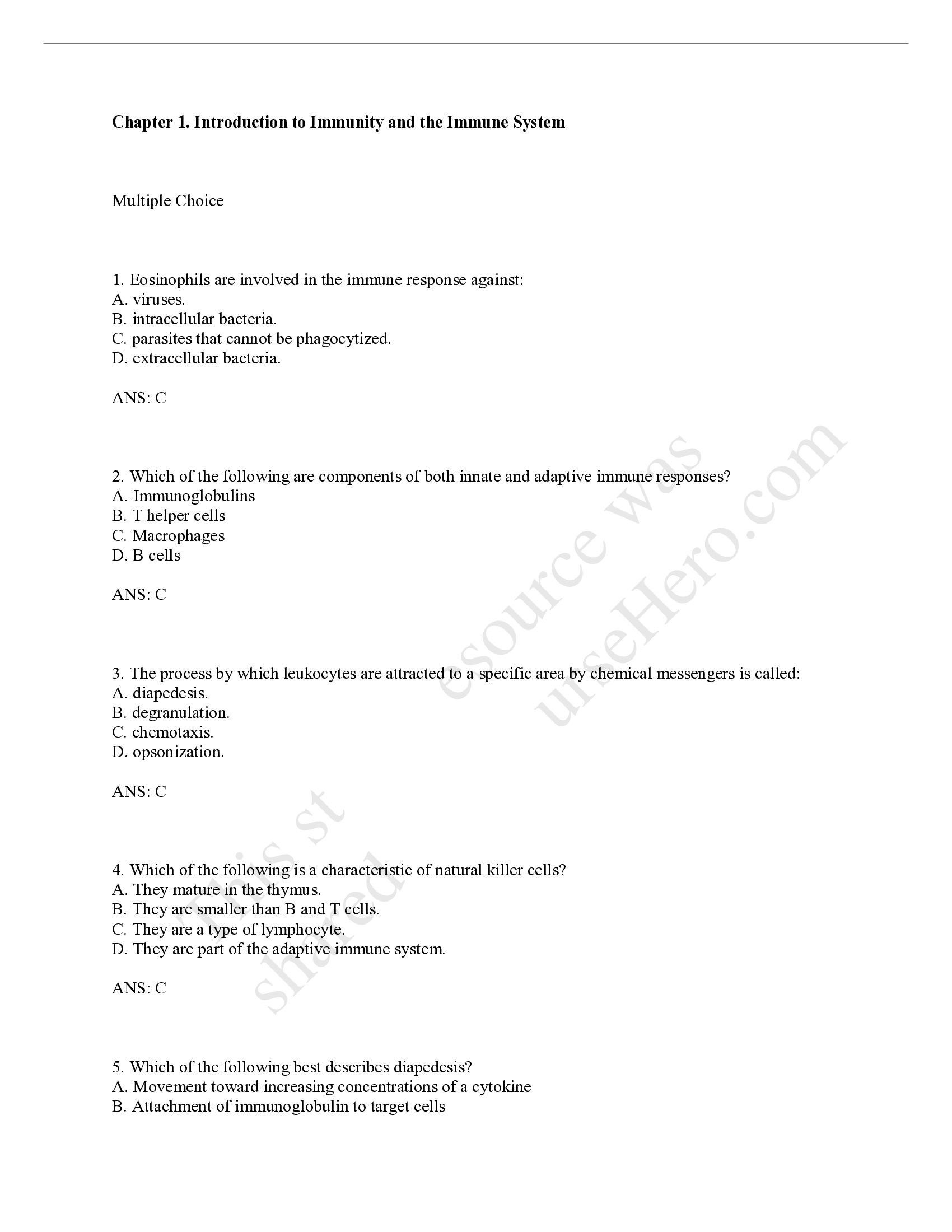
Chapter 1. Introduction to Immunity and the Immune System

Multiple Choice

1. Eosinophils are involved in the immune response against:

A. viruses.

B. intracellular bacteria.

C. parasites that cannot be phagocytized.

D. extracellular bacteria.

ANS: C

2. Which of the following are components of both innate and adaptive immune responses?

A. Immunoglobulins

B. T helper cells

C. Macrophages

D. B cells

ANS: C

3. The process by which leukocytes are attracted to a specific area by chemical messengers is called:

A. diapedesis.

B. degranulation.

C. chemotaxis.

D. opsonization.

ANS: C

4. Which of the following is a characteristic of natural killer cells?

A. They mature in the thymus.

B. They are smaller than B and T cells.

C. They are a type of lymphocyte.

D. They are part of the adaptive immune system.

ANS: C

5. Which of the following best describes diapedesis?

A. Movement toward increasing concentrations of a cytokine

B. Attachment of immunoglobulin to target cells

C. Movement through blood vessel walls as cells exit the circulation

D. Engulfment of target cells

ANS: C

6. The most effective phagocytic and antigen-presenting cell is the:

A. neutrophil.

B. monocyte.

C. dendritic cell.

D. macrophage.

ANS: C

7. Which of the following is characteristic of natural immunity?

A. It involves memory.

B. T lymphocytes play a major role.

C. It involves specificity.

D. Mechanisms are always present and fully functional.

ANS: D

8. All of the following cells are considered part of natural immunity EXCEPT:

A. eosinophils.

B. B lymphocytes.

C. monocytes.

D. neutrophils.

ANS: B

9. Where does the specific immune response to a foreign antigen mainly occur?

A. Lymph nodes

B. Blood

C. Bone marrow

D. Skin

ANS: A

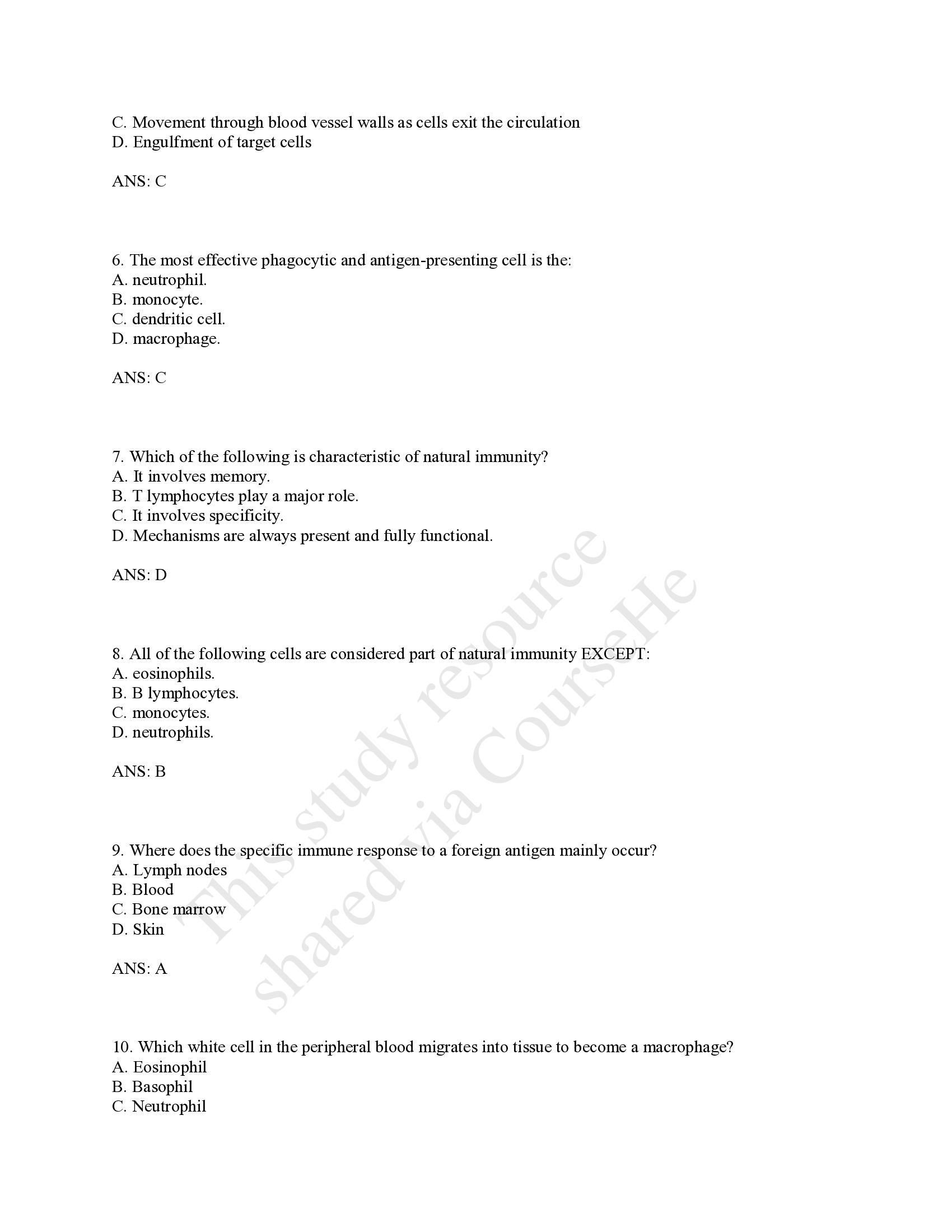
10. Which white cell in the peripheral blood migrates into tissue to become a macrophage?

A. Eosinophil

B. Basophil

C. Neutrophil

D. Monocyte

ANS: D

11. A white blood cell that is 16 to 18 micrometers in diameter, has a horseshoe-shaped nucleus, and is

capable of phagocytosis is a:

A. neutrophil.

B. eosinophil.

C. basophil.

D. monocyte.

ANS: D

12. Pasteur's discovery that older bacterial cultures would not cause disease in chickens but would protect

them from subsequent infection with more virulent strains is an example of:

A. attenuated vaccine.

B. natural immunity.

C. passive immunity.

D. cross-immunity.

ANS: A

13. Antibodies are secreted by:

A. plasma cells.

B. B cells.

C. T cells.

D. dendritic cells.

ANS: A

14. Which of the following is characteristic of mucosal-associated lymphoid tissue?

A. It is one of the primary lymphoid organs.

B. It clears pathogens from the bloodstream.

C. It includes the tonsils and the appendix.

D. It includes the liver and spleen.

ANS: C

15. Acquired (adaptive) immunity can be characterized as:

A. nonspecifically activated.

B. immediately responsive.

C. neutrophil dependent.

D. involving memory.

ANS: D

16. Which of the following is NOT a characteristic of neutrophils?

A. Congregate in the marginating pool in blood vessels

B. Capable of diapedesis

C. Granules that become bright orange with Wright stain

D. Segmented nucleus

ANS: C

17. The function of NK cells is to:

A. produce antibody.

B. phagocytize bacteria.

C. present antigen to T cells.

D. kill target cells such as tumor and virally infected cells.

ANS: D

18. All of the following are involved in adaptive immunity EXCEPT:

A. memory.

B. lymphocytes.

C. specificity.

D. neutrophils.

ANS: D

19. Which of the following is NOT a characteristic of a lymph node?

A. Filters interstitial fluid draining from tissues

B. Colonized with T and B cells

C. Between 1 and 25 mm in size

D. Considered a primary or central lymphoid organ

ANS: D

20. All of the following are considered part of natural immunity EXCEPT:

A. eosinophils.

B. lymphocytes.

C. acute-phase reactants.

D. neutrophils.

ANS: B

21. Macrophages that migrate to the liver are called:

A. alveolar macrophages.

B. histiocytes.

C. microglial cells.

D. Kupffer cells.

ANS: D

22. Innate immunity can be characterized as:

A. specific.

B. slow to respond.

C. dependent upon neutrophils and macrophages.

D. involving memory.

ANS: C

23. The ability to resist infection through normally present body functions best characterizes:

A. autoimmunity.

B. natural immunity.

C. acquired immunity.

D. alloimmunity.

ANS: B

24. Which type of cell has a diameter between 10 and 15 micrometers, has a multi-lobed nucleus, and

usually comprises more than 50% of circulating leukocytes?

A. Neutrophil

B. Lymphocyte

C. Basophil

D. Monocyte

ANS: A

25. Which of the following is NOT a component or characteristic of natural (innate) immunity?

A. Repeated exposure to a pathogen does not change the response.

B. The response involves acute-phase reactants.

C. The response involves phagocytosis.

D. The response involves antibodies.

ANS: D

26. T cells are mainly concentrated in which region of the lymph nodes?

A. Primary follicles

B. Secondary follicles

C. Paracortex

D. Medulla

ANS: C

27. A primary site of antigen trapping and presentation to immune cells is the:

A. spleen.

B. thymus.

C. bone marrow.

D. brain.

ANS: A

28. Hematopoietic stem cells are located in the:

A. lymph nodes.

B. spleen.

C. bone marrow.

D. thymus.

ANS: C

29. Which of the following is NOT a characteristic or function of the spleen?

A. Removes old red blood cells from the circulation

B. Filters infectious agents and foreign matter from the blood

C. Less than 25 mm in size

D. Is considered a secondary lymphoid organ

ANS: C

30. T cells mature in the:

A. bone marrow.

B. thymus.

C. lymph nodes.

D. spleen.

ANS: B

31. Primary lymphoid organs include which of the following?

A. Spleen

B. Tonsils

C. Thymus

D. Lymph nodes

ANS: C

32. B cells that are actively responding to antigen can be found in the:

A. peripheral blood.

B. primary follicles.

C. germinal centers.

D. bone marrow.

ANS: C

33. Contact with antigen and activation of B cells normally occurs in the:

A. peripheral blood.

B. connective tissue.

C. thymus.

D. lymph nodes.

ANS: D

34. Which best describes lymph nodes?

A. They line the interior of small blood vessels.

B. They are concentrated where appendages join the thorax of the body.

C. They are approximately 12 cm in size.

D. They are considered primary or central lymphoid organs.

ANS: B

35. Which of the following is a characteristic of opsonins?

A. They are carbohydrates that stimulate T cells.

B. They are molecules that coat bacteria, making them more susceptible to phagocytosis.

C. They are expressed on the surface of neutrophils.

D. They are produced by NK cells.

ANS: B

36. “Cluster of differentiation” refers to:

A. a category of cell surface proteins used to identify cell types.

B. aggregates of differentiating stem cells.

C. groups of antigens that identify a cell as foreign.

D. the cells that congregate in germinal centers.

ANS: A

37. All of the following are commonly found within non-lymphoid tissues EXCEPT:

A. B cells.

B. macrophages.

C. mast cells.

D. dendritic cells.

ANS: A

Matching

Match each scientist with the appropriate immunological discovery.

A. Elie Metchnikoff

B. Edward Jenner

C. Emil Von Behring

D. Almoth Wright

38. Vaccination

39. Opsonization

40. Humoral immunity

41. Phagocytosis

38. B

39. D

40. C

41. A

Contact the Seller

Please Sign In to contact this seller.


  • 👎  Report Copyright Violation

Frequently Asked Questions

What Do I Get When I Buy This Study Material?

+

When you buy a study material on Passing Grades, an instant download link will be sent directly to your email, giving you access to the file anytime after payment is completed.

Is Passing Grades a Trusted Platform?

+

Yes, Passing Grades is a reputable students’ marketplace with a secure payment system and reliable customer support. You can trust us to ensure a safe and seamless transaction experience.

Will I Be Stuck with a Subscription?

+

No, all purchases on Passing Grades are one-time transactions. You only pay for the notes you choose to buy, with no subscriptions or hidden fees attached.

Who Am I Buying These Study Materials From?

+

Passing Grades is a marketplace, which means you are purchasing the document from an individual vendor, not directly from us. We facilitate the payment and delivery process between you and the vendor.

Does Passing Grades Offer Free Study Materials?

+

Yes, sellers on Passing Grades have uploaded numerous free test banks, exams, practice questions, and class notes that can be downloaded at no cost.

Pasinggrades - Quality Study Materials

USD 15

    • Quality checked by Pasing Grades
    • 100% satisfaction guarantee
    • Seller: GradeA
Buy PDF $15

Seller Information

GradeA

Member since April 2021

  • icon
  • icon
  • icon
View Profile
  • total sales

    2
  • Favourites

    1
  • Comments

    0
    ( 0 Ratings )

Item Information

  • Uploaded

    13 March 2023

  • Updated

    24 October 2025

  • Category

    Nursing

  • Item Type

    test bank

  • Tags

    TEST BANK

Related Exam Prep Guides by GradeA

Test Bank for Fundamentals of Corporate Finance 12th Edition By Stephen Ross and Randolph Westerfield and Bradford Jordan
View Document

Test Bank for Fundam...

  • GradeA

    GradeA

  • test bank

Test Bank for Fundamentals of Corporate Finance 12th Edition By Stephen Ross and Randolph Westerfiel...

15 USD

1

2

[SOLUTION MANUAL) Fundamentals of Corporate Finance 12th Edition By Stephen Ross and Randolph Westerfield and Bradford Jordan
View Document

[SOLUTION MANUAL) Fu...

  • GradeA

    GradeA

  • test bank

[SOLUTION MANUAL) Fundamentals of Corporate Finance 12th Edition By Stephen Ross and Randolph Wester...

15 USD

1

2

QMI1500 Assignment 02 2021 AS PER UPDATED TUTORIAL LETTER
View Document

QMI1500 Assignment 0...

  • GradeA

    GradeA

  • test bank

QMI1500 Assignment 02 2021 AS PER UPDATED TUTORIAL LETTER...

15 USD

1

2

Purchase

Download link will be sent to this email immediately after purchase.

IMPORTANT LINKS

  • How To Upload Class Notes
  • Selling Tips
  • Passing Grades's Study Materials
  • Scholarships for International Students 2025

POPULAR CATEGORIES

  • Law
  • Accounting
  • English
  • Psychology
  • Business
  • Nursing
  • Computer Science
  • General

View Document

  • Blog
  • Contact
  • Delivery Policy
  • Latest Scholarships Around the World
  • How to Pass Bar Exams: Passing Grades’ Strategies
  • How to Study and Pass the CPA Exam
  • All Test Banks
  • Faq
  • Copyright Claims
  • Privacy Policy
  • Terms of Use

KNOWLEDGE BASE

  • How to Write A+ Grade Good Research Paper
  • How to Manage Stress During Exam Period
  • Best Time to Study
  • How to Pass NCLEX-RN Exam
  • How To Effectively Utilize Test Banks
  • Popular Shadow Health Exam Assessments
  • Popular HESI Case Studies
  • How to Prepare for a Nursing Career
  • The Importance Of Summaries in Exam Revisvion

© 2026 Pasing Grades. All rights reserved.