Pasing Grades
  • Start Selling
  • Blog
  • Contact
  • 0

    Your cart is empty!

English

  • English
  • Spanish
  • Arabic
Create Account Sign In
  • Library
    • New Prep Guides
    • Featured Prep Guides
    • Free Exam Prep Guides
    • Best sellers
  • General
  • Nursing
    • Research Paper
    • Case Study
    • Discussion Post
    • Assignment
    • Exam
    • Practice Questions and Answers
    • Test Bank
    • solutions manual
  • Accounting
    • Case Study
    • Thesis
    • Study Guide
    • Summary
    • Research Paper
    • test bank
  • English
    • Creative Writing
    • Research Paper
    • Summary
    • Rhetorics
    • Literature
    • Journal
    • Exam
    • Grammar
    • Discussion Post
    • Essay
  • Psychology
    • Hesi
    • Presentation
    • Essay
    • Summary
    • Study Guide
    • Essay
    • Solution Manual
    • Final Exam Review
    • Class Notes
    • test bank
  • Business
    • Lecture Notes
    • Solution Manual
    • Presentation
    • Business Plan
    • Class Notes
    • Experiment
    • Summary
    • Practice Questions
    • Study Guide
    • Case Study
    • test bank
    • Exam
  • More
    • Computer Science
    • Economics
    • Statistics
    • Engineering
    • Biology
    • Religious Studies
    • Physics
    • Chemistry
    • Mathematics
    • History
    • Sociology
    • Science
    • Philosophy
    • Law
  • Pages
    • About Us
    • Selling Tips
    • Delivery Policy
    • Faq
    • Privacy Policy
  • Flash Sale
  • Home
  • NCSBN Online review Complete with Answers

NCSBN Online review Complete with Answers

Preview page 1 Preview page 2 Preview page 3
Add To Favorites

Share this item Share this item

  • Item Details
  • Comments (0)
  • Reviews (0)
  • Contact Seller

NCSBN Online review Complete with Answers

You might find this documents helful, check them out 

NCSBN QUESTION BANK 2021

NCSBN ON-LINE REVIEW {QUESTIONS AND VERIFIED ANSWERS} 2021

NCSBN QUESTION BANK 2021 100% CORRECT

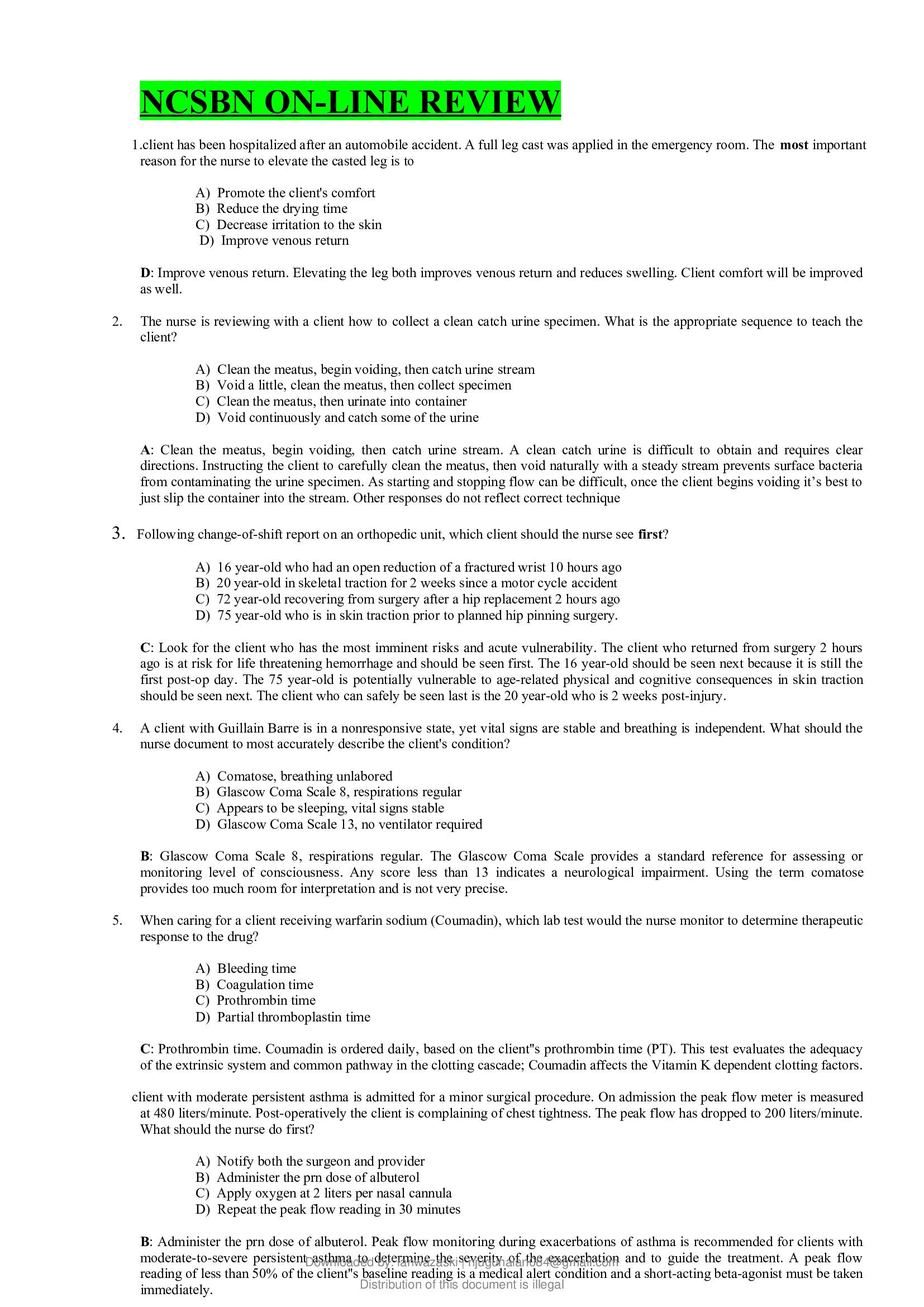
NCSBN ON-LINE REVIEW

1.client has been hospitalized after an automobile accident. A full leg cast was applied in the emergency room. The most important

reason for the nurse to elevate the casted leg is to

A) Promote the client's comfort

B) Reduce the drying time

C) Decrease irritation to the skin

D) Improve venous return

D: Improve venous return. Elevating the leg both improves venous return and reduces swelling. Client comfort will be improved

as well.

2. The nurse is reviewing with a client how to collect a clean catch urine specimen. What is the appropriate sequence to teach the

client?

A) Clean the meatus, begin voiding, then catch urine stream

B) Void a little, clean the meatus, then collect specimen

C) Clean the meatus, then urinate into container

D) Void continuously and catch some of the urine

A: Clean the meatus, begin voiding, then catch urine stream. A clean catch urine is difficult to obtain and requires clear

directions. Instructing the client to carefully clean the meatus, then void naturally with a steady stream prevents surface bacteria

from contaminating the urine specimen. As starting and stopping flow can be difficult, once the client begins voiding it’s best to

just slip the container into the stream. Other responses do not reflect correct technique

3. Following change-of-shift report on an orthopedic unit, which client should the nurse see first?

A) 16 year-old who had an open reduction of a fractured wrist 10 hours ago

B) 20 year-old in skeletal traction for 2 weeks since a motor cycle accident

C) 72 year-old recovering from surgery after a hip replacement 2 hours ago

D) 75 year-old who is in skin traction prior to planned hip pinning surgery.

C: Look for the client who has the most imminent risks and acute vulnerability. The client who returned from surgery 2 hours

ago is at risk for life threatening hemorrhage and should be seen first. The 16 year-old should be seen next because it is still the

first post-op day. The 75 year-old is potentially vulnerable to age-related physical and cognitive consequences in skin traction

should be seen next. The client who can safely be seen last is the 20 year-old who is 2 weeks post-injury.

4. A client with Guillain Barre is in a nonresponsive state, yet vital signs are stable and breathing is independent. What should the

nurse document to most accurately describe the client's condition?

A) Comatose, breathing unlabored

B) Glascow Coma Scale 8, respirations regular

C) Appears to be sleeping, vital signs stable

D) Glascow Coma Scale 13, no ventilator required

B:  Glascow Coma  Scale  8,  respirations regular.  The  Glascow Coma  Scale  provides a  standard reference  for assessing or

monitoring level of consciousness. Any score less than 13 indicates a neurological impairment. Using the term comatose

provides too much room for interpretation and is not very precise.

5. When caring for a client receiving warfarin sodium (Coumadin), which lab test would the nurse monitor to determine therapeutic

response to the drug?

A) Bleeding time

B) Coagulation time

C) Prothrombin time

D) Partial thromboplastin time

C: Prothrombin time. Coumadin is ordered daily, based on the client''s prothrombin time (PT). This test evaluates the adequacy

of the extrinsic system and common pathway in the clotting cascade; Coumadin affects the Vitamin K dependent clotting factors.

client with moderate persistent asthma is admitted for a minor surgical procedure. On admission the peak flow meter is measured

at 480 liters/minute. Post-operatively the client is complaining of chest tightness. The peak flow has dropped to 200 liters/minute.

What should the nurse do first?

A) Notify both the surgeon and provider

B) Administer the prn dose of albuterol

C) Apply oxygen at 2 liters per nasal cannula

D) Repeat the peak flow reading in 30 minutes

B: Administer the prn dose of albuterol. Peak flow monitoring during exacerbations of asthma is recommended for clients with

moderate-to-severe persistent asthma to determine the severity of the exacerbation and to guide the treatment. A peak flow

reading of less than 50% of the client''s baseline reading is a medical alert condition and a short-acting beta-agonist must be taken

immediately.

Downloaded by: ianwazaski | njugunaian084@gmail.com

Distribution of this document is illegal

B) The client’s potassium level is 4 mEq/liter.

St

St

.

.

 - The Marketplace to Buy and Sell your Study Material

 - The Marketplace to Buy and Sell your Study Material

C) The client’s urine output was 1500 cc in 5 hours

D) The client is to receive another dose of Lasix at 10 PM

C: The client’s urine output was 1500 cc in 5 hours. Although all of these may be correct information to include in report, the

essential piece would be the urine output.

client has been tentatively diagnosed with Graves' disease (hyperthyroidism). Which of these findings noted on the initial nursing

assessment requires quick intervention by the nurse?

A) a report of 10 pounds weight loss in the last month

B) a comment by the client "I just can't sit still."

C) the appearance of eyeballs that appear to "pop" out of the client's eye sockets

D) a report of the sudden onset of irritability in the past 2 weeks

C: the appearance of eyeballs that appear to "pop" out of the client''s eye sockets. Exophthalmos or protruding eyeballs is a

distinctive characteristic of Graves'' Disease. It can result in corneal abrasions with severe eye pain or damage when the eyelid is

unable to blink down over the protruding eyeball. Eye drops or ointment may be needed.

9.

The nurse has performed the initial assessments of 4 clients admitted with an acute episode of asthma. Which assessment 

finding would cause the nurse to call the provider immediately?

A) prolonged inspiration with each breath

B) expiratory wheezes that are suddenly absent in 1 lobe

C) expectoration of large amounts of purulent mucous

D) appearance of the use of abdominal muscles for breathing

B: expiratory wheezes that are suddenly absent in 1 lobe. Acute asthma is characterized by expiratory wheezes caused by

obstruction of the airways. Wheezes are a high pitched musical sounds produced by air moving through narrowed airways.

Clients often associate wheezes with the feeling of tightness in the chest. However, sudden cessation of wheezing is an ominous

or bad sign that indicates an emergency -- the small airways are now collapsed.

10. During the initial home visit, a nurse is discussing the care of a client newly diagnosed with Alzheimer's disease with family

members. Which of these interventions would be most helpful at this time?

A) leave a book about relaxation techniques

B) write out a daily exercise routine for them to assist the client to do

C) list actions to improve the client's daily nutritional intake

D) suggest communication strategies

D: suggest communication strategies. Alzheimer''s disease, a progressive chronic illness, greatly challenges caregivers. The nurse

can be of greatest assistance in helping the family to use communication strategies to enhance their ability to relate to the client.

By use of select verbal and nonverbal communication strategies the family can best support the client’s strengths and cope with

any aberrant behavior.

11. An 80 year-old client admitted with a diagnosis of possible cerebral vascular accident has had a blood pressure from 160/100 to

180/110 over the past 2 hours. The nurse has also noted increased lethargy. Which assessment finding should the nurse report

immediately to the provider?

A) Slurred speech

B) Incontinence

C) Muscle weakness

D) Rapid pulse

A: Slurred speech. Changes in speech patterns and level of conscious can be indicators of continued intracranial bleeding or

extension of the stroke. Further diagnostic testing may be indicated.

12. A school-aged child has had a long leg (hip to ankle) synthetic cast applied 4 hours ago. Which statement from the parent

indicates that teaching has been inadequate?

A) "I will keep the cast uncovered for the next day to prevent burning of the skin."

B) "I can apply an ice pack over the area to relieve itching inside the cast."

C) "The cast should be propped on at least 2 pillows when my child is lying down."

D) "I think I remember that my child should not stand until after 72 hours."

D: "I think I remember that my child should not stand until after 72 hours.". Synthetic casts will typically set up in 30 minutes

and dry in a few hours. Thus, the client may stand within the initial 24 hours. With plaster casts, the set up and drying time,

especially in a long leg cast which is thicker than an arm cast, can take up to 72 hours. Both types of casts give off a lot of heat

when drying and it is preferable to keep the cast uncovered for the first 24 hours. Clients may complain of a chill from the wet

cast and therefore can simply be covered lightly with a sheet or blanket. Applying ice is a safe method of relieving the itching.

13. Which blood serum finding in a client with diabetic ketoacidosis alerts the nurse that immediate action is required?

A) pH below 7.3

B) Potassium of 5.0

C) HCT of 60

D) Pa O2 of 79%

Downloaded by: ianwaz

Stuvia.com - The Marketplace to Buy and Sell your Study Material

C: HCT of 60. This high hematocrit is indicative of severe dehydration which requires priority attention in diabetic ketoacidosis.

Without sufficient hydration, all systems of the body are at risk for hypoxia from a lack of or sluggish circulation. In the absence

of insulin, which facilitates the transport of glucose into the cell, the body breaks down fats and proteins to supply energy

Stuvia.com - The Marketplace to Buy and Sell your Study Material

ketones, a by-product of fat metabolism. These accumulate causing metabolic acidosis (pH < 7.3), which would be the second

concern for this client. The potassium and PaO2 levels are near normal.

14. The nurse is preparing a client with a deep vein thrombosis (DVT) for a Venous Doppler evaluation. Which of the following

would be necessary for preparing the client for this test?

A) Client should be NPO after midnight

B) Client should receive a sedative medication prior to the test

C) Discontinue anti-coagulant therapy prior to the test

D) No special preparation is necessary

D: No special preparation is necessary. This is a non-invasive procedure and does not require preparation other than client

education.

15. A client is admitted with infective endocarditis (IE). Which finding would alert the nurse to a complication of this condition?

A) dyspnea

B) heart murmur

C) macular rash

D) Hemorrhage

B: heart murmur. Large, soft, rapidly developing vegetations attach to the heart valves. They have a tendency to break off,

causing emboli and leaving ulcerations on the valve leaflets. These emboli produce findings of cardiac murmur, fever, anorexia,

malaise and neurologic sequelae of emboli. Furthermore, the vegetations may travel to various organs such as spleen, kidney,

coronary artery, brain and lungs, and obstruct blood flow.

16. The nurse explains an autograft to a client scheduled for excision of a skin tumor. The nurse knows the client understands the

procedure when the client says, "I will receive tissue from

A) a tissue bank."

B) a pig."

C) my thigh."

D) synthetic skin."

C: my thigh.". Autografts are done with tissue transplanted from the client''s own skin.

client is admitted to the emergency room following an acute asthma attack. Which of the following assessments would be

expected by the nurse?

A) Diffuse expiratory wheezing

B) Loose, productive cough

C) No relief from inhalant

D) Fever and chills

A: Diffuse expiratory wheezing. In asthma, the airways are narrowed, creating difficulty getting air in. A wheezing sound results.

18. A client has been admitted with a fractured femur and has been placed in skeletal traction. Which of the following nursing

interventions should receive priority?

A) Maintaining proper body alignment

B) Frequent neurovascular assessments of the affected leg

C) Inspection of pin sites for evidence of drainage or inflammation

D) Applying an over-bed trapeze to assist the client with movement in bed

B: Frequent neurovascular assessments of the affected leg. The most important activity for the nurse is to assess neurovascular

status. Compartment syndrome is a serious complication of fractures. Prompt recognition of this neurovascular problem and early

intervention may prevent permanent limb damage.

19. The nurse is assigned to care for a client who had a myocardial infarction (MI) 2 days ago. The client has many questions about

this condition. What area is a priority for the nurse to discuss at this time?

A) Daily needs and concerns

B) The overview cardiac rehabilitation

C) Medication and diet guideline

D) Activity and rest guidelines

A: Daily needs and concerns. At 2 days post-MI, the client’s education should be focused on the immediate needs and concerns

for the day.

20. A 3 year-old child is brought to the clinic by his grandmother to be seen for "scratching his bottom and wetting the bed at night."

Based on these complaints, the nurse would initially assess for which problem?

Downloaded by: ianwazaski | njugunaian084@gmail.com

Distribution of this document is illegal

A) allergies

B) scabies

Stuvia.com - The Marketplace to Buy and Sell your Study Material

D: pinworms. Signs of pinworm infection include intense perianal itching, poor sleep patterns, general irritability, restlessness,

bed-wetting, distractibility and short attention span. Scabies is an itchy skin condition caused by a tiny, eight-legged burrowing

mite called Sarcoptes scabiei . The presence of the mite leads to intense itching in the area of its burrows.

Stuvia.com - The Marketplace to Buy and Sell your Study Material

21. The nurse is caring for a newborn with tracheoesophageal fistula. Which nursing diagnosis is a priority?

A) Risk for dehydration

B) Ineffective airway clearance

C) Altered nutrition

D) Risk for injury

B: Ineffective airway clearance. The most common form of TEF is one in which the proximal esophageal segment terminates in a

blind pouch and the distal segment is connected to the trachea or primary bronchus by a short fistula at or near the bifurcation.

Thus, a priority is maintaining an open airway, preventing aspiration. Other nursing diagnoses are then addressed.

22. The nurse is developing a meal plan that would provide the maximum possible amount of iron for a child with anemia. Which

dinner menu would be best?

A) Fish sticks, french fries, banana, cookies, milk

B) Ground beef patty, lima beans, wheat roll, raisins, milk

C) Chicken nuggets, macaroni, peas, cantaloupe, milk

D) Peanut butter and jelly sandwich, apple slices, milk

B: Ground beef patty, lima beans, wheat roll, raisins, milk. Iron rich foods include red meat, fish, egg yolks, green leafy

vegetables, legumes, whole grains, and dried fruits such as raisins. This dinner is the best choice: It is high in iron and is

appropriate for a toddler.

23. The nurse admitting a 5 month-old who vomited 9 times in the past 6 hours should observe for signs of which overall imbalance?

A) Metabolic acidosis

B) Metabolic alkalosis

C) Some increase in the serum hemoglobin

D) A little decrease in the serum potassium

B: Metabolic alkalosis. Vomiting causes loss of acid from the stomach. Prolonged vomiting can result in excess loss of acid and

lead to metabolic alkalosis. Findings include irritability, increased activity, hyperactive reflexes, muscle twitching and elevated

pulse. Options C and D are correct answers but not the best answers since they are too general.

24. A two year-old child is brought to the provider's office with a chief complaint of mild diarrhea for two days. Nutritional

counseling by the nurse should include which statement?

A) Place the child on clear liquids and gelatin for 24 hours

B) Continue with the regular diet and include oral rehydration fluids

C) Give bananas, apples, rice and toast as tolerated

D) Place NPO for 24 hours, then rehydrate with milk and water

B: Continue with the regular diet and include oral rehydration fluids. Current recommendations for mild to moderate diarrhea are

to maintain a normal diet with fluids to rehydrate.

25. The nurse is teaching parents about the appropriate diet for a 4 month-old infant with gastroenteritis and mild dehydration. In

addition to oral rehydration fluids, the diet should include

A) formula or breast milk

B) broth and tea

C) rice cereal and apple juice

D) gelatin and ginger ale

A: formula or breast milk. The usual diet for a young infant should be followed.

26. A child is injured on the school playground and appears to have a fractured leg. The first action the school nurse should take is

A) call for emergency transport to the hospital

B) immobilize the limb and joints above and below the injury

C) assess the child and the extent of the injury

D) apply cold compresses to the injured area

C: assess the child and the extent of the injury. When applying the nursing process, assessment is the first step in providing care.

The "5 Ps" of vascular impairment can be used as a guide (pain, pulse, pallor, paresthesia, paralysis).

27. The mother of a 3 month-old infant tells the nurse that she wants to change from formula to whole milk and add cereal and meats

to the diet. What should be emphasized as the nurse teaches about infant nutrition?

A) Solid foods should be introduced at 3-4 months

B) Whole milk is difficult for a young infant to digest

C) Fluoridated tap water should be used to dilute milk

D) Supplemental apple juice can be used between feedings

Downloaded by: ianwazaski | njugunaian084@gmail.com

Distribution of this document is illegal

B: Whole milk is difficult for a young infant to digest. Cow''s milk is not given to infants younger than 1 year because the tough, 

Stuvia.com - The Marketplace to Buy and Sell your Study Material

28. The nurse is preparing a handout on infant feeding to be distributed to families visiting the clinic. Which notation should be

included in the teaching materials?

Stuvia.com - The Marketplace to Buy and Sell your Study Material

A) Solid foods are introduced one at a time beginning with cereal

B) Finely ground meat should be started early to provide iron

C) Egg white is added early to increase protein intake

D) Solid foods should be mixed with formula in a bottle

A: Solid foods are introduced one at a time beginning with cereal. Solid foods should be added one at a time between 4-6

months. If the infant is able to tolerate the food, another may be added in a week. Iron fortified cereal is the recommended first

food.

29. The nurse planning care for a 12 year-old child with sickle cell disease in a vaso-occlusive crisis of the elbow should include

which one of the following as a priority?

A) Limit fluids

B) Client controlled analgesia

C) Cold compresses to elbow

D) Passive range of motion exercise

B: Client controlled analgesia. Management of a sickle cell crisis is directed towards supportive and symptomatic treatment. The

priority of care is pain relief. In a 12 year-old child, client controlled analgesia promotes maximum comfort.

30. The nurse is performing a physical assessment on a toddler. Which of the following actions should be the first?

A) Perform traumatic procedures

B) Use minimal physical contact

C) Proceed from head to toe

D) Explain the exam in detail

B: Use minimal physical contact. The nurse should approach the toddler slowly and use minimal physical contact initially so as

to gain the toddler''s cooperation. Be flexible in the sequence of the exam, and give only brief simple explanations just prior to

the action.

31. What finding signifies that children have attained the stage of concrete operations (Piaget)?

A) Explores the environment with the use of sight and movement

B) Thinks in mental images or word pictures

C) Makes the moral judgment that "stealing is wrong"

D) Reasons that homework is time-consuming yet necessary

C: Makes the moral judgment that "stealing is wrong". The stage of concrete operations is depicted by logical thinking and moral

judgments.

32. The mother of a child with a neural tube defect asks the nurse what she can do to decrease the chances of having another baby

with a neural tube defect. What is the best response by the nurse?

A) "Folic acid should be taken before and after conception."

B) "Multivitamin supplements are recommended during pregnancy."

C) "A well balanced diet promotes normal fetal development."

D) "Increased dietary iron improves the health of mother and fetus."

A:  "Folic  acid should be  taken before  and after conception.".  The  American Academy of Pediatrics recommends that  all

childbearing women increase folic acid from dietary sources and/or supplements. There is evidence that increased amounts of

folic acid prevents neural tube defects.

33. The provider orders Lanoxin (digoxin) 0.125 mg PO and furosemide 40 mg every day. Which of these foods would the nurse

reinforce for the client to eat at least daily?

A) Spaghetti

B) Watermelon

C) Chicken

D) Tomatoes

B: Watermelon. Watermelon is high in potassium and will replace potassium lost by the diuretic. The other foods are not high in

potassium.

34. While teaching the family of a child who will take phenytoin (Dilantin) regularly for seizure control, it is most important for the

nurse to teach them about which of the following actions?

A) Maintain good oral hygiene and dental care

B) Omit medication if the child is seizure free

C) Administer acetaminophen to promote sleep

D) Serve a diet that is high in iron

Downloaded by: ianwazaski | njugunaian084@gmail.com

Distribution of this document is illegal

A: Maintain good oral hygiene and dental care. Swollen and tender gums occur often with use of phenytoin. Good oral hygiene

Stuvia.com - The Marketplace to Buy and Sell your Study Material

Stuvia.com - The Marketplace to Buy and Sell your Study Material

A) "I strap the infant car seat on the front seat to face backwards."

B) "I place my infant in the middle of the living room floor on a blanket to play with my four year-old while I make

supper in the kitchen."

C) "My sleeping baby lies so cute in the crib with the little buttocks stuck up in the air while the four year-old naps on

the sofa."

D) "I have the four year-old hold and help feed the four month-old a bottle in the kitchen while I make supper."

D: The infant seat is to be placed on the rear seat. Small children and infants are not to be left unsupervised.

36. The nurse admits a 7 year-old to the emergency room after a leg injury. The x-rays show a femur fracture near the epiphysis. The

parents ask what will be the outcome of this injury. The appropriate response by the nurse should be which of these statements?

A) "The injury is expected to heal quickly because of thin periosteum."

B) "In some instances the result is a retarded bone growth."

C) "Bone growth is stimulated in the affected leg."

D) "This type of injury shows more rapid union than that of younger children."

B: "In some instances the result is a retarded bone growth.". An epiphyseal (growth) plate fracture in a 7 year-old often results in

retarded bone growth. The leg often will be different in length than the uninjured leg.

37. The parents of a 4 year-old hospitalized child tell the nurse, “We are leaving now and will be back at 6 PM.” A few hours later

the child asks the nurse when the parents will come again. What is the best response by the nurse?

A) "They will be back right after supper."

B) "In about 2 hours, you will see them."

C) "After you play awhile, they will be here."

D) "When the clock hands are on 6 and 12."

A: "They will be back right after supper." Time is not completely understood by a 4 year-old. Preschoolers interpret time with

their own frame of reference. Thus, it is best to explain time in relationship to a known, common event.

38. The nurse is giving instructions to the parents of a child with cystic fibrosis. The nurse would emphasize that pancreatic enzymes

should be taken

A) once each day

B) 3 times daily after meals

C) with each meal or snack

D) each time carbohydrates are eaten

C: Pancreatic enzymes should be taken with each meal and every snack to allow for digestion of all foods that are eaten.

39. A nurse is providing a parenting class to individuals living in a community of older homes. In discussing formula preparation,

which of the following is most important to prevent lead poisoning?

A) Use ready-to-feed commercial infant formula

B) Boil the tap water for 10 minutes prior to preparing the formula

C) Let tap water run for 2 minutes before adding to concentrate

D) Buy bottled water labeled "lead free" to mix the formula

C: Let tap water run for 2 minutes before adding to concentrate. Use of lead-contaminated water to prepare formula is a major

source of poisoning in infants. Drinking water may be contaminated by lead from old lead pipes or lead solder used in sealing

water pipes. Letting tap water run for several minutes will diminish the lead contamination.

40. Which of the following manifestations observed by the school nurse confirms the presence of pediculosis capitis in students?

A) Scratching the head more than usual

B) Flakes evident on a student's shoulders

C) Oval pattern occipital hair loss

D) Whitish oval specks sticking to the hair

D: Whitish oval specks sticking to the hair. Diagnosis of pediculosis capitis is made by observation of the white eggs (nits)

firmly attached to the hair shafts. Treatment can include application of a medicated shampoo with lindane for children over 2

years of age, and meticulous combing and removal of all nits.

41. When interviewing the parents of a child with asthma, it is most important to assess the child's environment for what factor?

A) Household pets

B) New furniture

C) Lead based paint

D) Plants such as cactus

A: Household pets. Animal dander is a very common allergen affecting persons with asthma. Other triggers may include pollens,

carpeting and household dust.

Downloaded by: ianwazaski | njugunaian084@gmail.com

Distribution of this document is illegal

42. The mother of a 2 month-old baby calls the nurse 2 days after the first DTaP, IPV, Hepatitis B and HIB immunizations. She

Stuvia.com - The Marketplace to Buy and Sell your Study Material

Stuvia.com - The Marketplace to Buy and Sell your Study Material

A) DTaP

B) Hepatitis B

C) Polio

D) H. Influenza

A: DTaP. The majority of reactions occur with the administration of the DTaP vaccination. Contradictions to giving repeat DTaP

immunizations include the occurrence of severe side effects after a previous dose as well as signs of encephalopathy within 7

days of the immunization.

43. The mother of a 2 year-old hospitalized child asks the nurse's advice about the child's screaming every time the mother gets ready

to leave the hospital room. What is the best response by the nurse?

A) "I think you or your partner needs to stay with the child while in the hospital."

B) "Oh, that behavior will stop in a few days."

C) "Keep in mind that for the age this is a normal response to being in the hospital."

D) "You might want to "sneak out" of the room once the child falls asleep."

C: The protest phase of separation anxiety is a normal response for a child this age. In toddlers, ages 1 to 3, separation anxiety is

at its peak

44. A couple experienced the loss of a 7 month-old fetus. In planning for discharge, what should the nurse emphasize?

A) To discuss feelings with each other and use support persons

B) To focus on the other healthy children and move through the loss

C) To seek causes for the fetal death and come to some safe conclusion

D) To plan for another pregnancy within 2 years and maintain physical health

A: To discuss feelings with each other and use support persons. To communicate in a therapeutic manner, the nurse''s goal is to

help the couple begin the grief process by suggesting they talk to each other, seek family, friends and support groups to listen to

their feelings.

45. The nurse is performing a pre-kindergarten physical on a 5 year-old. The last series of vaccines will be administered. What is the

preferred site for injection by the nurse?

A) vastus intermedius

B) gluteus maximus

C) vastus lateralis

D) dorsogluteaI

C: vastus lateralis. Vastus lateralis, a large and well developed muscle, is the preferred site, since it is removed from major

nerves and blood vessels.

46. A 7 month pregnant woman is admitted with complaints of painless vaginal bleeding over several hours. The nurse should

prepare the client for an immediate

A) Non stress test

B) Abdominal ultrasound

C) Pelvic exam

D) X-ray of abdomen

B: Abdominal ultrasound. The standard for diagnosis of placenta previa, which is suggested in the client''s history of painless

bleeding, is abdominal ultrasound.

47. A nurse entering the room of a postpartum mother observes the baby lying at the edge of the bed while the woman sits in a chair.

The mother states "This is not my baby, and I do not want it." After repositioning the child safely, the nurse's best response is

A) "This is a common occurrence after birth, but you will come to accept the baby."

B) "Many women have postpartum blues and need some time to love the baby."

C) "What a beautiful baby! Her eyes are just like yours."

D) "You seem upset; tell me what the pregnancy and birth were like for you."

D: "You seem upset; tell me what the pregnancy and birth were like for you." A non-judgmental, open ended response facilitates

dialogue between the client and nurse.

48. The nurse notes that a 2 year-old child recovering from a tonsillectomy has an temperature of 98.2 degrees Fahrenheit at 8:00

AM. At 10:00 AM the child's parent reports that the child "feels very warm" to touch. The first action by the nurse should be to

A) reassure the parent that this is normal

B) offer the child cold oral fluids

C) reassess the child's temperature

D) administer the prescribed acetaminophen

Downloaded by: ianwazaski | njugunaian084@gmail.com

Distribution of this document is illegal

C: reassess the child''s temperature. A child''s temperature may have rapid fluctuations. The nurse should listen to and show

Stuvia.com - The Marketplace to Buy and Sell your Study Material

49. The nurse is caring for a  client  who was successfully resuscitated from a pulseless dysrhythmia. Which of the  following

assessments is critical for the nurse to include in the plan of care?

Stuvia.com - The Marketplace to Buy and Sell your Study Material

A) hourly urine output

B) white blood count

C) blood glucose every 4 hours

D) temperature every 2 hours

A: hourly urine output. Clients who have had an episode of decreased glomerular perfusion are at risk for pre-renal failure. This

is caused by any abnormal decline in kidney perfusion that reduces glomerular perfusion. Pre-renal failure occurs when the

effective arterial blood volume falls. Examples of this phenomena include a drop in circulating blood volume as in a cardiac

arrest  state  or  in  low  cardiac  perfusion  states  such  as  congestive  heart  failure  associated  with  a  cardiomyopathy.  Close

observation of hourly urinary output is necessary for early detection of this condition.

50. A client is admitted to the rehabilitation unit following a cerebral vascular accident (CVA) and mild dysphagia. The most

appropriate intervention for this client is to

A) position client in upright position while eating

B) place client on a clear liquid diet

C) tilt head back to facilitate swallowing reflex

D) offer finger foods such as crackers or pretzels

A: position client in upright position while eating. An upright position facilitates proper chewing and swallowing.

51. A 72 year-old client with osteomyelitis requires a 6 week course of intravenous antibiotics. In planning for home care, what is

the most important action by the nurse?

A) Investigating the client's insurance coverage for home IV antibiotic therapy

B) Determining if there are adequate hand washing facilities in the home

C) Assessing the client's ability to participate in self care and/or the reliability of a caregiver

D) Selecting the appropriate venous access device

C: Assessing the client''s ability to participate in self care and/or the reliability of a caregiver. The cognitive ability of the client

as well as the availability and reliability of a caregiver must be assessed to determine if home care is a feasible option.

52. A nurse administers the influenza vaccine to a client in a clinic. Within 15 minutes after the immunization was given, the client

complains of itchy and watery eyes, increased anxiety, and difficulty breathing. The nurse expects that the  first  action in the

sequence of care for this client will be to

A) Maintain the airway

B) Administer epinephrine 1:1000 as ordered

C) Monitor for hypotension with shock

D) Administer diphenhydramine as ordered

B:  Administer epinephrine  1:1000  as  ordered.  All  the  answers  are  correct  given the  circumstances,  but  the  priority is to

administer  the  epinephrine,  then  maintain  the  airway.  In  the  early  stages  of  anaphylaxis,  when  the  patient  has  not  lost

consciousness and is normotensive, administering the epinephrine is first, and applying the oxygen, and watching for

hypotension and shock, are later responses. The prevention of a severe crisis is maintained by using diphenhydramine.

53. The nurse instructs the client taking dexamethasone (Decadron) to take it with food or milk. The physiological basis for this

instruction is that the medication

A) retards pepsin production

B) stimulates hydrochloric acid production

C) slows stomach emptying time

D) decreases production of hydrochloric acid

B:  stimulates  hydrochloric  acid  production.  Decadron  increases  the  production  of  hydrochloric  acid,  which  may  cause

gastrointestinal ulcers.

54. A client receiving chlorpromazine HCL (Thorazine) is in psychiatric home care. During a home visit the nurse observes the

client smacking her lips alternately with grinding her teeth. The nurse recognizes this assessment finding as what?

A) Dystonia

B) Akathisia

C) Brady dyskinesia

D) Tardive dyskinesia

D: Tardive dyskinesia. Signs of tardive dyskinesia include smacking lips, grinding of teeth and "fly catching" tongue

movements. These findings are often described as Parkinsonian.

55. Which of the following findings contraindicate the use of haloperidol (Haldol) and warrant withholding the dose?

Downloaded by: ianwazaski | njugunaian084@gmail.com

Distribution of this document is illegal

A) Drowsiness, lethargy, and inactivity

B) Dry mouth, nasal congestion, and blurred vision

Stuvia.com - The Marketplace to Buy and Sell your Study Material

C: Rash, blood dyscrasias, severe depression. Rash and blood dyscrasias are side effects of anti-psychotic drugs. A history of

severe depression is a contraindication to the use of neuroleptics.

Stuvia.com - The Marketplace to Buy and Sell your Study Material

56. The nurse is reinforcing teaching to a 24 year-old woman receiving acyclovir (Zovirax) for a Herpes Simplex Virus type 2

infection. Which of these instructions should the nurse give the client?

A) Complete the entire course of the medication for an effective cure

B) Begin treatment with acyclovir at the onset of symptoms of recurrence

C) Stop treatment if she thinks she may be pregnant to prevent birth defects

D) Continue to take prophylactic doses for at least 5 years after the diagnosis

B: Begin treatment with acyclovir at the onset of symptoms of recurrence. When the client is aware of early symptoms, such as

pain, itching or tingling, treatment is very effective. Medications for herpes simplex do not cure the disease; they simply decrease

the level of symptoms.

57. A 14 month-old child ingested half a bottle of aspirin tablets. Which of the following would the nurse expect to see in the child?

A) Hypothermia

B) Edema

C) Dyspnea

D) Epistaxis

D: Epistaxis. A large dose of aspirin inhibits prothrombin formation and lowers platelet levels. With an overdose, clotting time is

prolonged.

58. An 80 year-old client on digitalis (Lanoxin) reports nausea, vomiting, abdominal cramps and halo vision. Which of the following

laboratory results should the nurse analyze first?

A) Potassium levels

B) Blood pH

C) Magnesium levels

D) Blood urea nitrogen

A: Potassium levels. The most common cause of digitalis toxicity is a low potassium level. Clients must be taught that it is

important to have adequate potassium intake especially if taking diuretics that enhance the loss of potassium while they are

taking digitalis.

59. A 42 year-old male client refuses to take propranolol hydrochloride (Inderal) as prescribed. Which client statement from the

assessment data is likely to explain his noncompliance?

A) "I have problems with diarrhea."

B) "I have difficulty falling asleep."

C) "I have diminished sexual function."

D) "I often feel jittery."

C: "I have diminished sexual function." Inderal, a beta-blocking agent used in hypertension, prohibits the release of epinephrine

into the cells; this may result in hypotension which results in decreased libido and impotence.

60. The nurse caring for a 9 year-old child with a fractured femur is told that a medication error occurred. The child received twice

the ordered dose of morphine an hour ago. Which nursing diagnosis is a priority at this time?

A) Risk for fluid volume deficit related to morphine overdose

B) Decreased gastrointestinal mobility related to mucosal irritation

C) Ineffective breathing patterns related to central nervous system depression

D) Altered nutrition related to inability to control nausea and vomiting

C: Ineffective breathing patterns related to central nervous system depression. Respiratory depression is a life-threatening risk in

this overdose.

61. Lactulose (Chronulac) has been prescribed for a client with advanced liver disease. Which of the following assessments would

the nurse use to evaluate the effectiveness of this treatment?

A) An increase in appetite

B) A decrease in fluid retention

C) A decrease in lethargy

D) A reduction in jaundice

C: A decrease in lethargy. Lactulose produces an acid environment in the bowel and traps ammonia in the gut; the laxative effect

then aids in removing the ammonia from the body. This decreases the effects of hepatic encephalopathy, including lethargy and

confusion.

62. The nurse is teaching a class on HIV prevention. Which of the following should be emphasized as increasing risk?

A) Donating blood

B) Using public bathrooms

C) Unprotected sex

D) Touching a person with AIDS

Downloaded by: ianwazaski | njugunaian084@gmail.com

Distribution of this document is illegal

Stuvia.com - The Marketplace to Buy and Sell your Study Material

Stuvia.com - The Marketplace to Buy and Sell your Study Material

63. While interviewing a new admission, the nurse notices that the client is shifting positions, wringing her hands, and avoiding eye

contact. It is important for the nurse to

A) ask the client what she is feeling

B) assess the client for auditory hallucination

C) recognize the behavior as a side effect of medication

D) re-focus the discussion on a less anxiety provoking topic

A: ask the client what she is feeling. The initial step in anxiety intervention is observing, identifying, and assessing anxiety. The

nurse should seek client validation of the accuracy of nursing assessments and avoid drawing conclusions based on limited data.

In the situation above, the client may simply need to use the restroom but be reluctant to communicate her need!

64. A young adult seeks treatment in an outpatient mental health center. The client tells the nurse he is a government official being

followed by spies. On further questioning, he reveals that his warnings must be heeded to prevent nuclear war. What is the most

therapeutic approach by the nurse?

A) Listen quietly without comment

B) Ask for further information on the spies

C) Confront the client’s delusion

D) Contact the government agency

A: Listen quietly without comment. The client''s comments demonstrate grandiose ideas. The most therapeutic response is to

listen but avoid being incorporated into the client’s delusional system.

65. The nurse is assessing a 17 year-old female client with bulimia. Which of the following laboratory reports would the nurse

anticipate?

A) Increased serum glucose

B) Decreased albumin

C) Decreased potassium

D) Increased sodium retention

C: Decreased potassium. In bulimia, loss of electrolytes can occur in addition to other findings of starvation and dehydration.

66. A client, recovering from alcoholism, asks the nurse, "What can I do when I start recognizing relapse triggers within myself?"

How might the nurse best respond?

A) "When you have the impulse to stop in a bar, contact a sober friend and talk with him."

B) "Go to an AA meeting when you feel the urge to drink."

C)"It is important to exercise daily and get involved in activities that will cause you not to

think about drug use."

D) "Let’s talk about possible options you have when you recognize relapse triggers in

yourself."

D: This option encourages the process of self evaluation and problem solving, while avoiding telling the client what to do.

Encouraging the client to brainstorm about response options validates the nurse’s belief in the client’s personal competency and

reinforces a coping strategy that will be needed when the nurse may not be available to offer solutions.

67. Therapeutic nurse-client interaction occurs when the nurse

A) assists the client to clarify the meaning of what the client has said

B) interprets the client’s covert communication

C) praises the client for appropriate feelings and behavior

D) advises the client on ways to resolve problems

A: assists the client to clarify the meaning of what the client has said. Clarification is a facilitating/therapeutic communication

strategy. Interpretation, changing the focus/subject, giving approval, and advising are non-therapeutic/barriers to communication.

68. Which nursing intervention will be most effective in helping a withdrawn client to develop relationship skills?

A) Offer the client frequent opportunities to interact with 1 person

B) Provide the client with frequent opportunities to interact with other clients

C) Assist the client to analyze the meaning of the withdrawn behavior

D) Discuss with the client the focus that other clients have similar problems

A: Offer the client frequent opportunities to interact with 1 person. The withdrawn client is uncomfortable in social interaction.

The nurse-client relationship is a corrective relationship in which the client learns both tolerance and skills for relationships.

69. An important goal in the development of a therapeutic inpatient milieu is to

A) provide a businesslike atmosphere where clients can work on individual goals

B) provide a group forum in which clients decide on unit rules, regulations, and policies

C) provide a testing ground for new patterns of behavior while the client takes responsibility for his or her own actions

D) discourage expressions of anger because they can be disruptive to other clients

Downloaded by: ianwazaski | njugunaian084@gmail.com

Distribution of this document is illegal

Stuvia.com - The Marketplace to Buy and Sell your Study Material

70. A client with paranoid delusions stares at the nurse over a period of several days. The client suddenly walks up to the nurse and

shouts "You think you’re so perfect and pure and good." An appropriate response for the nurse is

Stuvia.com - The Marketplace to Buy and Sell your Study Material

A) "Is that why you’ve been staring at me?"

B) "You seem to be in a really bad mood."

C) "Perfect? I don’t quite understand."

D) "You seem angry right now."

D: "You seem angry right now.". The nurse recognizes the underlying emotion with a matter of fact attitude, but avoids telling

the clients how they feel.

71. A client who is a former actress enters the day room wearing a sheer nightgown, high heels, numerous bracelets, bright red

lipstick and heavily rouged cheeks. Which nursing action is the best in response to the client’s attire?

A) Gently remind her that she is no longer on stage

B) Directly assist client to her room for appropriate apparel

C) Quietly point out to her the dress of other clients on the unit

D) Tactfully explain appropriate clothing for the hospital

B: Directly assist client  to her room  for appropriate  apparel.  It  assists the  client to maintain self-esteem  while  modifying

behavior.

72. When teaching suicide prevention to the parents of a 15 year-old who recently attempted suicide, the nurse describes the

following behavioral cue as indicating a need for intervention.

A) Angry outbursts at significant others

B) Fear of being left alone

C) Giving away valued personal items

D) Experiencing the loss of a boyfriend

C: Giving away valued personal items. Eighty percent of all potential suicide victims give some type of indication that selfdestructiveness

should

be

 addressed.  These  clues might  lead one  to suspect that  a client  is having suicidal  thoughts or is

developing a plan.

73. Which statement made by a client indicates to the nurse that the client may have a thought disorder?

A) "I’m so angry about this. Wait until my partner hears about this."

B) "I’m a little confused. What time is it?"

C) "I can't find my 'mesmer' shoes. Have you seen them?"

D) "I’m fine. It's my daughter who has the problem."

C: "I can''t find my ''mesmer'' shoes. Have you seen them?". A neologism is a new word self invented by a person and not readily

understood by another. Using neologisms is often associated with a thought disorder.

74. In a psychiatric setting, the nurse limits touch or contact used with clients to handshaking because

A) some clients misconstrue hugs as an invitation to sexual advances

B) handshaking keeps the gesture on a professional level

C) refusal to touch a client denotes lack of concern

D) inappropriate touch often results in charges of assault and battery

A: some clients misconstrue hugs as an invitation to sexual advances. Touch denotes positive feelings for another person. The

client may interpret hugging and holding hands as sexual advances.

75. A client with anorexia is hospitalized on a medical unit due to electrolyte imbalance and cardiac dysrhythmias. Additional

assessment findings that the nurse would expect to observe are

A) brittle hair, lanugo, amenorrhea

B) diarrhea, nausea, vomiting, dental erosion

C) hyperthermia, tachycardia, increased metabolic rate

D) excessive anxiety about symptoms

A: brittle hair, lanugo, amenorrhea. Physical findings associated with anorexia also include reduced metabolic rate and lower

vital signs.

76. Which intervention best demonstrates the nurse's sensitivity to a 16 year-old’s appropriate need for autonomy?

A) Alertness for feelings regarding body image

B) Allows young siblings to visit

C) Provides opportunity to discuss concerns without presence of parents

D) Explores his feelings of resentment to identify causes

C: Provides opportunity to discuss concerns without presence of parents. This intervention provides the teen with the opportunity

to have control and encourages decision making.

Downloaded by: ianwazaski | njugunaian084@gmail.com

Distribution of this document is illegal

77. The nurse's primary intervention for a client who is experiencing a panic attack is to

Stuvia.com - The Marketplace to Buy and Sell your Study Material

C) maintain safety for the client

D) teach the client to control his or her own behavior

Stuvia.com - The Marketplace to Buy and Sell your Study Material

C: maintain safety for the client. Clients who display signs of severe anxiety need to be supervised closely until the anxiety is

decreased because they may harm themselves or others.

78. A client was admitted to the eating disorder unit with bulimia nervosa. The nurse assessing for a history of complications of this

disorder expects

A) Respiratory distress, dyspnea

B) Bacterial gastrointestinal infections, overhydration

C) Metabolic acidosis, constricted colon

D) Dental erosion, parotid gland enlargement

D:  Dental  erosion,  parotid gland enlargement.  Dental  erosion and parotid gland enlargement  due  to purging are  common

complications of binge eating followed by self-induced vomiting.

79. Which of the following times is a depressed client at highest risk for attempting suicide?

A) Immediately after admission, during one-to-one observation

B) 7 to 14 days after initiation of antidepressant medication and psychotherapy

C) Following an angry outburst with family

D) When the client is removed from the security room

B: 7 to 14 days after initiation of antidepressant medication and psychotherapy. As the depression lessens, the depressed client

acquires energy to follow the plan.

80. A client is admitted to a psychiatric unit with delusions. What findings could the nurse observe that would be consistent with

delusional thought patterns?

A) Flight of ideas and hyperactivity

B) Suspiciousness and resistance to therapy

C) Anorexia and hopelessness

D) Panic and multiple physical complaints

B: Suspiciousness and resistance to therapy. Clinical features of paranoid delusional disorder include extreme suspiciousness,

jealousy, distrust, and a belief that others intend to invoke harm.

81. As the nurse takes a history of a 3 year-old with neuroblastoma, what comments by the parents require follow-up and are

consistent with the diagnosis?

A) "The child has been listless and has lost weight."

B) "The urine is dark yellow and small in amounts."

C) "Clothes are becoming tighter across her abdomen."

D) "We notice muscle weakness and some unsteadiness."

C: "Clothes are becoming tighter across her abdomen.". One of the most common signs of neuroblastoma is increased abdominal

girth. The parents'' report that clothing is tight is significant, and should be responded to with additional assessments.

82. Parents call the emergency room to report that a toddler has swallowed drain cleaner. The triage nurse instructs them to call for

emergency transport to the hospital. The nurse would also suggest that the parents give the toddler sips of                  


 while waiting

for an ambulance.

A) Tea

B) Water

C) Milk

D) Soda

B: Water. Small amounts of water will dilute the corrosive substance prior to gastric lavage.

83. A 16 year-old enters the emergency department. The triage nurse identifies that this teenager is legally married and signs the

consent form for treatment. What would be the appropriate action by the nurse?

A) Ask the teenager to wait until a parent or legal guardian can be contacted

B) Withhold treatment until telephone consent can be obtained from the partner

C) Refer the teenager to a community pediatric hospital emergency department

D) Proceed with the triage process in the same manner as any adult client

D: Proceed with the triage process in the same manner as any adult client. Minors may become known as an "emancipated

minor" through marriage, pregnancy, high school  graduation,  independent living or service in the military. Therefore,  this

married client has the legal capacity of an adult.

84. The pediatric clinic nurse examines a toddler with a tentative diagnosis of neuroblastoma. Findings observed by the nurse that is

associated with this problem include which of these?

Downloaded by: ianwazaski | njugunaian084@gmail.com

Distribution of this document is illegal

A) Lymphedema and nerve palsy

Stuvia.com - The Marketplace to Buy and Sell your Study Material

Stuvia.com - The Marketplace to Buy and Sell your Study Material

D: Abdominal mass and weakness. Clinical manifestations of neuroblastoma include an irregular abdominal mass that crosses

the midline, weakness, pallor, anorexia, weight loss and irritability.

85. The nurse is preparing the teaching plan for a group of parents about risks to toddlers and is including the proper communication

in the event of accidental poisoning. The nurse should tell the parents to first state what substance was ingested and then what

information should be the priority for the parents to communicate?

A) The parents' name and telephone number

B) The currency of the immunization and allergy history of the child

C) The estimated time of the accidental poisoning and a confirmation that the parents

will bring the containers of the ingested substance

D) The affected child's age and weight

D: The affected child''s age and weight. All of the above information is important. However, after the substance is identified the

age and weight are the priorities. This gives the appropriate health care providers an opportunity to calculate the needed dosage

for an antidote while the child is being transported to the emergency department. After this information, the time of the

86. The nurse has admitted a 4 year-old with the diagnosis of possible rheumatic fever. Which statement by the parent would the

nurse suspect is relevant to this disease?

A) Our child had chickenpox 6 months ago.

B) Strep throat went through all the children at the day care last month.

C) Both ears were infected at 3 months of age.

D) Last week both feet had a fungal skin infection.

B: Strep throat went through all the children at the day care last month.. Evidence supports a strong relationship between

infection with Group A streptococci and subsequent rheumatic fever (usually within 2 to 6 weeks). Therefore, the history of

playmates recovering from strep throat would indicate that the child most likely also had strep throat. Sometimes such an

infection has no clinical symptoms.

87. The nurse provides discharge teaching to the parents of a 15 month-old child with Kawasaki disease. The child has received

immunoglobulin therapy. Which instruction would be appropriate?

A) High doses of aspirin will be continued for some time

B) Complete recovery is expected within several days

C) Active range of motion exercises should be done frequently

D) The measles, mumps and rubella vaccine should be delayed

D: The measles, mumps and rubella vaccine should be delayed. Discharge instructions for a child with Kawasaki disease should

include the information that immunoglobulin therapy may interfere with the body''s ability to form appropriate amounts of

antibodies. Therefore, live immunizations should be delayed.

88. A 10 year-old client is recovering from a splenectomy following a traumatic injury. The clients laboratory results show a

hemoglobin of 9 g/dL and a hematocrit of 28 percent. The best approach for the nurse to use is to

A) limit milk and milk products

B) encourage bed activities and games

C) plan nursing care around lengthy rest periods

D) promote a diet rich in iron

C: plan nursing care around lengthy rest periods. The initial priority for this client is rest due to the inability of red blood cells to

carry oxygen.

89. The nurse is planning care for a 14 year-old client returning from scoliosis corrective surgery. Which of the following actions

should receive priority in the plan?

A) Antibiotic therapy for 10 days

B) Teach client isometric exercises for legs

C) Assess movement and sensation of extremities

D) Assist to stand up at bedside within the first 24 hours

C: Assess movement and sensation of extremities. Following corrective surgery for scoliosis, neurological status requires special

attention and assessment, especially that of the extremities.

90. The nurse is teaching parents about accidental poisoning in children. Which point should be emphasized?

A) Call the Poison Control Center once the situation is identified

B) Empty the child's mouth in any case of possible poisoning

C) Keep the child as quiet as possible if a toxic substance was inhaled

D) Do not induce vomiting if the poison is a hydrocarbon

B: Empty the child''s mouth in any case of possible poisoning. Emptying the mouth of poison prevents further ingestion and

should be done first to limit damage from the substance. Note that all of the actions are correct, but option B is the priority.

Downloaded by: ianwazaski | njugunaian084@gmail.com

Distribution of this document is illegal

91. The nurse is assessing an 8 month-old infant with a malfunctioning ventriculoperitoneal shunt. Which one of the following

Stuvia.com - The Marketplace to Buy and Sell your Study Material

B) Irritability

C) Negative Moro

D) Depressed fontanel

Stuvia.com - The Marketplace to Buy and Sell your Study Material

B: Irritability. Signs of increased intracranial pressure (IICP) in infants include bulging fontanel, instability, high-pitched cry,

and cries when held. Vital sign changes include pulse that is variable, e.g., rapid, slow and bounding, or feeble. Respirations are

more often slow, deep, and irregular.

92. The nurse is caring for a 4 year-old two hours after tonsillectomy and adenoidectomy. Which of the following assessments must

be reported immediately?

A) Vomiting of dark emesis

B) Complaints of throat pain

C) Apical heart rate of 110

D) Increased restlessness

D: Increased restlessness. Restlessness and increased respiratory and heart rates are often early signs of hemorrhage.

93. The nurse is caring for a client with sickle cell disease who is scheduled to receive a unit of packed red blood cells. Which of the

following is an appropriate action for the nurse when administering the infusion?

A) Storing the packed red cells in the medicine refrigerator while starting IV

B) Slow the rate of infusion if the client develops fever or chills

C) Limit the infusion time of each of the unit to a maximum of 4 hours

D) Assess vital signs every 15 minutes throughout the entire infusion

C: Limit the infusion time of each of the unit to a maximum of 4 hours. Infuse the specified amount of blood within 4 hours. If

the infusion will exceed this time, the blood should be divided into appropriately sized quantities.

94. The nurse is caring for a 17 month-old with acetaminophen poisoning. Which of the following lab reports should the nurse

review first?

A) Prothrombin Time (PT) and partial thromboplastin time (PTT)

B) Red blood cell and white blood cell counts

C) Blood urea nitrogen and creatinine clearance

D) Liver enzymes (AST and ALT)

D: Liver enzymes (AST and ALT). Because acetaminophen is toxic to the liver and causes hepatic cellular necrosis, liver

enzymes are released into the blood stream and serum levels of those enzymes rise. Other lab values are reviewed as well.

95. A nurse admits a premature infant who has respiratory distress syndrome (RDS). In planning care, nursing actions are based on

the fact that the most likely cause of this problem stems from the infant's inability to

A) stabilize thermoregulation

B) maintain alveolar surface tension

C) begin normal pulmonary blood flow

D) regulate intracardiac pressure

B: maintain alveolar surface tension. RDS is primarily a disease related to a developmental delay in lung maturation. Although

many factors may lead to the development of the problem, the central factor is the lack of a normally functioning surfactant

system in the alveolar sac from immaturity in lung development since the infant is premature.

96. The nurse is planning care for a 3 month-old infant immediately postoperative following placement of a ventriculoperitoneal

shunt for hydrocephalus. The nurse needs to

A) assess for abdominal distention

B) maintain infant in an upright position

C) begin formula feedings when infant is alert

D) pump the shunt to assess for proper function

A: assess for abdominal distention. The child is observed for abdominal distention because cerebrospinal fluid may cause

peritonitis or a postoperative ileus as a complication of distal catheter placement.

97. A 6 year-old child is seen for the first time in the clinic. Upon assessment, the nurse finds that the child has deformities of the

joints, limbs, and fingers, thinned upper lip, and small teeth with faulty enamel. The mother states: ”My child seems to have

problems in learning to count and recognizing basic colors.” Based on this data, the nurse suspects that the child is most likely

showing the effects of which problem?

A) congenital abnormalities

B) chronic toxoplasmosis

C) fetal alcohol syndrome (FAS)

D) lead poisoning

C: fetal alcohol syndrome (FAS). Major features of FAS consist of facial and associated physical features, such as small head

circumference and brain size (microcephaly), small eyelid openings, a sunken nasal bridge, an exceptionally thin upper lip, a

short, upturned nose and a smooth skin surface between the nose and upper lip. Vision difficulties include nearsightedness

(myopia).  Other  findings  are  mental  retardation,  delayed  development,  abnormal  behavior  such  as  short  attention  span,

Downloaded by: ianwazaski | njugunaian084@gmail.com

Distribution of this document is illegal

Stuvia.com - The Marketplace to Buy and Sell your Study Material

98. A 15 year-old client has been placed in a Milwaukee brace. Which statement from the adolescent indicates the need for

additional teaching?

Stuvia.com - The Marketplace to Buy and Sell your Study Material

A) "I will only have to wear this for 6 months."

B) "I should inspect my skin daily."

C) "The brace will be worn day and night."

D) "I can take it off when I shower."

A: "I will only have to wear this for 6 months.". The brace must be worn long-term, during periods of growth, usually for 1 to 2

years. It is used to correct curvature of the spine.

99. The nurse is caring for a 4 year-old admitted after receiving burns to more than 50% of his body. Which laboratory data should

be reviewed by the nurse as a priority in the first 24 hours?

A) Blood urea nitrogen

B) Hematocrit

C) Blood glucose

D) White blood count

A: Blood urea nitrogen. Glomerular filtration is decreased in the initial response to severe burns, with fluid shift occurring.

Kidney function must be monitored closely, or renal failure may follow in a few days.

100. The nurse is caring for a client with a colostomy pouch. During a teaching session, the nurse appropriately recommends that the

pouch be emptied

A) when it is 1/3 to 1/2 full

B) prior to meals

C) after each fecal elimination

D) at the same time each day

A: when it is 1/3 to 1/2 full. If the pouch becomes more than half full it may separate from the flange.

101. An 18 year-old client is admitted to intensive care from the emergency room following a diving accident. The injury is suspected

to be at the level of the 2nd cervical vertebrae. The nurse's priority assessment should be the client’s

A) response to stimuli

B) bladder control

C) respiratory function

D) muscle weakness

C: respiratory function. Spinal injury at the C-2 level results in quadriplegia. While the client will experience all of the problems

identified, respiratory assessment is a priority.

102. A client has been admitted to the coronary care unit with a myocardial infarction. Which nursing diagnosis should have priority?

A) pain related to ischemia

B) risk for altered elimination: constipation

C) risk for complication: dysrhythmias

D) anxiety related to pain

A: pain related to ischemia. Pain is related to ischemia of the heart muscle, and relief of pain will decrease myocardial oxygen

demands, reduce blood pressure and heart rate and relieve anxiety. Pain also stimulates the sympathetic nervous system and

increased preload, further increasing myocardial demands.

103. The nurse is caring for a client with a distal tibia fracture. The client has had a closed reduction and application of a toe to groin

cast. 36 hours after surgery, the client suddenly becomes confused, short of breath and spikes a temperature of 103 degrees

Fahrenheit. The first assessment the nurse should perform is

A) orientation to time, place and person

B) pulse oximetry

C) circulation to casted extremity

D) blood pressure

B: pulse oximetry. Restlessness, confusion, irritability and disorientation may be the first signs of fat embolism syndrome

followed by a very high temperature. The nurse needs to confirm hypoxia first.

104. The nurse is assessing a client with a Stage 2 skin ulcer. Which of the following treatments is most effective to promote healing?

A) Covering the wound with a dry dressing

B) Using hydrogen peroxide soak

C) Leaving the area open to dry

D) Applying a hydrocolloid or foam dressing

Downloaded by: ianwazaski | njugunaian084@gmail.com

Distribution of this document is illegal

Stuvia.com - The Marketplace to Buy and Sell your Study Material

Stuvia.com - The Marketplace to Buy and Sell your Study Material

client is recovering from a thyroidectomy. While monitoring the client's initial post-operative condition, which of the following

should the nurse report immediately?

A) Tetany and paresthesia

B) Mild stridor and hoarseness

C) Irritability and insomnia

D) Headache and nausea

A: Tetany and paresthesia. Because the parathyroid gland may be damaged in this surgery, secondary hypocalcemia may occur.

Findings of hypoparathyroidism include tetany, paresthesia, muscle cramps and seizures.

106. A client is scheduled for an intravenous pyelogram (IVP). Which of the following data from the client’s history indicate a

potential hazard for this test?

A) Reflex incontinence

B) Allergy to shellfish

C) Claustrophobia

D) Hypertension

B: Allergy to shellfish. It is important to know if the client has an allergy to iodine or shellfish. If the client does, they may have

an allergic reaction to the IVP contrast dye injected during the procedure.

107. A client enters the emergency department unconscious via ambulance. What document should be given priority to guide the

direction of care for this client?

A) The statement of client rights and the client self determination act

B) Orders written by the provider

C) A notarized original of advance directives brought in by the partner

D) The clinical pathway protocol of the agency and the emergency department

C: A notarized original of advance directives brought in by the partner. This document specifies the client''s wishes.

108. A client diagnosed with hepatitis C discusses his health history with the admitting nurse. The nurse should recognize which

statement by the client as the most important?

A) I got back from Central America a few weeks ago.

B) I had the best raw oysters last week.

C) I have many different sex partners.

D) I had a blood transfusion 15 years ago.

D: I had a blood transfusion 15 years ago.. The client who was transfused prior to blood screening for hepatitis C may show

findings many years later. Options B and C are associated with risk of hepatitis B.

109. Which of these children at the site of a disaster at a child day care center would the triage nurse put in the "treat last" category?

A) An infant with intermittent bulging anterior fontanel between crying episodes

B) A toddler with severe deep abrasions over 98% of the body

C) A preschooler with a lower leg fracture on one side and an upper leg fracture on the other

D) A school-age child with singed eyebrows and hair on the arms

B: A toddler with severe deep abrasions over 98% of the body. This child has the least chance of survival. Severe deep abrasions

should be thought of as second and third degree burns. The child has great risk of both shock and infection combined.

110. A client has returned to the unit following a renal biopsy. Which of the following nursing interventions is appropriate?

A) Ambulate the client 4 hours after procedure

B) Maintain client on NPO status for 24 hours

C) Monitor vital signs

D) Change dressing every 8 hours

C: Monitor vital signs. The potential complication of this procedure is internal hemorrhage. Monitoring vital signs is critical to

detect early indications of bleeding.

111. The nurse is providing instructions for a client with asthma. Which of the following should the client monitor on a daily basis?

A) Respiratory rate

B) Peak air flow volumes

C) Pulse oximetry

D) Skin color

Downloaded by: ianwazaski | njugunaian084@gmail.com

Distribution of this document is illegal

B: Peak air flow volumes. The peak airflow volume decreases about 24 hours before clinical manifestations of exacerbation of

asthma.

Stuvia.com - The Marketplace to Buy and Sell your Study Material

Stuvia.com - The Marketplace to Buy and Sell your Study Material

A) Review other lab data

B) Notify the health care provider

C) Administer oxygen

D) Calm the client

C: Administer oxygen. The client has a low PCO2 due to increased respiratory rate from the hypoxemia and signs of respiratory

alkalosis. Immediate intervention is indicated.

113. The nurse is teaching a newly diagnosed asthma client on how to use a peak flow meter. The nurse explains that this should be

used to

A) determine oxygen saturation

B) measure forced expiratory volume

C) monitor atmosphere for presence of allergens

D) provide metered doses for inhaled bronchodilator

B: measure forced expiratory volume. The peak flow meter is used to measure peak expiratory flow volume. It provides useful

information about the presence and/or severity of airway obstruction.

114. The nurse is assessing a 55 year-old female client who is scheduled for abdominal surgery. Which of the following information

would indicate that the client is at risk for thrombus formation in the post-operative period?

A) Estrogen replacement therapy

B) 10% less than ideal body weight

C) Hypersensitivity to heparin

D) History of hepatitis

A: Estrogen replacement therapy. Estrogen increases the hypercoagulability of the blood and increased the risk for development

of thrombophlebitis.

115. During the check up of a 2 month-old infant at a well baby clinic, the mother expresses concern to the nurse because a flat pink

birthmark on the baby's forehead and eyelid has not gone away. What is an appropriate response by the nurse?

A) "Mongolian spots are a normal finding in dark-skinned children."

B) "Port wine stains are often associated with other malformations."

C) "Telangiectatic nevi are normal and will disappear as the baby grows."

D) "The child is too young for consideration of surgical removal of these at this time."

C: Telangiectatic nevi, salmon patch or stork bite birthmarks, are a normal variation and the facial nevi will generally disappear

by ages 1 to 2 years.

116. A 3 year-old child diagnosed as having celiac disease attends a day care center. Which of the following would be an appropriate

snack?

A) Cheese crackers

B) Peanut butter sandwich

C) Potato chips

D) Vanilla cookies

C: Children with celiac disease should eat a gluten free diet. Gluten is found mainly in grains of wheat and rye and in smaller

quantities in barley and oats. Corn, rice, soybeans and potatoes are digestible by persons with celiac disease.: F.A. Davis

Company.

117. A nurse assigned to a manipulative client for 5 days becomes aware of feelings of reluctance to interact with the client. The next

action by the nurse should be to

A) Discuss the feeling of reluctance with an objective peer or supervisor

B) Limit contacts with the client to avoid reinforcement of the manipulative behavior

C) Confront the client about the negative effects of behaviors on other clients and staff

D) Develop a behavior modification plan that will promote more functional behavior

A: Discuss the feeling of reluctance with an objective peer or supervisor. The nurse who experiences stress in the therapeutic

relationship can gain objectivity through supervision. The nurse must attempt to discover attitudes and feelings in the self that

influence the nurse-client relationship.

118. A client is being treated for paranoid schizophrenia. When the client became loud and boisterous, the nurse immediately placed

him in seclusion as a precautionary measure. The client willingly complied. The nurse’s action

A) may result in charges of unlawful seclusion and restraint

B) leaves the nurse vulnerable for charges of assault and battery

C) was appropriate in view of a client history of violence

D) was necessary to maintain the therapeutic milieu of the unit

A: may result in charges of unlawful seclusion and restraint. Seclusion should only be used when there is an immediate threat of

violence or threatening behavior toward the staff, the other clients, or the client himself.

Downloaded by: ianwazaski | njugunaian084@gmail.com

Distribution of this document is illegal

119. The provisions of the law for the Americans with Disabilities Act require nurse managers to

Stuvia.com - The Marketplace to Buy and Sell your Study Material

C) Make all necessary accommodations for disabled individuals

D) Consider both mental and physical disabilities

Stuvia.com - The Marketplace to Buy and Sell your Study Material

B: Provide reasonable accommodations for disabled individuals. The law is designed to permit persons with disabilities access to

job opportunities. Employers must evaluate an applicant’s ability to perform the job and not discriminate on the basis of a

disability. Employers also must make "reasonable accommodations."

120. Upon completing the admission documents, the nurse learns that the 87 year-old client does not have an advance directive. What

action should the nurse take?

A) Record the information on the chart

B) Give information about advance directives

C) Assume that this client wishes a full code

D) Refer this issue to the unit secretary

B: Give information about advance directives. For each admission, nurses should request a copy of the current advance directive.

If there is none, the nurse must offer information about what an advance directive implies. It is then the client’s choice to sign it.

In option 1 just recording the information is not sufficient. In option 3 the nurse should not assume that the client has been

informed of choices for emergency care. In option 4 this represents an inappropriate delegation approach.

client with a diagnosis of Methicillin resistant Staphylococcus aureus (MRSA) has died. Which type of precautions is appropriate

to use when performing postmortem care?

A) Airborne precautions

B) Droplet precautions

C) Contact precautions

D) Compromised host precautions

C: Contact precautions. The resistant bacteria remain alive for up to 3 days after the client dies. Therefore, contact precautions

must still be implemented. The body should also be labeled as MRSA-contaminated so that the funeral home staff can protect

themselves as well. Gown and gloves are required.

122. An 8 year-old client is admitted to the hospital for surgery. The child’s parent reports the allergies listed below. Which of these

allergies should all health care personnel be aware of?

A) Shellfish

B) Molds

C) Balloons

D) Perfumed soap

C: Balloons. Allergy to balloons indicates a latex allergy. All personnel in contact with the child will need to be aware of this

condition and use non-latex gloves.

nurse is stuck in the hand by an exposed used hypodermic needle. What immediate action should the nurse take?

A) Look up the policy on needle sticks

B) Contact employee health services

C) Immediately wash the hands with vigor

D) Notify the supervisor and risk management

C:  Immediately  wash  the  hands  with  vigor.  The  immediate  action  of  vigorously  washing  will  help  remove  possible

contamination. Then the sequence would be options D, A, B.

124. The nurse is having difficulty reading the health care provider's written order that was left just before the shift change. What

action should be taken?

A) Leave the order for the oncoming staff to follow-up on

B) Contact the charge nurse for an interpretation

C) Ask the pharmacy for assistance in the interpretation

D) Call the provider for clarification

D: Call the provider for clarification. Relying on anyone else''s interpretation is very risky. When in doubt, check it out with the

person who wrote the difficult-to-read order. Order entry systems help to minimize this problem.

125. When admitting a client to an acute care facility, an identification bracelet is sent up with the admission form. In the event these

do not match, the nurse’s best action is to

A) change whichever item is incorrect to the correct information

B) use the bracelet and admission form until a replacement is supplied

C) notify the admissions office and wait to apply the bracelet

D) make a corrected identification bracelet for the client

Downloaded by: ianwazaski | njugunaian084@gmail.com

Distribution of this document is illegal

C: notify the admissions office and wait to apply the bracelet. The Admissions Office has the responsibility to verify the client’s

identity and keep all the records in the system consistent. Making the changes puts the client at risk for misidentification. Using

an incorrect identification bracelet is unsafe.

Stuvia.com - The Marketplace to Buy and Sell your Study Material

126. The nurse is planning discharge for a 90 year-old client with musculo-skeletal weakness. Which intervention should be included

in the plan that would be most effective for the prevention of falls?

Stuvia.com - The Marketplace to Buy and Sell your Study Material

A) Place nightlights in the bedroom

B) Wear eyeglasses at all times

C) Install grab bars in the bathroom

D) Teach muscle strengthening exercises

A: Place nightlights in the bedroom. Because more falls occur in the bedroom than any other location, begin there. However,

work in partnership with the client and family so they are willing to move furniture, lamp cords, and storage areas, add lighting,

remove throw rugs, and eliminate other environmental hazards.

127. An 8 year-old child is hospitalized during the edema phase of minimal change nephrotic syndrome. The nurse is assisting in

choosing the lunch menu. Which menu is the best choice?

A) Bologna sandwich, pudding, milk

B) Frankfurter, baked potato, milk

C) Chicken strips, corn on the cob, milk

D) Grilled cheese sandwich, apple, milk

C: Chicken strips, corn on the cob, milk. This menu is lowest in sodium. Ideally, low fat milk would be available.

128. The nurse is teaching a client with non-insulin dependent diabetes mellitus about the prescribed diet. The nurse should teach the

client to

A) maintain previous calorie intake

B) keep a candy bar available at all times

C) reduce carbohydrates intake to 25% of total calories

D) keep a regular schedule of meals and snacks

D: keep a regular schedule of meals and snacks. Currently, calorie-controlled diets with strict meal plans are rarely suggested for

clients who have diabetes. Try to incorporate schedule or food changes into clients'' existing dietary patterns. Help clients learn to

read labels and identify specific canned foods, frozen entrees, or other foods which are acceptable and those which should be

avoided.

129. A depressed client in an assisted living facility tells the nurse that "life isn't worth living anymore." What is the best response to

this statement?

A) "Come on, it is not that bad."

B) "Have you thought about hurting yourself?"

C) "Did you tell that to your family?"

D) "Think of the many positive things in life."

B: "Have you thought about hurting yourself?". It is appropriate and necessary to determine if someone who has voiced thoughts

about death is considering a suicidal act. This response is most therapeutic in the circumstances. Options A and D deny the

validity of the client’s statement, and the purpose of option C is unclear and it lacks client focus.

130. The nurse is observing a client with an obsessive-compulsive disorder in an inpatient setting. Which behavior is consistent with

this diagnosis?

A) Repeatedly checking that the door is locked

B) Verbalized suspicions about thefts

C) Preference for consistent caregivers

D) Repetitive, involuntary movements

A: Repeatedly checking that the door is locked. Behaviors that are repeated are symptomatic of obsessive-compulsive disorders.

These behaviors, performed to reduced feelings of anxiety, often interfere with normal function and employment.

female client is admitted for a breast biopsy. She says, tearfully to the nurse, "If this turns out to be cancer and I have to have my

breast removed, my partner will never come near me." The nurse's best response would be which of these statements?

A) "I hear you saying that you have a fear for the loss of love."

B) "You sound concerned that your partner will reject you."

C) "Are you wondering about the effects on your sexuality?"

D) "Are you worried that the surgery will lead to changes?"

D: "Are you worried that the surgery will lead to changes?". This is a general lead in type of response that encourages further

discussion without focusing on an area that the nurse, but possibly not the client, feels is a problem.

132. A client is admitted for treatment of a right upper lobe infiltrate and to rule out tuberculosis. Which of these would be the most

appropriate self-protective action by the nurse ?

A) Provide negative room ventilation

B) Wear a face mask with shield

C) Wear a particulate respirator mask

D) Institute airborne precautions

Downloaded by: ianwazaski | njugunaian084@gmail.com

Distribution of this document is illegal

Stuvia.com - The Marketplace to Buy and Sell your Study Material

C: Wear a particulate respirator mask. Tight fitting, high-efficiency masks are required when caring for clients who have a

suspected communicable disease of the airborne variety.

Stuvia.com - The Marketplace to Buy and Sell your Study Material

133. The charge nurse has a health care team that consists of 1 practical nurse (PN), 1 unlicensed assistive personnel (UAP) and 1 PN

nursing student. Which assignment should be questioned by the nurse manager?

A) An admission at the change of shifts with atrial fibrillation and heart failure - PN

B) Client who had a major stroke 6 days ago - PN nursing student

C) A child with burns who has packed cells and albumin IV running - charge nurse

D) An elderly client who had a myocardial infarction a week ago – UAP

A: An admission at the change of shifts with atrial fibrillation and heart failure - PN. The care for a new admissions should be

performed by an RN. Since the client was admitted at the change of shifts, the stability of the client would not have been

established. The charge nurse should take this client. The PN could monitor the IV fluids in option C. Tasks that do not require

independent judgment should be delegated. The nurse may delegate the care for a stable client to a UAP.

134. The nurse is teaching an elderly client how to use MDI's (multi-dose inhalers). The nurse is concerned that the client is unable to

coordinate the release of the medication with the inhalation phase. What is the nurse's best recommendation to improve delivery

of the medication?

A) Nebulized treatments for home care

B) Adding a spacer device to the MDI canister

C) Asking a family member to assist the client with the MDI

D) Request a visiting nurse to follow the client at home

B: Adding a spacer device to the MDI canister. If the client is not using the MDI properly, the medication can get trapped in the

upper airway, resulting in dry mouth and throat irritation. Using a spacer will allow more drug to be deposited in the lungs and

less in the  mouth.  It  is especially useful  in the  elderly because  it  allows more  time  to inhale  and requires less eye-hand

coordination.

135. The nurse is teaching a client newly diagnosed with asthma how to use the metered-dose inhaler (MDI). The client asks when

they will know the canister is empty. The best response is

A) Drop the canister in water to observe floating

B) Estimate how many doses are usually in the canister

C) Count the number of doses as the inhaler is used

D) Shake the canister to detect any fluid movement

A: Drop the canister in water to observe floating. Dropping the canister into a bowl of water assesses the amount of medications

remaining in a metered-dose inhaler. The client should obtain a refill when the inhaler rises to the surface and begins to tip over.

Some of the newer canisters have counters.

client has an order for 1000 ml of D5W over an 8 hour period. The nurse discovers that 800 ml has been infused after 4 hours.

What is the priority nursing action?

A) Ask the client if there are any breathing problems

B) Have the client void as much as possible

C) Check the vital signs

D) Auscultate the lungs

D: Auscultate the lungs. All of the options would be part of the evaluation for the effects of the large amount of fluid in a short

period of time. However the worst result is heart failure with lung congestion so the auscultation of the lungs is the priority

action. The sequence of actions would be D, A, C, B.

137. A nurse observes a family member administer a rectal suppository by having the client lie on the left side for the administration.

The family member pushed the suppository until the finger went up to the second knuckle. After 10 minutes the client was told

by the family member to turn to the right side and the client did this. What is the appropriate comment for the nurse to make?

A) Why don’t we now have the client turn back to the left side.

B) That was done correctly. Did you have any problems with the insertion?

C) Let’s check to see if the suppository is in far enough.

D) Did you feel any stool in the intestinal tract?

B: That was done correctly. Did you have any problems with the insertion?. Left side-lying position is the optimal position for

the client receiving rectal medications. Due to the position of the descending colon, left side-lying allows the medication to be

inserted and move along the natural curve of the intestine and facilitates retention of the medication. After a short time it will not

hurt the client to turn in any manner. The suppository should be somewhat melted after 10 to 15 minutes. The other responses are

incorrect since no data are in the stem to support such comments.

138. As the nurse observes the student nurse during the administration of a narcotic analgesic IM injection, the nurse notes that the

student begins to give the medication without first aspirating. What should the nurse do?

Downloaded by: ianwazaski | njugunaian084@gmail.com

Distribution of this document is illegal

A) Ask the student: "What did you forget to do?”


Contact the Seller

Please Sign In to contact this seller.


  • 👎  Report Copyright Violation

Frequently Asked Questions

What Do I Get When I Buy This Study Material?

+

When you buy a study material on Passing Grades, an instant download link will be sent directly to your email, giving you access to the file anytime after payment is completed.

Is Passing Grades a Trusted Platform?

+

Yes, Passing Grades is a reputable students’ marketplace with a secure payment system and reliable customer support. You can trust us to ensure a safe and seamless transaction experience.

Will I Be Stuck with a Subscription?

+

No, all purchases on Passing Grades are one-time transactions. You only pay for the notes you choose to buy, with no subscriptions or hidden fees attached.

Who Am I Buying These Study Materials From?

+

Passing Grades is a marketplace, which means you are purchasing the document from an individual vendor, not directly from us. We facilitate the payment and delivery process between you and the vendor.

Does Passing Grades Offer Free Study Materials?

+

Yes, sellers on Passing Grades have uploaded numerous free test banks, exams, practice questions, and class notes that can be downloaded at no cost.

Pasinggrades - Quality Study Materials

USD 7

    • Quality checked by Pasing Grades
    • 100% satisfaction guarantee
    • Seller: Angelicer
Buy PDF $7

Seller Information

Angelicer

Member since April 2021

  • icon
  • icon
View Profile
  • total sales

    0
  • Favourites

    0
  • Comments

    0
    ( 0 Ratings )

Item Information

  • Uploaded

    19 October 2021

  • Updated

    24 October 2025

  • Category

    Nursing

  • Item Type

    test bank

  • Tags

    NCSBN Online review nursing exam questions and answers

Related Exam Prep Guides by Angelicer

Test Bank for Success in Practical Vocational Nursing 8th Edition by Knecht
View Document

Test Bank for Succes...

  • Angelicer

    Angelicer

  • test bank

Enhance your study with the Test Bank for Success in Practical Vocational Nursing 8th Edition by Kne...

7 USD

0

0

Test Bank for Illustrated Anatomy of the Head and Neck 5th Edition by Fehrenbach
View Document

Test Bank for Illust...

  • Angelicer

    Angelicer

  • test bank

Boost your understanding with the Test Bank for Illustrated Anatomy of the Head and Neck 5th Edition...

7 USD

0

0

ATI PEDS Proctored Exam Questions and Answers 2026 | Comprehensive Study Guide
View Document

ATI PEDS Proctored E...

  • Angelicer

    Angelicer

  • test bank

Get the ATI PEDS Proctored Exam Questions and Answers for 2025. This comprehensive study guide offer...

7 USD

0

0

Purchase

Download link will be sent to this email immediately after purchase.

IMPORTANT LINKS

  • How To Upload Class Notes
  • Selling Tips
  • Passing Grades's Study Materials
  • Scholarships for International Students 2025

POPULAR CATEGORIES

  • Law
  • Accounting
  • English
  • Psychology
  • Business
  • Nursing
  • Computer Science
  • General

View Document

  • Blog
  • Contact
  • Delivery Policy
  • Latest Scholarships Around the World
  • How to Pass Bar Exams: Passing Grades’ Strategies
  • How to Study and Pass the CPA Exam
  • All Test Banks
  • Faq
  • Copyright Claims
  • Privacy Policy
  • Terms of Use

KNOWLEDGE BASE

  • How to Write A+ Grade Good Research Paper
  • How to Manage Stress During Exam Period
  • Best Time to Study
  • How to Pass NCLEX-RN Exam
  • How To Effectively Utilize Test Banks
  • Popular Shadow Health Exam Assessments
  • Popular HESI Case Studies
  • How to Prepare for a Nursing Career
  • The Importance Of Summaries in Exam Revisvion

© 2026 Pasing Grades. All rights reserved.