Pasing Grades
  • Start Selling
  • Blog
  • Contact
  • 0

    Your cart is empty!

English

  • English
  • Spanish
  • Arabic
Create Account Sign In
  • Library
    • New Prep Guides
    • Featured Prep Guides
    • Free Exam Prep Guides
    • Best sellers
  • General
  • Nursing
    • Research Paper
    • Case Study
    • Discussion Post
    • Assignment
    • Exam
    • Practice Questions and Answers
    • Test Bank
    • solutions manual
  • Accounting
    • Case Study
    • Thesis
    • Study Guide
    • Summary
    • Research Paper
    • test bank
  • English
    • Creative Writing
    • Research Paper
    • Summary
    • Rhetorics
    • Literature
    • Journal
    • Exam
    • Grammar
    • Discussion Post
    • Essay
  • Psychology
    • Hesi
    • Presentation
    • Essay
    • Summary
    • Study Guide
    • Essay
    • Solution Manual
    • Final Exam Review
    • Class Notes
    • test bank
  • Business
    • Lecture Notes
    • Solution Manual
    • Presentation
    • Business Plan
    • Class Notes
    • Experiment
    • Summary
    • Practice Questions
    • Study Guide
    • Case Study
    • test bank
    • Exam
  • More
    • Computer Science
    • Economics
    • Statistics
    • Engineering
    • Biology
    • Religious Studies
    • Physics
    • Chemistry
    • Mathematics
    • History
    • Sociology
    • Science
    • Philosophy
    • Law
  • Pages
    • About Us
    • Selling Tips
    • Delivery Policy
    • Faq
    • Privacy Policy
  • Flash Sale
  • Home
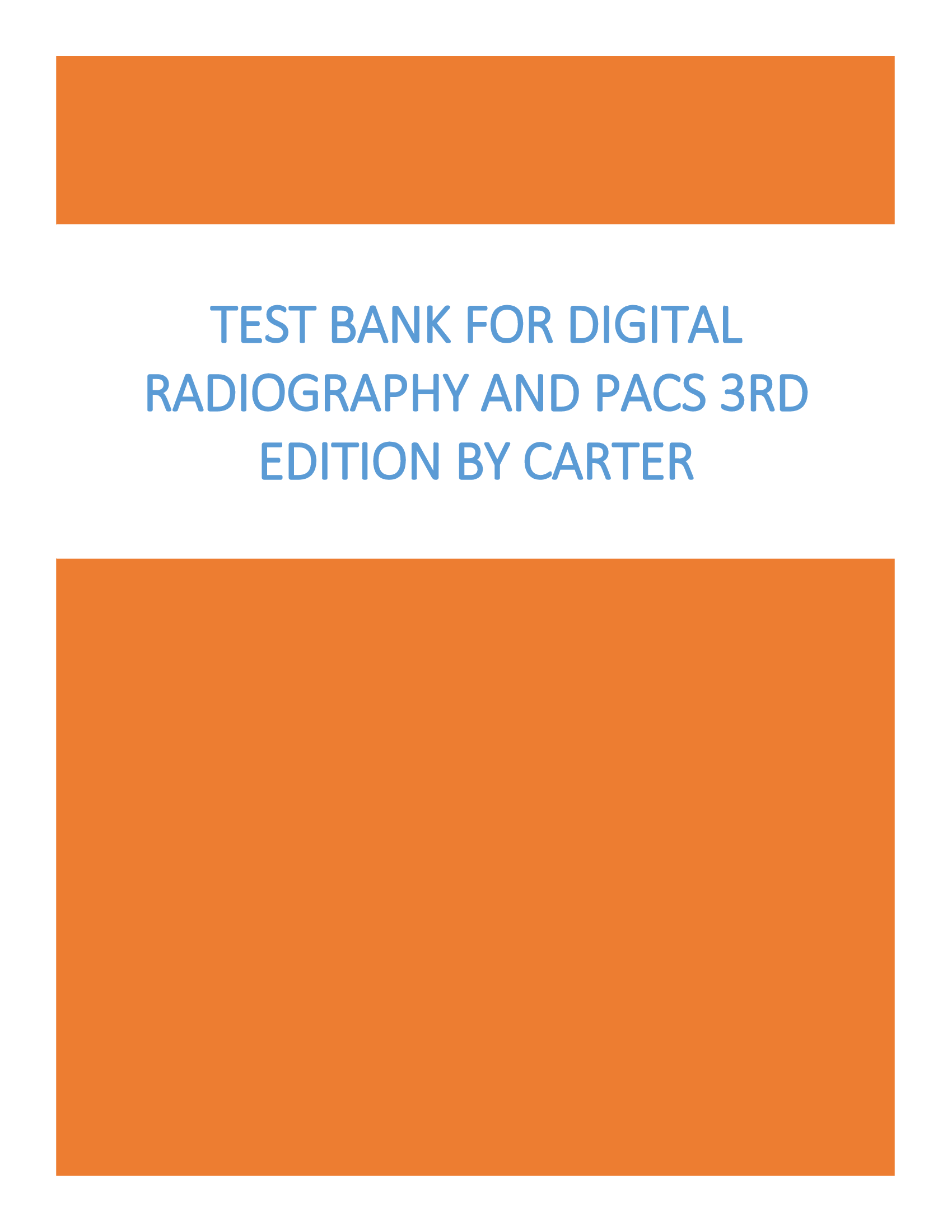
  • Digital Radiography and PACS 3rd Edition by Carter | Test Bank

Digital Radiography and PACS 3rd Edition by Carter | Test Bank

Preview page 1 Preview page 2 Preview page 3
Add To Favorites

Share this item Share this item

  • Item Details
  • Comments (0)
  • Reviews (0)
  • Contact Seller

Test Bank for Digital Radiography and PACS 3rd Edition by Carter

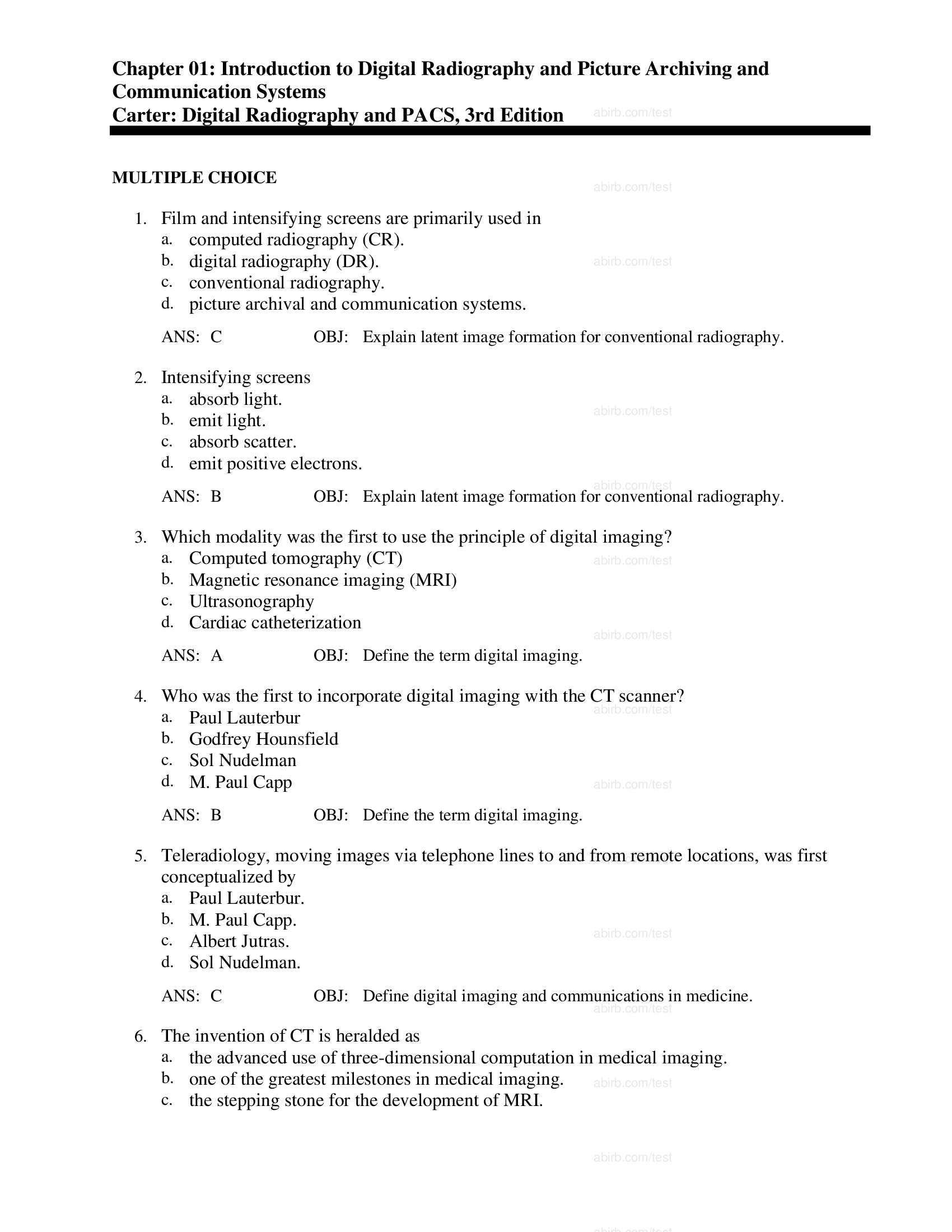
Chapter 01: Introduction to Digital Radiography and Picture Archiving and Communication Systems

Carter: Digital Radiography and PACS, 3rd Edition

MULTIPLE CHOICE

1.         Film and intensifying screens are primarily used in

a.        computed radiography (CR).

b.        digital radiography (DR).

c.        conventional radiography.

d.        picture archival and communication systems.

               ANS: C                  OBJ: Explain latent image formation for conventional radiography.

2.         Intensifying screens

a.        absorb light.

b.        emit light.

c.        absorb scatter.

d.        emit positive electrons.

               ANS: B                  OBJ: Explain latent image formation for conventional radiography.

3.         Which modality was the first to use the principle of digital imaging?

a.        Computed tomography (CT)

b.        Magnetic resonance imaging (MRI)

c.        Ultrasonography

d.        Cardiac catheterization

               ANS: A                    OBJ: Define the term digital imaging.

4.         Who was the first to incorporate digital imaging with the CT scanner?

a.        Paul Lauterbur

b.        Godfrey Hounsfield

c.        Sol Nudelman

d.        M. Paul Capp

               ANS: B                    OBJ: Define the term digital imaging.

5.         Teleradiology, moving images via telephone lines to and from remote locations, was first conceptualized by a.         Paul Lauterbur.

b.        M. Paul Capp.

c.        Albert Jutras.

d.        Sol Nudelman.

               ANS: C                   OBJ: Define digital imaging and communications in medicine.

6.         The invention of CT is heralded as

a.        the advanced use of three-dimensional computation in medical imaging.

b.        one of the greatest milestones in medical imaging.

c.        the stepping stone for the development of MRI.

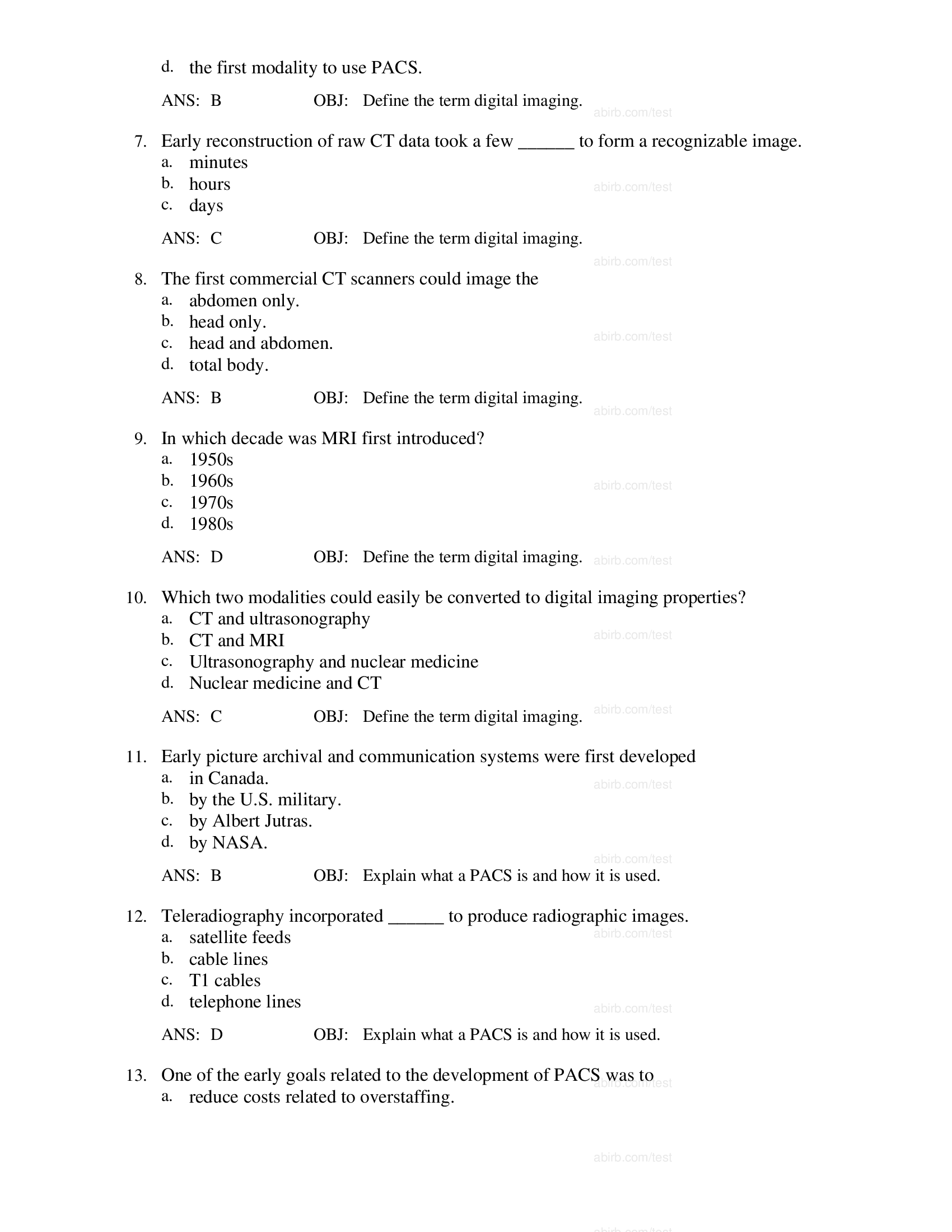
d.        the first modality to use PACS.

               ANS: B                    OBJ: Define the term digital imaging.

7.         Early reconstruction of raw CT data took a few ______ to form a recognizable image.

a.        minutes

b.        hours

c.        days

               ANS: C                    OBJ: Define the term digital imaging.

8.         The first commercial CT scanners could image the

a.        abdomen only.

b.        head only.

c.        head and abdomen.

d.        total body.

               ANS: B                    OBJ: Define the term digital imaging.

9.         In which decade was MRI first introduced?

a.        1950s

b.        1960s

c.        1970s

d.        1980s

               ANS: D                    OBJ: Define the term digital imaging.

10.     Which two modalities could easily be converted to digital imaging properties?

a.        CT and ultrasonography

b.        CT and MRI

c.        Ultrasonography and nuclear medicine

d.        Nuclear medicine and CT

               ANS: C                    OBJ: Define the term digital imaging.

11.     Early picture archival and communication systems were first developed

a.        in Canada.

b.        by the U.S. military.

c.        by Albert Jutras.

d.        by NASA.

               ANS: B                   OBJ: Explain what a PACS is and how it is used.

12.     Teleradiography incorporated ______ to produce radiographic images. a.        satellite feeds

b.        cable lines

c.        T1 cables

d.        telephone lines

               ANS: D                   OBJ: Explain what a PACS is and how it is used.

13.     One of the early goals related to the development of PACS was to

a.        reduce costs related to overstaffing.

b.        allow radiologists to read stat films from a hospital while at home.

c.        provide a means to move battlefield images to an established hospital.

d.        eliminate the need for chemical processing.

               ANS: C                   OBJ: Explain what a PACS is and how it is used.

14.     CR acquires an image through

a.        conventional film/screen processing using a digital scanner.

b.        the heating of a thermoluminescent device.

c.        an electrically charged cassette.

d.        the use of a storage phosphor plate.

               ANS: D                  OBJ: Describe the latent image formation process for PSP image capture.

15.     Storage phosphor plates are similar to

a.        intensifying screens.

b.        xeromammography cassettes.

c.        flat panel detectors.

d.        cardboard cassettes.

               ANS: A                  OBJ: Describe the latent image formation process for PSP image capture.

16.     In a DR system, which of the following are needed to produce a radiographic image?

a.        X-ray absorber and a CCD

b.        Intensifying screen and a TFT

c.        Storage phosphor plate and a CCD

d.        Storage phosphor plate and a TFT

               ANS: A                  OBJ: Compare and contrast the latent image formation processes.

17.     The two elements needed to convert light signals into an electrical signal while using indirect capture DR are TFT and a.     photodiodes.

b.        photoconductors.

c.        phototransistors.

d.        photostators.

               ANS: A                  OBJ: Compare and contrast the latent image formation processes.

18.     The x-ray absorber typically used in direct capture DR is a

a.        photodiode.

b.        phototransistor.

c.        photoconductor.

d.        photoelectron.

               ANS: C                  OBJ: Compare and contrast the latent image formation processes.

19.     Technologist efficiency ratings are generally the same when comparing conventional radiography with ______ radiography. a.    computed

              b.    digital

               ANS: A                  OBJ: Compare and contrast the latent image formation processes.

20.     Compared with a 90-second processing time found in conventional radiography, image acquisition with DR has now been reduced to

a.        instantaneous acquisition.

b.        1–2 seconds.

c.        3–5 seconds.

d.        6–8 seconds.

               ANS: C                  OBJ: Compare and contrast the latent image formation processes.

21.     The active element in a storage phosphor is

a.        lithium.

b.        glutaraldehyde.

c.        europium.

d.        barium fluorohalide.

               ANS: D                  OBJ: Compare and contrast the latent image formation processes.

22.     In reference to PSP image capture, to release the latent image, which of the following devices is scanned over the phosphor plate? a.          Photomultiplier tube

b.        Fluorescent light

c.        Focused laser light

d.        Lithium crystal

               ANS: C                  OBJ: Describe the latent image formation process for PSP image capture.

23.     Which of the following best describes the sequence for PSP image capture?

a.        Phosphor plate, focused laser light scanner, photomultiplier, digital-analog converter, review station

b.        Phosphor plate, focused laser light scanner, photodensitometer, digital-analog converter, review station

c.        Phosphor plate, focused laser light scanner, photodensitometer, analog-digital converter, review station

d.        Phosphor plate, focused laser light scanner, photomultiplier, analog-digital converter, review station

               ANS: D                  OBJ: Compare and contrast the latent image formation processes.

24.     X-ray energy related to direct capture DR will stimulate a ______, which eventually is changed into an electrical signal. a.           photodensitometer

b.        scintillator

c.        TFT array

d.        charge-coupled device

               ANS: B                  OBJ: Compare and contrast the latent image formation processes.

25.     The ______ converts x-ray energy directly to a digital electrical signal.

a.        photoconductor

b.        photomultiplier

c.        scintillator

d.        TLD

               ANS: A                  OBJ: Compare and contrast the latent image formation processes.

26.     Exposure latitude is to conventional radiography as _______ is to DR.

a.        characteristic response

b.        linear manner

c.        subject contrast

d.        dynamic range

               ANS: D                  OBJ: Compare and contrast the latent image formation processes.

27.     A look-up table maps

a.        latent images.

b.        subject contrasts.

c.        image grayscale values.

d.        optical density.

               ANS: C                  OBJ: Compare and contrast the latent image formation processes.

28.     With conventional radiography, optical density is primarily controlled by

a.        kilovoltage.

b.        milliamperage.

c.        line voltage.

d.        milliampere-seconds.

               ANS: D                  OBJ: Compare and contrast the latent image formation processes.

29.     Preset image annotation controls include all of the following except

a.        arrows.

b.        position indicators.

c.        date and time stamps.

d.        image acquisition markers.

               ANS: C                   OBJ: Explain what a PACS is and how it is used.

30.     The first full-scale PACS was installed in 1993 in

a.        Boston.

b.        Philadelphia.

c.        New York.

d.        Baltimore.

               ANS: D                   OBJ: Explain what a PACS is and how it is used.

31.     All of the following are components of a PACS except

a.        independent kilovoltage peak and milliampere-second stations.

b.        web access.

c.        multiple interfaces.

d.        reading stations.

               ANS: A                   OBJ: Explain what a PACS is and how it is used.

TRUE/FALSE

1.      Light exposing the film is in direct proportion to the amount and energy of the incident photon upon the screen.

               ANS: T                  OBJ: Explain latent image formation for conventional radiography.

2.      The earliest CT of the head took several hours to acquire a single slice of information.

               ANS: T                    OBJ: Define the term digital imaging.

3.      When switching from a conventional diagnostic radiography room to one that incorporates CR, major equipment changes are to be expected.

               ANS: F                   OBJ: Describe the latent image formation process for PSP image capture.

4.      Similar to CR, DR can use the existing diagnostic equipment found in today’s imaging departments.

ANS: F OBJ: Compare and contrast the latent image formation processes.  5. Indirect capture DR converts absorbed x-ray energy into visible light.

ANS: T OBJ: Compare and contrast the latent image formation processes.  6. A Bucky apparatus is required for DR.

               ANS: F                   OBJ: Compare and contrast the latent image formation processes.

7.      Many PACS reading stations also have image-processing capabilities.

               ANS: T                   OBJ: Explain what a PACS is and how it is used.

8.      DICOM is a standard that allows imaging modalities and PACS to communicate in the same language.

               ANS: T                   OBJ: Explain what a PACS is and how it is used.

Contact the Seller

Please Sign In to contact this seller.


  • 👎  Report Copyright Violation

Frequently Asked Questions

What Do I Get When I Buy This Study Material?

+

When you buy a study material on Passing Grades, an instant download link will be sent directly to your email, giving you access to the file anytime after payment is completed.

Is Passing Grades a Trusted Platform?

+

Yes, Passing Grades is a reputable students’ marketplace with a secure payment system and reliable customer support. You can trust us to ensure a safe and seamless transaction experience.

Will I Be Stuck with a Subscription?

+

No, all purchases on Passing Grades are one-time transactions. You only pay for the notes you choose to buy, with no subscriptions or hidden fees attached.

Who Am I Buying These Study Materials From?

+

Passing Grades is a marketplace, which means you are purchasing the document from an individual vendor, not directly from us. We facilitate the payment and delivery process between you and the vendor.

Does Passing Grades Offer Free Study Materials?

+

Yes, sellers on Passing Grades have uploaded numerous free test banks, exams, practice questions, and class notes that can be downloaded at no cost.


Pasinggrades - Quality Study Materials

USD 15

    • Quality checked by Pasing Grades
    • 100% satisfaction guarantee
    • Seller: mentor2000
Buy PDF $15

Seller Information

mentor2000

Member since April 2021

  • icon
  • icon
View Profile
  • total sales

    1
  • Favourites

    0
  • Comments

    0
    ( 0 Ratings )

Item Information

  • Uploaded

    03 April 2023

  • Updated

    01 October 2025

  • Category

    General

  • Item Type

    test bank

  • Tags

    Test Bank for Digital Radiography and PACS 3rd Edition by Carter Carter Test Bank Digital Radiography test bank PACS test bank

Related Exam Prep Guides by mentor2000

Test Bank for Essentials for Nursing Practice 8th Edition by Potter | All Chapters
View Document

Test Bank for Essent...

  • mentor2000

    mentor2000

  • test bank

Master nursing concepts with this study material; Test Bank for Essentials for Nursing Practice, 8th...

15 USD

0

1

A &P 1 MA278 BSC2 Final Module II Questions & Answers 2026 Update
View Document

A &P 1 MA278 BSC2 Fi...

  • mentor2000

    mentor2000

  • test bank

Prepare for success with A&P 1 MA278 BSC2 Final Module II 2024 Q&A. Boost your grades with this comp...

15 USD

0

1

ATI Comprehensive Predictor Exam 2026
View Document

ATI Comprehensive Pr...

  • mentor2000

    mentor2000

  • test bank

Prepare for success with the ATI Comprehensive Predictor Exam 2026. Access key practice questions to...

15 USD

0

1

Purchase

Download link will be sent to this email immediately after purchase.

IMPORTANT LINKS

  • How To Upload Class Notes
  • Selling Tips
  • Passing Grades's Study Materials
  • Scholarships for International Students 2025

POPULAR CATEGORIES

  • Law
  • Accounting
  • English
  • Psychology
  • Business
  • Nursing
  • Computer Science
  • General

View Document

  • Blog
  • Contact
  • Delivery Policy
  • Latest Scholarships Around the World
  • How to Pass Bar Exams: Passing Grades’ Strategies
  • How to Study and Pass the CPA Exam
  • All Test Banks
  • Faq
  • Copyright Claims
  • Privacy Policy
  • Terms of Use

KNOWLEDGE BASE

  • How to Write A+ Grade Good Research Paper
  • How to Manage Stress During Exam Period
  • Best Time to Study
  • How to Pass NCLEX-RN Exam
  • How To Effectively Utilize Test Banks
  • Popular Shadow Health Exam Assessments
  • Popular HESI Case Studies
  • How to Prepare for a Nursing Career
  • The Importance Of Summaries in Exam Revisvion

© 2026 Pasing Grades. All rights reserved.