Pasing Grades
  • Start Selling
  • Blog
  • Contact
  • 0

    Your cart is empty!

English

  • English
  • Spanish
  • Arabic
Create Account Sign In
  • Library
    • New Prep Guides
    • Featured Prep Guides
    • Free Exam Prep Guides
    • Best sellers
  • General
  • Nursing
    • Research Paper
    • Case Study
    • Discussion Post
    • Assignment
    • Exam
    • Practice Questions and Answers
    • Test Bank
    • solutions manual
  • Accounting
    • Case Study
    • Thesis
    • Study Guide
    • Summary
    • Research Paper
    • test bank
  • English
    • Creative Writing
    • Research Paper
    • Summary
    • Rhetorics
    • Literature
    • Journal
    • Exam
    • Grammar
    • Discussion Post
    • Essay
  • Psychology
    • Hesi
    • Presentation
    • Essay
    • Summary
    • Study Guide
    • Essay
    • Solution Manual
    • Final Exam Review
    • Class Notes
    • test bank
  • Business
    • Lecture Notes
    • Solution Manual
    • Presentation
    • Business Plan
    • Class Notes
    • Experiment
    • Summary
    • Practice Questions
    • Study Guide
    • Case Study
    • test bank
    • Exam
  • More
    • Computer Science
    • Economics
    • Statistics
    • Engineering
    • Biology
    • Religious Studies
    • Physics
    • Chemistry
    • Mathematics
    • History
    • Sociology
    • Science
    • Philosophy
    • Law
  • Pages
    • About Us
    • Selling Tips
    • Delivery Policy
    • Faq
    • Privacy Policy
  • Flash Sale
  • Home
  • Chemistry 1010 Exam 2 Clemson test questions and answers

Chemistry 1010 Exam 2 Clemson test questions and answers

Preview page 1 Preview page 2 Preview page 3
Add To Favorites

Share this item Share this item

  • Item Details
  • Comments (0)
  • Reviews (0)
  • Contact Seller
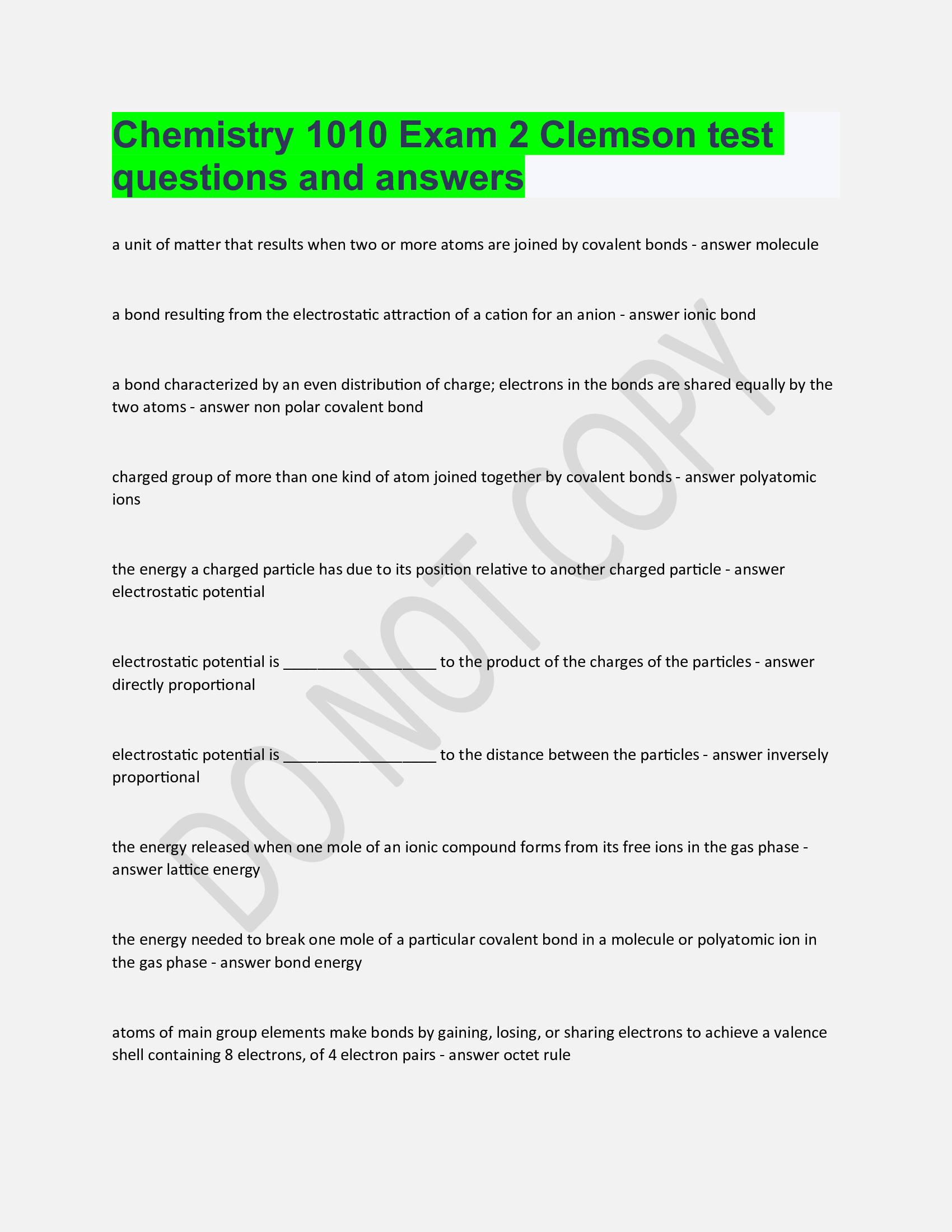
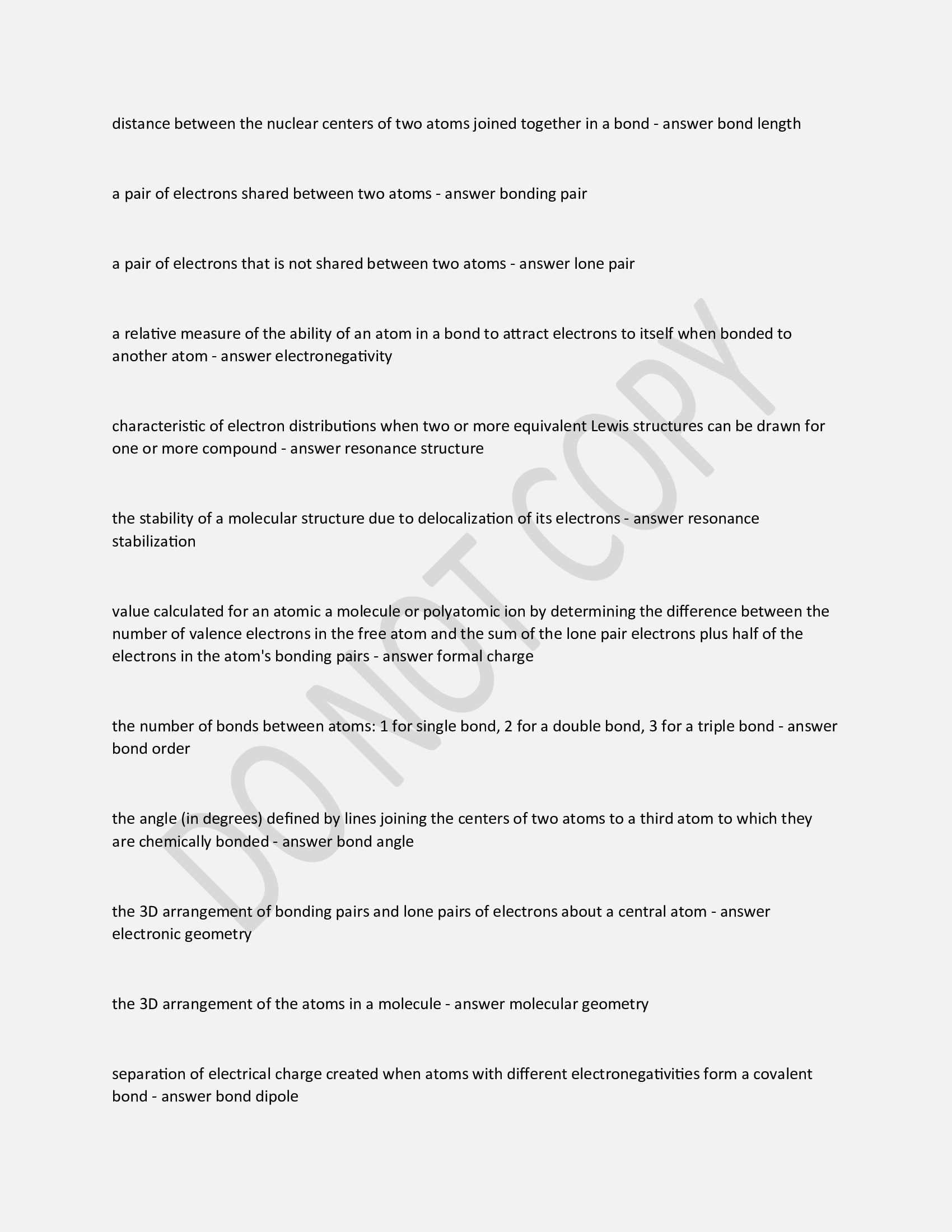
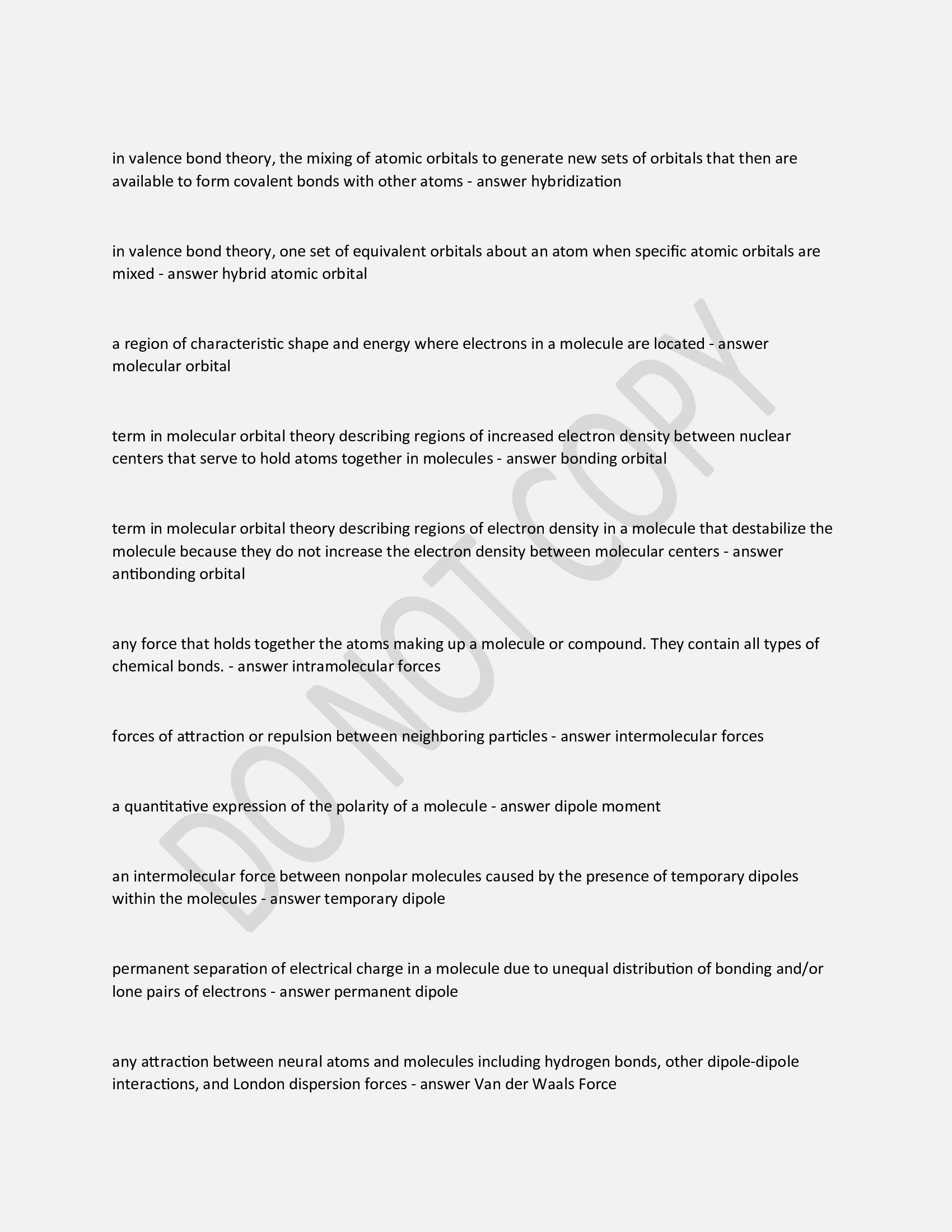
a unit of matter that results when two or more atoms are joined by covalent bonds - answer molecule a bond resulting from the electrostatic attraction of a cation for an anion - answer ionic bond a bond characterized by an even distribution of charge; electrons in the bonds are shared equally by the two atoms - answer non polar covalent bond charged group of more than one kind of atom joined together by covalent bonds - answer polyatomic ions the energy a charged particle has due to its position relative to another charged particle - answer electrostatic potential electrostatic potential is __________________ to the product of the charges of the particles - answer directly proportional electrostatic potential is __________________ to the distance between the particles - answer inversely proportional the energy released when one mole of an ionic compound forms from its free ions in the gas phase - answer lattice energy the energy needed to break one mole of a particular covalent bond in a molecule or polyatomic ion in the gas phase - answer bond energy atoms of main group elements make bonds by gaining, losing, or sharing electrons to achieve a valence shell containing 8 electrons, of 4 electron pairs - answer octet rule distance between the nuclear centers of two atoms joined together in a bond - answer bond length a pair of electrons shared between two atoms - answer bonding pair a pair of electrons that is not shared between two atoms - answer lone pair a relative measure of the ability of an atom in a bond to attract electrons to itself when bonded to another atom - answer electronegativity characteristic of electron distributions when two or more equivalent Lewis structures can be drawn for one or more compound - answer resonance structure the stability of a molecular structure due to delocalization of its electrons - answer resonance stabilization value calculated for an atomic a molecule or polyatomic ion by determining the difference between the number of valence electrons in the free atom and the sum of the lone pair electrons plus half of the electrons in the atom's bonding pairs - answer formal charge the number of bonds between atoms: 1 for single bond, 2 for a double bond, 3 for a triple bond - answer bond order the angle (in degrees) defined by lines joining the centers of two atoms to a third atom to which they are chemically bonded - answer bond angle the 3D arrangement of bonding pairs and lone pairs of electrons about a central atom - answer electronic geometry the 3D arrangement of the atoms in a molecule - answer molecular geometry separation of electrical charge created when atoms with different electronegativities form a covalent bond - answer bond dipole in valence bond theory, the mixing of atomic orbitals to generate new sets of orbitals that then are available to form covalent bonds with other atoms - answer hybridization in valence bond theory, one set of equivalent orbitals about an atom when specific atomic orbitals are mixed - answer hybrid atomic orbital a region of characteristic shape and energy where electrons in a molecule are located - answer molecular orbital term in molecular orbital theory describing regions of increased electron density between nuclear centers that serve to hold atoms together in molecules - answer bonding orbital term in molecular orbital theory describing regions of electron density in a molecule that destabilize the molecule because they do not increase the electron density between molecular centers - answer antibonding orbital any force that holds together the atoms making up a molecule or compound. They contain all types of chemical bonds. - answer intramolecular forces forces of attraction or repulsion between neighboring particles - answer intermolecular forces a quantitative expression of the polarity of a molecule - answer dipole moment an intermolecular force between nonpolar molecules caused by the presence of temporary dipoles within the molecules - answer temporary dipole permanent separation of electrical charge in a molecule due to unequal distribution of bonding and/or lone pairs of electrons - answer permanent dipole any attraction between neural atoms and molecules including hydrogen bonds, other dipole-dipole interactions, and London dispersion forces - answer Van der Waals Force an intermolecular force between molecules caused by the presence of temporary dipoles in the molecules - answer London dispersion force an attractive force between an ion and a molecule that has a permanent dipole - answer ion-dipole interaction an attraction between regions of polar molecules that have partial charges of opposit

Contact the Seller

Please Sign In to contact this seller.


  • 👎  Report Copyright Violation

Frequently Asked Questions

What Do I Get When I Buy This Study Material?

+

When you buy a study material on Passing Grades, an instant download link will be sent directly to your email, giving you access to the file anytime after payment is completed.

Is Passing Grades a Trusted Platform?

+

Yes, Passing Grades is a reputable students’ marketplace with a secure payment system and reliable customer support. You can trust us to ensure a safe and seamless transaction experience.

Will I Be Stuck with a Subscription?

+

No, all purchases on Passing Grades are one-time transactions. You only pay for the notes you choose to buy, with no subscriptions or hidden fees attached.

Who Am I Buying These Study Materials From?

+

Passing Grades is a marketplace, which means you are purchasing the document from an individual vendor, not directly from us. We facilitate the payment and delivery process between you and the vendor.

Does Passing Grades Offer Free Study Materials?

+

Yes, sellers on Passing Grades have uploaded numerous free test banks, exams, practice questions, and class notes that can be downloaded at no cost.

Pasinggrades - Quality Study Materials

USD 11

    • Quality checked by Pasing Grades
    • 100% satisfaction guarantee
    • Seller: BACKTOSCHOOL
Buy PDF $11

Seller Information

BACKTOSCHOOL

Member since January 2024

  • icon
View Profile
  • total sales

    0
  • Favourites

    0
  • Comments

    0
    ( 0 Ratings )

Item Information

  • Uploaded

    04 January 2024

  • Updated

    24 November 2025

  • Category

    Chemistry

  • Item Type

    exam

  • Tags

    Chemistry 1010 Exam 2 Clemson test questions and answers

Related Exam Prep Guides by BACKTOSCHOOL

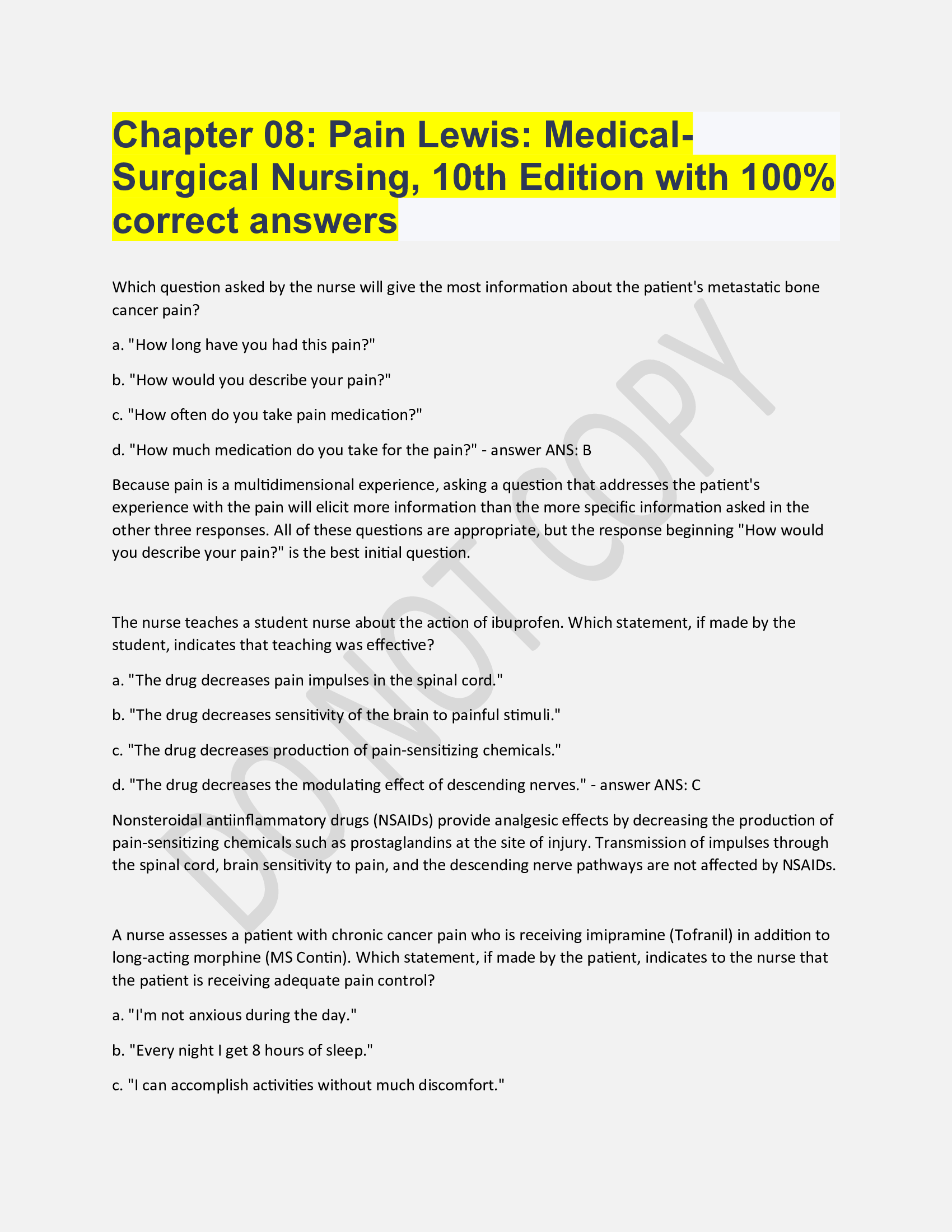
Chapter 08: Pain Lewis: Medical-Surgical Nursing, 10th Edition with 100% correct answers
View Document

Chapter 08: Pain Lew...

  • BACKTOSCHOOL

    BACKTOSCHOOL

  • exam

Chapter 08: Pain Lewis: Medical-Surgical Nursing, 10th Edition with 100% correct answers Which quest...

11 USD

0

0

Care of the Surgical Patient nclex test questions and answers 2025/2026
View Document

Care of the Surgical...

  • BACKTOSCHOOL

    BACKTOSCHOOL

  • exam

Care of the Surgical Patient nclex test questions and answers 2025/2026 A perioperative nurse is pre...

11 USD

0

0

Surgery: Surgical Nursing Exam with Verified Solutions
View Document

Surgery: Surgical Nu...

  • BACKTOSCHOOL

    BACKTOSCHOOL

  • exam

Surgery: Surgical Nursing with verified solutions...

11 USD

0

0

Purchase

Download link will be sent to this email immediately after purchase.

IMPORTANT LINKS

  • How To Upload Class Notes
  • Selling Tips
  • Passing Grades's Study Materials
  • Scholarships for International Students 2025

POPULAR CATEGORIES

  • Law
  • Accounting
  • English
  • Psychology
  • Business
  • Nursing
  • Computer Science
  • General

View Document

  • Blog
  • Contact
  • Delivery Policy
  • Latest Scholarships Around the World
  • How to Pass Bar Exams: Passing Grades’ Strategies
  • How to Study and Pass the CPA Exam
  • All Test Banks
  • Faq
  • Copyright Claims
  • Privacy Policy
  • Terms of Use

KNOWLEDGE BASE

  • How to Write A+ Grade Good Research Paper
  • How to Manage Stress During Exam Period
  • Best Time to Study
  • How to Pass NCLEX-RN Exam
  • How To Effectively Utilize Test Banks
  • Popular Shadow Health Exam Assessments
  • Popular HESI Case Studies
  • How to Prepare for a Nursing Career
  • The Importance Of Summaries in Exam Revisvion

© 2026 Pasing Grades. All rights reserved.