Pasing Grades
  • Start Selling
  • Blog
  • Contact
  • 0

    Your cart is empty!

English

  • English
  • Spanish
  • Arabic
Create Account Sign In
  • Library
    • New Prep Guides
    • Featured Prep Guides
    • Free Exam Prep Guides
    • Best sellers
  • General
  • Nursing
    • Research Paper
    • Case Study
    • Discussion Post
    • Assignment
    • Exam
    • Practice Questions and Answers
    • Test Bank
    • solutions manual
  • Accounting
    • Case Study
    • Thesis
    • Study Guide
    • Summary
    • Research Paper
    • test bank
  • English
    • Creative Writing
    • Research Paper
    • Summary
    • Rhetorics
    • Literature
    • Journal
    • Exam
    • Grammar
    • Discussion Post
    • Essay
  • Psychology
    • Hesi
    • Presentation
    • Essay
    • Summary
    • Study Guide
    • Essay
    • Solution Manual
    • Final Exam Review
    • Class Notes
    • test bank
  • Business
    • Lecture Notes
    • Solution Manual
    • Presentation
    • Business Plan
    • Class Notes
    • Experiment
    • Summary
    • Practice Questions
    • Study Guide
    • Case Study
    • test bank
    • Exam
  • More
    • Computer Science
    • Economics
    • Statistics
    • Engineering
    • Biology
    • Religious Studies
    • Physics
    • Chemistry
    • Mathematics
    • History
    • Sociology
    • Science
    • Philosophy
    • Law
  • Pages
    • About Us
    • Selling Tips
    • Delivery Policy
    • Faq
    • Privacy Policy
  • Flash Sale
  • Home
  • ATI RN Medical-Surgical Proctored Exam 2023-2026 Questions & Answers with Rationales, Guaranteed A+ Score, Latest Update

ATI RN Medical-Surgical Proctored Exam 2023-2026 Questions & Answers with Rationales, Guaranteed A+ Score, Latest Update

Preview page 1 Preview page 2 Preview page 3
Add To Favorites

Share this item Share this item

  • Item Details
  • Comments (0)
  • Reviews (0)
  • Contact Seller

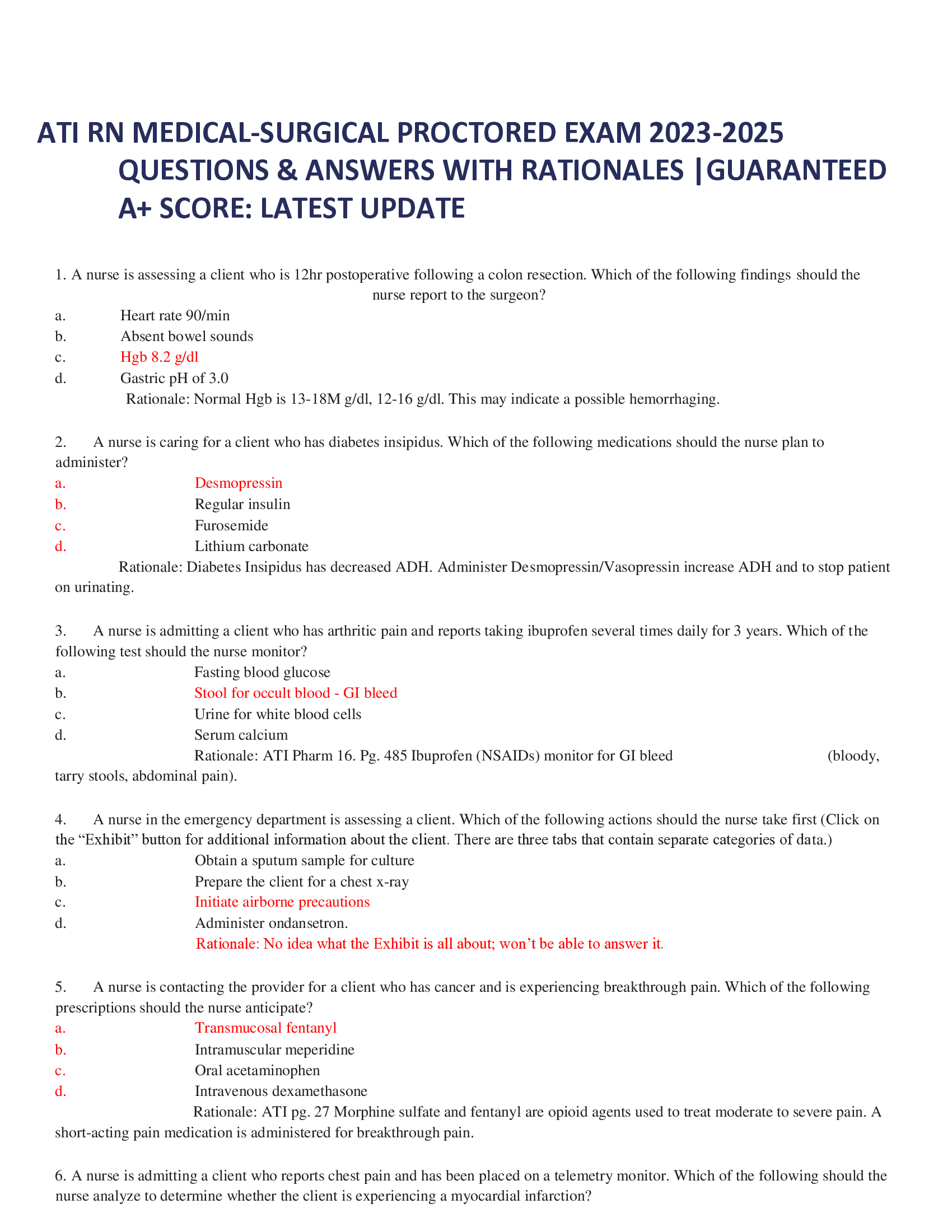
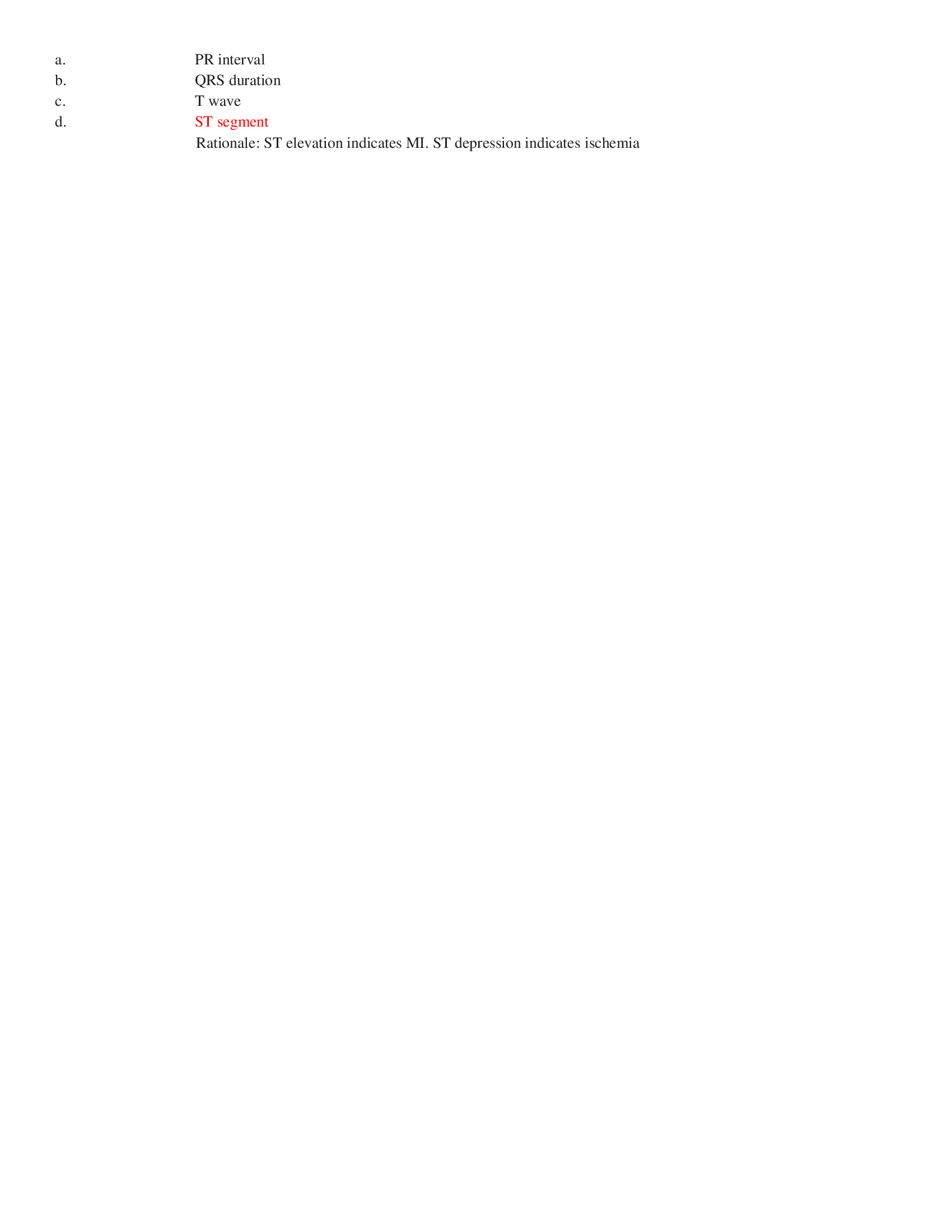
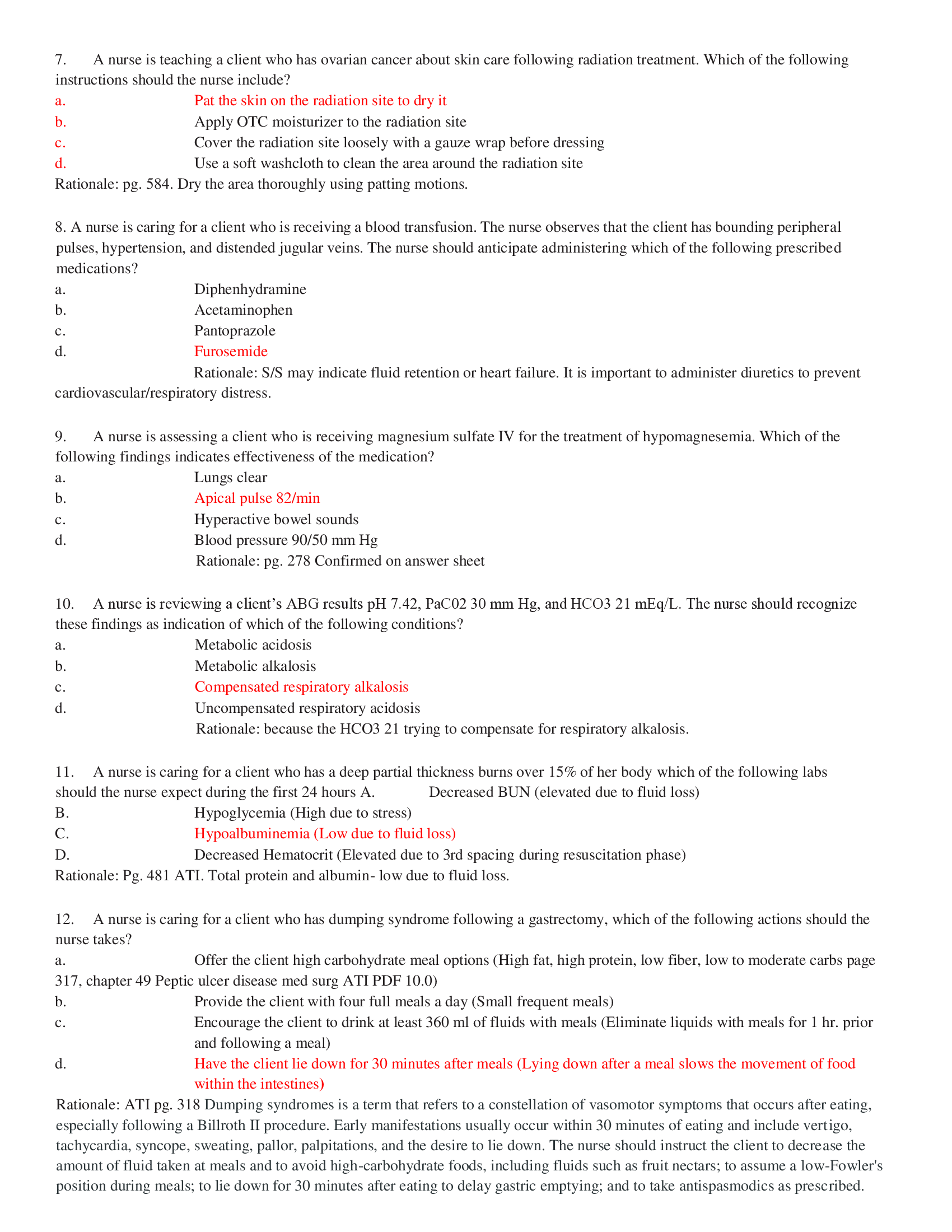
ATI RN Medical-Surgical Proctored Exam 2023-2025 Questions & Answers with Rationales, Guaranteed A+ Score, Latest Update 1. A nurse is assessing a client who is 12hr postoperative following a colon resection. Which of the following findings should the nurse report to the surgeon? a. Heart rate 90/min b. Absent bowel sounds c. Hgb 8.2 g/dl d. Gastric pH of 3.0 Rationale: Normal Hgb is 13-18M g/dl, 12-16 g/dl. This may indicate a possible hemorrhaging. 2. A nurse is caring for a client who has diabetes insipidus. Which of the following medications should the nurse plan to administer? a. Desmopressin b. Regular insulin c. Furosemide d. Lithium carbonate Rationale: Diabetes Insipidus has decreased ADH. Administer Desmopressin/Vasopressin increase ADH and to stop patient on urinating. 3. A nurse is admitting a client who has arthritic pain and reports taking ibuprofen several times daily for 3 years. Which of the following test should the nurse monitor? a. Fasting blood glucose b. Stool for occult blood - GI bleed c. Urine for white blood cells d. Serum calcium Rationale: ATI Pharm 16. Pg. 485 Ibuprofen (NSAIDs) monitor for GI bleed (bloody, tarry stools, abdominal pain). 4. A nurse in the emergency department is assessing a client. Which of the following actions should the nurse take first (Click on the “Exhibit” button for additional information about the client. There are three tabs that contain separate categories of data.) a. Obtain a sputum sample for culture b. Prepare the client for a chest x-ray c. Initiate airborne precautions d. Administer ondansetron. Rationale: No idea what the Exhibit is all about; won’t be able to answer it. 5. A nurse is contacting the provider for a client who has cancer and is experiencing breakthrough pain. Which of the following prescriptions should the nurse anticipate? a. Transmucosal fentanyl b. Intramuscular meperidine c. Oral acetaminophen d. Intravenous dexamethasone Rationale: ATI pg. 27 Morphine sulfate and fentanyl are opioid agents used to treat moderate to severe pain. A short-acting pain medication is administered for breakthrough pain. 6. A nurse is admitting a client who reports chest pain and has been placed on a telemetry monitor. Which of the following should the nurse analyze to determine whether the client is experiencing a myocardial infarction? a. PR interval b. QRS duration c. T wave d. ST segment Rationale: ST elevation indicates MI. ST depression indicates ischemia 7. A nurse is teaching a client who has ovarian cancer about skin care following radiation treatment. Which of the following instructions should the nurse include? a. Pat the skin on the radiation site to dry it b. Apply OTC moisturizer to the radiation site c. Cover the radiation site loosely with a gauze wrap before dressing d. Use a soft washcloth to clean the area around the radiation site Rationale: pg. 584. Dry the area thoroughly using patting motions. 8. A nurse is caring for a client who is receiving a blood transfusion. The nurse observes that the client has bounding peripheral pulses, hypertension, and distended jugular veins. The nurse should anticipate administering which of the following prescribed medications? a. Diphenhydramine b. Acetaminophen c. Pantoprazole d. Furosemide Rationale: S/S may indicate fluid retention or heart failure. It is important to administer diuretics to prevent cardiovascular/respiratory distress. 9. A nurse is assessing a client who is receiving magnesium sulfate IV for the treatment of hypomagnesemia. Which of the following findings indicates effectiveness of the medication? a. Lungs clear b. Apical pulse 82/min c. Hyperactive bowel sounds d. Blood pressure 90/50 mm Hg Rationale: pg. 278 Confirmed on answer sheet 10. A nurse is reviewing a client’s ABG results pH 7.42, PaC02 30 mm Hg, and HCO3 21 mEq/L. The nurse should recognize these findings as indication of which of the following conditions? a. Metabolic acidosis b. Metabolic alkalosis c. Compensated respiratory alkalosis d. Uncompensated respiratory acidosis Rationale: because the HCO3 21 trying to compensate for respiratory alkalosis. 11. A nurse is caring for a client who has a deep partial thickness burns over 15% of her body which of the following labs should the nurse expect during the first 24 hours A. Decreased BUN (elevated due to fluid loss) B. Hypoglycemia (High due to stress) C. Hypoalbuminemia (Low due to fluid loss) D. Decreased Hematocrit (Elevated due to 3rd spacing during resuscitation phase) Rationale: Pg. 481 ATI. Total protein and albumin- low due to fluid loss. 12. A nurse is caring for a client who has dumping syndrome following a gastrectomy, which of the following actions should the nurse takes? a. Offer the client high carbohydrate meal options (High fat, high protein, low fiber, low to moderate carbs page 317, chapter 49 Peptic ulcer disease med surg ATI PDF 10.0) b. Provide the client with four full meals a day (Small frequent meals) c. Encourage the client to drink at least 360 ml of fluids with meals (Eliminate liquids with meals for 1 hr. prior and following a meal) d. Have the client lie down for 30 minutes after meals (Lying down after a meal slows the movement of food within the intestines) Rationale: ATI pg. 318 Dumping syndromes is a term that refers to a constellation of vasomotor symptoms that occurs after eating, especially following a Billroth II procedure. Early manifestations usually occur within 30 minutes of eating and include vertigo, tachycardia, syncope, sweating, pallor, palpitations, and the desire to lie down. The nurse should instruct the client to decrease the amount of fluid taken at meals and to avoid high-carbohydrate foods, including fluids such as fruit nectars; to assume a low-Fowler's position during meals; to lie down for 30 minutes after eating to delay gastric emptying; and to take antispasmodics as prescribed. 12. A nurse is teaching a group of young adult clients about risk factors for hearing loss. Which of the following factors should the nurse include in the teaching? a. Born with a high weight b. Chronic infections of the middle ear c. Use a loop diuretic such as furosemide and antibiotics like aminoglycoside and gentamicin leads to ototoxic medication d. Perforation of the eardrum e. Frequent exposure to low volume noise Rationale: Peds ATI pg. 77 Exposure to loud environmental sounds. Hearing defects can be caused by a variety of conditions, including anatomic malformation, maternal ingestion of toxic substances during pregnancy, perinatal asphyxia, perinatal infection, chronic ear infection, and ototoxic medications.

Contact the Seller

Please Sign In to contact this seller.


  • 👎  Report Copyright Violation

Frequently Asked Questions

What Do I Get When I Buy This Study Material?

+

When you buy a study material on Passing Grades, an instant download link will be sent directly to your email, giving you access to the file anytime after payment is completed.

Is Passing Grades a Trusted Platform?

+

Yes, Passing Grades is a reputable students’ marketplace with a secure payment system and reliable customer support. You can trust us to ensure a safe and seamless transaction experience.

Will I Be Stuck with a Subscription?

+

No, all purchases on Passing Grades are one-time transactions. You only pay for the notes you choose to buy, with no subscriptions or hidden fees attached.

Who Am I Buying These Study Materials From?

+

Passing Grades is a marketplace, which means you are purchasing the document from an individual vendor, not directly from us. We facilitate the payment and delivery process between you and the vendor.

Does Passing Grades Offer Free Study Materials?

+

Yes, sellers on Passing Grades have uploaded numerous free test banks, exams, practice questions, and class notes that can be downloaded at no cost.

Pasinggrades - Quality Study Materials

USD 10

    • Quality checked by Pasing Grades
    • 100% satisfaction guarantee
    • Seller: Kaponga
Buy PDF $10

Seller Information

Kaponga

Member since September 2022

  • icon
  • icon
View Profile
  • total sales

    0
  • Favourites

    0
  • Comments

    0
    ( 0 Ratings )

Item Information

  • Uploaded

    04 May 2024

  • Updated

    05 January 2026

  • Category

    Nursing

  • Item Type

    questions & answers

  • Tags

    ATI RN Medical Surgical Proctored Exam 2023 2025 Questions & Answers with Rationales Guaranteed A+ Score Latest Update

Related Exam Prep Guides by Kaponga

Nursing Fundamentals for NCLEX: The Only Study Guide You Need To PASS NCLEX Exam | 2026
View Document

Nursing Fundamentals...

  • Kaponga

    Kaponga

  • questions & answers

Nursing Fundamentals for NCLEX; The Only Study Guide You Need to Pass NCLEX Exam, 2025, Comprehensiv...

10 USD

0

0

SEJPME II Module Test Bank: From Module 3 to 22 with Verified Answers Latest (2022)
View Document

SEJPME II Module Tes...

  • Kaponga

    Kaponga

  • questions & answers

SEJPME II Module Test Bank: From Module 3 to 22 with Verified Answers Latest (2022)...

10 USD

0

0

NUR109 EXAM 2 QUESTIONS WITH ANSWERS (Excelsior School 2022)
View Document

NUR109 EXAM 2 QUESTI...

  • Kaponga

    Kaponga

  • questions & answers

NUR109 EXAM 2 QUESTIONS WITH ANSWERS (Excelsior School 2022)...

10 USD

0

0

Purchase

Download link will be sent to this email immediately after purchase.

IMPORTANT LINKS

  • How To Upload Class Notes
  • Selling Tips
  • Passing Grades's Study Materials
  • Scholarships for International Students 2026

POPULAR CATEGORIES

  • Law
  • Accounting
  • English
  • Psychology
  • Business
  • Nursing
  • Computer Science
  • General

View Document

  • Blog
  • Contact
  • Delivery Policy
  • Latest Scholarships Around the World
  • How to Pass Bar Exams: Passing Grades’ Strategies
  • How to Study and Pass the CPA Exam
  • All Test Banks
  • Faq
  • Copyright Claims
  • Privacy Policy
  • Terms of Use

KNOWLEDGE BASE

  • How to Write A+ Grade Good Research Paper
  • How to Manage Stress During Exam Period
  • Best Time to Study
  • How to Pass NCLEX-RN Exam
  • How To Effectively Utilize Test Banks
  • Popular Shadow Health Exam Assessments
  • Popular HESI Case Studies
  • How to Prepare for a Nursing Career
  • The Importance Of Summaries in Exam Revisvion

© 2026 Pasing Grades. All rights reserved.