
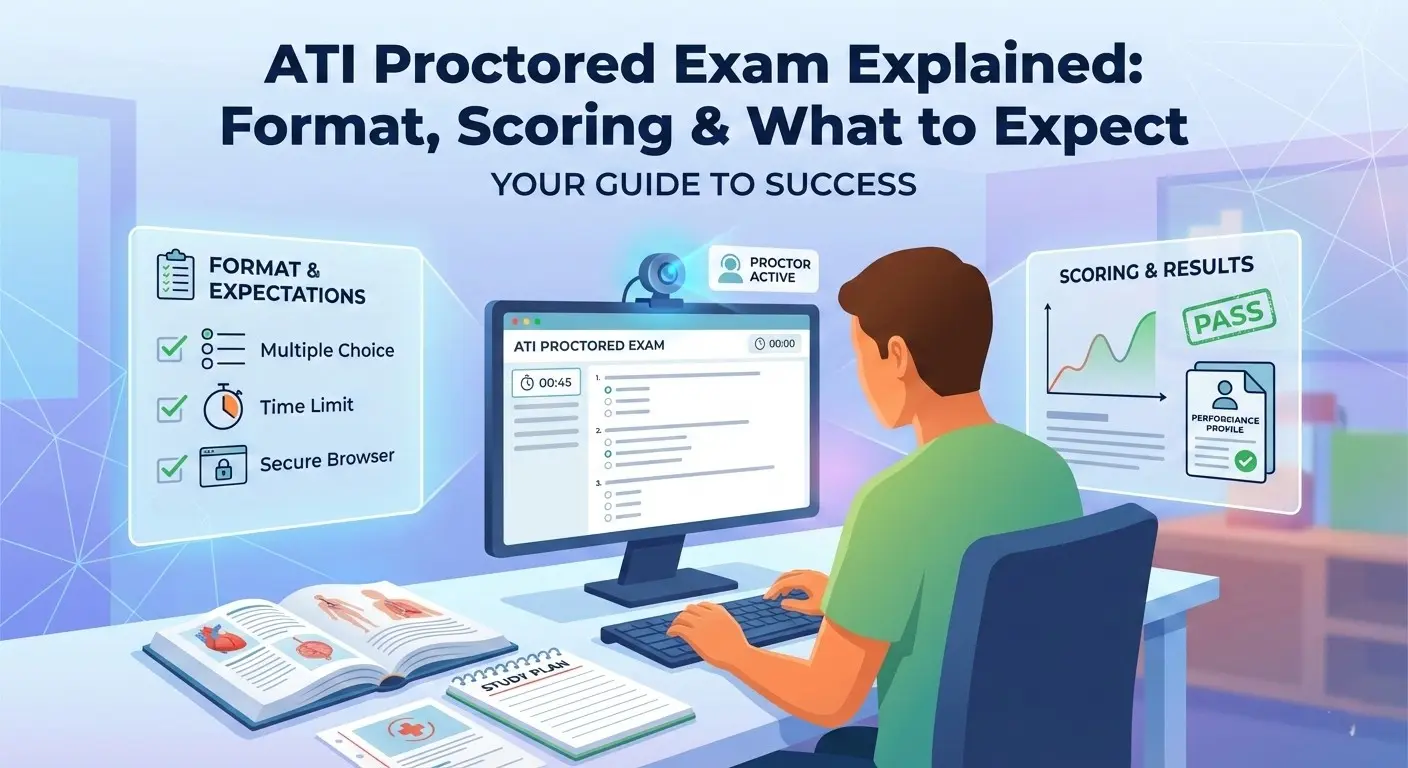
If you are a nursing student, or just joined the nursing program, high chances are you will face the ATI Proctored exam. This is one of the exams that stress a lot of students.
In this guide, we are going to explain what is ATI proctored exam, how it works, how it’s scored and the things you should expect on exam day. This is important as it will significantly help you reduce anxiety and improve performance.
What Is an ATI Proctored Exam?
An ATI proctored exam is a standardized nursing assessment administered under supervision. The exam is created by the Assessment Technologies Institute. At the core the ATI body designs the exams to gauge student mastery of key nursing concepts in different areas. Common tested areas in ATI exams are nursing fundamentals, pharmacology, medical surgical nursing, pediatrics and mental health among many others.
In your nursing program, chances are you will encounter ATI proctored exams as many nursing schools use them to evaluate the readiness of students, guide remediation and at times determine progression. Since it’s a secure supervised exam, it ensures fairness and academic integrity across all test-takers.
Related read: The Ultimate 2026 Guide to Shadow Health, ATI, and NCLEX Success: Strategies for Modern Nursing Students
ATI Proctored Exam Format
ATI proctored exams are computer-based and typically taken either in a testing center or a controlled classroom environment.
With the advancement in technology, remote proctoring is employed in some programs. In such cases, webcam monitoring and identity verification is implemented.
The number of questions often varies by subject but generally ranges from 60 to 170 questions. The exams are taken within a fixed time limit often running up to 209 minutes (3 hours, 29 minutes).
In ATI exams, questions are primarily multiple-choice, but newer exams may include Next Generation NCLEX (NGN)-style items, such as multiple-response, case-based questions, and prioritization tasks.
Once the exam begins, students are expected to follow strict rules. In the exam room, personal items, phones, and notes are not allowed.
ATI Proctored Exam Scoring Explained
Regarding scoring, ATI uses a proficiency level system rather than a traditional pass/fail score. These levels judge your performance against NCLEX standards for specific content areas. Ususally, scores are grouped into levels, these levels indicate how well a student understands the tested content:
- Level 3 (Exceeds): Likely to exceed NCLEX standards.
- Level 2 (Meets): Fairly certain to meet NCLEX standards.
- Level 1 (Minimum): Likely to just meet minimum NCLEX standards; requires focused review.
- Below Level 1 (Risk): Significant risk of not meeting NCLEX standards.
- Adjusted Individual Total Score: Your raw score is adjusted based on exam difficulty, then converts it into a standardized score that can be used to predict NCLEX readiness
- NCLEX Predictor Score: A percentage showing your likelihood of passing the NCLEX on the first attempt (e.g., 80.7% score = 99% NCLEX pass chance).
It is worth noting that scoring varies by school. Each nursing program decides how these levels are used. There are some schools which require a minimum proficiency level for course completion. On the other hand, there are some schools which use the results to assign mandatory remediation. It’s important to understand your school’s specific policy. This is important because the same score may have different consequences depending on the program.
What to Expect on ATI Exam Day

On exam day, expect strict monitoring via webcam/microphone. It is mandatory to have photo ID, a pre-exam room/desk scan, and the use of on-screen tools (calculator, scratch paper) for the same content as in-person tests.
Therefore, make sure to have your ATI login ready and to remain on camera, with a brief break after the math section. Lastly, ensure that you adhering to all proctor instructions. Lastly, follow the strict rules against personal items and communication to avoid dismissal.
Many students struggle with ATI questions because the exam tests how you apply nursing knowledge in clinical situations and not your ability to recall facts. During the test taking day, you will often be asked to choose the best nursing action, prioritize care, or identify what requires immediate attention.
Because of this, managing your time is important. Don’t answer questions too quickly as this can lead to careless errors. However, take note that spending too long on one question can leave you short on time later.
How to Pass ATI Proctored Exams
Passing ATI exams requires preparation and strategy:
- Understand the format: Proctored exams may be timed and require critical thinking.
- Use ATI study resources: Practice tests, quizzes, and modules help reinforce content.
- Focus on weak areas: Review topics where previous scores were lower.
- Simulate test conditions: Practice in quiet settings to build focus and stamina.
- Apply concepts: Use case studies or clinical scenarios to connect theory to practice.
Consistent preparation and active engagement with study materials significantly increase the likelihood of achieving Level 2 or 3 scores.
Final Thoughts
Summing up, the ATI proctored exam is designed to assess readiness for real-world nursing practice. As a student, you can approach the ATI exam with more confidence and less stress by understanding the format, scoring system, and exam-day expectations,
Preparation, familiarity with ATI-style questions, and knowing what to expect can make a significant difference. With the right approach, the ATI proctored exam becomes less of a mystery and more of a manageable milestone in your nursing journey.
Frequently Asked Questions
What Level is a 66.7 on ATI?
ATI proctored exams categorize performance into levels, usually Level 1, Level 2, and Level 3. A score of 66.7% typically corresponds to Level 2. Level 2 indicates satisfactory performance meaning you have a solid understanding of the material but may need some review in certain areas.
How Hard is the ATI Fundamentals Exam?
Many students consider the ATI Fundamentals exam moderately challenging. However, difficulty largely depends on your preparation. The exam focuses on core nursing concepts such as safety, patient care, and basic clinical skills. Questions are mostly application-based rather than simple recall. Using ATI practice questions, simulations, and review materials consistently can significantly improve performance and confidence.
0
891