Pasing Grades
  • Start Selling
  • Blog
  • Contact
  • 0

    Your cart is empty!

English

  • English
  • Spanish
  • Arabic
Create Account Sign In
  • Library
    • New Prep Guides
    • Featured Prep Guides
    • Free Exam Prep Guides
    • Best sellers
  • General
  • Nursing
    • Research Paper
    • Case Study
    • Discussion Post
    • Assignment
    • Exam
    • Practice Questions and Answers
    • Test Bank
    • solutions manual
  • Accounting
    • Case Study
    • Thesis
    • Study Guide
    • Summary
    • Research Paper
    • test bank
  • English
    • Creative Writing
    • Research Paper
    • Summary
    • Rhetorics
    • Literature
    • Journal
    • Exam
    • Grammar
    • Discussion Post
    • Essay
  • Psychology
    • Hesi
    • Presentation
    • Essay
    • Summary
    • Study Guide
    • Essay
    • Solution Manual
    • Final Exam Review
    • Class Notes
    • test bank
  • Business
    • Lecture Notes
    • Solution Manual
    • Presentation
    • Business Plan
    • Class Notes
    • Experiment
    • Summary
    • Practice Questions
    • Study Guide
    • Case Study
    • test bank
    • Exam
  • More
    • Computer Science
    • Economics
    • Statistics
    • Engineering
    • Biology
    • Religious Studies
    • Physics
    • Chemistry
    • Mathematics
    • History
    • Sociology
    • Science
    • Philosophy
    • Law
  • Pages
    • About Us
    • Selling Tips
    • Delivery Policy
    • Faq
    • Privacy Policy
  • Flash Sale
  • Home
  • AP stats study guide

AP stats study guide

Preview page 1 Preview page 2 Preview page 3
Add To Favorites

Share this item Share this item

  • Item Details
  • Comments (0)
  • Reviews (0)
  • Contact Seller

AP stats study guide

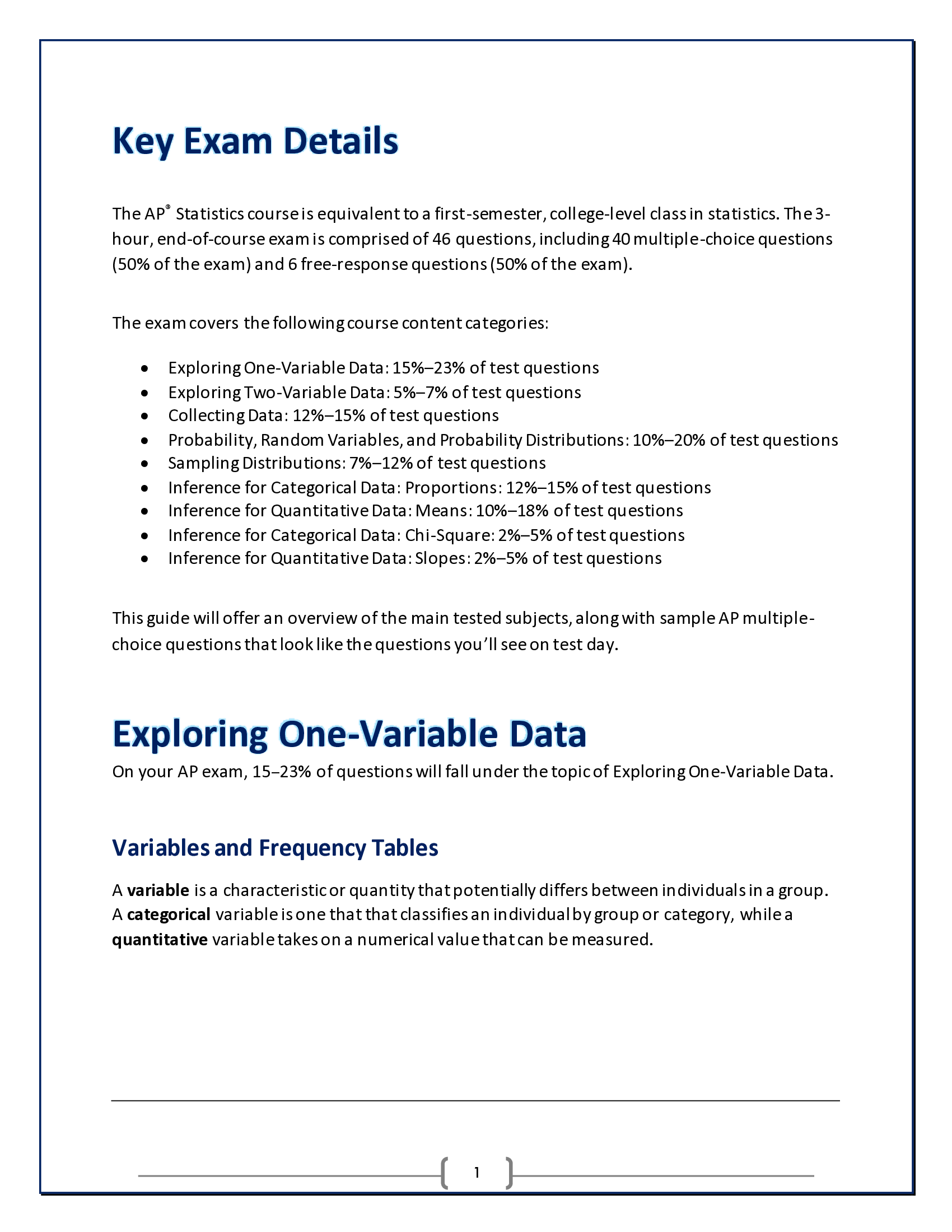
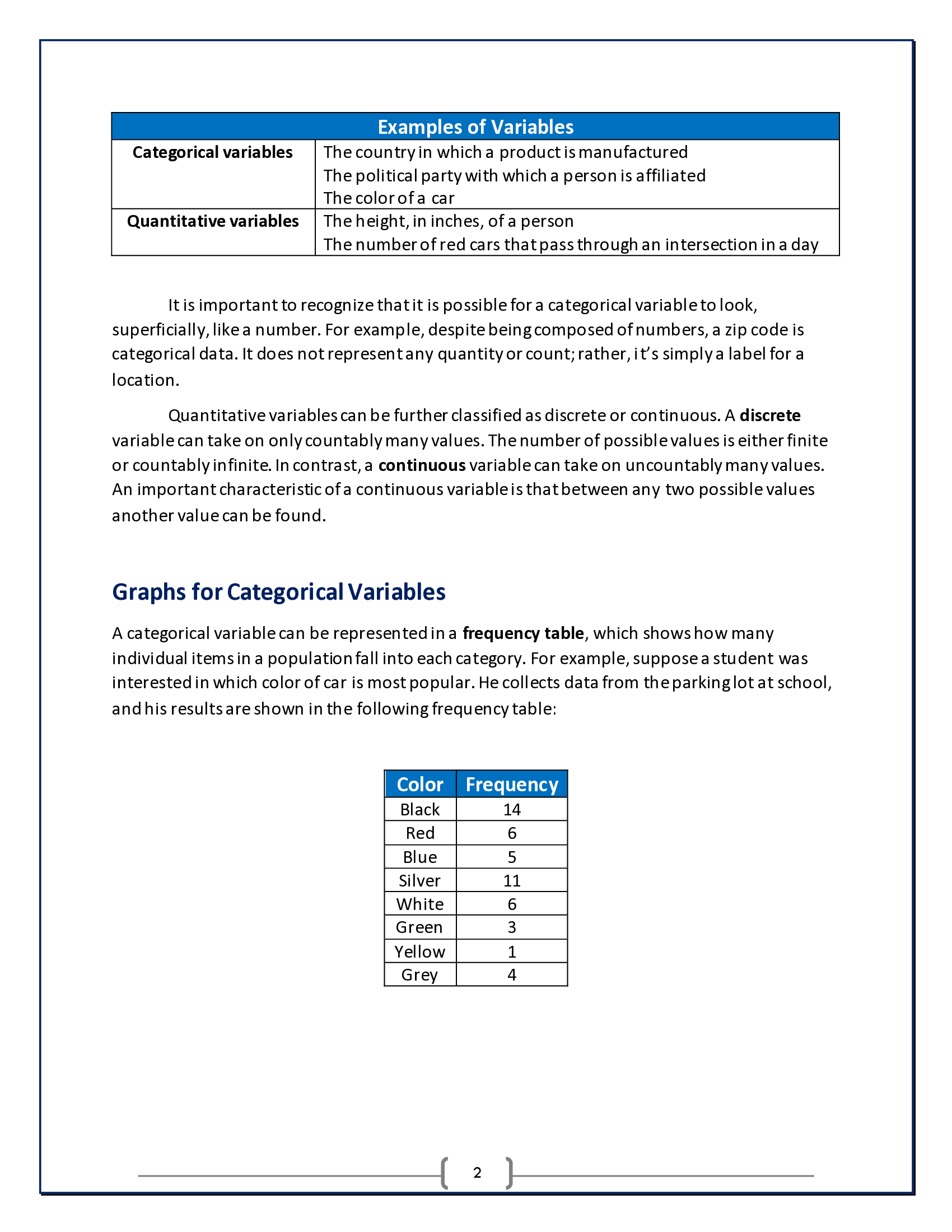
Key Exam Details The AP® Statistics course is equivalent to a first-semester, college-level class in statistics. The 3- hour, end-of-course exam is comprised of 46 questions, including 40 multiple-choice questions (50% of the exam) and 6 free-response questions (50% of the exam). The exam covers the following course content categories: • Exploring One-Variable Data: 15%‒23% of test questions • Exploring Two-Variable Data: 5%‒7% of test questions • Collecting Data: 12%‒15% of test questions • Probability, Random Variables, and Probability Distributions: 10%‒20% of test questions • Sampling Distributions: 7%‒12% of test questions • Inference for Categorical Data: Proportions: 12%‒15% of test questions • Inference for Quantitative Data: Means: 10%‒18% of test questions • Inference for Categorical Data: Chi-Square: 2%‒5% of test questions • Inference for Quantitative Data: Slopes: 2%‒5% of test questions This guide will offer an overview of the main tested subjects, along with sample AP multiplechoice questions that look like the questions you’ll see on test day. Exploring One-Variable Data On your AP exam, 15‒23% of questions will fall under the topic of Exploring One-Variable Data. Variables and Frequency Tables A variable is a characteristic or quantity that potentially differs between individuals in a group. A categorical variable is one that that classifies an individual by group or category, while a quantitative variable takes on a numerical value that can be measured. 1 Examples of Variables Categorical variables The country in which a product is manufactured The political party with which a person is affiliated The color of a car Quantitative variables The height, in inches, of a person The number of red cars that pass through an intersection in a day It is important to recognize that it is possible for a categorical variable to look, superficially, like a number. For example, despite being composed of numbers, a zip code is categorical data. It does not represent any quantity or count; rather, it’s simply a label for a location. Quantitative variables can be further classified as discrete or continuous. A discrete variable can take on only countably many values. The number of possible values is either finite or countably infinite. In contrast, a continuous variable can take on uncountably many values. An important characteristic of a continuous variable is that between any two possible values another value can be found. Graphs for Categorical Variables A categorical variable can be represented in a frequency table, which shows how many individual items in a population fall into each category. For example, suppose a student was interested in which color of car is most popular. He collects data from the parking lot at school, and his results are shown in the following frequency table: Color Frequency Black 14 Red 6 Blue 5 Silver 11 White 6 Green 3 Yellow 1 Grey 4 2 A relative frequency table gives the proportion of the total that is accounted for by each category. For example, in the previous data, 14 of the 50 cars, or 28%, were black. The full relative frequency table is as follows: Color Relative Frequency Black 28% Red 12% Blue 10% Silver 22% White 12% Green 6% Yellow 2% Grey 8% Note that the percentages add up to 100%, since all of the cars were of one of the colors represented in the table. A bar chart is a graph that represents the frequencies, or relative frequencies, of a categorical variable. The categories are organized along a horizontal axis, with a bar rising above each category. The height of the bar corresponds to the number of observations of that category. The vertical axis may be labeled with frequencies or with relative frequencies, as in the following examples. A bar chart representing data from more than one set is useful for comparing the frequencies across the sets. For example, suppose that the day after collecting the initial data on car colors, the student collected the same information from a parking lot at a nearby school. The results can be compared using the following bar chart, which shows the relative frequencies for each color, separated by school: 3 Graphs for Quantitative Variables A histogram is related to a bar chart but is used for quantitative data. The data is split into intervals, or bins, and the number of data points in each interval is counted. The horizontal axis contains the different intervals, which are adjacent to each other, as they form a number line. The vertical axis shows the count for each interval. The following histogram represents the scores that 50 students received on a test: How the data is split into intervals can have a big impact on the appearance of the histogram. Two histograms that represent the same data can show different characteristics, depending on the choice of interval width. 4 A stem-and-leaf plot is another graphical representation of a quantitative variable. Each data value is split into a stem (one or more digits) and a leaf (the last digit). The stems are arranged in a column, and the leaves are listed alongside the stem to which they belong. The test score data is shown in the following stem-and-leaf plot: 4 9 5 1 3 5 5 6 9 9 0 6 0 1 3 3 3 4 4 5 6 8 8 8 9 7 1 1 2 2 4 5 5 5 6 6 7 7 8 9 8 0 0 2 2 3 3 3 5 5 6 7 7 7 8 In a dotplot, each data value is represented by a dot placed above a horizontal axis. The height of a column of dots shows how many repetitions there are of that value. The following is a subset of the test score data: The Distribution of a Quantitative Variable The distribution of quantitative data is described by reference to shape, center, variability, and unusual features such as outliers, clusters, and gaps. When a distribution has a longer tail on either the right or left, the distribution is said to be skewed in that direction. If the right and left sides are approximately mirror images, the distribution is symmetric. A distribution with a single peak is unimodal; if it has two distinct peaks, it is bimodal. A distribution without any noticeable peaks is uniform. An outlier is a value that is unusually large or small. A gap is a significant interval that contains no data points, and a cluster is an interval that contains a high concentration of data points. In many cases, a cluster will be surrounded by gaps. 

Contact the Seller

Please Sign In to contact this seller.


  • 👎  Report Copyright Violation

Frequently Asked Questions

What Do I Get When I Buy This Study Material?

+

When you buy a study material on Passing Grades, an instant download link will be sent directly to your email, giving you access to the file anytime after payment is completed.

Is Passing Grades a Trusted Platform?

+

Yes, Passing Grades is a reputable students’ marketplace with a secure payment system and reliable customer support. You can trust us to ensure a safe and seamless transaction experience.

Will I Be Stuck with a Subscription?

+

No, all purchases on Passing Grades are one-time transactions. You only pay for the notes you choose to buy, with no subscriptions or hidden fees attached.

Who Am I Buying These Study Materials From?

+

Passing Grades is a marketplace, which means you are purchasing the document from an individual vendor, not directly from us. We facilitate the payment and delivery process between you and the vendor.

Does Passing Grades Offer Free Study Materials?

+

Yes, sellers on Passing Grades have uploaded numerous free test banks, exams, practice questions, and class notes that can be downloaded at no cost.

Pasinggrades - Quality Study Materials

USD 7

    • Quality checked by Pasing Grades
    • 100% satisfaction guarantee
    • Seller: mentor2000
Buy PDF $7

Seller Information

mentor2000

Member since April 2021

  • icon
  • icon
View Profile
  • total sales

    0
  • Favourites

    0
  • Comments

    0
    ( 0 Ratings )

Item Information

  • Uploaded

    08 May 2024

  • Updated

    29 September 2025

  • Category

    No category

  • Item Type

    exam

  • Tags

    AP stats study guide

Related Exam Prep Guides by mentor2000

Test Bank for Essentials for Nursing Practice 8th Edition by Potter | All Chapters
View Document

Test Bank for Essent...

  • mentor2000

    mentor2000

  • exam

Master nursing concepts with this study material; Test Bank for Essentials for Nursing Practice, 8th...

7 USD

0

0

A &P 1 MA278 BSC2 Final Module II Questions & Answers 2026 Update
View Document

A &P 1 MA278 BSC2 Fi...

  • mentor2000

    mentor2000

  • exam

Prepare for success with A&P 1 MA278 BSC2 Final Module II 2024 Q&A. Boost your grades with this comp...

7 USD

0

0

ATI Comprehensive Predictor Exam 2026
View Document

ATI Comprehensive Pr...

  • mentor2000

    mentor2000

  • exam

Prepare for success with the ATI Comprehensive Predictor Exam 2026. Access key practice questions to...

7 USD

0

0

Purchase

Download link will be sent to this email immediately after purchase.

IMPORTANT LINKS

  • How To Upload Class Notes
  • Selling Tips
  • Passing Grades's Study Materials
  • Scholarships for International Students 2025

POPULAR CATEGORIES

  • Law
  • Accounting
  • English
  • Psychology
  • Business
  • Nursing
  • Computer Science
  • General

View Document

  • Blog
  • Contact
  • Delivery Policy
  • Latest Scholarships Around the World
  • How to Pass Bar Exams: Passing Grades’ Strategies
  • How to Study and Pass the CPA Exam
  • All Test Banks
  • Faq
  • Copyright Claims
  • Privacy Policy
  • Terms of Use

KNOWLEDGE BASE

  • How to Write A+ Grade Good Research Paper
  • How to Manage Stress During Exam Period
  • Best Time to Study
  • How to Pass NCLEX-RN Exam
  • How To Effectively Utilize Test Banks
  • Popular Shadow Health Exam Assessments
  • Popular HESI Case Studies
  • How to Prepare for a Nursing Career
  • The Importance Of Summaries in Exam Revisvion

© 2026 Pasing Grades. All rights reserved.