Pasing Grades
  • Start Selling
  • Blog
  • Contact
  • 0

    Your cart is empty!

English

  • English
  • Spanish
  • Arabic
Create Account Sign In
  • Library
    • New Prep Guides
    • Featured Prep Guides
    • Free Exam Prep Guides
    • Best sellers
  • General
  • Nursing
    • Research Paper
    • Case Study
    • Discussion Post
    • Assignment
    • Exam
    • Practice Questions and Answers
    • Test Bank
    • solutions manual
  • Accounting
    • Case Study
    • Thesis
    • Study Guide
    • Summary
    • Research Paper
    • test bank
  • English
    • Creative Writing
    • Research Paper
    • Summary
    • Rhetorics
    • Literature
    • Journal
    • Exam
    • Grammar
    • Discussion Post
    • Essay
  • Psychology
    • Hesi
    • Presentation
    • Essay
    • Summary
    • Study Guide
    • Essay
    • Solution Manual
    • Final Exam Review
    • Class Notes
    • test bank
  • Business
    • Lecture Notes
    • Solution Manual
    • Presentation
    • Business Plan
    • Class Notes
    • Experiment
    • Summary
    • Practice Questions
    • Study Guide
    • Case Study
    • test bank
    • Exam
  • More
    • Computer Science
    • Economics
    • Statistics
    • Engineering
    • Biology
    • Religious Studies
    • Physics
    • Chemistry
    • Mathematics
    • History
    • Sociology
    • Science
    • Philosophy
    • Law
  • Pages
    • About Us
    • Selling Tips
    • Delivery Policy
    • Faq
    • Privacy Policy
  • Flash Sale
  • Home
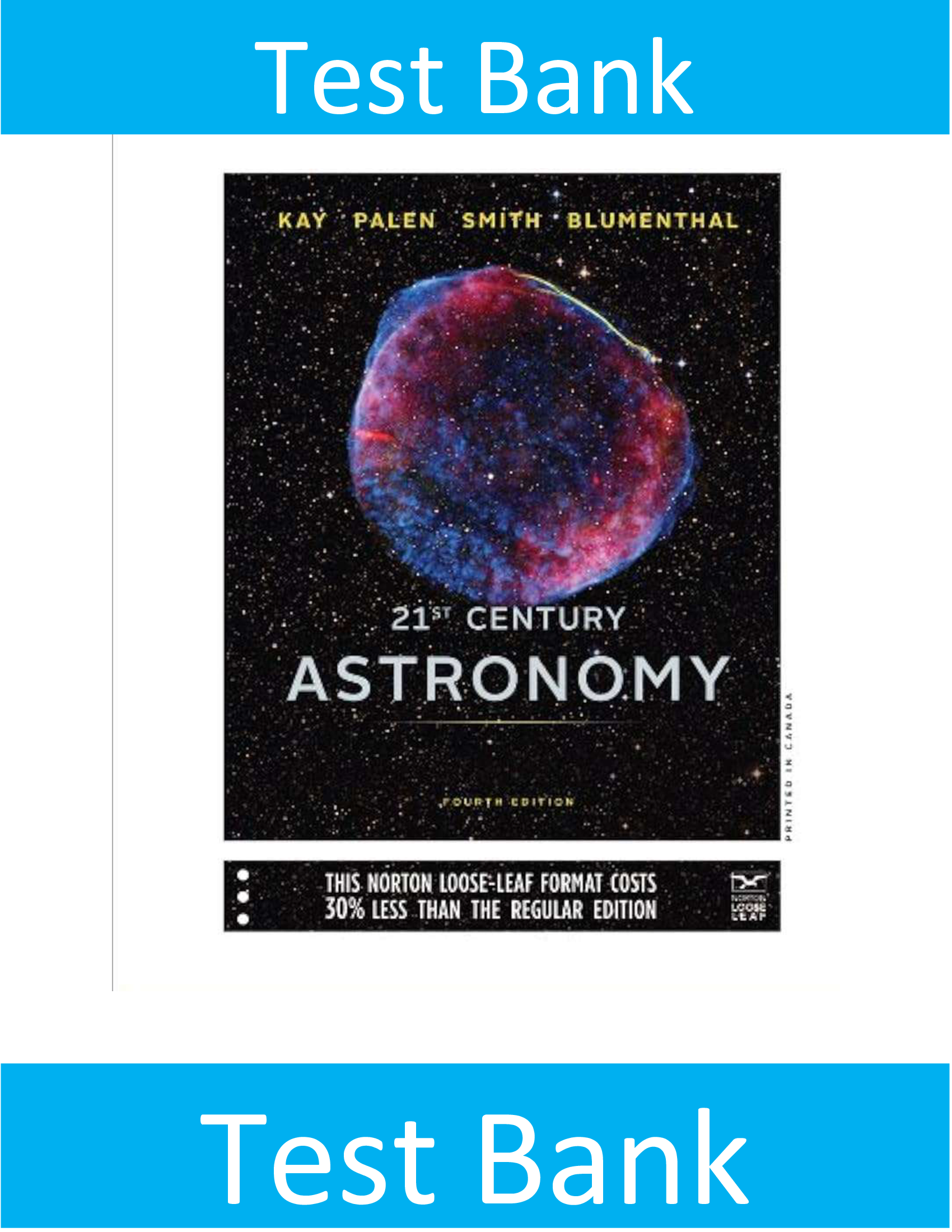
  • 21st Century Astronomy 4th Edition Kay Test Bank

21st Century Astronomy 4th Edition Kay Test Bank

Preview page 1 Preview page 2 Preview page 3
Add To Favorites

Share this item Share this item

  • Item Details
  • Comments (0)
  • Reviews (0)
  • Contact Seller

Test Bank for 21st Century Astronomy 4th Edition Kay

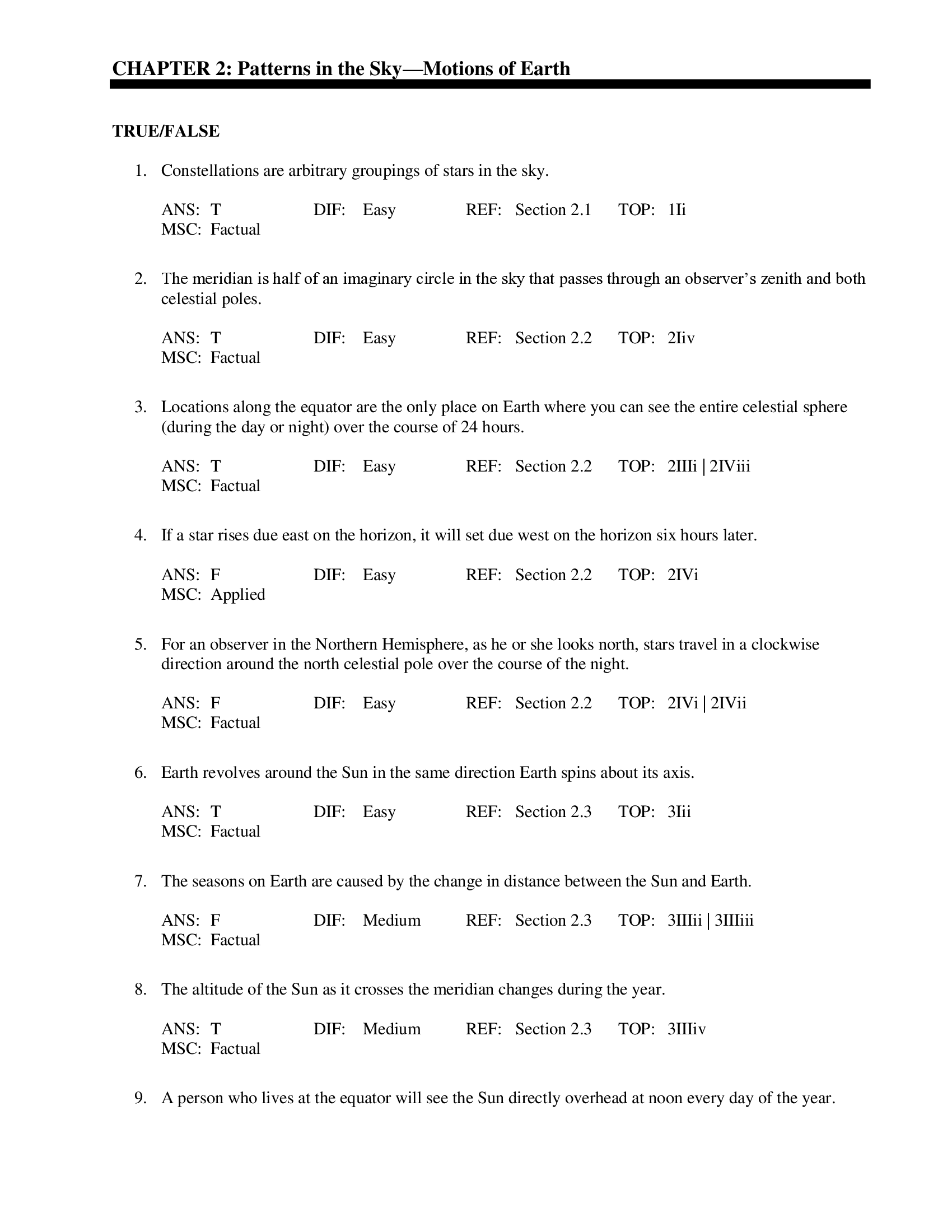
1.         Constellations are arbitrary groupings of stars in the sky.

                                          ANS: T                      DIF: Easy                 REF: Section 2.1       TOP: 1Ii

MSC: Factual  

2.         The meridian is half of an imaginary circle in the sky that passes through an observer’s zenith and both celestial poles.


                                          ANS: T                      DIF: Easy                 REF: Section 2.2       TOP: 2Iiv

MSC: Factual


3.         Locations along the equator are the only place on Earth where you can see the entire celestial sphere (during the day or night) over the course of 24 hours.


                                          ANS: T                      DIF: Easy                 REF: Section 2.2      TOP: 2IIIi | 2IViii

MSC: Factual


4.         If a star rises due east on the horizon, it will set due west on the horizon six hours later.


                                          ANS: F                      DIF: Easy                 REF: Section 2.2       TOP: 2IVi

MSC: Applied


5.         For an observer in the Northern Hemisphere, as he or she looks north, stars travel in a clockwise direction around the north celestial pole over the course of the night.


                                          ANS: F                      DIF: Easy                 REF: Section 2.2       TOP: 2IVi | 2IVii

MSC: Factual


6.         Earth revolves around the Sun in the same direction Earth spins about its axis.


                                          ANS: T                      DIF: Easy                 REF: Section 2.3       TOP: 3Iii

MSC: Factual


7.         The seasons on Earth are caused by the change in distance between the Sun and Earth.


                                          ANS: F                      DIF: Medium           REF: Section 2.3       TOP: 3IIIii | 3IIIiii

MSC: Factual


8.         The altitude of the Sun as it crosses the meridian changes during the year.


                                          ANS: T                     DIF: Medium           REF: Section 2.3       TOP: 3IIIiv

MSC: Factual


9.         A person who lives at the equator will see the Sun directly overhead at noon every day of the year.


                                          ANS: F                      DIF: Medium           REF: Section 2.3       TOP: 3IIIiv

MSC: Applied


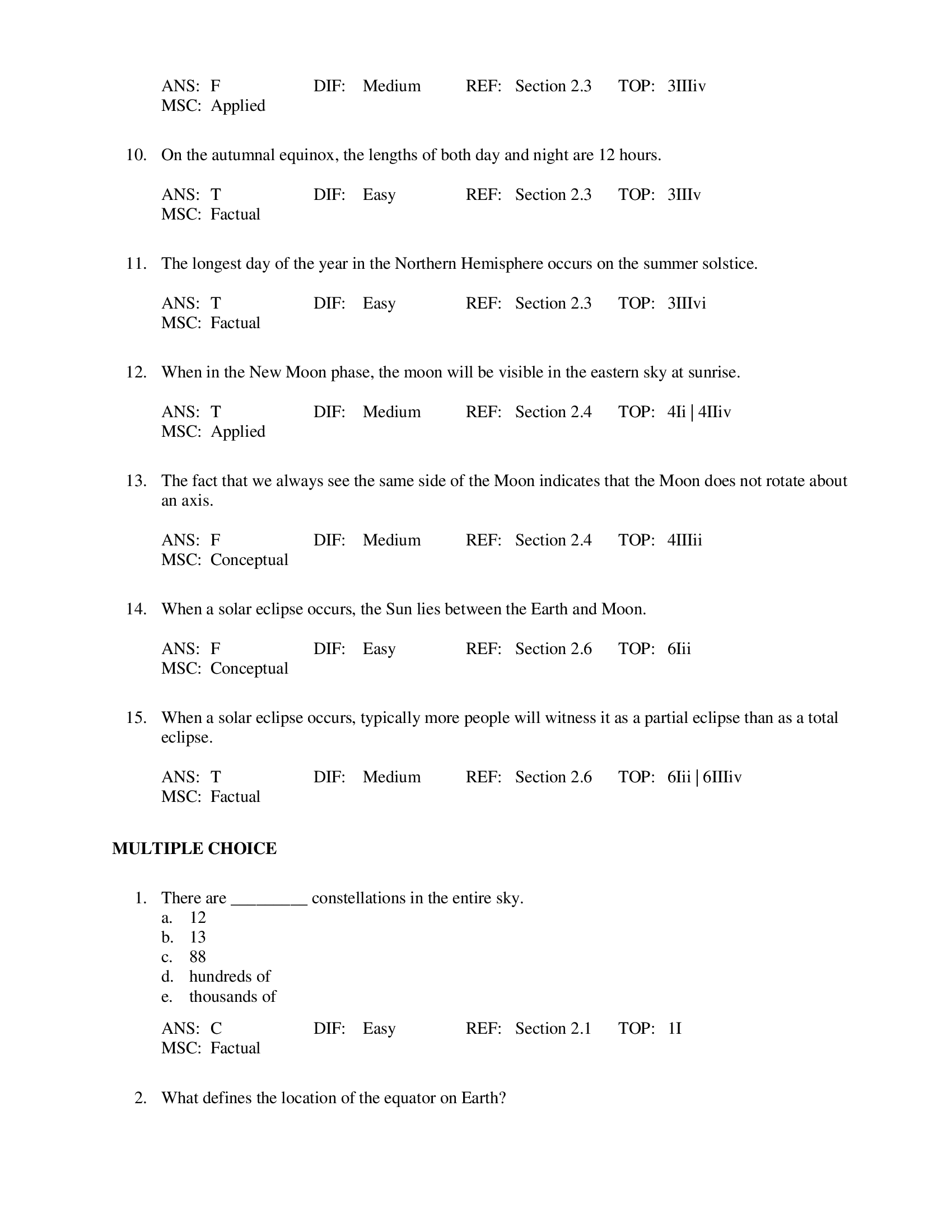
10.     On the autumnal equinox, the lengths of both day and night are 12 hours.


                                          ANS: T                      DIF: Easy                 REF: Section 2.3       TOP: 3IIIv

MSC: Factual


11.     The longest day of the year in the Northern Hemisphere occurs on the summer solstice.


                                          ANS: T                      DIF: Easy                 REF: Section 2.3       TOP: 3IIIvi

MSC: Factual


12.     When in the New Moon phase, the moon will be visible in the eastern sky at sunrise.


                                          ANS: T                     DIF: Medium           REF: Section 2.4      TOP: 4Ii | 4IIiv

MSC: Applied


13.     The fact that we always see the same side of the Moon indicates that the Moon does not rotate about an axis.


                                          ANS: F                      DIF: Medium           REF: Section 2.4       TOP: 4IIIii

MSC: Conceptual


14.     When a solar eclipse occurs, the Sun lies between the Earth and Moon.


                                          ANS: F                      DIF: Easy                 REF: Section 2.6       TOP: 6Iii

MSC: Conceptual


15.     When a solar eclipse occurs, typically more people will witness it as a partial eclipse than as a total

eclipse.


                                          ANS: T                     DIF: Medium           REF: Section 2.6       TOP: 6Iii | 6IIIiv

MSC: Factual


MULTIPLE CHOICE


1.      There are _________ constellations in the entire sky.

a.       12

b.      13

c.       88

d.      hundreds of

e.       thousands of


                                          ANS: C                     DIF: Easy                 REF: Section 2.1       TOP: 1I

MSC: Factual


2.      What defines the location of the equator on Earth?

a.       the axis around which Earth rotates

b.      where the ground is the warmest

c.       the tilt of Earth’s rotational axis relative to its orbit around the Sun

d.      the orbit of Earth around the Sun

e.       all of the above


                                          ANS: A                     DIF: Easy                 REF: Section 2.2       TOP: 2Iii

MSC: Factual


3.      If the star Polaris has an altitude of 35°, then we know that:

a.       our longitude is 55°

b.      our latitude is 55°

c.       our longitude is 35°

d.      our longitude is 35°

e.       our latitude is 35°


                                          ANS: E                     DIF: Medium           REF: Section 2.2       TOP: 2Iii | 2Iviii

MSC: Applied


4.      At a latitude of 50°, how far above the horizon is the north celestial pole located? a. 0°

b.      40°

c.       50°

d.      90°

e.       It is not visible at that latitude.


                                          ANS: C                     DIF: Medium           REF: Section 2.2      TOP: 2Iii | 2Iiii | 2Ivi

MSC: Applied


5.      At what latitude is the north celestial pole located at your zenith?

a.       0°

b.      30°

c.       60°

d.      90°

e.       This occurs at every latitude.


                                          ANS: D                     DIF: Medium           REF: Section 2.2      TOP: 2Iii | 2Iv | 2Ivi

MSC: Applied


6.      At what latitude is the north celestial pole at your horizon?

a.       0°

b.      30°

c.       60°

d.      90°

e.       This can never happen.


                                          ANS: A                     DIF: Medium           REF: Section 2.2      TOP: 2Iii | 2Iiii | 2Ivi

MSC: Applied


7.      For a person who lives at a latitude of 40°, when is the Sun directly overhead at noon?

a.       only on the summer solstice

b.      only on the winter solstice

c.       only on the vernal and autumnal equinoxes

d.      never

e.       always


                                          ANS: D                     DIF: Medium           REF: Section 2.3       TOP: 2Iii | 3IIIi

MSC: Applied


8.      For a person living in Vancouver, Canada, at latitude of 49°, the Sun will reach a maximum height above the Southern horizon on winter solstice of a. 41.0°

b.      17.5°

c.       25.5°

d.      37.0°

e.       64.5°


                                          ANS: B                     DIF: Difficult           REF: Section 2.3      TOP: 2Iii | 3IIIi | 3IIIvi

MSC: Applied


9.      The meridian is defined as an imaginary circle on the sky on which lie the:

a.       celestial equator and vernal equinox

b.      north and south celestial poles

c.       zenith and the north and south celestial poles

d.      zenith and east and west directions

e.       celestial equator and summer solstice

Contact the Seller

Please Sign In to contact this seller.


  • 👎  Report Copyright Violation

Frequently Asked Questions

What Do I Get When I Buy This Study Material?

+

When you buy a study material on Passing Grades, an instant download link will be sent directly to your email, giving you access to the file anytime after payment is completed.

Is Passing Grades a Trusted Platform?

+

Yes, Passing Grades is a reputable students’ marketplace with a secure payment system and reliable customer support. You can trust us to ensure a safe and seamless transaction experience.

Will I Be Stuck with a Subscription?

+

No, all purchases on Passing Grades are one-time transactions. You only pay for the notes you choose to buy, with no subscriptions or hidden fees attached.

Who Am I Buying These Study Materials From?

+

Passing Grades is a marketplace, which means you are purchasing the document from an individual vendor, not directly from us. We facilitate the payment and delivery process between you and the vendor.

Does Passing Grades Offer Free Study Materials?

+

Yes, sellers on Passing Grades have uploaded numerous free test banks, exams, practice questions, and class notes that can be downloaded at no cost.


Pasinggrades - Quality Study Materials

USD 15

    • Quality checked by Pasing Grades
    • 100% satisfaction guarantee
    • Seller: mentor2000
Buy PDF $15

Seller Information

mentor2000

Member since April 2021

  • icon
  • icon
View Profile
  • total sales

    0
  • Favourites

    0
  • Comments

    0
    ( 0 Ratings )

Item Information

  • Uploaded

    19 June 2025

  • Updated

    19 June 2025

  • Category

    General

  • Item Type

    test bank

  • Tags

    Test Bank for 21st Century Astronomy 4th Edition Kay

Related Exam Prep Guides by mentor2000

Test Bank for Essentials for Nursing Practice 8th Edition by Potter | All Chapters
View Document

Test Bank for Essent...

  • mentor2000

    mentor2000

  • test bank

Master nursing concepts with this study material; Test Bank for Essentials for Nursing Practice, 8th...

15 USD

0

0

A &P 1 MA278 BSC2 Final Module II Questions & Answers 2026 Update
View Document

A &P 1 MA278 BSC2 Fi...

  • mentor2000

    mentor2000

  • test bank

Prepare for success with A&P 1 MA278 BSC2 Final Module II 2024 Q&A. Boost your grades with this comp...

15 USD

0

0

ATI Comprehensive Predictor Exam 2026
View Document

ATI Comprehensive Pr...

  • mentor2000

    mentor2000

  • test bank

Prepare for success with the ATI Comprehensive Predictor Exam 2026. Access key practice questions to...

15 USD

0

0

Purchase

Download link will be sent to this email immediately after purchase.

IMPORTANT LINKS

  • How To Upload Class Notes
  • Selling Tips
  • Passing Grades's Study Materials
  • Scholarships for International Students 2025

POPULAR CATEGORIES

  • Law
  • Accounting
  • English
  • Psychology
  • Business
  • Nursing
  • Computer Science
  • General

View Document

  • Blog
  • Contact
  • Delivery Policy
  • Latest Scholarships Around the World
  • How to Pass Bar Exams: Passing Grades’ Strategies
  • How to Study and Pass the CPA Exam
  • All Test Banks
  • Faq
  • Copyright Claims
  • Privacy Policy
  • Terms of Use

KNOWLEDGE BASE

  • How to Write A+ Grade Good Research Paper
  • How to Manage Stress During Exam Period
  • Best Time to Study
  • How to Pass NCLEX-RN Exam
  • How To Effectively Utilize Test Banks
  • Popular Shadow Health Exam Assessments
  • Popular HESI Case Studies
  • How to Prepare for a Nursing Career
  • The Importance Of Summaries in Exam Revisvion

© 2026 Pasing Grades. All rights reserved.